Wednesday, November 23, 2005

Nom d'un nom d'un nom

A great deal of excitement has been generated on the French blogosphere, both in English and in French. It seems that Nicolas Sarkozy, Minister of the Interior and President-in-Waiting-if-that-dastardly-Villepin-does-not-beat-him has become involved in a blog discussion with the Kassowitz, a cinéaste.

This, as our French colleagues point out, is going beyond the sort of silly self-promotion that the fragrant Margot is indulging in. This is the beginnings of a serious political debate. Will our politicians learn to to do the same?

COMMENT THREAD

A grave and important development

Congratulations are due to the Financial Times for behaving like a grown-up newspaper, leading as they do today on the story about the UK being denied the waiver on US arms technology.

This is the ITAR (International Trade in Arms Regulations) controversy which we first broached on this Blog in October 2004 - amazingly over a year ago – and which has largely been ignored by our own infantile media – despite the fundamental strategic importance of the issue to our nation.

Then, over a year ago, the UK was looking to a relaxation of the regulations, by way of a “waiver”, which would have eased the cumbersome bureaucratic control on the transfer of technology. But, while Bush was disposed to grant it, two powerful Senators, Rep. Duncan Hunter, R-Calif., chairman of the House Armed Services Committee, and Rep. Henry Hyde, R-Ill., chairman of the House International Relations Committee, mounted a successful campaign to prevent the president giving way.

Since then, there have been a succession of UK officials wending their way to the Hill, in an attempt to resuscitate the "waiver", and even direct intervention by Geoff Hoon, then UK defence minister, and by Blair. But, as the FT now reports, the UK looks set to lose what has been a five-year battle on the waiver, having been told by Bush administration officials that political opposition on the Hill technologies has become insurmountable.

The FT also reports that US and UK officials are now trying to come up with ways to strengthen military technology co-operation without having to change the US export law

The central figure in the blockage all along has been Henry Hyde, and his concern, as it has always been, is the leakage of technology from the UK to our European “partners” and thence to China and other potentially hostile powers. Currently, he cites the UK’s refusal to strengthen its own laws on transferring military technologies to third countries. He will know, however, the of the Framework Agreement with European nations, signed by Geoff Hoon in 2000, which prevents the UK doing just that.

To Hyde, this lack of specific laws that prevent transfers of military technology to third countries has been a particular problem. With the open UK defence market, which has big representation from military contractors based in places such as Paris and Munich, Hyde has warned that technologies transferred to Britain may find their ways to capitals less friendly to US interests. And, in a blistering report prepared by Hyde's committee last year, he lashed out at Britain's refusal to address the third-party loophole, calling it "not only disappointing, but potentially highly prejudicial to US interests around the world".

His views have also been coloured by Britain's push to lift the European Union's arms embargo on China and has been an outspoken critic of the EU's move, and Britain's support for removing the ban.

In more immediate practical terms, this could have a significant impact on the STOVL version of the joint Anglo-US F-35 Joint Strike Fighter project, as we pointed out last July, and its implications for the carrier project. We cannot help but wonder whether John Reid’s enthusiasm for the "voluntary" code of practice on European arms procurement, which was formally agreed on Monday in Brussels, is in some way related to this whole issue.

Either way, today's news from the FT is a grave and important development. It is a pity that the rest of the media is not sufficiently grown-up to report on the implications.

COMMENT THREAD

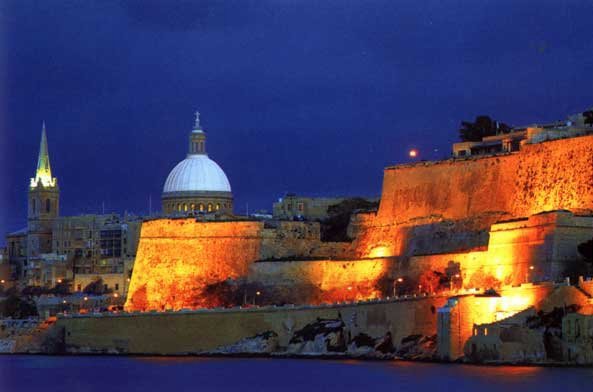
Malta joins another club

It seems we have good company as far as general disillusionment with the EU goes. According to Reuters, Malta is qualifying for membership of this once exclusive club, with "euphoria" waning as the EU struggles to approve a budget and poorer new members face having to share the cost of enlargement.

Prime minister Lawrence Gonzi says his country still stood by the sacrifices it made to qualify and was benefiting from millions of euros of annual aid but the joy of joining had yielded to a realisation that the proposed EU constitution was in limbo and that the budget was in deadlock.

Another factor which might even turn disillusionment into cynicism and even downright hostility is the extraordinary news that, according to Malta Today, Gonzi’s National Party has been awarded a major €565,000 contract from the EU for providing a daily press review to the Commission representation in Malta.

Incredibly, the EU commission is claiming there is no "situation of conflict of interest", even though the press review is prepared by the in-house research bureau, which also provides the party with its own press review every day.

The contract won by Media.Link Communications, which is owned by the PN. Deputy prime minister Tonio Borg, is both a nominal shareholder and a director of the company. A direct UK equivalent would be the commission awarding the contract to a press company owned by the Labour Party, with John Prescott as a director.

Nevertheless, a spokesperson for the fragrant Margot, Mikolaj Dowgielewicz, insists that, "The fact that a tenderer was owned by a political party was not considered to be a situation of conflict of interests as defined in the tender specifications."

So that's all right then.

COMMENT THREAD

Tuesday, November 22, 2005

The battle continues

There has been an interesting development in the saga of criminal penalties applicable to EU law.

Readers will recall the furore last September when the ECJ overturned a Council framework decision on this issue, specifically who had authority to dictate penalties relating to environmental law.

Widely misunderstood by the hacks at the time – many of whom believed that the EU had suddenly acquired powers to send people to jail, this – as we pointed out – was actually a turf war. The Council had decided it could determine criminal penalty levels under the judicial co-operation provisions of the Maastricht Treaty, as amended – the so-called "third pillar" provisions - while the commission disagreed.

Instead, the commission argued that, where the policy areas came within the competences of the Treaty, and the application of criminal law was necessary to ensure the effective implementation of laws made within those policy areas, then the "first pillar" legislative procedures should be used, with the commission maintaining its exclusive right to make proposals.

With the ECJ having agreed with the commission, officials have gone back through previous Council decisions relating to criminal penalties and, tomorrow, the commission will unveil a “communication (as yet unnumbered) pointing out that other areas of community law are affected as well. In these areas, it further asserts that the Council's decisions are made "on the wrong legal basis" and thus intends to issue proposals to remedy the situation.

Issues the commission believes require remedial treatment include criminal penalties and sanctions against counterfeiting in connection with the euro, "combating fraud and counterfeiting of non-cash means of payment", money laundering, assisting illegal immigration, corruption in the private sector, attacks against information systems and ship-source pollution.

No doubt, following the official publication of the commission’s proposals tomorrow, there may be much media outrage at the fact that the Community is specifying penalties in these areas at all. If nothing else, this will help to underline how much of our government – including the definition of specific offences and the determination of the type of penalties that should be applied.

But, as before, in practical terms, nothing much has changed. The principle has long been accepted. All this is about is whether the Council on its own, or the commission proposing to the Council (and EU parliament), can decide on these issues. And, in the final analysis, if the Council – and/or the parliament for that matter – does not like the commission's proposals, either can reject them.

Nevertheless, it is fascinating to watch the power-play at work and, as we noted earlier, this time the commission has succeeded in taming the unilateralist tendencies of the Council. So the battle continues.

COMMENT THREAD

In case you were wondering

Some of our readers (not many I expect) may have wondered why we should be so vehement in our attack on the idea that the UN should set up an international forum, on which all the many tyrants and dictators are to be represented to run the internet. Why did we think it was disgraceful that Britain, on whose behalf the EU negotiated, should find herself on the side of the tranzis and the tyrants and against the US, Australia, Canada and other liberal democracies? After all, does it really matter?

Let us look a little more closely at what might be motivating one of the proponents of the move, Iran. The mullahs and the new president, who is busy purging all opponents, reversing the few liberalizing measures and threatening Israel with extinction, have a problem on their hands. It is called the internet, more specifically the blogosphere, which is enthusiastically used by all the dissidents.

According to Rachel Hoff, a research assistant at the American Enterprise Institute,
“Iranian dissidents are increasingly penning blogs to voice criticism of the Islamic Republic and to push for freedom and democracy. With an estimated 100,000 active Iranian blogs, Persian is now tied with French as the second most common blogging language after English.”
This puts the British reluctance to take blogs seriously into a perspective and not a particularly pleasant one, at that.

The Iranian bloggers are in constant danger. They are arrested, imprisoned, tortured, just beaten up in their homes. And yet they continue to blog, to send messages to the world about their country.
“Blogging has revolutionized dissent in Iran. By providing private citizens a public voice, blogs may be the most powerful tool in the dissidents' arsenal. As an Iranian blogger known as Saena wrote, "Weblogs are one weapon that even the Islamic Republic cannot beat."[7] As the cases of Arash Sigarchi and other imprisoned bloggers show, though, the Iranian regime is trying to crush these new outlets of democratic dissent. Throughout the Middle East, the race is on between journalists opening new websites and regimes such as the Islamic Republic trying to censor cyberspace.”
Ms Hoff castigates the White House and the State Department for not speaking out in support of the bloggers, who need western help in the same way as the Soviet dissidents did before 1991 and the Chinese ones do now. She is right, of course. But what about us? We not only refuse to voice any support – we line up with the oppressors as they try to impose their control on the internet.

COMMENT THREAD

Our unaccountable masters

All the way from the Commission to Transport for London, taking in the police and many other organizations en route. It is the TfL and its haughty attitude to the people of London with regards to the Routemaster and those ghastly and inefficient bendy buses, that are the subject of the OneLondon posting.

COMMENT THREAD

European values

I confidently asserted yesterday that the mainstream media would take no notice whatsoever of the decision by defence ministers of the EU member states to adopt a "voluntary" code of practice on European arms procurement.

In one particular respect, I was wrong. The Times, at least, has run an article, albeit a tiny, down-page affair, which announces: "Europe to open up arms trade".

Written by the paper's EU correspondent Anthony Browne, however, the paper need not have bothered. If it is the duty of the media to inform, then Browne's piece was a parody of journalism.

True, he gets the basics right – but then he could have picked those up from any agency report – that “European” defence ministers have agreed to open up Europe’s €30 billion (£21 billion) annual military equipment market. Browne reports that this is "a big step towards the EU's desire to become a military superpower", which is highly debatable, given that all member states bar France and the UK are cutting back heavily on defence spending.

But the most tendentious comment from Browne is that: "The move will create a potential bonanza for British defence companies, which are among the most efficient in the continent, giving them far greater access to the European market." He goes on to write: "John Reid, the Defence Secretary, brokered an agreement with his counterparts to stop protecting national defence industries, in an attempt to boost Europe’s military capacity by creating a continent-wide defence industry."

In terms of reporting, this is utter garbage. The very history of the project tells us that when EU markets are "opened up", the invariable result is that the UK lifts its restrictions while the "colleagues" maintain theirs and the flow of goods is one-way.

Given the extraordinary flow of military spending on European supplies – well recorded by this Blog – any so-called "liberalisation" can only be expected to increase the amount of European equipment purchased by the MoD, with very little in the way of reciprocal spending by our "partners".

Nor is the spending solely determined by political imperatives. As I has hoped when we started taking a very public interest in defence procurement, people are starting to come out of the woodwork.

Recently, I received a comprehensive dossier on bribery and corruption relating to the purchase by the MoD of defence equipment from a European company, in preference to one of our own, on the basis of very large sums of “brown envelope” cash changing hands.

Corruption is nothing new in the MoD, although it seems one part of the defence integration process is to import some of the less desirable “European values”, those which are practised so freely in the EU commission and French political circles. I will have more to write about this in due course.

COMMENT THREAD

Impasse

We covered it last night - the EU budget meeting in Brussels - when it was predicted that it would be a waste of time. And despite the burbling of the Today programme this morning, about what great things Jack Straw would do, that is precisely what it turned out to be – in spades.

But what is different this time is the candour with which the other member states are expressing themselves - none of your carefully crafted diplomacy here.

Belgian foreign minister, Karel de Gucht, set the tone, saying: "We are sitting here wasting our time." Finnish foreign minister, Erkii Tuomioja, told Mr Straw: "As there is nothing new to discuss, I have nothing new to say," and French foreign minister, Philippe Douste-Blazy, warned the UK presidency that there was a "general feeling of concern" over the lack of progress.

Little Straw was left bleating that the British position on the rebate was justified and Europe minister, Douglas Alexander, told the talks that the rebate was "an enduring British reality".

It is an odd thing that, for a "dead end" we use a French phrase that the French themselves don't use – cul de sac. They use the word impasse. And that is just what it is.

COMMENT THREAD

Monday, November 21, 2005

They are the masters now

Such is the thrall of the "Dianafication" phenomenon in the treatment of tragic events, that criticism of the police in juxtaposition to news of the Bradford shootings has brought rebukes on this Blog's forum.

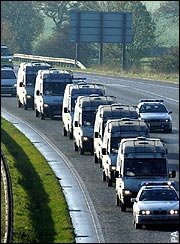
But I do wonder whether I am the only person in the world to have read the description of the transfer of the shooting suspects from London back to Yorkshire with growing dismay. Recorded by the Daily Mirror, the account went as follows:

A ring of steel surrounded five of the six suspects as they were driven 200 miles from London to West Yorkshire yesterday. The maximum security convoy was guarded by armed officers and shadowed by a police helicopter. It included seven white Transit vans and eight police cars with flashing lights. Other unmarked vehicles travelled alongside in a rolling roadblock up the M1. Slip roads were temporarily sealed off to allow the convoy a smooth passage north.
These suspects are not terrorists, part of a larger armed group at war with society – like the IRA – whose members might be prepared to attack a police van carrying prisoners, on which basis, 15 police vehicles and a helicopter, plus all the others used to seal off the motorway slip roads, seems a grossly excessive use of resources – and power.

Pity the unfortunate motorists, truck drivers and others who were caught up in this charade. But I do not have to imagine the disruption as this is not that unusual. Every week or so, there is a transfer of bullion from London to Leeds, which is carried out by a convoy of armoured vehicles escorted by police cars, which forms a rolling roadblock up the M1, causing considerable delays to traffic.

This once cost me 40 minutes on a journey and, when I enquired as to the reasons for the delay, I was told that the consignment used to go by train, but it was cheaper by road. Cheaper, it is, for the authorities, what is the cost to the thousands of people delayed by what amounts to administrative convenience?

Similarly, how many people were inconvenienced in central Bradford last Friday, when the police not only closed off the immediate crime scene but extended the road closures to the main roundabout on the central ring road on the very evening that the Christmas lights were switched on and people were flocking to town to see them. Whether accident or incident, the police these days seem to delight at closing off as many roads as they can get away with, causing maximum disruption.

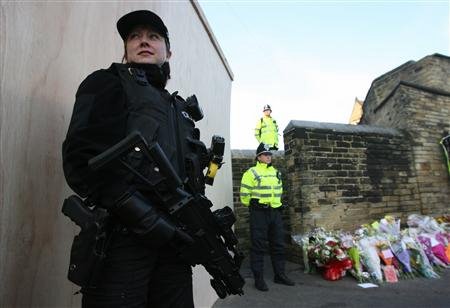
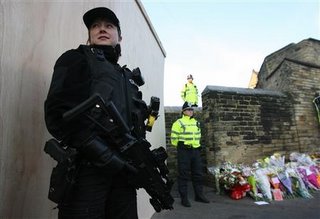
And what was the point of the girlie with the gun (right) guarding the flowers laid at the scene of the shooting? The photograph was taken after the announcement that six suspects had been detained in London, so what did the police think they were achieving?

Then, with talk now from ex-chief constables of reintroducing the death penalty for killing policemen, what price the life of a public-spirited citizen who gives chase, as with Mr Taz-war Hussein who was gunned down in a very similar incident? What makes the police so special?

And why are not more questions being asked about why two probationers were despatched to a high risk premises – viz the BBC website, which records:

Significant amounts of cash are handed in at travel agencies by people arranging money transfers for relatives in Pakistan. Shahid Bhatti, owner of Bradford Travel on Lumb Lane in Bradford city centre, said: "Over the past 10 years a pattern has been established of robberies on travel agencies in Bradford. "We have been targeted because people know about the money transfers. "My brother was robbed outside our office in 1997 and since then we have increased our security. We have installed CCTV cameras and we report any unusual behaviour on Lumb Lane. "This incident is a horrible tragedy, but we've been expecting something like this."
More and more, this looks like – as we asserted earlier – a major cock-up by the police, but, in the welter of maudlin sentimentality over the murder of a female police officer – few dare offer a note of criticism.

And what has this got to do with a site called EU Referendum, dedicated primarily to EU affairs? Well, the answer is simple. What we are seeing here is the visible side of unrestrained power exercised by officials – excesses which always happen when democratic control and accountability break down.

That is the way the EU commission behaves, only it is less visible. The current behaviour of the police illustrates why officials must always be under the control of democratically elected politicians. And that is why the EU cannot be allowed to survive, lacking as it does that essential element.

COMMENT THREAD

Half a million up…

Today, we reach an important milestone in the life of this Blog, our first half-million hits since we started on Thursday 22 April 2004. Having posted over 3,000 articles since then, we thank our readers from around the world for visiting the site and for commenting on our posts – especially our 168 forum members who take their savaging in such good heart.

That said, the average daily hit rate in the nineteen months of our existence is less than a thousand per day, representing considerably fewer actual readers. And even though we did manage to peak at nearly 5,000 hits on the day, at the time of the Dutch referendum in June, we now stumble on at an average daily rate during the week of about 1300.

Measured in crude terms, against the circulation of the mainstream media and the political magazines such as the Spectator, that is truly a pathetic performance. Even with the syndication to the Bruges Group and the "No Campaign" website, and e-mail distribution of some of our posts, it is a circulation that does not merit the prodigious amount of hard work that I and my co-editor, Dr Helen Szamuely, put into the writing.

This is not a reflection of the content. Both Helen and I are published authors and write frequently for paid journals – not least my piece in The Business yesterday. We know that our material is good quality, and appreciate those of our readers who write to us, telling us so.

Given that we are one of the more successful sites, what this demonstrates is that, while blogging has come of age in the United States – with some of the political sites taking over half a million hits a day – it is a phenomenon that has yet to make its mark in the United Kingdom, especially so as more than 40 percent of our hits come from the United States.

That we are so often behind the United States in various trends, yet often follow, is some small consolation to us. We anticipate that, as blogging catches on here, our hit rate will climb accordingly. As my co-editor often remarks, we are in this for the long term.

However, in watching the glacial climb of the daily average – and it is rising, following the dip after the French and Dutch referendums - we have learned something of our readership and what we have found remarkable is as much who does not visit the site as who does. While many journalists visit us, notably absent are politicians and their research assistants in both Westminster and the EU parliament. But especially absent are the bulk of people who call themselves activists in the Eurosceptic movement.

The absence of the latter category is especially interesting as, in starting out the blog, we thought a diet of news and informed comment from two experts in the field would be of special interest to activists. In presuming this, however, we were wrong. It is a measure of the failure of the Eurosceptic movement that it is actually largely uninterested in the European Union and its machinations, or issues relating to it. Many of its members are often so self-obsessed that the epithet "little Englander" is quite correctly applied to them.

To an extent, though, we have not set out to court this group, and will not pander to their prejudices – we have enough of our own. And, in other instances, we have quite deliberately set out to antagonise groups that might be thought to be our natural allies, such as the new Open Europe group. But we maintain our stance that the EU "reformers" are probably more harmful to the cause than the out and out Europhiles, in diluting the message that the construct is unreformable.

For others, our robust commentary is not to their taste, or they find our "line" offensive or so profoundly disagree with us that they cannot read us. Thus, it is a small but select band that regularly visits our site. We would be less than honest if we said other than we would prefer it to be larger but, despite that, we intend to retain our fiercely independent and individual styles, calling it as we see it. And, if even as co-editors, we do not always agree amongst ourselves, we do not expect our readers always to agree with us.

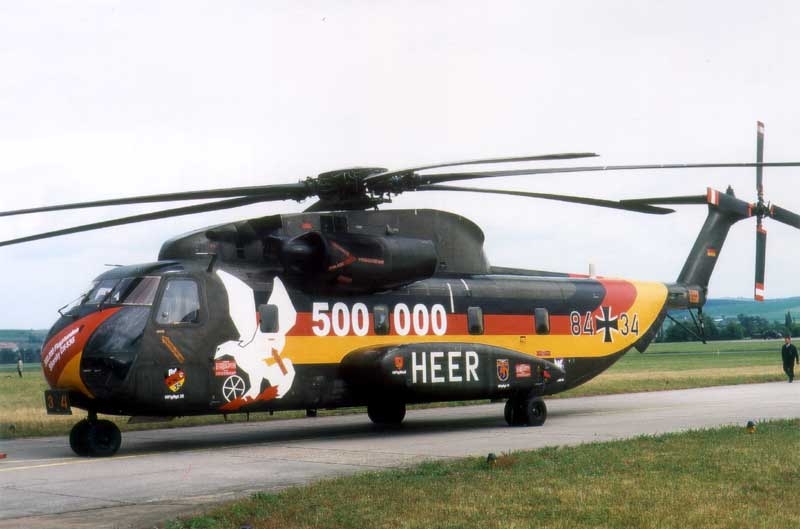
So, here we are, 500,000-up, and I even managed to find a picture of a "toy" to celebrate the event. With modest growth, we should make the million-mark about this time next year, if we are still around. That, dear readers – all else being equal – is up to you. As long as we see steady growth in the readership, we judge that our writing is worth the effort. On the other hand, in the free market for information that is the internet, if there is no demand for our product, then we will let market forces take their course.

You can decide whether the blog survives, by talking about it and promoting it, and encouraging others to visit. Or you can allow it to slide to the obscurity of a decent burial. Over to you.

COMMENT THREAD

A matter of little importance?

The Financial Times has picked up on the defence ministers' meeting which will be held today formally to agree a “voluntary” code of practice on defence procurement. This news we tucked in to a post on Saturday, reminding our readers that the heads of agreement were in fact settled in October at RAF Lyneham.

Although we have followed the twists and turns of this issue very closely, from the EU commission's white paper on defence procurement in September 2004 to the present day, it is one which has been almost totally ignored by the mainstream media. My guess is that, beyond the Financial Times and le Figaro, that indifference will continue – athough a full account can be found on the Euractiv site.

Reading the runes of the FT piece, however, we note with interest that our own defence secretary, John Reid, is hailing the agreement as “a practical first step towards more competition”, and also praising EU countries’ efforts “to move towards common purchasing for projects such as air-to-air refuelling and drone aircraft.” Having bought the Airbus flight refuelling option, Reid is in this respect indulging in an element of self-congratulation, but the reference to "drones" (i.e., unmanned aerial vehicles) is perhaps just as significant.

As we remarked earlier, until June this year when the project was cancelled, the UK was in partnership with the United States on the development of advanced UAVs in a programme known as FOAS – the Future Offensive Air System. This was to replace the strike capability of the RAF's fleet of Tornado GR4s which is expected to reach the end of its operational life around 2018.

So far, no other programme has been substituted by the French are running a multi-national project called Neuron, aimed at developing the advanced UAVs to which the FOAS programme was devoted. A mock-up of the first model was unveiled at the Paris air show on 2 June (see picture), just as Reid was cancelling FOAS. The suspicion is that the UK will now throw its lot in with the French, further integrating our defence capabilities – a suspicion reinforced by Reid's comments.

In an equally sinister development, the French are co-operating closely with the Russians on UAV development and, of course, the Russians are major arms suppliers to the Chinese. The closer integration of defence procurement that will come today with the signing of the agreement will, therefore, suck us into the nexus of arms suppliers to the Peoples' Republic of China and, inevitably, distance us further from the United States.

Nevertheless, none of this is important enough for the mainstream media to report.

COMMENT THREAD

Fax diplomacy

If it's Monday it must be Brussels, and if it's Brussels, it must be the budget… it's groundhog day again. And the other foreign ministers of the EU member states are not only fed up with what they believe to be British stalling tactics, they are preparing to say so.

According to Reuters, poor little Jackie Straw has promised "comprehensive proposals" on the 2007-2013 budget settlement, but only just before a special ministerial meeting on 7 December, giving little time for consideration before the European Council on 15-16 December.

Needless to say, this is not good enough for the "colleagues". "We are wasting time talking about secondary issues without tackling the real problem," one EU ambassador complained. Yet another member state official said ministers might as well exchange statements by letter and save the plane fare to Brussels since there was to be no negotiation.

We have a better idea. Why don’t they join the 20th Century and send each other faxes?

COMMENT THREAD

Sunday, November 20, 2005

A narrative for the future

Yesterday’s Bruges Group conference ended with a session I chaired (with ferocious discipline, even though I say so myself) with two speakers: my colleague Dr Richard North (no, we did not plan this) and the redoubtable Ruth Lea, Director of the Centre for Policy Research.

My colleague has already mentioned the event but I want to tackle the subject from a slightly different perspective.

There was not a great deal of disagreement between the two in that both spoke of the need for this country to leave the EU and both mentioned without going into too much detail several alternative scenarios. Where there was a divergence was between Ms Lea’s sunny political optimism and Dr North’s rather more difficult discussion of the practical problems that will need to be overcome for this country to start functioning again as an independent entity. Not that they cannot be overcome but there seems little point in pretending that they do not or will not exist.

One interesting point that came up, though it was not really discussed either in that session or a previous one when Dan Hannan had touched on it: what kind of a country do we want to live in. Mr Hannan is a member of the Direct Democracy group in the Conservative Party and is very keen on local accountability – a view with which this blog sympathizes a great deal.

During questions Mr Hannan repeated several times that reforms to make government accountable will have to be introduced in this country as well. (In fact, his comments on the police, particularly the Met, would not have pleased several of our readers and members of the forum.)

This is a subject we have discussed on this blog several times and intend to do so again and again in the future: freedom, democracy, accountability are issues that will not simply go away if and when we are out of the European Union. The infamous European model has eaten into our social structure.

Dr North put this slightly differently: we need to work out what kind of a country we are and want to be. I would go even further: we need to find a new historical narrative that links the past with the future.

That means that we cannot simply go back to some nebulous past entity. In the first place, one can never go back. Nothing is the same, the world has changed and what seemed right for this country fifty or seventy years ago, cannot be so any more. (And that assumes that what people imagine was true for that period was, indeed, so – an unlikely proposition.)

Secondly we started from that situation to get to what we have now. So, even if we could, we probably would not want to go back there, for fear of ending up with exactly the same or, even, worse result.

Interestingly enough, this discussion is going on in other countries, particularly among people who are developing the Anglosphere idea. The Anglosphere is not the old Commonwealth writ large or writ any way. It is a narrative that is being developed for the future, linking many past ones, one of which was the Commonwealth.

A recent posting on Albion’s Seedling by Lexington Green deals with precisely that issue and raises some important points that need to be discussed. I can, at this stage, do no better than direct those of our readers who are interested in the subject to Lex’s words. The project, of course, is to be continued.

COMMENT THREAD

Tackling the mindset

"Leaving the EU would not make any difference," my colleague Helen Szamuely remarked yesterday evening. She was chairing the final session of the Bruges Group meeting in Kings College London, where Ruth Lea and I had given our views on alternatives the European Union.

The point Helen was making – which Ruth Lea had also made – is that as long as this government (and previous ones, for that matter), share the same dirigiste, centrist mindset as the legislators in our Brussels government, then we would continue to suffer from the same type of managerial, anti-democratic form of government that emanates from the European Union. Nothing very much will change.

No more so is that evident that in the story offered by Christopher Booker in his column this week, where he reports on the government plans to restructure the 43 local police forces of England and Wales on regional lines.

Although the title of the piece is: "The urge for 'Euro-regions' plays fast and loose with law and order", there is no evidence that this restructuring – the most fundamental in 170 years of British policing – is being carried out to any sort of European agenda. While, as Booker's story reveals, home secretary Charles Clarke is pushing regional structures with extraordinary speed, there is no "smoking gun" which can prove that Brussels is behind the plan.

Nevertheless, there is clearly a European agenda to the regionalisation process, which is being pursued regardless of the decisive "no" vote in the North East regional assembly referendum. This will result in our police forces being cut from the existing 43 to 12, corresponding with the 10 regions of England, London and Wales (the two largest regions, South East and North West, can each have two forces). Wales is to have just one force, not four as now. The seven South West forces are also to be merged into just one, from the Cotswolds to Cornwall.

With the murder of Sharon Beshenivsky, the 38-year-old Bradford, PC still very recent, there is much in this weekend's newspapers on the story but it is only Booker who deals with the regionalisation story. Yet, while the general media takes the predictable and largely unproductive line of pursuing the question of whether all police officers should be armed – the Beshenivsky death and the move towards larger police forces are not entirely unconnected.

Rehearsing the key facts of the Beshenivsky murder, we are told that she and her colleague, Teresa Milburn, 37, were responding to a silent panic alarm, relayed from a private security company, and walked into a hail of bullets as they arrived at the scene, an Asian travel agent in Morely Street, Bradford, by the name of The Universal Travel Express.

West Yorkshire chief constable Colin Cramphorn says they had no reason to believe that this was anything but a routine call-out, but the locals might disagree. According to The Sunday Times report:

Though the modest shop looks unremarkable, it was, as locals knew, a conduit for significant amounts of cash. Many of the largely Asian local community took money to the agency so that it could be transferred to friends or relatives in Pakistan. It was known as one of the quickest ways to send help to those in need after the earthquake in Kashmir. "There was a lot of cash there; people come in with it so it can be wired back home," said Sher Khan, a local councillor and friend of the family that runs the agency. "Many extra people have been doing that since the earthquake."
Then, those with longer memories will recall that, in January 2003, there was another armed robbery of an Asian travel agent in Bradford, when a "substantial quantity of cash" from a travel agency, this one in Lumb Lane, not ten minutes drive from the Morely Street premises. That time, there was also a fatal shooting, Mr Taz-war Hussein, 36, who was praised for his bravery after he and a friend had chased the robbers' car before a confrontation in which he was shot once in the chest with a handgun.

In a comment that could apply equally well today, Mehrban Hussain, a Conservative councillor for the university ward, which covered the area where the incident took place said that gun crime was a major problem in the Bradford area. “We have had a few shootings in different areas of the city over the past year," he said. "A lot of criminals are now carrying guns. The police have got to be stronger in clamping down on these people.”

Gerry Sutcliffe, MP for Bradford South, said he would be raising concerns about shooting incidents in the city with West Yorkshire's chief constable, Colin Cramphorn. "I have my concerns because there have been a number of incidents in Bradford of late," said Mr Sutcliffe. "Guns are too freely available. It is an issue the government is tackling. Anyone who carries a gun is a risk."

Coming back to the present, much is made of the fact that the current shooting took place in a location minutes away (in fact, just across the road) from the main Bradford police station. But that is to give a false impression of the nature of the police station and its proximity. The building is the Bradford police headquarters, a vast, sixties, multi-story office, full not of operation police but bureaucrats in uniform. Furthermore, the side adjacent Morely Street is the cells entrance. The main entrance is the other side of the complex, perhaps ten minutes brisk walk from the scene.

As it transpires, it was not police from this building who attended the scene. Beshenivsky and Miburn were, in fact, based at Eccleshill, in the northern suburbs of the city, and would not have had the local knowledge of the patch. Indeed, they responded by car, rather than as a foot patrol working in the locality.

What we have, therefore, is an out-of-area team of probationary women police officers responding to a panic alarm from a high-risk premises of a type with a known vulnerability to armed attack – the sort of premises which, one would of thought, would merit automatic attendance from an armed response team, as would be the case if a bank or building society was being attacked.

On the face of it, therefore, this looks like yet another cock-up by West Yorkshire's finest, one that ended up with two of its officers being shot and one killed. But the broader issue is that it seems also to be a failure of local, and particularly intelligence-led community policing.

By coincidence, in the Sunday Times today, is an article on the success of community policing – in Chicago, where the stress is on local knowledge, responsibility and accountability.

In Bradford, however, we do not have local policing. We do not have a local police force. We are policed by West Yorkshire Police, with its headquarters in Wakefield – distant, unaccountable, remote, inefficient and, ultimately deadly. And, as Booker reports, the government’s answer is to make such police forces more distant, more unaccountable, more remote – with results that are all too predictable.

This may not be in response to a European agenda, but it is certainly from the same wellspring, which favours distant, unaccountable, remote and invariably inefficient forms of government. As Helen told us therefore, leaving the EU is not by any means the whole answer to our problems. We have to tackle bad government, whether from Brussels, Westminster or even the "local" Euro-region.

Needless to say, but for Booker, that issue is not even on the agenda. Instead, we have the media re-opening this tired, lame issue of whether all police should be routinely armed. Leaving aside the question as to whether two "rookie" policewomen with handguns might be more danger to themselves and the public than any criminals, the real problem seems to me that our greatest danger is the bureaucratic mindset which is at the root of too many of our problems.

COMMENT THREAD
Stalemate

Why nobody ever does anything about Brussels' great financial scandal.

For the eleventh year in a row, the EU's auditors have refused to sign the Commission's accounts. Europe’s finance ministers keep turning a blind eye and so the problem goes on and on...

In The Business today, by European Analyst, Richard North.

Enjoy.

COMMENT THREAD

Saturday, November 19, 2005

Slaughter of the innocents

I have had several phone calls asking me whether I was involved in the shooting of the two police officers in Bradford yesterday… I cannot imagine why.

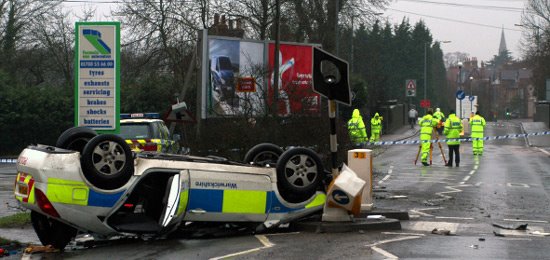
Rather sourly, however, I note that there is rather less of an outpouring of grief for the 20 percent rise in deaths involving police vehicles, the figure now reaching 44 last year, up from 17 in 2000-1. And the current figure includes four entirely innocent pedestrians, including an 18-year-old woman, slaughtered by police cars responding to emergency calls.

Driving of a different sort is on the mind of the Irish Independent, which headlines today, "The EU has driven us to war... virtually". It is reporting that the EU is running a war game next Tuesday for 10 days, a virtual war fought out in computer generated form on an "imaginary" island of Atlantia. The exercise is based on the rapid deployment of troops in a "fictitious crisis scenario". Known as Milex 05, the military exercise will test how the EU's newly created command structure would work in the event of a crisis.

The Irish Independent notes a curious similarity between "Atlantia" and the Emerald Isle, where a conflict scenario between two ethnic groups has been set up to test the mettle of 450 EU military planners. That, at the moment, is 450 more than the number of troops the EU is able to field.

Meanwhile, in what passes for the real world, next Monday defence ministers of the EU member states will meet to agree a voluntary code of conduct on equipment procurement. This formalises the agreement reached in October, at RAF Lyneham, ostensibly opening up the $35 billion a year trade in European defence equipment.

The deal will be made at a meeting of the European Defence Agency's steering board in Brussels, when all the EU member state defence ministers apart from Denmark are expected to sign up.

Nick Witney, chief executive of the European Defence Agency happily burbles that this will be a landmark decision. "The desire to inject competition into this hitherto protected market has been something that has been recognised as hugely beneficial for decades, but we haven't found a way to do it," he says.

Behind this initiative is the shadowy figure of the EU commission, which has threatened to propose legislation, redefining the defence exemptions encapsulated in Article 296 of the Treaty. It has now promised to hold off until it sees how the code of practice works.

Meanwhile, Joachim Wuermeling, the German MEP who drew up the EU parliament's response to the commission's green paper on defence procurement, is claiming that greater competition in the industry would "save taxpayers' money, make the European defence industry more competitive and help create a European defence identity." Presumably, he has not heard of the Luftwaffe plans to lease US-built C-130s.

Nevertheless, it is, of course, the creation of the "European defence identity" which is of greatest interest to the EU but, as long as the "colleagues" confine themselves to virtual war games, sorting out ethnic groups in "Atlantia", no great harm can come. The slaughter of innocent civilians can be safely left to the police.

COMMENT THREAD

The first confession

It has begun. The first person to admit that yes, indeed, he did take money from Saddam Hussein as part of the oil-for-food scam, is Jean-Bernard MĂ©rimĂ©e, a distinguished French diplomat (aren’t they all?) and one who holds the rather bizarre title of “ambassador for life”.

M MĂ©rimĂ©e told judge Philippe Courroye that he was very sorry that he took the $156,000 (then worth about £108,000) in 2002, allegedly to renovate the house he owned in southern Morocco. What is interesting about the date is that at the time M MĂ©rimĂ©e was not French ambassador to the UN but special adviser to SecGen Kofi Annan (father of Kojo).

It seems that M l’ambassadeur, according to Le Figaro, as quoted in the Daily Telegraph is only half regretful. Clearly he regrets having been found out but he does not precisely see what is wrong with being paid for services.

The money, according to him, was in recompense for the work he did for Iraq and work must be paid for. Well, that is not completely unreasonable. It just depends on your definition of Iraq.

COMMENT THREAD

Friday, November 18, 2005

Tilting the balance

The really depressing thing about the REACH vote in the EU parliament yesterday is the waste of so much energy by so many people who, though basically well-intentioned, have done completely the wrong thing.

REACH, as readers will recall, is another of those clever little acronyms at which the EU regulators so excel, standing for Registration, Evaluation and Authorisation of Chemicals system. As the Telegraph puts it today, it will – if finally approved - force companies to test thousands of chemicals, many used in common household products like paint, cleaners, toys and furniture, for their effects on human health and the environment.

It has been described by Gunter Verheugen, the EU industry commissioner, as "possibly the most controversial and complex piece of legislation in European history" and it was yesterday that the EU parliament passed the law through the "first reading" procedure, having substantially amended it in is passage.

As it stood, the law applied to some 30,000 commercially produced chemicals formulated before 1981, requiring producers to demonstrate that they are "safe" for use before they can continue marketing them, but the MEPs, while accepting the principal of the legislation, have introduced lower requirements on chemicals produced in quantities of less than 10 tons a year. This means that the industry will not have to assess the harmfulness of up to 90 percent of 17,500 chemicals in that category.

Voting 407 to 155 for the amended legislation with 41 abstentions, the MEPs were applauded by their president, Josep Borrell, who said that the parliament had shown "that it lives up to its responsibilities and, as legislator, has responded to some of the fears of Europeans, ensuring competitive jobs together with a high level of protection of health and the environment."

In fact, it has achieved exactly the opposite - albeit is a less damaging form than was originally proposed – as the very idea of a regulatory regime for testing and authorising chemicals is fundamentally flawed.

Working with campaigners on the harm done to farmers by organophosphate sheep dips and other pesticides from the same group, I have seen first hand how the regulatory system – of the type now adopted in REACH - not only fails to protect vulnerable people but actually perpetuates their misery and prevents demonstrably harmful chemicals from being withdrawn.

The problem lies in the fallibility of the testing regime which, based on animal tests, can neither predict fully human reactions to chemicals nor in any way deal with the effects of low-level toxicity or the proportion of people who may be unduly susceptible to particular chemicals. Nor even can the testing regime deal with the effects of mixtures of chemicals which may be used in the same environment, which exhibit can exhibit significant synergistic effects.

Instead, what the testing and authorisation regime does do is provide government approval to a product which has passed a a wholly inadequate testing regime, which becomes a de facto certificate of safety, which the government itself underwrites. Thus when – as on occasions happens – a product is found to be unduly hazardous in a way not predicted by the testing regime, the government is complicit in the failure. Victims of chemical damage, therefore, then not only have to take on the chemical manufacturers but the government as well.

A far better system would be that originally applying to food where anyone can market a product but must apply a duty of care – which includes predictive testing where appropriate. Ranged against the producer is the whole weight of the state - backed by a fully funded surveillance system and untainted by having given "prior approval" - which can prosecute those who get it wrong, and can assist victims in securing damages. The deterrent effect has ensured that our food supply has been largely the safest in the world.

By introducing a system which in many cases has failed to ensure pharmaceutical and pesticide safety, the MEPs have not, as Borrell claims, ensured high level of protection of health and the environment. They have, in fact, tilted the balance decisively against the consumer.

However, all is not lost – yet. Britain, as holder of the EU presidency, has decided that the Council will consider its position on the directive on 19 December. If it does not agree with the parliament's position, then the parliament will either have to change its stance, or the legislation will fall. It could be well into next year before we know the fate of this law.

COMMENT THREAD

Meanwhile in Tunisia

It is, in a sense, appropriate that the World Summit on the Information Society (WSIS) should have taken place in Tunisia, a country with a particularly bad human rights record when it comes to journalists and, indeed, users of the net.

As this blog has reported, the agreement has left control of the domain distribution in the hands of ICANN but has also charged the UN with setting up a forum that will, as the EU and others hope, eventually take over.

The aim of this Summit and, indeed, of the attempted power grab was supposed to be to overcome the digital divide between rich developed countries and others. But the digital divide, as we know, is between countries where people can use the internet freely and those where the government controls its use and punishes those who try to step outside that control. By a strange coincidence the impetus to move control of the internet from the USA to the UN came from the latter governments and has been, shamefully, supported by the EU, which speaks on Britain’s behalf.

According to the ISN Security Watch:

“The New York-based Human Rights Watch has accused the Tunisian government of detaining critical online writers and blocking websites that publish reports of human rights abuses in the country.

The group stressed that Tunisia had made some progress in increasing access to the internet over the past few years, lifting bans on some websites, but that it continued to flout its national and international legal commitments to free expression, the right to access information, and the right to privacy by censoring the internet. The group said the government was still imprisoning
writers for expressing their views online, and imposing undue regulations on its Internet Service Providers (ISPs) and internet cafĂ©s.”

Entirely the right country in which the discussion about the digital divide should be taking place.

Interestingly, the Summit was opened by the President of Switzerland, who made the following apposite comments:

“It is, quite frankly, unacceptable for the United Nations to continue to include among its members states which imprison citizens for the sole reason that they have criticized their government on the Internet or in the media.”

How sad. Because, of course, we have to accept that state of affairs and it is that very United Nations that is claiming the right to take over and run the internet (as well as, if not better than the way they ran the oil-for-food programme).

While this was going on, the Tunisian police prevented a meeting of the Tunisian Civil Society summit and its spokesman’s attempt to describe the situation to ISN Security Watch by telephone was interrupted.

There have been other incidents of attacks on journalists both Tunisian and foreign, whenever stories appeared about the human rights situation.

And just to demonstrate quite definitively what that digital divide is about

“Tests conducted between 2.30pm and 4.30pm using the 3S Global Net ISP found that the French and Arabic press releases for Human Rights Watch’s latest report on internet freedom in the Middle East were also blocked in Tunis.

Users trying to access these pages received a page disguised to look like a French-language Microsoft Internet Explorer error page that read “Impossible de trouver la page” (“Impossible to find the page”).

The results were consistent with the blocking behaviour exhibited in previous tests documented in a Human Rights Watch’s report.”

These are the people who are demanding that the terrible American “control” of the internet should cease and they are the ones with whom we, in Europe, line ourselves up.

COMMENT THREAD

Your freedom in their hands

There was a time when Her Majesty's Government was responsible for the defence of this country, and with it the freedom of the Queen's subjects. But, in the brave new Blairite world, this, it seems, is no longer the case.

That much emerges from our reports on the closure by BAE Systems of the former Royal Ordnance factories in Bridgwater and Chorley, which provoked a flurry of Parliamentary Questions from Conservative defence spokesman Gerald Howarth, and others.

Asked by Howarth whether he expected the supply of components to be affected by the proposed closure of the BAE ordnance factory at Bridgwater, minister of state for defence, Adam Ingram, replied that BAE Systems Land Systems would "remain responsible for the maintenance of security of supply of components currently manufactured at the Bridgwater factory".

When also asked what assessment he had made of the implications for security of supply of the proposed closure of sites at Bridgewater and Chorley, Ingram replied in like manner that BAE Systems "are responsible for security of supply of ammunition." He went on to say that they have provided detailed plans to the Ministry of Defence, plans which, of course, are not in the public domain.

To an extent, the possible adverse effects of our ammunition and other essential military supplies being manufactured abroad can be militated by maintaining strategic stocks in this country. Thus, the question by Lindsay Hoyle, Labour MP for Chorley, was of special relevance.

Hoyle asked what were the plans for the management and security of the Heapey ammunitions storage facility, in the event of the closure Royal Ordnance Chorley, only to get another dead-bat answer from Ingram: "The Heapey magazine facility is owned by BAE Systems. The management and security of the facility are matters for the company."

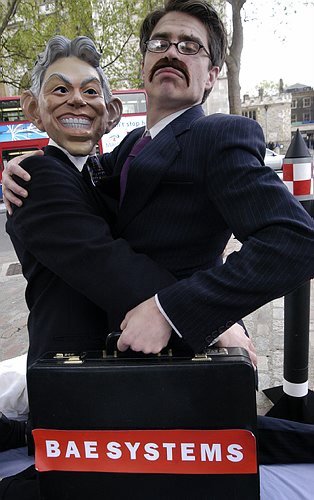
There it is then. The provision and security of vital military supplies is nothing to do with her Majesty's government. It is entirely the responsibility of BAE Systems – and, of course, L'Escroc Chirac, in whose country much of the supplies will now be manufactured.

COMMENT THREAD

Well, well, well…

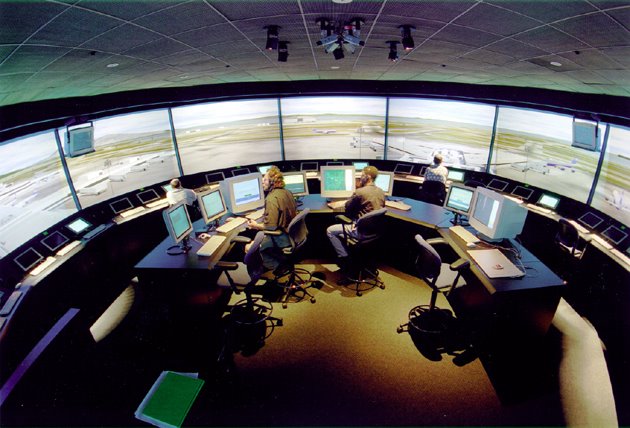
Jacques "Wheel" Barrot, the EU’s transport commissioner has announced a €20 billion makeover for Europe’s air traffic control system, allowing a doubling of the number of flights in the next 15 years.

Styled as a "European air traffic management Master Plan", it is code-named SESAR. The Commission claims it to be a "new-generation air traffic management system" which "will be vital for managing the growth in air traffic". It is to be developed together with Eurocontrol - which will meet half the initial €30 million costs - and, in a second phase, with (unspecified) industrial partners.

And at the heart of this system, which is part of the EU's "Single European Sky" initiative is, guess what – the Galileo satellite global positioning system. And there is the money-spinner. Despite the fact that commercial (and military) aircraft currently use the US "Navstar" GPS system, the EU will make it mandatory for all aircraft entering European airspace to be equipped to receive the Galileo system – for a fee, of course, thus bailing out a totally unnecessary system.

All we have to do now it wait to see which French firm (or consortium) gets the development contract – or is that being too cynical?

COMMENT THREAD

Thursday, November 17, 2005

Snigger…

Having spent two days out in London, talking to anyone who would listen about the EU defence agenda, I return to read the current edition of DefenseNews. Reading one particular piece, I could not avoid a little snigger – I think they call it schadenfreude.

Anyhow, what gives rise to the amusement is that the German Air Force, which still rejoices in the title Luftwaffe, is so embarrassed by the limitations of its fleet of two-engined Transall military cargo aircraft – with an average age of 30 years - that it is looking to lease new aircraft to augment its capability.

Bear in mind, please, that the Germans are one of the launch customers for that sterling symbol of European aviation prowess, proposing to buy 60 Airbus A400Ms. These are the aircraft that the UK has also committed to buy, whence it will progressively phase out its US-built Lockheed Martin C-130 Hercules fleet.

And the aircraft the Germans are considering? Er… Germany's defense chief has ordered the Air Force to study options for leasing a handful of Lockheed Martin C-130J airlifters.

Army Gen. Wolfgang Schneiderhan made the request to Lt. Gen. Klaus-Peter Stieglitz, Air Force chief, shortly after the parliamentary elections in September. The four-engine C-130s would augment the country's 86 two-engine C-160 Transalls, which have had difficulties crossing the Hindu Kush Mountains in Afghanistan while flying from Uzbekistan to Kabul and Kunduz, delaying the delivery of supplies, troops.

Even German Defence Minister Peter Struck has been embarrassed by the poor performance, and has began flying aboard foreign C-130s to visit troops.

Of course, the "colleagues" are a tad worried, with one official reporting that they fear the lease would delay the service entry of the Airbus A400M European transport aircraft and jeopardise other procurement programmes. Their concerns are strengthened by one parliamentary source in Berlin who is suggesting a long-term lease. Some Air Force officials fear that such a solution could potentially deviate existing program arrangements for the A400M.

However, reality is intruding. Another defence official in Berlin is saying that a lease would improve the Bundeswehr's ability to participate in military operations abroad. "The current fleet of C-160s just has too many limitations in terms of range, the capability to land on austere airfields, etc.," he says.

Lockheed Martin is, of course, delighted, and says it is "in discussions with several European countries with reference to the lease or acquisition of C-130Js." Of course, being American, they are far to polite to snigger. As for this Blog…

COMMENT THREAD

Freedom of the net is safe - for the time being

The outcome of the Internet Governance summit in Tunis was a compromise. Luckily for all users of the net, it was a compromise that left the management and administration of the Domain Name System in the hands of ICANN. This organization, though non-profit-making, international in its board and staff, and not heavy-handed in its control, seems to have acquired the aspect of the devil incarnate as far as the opposition to “American control of the net” is concerned.

The agreement in Tunis calls on the UN to establish an Internet Governance Forum next year. One hundred countries have signed up to the agreement and expect the Forum eventually to yield some kind of an international bureaucracy to plague the net users, whether they be big business or individual bloggers.

So far, the forum, according to the agreement,
“would have no oversight function and would not replace existing arrangements, mechanisms, institutions and organizations”.
Furthermore, the new forum
“would have no involvement in day-to-day or technical operations of the Internet”.
This, as the Wall Street Journal Europe points out, is a victory for the American negotiators, supported as they were by certain allies, such as Canada and Australia. Britain, alas, as a member of the EU, who negotiated on our behalf, was on the side of the unholy alliance of tranzi regulators and tyrannical dictators, such as the Iranian mullahs, the Chinese party gerontocracy and, among others, President Mugabe. A truly wonderful line-up.

What will the new forum be doing, assuming it will get past the inevitable international squabbles and behind-the-scene negotiations?

The WSJE expresses the very sensible opinion:
“As little as possible, one would hope. It would be most useful as a means of co-ordinating efforts to address such cyber crimes as e-mail fraud (also known as “phishing”) and cyber annoyances like spam.”
As the forum will be under UN auspices, it seems unlikely that there will ever be a remotely useful activity along the lines outlined above.
“Beyond that, it’s difficult to see how the forum differs significantly from ICANN’s existing Governmental Advisory Committee other than operating under the UN’s auspices. In this some participants – notably, the European Union – are inclined to see the birth of an entity that will evolve into ICANN’s successor.

Others, led by the US, are confident that a forum envisioned in Tunis as “lightweight and decentralized” will remain so. Businesses and other parties interested in a red-tape-free Internet must be vigilant to prevent the scenario preferred by Europeans from becoming reality.”
Indeed so. According to Deutsche Welle
“The agreement would lead to "further internationalization of Internet governance, and enhanced intergovernmental cooperation to this end," wrote the European Union in a statement.

"In the short term, US oversight is not immediately challenged," an EU source told Reuters. "But in the long term they are under obligation to negotiate with all the states about the future and evolution of Internet governance."”
In other words, they have not given up. Deutsche Welle itself snarls about “United States' single-handed control over the private body known as the Internet Corporation for Assigned Names and Numbers (ICANN)”. Curiously, they omit to mention that no less a person than SecGen Kofi Annan, a man usually quoted with reverence by the European media, described the present arrangements as performing “fairly and adequately”.

And what has that to do with anything? What matters is that it should not be in American or more or less American hands. The Hamburger Abendblatt put it fatuously but threateningly:
“A world wide web should also be in the world's control -- not the only world power. The decision of what really happens in the Internet continues to be made by ICANN. It won't be long before the problem is once again on the agenda of a world summit.”
Well, we have all been warned. As abolitionist, orator and journalist Wendell Philips said: “Eternal vigilance is the price of liberty.” And that was before the United Nations or the European Union had even been heard of.

COMMENT THREAD

Where does our legislation originate?

Say what you like about Lord Pearson of Rannoch but he is persistent. And a good thing, too.

This week he had a reply to a written question:
“What proportion of new United Kingdom legislation has originated in the European Union since 1998?”
A fair point, since we are told repeatedly that the proportion has gone down as the completion of the Single Market – something of a never-quite-achieved goal – came nearer and nearer.

Lord Triesman’s civil servants replied on behalf of Her Majesty’s Government:
“Based on the analysis of regulatory impact assessments carried out on EU and domestic legislation, we estimate that around half of all UK legislation with an impact on business, charities or the voluntary sector emanates from the EU. Analysis by the Library of the House of UK statutory instruments implemented annually under the European Communities Act, suggests that on average, since 1998, around 9 per cent. of statutory instruments originate from Brussels (Standard Note SN/IA/2888). The total volume of statutory instruments of course encompasses a wide range of instruments, including those, such as road closures, with purely local effect.”
I am not really sure why HMG needs to have quite so many caveats. For instance, why do they need to base the proportion on the regulatory assessments? Why not just add up the number of laws and statutory instruments that are passed in order to implement European legislation?

Of course, it is not quite so simple, as some European legislation is implemented by quangoes like the Food Standards Agency and the Environmental Agency. One wonders whether that is included in the assessment.

Then there is that business of “an impact on business, charities or the voluntary sector”. Lord Pearson asked about legislation. Are we to understand that there is legislation that has all that impact and legislation that does not? And if that is so, what proportion of the latter originates from the European Union?

Nor am I that impressed by the suggestion that 9 per cent of the statutory instruments are based on European legislation. Is that affirmative or negative SIs, one asks oneself. I think I must be very unlucky because on any given day that I happen to look at the list of the statutory instruments laid before Parliament I find at least 40 per cent originating in European legislation.

Presumably, on the days I do not look at the list there are no statutory instruments that implement European legislation at all. Otherwise, I cannot see how the figure of 9 per cent is arrived at.

Wednesday, November 16, 2005

Less on the blog today

Dr North will be in London for his presentation at the Centre for Policy Studies of the paper "The wrong side of the hill". I shall be in the audience, quiet as a mouse. He is staying over to give evidence to the Conservative European Reform Forum. I am sure readers will wish him luck and we are all looking forward to his account of both events. In the meantime, I shall try to pick up the slack on the forum but, inevitably, there will be a little less posting today.

Mistaken identity

The EU is losing patience with (some) member states – notably Spain, Portugal, Greece and Ireland – over the so-called deregulation of the energy market. The commission is thus threatening legal action to stop, according to the International Herald Tribune "remnants of state energy monopolies from crippling competition in power markets around the EU".

The European antitrust commissioner, Neelie Kroes, said a new report "found evidence of serious malfunctions" in the Union energy market, declaring, "I am determined to use competition law to protect European industry and consumers," Kroes said.

The commission's report described a lethargic market where deregulation had so far largely failed. Millions of customers were still left without an alternative to the nationally established suppliers, often the successors of monopoly companies.
On this, the commission is positioning itself as the "consumers' champion", pointing out that in most member states, the three biggest companies have a share of more than three-quarters of the national electricity and natural gas markets, despite years of European legislation designed to open up the sector.

However, what is often termed the "liberalisation agenda" of the commission is much misunderstood, particularly by Conservative MEPs, who often laud this as one of the unalloyed benefits of the EU. But the real agenda is revealed by Barroso, who is promising that the commission "come forward with a new, truly European energy policy in 2006."

This is not liberalisation or privatisation in the Thatcherite mould, but something completely different. What the commission is after is, as Barosso reveals, the creation of a European energy market, where the individual utilities are detached from their national bases and recreated on a cross-border, European level, under the regulatory control of the commission.

In essence, therefore, energy “liberalisation” is a profoundly integrationalist measure, on the one hand forcing member states to become reliant on each other for energy supplies – the doctrine of "interdependence", which is at the heart of the Monnet method - while, on the other, giving the supreme control of the energy market to the supranational government – the commission in Brussels.

For those simple souls who actually believe that the commission's agenda is motivated by anything else, they need to be aware that they are labouring under false impressions, a serious case of mistaken identity.

COMMENT THREAD

Tuesday, November 15, 2005

Condi has sleepless nights

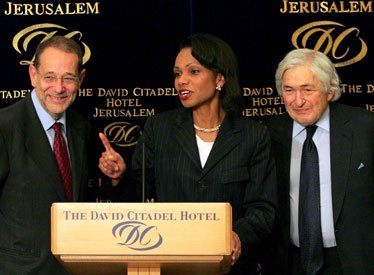
For reasons that may not be entirely clear to everybody, Secretary of State Condoleezza Rice has made the progress on the Palestinian state her very own project. Maybe, having been known as a Russian expert and having not managed to understand the European Union, she is enlarging her specialist expertise.

Whatever the reason, she postponed a trip to the APEC meeting, to stay in Jerusalem and beat her way through to an agreement on the Rafah crossing between Gaza and Egypt.

Secretary Rice has spoken soulfully of the various things the Palestinians, especially in Gaza, need, in order to achieve economic and political progress, saying of the latest agreement:
“This agreement is intended to give the Palestinian people the freedom to move, to trade, to live ordinary lives.”
Somehow, she forgot to mention that one of the things they need to achieve all of that is a little less fighting between the various militant groups.

She has tried to put pressure repeatedly on Mahmoud Abbas to stand up to militant groups but neither the pressure nor Abbas’s own rather vague promises have achieved anything. In fact, according to Reuter’s
“In a sign of tensions, President Mahmoud Abbas, in a speech after the Gaza deal was unveiled, accused Israel of trying to avoid peace talks and incite Palestinian civil war by insisting that militants be disarmed before any negotiations on statehood.”
Pretty unreasonable, I call it. Anyway, after long negotiations that have left the Secretary of State looking less than her usual radiant self because of lack of sleep certain arrangements have been achieved and the EU is very much part of it.

The Rafah crossing will be open and will be monitored by Palestinian border guards and European Union security forces, so far unspecified. The Israelis had tried to insist that they be given real-time video information about crossing as they are worried about arms and terrorists being smuggled through Rafah.

The Palestinians have insisted that Israeli presence would impinge on their sovereignty. Reuter’s reports:
“An Israeli Defense Ministry source said a compromise was reached whereby Israeli and Palestinian security officers will man a control room a few kilometers (miles) from Rafah monitoring remote-control cameras at the border crossing.”
The BBC World Service website describes the agreement slightly differently:
“The deal also includes video surveillance of the Rafah crossing to Egypt by a joint EU-Palestinian team.

Israel will have access to the video via the Europeans, but will not have veto power over individuals moving through Rafah, as it had wanted.”
One hopes that the first terrorist atrocity carried out by someone who was allowed through Rafah will produce a certain amount of soul-searching but one does not hope too much.

Secretary Rice will smile radiantly and plead for more patience on the part of the Israelis, while the EU will swank around on its first really big overseas mission. It is, of course, also supposed to be training the Palestinian police force, a task it has not in the past been particularly successful in, the Palestinian police force not being one to reckon with.

Other aspects of the deal include travel for Palestinians between Gaza and the West Bank some time in the near future, the building of Gaza seaport and a possible airport (presumably on international money), and “allowing the urgent export from Gaza of all the agricultural produce of the 2005 harvest”.

COMMENT THREAD

The EU's spies in the sky

An extraordinary article in The Daily Telegraph today announced that the EU is "to build network of spy satellites".

The multi-billion-pound system is known as "Global Monitoring for Environment and Security" (GMES), on which the commission, with the European Space Agency, has already spent £154 million on preparatory work, and expects the whole project to cost £1.54 billion between 2006 and 2013.

But what makes the article so extraordinary is that this project was actually announced in March 2002 and its definitive structure was set out in a commission communication in February last year.

However, far be it for us to look a gift horse in the mouth. Anything which draws attention to the EU's plans in space is welcome, especially as the Telegraph piece, by David Rennie, tells us that this network of spy satellites will allow Brussels "to ensure nations and private individuals are obeying its policies."

Also of interest is that, while the system was originally intended to be up and running by 2008, the date has slipped to 2010, according to a commission spokesman, announcing the launch of a "pilot stage" for GMES.

Predictably, as it has done with Galileo, the commission stressed its "user-friendly" application in guiding relief work after disasters or providing real time images of forest fires or oil spills. But, writes Rennie, “a commission memo” also acknowledged that GMES would play a key role in the "implementation, review and monitoring of EU policies", including watching for agriculture and fisheries fraud and boosting "internal security".

In addition, Rennie continues, officials hope GMES will support the EU's first steps towards becoming a military power. It will "provide authorities with necessary elements for a European Security and Defence Policy", the commission memo said.

That "memo" was the commission communication produced in 2004 (link above), but never mind – it is good to see this Blog's warnings in print in the MSM, especially as Rennie goes on to write that US politicians are already suspicious of Galileo project.

Curiously, there is nothing written of UK involvement in GMES but, as part of the EU and a member of the ESA, we will be funding the system, even though, traditionally, we have largely relied on US satellite data. Once again, therefore, the UK is piggy-in-the-middle, with yet another strand pulling it in the direction of Europe.

COMMENT THREAD

Be careful what you wish for

So, for the eleventh year, the EU's Court of Auditors has refused to sign off the accounts. That much was revealed by ECA president Hubert Weber at the EU parliament in Strasbourg yesterday, leading to a predictable chorus of disapproval, not least from the Conservatives and UKIP, which denounces "The EU's Fairytale Accounts".

However, while your average Eurosceptic may be crowing at yet another example of the EU’s ineptitude, not everything is quite as straightforward as it seems. Several reports, not least in Eupolitix and The Independent point up that because about 80 percent of EU spending is conducted by national and regional authorities and it is in these areas that the greatest concern is expressed by the Court.

Says Weber, "The supervisory and control systems are not yet implemented and operating effectively and payments are still affected by errors," adding that agricultural spending was particularly error-strewn. Far from directing his ire at the commission, therefore, Weber was particularly critical of the national authorities, stating that "The improvement in systems and controls at the level of the commission has not been reflected in those within the member states."

Even the triumphant Conservative MEP James Elles is warning that the member states must face up to their responsibility to ensure euro-funds channelled through them were better accounted for. He is echoes by Chris Davies, leader of the British Liberal Democrat MEPs, who declares that: "The finger of blame should be pointed towards Gordon Brown and his fellow finance ministers who have refused to accept responsibility for the money spent by their own administrations.”

As for the commission, in its classic, gruesome Euro-speak, it is telling us that it has:

…proposed to the other institutions a roadmap to an integrated control framework, which will provide the Commission and its stakeholders with a reinforced assurance as to the legal and regular use of EU monies, including under shared management with Member States. The Commission has undertaken an analysis of the gaps between its existing internal control framework and that advocated by the Court of Auditors in its opinion 2/2004 on the "single audit" model and a proposal for a Community internal control framework. The gap analysis has been discussed by an expert panel with representatives from all Member States in September 2005, and is being jointly examined by Commission services and the auditors.
Cutting to the chase, this simply means more power to the commission to vet member state accounts, an inevitable consequence of a supranational system where the central government – in this case the commission – is disbursing funds to its subordinate tiers.

Never mind the overt fraud and maladministration in the commission itself, the responsibility for the bulk of the funds that are not properly accounted for does lie with the member states. To cure that, the commission needs more power. Those who want more accountability, therefore, had better be careful what they wish for.

The alternative, of course, is to get rid of the EU budget altogether, and have member states paying their own way, with their governments accountable to their own parliaments. Now, that would be a refreshing change.

COMMENT THREAD

More bilateral problems?

Old enmities die hard, and never more so than between Poland and Russia. Relations are already strained by a deal between Russian and Germany to build a $5 billion gas pipeline under the Baltic Sea, bypassing Poland and the Baltic states and taking Russian gas directly to western Europe - thereby depriving the detoured countries of lucrative transit fees.

This is on the back of Ukraine's "orange revolution", when Poland acted as mediator, and pro-Western Viktor Yushchenko beat his pro-Russian rival Viktor Yanukovich in the disputed presidential election.

Relations then worsened in May, when Polish President Aleksander Kwasniewski was snubbed by Russian President Vladimir Putin during a visit to Moscow to mark the 60th anniversary of the end of World War II.

But now, inexplicably, according to Polish foreign minister Stefan Meller, Russia has imposed restrictions on imports of Polish farm produce and meat.

So serious is the situation that, prime minister Kazimierz Marcinkiewicz is appealing to the EU commission to help sort it out, with the news agency AFX reporting that he has even made a public appeal on national radio.

The Russian authorities are saying that they have taken their action because of fraudulent practices among Polish exporters, including falsification of health and hygiene certificates, as if a member of the European Union could ever stoop so low.

In Poland, the restrictions are considered politically motivated and aimed as a test of the new conservative minority government led by Marcinkiewicz. "All the signs from Moscow must be analysed in a political context," Meller said in the Polish Rzeczpospolita daily. "If the incidents of which Russia accuses us did occur, they were already known," he said.

So far, there are no tanks massing on the borders but it remains to be seen whether the commission will intervene or whether, as so often is the case with the Eastern and central European states, their external relations are suddenly, in defiance of the Common Foreign and Security Policy, merely "bilateral" problems.

COMMENT THREAD