Thursday, August 24, 2006

Green Helmet update

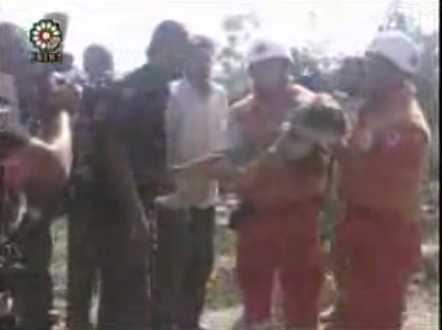
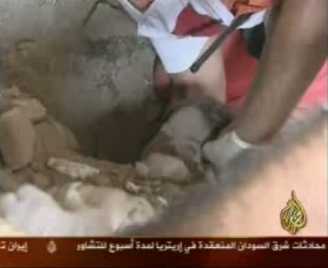
We have been sent some important new video footage which has enabled me to update the "Qanagate" report. So far, I have made significant changes to Part 4 – Red Cross workers, adding three sequences.

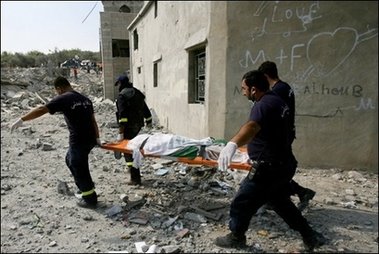
The first shows Green Helmet stopping a Red Cross worker from evacuating the body of a girl, telling him to put it on a stretcher – whence it is used for a number of staged scenes.

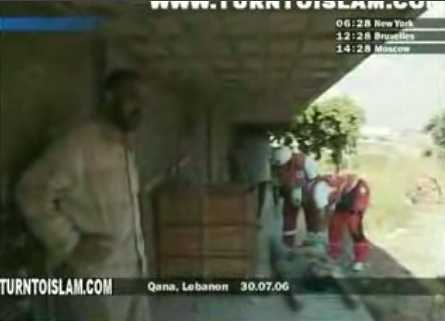
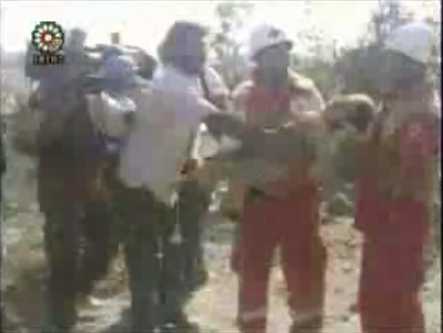
The second, shown above, expands scene 2. It actually shows a Red Cross worker being placed at the location. Only once his "minders" are satisfied with the positioning does the bearded man in the white shirt - acting as the "prop master" - hand him the body of the child. Another Red Cross worker to his side takes hold of the head, in what is evidently a pre-arranged pose, the pair acting as a duo.

Now that the actors are in place, with the "prop" suitably position, "Black baseball cap" moves in to check the arrangements and give last minute instructions to the actors. Then, as is shown in the report, the actors march off in front of the cameras to give their ghoulish display.

The third addition supplements an already published still frame from AP's Nasser Nasser. Apparently showing an "action shot" with Nasser claiming to show Red Cross workers carrying away a body, the video footage actually shows the workers stationary for many seconds, posing for the shot.

We have other material which we are still processing and will have to add to other sections of the report. Each time, the case strengthens - nothing so far in any way contradicts our original thesis that the bulk of the scenes at Khuraybah were staged.

Meanwhile, the rats continue to nibble at the edges. Two more attacks are up on the web, here and here. Both follow classic lines. The first attacks the author for having an "agenda" while the second lumps the EU Referendum material in with other work and then attacks the latter, damning ours by association. But neither address the substantive evidence offered by this blog.

The first of the pieces, by Greg Mitchell of the Editor & Publisher is now suplemented by a second. The man is in denial. Perhaps he should listen to the advice given to many a politician - when you're in a hole, stop digging.

As to ongoing changes, I have also amended the main graphic in Part 2 and we will keep you informed of further updates.

Comments - use the "Green Helmet/AP" thread

The Irish Question reappears

According to what might be the greatest book of English and British history “1066 And All That”, Mr Gladstone’s sole aim was to solve the Irish Question but the Irish cheated: every time he came near to doing just that, they changed the Question. For those of us who are old enough to have studied history at school that remains the best description of the endless toing and froing over Ireland in the second half of the nineteenth and early twentieth century.

The creation of the Irish Free State appeared to solve the Question but it left Britain with the Ulster Problem and I am not going to spend the next three hours trying, rather ineffectually, I suspect, to analyze that.

One would think that with both Britain and Ireland being members of the European Union, a transnational organization devoted to the destruction of existing national states and creating a new one, that of a common European State (super or otherwise) would have put pay to all that discussion and the constant changing of the Question. Let’s face it, the EU will have its work cut out with the Transylvanian Question once Romania is part of it.

It seems, we have underestimated Irish tenaciousness. A good Question is not to be discarded just because centuries have gone by and fruitless battles have been waged.

According to the BBC, Gay Mitchell, a member of the Irish Parliament and of the European Parliament, made what turned out to be inflammatory remarks at the annual Fine Gael Collins-Griffith Memorial in Dublin on Sunday.

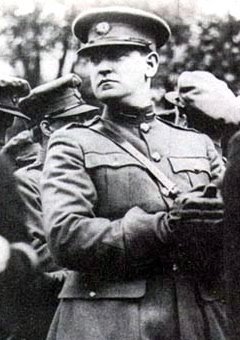
(It is, perhaps, worth noting that the two men commemorated are Arthur Griffith, the first President of the Irish Free State, who died in 1922 because of stress brought on by the country’s indubitable slide into an extremely bloody civil war and Michael Collins, the leader of the IRA who signed the treaty with the British Government and immediately started undermining it, though this remained unknown to many of his erstwhile comrades. Collins was planning to launch a guerrilla war in Northern Ireland but was distracted by that civil war and was clearly involved in the assassination of Sir Henry Wilson. Despite all this, as Sellars and Yeatman might have said, he was assassinated by disgruntled IRA members 10 days after Griffith’s death. Oh dear, I wasn’t going to go into Irish history.)

Anyway, what did Mr Mitchell say that annoyed everyone so much?
“As a constitutional nationalist, he was interested in looking at Ireland's relationship with NI's unionist population, he said.

He widened his argument to ask what role the British monarchy would have if a united Ireland came about by consent.

"Are we prepared to actually think out of the box and say, well how - if this is to come about - it will be accommodated," he asked.

"Or alternatively, are we saying that we are abdicating solely to Provisional Sinn Fein, the role of being advocates for a united Ireland in the Republic?

"I think that would be a disastrous thing to do."”
Needless to say, Sinn Fein condemned the remarks immediately as did the DUP and these are the only two parties that count for anything in Northern Ireland.

My question remains similar to the one at the beginning of this posting. Mr Mitchell is musing about a united Ireland brought about by consent (another instalment from “Tales of Porcine Aviation”). Is that not rather a passé notion in the brave new world of the European Union? And should Mr Mitchell, as an MEP, not know this fact?

The enemy between

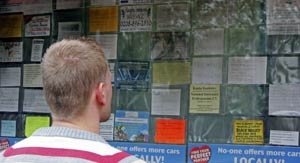
A Polish jobseeker looking at vacanciesEven though I am still coming up for air after spending more than three weeks on my "Qanagate report" (would you believe 84 pages when I printed it all out, with 173 illustrations?), even I managed to notice that there was a certain amount of interest in immigration over the last 24 hours.

This, I gathered, had something to do with the release by the government of official figure, recording that half a million East (and Central) Europeans had applied for work in Britain during the last two years – i.e., since EU enlargement.

In today’s edition, The Times is chuntering on about this, as is the Mirror and sundry other newspapers. The Beeb had its go yesterday, devoting most of its Radio 4 World Tonight newscast to the issue.

The influx, we are told, is much greater than the Government's prediction of 15,000 immigrants per year and the actual number of workers from these countries is likely to be higher still since the figures do not include self-employed people like builders or plumbers, who do not have to join a workers' registration scheme.

Tony McNulty, the immigration minister, said estimates that included self-employed people would put the total number of from immigrants from the so-called "A8" nations nearer to 600,000.

But, if those are the bald figures, what we have not heard or seen anywhere from the media is why it is happening, and why this mass migration was both inevitable and predictable, once these countries entered the European Union.

Classically, this is in fact a problem of agriculture, about which we wrote in December last year. And this is a problem as old as the hills.

Basically, something like 25 percent of Poland's 40 million population is dependent for its income on the land – 10 million or so people - and other enlargement countries have similar ratios. Yet, in a modern economy, this is unsustainable. Agriculture, typically, can only support between 2-4 percent (in Britain it is lower), and then only with considerable protection and subsidy.

In joining the EU, the enlargement countries – as expected – have been forced into a massive programme of rationalising their farming industries, which means that people are being forced off the land as rural employment declines.

The same rationalisation occurred in the UK during the 18th and 19th Centuries but, fortunately for us, this coincided with the industrial revolution, which soaked up the excess labour and kept it productive.

In the accession countries, however, far from expanding, the industrial base is contracting. Under the dual assault of EU environmental protection laws and the prohibition on state aid – with the added problem of global competition - many of the former state-owned enterprises have shut down or have reduced their labour forces. Thus, we have a situation where, just as the rural economy is shedding labour, so is the industrial sector.

France had something of a similar problem, although it came late – in the 1950s and 60s. It was this which prompted de Gaulle to fight for the CAP, subsidising farmers to keep them on the land and thus slow down the movement from country to city, making it more managable.

But, in the 1999 enlargement settlement (the so-called "Agenda 2000"), existing member states refused this option, cutting back on the entitlement for enlargement countries and then changing the rules which made it more difficult to apply for the funds that were available.

Caught in this classic squeeze, there is only one answer for the economically active population – migration. The ridiculous thing is that this was so predictable that, back in 2003, Booker and I wrote about it in our book, The Great Deception. I pulled off the original text from my files, and this is what we wrote:

Unlike the French back in the 1960s, the Poles were not to get a cushion for their peasantry. They were to be exposed to the full force of competition from highly-subsidised EU produce, transported faster and cheaper down the Trans-European Network to Warsaw than many local farmers could hope to compete with. The only result could be an accelerated drift to the cities. Yet, the EU had also forced the "rationalisation" of Poland's core industries, such as steel, intensifying already serious unemployment and wiping out any potential jobs for the dispossessed farmers.

Emigration would be the only option, something foreseen by the existing EU member states, most of which had refused to allow rights of establishment for seven years. But not so Britain. Following Ireland’s lead, she would allow entry to the eastern Europeans from day one of their accession. Furthermore, they would have the same entitlements to benefits, health care and education as UK nationals. The Home Office believed that only 5,000 to 13,000 would take advantage of this, but Migration Watch UK, a specialist think tank, warned that the UK could be facing 2.1 million immigrants by the year 2021.
That is exactly what is coming to pass. To try and stop it, without dealing with the core issue – agricultural subsidies – is like Canute trying to stop the tide coming in. He knew it could not be done and wiser heads know that this wave of migration – for good or bad – cannot be checked under the current regime.

But, as I observed, nothing of this is discussed by the media. I doubt there is a great conspiracy though. This is just another of those all too common examples of the ignorance and lack of professionalism that passes for journalism these days.

Whether it is the Middle East, foreign affairs generally, domestic or EU affairs, the very last thing you can do is rely on the media for an honest or intelligent appraisal of current events. Through their lame and often trivial efforts, they let the governments of the day off the hook and, in so doing, become part of the problem. Standing between us and the government and still dominating the debate and filtering out alternative views, they hinder understanding and the accountability that comes with it.

They the media, therefore, are not so much the enemy within – they are the enemy between.

COMMENT THREAD

Wednesday, August 23, 2006

Abbas hands over the money

According to Ha’aretz
“Palestinian Authority Chairman Mahmoud Abbas (Abu Mazen) gave some 5,000 members of Hamas' special "operational force" salaries this week, Palestinian sources say. The salaries came from funds the Arab League sent to Abu Mazen's office to pay the wages of 170,000 PA officials. Most members of the "operational force" belong to Hamas' military wing, Iz al-Din al-Qassam, led by Yussef al-Zahar, the Palestinian foreign minister's brother.”
Although a few weeks ago the PA and Hamas signed an agreement, which had brought many of the Hamas fighters into the fold, before that this operational force had spent a great deal of time fighting Fatah. Nor have any of the force agreed to abandon their terrorist activities or to recognize Israel’s right to exist.

In itself, that is nothing new. There have been many protests about the non-payment of salaries and protests in that part of the world are apt to turn violent. There have also been protests by the many unemployed, demanding that the Palestinian Authority find them work, a task that would be beyond most governments.

However, the EU is not uninvolved:
“According to Palestinian sources, the European Union operates a body which, together with Abu Mazen, supervises the transfer of the payments from the Arab League. On Saturday it approved $89 million for payment of salaries going back to the month of May. However some 20 special advisers to the government were not permitted to receive payments. The operational force was nevertheless allowed to receive money because it joined the Palestinian police force six weeks ago as part of Abu Mazen's agreement with Hamas.”
So much for Hamas fighters not getting the money that is being handed over to the PA for humanitarian purposes.

Sadly, they have no shame

An item on the Power Line blog leads us to an article in the Washington Times with the interesting information that a Swedish Foreign Ministry report into the Oil-for-Food scam has established that Norway’s ambassador to the UN, Ole Peter Kolby knew all about the shenanigans but preferred to keep silent “for fear of angering Iraq and big companies involved in the program”.

The report has now been broadcast on Swedish radio and written about in Aftenposten. The Norwegian radio interviewed Mr Kolby, who said that all he had was suspicions and rumours, not proof. Ought he not have followed some of the rumours up or asked someone else to do so? Apparently not.

“Henrik Thune of the Norwegian Institute of International Affairs told Aftenposten that Kolby was caught between competing interests, including fear of fueling the push for war in the Bush administration if he revealed corruption in the Oil for Food program.

"In reality, Norway found itself in a hornets nest of large countries' politics, large companies' interests and the humanitarian situation in Iraq," Thune said. "I don't think Norway really had any freedom to act, and the criticism should be directed at the superpowers within the U.N. Security Council."”

Well, diddums. I trust people will remember this bit of whingeing when some of those small countries strut their amazing moral superiority, which does not prevent them from keeping very quiet, indeed, when a major financial scandal is going on.

And what are we to make of that little comment about Kolbe being afraid fuelling “the push for war in the Bush administration”? Clear as clear can be: it was all Bush’s fault. Some of us might think that Mr Kolbe betrayed the trust that had been placed in him by the Norwegian government but we would be wrong. It was all them, the big guys. They didn’t actually make him do it but he was afraid that they might use his comments as a justification.

So the scandal went on, the money was stolen, the people of Iraq suffered and Mr Kolbe glowed in his self-righteousness.

Just a reminder

Some of our readers will say that this posting is entirely irrelevant to the core themes of the blog. I am not sure and, in any case, I find it interesting that two crucial events of the Second World War began on the same day, though two years apart.

Today is the anniversary of the beginning of the Blitz, the night-time bombing of British cities and towns by the Luftwaffe in 1940.

It is also the anniversary of the start of the Battle of Stalingrad in 1942 - a more destructive and, as it turned out, more decisive event. The picture above is of Stalingrad (now known as Volgagrad while the battle is mostly known as the Battle on the Volga).

Finished

It's done, all bar the tweaks: the "Qanagate" report. Start here.

COMMENT THREAD

Tuesday, August 22, 2006

They will come to Beirut (maybe)

One of Agatha Christie’s better spy thrillers is called “They Came to Baghdad” and deals with a rather villainous organization led by a man who sees himself as a superman, intending to destroy what exists and build a completely new world structure. Not all that far-fetched really. At the centre of the novel is a projected conference between the Soviet and the American leaders in Baghdad and, therefore, all sorts of people, important and otherwise descend on that city.

Well, if not Baghdad, then Beirut (maybe) as the discussions continue about that international contingent that will, together with the Lebanese army, ensure peace on the Israeli-Lebanese border.

The line-up seems to be: 200 French of whom some have begun to arrive with the Minister of Defence insisting that a better mandate is needed. True enough but who co-sponsored Resolution 1701 and insisted on a speedy agreement in the Security Council? France has also called for a meeting of EU ministers to “co-ordinate” the European part of the projected UN force as has Italy's Prime Minister, Romano Prodi. When in doubt, call a conference to co-ordinate something or other.

Germany will probably send a naval contingent but no land or air ones and is likely to concentrate on humanitarian aid to Lebanon to which the United States has already given $230 (£121) million.

The current favourite to lead the international force is Italy, who has promised 3,000 soldiers but there is a caveat.

“But Italy's offer to lead the force appears to be conditional on an agreement being reached on a new UN resolution, the AFP news agency reported.

The agency quoted Mr Prodi as saying a new resolution should provide "a specific mandate, specific contents and a very clear definition of the alliances".”

Again, fair enough but was this not clear from the moment Resolution 1701 appeared on the negotiating table? The right-wing opposition in Italy is likely to play on the general dislike of foreign military adventures in that country (at the moment, anyway) and on there being little support from other European countries. As Reuter’s reports through Al-Jazeera:

“Italy's centre-right opposition, mindful of the public sensitivity to military casualties, said Rome's enthusiasm was unmatched by its neighbours.

"Chirac will send a few generals, Germany a launch or two, while we have to send troops dressed as kamikazes in the Italian flag," said Francesco Storace of the rightist National Alliance.”

What a lovely picture that presents. The Italian Foreign Minister Massimo d’Alema has emphsised that, although disarming Hezbollah was quite a good idea, it was more important that Israel must not break the truce. Otherwise the Italian troops cannot go in. Whether they can go in if Hezbollah breaks the truce remains a moot point.

“On Monday, the Shia militant group's deputy leader rejected calls for it to disarm. Sheikh Naeem Kassem reportedly told the Arabic TV station al-Jazeera: "I say it clearly: the resistance will continue. We must remain in a state of readiness with this enemy [Israel]."”

This does not bother our own super-tranzi, Mark Malloch-Brown (or, needless to say, SecGen Kofi Annan) whose biggest worry is that Israel should have no say in the make-up of the international force. Israel, as our readers will recall, expressed some concern about countries with whom it had no diplomatic links and who did not acknowledge the country’s existence, being part of the international force.

“"Yes [the force] must enjoy the confidence of Israel, but that doesn't give them a right to blackball individual contributions," he said.

"We'll expect them to look at... the totality of the force and whether it represents a broad multilateral balance."”

I dare say Mr Malloch-Brown expects Santa Claus to come down the chimney every Christmas Eve as well.

Meanwhile, Salim Mansur has had a look at Resolution 1701 and has come to the conclusion that it is under Chapter 6 (Pacific Settlement of Disputes) rather than Chapter 7 (Action with Respect to Threats to the Peace, Breaches of the Peace, and Acts of Aggression). This is important. Chapter 6 Resolutions leave it to the participants to sort the problems out with the UN looking on and generally guiding procedures. Chapter 7 Resolutions give the UN power to enforce them.

“Resolution 1701 calls for "cessation of hostilities" between Hezbollah and Israel and, thereby, establishes an outrageous equivalence between a terrorist organization and Israel, a member state with a democratically elected government.

It reiterates earlier resolutions (1680, of this past May, and 1559, of September 2004) that called for all "foreign forces to withdraw from Lebanon" and for "the disbanding and disarmament of all Lebanese and non-Lebanese militias."

But what has happened since those resolutions? Israel withdrew completely from Lebanon by June 2000. The effort to get Syria to withdraw as well culminated instead with the still-unsolved murder in February 2005 of former Lebanese prime minister Rafik Hariri, who was instrumental in securing the passage of Resolution 1559.

As for the disbanding of militias, Hezbollah has only gathered strength with the full backing of Iran and Syria.

The war started by Hezbollah on July 12 illustrated, as if any further proof was needed, that Lebanon has little more than an empty shell of a government. It lacks any meaningful authority over its territory, and de facto power rests with a terrorist group that does the bidding of Tehran and Damascus.

Since Resolution 1559 has remained unenforceable, there is no reason to think that Resolution 1701 will fare any better.”

It is, perhaps, just as well that as far as any of us can tell, the Armageddon promised for August 22 by Iran does not seem to be happening. The UN might decide to pass another Resolution.

A single picture...

...can tell a thousand lies.

And so it goes on.

Our hidden government

Pricing by size as well as shape came in on Monday - by courtest of the EUIn The Daily Telegraph today, there is a strident editorial castigating the Post Office for introducing complex and unnecessary changes to the postal system on Monday, whereby mail is now charged not only by weight but also by size.

What the paper failed to note was that which had been pointed out by Christopher Booker last Sunday – the Post Office had no choice – it had to impose the changes to comply with an directive on opening up European postal services to competition.

An essential part of that is harmonising the basis of the charging regime and, as always, since we operate a different – and simpler – system, it is us that have to come into line. Never mind that we had a postal service before most of our European neighbours had countries.

Why the newspaper should have failed to mention the EU dimension is incomprehensible, but it is typical of a media which consistently avoids referring to what we so often call "the elephant in the room".

And, strangely, this failing has a great deal in common with the media coverage of the "Qana" incident. On this, we have complained about lies and distortions, but this is more of the same – albeit in a different league.

Being brought up as a good Catholic boy - by Jesuits, no less - I committed to memory the then version of the Catechism, and recall to this day the definition of a lie. It could be, said the book of words, an act, default or omission. Failing to point out something which is relevant to an issue and vital to the correct understanding of it – to the extent that false understanding arises as a result – is as much a lie as telling a direct untruth.

In that context, today's editorial is a lie. Worse still, it is part of a bigger and continued lie – the refusal of our media to inform us of the extent to which we are ruled by an alien government, based in Brussels. In its own way, that is every bit as important as the lies and distortions coming out of the Middle East and – in all probability – stems from the same wellspring of mendacity, sloath and lack of professionalism.

Either which way you cut it though, through the complicity of the media, we have a hidden government. And the worst of it all it that no one (and especially the media) seems particularly to care. I wonder how Americans would react if their government had moved offshore, say to Havana?

COMMENT THREAD

Madness abroad

The UN thunders to the rescueThere is a serious madness abroad – both literally and figuratively – not least in DR Congo, where the high farce descends into low tragedy, the second round of the national elections breaking down into all-too-predictable violence.

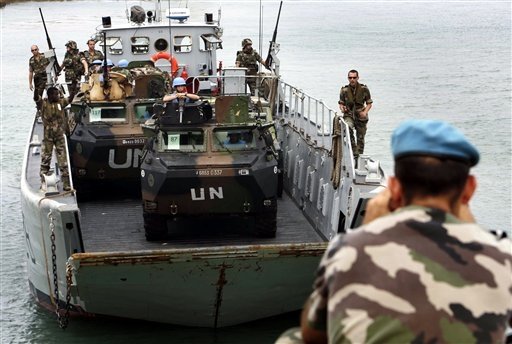
This is where, of course, the EU army, was going to move in and sort things out – which is why it took 150 UN troops in armoured personnel carriers (pictured) to dash to the rescue fourteen UN and foreign ambassadors. They were meeting at the house of Jean-Pierre Bemba, one of four vice-presidents, who came second to the President in the vote – when a gun battle erupted in the vicinity.

The ambassadors had, it seems, been trying to broker a meeting between the two candidates who now face a run-off in the vast country’s historic elections, while shooting gunfire echoed around the capital for several hours. UN and European Union soldiers, we are told, "were placed on high alert" but – you will be surprised to learn - "did not intervene".

It was left to Jean-Tobie Okala, deputy spokesman for the UN mission in the country, to say: "We appeal to everyone to remain calm and respect the results from the vote." There's that word, "respect" again. Where have we heard it before, I wonder?

Analysts, according to The Times, have said that the United Nations, which has 17,500 peacekeepers in the country, "would have to act with unaccustomed resolution to prevent the run-off from spiralling out of control and returning the country to civil war," - which will never happen. That means the country is almost certainly doomed to another bloody bout of civil war.

Anyhow, one can only applaud the ambassadors on their choice of company for such a propitious event as a high-profile gun battle. Presidential candidate Bemba controls about 6,000 former rebel fighters, supposedly integrated into a newly constituted national army. His movement is accused of cannibalism after slaughtering pygmies in an attempt to inherit their magic powers and he himself was reported to the International Criminal Court for war crimes. Sounds just the sort of man we can do business with.

Mind you, if you want total madness, read this or even this.

COMMENT THREAD

Monday, August 21, 2006

The public intellectual's travails

One would have to have a heart of stone not to laugh heartily at the travails of that most eminent of Europe’s public intellectuals, Günter Grass, author of many intellectual novels, all-purpose anti-American and anti-capitalist campaigner and the self-designated conscience of Germany.

Having spent many decades calling on the Germans to confess their sins, to come clean on their Nazi past and to atone for all the crimes (though, curiously, he has never been known to call for Communists to atone for their equally terrible and far more voluminous crimes) he has now admitted that in 1944, at the age of 17 he joined the Waffen SS.

My first reaction on reading the story was an amused shrug. Grass is undoubtedly an excrescence on the horizon of public intellectualdom but no worse than many others, say, our own Harold Pinter. In addition Grass is a much better writer than Pinter.

Furthermore, people do very stupid things when they are 17. There are many people around who stayed in the Communist Party till a considerably later age. All the same, it is curious that the young Günter didn’t simply join the army, as he would have had to by 1944 but the elite Waffen SS that was implementing the Final Solution.

He himself maintains that he did not take part in any of the crimes, which is possible, though what on earth he did as a young recruit remains somewhat mysterious. In any case, whatever he did, it would have aided and abetted those who did carry out the crimes.

The fuss is not going away, though, largely because it has taken Grass so long to admit to his early “peccadilloes”, coincidentally just before his autobiography is due to be published.

The real problem is the hypocrisy. Grass had been castigating everyone on the right for so long, demanding so many repentances (though in 2003 he wrote a novel “Crabwalk” in which he called Germans the victims of World War II as well, but presumably only because the nasty British and Americans defeated them), that questions do have to be asked as to why he has kept so quiet for so long about this rather embarrassing episode in his life.

As Suzanne Fields writes:
“And it was a big halo. Like others of the arrogant intellectual left of European letters (such as the English playwright Harold Pinter, another Nobel Prize-winner), he never lost an opportunity to use his fame and sense of moral superiority to scold America. During the Vietnam War, he compared our "war crimes" to the war crimes of Nazi Germany. He never bothered until now to say that he was a member of the elite Nazi unit commissioned to execute the worst of Holocaust thuggery.

He went out of his way to criticize Konrad Adenauer for his friendship with the United States; he blamed the resurgence of German capitalism, which he loathed, on America. He even invited sympathy from Jews for opposing Ronald Reagan's visit to the cemetery at Bitburg in 1985 because some of his old comrades of the Waffen SS were buried there along with American soldiers. Imagine how eloquent that opposition might have been if he had said then that he, too, was Waffen SS. Instead he only sneered at President Reagan.”
All that self-righteousness, all that civil sainthood – all gone. How sad for him – how wonderfully funny for the rest of us.

Death of a photographer who deserved the Pulitzer Prize

Not to be outdone in the war photography stakes, I have also decided to put up a short posting (please control that cheering at the back) on the subject but, as befits one who aspires to be an historian, my story goes back in time.

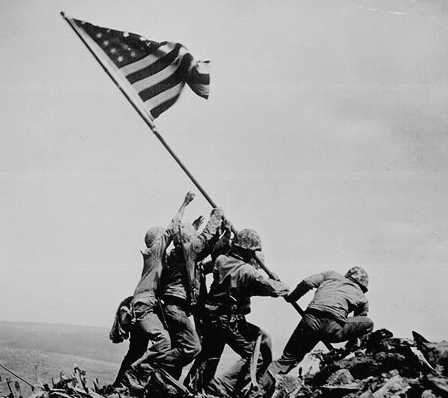
ABC News has announced the death, at the age of 94, of Joe Rosenthal, the man who won the Pulitzer Prize for one of the most famous photographs of the Second World War: the raising of the flag at Iwo Jima.

The photograph, taken on February 23, 1945 was actually that of a second flag raising, as the first flag was not deemed to be large enough. This had been decided before Rosenthal got there for reasons of military morale rather than the need to send a better picture. In a sense, one could argue that this, too, was an example of messing around with photographs, especially as it is the slightly cropped version that became famous rather than the original shot.There is a slight difference, however. The Iwo Jima photograph, listed as no. 68 in a 1999 New York University survey of the 100 best examples of photojournalism of the century (goodness only knows what sins are buried in that survey), was never simply a news story.

The photo did not lie in the sense that Iwo Jima had been taken with a great deal of sacrifice. But what it really concentrated on is the effort and achievement of war and of the US Marine Corps, in particular.
“"What I see behind the photo is what it took to get up to those heights the kind of devotion to their country that those young men had, and the sacrifices they made," Rosenthal once said. "I take some gratification in being a little part of what the U.S. stands for."”
One wonders whether any of AP’s photographers would agree with that or, even, believe in it.

The photograph was the basis for the Marine memorial in Washington DC, officially dedicated by President Dwight D. Eisenhower on November 10, 1954, the 179th anniversary of the U.S. Marine Corps.

Its influence was shown in another, more recent iconic photograph: that of the three firemen raising the Stars and Stripes over the rubble that had been the World Trade Centre.

Conclusive evidence?

I had not intended to post again on the "Qanagate" affair until the report in preparation was finished - which still needs a few more days.

However, one of our readers has recently unearthed additional video footage, shot by Aljazeera. This more or less proves that the "dead baby" scene, in which "Green Helmet" was photographed by Reuters' Adnan Hajj (he of doctored photograph fame) uncovering the body of Abbas Ahmad Hashim, was not only staged, but faked.

The very strong indications are that the body of baby Hashim was uncovered early in the recovery effort by two Red Cross workers and subsequently re-buried so that it could be "discovered" by "Green Helmet" in a way that maximised the propaganda value.

The footage showing the initial discovery has been posted on this site, from which three "grabs" are reproduced here.

The first of the "grabs" is lifted after scenes of the early stages of the recovery effort in the wrecked basement at Khuraybah, with a Red Cross worker digging in the debris. The camera focuses on a head cradled in the hand of the worker (see right). There is an object obstructing the full face, though, so we do not see it clearly, but the scale and definition indicates that it is very small, entirely compatible with it being that of the body of a baby.

Then, the Red Cross worker lifts the head slightly towards the camera, to give the clearest image of all three sequences of the television footage we have available. The head is still not completely unobscured, but the definition is better than in any other television footage. Colour balance is not as distorted in other footage, showing the grey colouration of the head, in contrast with the colour of the Red Cross workers' uniforms.

As the worker continues digging, the full body becomes visible (bottom right of the frame). another worker joins in and clears the legs, which he starts to lift from the debris, revealing the body. It is unmistakably that of a baby, the low-neck singlet is the same as seen in the still frames of Abbas Ahmad Hashim's body, and the legs appear to be bare, compatible with the shorts seen in those frames.

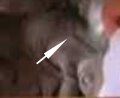
And here, is a slightly enlarged cut-out of this frame, we see arrowed, a thickish line extending vertically upwards (as viewed) ending in an indistinct blob with a hint of blue colouration. This is too indistinct for certainty, but it looks very much like the blue "pacifier" seen in the still frames.

This is now one of three video sequences which we have gathered and the full evidence is set out here.

As we remark in this section of the report, Reuters have some explaining to do, as have the other agencies who are trying to ignore this issue. The evidence is here for all to see and, with the three video sequences now available, we are convinced that there are now very strong grounds for a full enquiry into the events leading to the photographs by Adnan Hajj and others.

Comments - use the "Green Helmet/AP" thread

Sunday, August 20, 2006

The wrong kind of war

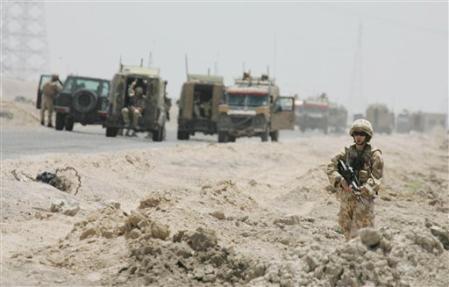
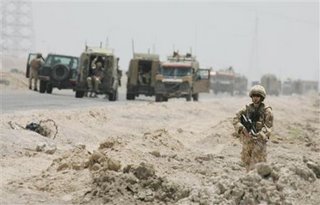
On the road to Al-Zubair - a Snatch convoy ambushedFamously, in the days when we had a nationalised railway network and the system was routinely brought to a grinding halt with the even moderate winter snows, a hapless executive was hauled before the cameras to explain why, on one particular occasion, a particularly light fall of snow had brought trains to a complete halt.

It was, he explained to the incredulous media, "the wrong kind of snow". This he later expanded upon, telling us that it has been a very fine snow which, while not heavy enough to block the lines, had invaded the engines, blocking filters and shorting out electrics. This was plausible enough but too late. Forever in the vocabulary now rests that sneering commentary on the inadequacies of nationalised industries, "…the wrong kind of snow".

Reviewing now the recent performance of the Israelis in the Lebanon campaign – something which I promised in a post a week ago, I suppose the best that can be said of it is that the IDF was fighting "the wrong kind of war".
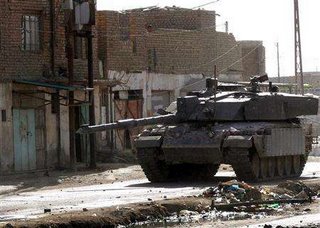
What brought this to mind was a photograph in today's edition of The Sunday Telegraph which we published on this blog nearly a month ago (so much for blogs being "derivative"), which illustrates a different facet of precisely the problem which the Israelis currently face (above left).

In the instance illustrated by the photograph and the accompanying story we have an issue rehearsed at length (and in depth) by this blog, where we argue that British troops attempting to police southern Iraq are dangerously ill-equipped.

More specifically, we have an army in theatre relying on equipment such as the Challenger Main Battle Tank (MBT) (pictured above, on patrol in Al Amarah, southern Iraq) and the Warrior Mechanised Infantry Combat Vehicle (MICV) which were devised as the core weapons of armoured divisions intended to combat a massed Warsaw Pact armoured thrust in northern Europe. In short, they were never intended for counter-insurgency operations (especially in the high temperatures of the Iraqi theatre) and are wholly unsuited to it.
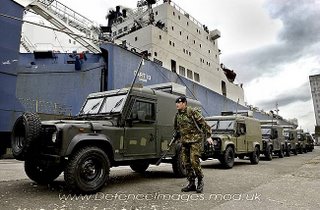
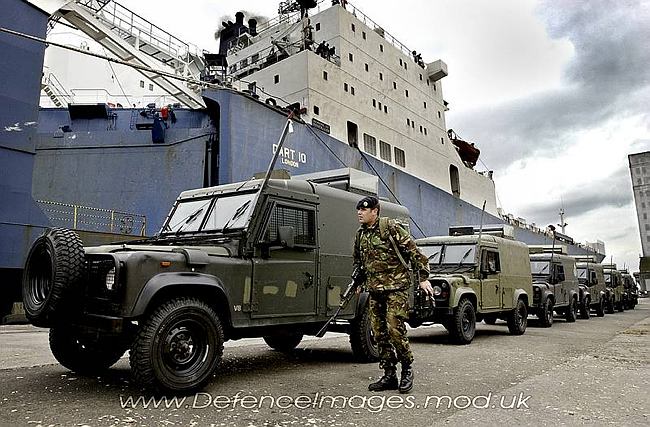
Snatch Land Rovers on the dock in BelfastPartly recognising this, in late 2003, the British Ministry of Defence drafted in a consignment of mothballed armoured Land Rovers (the nearest equivalent to the up-armoured Humvee), themselves designed for dealing with street violence in Belfast and other Northern Ireland locations, during the height of the "troubles".

Known universally as "Snatch" Land Rovers, these might have been adequate for dealing with the provisional IRA and general street violence but against an enemy which had access to any number of munitions and increasingly sophisticated roadside bombs – such as the explosively formed projectile (EFP) roadside mine – they proved easy prey. Thus it was that, by early this year, soldiers patrolling in "Snatch" Land Rovers had accounted for more than a quarter of our combat deaths in Iraq.

This was a problem which has also faced the US forces, which have suffered a higher proportion of casualties and larger absolute numbers from what are generically known as Improvised Explosive Devices or IEDs.
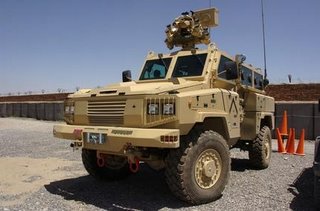
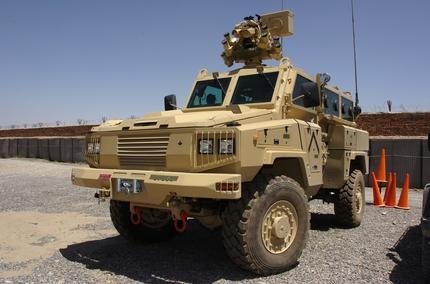
The RG-31, operated by Combat Engineers in the USMCIn response to that – after a series of false starts, which included a programme of adding armour to the standard utility vehicle, the Humvee – the US, led by the US Marine Corps, started a re-equipment programme using vehicles based on Rhodesian and South African experience, specifically designed to deal with the IED threat. These include the RG-31, the Cougar and the Buffalo.

Less obviously but just as significant, the US forces are undergoing a fundamental restructuring. In the war against the hit and run bomber, who will fight in civilian clothes and merge with the civilian population, there is no front line. Casualty rates amongst non-combatants (known from Vietnam days as REMFs) have matched those in combat units.
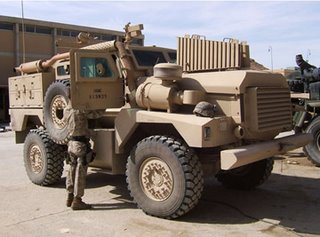
The USMC 'JERRV' Cougar vehicle used by ordnance disposal teamsThus, in this type of war, the spearhead troops are no longer the infantry and the tankers but the combat engineers. Numbers of these troops in the US order of battle have been increased substantially and, using their new RG-31s and other equipment, they have been active in hunting out IEDs. As a result, they are most often at the sharp end in the vicious fire-fights that develop when insurgents ambush the bomb hunters.

In Lebanon, the problem confronting the IDF was much the same – the hit-and-run fighter in civilian clothes – but the weapons employed by the enemy differed. In Iraqi desert conditions, where there is often little cover and most of the roads are metalled, the roadside bomb is the weapon of choice. In Afghanistan, where cover is also sparse in some areas, but many more of the roads are unmetalled, the mine is commonly used. But in south Lebanon, where the topography is in places more similar to the rolling, verdant hills of Gloucestershire and Somerset (not for nothing is the area known as "Little England"), the man-portable anti-tank weapon comes into its own.
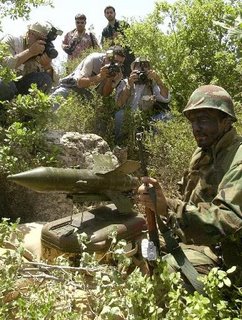
A Sagger missile - demonstrated by Hezbolla in yet another photo-opportunityWith thick cover, or the protection and disguise of civilian villages, small teams using RPG-7s, or the fearsome RPG-29, anti-tank teams can wreak havoc with armoured formations in what is nightmare country for tankers. Hezbolla have even been pressing into service Russian-made "Sagger" wire-guided missiles – which caused such great slaughter of Israeli tanks during the Yom Kippur war – and even captured (or purchased) US TOW missiles.

Combined with roadside bombs – some disguised as boulders, copying techniques pioneered by Iraqis, who have been known to cast their bombs into kerbstones) – these make a thing of the past, rapid armoured thrusts of the type that so thrilled us during the 1967 Six Day War, and the inspired counter-thrust over the Canal during Yom Kippur.

Instead, like the Americans have learnt to do, and the British are now following with a batch of Cougars on order, the Israelis have had to "up-armour" their engineers, on whom they rely for route clearing before what are now considered "conventional" armoured forces can be deployed. Thus did we see the widespread use of the Puma in the first, cautious phases of the ground campaign.
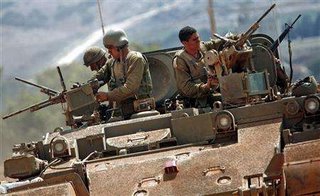
One of the most-photographed vehicle typesThese vehicles, deployed by combat engineers, are little more than turretless Centurion Main Battle Tanks, known as the Poretz Mokshim Handasati (minefield breakthrough vehicle). Although better than nothing, they are far from ideal, not least because they lack the essential attribute of an armoured personnel carrier – a rear exit door. Egressing troops are forced to clamber over the hull, exposing themselves to fire.
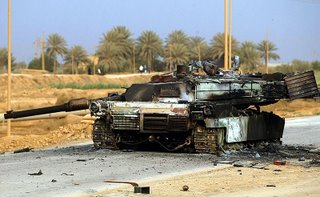
An Abrahms tank destroyed by an IEDFurthermore, as US forces have found – and as will the British – up-armouring invites a version of the arms race, where the terrorists use heavier and more sophisticated weapons, to the extent that not even the US 65-ton Abrams Main Battle Tank is immune from attack. As well as passive armour, therefore, a way of bringing the battle to the enemy must be found.

It was here, as we observed on this blog, that the Americans found a way, in the battle of Falluja which, when they comes to be drafted – will re-write the tactical manuals.

Contrary to perceived wisdom which has declared that tanks in urban warfare are death traps, the US used their Abrams as "point" to flush out the otherwise invisible enemies by presenting them with a highly attractive target. Dangerous it might have been for the tank crews but, generally, even if an Abrams is disabled, the crews tend to survive an RPG attack.
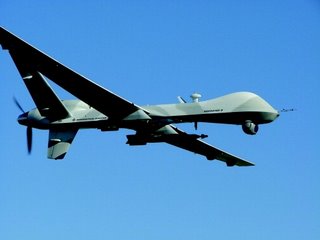
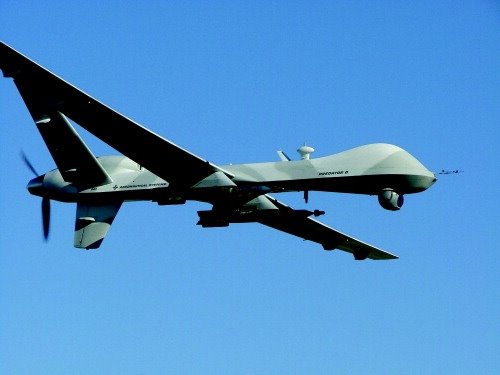
The US Predator UCAVOne the attackers had revealed themselves, above them were circling reconnaissance drones (Unmanned Aerial Vehicles, or UAVs) which would relay their co-ordinates to the artillery. Borrowing from a technique pioneered in Viet Nam, these were located in fire-bases away from the action and, within minutes, could bring down highly accurate, targeted fire on the insurgents, bringing instant death.

Additional assets, which could perform the same function as the artillery, were armed UAVs (known as UCAVs) or fighter-bombers stacked in the sky awaiting targets.

This, in the early stages, is what I though the IDF was doing, but it does not seem as if they had got the phasing and the tactics right. Casualties in tanks and crews, therefore, seem to have been relatively high, without corresponding gains in terrorists killed.

And, if this is the ground battle, there is the other element – the Katyusha strikes. In Iraq, the US forces are also prone to such attacks but their greater danger is the "White Van" mortar team. Merging with civilian traffic, these vans can park momentarily and discharge a mortar team to lob a few bombs, which then re-mount and drive off into the traffic, indistinguishable from the hundreds of other vans on the streets.

To counter this, the US has used counter-artillery radars which can locate the firing points of mortars within seconds and, with orbiting UCAVs, fighter bombers or even helicopter patrols, they can return accurate but lethal fire within minutes – or, if preferred, guide ground forces to intercept. Such would have been the expected response from the Israelis so, far from being impressed by their videos showing Katyusha launches, followed by IAF strikes a day or so later, this demonstrated that the capability was lacking.

The propaganda war

Alongside the shooting war, however, there has also been the propaganda war and it is here that the Israelis have proved dismally flat-footed. They are fighting an enemy which, as we have seen with the Qana incident – and many more – is willing to parade the bodies of its dead and, while hiding behind civilians (and even keeping them in harms way) exploits a sympathetic media and an "international community" which is locked into the paradigm that war is the greatest of all evils and any other solution is preferable.
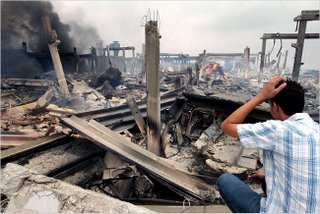
Hezbolla in particular are aided by the notoriously poor local building standards and their fragile, reinforced concrete-framed buildings which give rise to such spectacular pictures of collapsed buildings after relatively modest impacts. But, in using ordnance such as 500-1000lb bombs, with every attack, the Israelis have been creating propaganda opportunities for their enemies and detractors rather than achieving tactical battlefield gains.

And, while propaganda in war has always been important, it is more so in current campaigns. In the past, when Israel could conduct "lightning wars", by the time the international community had mobilised to enforce a cease-fire, the IDF had usually achieved its tactical and strategic goals.

But the nature of war has changed. No longer is territorial gain the objective and neither are the opposing armies conveniently lined up in uniform, fighting an open war. The objectives in this new type of war are to bring the enemy to battle and to kill people, to disrupt the hierarchy, the command and communication systems and to destroy materiel.

That process, against the weapons the enemy is prepared to deploy and tactics it uses, takes time. But, even at the glacial speed at which the international community operates, no sooner have the opening phases of combat been rolled out and the pressure is on to bring overt hostilities to a halt. To enable the battlefield objectives to be achieved, therefore, the armed forces also have to win the propaganda war, to give them enough time to complete their tasks.

Collateral damage

In this war, the currency is collateral damage – dead babies and destroyed buildings, images of which have had more effect on the battle than the tanks and guns deployed by the IDF (for a more detailed discussion, see here).

Therein, like the British Army in Iraq, the IDF is using the wrong weapons and tactics. For it too, it is the "wrong kind of war".

Much has been said and written as a result about the limits of military power – much of it nonsense. Of course, final solutions require diplomatic initiatives and societal changes but, when you have any enemy with weapons who is attempting to kill you, there is only one response – to kill them. That means military action and, therefore, war – by whatever name you call it.
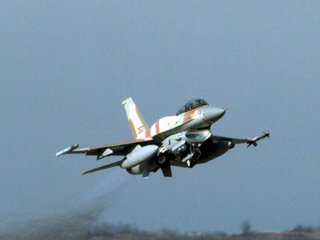
An IAF F-16But it is how that war is conducted that makes the difference, and the difference is a matter of technology. The IDF currently is equipped for its previous wars, with superb armoured formations and a fleet of high performance fighter bombers that are capable of executing great slaughter of conventional forces. But they are the wrong weapons for this type of war.

On the one hand, in the style of the Fallujah-type operation, they need heavy but highly mobile armour to protect their troops as they provide targets for the enemy, in order to flush them out. And, coming into service is a new generation of artillery with rates of fire that are simply stunning. Capable of firing 40 or more shells a minute, these guns can also lay up to seven shells on a target to arrive simultaneously. Combined with unprecedented accuracy from GPS guidance built into the shells, these can intervene immediately with deadly but highly localised force on any terrorist foolhardy enough to attack.

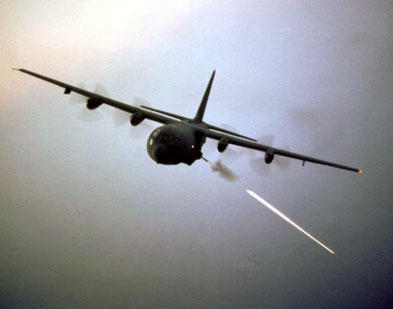
For the Katyusha problem, what is needed is not fast jets with limited endurance and, therefore, loiter capability, dropping big bombs. The weapons needed are long-endurance UCAVs and platforms like the AC130 Spectre, with high-precision, small-warhead weapons. One such, in the process of development, is the Viper Strike which, with a 7lb warhead, can kill the occupants of a car without scratching the paintwork of the next car in line, or take out the occupants of a room in a building, without disturbing the neighbours.
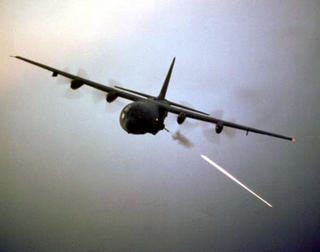
Suitable platforms, guided by sensor arrays in satellites, UAVs and electronic warfare aircraft, can loiter the battlefield and, when a fleeting target appears, can launch instant but again highly localised death, making terrorist attacks near certain suicide.

Will we learn?

Since Israel is fighting for its very survival, the odds are that it will learn its lessons from the Lebanon campaign, and apply them. There is some confidence that the US forces will do likewise – they, after all, are developing the technology.

One casualty will almost certainly be the multi-billion dollar project called the Future Combat System (FCS). The plan here is to equip forces not with heavier armour, but lightweight, air-portable vehicles, relying for their protection on sophisticated sensors, the rapid exchange of intelligence and stand-off weapons to take out the enemy before he is within range and can do damage. But, when faced with an enemy that has the capability to deliver lethal blows and reveals himself only in the act of firing his weapon (or not at all in the case of an IED or mine), this system is fatally flawed.

Many knowledgeable commentators believe the US will scrap this system but, as a letter in the Sunday Telegraph reminds us, the British Army is still committed to a similar system, a £14 billion fantasy known as the Future Rapid Effects System (FRES), all geared to providing the European Rapid Reaction Force with its "teeth".

Should this go ahead, we will find that not only are the British forces currently equipped for the wrong kind of war, they will perpetuate the error, at enormous cost in money and – eventually – lives. For once, we should look further afield and watch very closely what the Israelis do.

COMMENT THREAD
Your bluff has been called

The French Army storms ashoreIt always used to be said that those who can, do – and those who can’t, teach. Updating that pithy little saying, it seems now that people who can’t simply join the EU diplomatic corps (unless they’re already employed by the UN) and talk about other people doing things.

And no, just for once, I'm not talking about Lebanon – not yet at any rate – but Sudan. Believe it or not, we last wrote about this troubled region last April, a weary cry that predicted that nothing much would improve after the then attempt at brokering a cease fire.

Sure enough, nothing much has changed with the killing still going on and the EU bleating about the warring parties in Darfur needing to “respect” the latest, two-month old peace deal for the region.

It's funny how they always use that word "respect" when they surely mean "obey", but that word is too hard-edged for EU foreign policy chief Javier Solana. After all, if he did utter such a word, it might imply an "…or else", to which the answer might well be, "you and whose army"?

Any such defiance might be easily bolstered by the sight of the photograph we have published above, showing the latest French Army reinforcements storming into Lebanon to enforce the cease fire – all 49 of them.

Alright, that means that there are another 151 to follow – a prospect that, far from striking terror into the hearts of Hezbolla or any wannabe terrorist group can only invite mirth.

Yet, when I wrote about Darfur last, I suggested that:

…the greatest humanitarian need in this part of Africa is a body of disciplined men with guns and orders to shoot to kill … However, as long as the US is effectively neutralised by the Middle East, and by "world" opinion which would only condemn American intervention, the only credible force available must come from Europe.

That will not happen, since "Europe" has neutralised itself. It is incapable of finding the political will for muscular intervention, which means that hundreds of thousands more Africans must die. The tragedy is that, not only is the slaughter now virtually pre-ordained, much of it will be unreported while the "world" continues with its obsessive condemnation of the US as it tries to stop the slaughter in the Middle East.
And indeed, unreported it is, not least by this blog which, like so many others, has been obsessed with affairs in the Middle East.

That, perhaps, is the hidden cost of the recent and still unresolved Lebanon issue but the longer-term cost might be even greater. For all the world to see – and mock – on display is the hollowness of European military aspirations, naked in tooth and claw. When the chips are down, a Continent that once fielded armies of millions can only manage a rusty landing craft, a brace of armoured personnel carriers and 49 men.

Weep now Javier Solana – it ain't going to get any better. Your bluff has been called.

COMMENT THREAD

Saturday, August 19, 2006

Faking it!

After much labour, Part 6 of our report, "The Corruption of the Media" is now finished. Each part more or less stands on its own, and this one contains considerable new material.

Amongst the gems we found was this (left), a photograph from Nicolas Asfouri (AFP/Getty Images) from Khurabah/Qana, showing the eponymous "Green Helmet Guy" helping a stretcher party negotiate some wreckage.

But, as always with the pictures coming out of this incident, nothing is what it seems. Asfouri's caption reads:

Rescuers carry a wounded man out of the rubble of a house after Israeli air strikes on the southern Lebanese village of Qana 30 July 2006…
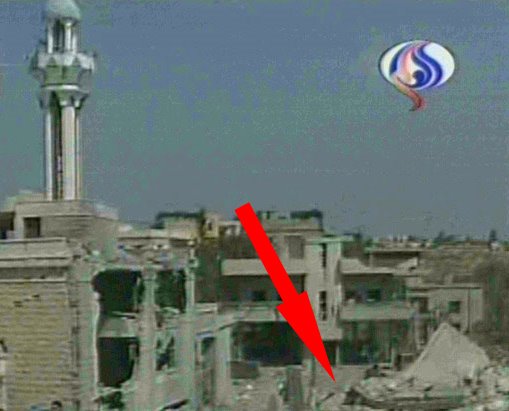
However, our analysis shows that the scene is at the bottom and the right of the road we call "Stretcher Alley". The stretcher party is some 400 yards from the wrecked house, at the point marked by the red arrow.

Furthermore, they have come from around the corner to the left, from just beyond the mosque in the picture. If, like all the rest coming from the wrecked house, they had followed the road round (see below left), they would have found the going easy. But, under the guidance of "Green Helmet", they have swung wide onto a field of debris left from a previously bombed house, to make the shot look more dramatic.
Once again, "Green Helmet" is faking it. And that is a fact that must have been obvious to AFP's Nicolas Asfouri who not only went along with it but wrote up a false caption to cover his tracks.

Can I just remind you of what Kathleen Carroll, AP's senior vice president and executive editor, said on behalf of her agency, AFP and Reuters? It went something like, "Photographers are experienced in recognizing when someone is trying to stage something for their benefit". Patrick Baz, Mideast photo director for AFP, however, was "totally stunned" at the idea that any of his photographers might be taking shots of staged scenes.

Yeah… right!

Comments - use Green Helmet/AP thread

Friday, August 18, 2006

More on that international contingent

The egregious Mark Malloch Brown, our own particular super-tranzi, chaired a meeting yesterday to sort out those international troops that will join the Lebanese on the border with Israel.

There has, in the meantime, been a certain amount of disagreement on whether Hezbollah is keeping a low profile or not, south of the Litani river, as detailed by Fausta’s Blog, which has detected differing stories on the BBC and France-2. (And on the subject of Hezbollah's presence, little has been heard in the MSM about their colleagues from Fox News, apparently kidnapped by that peace-loving organization.)

There are touching pictures of the Lebanese soldiers moving into position held for the last couple of weeks by the Israelis (kind of) and children shaking hands with the soldiers. All very jolly except for the slight discrepancy in timing.

The Lebanese troops are being stationed in Tyre and other places for the first time in decades. So, um, who was there in the last five or six years, even assuming that the Israelis occupied much of that until 2000? Could it be Hezbollah, the militia that was supposed to have been disarmed several years ago? And what would the Lebanese military have done if the Israelis had not gone into the country three weeks ago? Carried on as before, one assumes. In other words, the IDF has made it possible for the Lebanese government to send Lebanese troops into parts of Lebanon. What do you know about that?

Hezbollah, in the meantime, has expressed anger at video tapes that show Lebanese and Israeli soldiers sharing friendly glasses of tea.

Still, Lebanon cannot protect its borders on its own while there is a well-armed and well-trained militia operating within its territory. A new version of UNIFIL is needed and, while there is some talk of various countries offering troops, little of it is official.

To start with, Britain and the United States are keeping to their previous refusals, agreeing, nonetheless, to supply logistical support (no doubt from Cyprus). France is sending 200 soldiers, far fewer than expected, though there might be some officers as well. The reason is that, apparently, President Chirac and Defence Minister Michele Alliot-Marie (who had always been a little leery of the whole proposal), have realized that Hezbollah is not going to disarm and may well start shooting at the UN, that is, French troops. Naturally, l’escroc Chirac had not thought of it when he pushed through the cease-fire resolution, promising French peacekeeping forces when doubts were raised by Israel and the United States.

Italy says it may well send as many 3,000 troops though it is not clear how that is going to be achieved, given the financial straits the country’s armed forces have recently found themselves in.

Germany, who was not going to send troops, no, no, no, has now decided that it might do so after all but there is no agreement on the subject. There would be a land and naval element to the German contingent but numbers are so far unknown.

A few other countries have already volunteered. As Al-Jazeera reports:

“Bangladesh, Indonesia, Malaysia and Nepal had each offered at least one battalion, and Denmark two warships, one official, asking not to be named, said on Thursday.”

None of this seems particularly substantial except for the Danish warships. The numbers might go up – there are always troops available in the other four countries - but how the whole force is to be co-ordinated remains to be seen.

Another problem has arisen. Two of the countries in the forefront of those offers, Malaysia and Indonesia, do not recognize Israel as a state and the Israelis have objected to those troops being used on the border. Curiously enough, the Malaysian foreign minister does not see any difficulties:

“"We're going to be on Lebanese territory ... We're not going to be on Israeli territory," Foreign Minister Syed Hamid Albar said.”,

adding that Israel should have no say in the make-up of the UNIFIL troops, an unhelpful attitude at best. Of course, if you do not recognize one of the countries involved, the question of territory becomes moot. Besides, the peacekeeping forces will have to deal with the possibility (put at its lowest) of Hezbollah firing yet more rockets into Israel. Would Malaysian or Indonesian troops, who have been told that Israel is not really a country and has no right to exist, be all that bothered by that?

All in all, another fine mess for the international community.

Getting there

Before I get back down to some serious EU-bashing and related matters later today, I will leave you with three links on the "fauxtography" issue, each of them well worth reading (if you haven't already done so).

The first is from American Thinker, the second from The Washington Times - a newspaper which is usually as good as the Washington Post is bad – and the third is from Ynet News on "the first Photoshop war".

Meanwhile, I've all but finished Part 5 of the "Qanagate" report, with the addition of some important new material, and should put some more parts to bed tomorrow.

COMMENT THREAD

Thursday, August 17, 2006

What can you expect with those A-level results?

There is nothing quite so depressing for people who believe in the concept of constitutional democracy than having to read public opinion polls. The latest YouGov poll on what people think about British foreign policy and the fight against terrorism is no exception.

It is perhaps appropriate that the results of the poll should be published on the same day that yet another fantastic rise in A-level results is announced. In a year or so there will be more A grades at A-level than actual candidates, who are being sold a pup.

So it is in the education system that I prefer to look for the complete lack of logic in people’s responses to the questions they were asked while being fully aware that answers always depend on how the questions are phrased.

Soon after 9/11, as the war against terror (or, to be quite precise, against terrorists) began to unfold, Prime Minister Blair spent a lot of time running round the world, negotiating with all and sundry. At the time I thought that President Bush might have been mildly surprised by his friend and colleague’s behaviour. Not so the British media and public opinion.

It became almost axiomatic that the relationship that was being reinvented in the Bush-Blair scenario was that of Churchill and Roosevelt, that is Blair being the senior partner. Quite apart from that being a somewhat inaccurate description of the situation as it was by the time of Yalta, there was not the slightest likelihood of Britain with her inadequate military forces and rather confused view of the world, being the senior partner. And so it turned out.

As my colleague has extensively documented, the situation with the armed forces and their equipment is considerably worse than anyone had imagined. If one adds to that the confusion about the country’s position, what with the European Union and a complete lack of interest in the Anglosphere, as well as the steady drip of anti-Americanism fed by the media (including the Daily Telegraph) to the populace, the results of the poll become less surprising.

The gist of it, as we know, is the fact that the majority wants a tougher and more aggressive foreign policy and a much tougher fight against terrorism, including, if needs be, the abolition of the few remaining civil liberties, but, overwhelmingly, a policy that will break away from that of the United States and move closer to the European one.

I imagine if the same people were asked whether they wanted to integrate Britain’s foreign and defence policy into an EU one and send our soldiers out under French, Belgian or Luxembourgian command, to report back to the European Commission, they would shriek with horror and shout no, no, no. And yet that is what the EU is aiming at in its attempts to build up a common foreign policy.

Let us face it, in their dealings with Iran or Hamas or Hezbollah, the Europeans (with some exceptions) have not shown themselves to be particularly tough either internally or externally. Those European countries that have considered it necessary to join the world-wide battle are allying themselves with the United States. (Denmark, a supremely courageous country, springs to mind.)

So what does it mean to have a tougher and more aggressive foreign policy and a tougher stand on terrorism but having as little as possible to do with the United States? Should we bring our troops out of Afghanistan and Iraq and send them to southern Lebanon, where there has just been a surrender to the forces of terrorism?

Should we demand that the Americans leave and we handle Iraq or, at least, Afghanistan on our own or with our European “allies”? And where do we stand with relation to our other allies, for instance, the Australians? I suppose the people who do not want to have anything to do with Americans will welcome the Australian alliance. Kith and kin and all that, though, presumably, what is envisaged is a leading role for Britain. Somehow, I do not see Australia agreeing to that.

There was a sizeable majority in favour of longer detention without trial. Even allowing for the shock of the airline plot, that is an interesting view. I don’t suppose they teach them the history of liberty or constitutionalism in schools any more.

COMMENT THREAD

What will France do next?

As the post mortem continues about the latest war in Lebanon – and will continue until the next one starts, as Hezbollah has flatly refused to abide by the agreement so lovingly crafted by SecGen Kofi Annan (father of Kojo) – various interesting details emerge.

To start with, Lebanese politicians are getting worried, as well they might be. The country, if it can be called that, is now at the mercy of Hezbollah and its Syrian and Iranian sponsors. There is some evidence that the politicians and military commanders, having done nothing to disarm Hezbollah and prevent the importation of arms into Lebanon or about the creation of that state within a state, were thinking that perhaps Israel will solve the problem for them. Naturally, they would sit on the sidelines and cry foul every time the IDF bombed so-called civilian targets. The future looks considerably more bleak for them than for Israel.

Meanwhile the Beirut international airport has opened to commercial flights. Amid all the cheering there seems to be no mention of the fact that if it could be opened that easily it was presumably not bombed by those nasty Israelis, despite their well-known propensity to bomb everything indiscriminately.

The Lebanese army, having proved to be completely useless in the many months since Syria’s part-retreat from the country and having more or less sat the recent conflict out, is slowly taking up positions in southern Lebanon to prevent further attacks on and by Israel. Since they have already announced that they neither can nor will disarm Hezbollah, their achievements in this field are awaited with bated breath.

Another part of the whole arrangement that is awaited with bated breath is the appearance of the international force, for which there have been precious few volunteers. Past history of UN forces in the Middle East does not fill one with any great hope for a peaceful arrangement.

Who is to lead the contingent? The general assumption seems to be that it will be France and the BBC is terribly excited in a muddled sort of way about the prospect.

“Many see the French as natural mediators because of the strong historical ties between the two countries.

France's role in helping to negotiate the UN resolution allowed it to continue mending its relations with the US after the past divisions over Iraq.”
Those strong historical ties are not precisely that of equal partners, France having been the imperial ruler of Lebanon for a couple of decades until the Germans occupation of the former. Would the BBC advocate British meddling in Egyptian or Sudanese affairs because of the “strong historical ties”? I think not.

It is, of course, quite sensible for France to mend its relations with the US but the tortuous negotiations over the UN resolution that became a laughing-stock before the proverbial ink dried on it may not necessarily achieve this.

The same story points out that both President Chirac’s and Prime Minister de Villepin’s approval rating went up by 5 per cent but noticeably does not say what the figure had been before.

Still, even the BBC has to admit that the problems for France are only beginning. Exactly, what is it going to do in southern Lebanon? How many troops can it spare and who else is going in with them? They are already bogged down in Côte d’Ivoire and taking on Hezbollah will be a far harder test.

Public opinion in that country seems as incapable of thinking things through as it is in Britain, which is a comfort to those of us who have been somewhat depressed by the latest YouGov poll.

Seven out of ten, responding to a poll by the newspaper La Croix, are in favour of an international force and 53 per cent are in favour of sending French troops, because it is for peace, though it might bring terrorist attacks to France. (If it is only carbeques in the banlieux that does not count.)

The politicians, however, are worried.
“French Defence Minister Michele Alliot-Marie voiced concern about deploying troops without clearly defined goals.

"France wants the mission's rules of engagement to be clear and it to have real means," she told French TV.

"Sadly, all too often, the United Nations forces don't have the power that they asked for."

The main political parties share such reservations.

Jacques Myard, an MP in France's governing UMP party and a member of the parliamentary foreign affairs committee, told the BBC the last UN resolution
did not make it clear how France can act.

"I know that a lot of military, high-ranking officials in France are reluctant if this mandate is not very precise," he said.

The opposition socialists have also warned that "extreme vigilance" is needed, saying the UN resolution does nothing to address the conditions necessary for a political agreement that would guarantee the security of peacekeeping forces.

Above all, France wants to avoid a situation where its own soldiers find themselves having to disarm Hezbollah fighters.”
As it happens, Philippe Douze-Blasty has already announced that France has no intention of disarming Hezbollah, preferring to use “diplomatic methods”, whatever they might be in the circumstances. This, too, is known as speaking loudly but carrying a very small stick.

Still, there might be a solution to this problem: Turkey.
“Foreign Minister Abdullah Gul, in Beirut yesterday for talks, reportedly received the message that "all sides are waiting for the friendly Turkish soldiers" to take part in the United Nations sponsored peace-keeping force in southern Lebanon. FM Gul noted that the final decision from Ankara would come following his upcoming Sunday visit to Israel.”
Let us not forget that Turkey, in her previous incarnation as the Ottoman Empire, also has strong historical links with all the countries in the region.

COMMENT THREAD

Sorted!

We do listen! For our core readers, and our very welcome newcomers, we have reorganised the site, putting in a permanent link on the sidebar for the Qana material. New material, on a daily basis, will be built into our report - accessible on the sidebar link - which is growing daily.

The change will allow us to post our core material, on the European Union and our relationship with the wider world, without it being swamped by the developments on the "Green Helmet" saga.

I have also re-organised the Qana report and we have considerable unused material to go in, which will strengthen the case even further.

It looks like, now, we're in for the long haul. There is so much additional material that, realistically, it is going to take another week or so to complete the report - or even longer. Thus, in order to keep the blog going with its core material, I will be splitting my available time fairly evenly between keeping the blog going and working on the Qana report, with my co-editor pitching in as and when the day job allows.

We hope this works.

COMMENT THREAD

This is getting ridiculous

You must read this. We know AP has a love affair with Green Helmet … but this is getting ridiculous.

Meanwhile, the Fauxtography scandal continues to grow. Michelle Malkin’s piece has been syndicated.

Comments - use the "Green Helmet/AP" thread

Wednesday, August 16, 2006

Now we can all sleep soundly

Anyone worried about the alleged terrorist plot and the ways of dealing with it should desist immediately. BAA may have caused absolute mayhem and showed that it has no plans for dealing with what is a very likely emergency. The Leader of the Opposition may have felt that he was called upon to pontificate in a wandering-aimlessly-round-and-round sort of fashion.

Fear not, the real work is being done. John Reid has chaired a meeting of five other EU ministers of interior during which various ideas were discussed as to how the situation can be dealt with.

As ever, when anything happens, the first proposal was to push faster towards an integrated anti-terrorist policy. Then it was reduced to a few more concentrated ideas:
“[John Reid] said the talks had discussed practical measures in four areas:
· Tackling liquid explosives
· Co-ordination of transport security
· Exchange of intelligence
· The nature of European Islam”
I am not really certain what any of this means. After all, liquid explosives are not precisely legal even now and how one tackles them remains something of a mystery, though both Franco Frattini and Wolfgang Schäuble have called for something to be done about them.

One assumes that there is exchange of intelligence and co-ordination of transport security is already in place and not just involving terrorism. In fact, last week’s operation seems to have been carried out with the involvement of many other security services, European and others.

As for the nature or European Islam, that appears to me to be much too wide and difficult subject for the average minister interior or his minions to tackle.

On the other hand, ministers of interior are getting above their station if the BBC report is to be believed:
“But he [John Reid] said the presence of five other interior ministers and top EU officials symbolised Europe's determination to stand together and defend their values.”
Clearly, “values”, undefined, is going to be the buzzword for a while.

Why the Left is worried

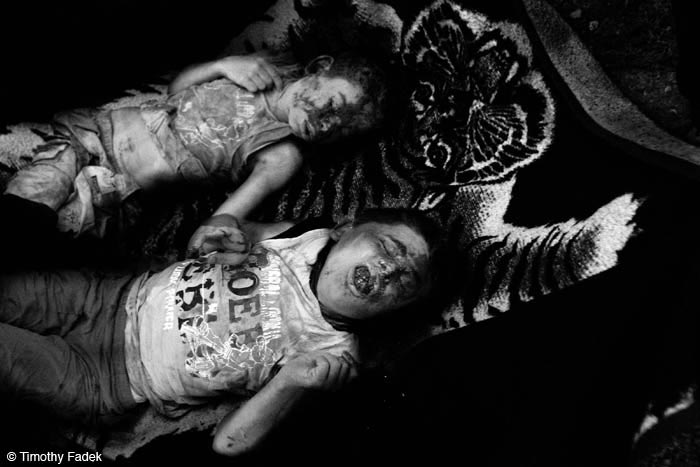
An unstaged photo taken at Qana by Tim FadekBelatedly, the Left is beginning to wake up to the danger of "Qanagate". But they're too late. They haven't even begun to realise how much evidence we already have, and how much more we have stashed away, ready to publish.

So far, the issue has been mainly the province of what are termed "right-wing" bloggers – such as our very own Little Green Footballs. And, to date, the stridency from the Left (not least in the hate-mail I have been receiving) has been focused on our critique as an example of pro-Israeli bias.

Only now that the cease-fire is in place in Lebanon (sort of) have they understood the real target – the liberal (not) media and its constant diet of lies and distortions in support of its favoured causes.

Thus, into the fray comes Huffington Post, with writer Michael Shaw declaring: "Qana was not staged", mounting what he thinks is a spirited defence of his beloved media.

To do so, he calls in aid free-lace photographer Tim Fadek, winner of the NPPA award for best still photography in International News in 2005 – who seems to specialise in faux art pictures from war zones – like the one above from Qana – which, of course, are not staged.

Tim, writes Shaw, "is recognised as one of the most respected photojournalists in his field" and, along with many of his colleagues covering the war in Lebanon, have become increasingly concerned over allegations fomenting in the States (particularly in the right wing 'sphere) about war photos being staged or "stage managed".

What we don't understand, you see – as opposed to those that were there like Fadek - is that "much is culturally lost - not to mention, politically filtered - in transit from East to West". Thus does Tim communicate this statement written by fellow photojournalist, Thorne Anderson on "how to understand the Qana photos". He writes:

Much of the debate about "staging" in Qana can be deflated a good deal by an appreciation of cultural differences. Among many Middle Eastern Muslims the display of the dead is very much a ritual part of dealing with death. Palestinian funeral parades, with or without media present, are a demonstration of this. While the display of the dead may appear callous and disrespectful to many western eyes, it is likely interpreted as a form of honor among those who actually display the dead - an attempt to give meaning to something senseless.

Photographing the display is not necessarily deceiptful (sic), but rather an honest record of the extraordinary ways people react in these terrible circumstances. And a rescueworker displaying a body does not a Media Mogul the rescue worker make. He/She is still a rescue worker. Though the caption for pictures from that portion of the event should read "Rescue workers display the body of..." rather than "Rescue workers remove the body of..."

Furthermore, the sporadic display of bodies at a scene like that shouldn't allow us to dismiss the event as merely a salvo in the "media war" being waged by "Hizbollah and their jihadi friends" in the "mainstream apologist media." And none of this changes the essential, and most important fact that a group of photographers put themselves at great risk to show the result of an Israeli air strike on an apartment building that left 28 people - among them 16 children - dead.
He adds:

I took a gut wrenching tour of LGF [Little Green Footballs] and a couple of other blogs that are super-hyping the "staging" issue to an audience of hundreds of thousands in what is a transparent and in some cases explicit attempt to deny the simple fact that an Israeli airstrike killed 16 children in Qana. That assault on the essential truth is a far more reprehensible act of overt media warfare (if there is such a thing) than any angry display of a dead body in the immediate aftermath of an airstrike. Reminds me of those who deny the Holocaust for political purposes.
So, it seems, in questioning the Qana photographs, we are akin to Holocaust deniers. And, to reinforce the point, Shaw devotes a post on his own blog, where he claims that the "firestorm" coming from "the Rathergate crowd", and doubts now spreading from the left wing (which rather unsettles him) "can start to feel like all reason is being subsumed by political hysteria."

But never mind. This time, Fadek explains it all.

When there is senseless death in this part of the world, it is completely normal to display the bodies. Whether in plastic or on blankets, it's done whether there are photographers there or not. The idea is to ready the public for what has happened - and also say, look what our enemies have done to us.
Regarding some of the images cited as evidence of manipulation, Fadek said: "a finer distinction is being lost in the West":

In Qana, rescue workers did not hold up a baby to set up a shot. They were not displaying them to the media, per se. Yes, it was not lost on these men that the cameras presented a window on the world. But these people were doing wrenching rescue work and are human beings. They were shaking and sweating. These instances [of holding up babies] were mostly spontaneous and momentary expressions of anger.
Another unstaged photo by Tim Fadek, taken at QanaFadek elaborates on the situation in terms of his own images, such as the "tasteful" one here (right), that he also took at Qana – which certainly, most definitely and absolutely was not staged. Although he felt the photo was more powerful depicted this way, he explained that a rescue worker did set down the body, briefly uncovering it for photographers to document.

For those inclined to consider the depictions as manipulated, Fadek also tells us:

Once removed from the collapsed building, these bodies were set on the ground to be taken down a hill. From this spot to the waiting ambulances was at least a four-minute walk. In this case, the two children were placed on this blanket where photographers had 1½ to 2 seconds to document them. Given the distance and the available manpower, the two bodies were placed on the same blanket to save effort.
In each case, we are told, Fadek's "understanding" was that the rescuers were doing something respectful, showing the victims in a manner reflecting a normal attitude toward the dead. "It's not a manipulation, it's a cultural distinction," claims Fadek. "It's the same as at a martyrs funeral, where faces are exposed, and the bodies marched through the streets. It's been done for years, media or otherwise."

Interestingly, that is exactly the line rehearsed by the egregious Kathy Gannon last Saturday, while Stern magazine last week also recruited Tim Fadek, who then told the magazine that he did not see evidence for a staging. He said:

Everybody was upset, it was quite chaotic. When they carried the bodies out of the basement, the workers themselves were finished. When they held a body to the cameras, it was nothing of a pose, but sheer distress and anger: look what they did to our children!
I don't know if Fadek actually believes this tosh but there is a common thread here, trying to pass off the "dead baby" incident (for that is what, obliquely, he is referring to) as a spontaneous display of "sheer distress and anger".

But what we already know – and have now documented - is that before the calculated posing to the camera with the dead baby, "Green Helmet" had already taken part in a carefully staged photo-shoot inside the wrecked basement. Furthermore, after the photo-shoot outside the wreckage, he went on to take part in two more, in different locations for two different photographers.

Then, in his artful description of the casualty evacuation process, Fadek tells us that photographers only had "1½ to 2 seconds" to document the dead children as they were laid in the assembly area, pending transport to the ambulances. But, if it was all so very tasteful and cultural, how does he explain the photo on the left or these?

What is more disingenuous (to be polite) is Fadek's failure to mention the staging area, the full role of which we ourselves have only recently understood (but, since we weren't there, we had to work it out).

Using the evidence we and our readers have gathered, and our collective analyses, we have learnt that, at the assembly area, there was a macabre selection process going on. "Normal" or unsightly corpses were marked up for despatch straight to the waiting ambulances. Those which were especially photogenic or with dramatic potential were sent to this "staging area". From there, the media circus was organised, and the "props" issued to the actors, for the displays of theatre that we have already recorded (and have more to come).

By the time we have finished collecting and collating the evidence, and produced our full analysis, we will have a dossier which so damns the media that not any amount of Huffington and Puffington will be able to counter. Nevertheless, not a few of our regular and faithful readers have written to us asking when we are going to get back to the issues for which this blog was set up. But, as my colleague points out, we never left them.

The point is that, while we all fight our separate battles, we all have a common enemy that protects our individual enemies – a lying, corrupt, wholly inadequate media. It does not just lie on the Middle East. It lies about affairs on the Beltway, in Whitehall and Brussels, and everywhere else that its malign presence is felt. So, when we see a weakness in the fortress walls, we should not go on hacking at our own little bit. We should all pile in and put our efforts into creating a breach. That's why we, with many others, "piled in" to Qanagate.

And that's why the Left is worried.

COMMENT THREAD