Thursday, March 14, 2013

Horsemeat fraud: back in the news


Reuters 013-tes.jpg

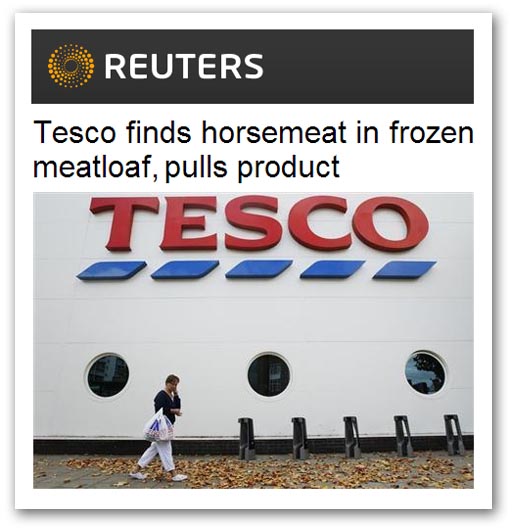
After something of a pause, food adulteration has suddenly made a brief reappearance. AnotherTesco product has been found to contain two to five percent horsemeat.

This is 600g packs of frozen meatloaf, sold as "Tesco Simply Roast Meatloaf", manufactured between October 2012 and January 2013 at Eurostock in Craigavon, Northern Ireland. The product has now been withdrawn and Tesco is telling the world that said it would complete its own investigation into tracing the "source of contamination" before it took a call to continue with the supplier.

If Tesco is still referring to "contamination", that suggests it is either being a little bit coy about being associated with the "adulteration" word, much less admitting to their involvement in what is a growing epidemic of fraud.

However, if the corporate Tesco is playing games, it is not alone. Food adulteration never actually went away. Over the weekend, for instance, the Scottish Sunday Mail reported that one in three curries tested in Scottish restaurants were "fake", using cheap beef instead of lamb in popular Indian dishes such as bhoona and korma.

Substitution was found in 46 of 129 restaurants tested; 33 contained no lamb at all and the remaining 13 had some lamb, a raw ingredient priced at about £9 a kilo, adulterated with cheaper cuts of beef which could be bought for £5 kilo. Officials have not so far taken any action against the restaurants, but are trying to track down the suppliers who, in some cases, are as far away as Birmingham.

Slightly further away is Romania, where Doctor Yordan Voynov, Executive Director of the Bulgarian Food Safety Agency, reveals that his agency has discovered unreported horsemeat instead of veal in four products: boiled smoked sausages and one cold smoked flat sausage. That is four out of 25 samples, the first batch of 100 samples taken from the commercial network.

France also has been testing and admits to horsemeat having been found in pre-cooked beef meals prepared meals from four companies other than the already-identified Spanghero-Comigel.

So far, out of 140 tests, two of the new companies, Covi and Gel Alpes who supply William Saurin and Panzani, were associated with Dutch firm Draap Trading – which has already been implicated as a source of the horsemeat. The two others were Davigel (Nestlé) and corned-beef maker Toupnot, but the reports says they have had very little horsemeat.

France, though, has not just had horsemeat to contend with. Like the Americans, they too are aware of the possibility of large-scale fish substitution . Anti-fraud agents from the DGCCRF have been ordered by Consumer Minister Benoît Hamon to check sole, halibut and sea bass, to ensure that cheaper fish has not been substituted.

DGCCRF agents say they have uncovered 15,700 frauds in 740,000 checks in 142,000 businesses last year and Hamon says that, despite a 16 percent reduction in staff over the past five years he was ringfencing jobs in 2013. He also called for increased use of "mystery shoppers" to uncover fraud.

The Germans, of course, have had their aflatoxin in animal feed and their organic egg scandal to deal with. And now, it seems, the Hungarians have something fishy going on with eggs – to coin a phrase. Recently, the Customs and Finance Guard discovered in a warehouse in the southeast of the country 864,000 undeclared eggs of unknown origin, worth over €100,000. The goods have been seized and proceedings initiated against the owner of the warehouse.

Alert veterinary officials in Poland have also been busy, raiding a manufacturer in the Bydgoszcz district. It is alleged to have mixed rotting meat with expired shelf-life meat to produce sausages. To date, 25 military units have been supplied with meat from this sausage company.

Iceland went to the other extreme, their investigators finding that one meat product tested for horsemeat adulteration passed the test with flying colours, but only because no meat at all was found in the product.

Into this heady mix, though, wafts the Consumers Association (CA), full of its own importance, telling "government" what action it should take.

"The answer is simple, something must be done", is almost the tenor of the advice, as it calls for, "more surveillance that's better coordinated", even though the chances of picking up adulteration from random sampling across the whole range of products on sale is slight indeed. The CA wants Defra and the FSA to improve co-ordination, but there is nothing about involving the international police agencies, which are in the forefront of the fight.

The same limited vision afflicts their advice on "tougher enforcement", with "tough penalties" for those prosecuted. Tough penalties, there already are.  Penalties for fraud include prison. But nothing is said of the effect of "due diligence" or of the role of paper-based controls, which have weakened the control system. Instead, the CA calls for better "traceability", and "improved labelling", even though neither would have an impact on food fraud.

And the one thing we have not seen throughout the continent is the structures of the control services having any impact on the prevalence of fraud. Yet the all-knowing, all-wise CA demands that the split between food standards and labelling issues between the FSA and Defra should be ended, with the responsibility for labelling and standards moved back to the FSA.

Never mind that, throughout Europe (and most developed countries), there is a split between food safety and food standards activities – for good reasons. The skill-sets required are different, and the disciplines are very separate.

What we see, though, is the failure to recognise that we are talking about criminal enterprise, with a strong international dimension. Beyond the limited vision of the Consumers Association, we need to see police and fraud specialists in the loop. Once again, it has to be emphasised, this is primarily a criminal issue, something which the CA clearly does not understand.

More usefully, we get Petra Wissenburg corporate quality projects director for Danone telling us that we must think like criminals to beat the food fraudsters. And that again is another skill set.

The fish products industry adds that the industry sectors must cooperate and work together. That means taking food fraud seriously, which even now – to judge from Mr Tesco – is not yet happening. But only when fraud is seen for what it is will we start to see some serious progress.


COMMENT THREAD

Wednesday, March 13, 2013

EU budget: procedures baffling brains


BBC 013-bud.jpg

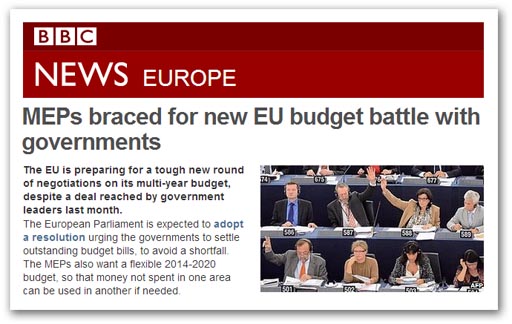
The EU budget was up for debate in the European Parliament today, and then for a vote. Yet, despite the importance of this issue, which was pitching the parliament against the member states heads of government – who believe they already have a deal - only the BBC andEuractiv offered reports, neither of which gave a clear – or comprehensive – picture of what was going on.

This is all the more puzzling as Die Welt signalled story weather ahead last week, which we reported on the day – almost the only English-language report on the net.

Current reports focus an a Motion for a Resolution drafted by the leaders of the main political groups in the parliament.

This is a potentially explosive document as it asserts that the European Council's conclusions on the MFF (Multiannual Financial Framework), is "no more than a political agreement between Heads of State and Government", and "rejects this agreement in its current form, as it does not reflect the priorities and concerns expressed by Parliament".

Euractiv, in its detailed report, suggested that there was strong pressure from national delegations to water down this wording. We were told that amendments tabled would remove the word "reject" and the proposed revisions would be voted upon in this week's session in Strasbourg.

The debate was held this morning, without the final text of the resolution being listed on the agenda, with a counter-motion proposed by Richard Ashworth on behalf of the ECR Group. The vote was scheduled for the midday session.

However, even if this resolution falls – which it well might – the battle is far from over. Procedurally, the Parliament is still required to come to an agreement with the Council on the detail of MFF. Formal negotiations are set to start in April with a target for an agreement by the summer.

Meanwhile, the procedure for agreeing the annual budget for 2014 is going ahead, on which there was a debate yesterday, on a separate motion. On this, a formal proposal is expected from the Commission in April, although without an agreement on the MFF, it is not clear how the budget will be framed.

All of this makes the position as clear as mud, so one can quite understand the media walking away from the complications, and going for the easy option of reporting on possible changes to the euro elections. After all, the EU comes under foreign news, and people aren't interested in what goes on in foreign parts, especially when there is so much important domestic news to absorb. 

UPDATE: The EP appears to have adopted the resolution rejecting the budget, and Schultz is now saying that the parliament will not accept the budget until all payments for 2012 have been made and there are agreements in place on future funding and a comprehensive revision.

On the face of it, this does drive a cart and horse through Mr Cameron's budget "victory", effectively reversing the 3.3 percent headline budget cut. The precise details remain to be established, but it could mean that the Member States have to find as much as €217 billion more, to cover existing commitments.

However, since the details remain obscure - for the moment - this is a slow-burn defeat for Mr Cameron and the other EU leaders. The extent of what could amount to a humiliating reversal will only emerge gradually, as the negotiations progress. As it stands, though, the MEPs will be chalking this up as a victory.


COMMENT THREAD

Climate change: not just us


Munzenberg.jpg

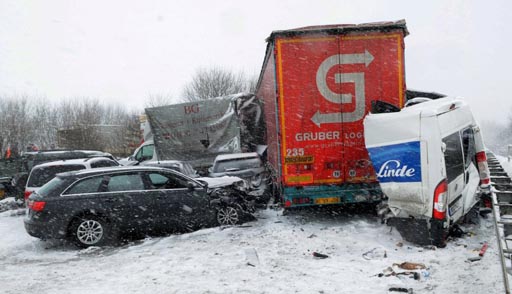
A pile-up in the snow on the A45 yesterday got full media coverage, as dozens of people were injured, some seriously. And it could have been much worse. According to police, up to 100 vehicles were involved in the accident, including several trucks.

Inevitably, there are questions about the lack of preparedness, leading one researcher to note that sudden changes in weather do create a special hazard. But, just for once, this is not the UK. The A45 in question is in Hesse, near Münzenberg, as opposed to the A23 in England which took the brunt of the weather here.

As always, there were complaints from motorists stranded overnight, but there were similar problems in the Channel Islands, and throughout Northern Europe, including France, Belgium. Holland and Germany.

Eurostar train services between London and Paris were suspended after snowfall of up to two feet on the tracks in northern France and Belgium, leaving passengers stranded at St Pancras. But then, nearly a third of France's regions were on alert and the government activated a ministerial crisis group.

Both of the main airports serving Paris were badly affected by the weather, with Charles de Gaulle and Orly cancelling up to a quarter of flights. No aircraft took off from the nearby Beauvais airport, which serves mainly low-cost airlines.

At Orly, a Tunisair flight carrying 140 people from Djerba skidded off the runway on landing but no one was injured, an airport source said. And a traffic accident near Lille injured 14 people and a 58-year-old homeless man was found dead, presumably from the cold, outside a building in the town of Saint-Brieuc in Brittany.

Belgium had its share of chaos, experiencing nearly a thousand miles of traffic jams on motorways caused by snowdrifts and ice. Buses and trains were cancelled or delayed in Brussels and other towns and the high-speed Thalys service linking Paris and Brussels was suspended.

Thus, it is not only Britain that suffers unduly when there is unexpected snowfall. Most of the European authorities seems to have been unprepared – as indeed were many drivers.

But most unprepared of all were the warmists. They have been very quiet indeed, although in due course they will be telling us that this unseasonable snow is down to global warming.

For us in the sunny North, though, this is the fifth bout of snow this season, with one session having lasted well over a week. We have not experience conditions like this for more than 20 years, and I can't remember when we last had snow this late.

With that, it doesn't matter what the warmists say. They really have lost the public argument. And when the lights go out, I suspect it will be open season for greens. And the more they parade their propaganda, I guess the worse it will be for them.


COMMENT THREAD

Tuesday, March 12, 2013

Energy: Japan extracts methane hydrate


BBC 012-gas.jpg

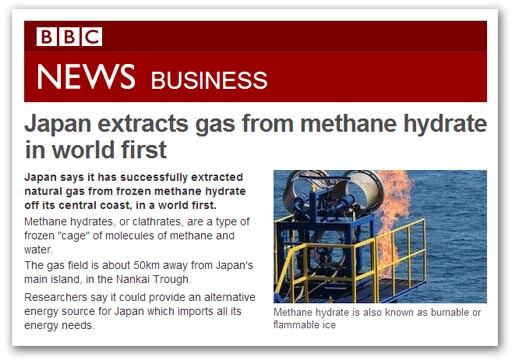
In what must been seen as a major setback for the greens, the Japanese have said that they have successfully extracted natural gas from frozen methane hydrate off the central coast of Japan - a world first.

Methane hydrates, or clathrates, we are told, are a type of frozen "cage" of molecules of methane and water. The gas field in question is about 30 miles away from Japan's main island, in the Nankai Trough, extracted from about 1,000 feet below the seabed.

Researchers say it could provide an alternative energy source for Japan which imports all its energy needs, and the estimated deposits in the Trough amount to at least 40 trillion cubic feet, sufficient for a decade or more of Japan's gas consumption. Total reserves may be sufficient to supply Japan for a century.

Globally, by some estimates, the energy locked up in methane hydrate deposits is more than twice the global reserves of all conventional gas, oil, and coal deposits combined. Other countries including Canada, the US and China have been looking into ways of exploiting the deposits and are also reporting promising results.

The Japanese aim is to establish methane hydrate production technologies for practical use within five years, following which substantial quantities will doubtless be extracted.

Any exploitation is bound to have a global impact as, since the backlash against the nuclear industry after the Fukushima disaster two years ago, Japan has become a major player on the global gas market, driving up prices of internationally traded gas.

A major new source of Japanese gas, therefore, is bound to have an effect on relieving the pressure on gas prices – even in the UK – making this fossil fuel more attractive, until the carbon tax wipes out its cost advantage.

This notwithstanding, a substantial addition to global reserves from this unconventional source further weakens claims that there is a global energy shortage. Success by other countries, and exploitation of what will then be proven energy reserves, will remove energy shortage from the political agenda, with interesting knock-on effects.


COMMENT THREAD
UK politics: the "Europe" card


Guardian 012-pol.jpg

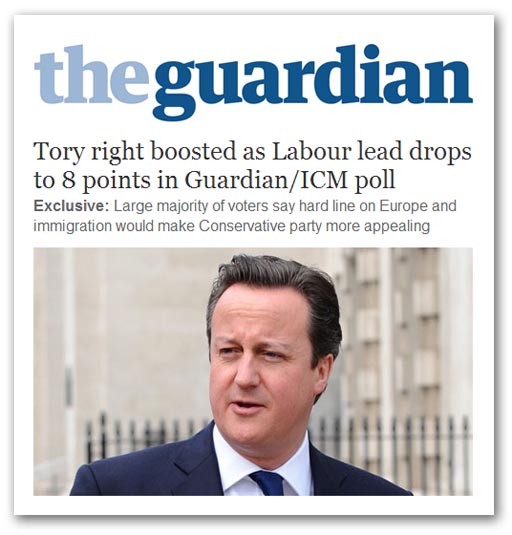
Polls may come and polls may go, but in the frenetic Westminster Village atmosphere of plot and counter-plot, this current Guardian/ICM poll is of some interest.

A month after Eastleigh, it has the Conservatives clawing back some of Labour's lead, to stand at 31 percent, while Ed Miliband's party stands at 39 percent. The Lib-Dems are up two, on 15 percent, and the UKIP "fever" has abated somewhat, with that party dropping from nine to seven percent.

But what is more significant is that there is apparent support across the political spectrum on issues such as the EU. By a majority of 67 to 25 percent, voters across the spectrum say "the Conservatives would be more appealing if they took a tougher line with Europe".

Thus, the poll indicates that the "right" is solid in believing a tougher line would boost the Tories. We get 83 percent of Tories, and 100 percent of UKIP supporters favouring this line, but even among Labour and the Lib Dems majorities of 56 and 64 percent respectively take the same view.

An even larger majority say the same about "a tougher line on immigration". Overall, a tougher policy is favoured by 75 to 21 percent. And in what the right may seize on as a rejection of gay marriage, voters judge by 69 to 24 percent that the Tories' appeal could be boosted by keeping "themselves on the side of traditional families".

Interestingly, though, there is little support for views of former defence secretary Liam Fox, who on Monday called for lower taxation as a priority, with a freeze on public spending. That attracts only 21 percent of the poll – respondents who hope for "lower taxes" above all else.

As regards the bigger picture, Fox in any event is seen as a busted flush and would be unlikely to attract any significant support in the Tory leadership stakes. Teresa May, having gone out early, with Hammond as a possible running mate, is attracting a degree of opprobrium for her lack of "loyalty".

She, like others (although she should know better) has been gulled by the media chatter about leadership contests – the standard fare of the media claque, whose political correspondents have long since ceased to report serious politics and are entirely focused on personalities and gossip.

However, going too early likely means she will crash and burn – the early front-runners rarely win the race. And, if this poll is any indicator, the "Europe" card may be as significant as we hoped it would be.


COMMENT THREAD
EU politics: strange and different times


Focus 011-ant.jpg

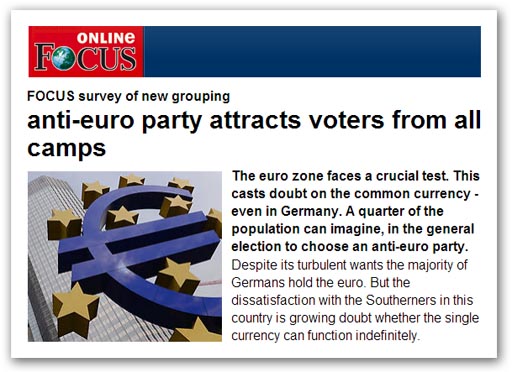
Without even having fought a single election, the Alternative für Deutschland is causing considerable perturbation in German politics, according to an opinion poll carried out for Focus magazine. Given the choice, the "prestigious Emnid poll" finds, more than a quarter of the electorate would vote for this anti-euro party.

Emnid CEO, Klaus-Peter Schöppner, says that the results are worth noting. "The 26 percent is a relatively high value [which] suggests that there may be potential for a new protest party".

Reuters, in a separate report, has picked up the poll, stating that the result highlights German unease over the costs of the eurozone crisis.

Germany's mainstream parties, it says, remain solidly pro-euro despite grumbling over bailouts of countries such as Greece. A German taboo on nationalism, rooted in atonement for the crimes of the Nazi era, has helped to muffle eurosceptic voices.

The poll, conducted by TNS-Emnid, not only showed that 26 percent of Germans would consider backing a party that wanted to take Germany out of the euro, as many as forty percent in the 40-49 age bracket would do so.

The new group was due to hold its first meeting yesterday in a northern suburb of Frankfurt but, so far, there have been no published reports about it, But one of the party founders, economics professor Bernd Lucke, says he has no concern that it would be able to raise the required 2,000 signatures in each German region to take part in September's federal election.

Reuters notes that previous eurosceptic parties in Germany have made little headway. One of them, the "Free Voters", has won seats in Bavaria's regional assembly but have yet to win support at the national level. AFD, though, could prove a greater challenge to Angela Merkel.

Nevertheless, the Frankfurter Rundschau has former economics professor Joachim Starbatty, one of the party's "mentors", admitting that the chances of a breakthrough are limited. It would be difficult for a new party in such a short time to build an infrastructure, he says.

In an attempt to bring them quickly into the game, AFD founder Bernd Lucke sought an alliance with the "Free Voters", but feelers have been rejected. Thus, this liberal-conservative group threatens to fragment the vote, with unknown effect.

Starbutty, though, believes it will be hard for the party to break the strong commitment people have to the establishment parties. But, says Reuters, many Germans, including at the Bundesbank, are deeply uncomfortable with the action by the ECB pledge and last month's inconclusive election in Italy.

These are strange and different times, where the Red Cross has never distributed so much food aid in Europe since the end of the Second World War, and a comedian is predicting a collapse of the political system. Anything can happen in the next six months.


COMMENT THREAD

Monday, March 11, 2013

Media: predicting the odds


Star 011-tem.jpg

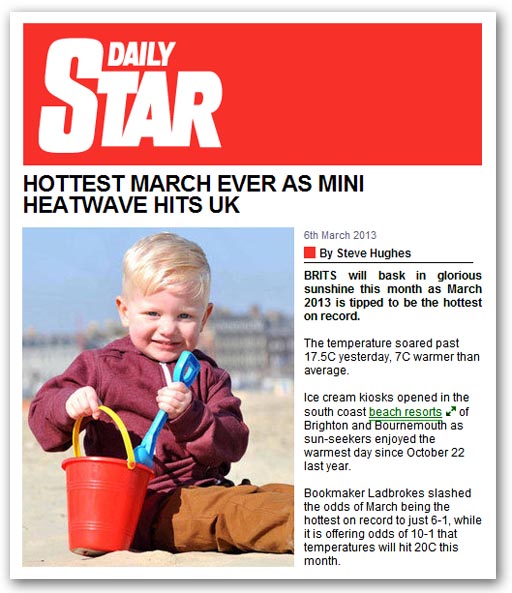
That was less than a week ago. And now we have the Telegraph reporting that snow and freezing gale force winds have caused travel chaos across the country as Britain faces some of the coldest temperatures of the winter.

To be fair, the "experts" are not involved in the Star forecast. The paper is relying on a Ladbrokes spokeswoman, on the basis of bets placed, saying that, "we're confident it’s going to be the hottest March ever rather than the coldest". But, on the other hand, this is the organisation offering odds of 11/10 on a Labour majority at the next election.

Punters, it would seem, are rather better at predicting elections than they are the weather. But then, Mr Cameron is making it rather easy for them.


COMMENT THREAD

Energy: electric cars kaput


Welt 011-ele.jpg

It was in October last year that Handelsblatt indicated that all was not well with the plan to produce (and sell) a million electric cars in Germany by 2020.

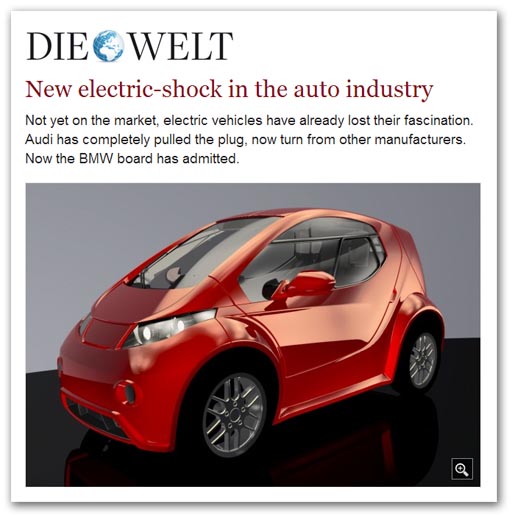
Now, despite the pivotal role of electric cars in future energy management systems, the German car industry is effectively giving up the struggle to produce electric models and will now concentrate on producing hybrid vehicles, and on fuel cell technology.

According to Die Welt, Audi has "completely pulled the plug" and BMW is not going to expand its range beyond its compact car.

Nor are the Germans on their own in finding electric cars hard going. Bloomberg reports that Nissan has put its electric-vehicle business under the direct supervision of the chief operating officer after sales of the Leaf missed the company's expectations.

Deliveries of Nissan’s flagship electric car in the US, we are told, failed to reach even half its 20,000 target for last year, a "blow" to the company's Chief Executive Officer Carlos Ghosn. He forecast that electric cars would become so popular that they would account for at least ten percent of global car sales by the end of the decade.

The problem is highlighted by this report, which makes the obvious point – which has clearly eluded Ghosn – that the electric car is a short-range vehicle, and an extremely expensive option.

Closer to the real world, therefore, is Ralf Speth, chief executive of Jaguar Land Rover. He says that electric cars will never be a mass-market solution to climate change and should not get government subsidies.

"The batteries are too expensive", he says, "the customer must be very rich, and can only use [them] in mega-cities [where there are charging points]". He asks: "Should we do it only for the rich?" In his view, it would be better to wait until the technology improves and there is a greater benefit to the environment.

Still, though, there are those trying and failing, such as the Better Place electric-car company in Israel, which has managed to pile up €500 million in losses in selling 750 cars. Clearly, unless you want to waste a great deal of money, electric cars are not much use for anything.


COMMENT THREAD

EU politics: settlement with the sinners


ekathim 011-dev.jpg

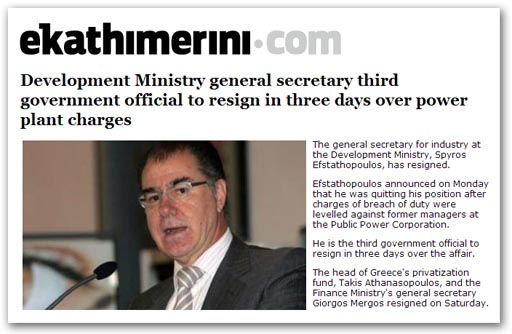
A juicy little scandal is sweeping through Athens, with the local English-language newspaper,Ekathimerini telling us of multiple resignations of high officials. These have arisen after alleged corruption over the commissioning of a natural gas electricity plant in central Greece in October 2007, which was completed last year.

Embarrassingly for the Greek government, the man at the centre of the storm is a senior finance ministry official and head of Greece's privatisation agency, Takis Athanasopoulos. He has now been charged with "breach of duty, with aggravating circumstances under the law about public embezzlement".

Greece, says Reuters has stepped up prosecutions of politicians and businessmen in recent months amid rising public anger against a wealthy elite partly blamed for dragging the country to the brink of bankruptcy.

On the other hand, when such high officials are charged with embezzlement, it shows that Greece must be a primitive country. Their officials and industry leaders have not yet learned to institutionalise and thereby legitimise such theft.

All they have to do is set up remuneration committees, manned by their pals, and award themselves obscene salaries and bonuses. As long as this is done in the open, in accordance with "procedure", they can steal as much as they can carry and even get knighthoods for their trouble.

Lacking such skill in advanced peculation, this – in the words of commenter Costas Iordanidis - has brought Greece to the point where the political system is unravelling.

He notes that two of the country's highest-profile politicians – former Thessaloniki Mayor Vassilis Papageorgopoulos, who also served as a New Democracy minister in the 1980s, and former Socialist heavyweight Akis Tsochatzopoulos, who also hails from the northern port city – have both been dragged to prison in what has been called "the settlement with the sinners".

In the past, writes Iordanidis, these politicians were supported by tens of thousands of PASOK and New Democracy voters, who placed trust in the integrity of their character or at least in their ability to manage public matters. The country's economic establishment was keen to schmooze with Tsochatzopoulos - he was a minister with nationwide influence – to advance their material interests.

In what has resonance here, Iordanidis then says that innocent supporters were disillusioned and the corrupt ones were ridiculed. Some, he says, are now worried about the potential repercussions as the scandalous deals with these politicians come to light. Greece's already discredited political system has suffered a devastating blow.

Some critics say that their punishment was, perhaps, too harsh. Others say that the judges were influenced by the overall mood or the reductions to their salaries – cries and signs of confusion from a system that is coming apart.

It's hard, Iordanidis observes, for traditional parties to accept their discrediting in such a short period of time. It's even harder for interests outside the political system to grapple with what is happening. But, he concludes, we are witnessing the dismantling of the Greek political system. And this is just the beginning.


COMMENT THREAD

EU politics: no help from the Italians


Corriere 011-ref.jpg

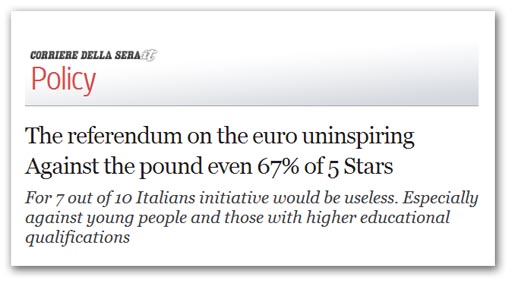
While the Google machine translation is quite good with German, it is less so with Italian, the headline for the Corriere Della Sera reading, "Il referendum sull'euro non entusiasma", which it turns into: "The referendum on the euro uninspiring".

It might perhaps be better put as "no enthusiasm" for a euro referendum, which is the thrust of the piece, telling us that Beppe Grillo's proposal is falling on stony ground. The majority (69 percent) of Italians surveyed in an opinion poll for the paper were against the idea of a referendum, with 36 percent strongly against, as against only 30 percent in favour.

Worst still for Grillo, even 67 percent of his own supporters did not want a referendum. And, on the substantive question, 73 percent did not want to return to the lira, very close to the 74 percent of overall response, with just 16 percent wanting to dump the euro.

Even amongst those who would be prepared to leave the euro, many still regard it as a "negative event", giving a majority (82 percent, including 53 percent who considers it "a disaster) who think it would be a bad thing. Furthermore, opinion is hardening. In June last it was 70 percent, with 74 percent recorded in September.

Significantly, 77 percent of Grillo's supporters who were in favour of an exit regarded it as a negative event for the economy.

Reuters report adds a little political background (although it does seem to muddle the figures), but the upshot is that the vast majority of the population seem to support the euro. Corriere Della Serathinks that is means that the traditional parties have a chance of recovering support from Grillo, although it concedes that how well they will do depends on their degree of persuasiveness.

For us, though, it would seem to suggest that the eurosceptic agenda does not exert much leverage with the Italian electorate, although one suspects that if a response was invited on immigration, a more EU-critical line might be apparent.

The strongly pro-euro line in Italy makes an interesting contrast to recent German sentiment – in terms of support for Alternative für Deutschland - and with the poll last June, which had only 43 percent of Germans voting to keep the euro, against 41 percent opting to return to their former currency.

What is fascinating, though is that, contrary to the received wisdom of a certain brand of British eurosceptic which sees in the EU a German plot to dominate Europe, on current form, it looks as if the our main support for bringing down the evil empire could come from Germany. 

Certainly, this country, rather than Italy, seems a good place to look for allies.


COMMENT THREAD

Sunday, March 10, 2013

Harrogate Agenda: a foundation year


Newport Rising.jpg

After launching the idea of the Harrogate Agenda last year, with the publication and subsequent approval of our six demands, things on the surface have been quiet – and deliberately so. We are in for the long haul and have decided to make this our foundation year, setting up the structures and refining the message, ready for a modest launch in September.

We could, of course, go faster, and some of our supporters argue passionately that we should. But the worst thing we could possibly do, in my estimation, is run before we can walk. History is littered with examples of campaigns that rise out of nowhere, achieve a degree of fame and then disappear as fast as they have risen, achieving nothing of consequence.

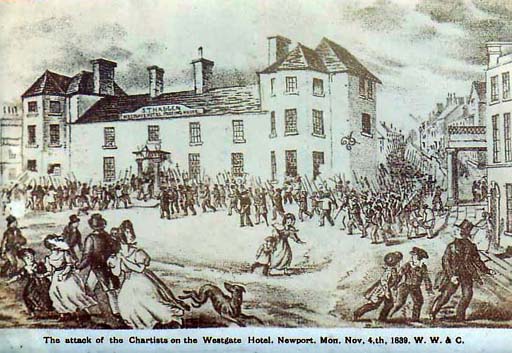
Here, one must remember that the Chartist Movement, on which we are loosely based, published its demands in 1838. A petition was presented to Parliament in July 1839, and in November 1839 came the "Newport Rising", a premature event which was a disaster for the movement.

Arguably, far from the cause being advanced, it was set back by the early activism to such a great degree that it was not until 1918 – eighty years after the first publication of the demands – that all but one were met, with the advent of universal suffrage.

One is conscious, therefore, of the Bastiat dictum that, "the worst thing that can happen to a good cause is, not to be skilfully attacked, but ineptly defended". The worst thing that can happen to the Harrogate Agenda is a premature launch and a misdirected or under-resourced campaign.

The crucial point, from which we can take comfort, is that the tide of history is with us. As Witterings from Witney never tires of pointing out, the "representative democracy" on which our government relies for its legitimacy is increasingly seen as an anachronism, totally unsuited to the needs of the time.

In that context, despite the ephemeral fluff which is the obsession of our own media, what may be two of the most significant political events to emerge in recent years have occurred abroad – one in Switzerland, the other in Germany.

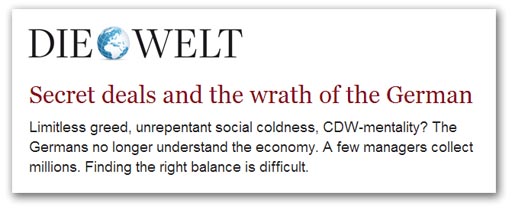
The first – barely mentioned in the UK – was the Swiss referendum on executive pay, followed by the considerable interest shown by the German media and political classes, which continues today with a major feature in Welt am Sonntag, where they are looking enviously at the Swiss (below).

Welt 010-sec.jpg

At the core of the Harrogate Agenda, or course, is the principle of "direct democracy", very much on the lines of Swiss democracy, borrowing from that country but not entirely copying it.

But what is significant about the recent Swiss referendum is that the mood is catching. As we noted yesterday, the new opposition group in Germany, the Alternative für Deutschland (AFD), has embraced the idea of direct democracy. It demands referendums on fundamental social issues. "Blatant bad decisions by our elected officials", it says. "need to be corrected. This especially applies to the assignment of important powers to the EU".

And here, an important theme begins to emerge. The AFD is the first specifically eurosceptic party to emerge in Germany. With a commitment to direct democracy, it confronts one of the core principles of the European Union, as specified in Article 10. This states that: "The functioning of the Union shall be founded on representative democracy" and that: "Citizens are directly represented at Union level in the European Parliament".

In other words, the AFD commitment to direct democracy, and indeed the Harrogate Agenda commitment, are incompatible with continued membership of the European Union. Direct democracy and the European Union cannot exist side-by-side. 

With unintended irony, the Treaty says that, "Every citizen shall have the right to participate in the democratic life of the Union", then telling us that, "Decisions shall be taken as openly and as closely as possible to the citizen". What it does not allow for is that decisions should be taken by the citizens.

Given that the European Union is our supreme government, this necessarily requires for the Harrogate Agenda to succeed that we first remove ourselves from membership of the European Union. This means that, in terms of any future "in-out" EU referendum, we very much have a dog in the fight.

In fact, not only does pursuit of the Harrogate Agenda require departure from the EU, it also gives us the reason for leaving. Direct democracy is an objective worth pursuing in its own right. If the price of gaining this objective is leaving the EU, that is extremely good value.

However, linkage between the EU withdrawal and the Harrogate Agenda also tends to influence the timing and the strategy of the latter.

What we must bear in mind is that, sooner or later, there will be an "in-out" referendum. At its earliest, it will be 2017, but then only in the event that the Conservatives win the next election – which looks increasingly unlikely. This notwithstanding, we must assume that, at some time in the future, there will be a referendum.

In any such contest, it will be necessary that THA (as we are beginning to call ourselves) is an active player. We would expect to be a key member of any coalition which formed to the official "no" campaign, and to promote the Harrogate Agenda as one of the positive reasons for leaving the EU.

Thus, in our view, the immediate objectives of THA are best served by forging an alliance with putative "no" campaigners, and ensuring that we have a seat at the table in any discussions about building a fighting coalition.

All of that suggests that we pace ourselves carefully, focusing initially on EU issues, and using them – and any "no" campaign - as a springboard for a full-blown Harrogate Agenda campaign. Through this, leaving the EU ceases to become an end in itself (thereby ensuring the failure of any campaign) but a means to an end.

On that basis, our target for a modest launch, with the infrastructure in place, by September, is a measured response to the need to mount a long-term campaign. And if UKIP, after 20 years and the expenditure of millions has yet to gain its first MP, for us to spend a year or so building our structures hardly seems extravagant. 


COMMENT THREAD

Booker: look at the graph


Booker 009-gra.jpg

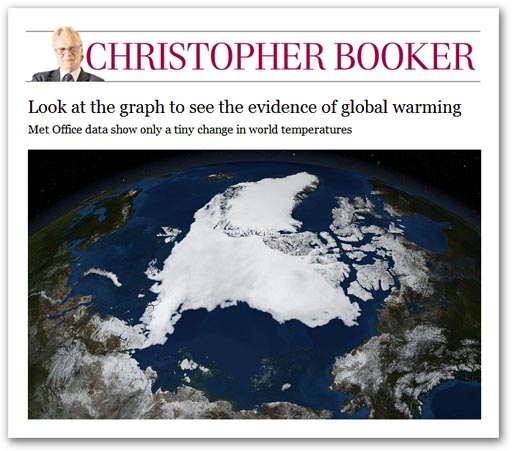
It was Booker who pointed me to the graph in the Financial Post which went on the blog earlier this week. Now Booker has reproduced it on his column - without a comment facility for the second week as the back office staff manage completely to screw up the website.

Nevertheless, the graph speaks for itself. By including the huge part of the data usually left out, we see that the line looks virtually flat. The actual changes look relatively so small, compared with those rises and falls of several whole degrees the world survived in the past, that any idea that we are facing catastrophic warming pales into insignificance.

In recent months, says Booker, even such fanatical proponents of the warmist orthodoxy as Rajendra Pachauri, chairman of the UN's Intergovernmental Panel on Climate Change, James Hansen of Nasa, and the Met Office have all had to concede that since 1997, the warming trend has stalled virtually to a standstill.

Of course, there was a modest temperature rise in the 20th century, as a continuation of the warming that began 200 years ago as the world naturally emerged from those centuries of cooling known as the Little Ice Age. But the 0.5C rise between 1976 and 1998 was no greater than the 0.5C rise between 1910 and 1940 (with 35 years of cooling between them, so that the net rise in the past century has been only 0.8C).

Yet it was on that modest rise in the 1980s and 1990s that the whole of the greatest and most expensive scare in history was launched on its way, with all the terrifying political and economic consequences we see around us today.

The very last people to recognise this, alas, will be our politicians, concludes Booker. They seem incapable of looking properly at the evidence. But the price we are all increasingly having to pay for their gullibility is incalculable.


COMMENT THREAD

EU politics: Schäuble's empty words


Srandard 009-sch.jpg

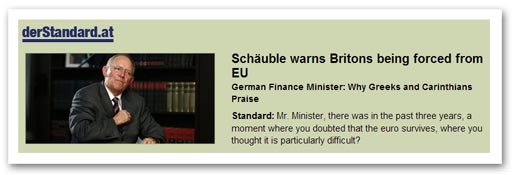
In an interview with the Austrian Der Standard, German Finance Minister Wolfgang Schäuble has warned against the idea of Britain leaving the EU, claiming it would be "catastrophic". "We have to try", Schäuble says, "not to make the British think 'Europe' isn't concerned about us, we will leave". 

His concern, though, is not primarily for the UK. "Try to imagine", he adds, "explaining to, for example, an Indonesian, that Europe is an incredibly strong, dynamic entity but that it is not in the position to keep a globally oriented member such as Britain. The damage to our reputation alone would be a catastrophe".

This, then, is a German who speaks with forked tongue. At one he is a man at the forefront of pushing for a "federal" Europe, yet on the other hand consistently offers emollient words about Britain not leaving the EU.

The last time he did this was in December when he declared that he would wish for more British involvement in Europe, not less, while cautioning that any attempt to "blackmail" Germany with threats of an exit would not be tolerated.

We thus appear to have an instance here where we take more note of what a politician does, rather than what he says. His words may say "in", while his actions so far have been calculated to push Britain towards the exit.

He would prefer, on the one hand, that Britain agrees with everything the EU throws at it – such as the limits on Bankers' bonuses – but then says he does not want the British to be driven out at the end of the EU, while doing nothing to stop it happening.

But then, in his current interview, he says that he "cannot support the voices in German politics that imagine an EU without the UK". This suggests a domestic agenda. Whatever he might actually feel about the UK, it is not politically advantageous to him to be seen to be driving it out of the EU.

Hence, we get the honeyed words. But, as FAZ once observed, he is a master of empty language (Sprachgirlande). The words mean nothing. 


COMMENT THREAD

Saturday, March 09, 2013

Energy policy: the lunacy of biomass


Mail 009-eco.jpg

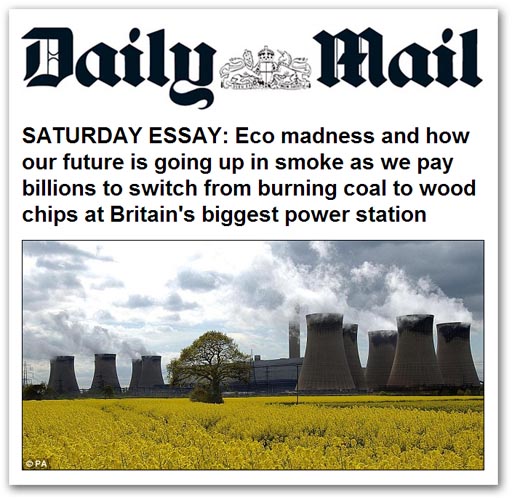
In the Saturday essay for the Daily Mail, Booker dissects Britain's energy policy by looking at the giant Drax power station in Yorkshire.

There is, he writes, no better symbol of madness than turning one of the biggest and most efficiently run coal-fired power stations into a world of eco-lunacy as it embarks on a £700 million switch away from burning coal in its six colossal boilers to devour millions of tons a year of wood chips instead.

Most of these chips will come from trees felled in forests covering a staggering 4,600 square miles in the USA, from where they will be shipped 3,000 miles across the Atlantic to Britain, to fulfil the insane pursuit of reducing CO2 emissions.

Unlike coal, which is now demonised as a filthy, planet-threatening pollutant, biomass is considered ‘sustainable’, because it supposedly only returns back to the atmosphere the amount of CO2 it drew out of the air while the original tree it came from was growing.

Yet coal is still by far the cheapest means of creating electricity. But the Government is so committed to meeting its own and the EU's targets for reducing Britain's "carbon emissions" that it is now going flat out to tackle the problem on two fronts — both of which forced the changes at Drax.

First, the Government wants to use a carbon tax to make burning fossil fuels such as coal so expensive that, before too long, it will become prohibitive for power companies to use them.

A new carbon tax will be introduced in three weeks' time, and applied to every ton of carbon dioxide produced during electricity production. The tax will start at a comparatively low level, but rise steeply every year so that, within 20 years, the cost of generating electricity from coal will have doubled and it will no longer be economical.

Second, the Government is determined to boost all those "carbon neutral" — but currently much more expensive — means of making electricity, such as wind farms, nuclear power and burning biomass. It hopes to achieve this by offering a host of subsidies, paid for by every household and business through electricity bills.

What forced Drax to embark on the switch from coal to "biomass" was ministers' decision last year to give any coal-fired power station which switched to "biomass" the same, near-100 per cent "renewable subsidy" that it already gives to the owners of onshore wind farms.

Tackling the problem: The Government is determined to boost all those 'carbon neutral' - but currently much more expensive - means of making electricity, such as wind farms, nuclear power and burning biomass.

When the experts at Drax did their sums, they could see how, if they stayed with coal, they would gradually be priced out of business by a carbon tax which will eventually make their electricity become twice as expensive. In terms of hard-headed realism, the Government was giving them little choice.

And that is the story Booker tells in his piece: how sensible, well founded business which produces seven percent of the nation's electricity, has been forced to double the cost of the electricity it produces, joining the ranks of the eco-loons in the process. Read what Booker has to say, and weep.


COMMENT THREAD

Food fraud: a growing problem


Zeit 009-egg.jpg

The very few that watched Defra questions in Parliament on Thursday last would have witnessed shadow environment secretary Mary Creagh trying to breathe life into the "horsemeat scandal",positioning it – as she always has tried to do – as a health scare rather than consumer fraud.

From a narrow political perspective, Creagh's obsession and limited grasp of the issues has been to the advantage of environment secretary Owen Paterson, who was able to sidestep her questioning which, although aggressive was ill-judged.

Had Creagh taken a wide view of the issue, as the German media are doing, she could have done much more damage in highlighting how ineffective the food control system has become, with the food industry increasingly prone to fraud.

What particularly she is missing is the calls for reform of the system, brought into high focus with the recent episode of contaminated animal feed in Germany, of which some 10,000 tons was delivered from Serbia to 4,500 farms in seven German, with higher than acceptable levels of aflatoxin.

Thus we had Berliner Zeitung retailing a call from the chairman of the Association of Food Inspectors, Martin Müller, who declared that it was time for a centralising of food controls, with the different state authorities joining forces to tackle the problems centrally and with greater expertise.

Müller, however, warned that Germany lacked 1500 qualified food inspectors, a complaint picked up by the magazine Stern, which also echoed Müller's call for "a kind of food Europol".

The need for this was pointed up in an earlier piece in Berliner Zeitung which warns, under the heading "Food Mafia", that the gangs have discovered the food market.

The criminal business of food is on the rise, says the paper. Drug cartels have already been caught dealing with chicken and the paper also recalls that, two years ago there was a major fraud based on adulterated with champagne, in which investigators seized thousands of bottles. In another incident, the Spanish Civil Guard found cheap caviar imported from China, which counterfeiters had misdeclared as high quality and very much more expensive Iranian caviar.

In Belgium, a cheap variety apples were sold as expensive Pink Lady. The Sicilian Mafia helped with the marketing of adulterated wine. And in 2011 Italian counterfeiters misdeclared 700,000 tons of conventional flour, soy and dried fruit as organic produce, selling it at the higher organic prices.

While criminal gangs in the past have enriched themselves mainly from arms trafficking, drug smuggling and human trafficking, they have spread their activities more and more into the area of consumer goods: electronics, counterfeit trainers, pharmaceuticals and now increasingly, foods and beverages.

"This is big business, in which you can earn a lot of money," says a Europol investigator. "The high number of fake and shoddy food we have seized is worrying". Furthermore, there are indications that the trade is being funded with the proceeds of other criminal activities such as drug and human trafficking, with the food trade also being used as a means of laundering "dirty" money.

The authorities complain that they do not know enough about the structure and dimension of the illegal food business. It is clear that there is fraud within the EU as well as via imports from the United States and Asian countries. As a result, in the last two years, national and international law enforcement bodies have stepped up investigations.

Trade with inferior and banned foods has always existed says a Europol investigator, but the scale of the trade is "a fairly new phenomenon" which has emerged only a few years ago".

The highly fragmented European food market is vulnerable to fraud, he says. With agriculture, middlemen, the food industry and the retail sector in Europe, there are 24 million people in 15 million businesses. In Germany alone, there are approximately 160,000 products on the market.

Inevitably, therefore, there are numerous entry points for fraud. The processing steps are numerous and there are long transport routes. To check all participants and products at any time is impossible for the authorities, making this trillion-dollar market attractive for fraudsters.

And while the health of consumers has not been prejudiced by the current rash of food fraud, fake and shoddy does pose a risk. "Criminals who are only interested in their profits have no respect for the consumer," says Europol. "Counterfeit and substandard food and drink are often produced, transported and stored outside of any regulation and hygiene control".

Time and again, though, we see frustrations raised at the changing nature of food controls, which have – under the aegis of the EU – become more and more paper-based.

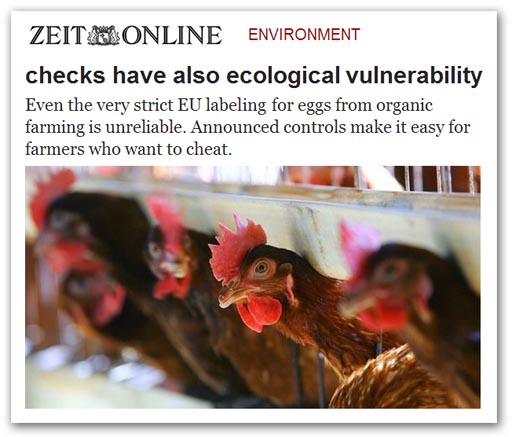
Thus we see in a recent edition of Die Zeit (pictured above) complaints that checks on organic eggs are based primarily on inspection of invoices and delivery notes. This means that if a farmer or orders too many chicken – and therefore breaches to density requirements – or buys cheaper, non-organic feed, he will suppress the relevant documents.

Also, inspections are made on announced dates which give farmers a chance to make things "disappear" and to reduce overcrowding and bring density down to acceptable limits. (It has been known, under such circumstances, to give birds a day trip to the seaside, keeping them away from the gaze of inspectors.)

However, in this instance the chairman of the Agriculture Committee of the Bundestag Hans-Michael Goldmann, does not hold back from blaming the inspectors. "To them it must have been obvious", he says, that the organic farms were producing far too many eggs for the number of birds registered.

But, says Stern magazine, although the inspectors go into the factories, they rely mostly on the written responses from the companies. The inspections by local veterinary authorities failed. Paper checks were relied upon because it was too difficult to count the chickens.

For consumers though, there is a lesson in the findings from the growing levels of food fraud, which is not evident from recent events. While the emphasis has been on supermarkets and cheap, processed food, Europol has bad news for consumers who swear by farmers' markets. Investigators find that these are the outlets most favoured for putting fake, substandard goods into circulation.

No amount of EU regulation will make it different. Laws only go so far, and paperwork is no guarantee against fraud. Thus we see the the calls for more enforcement. And perversely, as border controls are relaxed, the need increases – to the extent that one wonders whether many of the gains of the so-called Single Market are being wiped out.


COMMENT THREAD

Christopher Booker: Passing of the People's President


chavez 001.jpeg

Guest post
 

Since the proprietor and chief author of this blog is very careful to avoid listening to the Today programme or watching Channel 4 News, I have had to keep him posted in recent days on the remarkable coverage given by the BBC and the Channel 4 team to events in Caracas and the death of that legendary hero of our times, Hugo Chavez.

In its general tone this has been so striking that I was tempted to write about it in this week's Sunday Telegraph column, until more pressing subjects intervened.

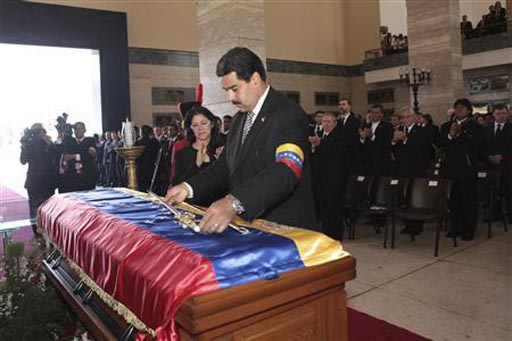
From the moment Chavez's death was announced, the BBC went into adulatory meltdown. "Charismatic and controversial" was the mantra phrase repeated half a dozen times before 9 o'clock that morning, to mark the passing of "the People's President", who among his many other achievements could have boasted that, under his benign rule, Venezuela became in 2010 the country with the highest murder rate in the world.

Where these reporters really came into their own was when they could wander round the streets of Caracas marvelling at such an astonishing explosion of collective grief, as vast crowds spontaneously gathered to mourn the passing of the man they looked on as their "Father".

According to Channel 4's Matt Frei, he could think of nothing remotely to compare with it since the scenes in Rome which marked the passing of Pope John Paul II. To the BBC, the comparison was with the upwelling of national grief at the death of Diana Princess of Wales.

As millions turned out for the lying-in-state – and 30 world leaders converged on Caracas for the state funeral, led by the rulers of some of the world's nastiest and most despotic regimes, such as Ahmedinajad of Iran, Lukashenko of Belarus and Raoul Castro of Cuba – I was irresistiibly reminded of the not dissimilar scenes in Moscow in 1953 when Stalin likewise lay in state in the Hall of Columns.

By a brilliant coup de theatre, Chavez even managed to die on 5 March, exactly 60 years to the day after the death of Stalin. And what a masterstroke it was to announce that Chavez's corpse is to be embalmed and put on permanent public show as an object of worship, just as was Stalin's until he had to be secretly hurried away for burial seven years later after being denounced by his successor Nikita Khruschev.

Accounts of the mood in Moscow in 1953 are remarkably reminiscent of what we have seen being reported on in Caracas, the vast, grief-stricken crowds counted in millions, the interviews with sobbing citizens, the sense of a people suddenly robbed of the man who had given them and their nation an elevated sense of identity.

To be fair, at least Matt Frei gave a brief interview with one man who was not entirely carried away by the general mood, who refused to say that he was sad at Chavez's passing, but then also refused to explain why.

In terms of group psychology, obviously these two events had much in common, as a monster whose presence had dominated all their lives for so long departed, leaving a horrible sense of vacuum behind.

But at least in Moscow in 1953 the crowds became so great that they had to call in the tanks of the Red Army, leaving hundreds of people crushed to death. When it comes to real monsters, the friend of Ken Livingstone and George Galloway was no more than a beginner.

PS. If you want to know more about Chavez, it's no good looking at Wikipedia. His entry has been taken over by Friends of Chavez, just as those on climate change have been hijacked by the warmists.


COMMENT THREAD

EU politics: Alternative für Deutschland


Spiegel 008-ant.jpg

"Democracy is eroding," reads a statement on its website (in German). "The will of the people regarding (decisions relating to the euro) is never queried and is not represented in parliament.

The government is depriving voters of a voice through disinformation, is pressuring constitutional organs, like parliament and the Constitutional Court, and is making far-reaching decisions in committees that have no democratic legitimacy".

Thus does Spiegel tell us of a anti-euro party in Germany, its founders a collection of some of the country's top economists and academics.

Named Alternative für Deutschland (Alternative for Germany), the group has a clear goal: "the dissolution of the euro in favour of national currencies or smaller currency unions". The party also demands an end to aid payments and the dismantling of the European Stability Mechanism bailout fund. 

And it also demands referendums on fundamental social issues. "Blatant bad decisions by our elected officials", it says. "need to be corrected. This especially applies to the assignment of important powers to the EU".

The party has yet to produce a party manifesto but its "impressive" list of prominent supporters includes a large number of conservative and economically liberal university professors.

The most notable name on the list is Hans-Olaf Henkel, the former president of the Federation of German Industries, but it also includes such economists as Joachim Starbatty and Wilhelm Hankel, who were part of the group that challenged Greek bailout aid at Germany's Constitutional Court.

The main founder, Bernd Lucke, a professor of macro-economics from Hamburg, was a member of Chancellor Angela Merkel's Christian Democrats for 33 years before leaving the party in 2011 as a result of euro bailout efforts. "The current, so-called rescue policies are exclusively focused on short-term interests, primarily those of the banks," he says.

Nevertheless, it is not yet certain that the party will be able to collect the requisite number of signatures in time to be included on the ballot in general elections this autumn - a minimum of 2,000 in each of Germany's 16 states or 0.1 percent of each state's population, whichever is lower. "We will make that decision based on the support we receive," Lucke adds. "But we have been overwhelmed by the public's reaction thus far".

Even if the party does get on the ballot, it remains unclear whether it will attract significant support, says Spiegel. So far, it remains a single-issue party - and even on that single issue there is a lack of clear consensus on exactly how to proceed.

There is a feeling though that, with concern in Germany growing that the country has become the de-facto paymaster for the rest of the euro zone, Alternative for Germany could attract a fair number of protest votes from frustrated conservatives.

But, most likely, the party's success will depend on the state of the euro at the time of the election. Should the crisis flare up, so too could anti-euro sentiment. If it does, concludes Spiegel, that sentiment in Germany now has a political home. 

COMMENT THREAD

Climate change: playing the health card


Heal 007-coa2.jpg

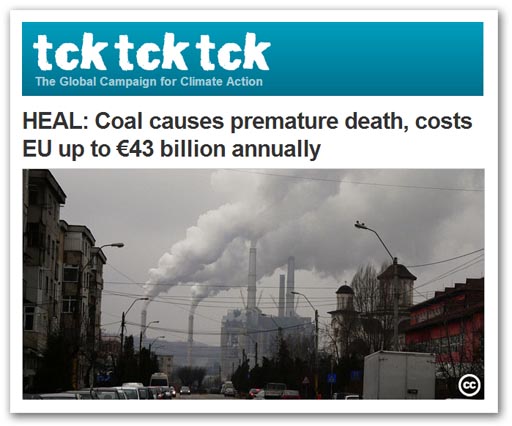
Launched upon the unsuspecting world today is a report headed "The Unpaid Health Bill - How coal power plants make us sick". Aimed at coal-fired electricity generation, this is a naked attempt to play the "health card", bolstered by faux economics, as a means of promoting the climate change agenda.

Translated into journalese by AFP, this becomes a tale about how Emissions from coal-fired power plants in the European Union contribute to over 18,000 premature deaths a year and cost an annual €42.8 billion.

The basis of this calculation is the allocation of a direct cost of €2.3 million to each premature death, at an upper range, which is a classic scare tactic. To put it in perspective, we are told that lung cancer in Europe (2008) caused 367,000 premature deaths.

Applying the same value (€2.3 million) to those deaths, we come up with a cost of €844,100,000,000. With the entire EU GDP standing at a mere €12 trillion, that would suggest that lung cancer deaths alone cost the EU economy a full seven percent of GDP.

It is worth remembering that yesterday, we had the great hoo-ha about processed meats adding 20,000 premature deaths to the list, in the UK alone. That, by the same reckoning, would cost the UK economy €46 billion.

Now, ignoring causes of premature death such as heart disease, and concentrating just on cancer, the deaths for the EU are about 550,000 a year. By definition, all of these are premature. Thus, if we apply the €2.3 million cost, we arrive at €1.265 trillion.

Then, if we take on board cardiovascular diseases (CVD), there are about two million deaths a year, of which, it is calculated that 80 percent are preventable and therefore – by definition – premature.

Apply the €2.3 million cost to this group, and we are looking at €3.7 trillion. This brings the total cost burden to the EU economies from cancer and CVD to nearly €5 trillion. Add other causes of premature death and we are easily looking at €6 trillion plus – more than half the entire annual EU GDP.

Clearly and very obviously, the figure of an annual cost of €42.8 billion for the health effects of coal-related air pollution is a gross exaggeration, more so when we look at some other claims in this respect. For instance, in 2005, we had a BBC report on a study by the European Commission which had air pollution (as a whole) responsible for 310,000 premature deaths in Europe each year, costing "more than" €80 billion.

So, when the European Commission looks at 310,000 deaths a few years back, they "cost" €80 billion, or thereabouts, but when the Health and Environment Alliance (HEAL) – the author of the current report – looks at just over 18,000 coal-related deaths, they cost €43 billion. 

Heal 007-coa.jpg

Look at the Commission and HEAL, though, we find – effectively – they are one and the same. The HEAL study is part-funded by the EU and the cost assessment is based on data reported under the Large Combustion Plants Directive (LCPD).

This relies on an assessment published in The Lancet in 2007, based on the results of the EU funded research project ExternE (to which the European Commission contributed €10 million), where one Terawatt hour (TWh) of electricity produced from hard coal was reckoned to cause on average 24.5 air pollution related deaths. Then, the calculation of health impacts and related costs is based on the same methodology as used by the Clean Air For Europe (CAFE) Programme – also funded by the EU.

Small wonder that the Commission prefers to use its paid proxies to spread its propaganda, with very convenient timing as the LCPD is set to knock out a major component of our generating capacity. Playing the "health scare" card is always a winner, especially if you can call in aid the "non-profit" Health and Environment Alliance to do your dirty work.


COMMENT THREAD

Friday, March 08, 2013

UK politics: grinding us down


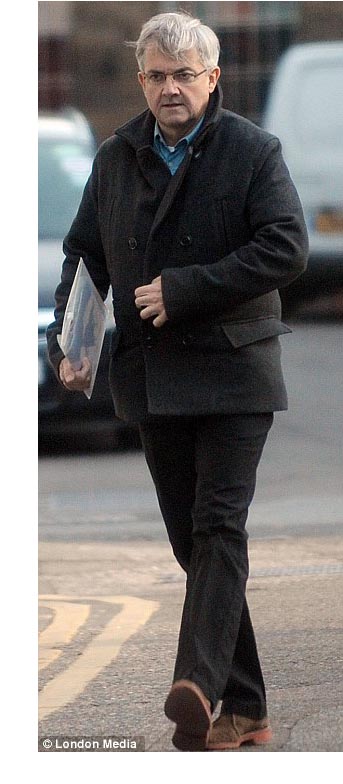
huhne.jpgThere can be no doubt about the number one political story of the moment – as far as the personality-obsessed media goes: the conviction ofVicky Price. We are left with the prospect of her, and her former husband, Chris Huhne going to jail in the near future.

What struck me though was the recent picture of Huhne in the Daily Mail. Out of office and no longer an MP, he somehow looks shrunken and ordinary – so very far from the puffed-up, self-important secretary of state that he once was.

The machinery of state, however, goes on, demonstrating that the placeholder has limited ability to affect the course of a department, and can so easily be replaced when he (or she) falls out of favour. But then, Huhne was going with the flow, an identikit warmist preaching to a gang of warmists. No wonder he is so easily replaceable.

Nevertheless, his potential to cause political damage does not seem to have ended, as there is some talk of the Lib-Dem hierarchy having known of his transgressions long before they become known to the police, leading to charges of a political cover-up. This may have legs but it may also die a death. Either way, it is probably no longer an issue in the grander scheme of things.

What is more significant, perhaps, is a sudden sense of loss of direction, as if the body politic has been stricken with an outbreak of what the French Foreign Legion used to call le cafard. The politicians posture and prattle as before, but their behaviour had acquired a sense of pointlessness. The coalition is dead men walking. Everybody now is waiting for it to die.

Perhaps that's why Murdoch is making some moves, although if they were that secret and important, their nature would not have been revealed. Murdoch is sending a message to Cameron, and doesn't care who knows it.

With that, and talk of rebellion in the ranks, high and low, Cameron seems to have lost any control, any semblance of conviction. He talks the talk, but one senses he is just going through the motions, waiting for the end.

Unlike Huhne, though, he looks bloated and podgy. But speaking in a West Yorkshire factory yesterday, he had as his background, "high-precision cylindrical grinding machines". Nevertheless, his incipient corpulence conceals the fact that he has a grinding machine of his own. The question is whether it is grinding him down, or us – or all of us.


COMMENT THREAD

Thursday, March 07, 2013

UK politics: aid for industry


Dfid 007-afg.jpg

Readers will be delighted to learn that the UK government, under the care of Mr Cameron, last nightannounced a £10 million aid package for the mining industry.

A slight downside to this award is that it is not for the hard-pressed British industry, but for thecorruption-prone Afghanistan Ministry of Mines, whose minister of mines reportedly accepted a bribe of $30 million in exchange for awarding the country's largest development project to a Chinese firm. This was the $3 billion contract to extract copper from the Aynak deposit, considered one of the world's largest unexploited copper deposits.

Last year, however, the project ground to a halt over the deteriorating security situation and the Chinese now need additional financing to restart the work. It is that, to which much of the British finance will be directed, giving the Chinese developers an annual income of close to half a billion dollars, based on current copper prices.

Meanwhile, back in Britain, we celebrate the final closure of one of Britain's last coal mines, with the loss of 650 jobs, brought about by an underground fire which continued to burn ferociously two weeks after it started.

The mine, which was once seen as the future of the industry in the UK but, with its owner UK Coalunable to obtain government support, there is now little option but to close the mine.

On the other hand, Drax power station in Yorkshire is to import millions of tons of wood chippings from the United States, to benefit from renewable subsidies which will double the cost of the electricity produced to the consumer.

Somehow, out of all this, one presumes that Mr Cameron wants us to believe that his coalition government has a coherent industrial and energy policy. But, if he is so determined to wreck our domestic enterprises, and burden us with unnecessary costs, while continuing to support his extravagant aid programme, it is unsurprising that he cannot afford any tax cuts.

But, when he blithely tells us there is "no magic money tree", he should perhaps be listening to himself.


COMMENT THREAD

UK politics: an ironic contrast


BBC 006-arm.jpg

The UK is to provide armoured vehicles and body armour to opposition forces in Syria "to help save lives", Foreign Secretary William Hague said yesterday.

This is as we approach the tenth anniversary of the invasion of Iraq, with troops crossing the border from Kuwait on the 20 March 2003. I wonder if Hague appreciates the irony of the moment – that our troops then were not equipped either with sufficient body armour, or suitable armoured vehicles.

And here we are, ten years later, giving away exactly that kit to people who could just have easily been on the other side and, at some time in the future, probably will be.


COMMENT THREAD