Showing posts with label Anthony Eden. Show all posts

Friday, May 22, 2009

Out there in the big bad world ...

... where an astonishing number of people have never heard of Nadine Dorries, despite the overwrought statements she makes, the debate seems to be hotting up. Yes, dear readers, I mean Ireland.

Thanks to Dr Anthony Coughlan of the National Platform we hear of an interesting letter by Dick Roche, Ireland's Europe Minister (pictured).

Replying to a letter by a Richard Murphy in the Irish Examiner, Mr Roche gets quite venomous. Mr Murphy had, apparently, proposed that the second Irish referendum should not take place till after the British general election, which is likely to bring in a Conservative government. With the Lisbon Treaty not in place, the Conservatives have pledged to have a referendum.

Mr Roche pours scorn on Mr Murphy's trust in the British Conservatives. On the whole I share that point of view but Mr Roche is not concerned with their rather feeble attempt at standing up to the juggernaut.

Having first informed the readers, somewhat erroneously (if we are to speak charitably) that the Lisbon Treaty will be modified by the various legal guarantees now under negotiation (it will not be modificed), Mr Roche goes for the jugular:

His faith in the Tory party is touching. I wonder what in the history of that party’s dealings with Ireland makes him want to put our future in Tory hands? Perhaps he hankers after the union we left in 1922 and sees our future in a more intimate relationship with a Tory-governed Britain.
Ireland's future, Mr Roche tells the readers, must be decided in Ireland, not in London. A fair point but why is Mr Roche wanting to have Ireland's politics decided in Brussels? Why is he insisting that the people of Ireland could not have known their own minds when they voted against the Constitutional Lisbon Treaty and need to vote again?

Dr Coughlan writes:

Ireland's Europe Minister Roche has spent the last year pressing various Governments in other EU countries - Sweden, the Czech Republic etc - to complete their ratification of Lisbon as quickly as possible so as to isolate his own country politically and put maximum pressure on Irish voters to reverse last year's rejection of Lisbon in the referendum re-run the Irish Government intends holding in October.

The Minister's letter shows his concern that if Irish voters become aware of the Conservative commitment to a UK referendum on Lisbon if it is still unratified when they come to office, it will make it harder for him and his fellow Yes-side campaigners to threaten Irish voters with isolation if they stand by last year's vote in the Lisbon re-run.
Could the Minister be worried? Charlemagne at the Economist thinks he has reason to be worried. Charlemagne is worried, too. Those uppity Irish might not listen to their betters once again.

COMMENT THREAD

Saturday, August 04, 2007

Blogger round-up

Away from the foetid smugness of the self-referential "big hitters" in the so-called (British) political blogosphere, individual bloggers are beginning to stir on the EU referendum. And, as the political temperature increases, we expect that more and more bloggers will join in the fray.

Thus, we have decided to run a weekly round-up of blogs which run stories (not forgetting the pictures) on the referendum and allied issues.

Most recent is from Not a sheep from London, who declares that he is "not a sheep" and adds: "I am fed up with being treated as one". In a piece headed, "Poor Gordon, Poor us", he speculates on the possibility of an early election, noting that one of Gordon's problems is the EU Constitution Treaty becoming a newsworthy story and the increasing calls for a referendum.

Not a sheep thinks that if Gordon calls an election soon enough then maybe he can have the election before the referendum calls become even louder, or perhaps he can do a Tony and promise a referendum to reduce the Conservative vote.

A similar theme is rehearsed by Open Democracy (one of several pieces), which has Anthony Barnett of London offering a piece under the heading, "Snap election – no easy snip".

A quick election now, he writes, may have a booby-trap built in: the EU referendum issue. If Brown went to the voters this autumn before 18 October and won, he could claim a Sarkozy-like mandate to sign the treaty. But he'd have to campaign on it saying that it is a necessary continuity of our role in Europe and no great change. It's hard to say this with a straight face when no other leader in Europe agrees.

If Brown holds an election in the Spring after 18 October, when he and other EU heads of government have met to ratify the treaty, it still hands the Conservatives a great issue: "You say you are for democracy, Prime Minister, but you have gone back on your word about giving us a say over the EU". Brown badly needs a positive policy on Europe. There is no sign of this.

Encouragingly, Pajamas Media picked up our piece on the Self-amending treaty, demonstrating the multiplier-effect of the blogging network, which means our pieces have a reach far beyond that which our hit rate suggests. It is not dissimilar to viral marketing.

Curly's Corner Shop is another example of that as he too picks up one of our pieces, plus the one and only reference from the Iain Dale blog, which manages to tear itself away from self-absorption long enough to throw a few gushing paragraphs in the direction of Open Europe as the approved voice of Euroscepticism.

This reference is to the EU treaty being published in English and the Open Europe estimate that, out of 250 proposals, only ten differ from the original constitution rejected by the voters of France and the Netherlands. Thus, 96 percent of the current treaty is the same as the rejected constitution.

Curly also offers comment on the news that the Conservative Party might commit itself to holding a private referendum, which he believes "must be greeted with some welcome." The Treaty, of course, writes Curly, is nothing other than the European Constitution rejected by millions of voters earlier. "Dressing it up in different words," he adds, "will not prevent many of us from campaigning to secure the rights of our Parliament to hang on to its legislative capacity."

That is certainly what Glyn Davies is doing, writing in his blog, A view from rural Wales, "We were promised a referendum on a new EU 'constitution' by Labour. No 'ifs', no 'buts'. It was a cast iron promise - with no wriggle room."

A left of field contribution comes from Klein Verzet who, for some reason, insists on calling the treaty the "Turnip". He links to our piece on the Supreme government of Europe and adds "yet another reason why a referendum on the Turnip is crucial for those that value their freedom." In his view, we will lose even more of our freedom of expression and a big chunk of our ability to defend ourselves against those parts of the Muslim community that see Western Europe as an Islamic colony.

The Huntsman is running his own "referendum news" series and in his latest piece remarks:

As a lawyer, I have to confess great admiration for the drafting skills of those who put the various documents together. It is not merely the incomprehensible language which attracts one's attention, but the sheer skill in producing something which looks, at first blush, wholly innocuous but when you start trying to draw all the strings together, actually amounts to the wholesale take-over of your country.

Armed with such a document, which must cost all of a fiver, who needs a billion pounds worth of tanks to park on someone else's lawn, especially when you have a compliant Quisling Government to slip it past a flock of particularly ovine MPs called The Parliamentary Labour Party, aided and abetted by 63 LibDem Turkeys?
On the transatlantic front, there is the Jurist blog, produced by the School of Law at the University of Pittsburgh. It produced a piece on Hague's calls for a referendum on the treaty, one of several it has published on the theme, slightly more, in fact, than Tory Diary, for instance, which has been more than a little sparing in its coverage of the EU referendum campaign.

Other bloggers on this issue have been Purple Scorpion, who reviewed the Stelzer piece in the Telegraph and PJC Journal, which reproduced our piece on the supreme government of Europe.

An intriguing piece came from Rhod on Public Affairs, a self-confessed Labour Party activist, who thought the privately funded referendum on the EU treaty a good idea and considered it "a rare show of wisdom on the part of the UK Conservative Party."

Norfolk Blogger, a Lib-Dem activist, thought otherwise, declaring that he would not waste the shoe leather to vote, preferring to see "a full referendum, a binding one called by the government."

But Martin Curtis, in his Spin Blog, himself a Tory activist, thought it a great idea. "Not only is it something that might capture the imagination,” he wrote, "it would be a step towards David Cameron reinforcing his credentials as an EU sceptic; it might also help to shore up support from some of the disaffected grass roots."

Curtis is perhaps articulating something many of us agree with, which does make you wonder why so many Tory bloggers are silent on this issue. This is especially strange since Daily Referendum applauds the Conservatives for doing a good job pushing for a referendum and Tony Sharp, in his Waendel Journal thinks the Tory promise of a referendum if Brown calls an election will be greeted with relief by many Tory activists.

But then, the momentum is growing and, if any of our readers have picked up a blog that we have missed, let us know and we will include it in our next round-up, same time next week.

COMMENT THREAD

Tuesday, April 03, 2007

Flawed choices

The combination of the 25th anniversary of the Falklands War and the current Iranian hostage crisis – all on the top of the festering sore of the Iraqi insurgency – has prompted The Daily Telegraph to commission a YouGov poll on how the public sees the role of Britain in the world.

The results do not make happy reading. A substantial majority of Britons would clearly like to see this country scale down its world role and begin to function internationally "more like Sweden, Canada or even Belgium". The mood, writes Anthony King for the paper is "markedly post-imperial - reluctant to see Britain maintain even its present overseas commitments and totally opposed to seeing them extended further."

"If capabilities are to be matched to commitments," King continues, "most voters would prefer to see Britain's commitments reduced rather than its capabilities expanded. With the Empire now a distant memory, people evidently believe that it is time for Britain to abandon its great-power pretensions."

What immediately strikes one of this survey, of course, is the limited scope. Not least, in what we are constantly told by the political classes is an interdependent world, the options are wider than simply whether to increase or reduce our commitments.

For instance, the Europhiles would have it that we could extend our global reach by working more closely with the European Union, striving for a common foreign policy and a European defence identity, gradually moving to a single European Army in all but name.

It has to say something of how far these options have moved down the political agenda that they are not even considered in the survey, yet – if we are to believe the propaganda – the one sure way of increasing our influence in the world, for no greater expenditure, is to pool our resources with the other EU member states.

Instead, the options offered are firmly cast within a national framework, one being that, if it was accepted that Britain’s armed forces are overstretched, “what do you think this government or any other government should do?”

Depressingly, some 60 percent want Britain's commitment overseas reduced "so that British forces do not become involved in crises overseas", while a mere 30 percent want spending increased so that the forces can continue to be deployed effectively.

What makes this so depressing is that, even within the limited national framework, the options are still hopelessly limited – and based on what could well be a false premise, that our forces are indeed deployed effectively.

Taking the last proposition first, if the arguments on this blog have any merit, no one could begin to argue that the soldiers, for instance, that the marines and sailors despatched to inspect that freighter on 23 Match were in any way "deployed effectively".

Arguably, this is but one small instance. The disastrous retreat from Camp Naji in al Amarah, abandoning an expensive asset to the militias can again hardly be regarded as the effective deployment of troops, and neither can the policy of soaking up punishment for daily mortar and rocket attacks on British bases, without any effective response.

Equally, through lack of suitable vehicles and helicopters, in a deteriorating security situation in Basra, troops venturing out of their barracks have to do so in large numbers, limited the scope of operations and the reach of British forces.

One example might be that, for lack of fast, light utility helicopters to deploy small packets of troops to key locations in the city, commanders have to detach slow-moving and vulnerable convoys comprising at least two Warriors and four Snatch Land Rovers (or other vehicles such as Bulldogs). Thus, where eight or ten troops might be employed, , to great effect, upwards of 40 might be tasked to do the same job, more slowly and less effectively.

Looking at the other proposition – the argument that the options offered are too limited – respondents are asked to link capacity and expenditure so that any increase in capacity is necessarily linked with more spending.

Time and time again on this blog, however, we have sought to show that these two issues are not linked. Most recently, we argued that significantly cheaper fixed-wing aircraft could do a crucial part of the job of a £14 million Lynx helicopter, at a fraction of the operating cost. Inasmuch as they have much great endurance, they could actually do a better job, as they would still be flying when a Lynx had returned for refuelling.

Add up the millions that could be saved from operational efficiencies and from dealing with the billions wasted on misguided and – frankly – insane procurement decisions and a case could be made for improved capacity at less or equal cost.

Now, standing back from the Telegraph survey, one can only speculate what the response would be if, instead of two options, respondent were given the choice of three: reduced capacity at current or less costs, increased capacity but at increased costs, or increased capacity with the same or less expenditure.

Alas – and it says much for the inadequacies of the media and the politicians – the case for better spending has not been made. Even on our own forum we read comments which demonstrate that their authors necessarily regard more spending as a given, to the extent that the debate is lost before it has even run its course.

However, there is one more element to this debate which should be a central part of it. When the hostage crisis broke, we observed that, while we are spending a King's ransom on our subscription to the EU – devoted in part to increasing our global influence – we might be better advised to spend our money where it really matters.

What would have been the response, one wonders, if the Telegraph survey had given respondents the choice of diverting our EU subscription to increasing our defence capacity and effectiveness.

COMMENT THREAD

Tuesday, January 16, 2007

A seriously unimportant story

There has been a great deal of what might be called kerfuffle around the formerly secret documents, now unearthed, that show Guy Mollet, then Prime Minister of France, proposed, firstly, a union between France and Britain and, when that was greeted with pursed lips and raised eyebrows, for France to become part of the Commonwealth.

As it happens, Sir Anthony Eden, then Prime Minister of Britain, rejected both suggestions, no doubt with some bemusement. Had he not done so, neither idea could possibly have got through either Westminster or the AssemblĂ©e Nationale. So, that’s really that. The story is of consequence only as a possible counterfactual analysis: what if France had become a member of the Commonwealth in 1956?

The only interesting part of this story, in so far there is anything interesting in it, is why did Mollet come up with such a harebrained and rather desperate scheme. After all, nobody had treated Churchill's suggestion of an Anglo-French union in 1940 particularly seriously.

Mollet is generally described as an Anglophile though as someone on the left of French politics his Anglophilia remains somewhat questionable. He does seem to have been impressed and grateful for the help Britain had given the French resistance during World War II.

There is the suggestion that he wanted to use the British card in his negotiations with West Germany over the Common Market. Unfortunately, the British card was no longer in the pack, having dropped out in 1955.

A more serious problem in the autumn of 1956 was France's involvement in North Africa and the Middle East. The Algerian War was beginning to take its toll in political and economic terms and the French suspected rightly that Gamal Nasser, the self-appointed ruler of Egypt was supplying the FLN with arms and ammunition in the name of the anti-colonial struggle.

As a left-winger, Mollet had previously opposed French colonialism in North Africa and welcomed all chances of negotiation with the FLN. As Prime Minister, he announced that the rebels had to be defeated first and negotiated with afterwards. Possibly, as one who had opposed the war previously, he felt anxious to prove his credentials as a strong leader.

France was still a staunch ally of Israel with a left-wing government being particularly strongly supportive. (How times change.)

When Nasser announced the nationalization of the Suez Canal in July, France was considerably more gung-ho than Britain in her desire to punish the upstart leader. It was France that pushed the initially reluctant Israelis towards a military plan.

September 1956 was a time when Britain once again seemed to be dragging her feet. British soldiers had left the Suez zone. Initial support for a military solution to the crisis was waning. Israel was worried that she would find herself in the unwelcome position of the fall guy. And the war in Algeria was going on.

Mollet came up with his rather desperate proposal in the hopes that Britain would be tied more firmly into the French struggle to hang on to Algeria and other parts of North Africa, nipping the growing anti-colonial fight led by Egypt, if not precisely in the bud then not too long after early flowering.

The ideas were rejected and the Suez adventure ended badly, not least because of lack of American support. As it happens, the Israelis were successful beyond their wildest dreams in the Sinai but Nasser and other Arab leaders chose to ignore that, concentrating on the humiliation of the two colonial powers, France and Britain.

It was after the Suez debacle that Konrad Adenauer told Mollet that he should make "Europe" his revenge for Suez and the negotiations proceeded apace. Britain chose to learn another lesson which, given the much closer cultural links with the United States, made perfect sense: a revival and fostering of the "special relationship".

The Algerian War went on to its disastrous ending and Nasser's refusal to accept that Egypt had been militarily defeated in Sinai led almost inexorably to the catastrophe (from the Arab point of view) of the Six-Day War in 1967.

Would any of it have been different if Mollet’s proposals had been taken seriously?

COMMENT THREAD

Monday, November 06, 2006

Make Europe your revenge

Although the "colleagues" will be celebrating next year the 50th anniversary of the Treaty of Rome, which launched what was to become the European Union, as we remarked in an earlier post, the make-or-break event occurred the year earlier, arising out of the Suez crisis.

Negotiations for the Treaty had begun in earnest in early 1956 but had, with the passage of ten months, become hopelessly stalled. None of the parties, particularly France and Germany, could see a way forward.

What broke the impasse, however, was the Suez Crisis or, more particularly, the unilateral decision by Anthony Eden on 6 November 1956 to abort the campaign, without even informing his French counterpart. German chancellor Konrad Adenauer, who was in Paris at the time consulting the French Cabinet, urged the prime minister to "make Europe your revenge".

So dramatic had been the impact of the crisis that the French did precisely that and previously insurmountable differences between them and the Germans melted away. As the deal came together, therefore, a colleague of Jean Monnet suggested, only half-jokingly, that a statue should be erected to the man who had triggered the crisis, Gamel Abdel Nasser, "the federator of Europe".

Today is the fiftieth anniversary of that fateful day – the day the "colleagues" made "Europe" their revenge.

COMMENT THREAD

Tuesday, August 29, 2006

Well, that just goes to show

I note with some admiration that my colleague has apologized for what he calls light blogging over the week-end as he was busy wrapping up the Green Helmet saga. I don’t have the same excuse for light blogging though I did manage to see two excellent World War II films by Sir Carol Reed “Night Train to Munich” and “The Young Mr Pitt” about which I shall be blogging somewhere. Then again, a large number of our readers or, at least, members of the forum, tell us quite frankly that they do not read what I write, have not noticed that there are two writers on this blog and do not care to find that out. All I can say to them: skip this posting.

What caught my eye this morning was a rather curious piece in the Daily Telegraph about who might have been the greatest twentieth century British Prime Minister. As Margaret Thatcher, whom I admire enormously, won I was going to nod and pass on. Then I noticed that Clement Attlee, author of the modern British welfare state, which is still causing endless problems to this country, came second and Edward Heath, possibly the most unsuccessful (well, give or take Anthony Eden) of our most recent Prime Ministers, third with Winston Churchill fourth and the unfortunate Neville Chamberlain last.

At that point I started paying attention. It is, of course, impossible to set up a real league table of premiers, as circumstances are so different for each. Influenced by Robert Donat and by William Hague’s excellent biography of Pitt the Younger, I would probably place him at the top of my complete list, as one who was successful in peace and war (though, clearly, not all the time in the latter). But back to the twentieth century that does not boast personalities like either of the Pitts.

The list was put together by Francis Beckett, a veteran left-wing journalist and a long-time contributor to The Tribune. In the circumstances I am not as surprised as Graeme Wilson, the Telegraph’s Political Correspondent, about him putting Tony Blair so low. I am surprised that he put him so high.

Mr Beckett is also an historian and biographer, mostly on left-wing themes, though there is a biography of Harold Macmillan due out soon (I suppose that, too, could be counted as left-wing) and, mysteriously, of Laurence Olivier. Mr Beckett has written short stories and plays of what looks like agit-prop persuasion, so, I suppose, he might be interested in one of our greatest modern actors.

There is a book due out, edited by Francis Beckett on 20 British twentieth century prime ministers and, presumably, this table is a precursor or, perhaps, a bit of free advertising. All in all, it gives an interesting insight into the thinking of a left-wing historian and journalist.

Margaret Thatcher was awarded full marks (five out of five) for “taking one kind of society” and turning it into another. Attlee, it seems, was awarded full marks for much the same thing. The fact that Thatcher’s great achievement was to dismantle a good deal of Attlee’s edifice and the tragedy of this country being that she did not have time to complete the Herculean task, does not seem to alter Mr Beckett’s view. He is, after all, a left-wing historian and for the likes of him criticizing Attlee’s government would come close to blasphemy.

His argument for not placing Churchill above fourth is not irrational. A great war leader, which makes him one of the greatest men in this country’s history, he was largely an unsuccessful peace-time politician and Prime Minister. Mr Beckett also points out that Churchill lost the 1945 election, which takes away some of the achievement.

Well, Attlee lost the 1951 election and Heath lost three of the four he fought. What makes Heath the third greatest twentieth century Prime Minister in this country? Was it the climb-down to the unions or the winter of discontent? Was it the three-day week or the destruction of local democracy? Was it the creation of the large police forces, the beginning of the process which has brought us to the sorry state of policing that we suffer from now?

It might be any or all of the above but what really endears Heath to Francis Beckett and the BBC History Magazine is the taking of Britain into the European Union as Mr Wilson puts it in the Telegraph. Possibly, Mr Wilson does not know that Heath took this country into the Common Market, having assured all and sundry that a political union was not and never had been on the cards. Possibly, Mr Beckett also holds that view. One does rather wonder why he should have such a low opinion of Tony Blair and his economical attitude to the truth and yet think so highly of Edward Heath.

Then again, why put Neville Chamberlain, who was really quite successful in domestic politics with many good ideas that came to fruition and many more better ones that would have created a much more successful welfare system than the one that came out of Attlee’s government, at the bottom? The Munich Agreement, of course, with Mr Beckett (or possibly Mr Wilson of the Telegraph) unaware of the many historical debates that have raged around that event, and the fact that he did not manage to avoid war.

True enough but then the purpose of the Munich Agreement was to do just that. Would not signing it have avoided war? And why is Edward Heath desperately going along with everything presented to him by the EEC negotiators, regardless of the benefits or disbenefits to this country, to be praised for his supposed achievements?

COMMENT THREAD

Thursday, June 08, 2006

Saddam "the federator of Europe"

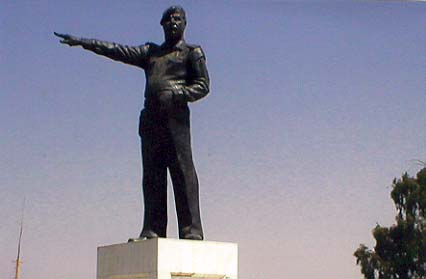
Saddam HusseinFrom the European Coal and Steel Community, based on the "Schuman Plan" of 1950, the progression to the Treaty of Rome in 1957 looks, from the distance of nearly 50 years, to have been a smooth and natural progression.

But, as we describe in The Great Deception, the Treaty of Rome was a close-run thing. Negotiations which has begun in earnest in early 1956 had, with the passage of ten months, become hopelessly stalled. None of the parties, particularly France and Germany, could see a way forward.

What broke the impasse, however, was the Suez Crisis or, more particularly, the unilateral decision by Anthony Eden to abort the campaign, without even informing his French counterpart. Adenauer, who was in Paris at the time, consulting the French Cabinet, urged the prime minister to "make Europe your revenge".

So dramatic has been the impact of the crisis that the French did precisely that and previously insurmountable differences between them and the Germans melted away. As the deal came together, therefore, a colleague of Jean Monnet suggested, only half-jokingly, that a statue should be erected to the man who had triggered the crisis, Gamel Abdel Nasser, "the federator of Europe".

That a Middle-East tyrant should have had such a pivotal role in the creation of the European Union is hugely ironic but an even greater irony is that history appears to be repeating itself.

That, at least, is one construction which can be put on a Populus opinion poll reported in The Times yesterday, which shows that the British public has become increasingly cool towards American policy and critical of its role in the world after the sustained violence in Iraq.

The survey indicates that fewer than half the public believe that America is a force for good in the world and – as sentiment turns away from America - nearly two thirds believe that Britain’s future lies more with Europe than with the US.

The exact figure is 65 percent, responding positively when asked of they believed that "Britain's future lies more with Europe than America". In March 2003, before the invasion, about 71 percent believed that "the conduct of the US towards Iraq makes it more important than ever that Britain is at the heart of Europe".

Care must be exercised in interpreting this result as surveys on sentiment towards "Europe" – as with other issues – depend notoriously in the context of the question. But it does suggest that the steady, malign drip of anti-Americanism is not without its perils, if turning away from the US creates a vacuum which is filled by the European Union.

Generally, the antithesis to European integration is most often seen as Atlanticism, with which Eurosceptics generally tend to be quite comfortable. However, almost entirely as a result of the Iraq War, there is a strand of virulent anti-Americanism emerging in some parts of the Eurosceptic movement, often thinly disguised as anti-Bush sentiment.

If this brings increasing numbers of people closer to the European camp – sometimes only because they hate the US more than they hate the EU – then, as the trigger of the crisis that brought this about, maybe some Europhiles in the future will be considering whether to raise a statue to that other Middle-East tyrant, Saddam Hussein, "the federator of Europe".

COMMENT THREAD