Wednesday, September 06, 2006

Dying of ignorance

A crop of letters in the Telegraph today (double-click to enlarge), under the heading, "Armed Forces deaths are the result of a lack of equipment", attests to the fact that the this blog is by no means alone in its view of the MoD's procurement performance – not that we ever thought we were.

But a recurrent theme in the debate is the issue of "underfunding". For instance, Telegraph correspondent James Heitz Jackson of London sees a direct correlation between the overstretch and underfunding imposed on our armed forces and the deaths of service personnel.

This is a charge made by former soldier Michael Moriarty in the "comment is free" section of the Guardian last week. Moriarty actually claims that soldiers are paying with their lives for the MoD’s incompetence, declaring that, "escalating commitments, budget squeezes and big equipment programmes have left Britain's forces fatally overstretched". He argues that:

Iraq and Afghanistan are stretching our forces - the army in particular - beyond the limits of the assumptions on which their funding is based. This situation has arisen through a combination of the government's enthusiasm for use of the armed forces to support its foreign-policy aims and the failure of defence chiefs to adequately highlight the limitations of military force and to demand that the government properly resource its military ambitions. There is a real risk that the armed forces could fail in their politically appointed tasks, with terrible long-term consequences for both them and Britain's world standing.
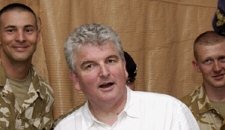
Des Browne, defence secretaryThis has had defence secretary Des Browne rushing to the ramparts with what he thinks is a rebuttal, denying that British troops are ill-equipped and that the defence budget is insufficient.

At the heart of Bowne's rebuttal is his claim that the Afghan operation is fully funded from the Special Reserve and, therefore, the defence budget is not threatened by operational costs. Furthermore, he claims, the annual defence budget has risen by five billion pounds over the last five years - well in excess of inflation.

One has to say that this sort of charge and counter-charge gets us nowhere. It is little more that the "yah-boo-sucks" type of exchange that you can get any day in any school playground, lacking as it does any detail upon which to chew.

The Eurofighter - white elephant extraordinaireActually, both are wrong and both are right – and neither has got to the key point. Yes, the defence budget has increased, and yes British forces are underfunded. And the reason both are right is that the money is going on useless projects like the Eurofighter, the Type 45 Destroyers and the Storm Shadow (the million pound bomb) – none of which are any use to the troops committed in either Iraq or Afghanistan.

But there is another all-important issue which neither of the proponents seem to have recognised. That is the value for money issue, which must also be assessed with regard to the tactical need.

Taking the second point first, outside a very narrow group of military specialists, there is very little debate as to what precisely is the right type and mix of equipment needed for counter-insurgency operations. Yet this issue is too important to be left to the specialists and – especially – the military establishment, which has a glorious and virtually unbroken record for getting it wrong.

Red coats and muskets - left to the military establishment, one somethimes thinks, these would still be frontline equipmentWhether it was the introduction of the rifle in the Napoleonic wars – which was strenuously resisted – the change from red tunics to khaki in the Boer War, and the tardy issue of machine guns, or failure to develop a suitable tank (or armoured personnel carrier) during the Second World War, the record is dismal.

One of the current, most vibrant arguments at the moment is the role of armour in counter-insurgency, one that came to the fore in the battle for Fallujah (see here and here), which has had the US military reappraising the role of Main Battle Tanks (MBTs) and committing to a major programme of upgrading their Abrams fleet to improve its survivability in urban warfare.

Similar thinking is influencing the Israeli military. Before the Lebanon war, it was a given that the IDF would halt production of the latest mark of its Merkava MBT.
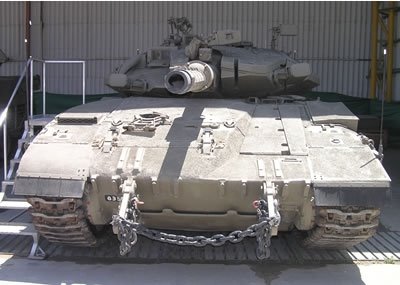
A Merkava Mk 3The view now – according to DefenseNews - is that the tank acquitted itself well in the recent fighting, not only in its primary role but in support missions such as escorting infantry, delivering supplies and even extracting battlefield casualties. The tank, therefore, is expected to evolve into a multi-purpose vehicle and its continued production looks assured.

Not only is the tank version undergoing a transformation, however, the Israelis are funding a project to develop the Merkava chassis into a dedicated armoured personnel carrier, called the Namera, building on their experiences with the Puma and its limitations.

All this is happening though at a time when the British Army is undergoing a major transformation, cutting back on its heavy armour and planning to replace much of its capability with medium-weight, wheeled armour, under the aegis of the £14 billion FRES programme, all to fit in with the EU concept of the European Rapid Reaction Force.

One can only marvel at the thought that the two armies which are most actively engaged at the sharp end with so-called "asymmetric warfare", in deadly counter-insurgency campaigns are opting for more and heavier armour while the British military establishment, imbued with the ethos of European integration, is going the other way.

A Namera APCBut, if the choice of equipment is suspect, what about the costs? One of the main disadvantages of the Israeli Namera, we are told, is the cost – at a cool $750,000 each. But that, in sterling, is £398,631 (at current exchange rates) yet this compares with £437,000 each for lightly armoured Pinzgauer trucks.

No one is saying that the Namera would be the most appropriate equipment for the British Army in Afghanistan – although I suspect that some commanders would not turn them away if they were offered them – but surely the MoD can do better than spend nearly half a million for a truck that offers little if any better protection than that afforded by a "Snatch" Land Rover.

Then, as we have reported before, while there is a crying need for tactical helicopters in both Iraq and Afghanistan, the MoD is committed to buying the " future Lynx" at an average cost of £14.2 million each, which means that they cannot be brought into service until 2014. Yet, the US Army is quite content with the well-proven Kiowa variant, at less than £2.3 million each.

The 'Panther' - at £417,000, more expensive than the NameraAll this and much more (such as the near £200 million on 400 useless Panthers – which cannot be used in Iraq - see also here) suggests that, not only is the MoD buying the wrong equipment, it is also paying far too much for what it does buy – the worst of all possible worlds. It also suggests that the problem is much more complex than the simple issue of "underfunding".

On the one hand, we have committed far too much on equipment that is of no use for the current campaigns and, on the other, much of what we do buy for the respective theatres is either overly expensive, under-performing or too late – or any combination of the three.

Echoing Booker's lament in his column last week: "Oh, for a properly clued-up media and an Opposition worthy of the name," we urgently need a properly informed debate both in Parliament and in the media.

Steve Bell in The GuardianWe have no great hopes of the former and, as for the latter, even if there were journalists around who were capable of understanding the issues, the likelihood is that they would not be allowed to write even half-way detailed stories (as we found to our cost here). Their editors, wedded to their dumbed-down diet of political soap operas and Diana-esq, human interest stories, can rise to the occasional cheap quickie - after the event – (or the occasional cartoon) but would judge detailed analyis too "boring" for their precious readers.

Thus is the public condemned to ignorance and, as we keep pointing out, the consequences are all too evident. Ironically, during the early '80s, when the killer disease AIDS made its appearance, the Department of Health advertising slogan – to increase awareness – was "don't die of ignorance". Decades later, this looks to be the fate of many of our soldiers. The horrible reality, though, is that it will not be their ignorance which does for them – but ours.

COMMENT THREAD

What a good question

It was the Russian Section of the BBC, as far as I can make out, who first reported that Iran’s President Ahmadinejad has called upon students in universities and colleges to get rid of liberal and secularly minded teachers.

The Russian Service website headed its article yesterday: “Iran’s president calls for a purge in higher education”, words that have a deadly meaning to all Russians. Interestingly enough, the English language website had a much milder heading: “Iran’s liberal lecturers targeted”. Could be anything, really.

The delightful Mr Ahmadinejad knows very well that universities do tend to explode into strikes and demonstrations against his ever more oppressive and obscurantist rule. So, after the destruction of the satellite dishes and the periodic crack-down on bloggers, the Iranian President has decided to launch another assault at the academic institutions.

Last year Teheran University acquired an ayatollah as its rector as part of the campaign to turn Iran into a completely backward kind of Islamic state. The students and academics responded by demonstrations after which many of the latter were sacked. (Though according to the BBC correspondent, that was not such a big problem as “many have found new jobs with institutions run by people linked to the president's political opponents”. Not for long, I imagine.

In the meantime, The American Thinker has asked a very pertinent question. Bearing in mind the outrage expressed by the Association of University Teachers on the subject of transgressions by the Israeli government, to the point of wanting to break all relations with all Israeli academics, can we look forward to a proposal for a boycott of Iranian academics? After all, unlike the case with Israel, what is at stake here is any semblance of academic freedom?

A reversal of roles

British fishing boats being scrapped under the CFP fleet reduction programmeFor all that so many people talk glibly about the "power of big business", the more normal experience when it comes to political issues is how cravenly neutral businesses often are. Many a time, on quite contentious issues, we have looked to them for leadership and support, only to find that they go for the easy, safe option and support the status quo – for fear of offending some of their customers.

It is quite remarkable, therefore, that yesterday, the Adsa supermarket chain came out with a press release calling for Britain's withdrawal from the EU's Common Fisheries Policy – which has destroyed our fisheries and wrecked the fishing fleet.

In US equivalent terms, this is something rather like Wal-Mart (which just happens to own Asda) calling for the abolition of hand guns. Getting directly involved in politics like this is something supermarkets simply do not do.

Anyhow, says Gordon Maddan, regulatory affairs manager at ASDA: "We want all the fish we sell to be sustainable. It's very clear however that the Common Fisheries Policy has failed to deliver this so we are now supporting calls for a radical change in approach."

As for Maddan's recipe, you need not waste your time on it – he provides the classic illustration of why shopkeepers should stick to selling their goods and not meddle in things they do not understand. But his heart is in the right place – he and his employer recognise that the CFP is fundamentally flawed and that we should withdraw from it.

But, if we are now seeing a supermarket chain taking an overtly political line, we are also seeing politicians taking an overtly non-political line – a complete reversal of the normal scheme of things. Enter Struan Stevenson MEP, formerly chairman of the EU parliament's fisheries committee and currently Conservative European spokesman on fisheries policy.

Asked by BBC Today programme's Sarah Montague why this was no longer Conservative Party policy, he simply blustered, saying: "It's not the easiest thing in the world to withdraw from the CFP". When Montague persisted as to what the current policy line was, Stevenson responded that, "If the CFP is not reformed substantially, then we retain the possibility of withdrawal".

It says something for quite how fatuous this response was that even Sarah Montague noted that reform "isn't going to happen…", leaving Stevenson stranded, high and dry.

Yet, since the Conservatives produced their green paper of fisheries in December last, written by then shadow fisheries minister Owen Paterson. this is as near to the first definitive statement on fisheries that we have had from the Cameron camp.

This is from a man who has never had the guts to stand up and declare openly that he has abandoned the withdrawal policy agreed by all three of his predecessors. Instead, we are going to seek "reform" – something even the BBC recognises is not going to happen.

Nevertheless, the two-faced Stevenson is going along with the fiction. This is the man who tells the BBC that the CFP is "a treaty obligation… something you can't simply unravel overnight."

Yet when he was asked – pre-Cameron - to respond to the Owen Paterson's green paper on withdrawal from the CFP, he wrote: "It is brilliant. My smile got broader and broader as I read through it! You've done a startling piece of work which will be widely applauded by the fishing communities in the UK and beyond."

It said of politicians that some are born great while others have greatness thrust upon them. Others, it would seem, are born shits and remain that way all their lives.

COMMENT THREAD

The stinger stung

Henry Mussa - Malawi's minister of works - and SecGen in waiting?I really don't know what to make of this report from the Chronicle Newspaper in Lilongwe via allafrica.com, other than to say that – undoubtedly due to my perverted sense of humour – I found it hugely amusing.

The report, under the headline, "Malawi govt uses EU name to dupe suppliers" tells how the government, which cannot attract suppliers for various items due to its failure to honour payments, has used the name of European Union to dupe four major companies to supply it with vehicles, tractors and other equipment.

This goes back to June last year when the Malawi ministry of transport and public works advertised for the supply of plant, equipment and vehicles. To ensure that it got a good crop of bidders, though, it claimed that the financing would be by the Government of Malawi with support from the European Development Fund (EDF).

Interestingly, the government had applied for EU funding but had been turned down. It went ahead with the tender invitation anyway, using the EU's EDF format. The ploy worked and, unusually, its ministry received overwhelming response. Companies were encouraged that they would be able to tender without concerns about usual delays of payment because the tender was backed financially by the European Union.

However, more than a year on, the government of Malawi has only paid 60 percent of the money now owed to four successful bidders and is failing to pay the remainder.

The scam came to light when the companies started chasing their balances in Brussels, only to have EU officials deny any involvement with the contract. The commission has now written to the government of Malawi protesting at this misrepresentation.

Minister of public works, Henry Mussa, however, is unrepentant. He is stating that he cannot recall any tender advertisement for the supply of the goods. "I am in the bush, very far away here in Mwanza where I am inspecting public works projects," he told the Chronicle.

"I am not involved in the day-to-day running pf operations. I only come in on policy issues; where there is need for political will and policy guidance. The ministry's chief executive is the principal secretary - he is the one you can talk to," explained Mussa.

Whether the companies involved – including Toyota Malawi – will ever see their money is questionable. But one thing you have to concede is that, while the tender may not have been genuine, Mr Mussa's approach to ministerial responsibility is pure, undistilled European Union.

Seems to me that, when Kofi finally gets his pension, the UN could do no better than headhunt our Henry.

COMMENT THREAD

Tuesday, September 05, 2006

PDF report available

In response to several requests, we have converted our web report on Corruption of the Media into a .pdf document.

This has necessitated repositioning and re-sizing the illustrations so we have also taken the opportunity to carry out some limited editing, to reduce the size slightly: it now comes to 75 pages (down from 104) - with some photographs omitted.

It can be downloaded from here. The link is also posted on the report site here.

The original report will remain accessible from the link on the sidebar.

Gone and largely forgotten

On 31 August, we picked up a "tirade" from Julia Langdon, in The Daily Telegraph, on the employment of 3,259 PR men by the government.

Readers will recall, though, that we were somewhat less than sympathetic with our Julia, not least because we felt her protest was simply a space-filler. There was no real commitment to seeking change and, as long as the situation suited the media, they would confine themselves to ritual complaints that would soon be forgotten.

In the letters column today, of the same newspaper, there is some support for our view from Christopher Jones, the Parliamentary correspondent for BBC Radio and Television News between 1964 and 1989.

What he has to say is that political journalists "should also look at the motes in their own eyes."

Since the premiership of Harold Wilson, governments have made every effort to control political reporting through the lobby system – a system that is based entirely on secrecy and unattributable gossip and rumour; the antithesis of good journalism.

This system means, of course, that politicians – and especially governments – hold the whip hand, since they can act against any journalists who break the secrecy code, while journalists accept the system in order to keep their credibility.

It also means that the proceedings of Parliament – the reason why politicians are at Westminster – now go entirely unreported (except by the BBC, which has a charter obligation to do so). Only the weekly nonsense of Prime Minister's Questions is ever covered, plus the occasional appearance of some unfortunate fall guy before an entirely toothless departmental select committee, or sketch-writers portraying politicians as figures of fun. Journalists should find it hard to complain about a PR system which is set up, at enormous taxpayers' expense, to feed them with their livelihood.
This is not quite the point we made – which was that whole tranches of the media rely for their copy on the never-ending supply of free government press releases – but it is a good one all the same.

And the net conclusion is the same. As long as the current government PR system suits the media – which indeed it does – we will see no fundamental change. Largely proving the point, the indignation so forcefully expressed by Mz Langdon is gone and largely forgotten. In due course, she will get her cheque for writing her piece and that will be the end of the matter.

COMMENT THREAD

What a great idea

I must admit that I have not until today come across the Bullwinkle Blog, which I found through the invaluable Instapundit.

Its writer has come up with an absolutely splendid idea as to who can replace SecGen Kofi Annan (father of Kojo) when he finally departs from the UN to pastures even greeener. Who other than Tony Soprano?

The argument is impeccable:
"He’d steal less. He wouldn’t take any shit from anybody and a UN Resolution would be enforced, or else."
Actually, I am not convinced about the first one of those.

COMMENT THREAD

Why don't they just go away?

You can tell it's September. The EU commissioners are back from the long hols and the EU news agenda is stirring back into life. And, like attention-seeking children, the commissioners feel they must have something on the slate to prove they still exist.

One seeking to grab the limelight is Markos Kyprianou, the EU health commissioner who has told the Financial Times that "Europe's" public healthcare systems must brace for radical change as barriers to patients crossing borders to seek treatment drop. Kyprianou is saying that he intends to act to implement the right of patients to travel for treatment across the EU, in the wake of recent court judgements.

This relates to a European Union Court of Justice (ECJ) ruling in May last which supported 74-year-old grandmother, Yvonne Watts, in her claim for free treatment in France after her own health care trust had placed her on a one-year waiting list for surgery.

But this is not the only case. Others include the B.S.M. Geraets-Smits v Stichting Ziekenfonds judgement in July 2001, which accepted that a system of prior authorisation, before patients could seek treatment abroad, was justified, if there were overriding reasons connected with "the financial balance of social security systems" and "the maintenance of hospital services available to all", provided such restrictions were not applied arbitrarily.

As we pointed out at the time, the EU is stretching the boundaries of the Treaties, all in a back-door attempt to create a European health service. The overall objective, though, is the same old thing – pursuing European integration by creating systems and service structures on an EU-wide level.

As we also noted, this initiative presents a serious challenge to eurosceptics. Most would welcome a weakening of state control over health services and wider patient choice, but it is uncomfortable to find that the impetus for "liberalisation" comes from the European Union.

But, as we all know, the EU has no real interest in the functioning of health care services – all it is interested in is having them at a European level. And, given its disastrous management of the Common Agricultural Policy, the Common Fisheries Policy and, latterly, its flawed rules on waste recycling, the only thing you can guarantee is that, however bad the current National Health Service is, under EU direction it would be even worse.

The temptation, therefore, is simply to say "no way Hosé" – or José, since the commission president bears that moniker – and to ignore the issue in the hope that it will go away, just as the Conservative Party and the media do.

But that is not a safe option. The commission niggles away at its pet projects, coming back again and again, never - as we saw with the constitution - able to take "no" for an answer. Even if they are defeated again and again, they still come back, wearing you down with their persistence until, eventually, they get their way.

But there are more important things than the EU's integrationalist ambitions – from the disaster in Darfur to the collapse of democratic government in our own country. Having to deal with the EU is a distraction, an irritation and a colossal drain on energy and resources that could and should be better expended elsewhere.

However, if you don't pay attention to the children, they will eventually wreck the joint – so we have to wade in and deal with them, even if it is just to slap them down. All the same though, we can do without this and not for the first time we find ourselves saying, "Why don't they just go away?"

COMMENT THREAD

Monday, September 04, 2006

Criminal incompetence

Not on the scale of the loss of the Nimrod over the weekend, another sad event occurred today with the death of two British troops in Iraq, and the serious injury of another, following a roadside bomb attack on their "Snatch" Land Rover, just north of Basra. A fourth soldier was lightly wounded.

A report from Middle East online describes how "insurgents" attacked a British army unit escorting a reconstruction team. They were tasked to escort a reconstruction unit to assist with the rebuilding of the area north of Basra.

The "Snatch" Land Rover was badly damaged, with the wreckage of the vehicle standing upright by the side of the road, part of the rear cabin ripped open by the force of the explosion.

This brings the total number of UK soldiers killed in operations in Iraq since the 2003 conflict to 117 and, by our reckoning, the number killed while patrolling or travelling in lightly armoured or unarmoured Land Rovers to 25 – the largest single group of casualties in the Iraq theatre.

This follows the story in the Scotland on Sunday last week, which revealed that the MoD had sold off 14 Mamba armoured vehicles for a fraction of their original cost.

That story was picked up yesterday by the Mail on Sunday and again by the Scotland on Sunday, based in information supplied by this blog.

Today, however, prime minister Tony Blair described the deaths as a "terrible tragedy". He should, perhaps, have a quiet chat with his defence procurement minister, Lord Drayson, who consistently maintained that the "Snatch" Land Rovers "provide us with the mobility and level of protection that we need".

It was only after a sustained campaign by this blog, backed by Conservative shadow ministers, Booker in The Sunday Telegraph, and then the Sunday Times, that Drayson eventually conceded that new armoured vehicles should be bought.

But, since these cannot be delivered to theatre until the end of this year, our troops must continue to ride – and die – in inadequately protected Land Rovers, and Blair has the nerve to call these deaths a "terrible tragedy". Criminal incompetence by his own government would be a better description.

COMMENT THREAD

They are getting there slowly

Italian 'peacekeepers' disembarking in LebanonThat famous UN peacekeeping force in southern Lebanon is getting there slowly. 1,000 Italian troops are supposed to have landed by yesterday evening, the eventual plan being 2,450 Italian ground troops. These will be deployed in the next two months and command will be assumed (if the French agree to give it up) next year.

Meanwhile of the reluctantly promised 2,000 French troops the same 250 that deployed last week are there and others are awaited. UNIFIL is commanded by Major General Alain Pellegrini, who is French.

The German naval deployment has been put on hold as the request from Lebanon had not yet arrived. Lebanon is supposed to ask the UN who is then supposed to pass the request on to the relevant country.

Indonesia said it would send 1,000 troops as Israel has withdrawn its objections. Indonesia is not just predominantly Muslim but is also a country that has refused to acknowledge Israel’s existence, which makes its role as a peacekeeper potentially very interesting.

Turkey is considering whether to participate, though the tiny Armenian community of Lebanon has protested because of the 1915 massacres. While those massacres were horrible, one rather wonders why an old historical event should weigh more heavily in the international community’s considerations than more recent attacks on a country that had been set up by the United Nations.

The UN has said that Israel should withdraw its forces as soon as the international contingent reaches 5,000 – some way to go. But the numbers matter less than the mandate. General Pellegrini may announce that the new UNIFIL has greater powers than the old one did but, in actual fact, neither the Lebanese army (despite all the huffing and puffing) nor the UN forces intend to disarm Hezbollah, who will, undoubtedly do what all terrorist organizations do when the UN moves in: rearm behind the shield of blue berets and blue helmets.

COMMENT THREAD

Sarkozy in the lead

One must never forget that Nicolas Sarkozy is the son of a Hungarian and is, therefore, reasonably familiar with the principle of coming ahead in the revolving door. He is also, interestingly enough, not an enarque, having attended the Institut d’Etudes Politiques de Paris (SciencePo) without graduating, rather than the Ecole Nationale d’Administration, the alma mater of almost the entire French political class.

At present, Sarkozy seems to be a good way ahead in the race for UMP nomination in the presidential elections, due next spring. The Ifop survey published in Le Journal du Dimanche says that 45 per cent of the electorate wants Sarkozy to be the centre-right candidate with only 8 per cent opting for Villepin and 3 per cent for Chirac. The rest, one assumes, preferred none of the above.

According to Emmanuel Rivière, head of political studies at the TNS Sofres polling institute, Sarkozy may be in the lead as far as UMP is concerned but defeating the Socialists will be considerably more difficult. That’s as may be. As the International Herald Tribune article puts it:
“Several long-time supporters of President Jacques Chirac and Prime Minister Dominique de Villepin, Sarkozy's main rivals in recent years, used the three-day conference in the port town of Marseille to express their support for the interior minister, among them the budget minister Jean-François Copé and the sports minister, Jean-François Lamour.

Villepin himself appeared to soften his opposition to Sarkozy, albeit without explicitly endorsing his candidature.

"Thank you Nicolas!" said Villepin on the opening day of the meeting on Friday. "Nicolas, you are a minister of state who is energetic, strong-willed and courageous. I give you all my gratitude."

The show of unity on the right comes one week after a similar gathering of the opposition Socialist Party was overshadowed by divisive squabbling among half a dozen potential candidates, several of whom multiplied their attacks on Ségolène Royal, the front- runner in opinion polls on the left.”
The three-day conference in Marseilles was for 6,000 young members of the party. They gave Sarkozy a rousing welcome and, apparently, endorsed his rather vague promises of creating a “new French model” and “reinventing the Republic”. The inevitable rock singers and, this being France, aged crooners were also present.

There seems to be some doubt in the reporting as to whether Sarkozy really does appeal to the young. On the one hand, we are told, he has not been forgiven for his references to the suburban rioters of last autumn, as “scum”. Forgiven by whom, one wonders. The suburban rioters are unlikely to vote UMP, anyway.

On the other hand, he has been promising lots of goodies to the middle class youngsters, who are likely to vote for him.
“On Sunday, he sought to woo young voters by proposing to create interest- free loans for students who want to set up a business and special education savings accounts. In a proposal that resembles one in the Socialist Party's program, he also suggested the introduction of a six-month community service for those aged between 18 and 30.

Sarkozy appeared to criticize a flexible work contract the government introduced a year ago, which allows small companies to fire employees without justification during the first two years. The contract is estimated to have created at least 40,000 jobs that would otherwise not have been created, but it has been fiercely criticized by labor unions and the Socialist Party.”
Meanwhile with les vacances annuaires over, children back at school, it is time for French politicians on the left to turn their attention to what really matters: next year’s presidential elections.

COMMENT THREAD

No war crimes in Darfur

As usual, it depends on who you are as to whether you might be a war criminal or not, rather than on what you have done. As Al-Jazeera reports, Israeli officials were told to watch what they are saying or they might be accused of being war criminals.
“The sources say the foreign ministry has established a legal team to deal with efforts by foreign groups to arrange the prosecution abroad of Israelis involved in the war against Hezbollah guerrillas and crackdowns on Palestinians.

A ministry memorandum issued to Israel's military and other government agencies urges officials to avoid belligerent remarks that could potentially be used to back up allegations they were complicit in excessive use of force in Lebanon or Gaza.

"The type of language now considered off-limits includes 'crushing' the enemy, and 'cleansing', 'levelling', or 'wiping out' suspected enemy emplacements," a political source who saw the memo told Reuters.”
There are, inevitably, all kinds of attempts in various countries, some democracies, some, like Morocco, whose own record on human rights would barely stand up to investigation, to prove that the Israeli army and only the Israeli army in the whole of the Middle East, has committed war crimes.
“According to the memo, numerous war crimes lawsuits against Israeli officials were being prepared. It cited venues such as France, Belgium, Morocco and Britain, but no further details were immediately available.

Three Moroccan lawyers said last month they were suing the Israeli defence minister, Amir Peretz, over the recent offensives.

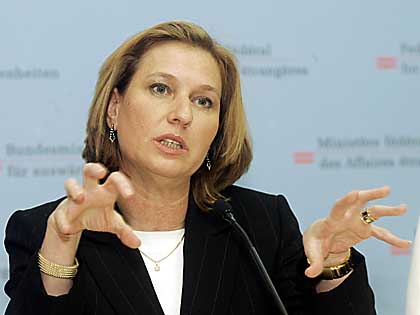
Israel Radio reported that a Danish politician also tried to have Tzipi Livni, the foreign minister detained and prosecuted during a recent visit to Copenhagen but the request for an arrest warrant was turned down by prosecutors.”
Let’s face it, no Danish or any other West European politician is ever going to say that prolonged Hezbollah attacks on Israeli settlements in the north (all civilian) or Hezbollah use of Lebanese civilians as human shields could possibly constitute a breach of international agreements. I wonder why that is.

Could it be a form of European superciliousness or hidden racism? Could the unnamed Danish politician be really thinking that one cannot sue organizations like Hamas, Fatah or Hezbollah for war crimes because they cannot be expected to understand the meaning of the term? Just a thought.

In the same way, one does not think of the government of Sudan or any of the militias it has trained and financed to attack and murder the people of Darfur (or various other parts of the country at various times) in very large numbers.

As Associated Press reports, the government of Sudan has demanded that the African Union, whose 7,000 strong “peace-keeping force” has achieved precisely nothing, leave the area before September 30, as they cannot stay beyond that, and not even think of handing over to UN troops.
“The government on Thursday rejected a UN Security Council resolution for the deployment of a 20,000-strong U.N. force in Darfur.

Instead it has launched a major offensive reportedly involving thousands of troops and militias in the northern part of Darfur.

The week-old offensive targets rebels who refused to sign a U.S.-brokered peace deal in May aimed at ending three years of conflict that has killed more than 200,000 people and displaced 2.5 million.”
Where the UN was going to get 20,000 peacekeepers for Darfur while still trying rather desperately to raise 15,000 for UNIFIL remains a mystery. It is probably just as well that they are not going to be allowed there. But is any Danish (or other West European) politician going to accuse Sudanese politicians and/or officials of war crimes? I thought not.

COMMENT THREAD

The tyranny of the officials

Your new councillor - it might just as well be, for all the power councillors now haveOne view of American society, reflected by the British in our soooo superior way, is the dismissive comment on its local democracy, summed up by the sneer: "…but they even elect their dogcatchers".

Well, that may be the case, but to such pathetic levels of inadequacy has our so-called democratic system sunk that we now elect our dogs… or, at least, we might just as well, for all the power our elected local representatives have. Dogs, one has to say, have a use.

This is brought home to us by a news item in The Daily Telegraph, headlined: "Prescott's ethics fiasco hampering democracy", a commentary on a new report published by Owen Paterson, the shadow transport minister, and Gerald Howarth, the shadow defence minister.

Owen Paterson and Gerald Howarth - authors of the reportEntitled, "A question of standards", this records how an organisation called The Standards Board of England", with a staff of 219 and a budget of £10 million a year, is wreaking havoc with local councils, imposing a draconian and absurd code of practice which ends up banning councillors from discussing local park-and-ride schemes if they own a car or barred them from speaking or voting on the location of a mobile phone mast if they themselves used a mobile phone.

Even councillors who have been elected specifically to fight a particular issue have fallen foul of the rules and found themselves told they cannot speak or vote on it.

The Standards Board for England, itself, was launched by deputy prime minister Prescott in 2001, who claimed that that the new body would help to ensure high ethical standards in local government. It supposedly handles complaints about councillors' behaviour and is supported by a network of ethical standards officers, who are each paid £61,000 a year. Each authority also has its own monitoring officers who advise councillors on their conduct.

In 2003-04 the board handled more than 3,500 allegations and launched 1,105 investigations. Sanctions were imposed on more than 200 councillors who were judged to have breached the code of conduct.

The net effect of the Board's activities, though, is to close down democratic debate and, as importantly, to elevate council officials to positions where they are able to monitor, judge and call to account elected representatives. In a system where, supposedly, it is the elected representatives which hold the officials to account, the tail is now wagging the dog.

The theme is taken up by a Telegraph leader which notes that the function of councils should be to maintain local administrative infrastructure, and to make and implement local policy in accordance with the wishes of the electorate expressed through the ballot box.

In fact, it says, our councils, responsible for raising only 25 per cent of their own budgets, have long been in thrall to Whitehall and Westminster, and have increasingly become the more or less willing tools of central government, distinguishable one from another by little more than the efficiency with which they organise refuse collection.

Bolton Town Hall - built in the heyday of local government power and prestige - now an empty shell, standing as a monument to former gloriesNow, it adds, their democratic autonomy is being undermined still further by the ethical guidelines instituted, ludicrously, by the deputy prime minister, John Prescott. Purportedly designed to prevent conflicts of interest, they in effect disqualify any councillor who knows about a particular issue from contributing to its resolution. Thus, informed debate and decision-making alike become impossible at the local level, and power, yet again, reverts to the centre: another victory for the New Labour ethic.

What could also be added is how like the European Union councils have now become. There, the whole ethos of the system is that appointed officials – the EU Commission – have power over elected representatives of the member states, to monitor them, to judge them and to hold them to account.

And, as national elections progressively become devoid of meaning, as the EU takes over more and more law-making powers, so it is too that local elections have become irrelevant as more and more power is vested in the hands of officials and council chambers become vacuous talking-shops, with "monitoring officers" ready to pounce if the councillors put a foot wrong.

Interestingly, it was an American, Thomas "Tip" O'Neill - a longtime Speaker of the House in the US Congress – who declared, "All politics is local". But here in the cradle of democracy, that is no longer the case. It has been replaced by the tyranny of the officials.

The full report can be downloaded from here (.pdf – 22 pages).

COMMENT THREAD

Late and badly…

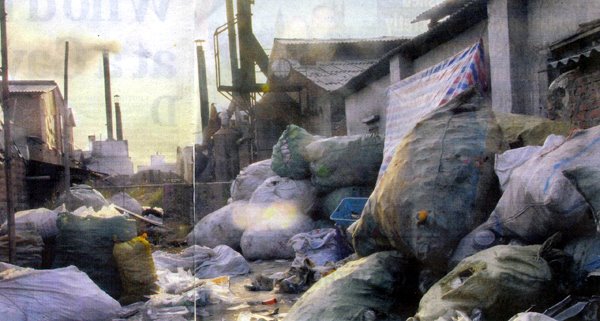
A Chinese recycling centre
It is ironic that, the day Booker devoted the main story in his column to an analysis if how EU directives were turning our system of waste collection and disposal into chaos, the Mail on Sunday should have reported on one of the dire consequences of this chaos – and not mentioned the EU once.

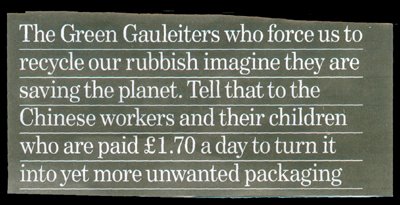
The piece starts with a strap which declares, "The Green Gauleiters who force us to recycle out rubbish…". It goes on to refer to local authorities who "bully UK residents into complying with new 'green' laws", and then refers to "town hall officials" who argue that "local recycling schemes – which carry fines if they are not obeyed - are essential to avoid a Britain blighted by landfill sites".

There is no mention of the origin of these "green" laws, nor any mention of why the local authorities might be fined if they do not obey them, nor indeed any mention, when we have been served by landfill sites for decades, why we should suddenly consider ourselves blighted by them.

Nothing more typifies the crass inability of the MSM to get to grips with EU issues, matched only by the inability of either of the main opposition parties to do likewise – giving extra force to Booker’s concluding line of his piece: "Oh, for a properly clued-up media and an Opposition worthy of the name." As for the MoS, when we finally get a story, it is late and done badly.

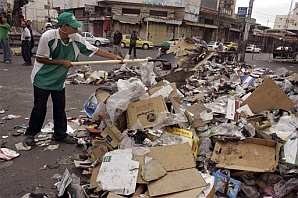
The MoS story is indeed dire – about the way supposedly recycled refuse is being transported to China, where it is processed in extremely poor hygienic conditions, with scant regard for the environment, causing massive pollution.

But even then, we reported on precisely this on 14 May this year, which was actually based in part on a story written up in the Guardian in September 2004. On the ball, the Mail on Sunday ain't.

But what the MoS could have done – and did not – was develop the story. That it did not is criminal. The horrific scenes that paper describes (see also picture) arise directly and as an inevitable consequence of the EU's obsession with creating regulatory-imposed targets for recycling, irrespective of the market capacity to absorb the material produced.

This is the classic producer-driven system against which all sane economists warn against, the very system that ensured the Soviet Union had massive surpluses of unwanted goods and never enough of the products in demand.

Essentially, with no market capacity to absorb the material in the UK, there is only one option – short of landfilling it, which is what is happening in some instances – and that is to export it to countries which are willing to deal with it. And that, currently, is China (as well as Indonesia).

An MoS reporter displays British rubbish - in ChinaThe MoS cites Greenpeace spokesman Edward Chan, calling on "British consumers" to put pressure on recyclers to make sure their waste goes where it can be managed without causing damage, but again that ignores the economics.

Firstly, the massive glut of recycled material drives the price down. In a competitive market, only those who process the material most cheaply can hope to make a profit. It is there that Chinese processors, paying workers a mere £1.70 a day and operating under primitive standards, are able to compete.

Secondly, recycled materials are competing against cheap raw materials and there is a limit to the prices the market will bear. If the cost of processing does increase, as result of increased wages and better hygiene and environmental standards, the material will be priced out of the market.

What this actually boils down to is that, under the current situation, it is not possible at all to process economically much of the material produced. It is only by cutting corners and using cheap labour that there is any demand for it at all.

On the other hand, there is no scope for increasing charges at the other end, where the waste is actually generated. The cost of separate collections, sorting and primary processing is already – as Booker reminds us – set to add £10 billion a year to the cost of the waste system. That, in the context of increased and highly unpopular Council Tax bills, is already politically unsustainable.

Booker, in his column, focuses on the experiences of Christina Speight, one of our most valuable forum members, who has confronted her council in Ealing about its mad scheme to issue residents with lidded plastic containers for "food waste". This was accompanied by a glossy leaflet illustrating the food waste allegedly thrown away by the average household each week, 8.5 kilograms (18 lbs) of it, including a mass of apparently untouched fruit and veg, bread, cream, milk and heaven knows what. "Our own household," says Mrs Speight, "throws away barely a tenth of that."

Christina discovered that the council had bought 95,000 of these containers from a firm in Italy, costing between £5 and £10 each, so that, in the name of saving the environment, whole truckloads had been brought half way across Europe. In recent days, Booker adds:

…our media (not least the correspondence columns) have been full of items on the chaos that now prevails in the collection and disposal of waste in Britain. They ranged from the 500,000 wheelie bins fitted with microchips (to measure how full they are) to householders so frustrated by new collection times and the mass of different containers into which they must sort their rubbish that a fifth of all Britain's 40,000 dustmen claim that in the past year they have been assaulted, many now saying they want to give up.

Further chaos results from a thicket of new rules governing what householders can or cannot dump at council tips. Some are now being asked by councils to pay for a permit allowing them to deposit waste at all. Rules making it more costly to get rid of old vehicles saw the number of "illegal disposals" last year soaring to 1.5 million.

With such a plethora of new laws making it ever harder to dispose of waste is it really surprising, many people ask, that Britain is seeing "an epidemic of fly-tipping"?
What is not explained, he goes on to say,

…is just why we are faced with this chaos. The answer is that the revolution in how we dispose of our rubbish has been imposed on us by a series of Brussels directives, the purpose of which is to phase out the burying of waste in landfill and to switch our efforts to recycling, while incinerating everything that cannot be recycled.
That is the eurosceptics’ main problem. Contrary to what our critics often complain, we do not oppose the European Union simply because of what it is, but also because what it does is inevitably a disaster. But, if the disasters it creates are not identified and publicised by the media – which seems more concerned to feed off a diet of never-ending "Euromyths", many of them which are imaginary – the public at large will never get to share the sentiment that we are "better off out".

When, on the other hand, still respected (by a majority) organs like the BBC puff up the non-existent achievements of the EU, the distortions magnify and the pressure for change is suppressed.

That the subject is so mundane and unglamorous as refuse, therefore, is not the point. What matters is that a previously efficent system that affects everyone is being turned into chaos at enormous cost – both to us and to those in China who suffer the consequences – and the media cannot be bothered to tell us the reason for it.

COMMENT THREAD

Sunday, September 03, 2006

Squandered lives

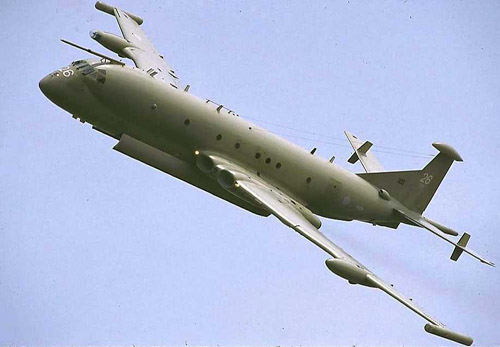
A Nimrod MR2It was with a genuine sense of shock that we learned yesterday of the loss of a Nimrod MR2 over Afghanistan, with the death of its entire crew of 14. We can only add to the expressions of sympathy to the relatives, friends and colleagues of the deceased.

The shock came in part because one does not expect to lose this type of aircraft, even in combat theatres. One presumes – as has been stated in a number of reports – that it would have been at an altitude safe from any anti-aircraft missiles that the Taliban could deploy. And, for a mature airframe, one does not expect a "mechanical defect" – the current MoD explanation – to have such a catastrophic effect.

Already though, the pundits are suggesting that it could have been a missile attack, discounting the MoD denials. They pointed out that the Hercules crash in Iraq in January last year was initially put down to "metal fatigue" when, in fact, it turned out to have been downed by a missile.

However, even if it had been a missile which downed the Nimrod, you would not expect the MoD to admit it immediately – and rightly so. It is simply not good sense to give the enemy, gratis, an after-action report, confirming his success.

A different line is taken by Colonel Tim Collins in The Sunday Telegraph today, who writes, "Government must find more funds or pull out". This is a line we ourselves have taken so we would not altogether disagree with Collins when he says:

If the 14 British servicemen killed in Afghanistan died because of the mechanical failure of their Nimrod plane, then it confirms what I have been saying for months — that the UK's aircraft and helicopters are old and absolutely worn out.
But, if The Sunday Times report is correct, and the aircraft was "co-ordinating special forces operations against the Taliban, intercepting their communications and providing real time video surveillance of what was going on on the ground", then there is an another problem which is quite as serious – if not more so – amounting to a major scandal.

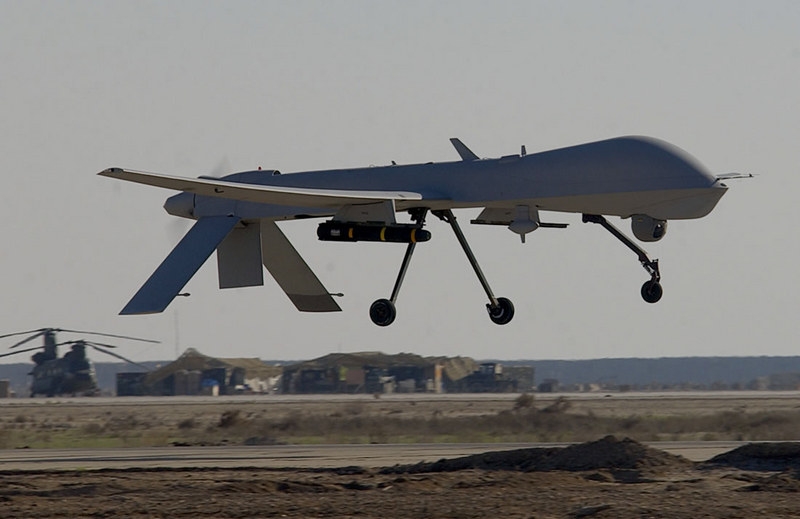
A Predator UAVThe fact is that, if the Nimrod was providing coordination and carrying out electronic communications intercepts and video surveillance (and it is really hard to think what else it could do – as a marine reconnaissance aircraft, it radars would have been next to useless) then it should not have been there at all. These functions do not require a manned aircraft and, in fact, are better (and more safely) carried out by unmanned aerial vehicles (UAVs), such as the Predator deployed by US forces and – to and extent, by UK forces.

Thus, the announcement last week that the UK government was to buy two Predators from the US, for use in Afghanistan, might not be entirely coincidental. Not only does it confirm that UAVs are needed for this theatre (as we have long argued) but it also suggests that the Nimrod was being used as a stop-gap, to make up for the lack of capability.

Therein lies the scandal. When you look at the MoD performance in seeking to equip British forces with UAVs, you are looking at a tale of incompetence which beggars belief and a colossal waste of money. So much has been wasted in fact, that we could have had the capacity already, for a fraction of the cost. There would be no wreckage of a fine aircraft and 14 men might still be alive.

A British Phoenix UAVThe story actually starts with the Phoenix UAV, developed originally for the Army for artillery spotting and then – as the MoD so often does – given a role extension to take in battlefield surveillance, for which purpose it was entirely unsuited. The story is spelt out here and makes for sorry reading.

But where the real scandal lies was elicited by Tory MP Andrew Rosindell in a Parliamentary question, answered in July 2006. This revealed that the "Phoenix unmanned aerial vehicle system" had cost approximately £345 million since inception. Ignored by the media, this was for a system that was introduced in 1998 with a minimum 15-year in-service life, which had never functioned effectively – or at all- and could not be used in either Iraq or Afghanistan where it is most needed.

Now, the point is that the deficiencies of this abysmal machine were well known – and certainly to the MoD – by the year 2000, when the system failed to perform in Kosovo. It was certainly abundantly clear in 2002 when a reported upgrade to allow it to operate in hot weather was "put off to save money".

In fact, the "upgrade" was more likely cancelled because no amount of money would improve a basically inadequate design but, whatever the reason, this meant that the British Army went into Iraq without what is universally regarded as vital equipment.

We do now know that the MoD partly made up for this deficiency by leasing time on Predators in Iraq, but this, we also know, has proved unsatisfactory. The UAVs have been treated as "theatre assets" and have not always been available to British forces.

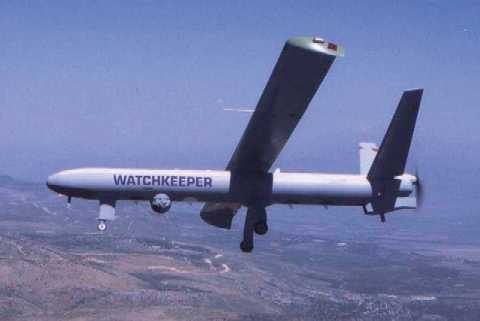
The proposed Watchkeeper UAVInstead of doing the sensible – and vitally necessary – thing, however, and buying more Predators from the US, not least to provide surveillance in other theatres such as Afghanistan, the MoD decided to launch on another programme of UAV development. And, with the speed of a glacier, that took until last October to finalise, with the government committing another £317 million to build 99 Israeli-designed Elbit Systems WK-450s, known as the Watchkeeper, the total contract running to £700 million.

But the worst of this was that, while the government was so eagerly committing troops to Afghanistan, the system was not due to come into service until 2010 – at the very earliest. Even then, its capabilities will fall far short of the Predator, which is already up and flying, proving its worth in both Iraq, Afghanistan and elsewhere.

Thus, having so far committed the best part of £1 billion to providing UAVs for the armed forces – with no prospect of them seeing any capability until 2010, the MoD last week decided to spend yet another £30 million on two Predators for Afghanistan, to tide them over and provide at least some of the much needed support that these machines can give.

In the meantime, Nimrod aircraft, it seems, have been filling the gap and, if our contention is correct, that is why there is why 14 men now lie dead in Afghanistan.

Nor, indeed, does the story end there. Predators are not line-of-sight vehicles – i.e., they operate out of sight of their controllers – which means you need satellites to convey the communications and control signals and to receive the data they produce. Furthermore, as the US has found out, UAVs chew up band-width to such an extent that this has proved a factor limiting their deployment, not least because other services compete for air time.

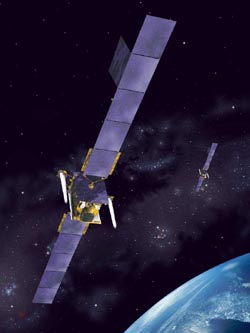
A Skynet 5 communications satelliteTo operate these Predators, the British government will need satellite capability and there has been no announcement on how this will be provided – or at what cost.

We do know, however, that the MoD is seriously short of capacity and is relying on its new communications satellite system, Skynet 5, which will not be fully operational until 2008. This could explain why only two Predators or being bought – for an area four times the size of Wales. It is quite possible that there is no capacity to operate more.

In any event, this whole sorry saga is yet another example of inefficiency, waste and mismanagement. As always, the taxpayer pays the monetary price, getting less for more, while those at the sharp end pay with their lives.

And, if the media has noticed something is wrong, it has not even begun to understand why.

COMMENT THREAD

They catch up … eventually


We did it on 3 July, barring a key bit of information that we had to tease out of the MoD through a Parliamentary question. This the Scotland on Sunday picked last week and we followed through last Friday.

Now, today – two months after we broke the original story - the Mail on Sunday has finally run it. Yet, at the end of the same month that we first ran it, little Shane Richmond, Telegraph web news editor, was happily pushing out an inane comment from Malcolm Gladwell, the author and New Yorker journalist, that blogs are "derivative".

Yet again this illustrates that sections of the MSM are so far up their own backsides that they haven't even begun to realise that, increasingly, blogs are running the agenda on certain issues. They are ahead of the curve.

As for the MoS, typically, it has gone for the cheap, sensationalist angle and has missed key parts of the story. That makes it just another space-filler rather than a contribution to the debate about the inadequacies of the MoD, which would have moved the issue forward.

Not least, it parrots uncritically the MoD line that the Mambas were "too heavy", without stating why - and that they "were not designed as a patrol vehicle". Yet, that is precisely what they were designed for, a task - even as we write - at which, in the form of the RG-31, they are excelling in Canadian hands in Afghanistan.

It then mentions that, last month, the MoD "revealed" that the Army is to get 300 new, "tougher" armoured vehicles for use in Iraq and Afghanistan - failing, of course, to note that 100-plus of these are the useless Pinzgauer coffins on wheels. This, incidentally, is from Whitehall correspondent, Jason Lewis, who should have been aware of what was happening. When the butcher's bill comes in, you can bet the MSM will be waxing indignant but now, when there is an opportunity to do something and actually save lives - they are silent.

And, although all the information for the MoS piece came directly from the exertions of this blog – they even used the same photographs – was there any mention of EU Referendum? I'll give you three guesses.

COMMENT THREAD

Which bit of useless?

It was on 12 September last year that my colleague wrote a somewhat less than laudatory analysis of UN SecGen, Kofi Annan.

Not quite a year later, we read this, published yesterday. And then, today, we read this.

The one is a Telegraph leader on the failure of the UN in Darfur, where this venerable organisation has been sidelined. The other is a stonking analysis in The Business, of the Iranian situation. There, guess what, the UN has been sidelined.

The final chapter on Lebanon, of course, has yet to be written but if the present UN force is supposed to be "UNIFIL on steroids", then the dose administered must be below detectable threshold.

All one can say of Mr Annan is, which bit of "useless" don't you understand?

COMMENT THREAD

Saturday, September 02, 2006

2011? Do I hear 2014?

Hungary's probable entry into the euro (probable in the sense of not being completely impossible) is shifting. Not before 2010 we were told earlier this month and, although the country's convergence plans were accepted this Friday by the EU as being more plausible than the earlier ones, the chances of anything happening before 2011 or, even, 2014 are unlikely.

Whether entering the euro is quite the solution for Hungary's multiplying economic problems is questionable, but that some reforms need to be introduced is certain.

Finance Minister János Veres has promised that the country will meet the EU's convergence criteria by 2009. Among other matters this would mean reducing the budget deficit from the 10.1 per cent of GDP, forecast for 2006 to 3.2 per cent.
"The government's euro adoption plan foresees a budget deficit of 6.8 percent of GDP in 2007, followed by 4.3 percent in 2008 and 3.2 percent in 2009.

The six-year plan begins by focusing on creating long-term balance in 2006-2009. A more dynamic, second period between 2009 and 2011 is meant to steadily boost Hungary's economic standing."
Hungarian central bank President Zsigmond Járai remains dissatisfied with the programme despite it being welcomed by Luxembourg's Prime Minister Jean-Claude Juncker, who heads Eurogroup, the committee of euro-zone finance ministers.
""Hungary's convergence plan "focuses too much on the revenue side", the central bank said in a separate statement on its Web site, adding the "program still underestimates the inflationary impact of the measures". The bank also said that without further austerity measures, the country's budget deficit may not be reduced after 2008."
Given the economic circumstances of most of the ten new member states it remains unlikely that any of them will join the euro in a hurry unless, the rules are bent, just a little, as they were for several of the original members.

COMMENT THREAD

Boredom

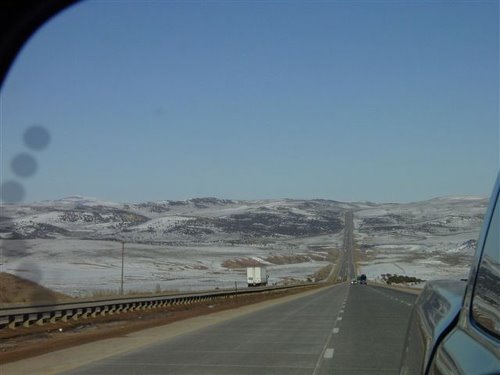
Wyoming - the 'big empty'It comes to something when an article in the New York Times is actually interesting, and even more so when the subject matter is boredom.

Written by Timothy Egan, the piece recounts how in Cody, Wyoming, barely five people per square mile live on the high, wind-raked ground. The entire state is a small town with long streets, as they say. The open space means room to roam and a sense of frontier freedom.

But, it also means that on any given night, an unusually high percentage of young people here are drinking alcohol until they vomit, pass out or do something that lands them in jail or nearly gets them killed.

A survey, conducted over three years by the federal Substance Abuse and Mental Health Services Administration, said south-central Wyoming led the nation with the highest rate of alcohol abuse by people age 12 and older. In Albany and Carbon counties, more than 30 percent of people under age 20 binge drink — 50 percent above the national average.

In examining behaviour in 340 regions of the country, the survey found that 7 of the top 10 areas for under-age binge drinking — defined as five or more drinks at a time — were in Wyoming, Montana and North and South Dakota.

At the other end of the scale, some of the lowest areas for under-age binge drinking were in the nation’s most densely packed cities — parts of Washington, D.C., Detroit and Los Angeles. An earlier federal study found that rural youths ages 12 and 13 were twice as likely as urban youths to abuse alcohol.

And while it may be a mystery to some why the least-populated part of the country leads the nation in the percentage of young people drinking to excess, it is no surprise to many people in Wyoming or Montana. Teenagers, police officers and counsellors offer the same reason: the boredom of the big empty.

The "big empty", as you might expect, is not exactly a problem we have to confront in overcrowded Britain, with a density that would have most Americans running for the barricades. But binge drinking we certainly do have, in our towns and cities, and an epidemic of alcohol abuse amongst our young. Furthermore, the same factor is quoted – nothing to do. They are bored.

This very issue came up earlier this year during a general election hustings meeting in North Shropshire, when an articulate young lady in the audience complained strongly and bitterly about the lack of entertainment opportunities for the youngsters in her town, and the failure of politicians, national and local, to address the issue.

It was actually the UKIP candidate who suggested that there was plenty do. If the young lady wanted to volunteer for leafleting duties, and any number of the multitudinous tasks involved in political campaigning, then she would be very welcome. She would never be able to complain of being bored.

The derision with which his suggestion was met by some sections of the audience was not entirely merited. You do not have to be a political nerd to appreciate that party activism can be highly rewarding and entertaining. You have a chance to meet like-minded people, to discuss and air views, and to down the odd pint or two in convivial company. And, for many decades, the Young Conservative Party was widely regarded as the dating agency for the middle classes.

But, bored as they are – or protest to be – the very last thing most young people would ever consider, on either side of the Atlantic, is engaging in the political process.

To digress slightly (alright, to digress hugely), I have never understood what it is to be bored. As I youth, I lived the greater part of my life in a top-floor three-bedroomed flat, sharing a room with my brother and with two sisters to contend with. We had neither television nor, in those days, computers. A "radiogramme" came only later - our first one, hillariously, bursting into flames when it was switched on. But bored I never was. In a slightly impoverished middle class family, we were perpetually short of cash and I had to earn my own pocket money. With cleaning neighbours' cars, delivering paraffin and a variety of odd jobs, my Saturdays were frenetic with activity. On a good week, I could earn as much as two whole pounds.

In the week that the Airfix model company has gone into administration, I have to record that the main object of my expenditure was Airfix kits and it is a measure of my relative wealth that, in those days, a basic kit cost a mere two shillings – 10p in new money.

But it was not just the making – with two long-standing friends, we developed an extraordinarily sophisticated war game, each of us with our own model armies – strictly to scale, courtesy of Airfix – and the latter parts of Saturdays and Sundays would often be spent locked in mortal combat.

With three equally matched armies, funded by equal levels of wealth, the object was for any one to beat the other two, which was usually done by setting the other two against each other and then mopping up the survivor. It was either that or two would gang up against the one, but you would try to make sure your temporary ally took most of the losses so that you could move in afterwards and finish him off. For Machiavellian deviousness, it had more in common with three-dimensional chess.

For the long holidays, around the family vacation, there was always the Combined Cadet Force – with which we were blessed at our school. By the time I was sixteen, I had earned my gliding license, had attended a signals course in Catterick, North Yorkshire, an Engineer course in Chatham, when we had the youthful delight of blowing things up, and a Royal Logistics course where I had the terrifying experience of driving a 3-tonner round Regent Street Barracks - the first time I ever took to the wheel of a vehicle.

There were also annual camps, one of which was in Gutersloh, Germany, where we had the exhilarating experience of flying high speed at low level over the tank ranges in an 18 Squadron Wessex helicopter, with the added frisson of the pilot practising engine failure procedures and flying on one engine.

By the time I was eighteen, I had completed a flying scholarship, qualifying for a private pilot's license long before I could officially drive a car – although I had then been driving Land Rovers and one-tonners on airfields for some years. Bored? I did not know the meaning of the word.

So much for the digression – it seems to me that boredom is a state of mind. Even when not active, there were always books. I stripped the local library clean of books, and then ordered more when I had read all the titles available. There was never enough time in the day. As for drinking. Forget it – there were too many Airfix kits to buy and make.

But now it is, when there are possibly more opportunities then ever in the history of mankind for entertainment and self-enrichment – not least radio, television, cheap telephones, computers and the internet, to say nothing of books that have never been cheaper and more easily accessible – we are bored.

Not only that, at all levels, we are too bored to engage in the political process, too bored to go out and vote, too bored to get upset about the latest inadequacies and dishonesties of our politicians. Instead – adults as well as our gilded, pampered youth – we go out and get "hammered".

What is wrong with our society? Is this the way our civilisation ends – in a pool of vomit, spilled out onto the pavement from over-indulgence?

COMMENT THREAD

The realities of power

In a democracy, the ultimate power rests with the people, who hold their government to account during elections, voting them out of office if they fail to perform or do things of which they disapprove. Or so the theory goes.

What then of the news that the EU yesterday began paying aid to the Palestinians? It is making "social allowances" payments to 625,000 public employees who have been "left unpaid and impoverished" because of the financial crisis besetting the Hamas-led Palestinian government.

We are told that the funds - made through a programme overseen by the World Bank - bypass the Palestinian Authority government and benefit "those who have suffered a significant loss of income" when much foreign aid and some of the Palestinians' own revenues dried up after Hamas came to power earlier this year.

Besides direct cash payments of about $347 to each person, EU money will finance Palestinian health services and utilities, notably fuel to run generators.
Among the 625,000 Palestinians now receiving direct financial support are 11,500 health workers who are no longer being paid, says EU External Relations Commissioner Benita Ferrero-Waldner.

Stepping aside from the specifics for a moment, the key issue here is that the money is being transferred by the EU. The report says that the EU is making the payments but, in the final analysis, the EU does not have any money other than is what is paid to it by its 25 member states. In other words, it is not EU money at all – it is member state money. And, on the basis of our gross budget contributions to the EU, about 12 percent of that is British – delivered by British taxpayers.

Now, I am a taxpayer and a voter. What if I disapprove of payments of my money made by the EU to the Palestinians? Well, if it was my government making these payments, I could object through the "usual channels" and, if I felt strongly enough about the issue, I could launch a campaign.

In the way of things in the democratic process, my exertions and those who I had convinced to support me - could make a sufficient difference to tip the government out of power. Even with out that, the fear of that happening could well make the government think again about what it was doing.

But this is the EU. I could campaign all I like, for as long as I like. By some miracle, I could gain the support of all the voters in the EU and I could even get the government to agree with me wholeheartedly.

It would not make one whit of difference. The EU does not need the specific approval of the British government to make these payments, and nothing the British government could do would stop them. In this respect – and many others – the EU is a law unto itself.

As it happens, I do disapprove of payments being made to a people which have voted a terrorist organisation into government. In fact, I object very strongly. And, if that was their democratic choice, then, in a grown-up world, there are consequences (not least a three day garbage collection strike – illustrated). Another of those consequences is me - and many others like me - wishing to exercise our democratic choice by not paying them any money.

Except that, in that very important respect, we no longer live in a democracy and we have no choice. Funny thing that – the Gaza territory run by a terrorist organisation is, in theory at least, probably more democratic than the country in which I now live.

Theory it may be – but that is also the reality. And I am not a happy bunny.

COMMENT THREAD

Friday, September 01, 2006

Not on this planet

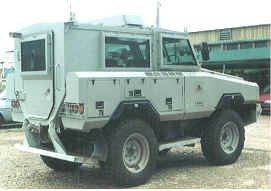
The Alvis 8 in Bosnia - claimed by Drayson to be an RG-31Regular readers will recall our campaign on "Snatch" Land Rovers and our calls for more better armoured vehicles, in particular the mine-protected RG-31 used by both US and Canadian forces.

During this campaign, it emerged that the MoD had already purchased a fleet of 14 RG-31 type vehicles - the precursor version called the Mamba (although they were also called the Alvis 4 and 8 series) – for use in Bosnia.

As a result, through MP Mike Hancock, questions were put in to find out what happened to these vehicles, knowing that some were actually in use in Iraq, being used to protect US diplomats travelling between Baghdad International Airport and the Green Zone.

The answers were picked up by Scotland on Sunday last week and make fascinating reading. It seems that all the vehicles in the fleet, which originally cost £4.5 million to buy, were sold abroad for the princely sum of just £44,000. Nine went to Estonia, four to "a US company" – which we know to be Blackwater Security Consulting - and one to a company based in Singapore.

Even now, though, the MoD is still attempting to put their "spin" on the deal. It claims that the modifications of the Mambas left them "too heavy" to go on patrol. This, as we know, was the addition of underside armour to deal with the TMRP-6 mine threat, the armour having been developed specifically for the MoD by a South African technology company (see right).

But we also know, from an exchange of e-mails with some of the soldiers who operated the vehicles out in Bosnia that they remained perfectly serviceable with the additional armour. Latterly, we were told that the real reason for the claimed "maintenance problems" was that the UK supplier, Alvis, had withdrawn technical support for the model - for reasons we know not why.

The Scotland on Sunday paper remarks that while the financial loss to taxpayers is another embarrassment for the MoD, but adds, "far more serious is the suggestion it could have put the lives of British troops at even greater risk."

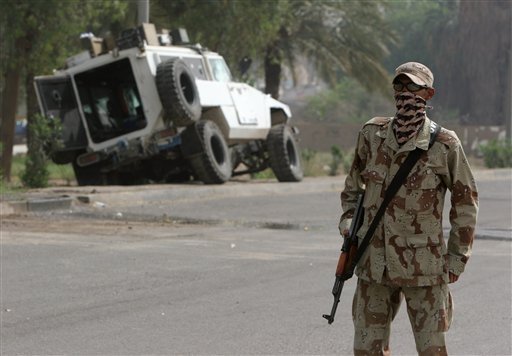
Bound for the airport on the way from the Green ZoneFor sure, 14 vehicles would not have made much difference in Iraq, where over 200 "Snatch" Land Rovers are operating, but even they could have helped. At least one death, for instance, was attributed to a Land Rover ambush, where the vehicle was being used to ferry an officer from the British base to the airport – precisely the use to which the Mambas are currently being put by Blackwater Security Consulting. And, as we also know, Blackwater vehicles have survived at least two IED attacks (see picture below).

A Mamba damaged by an IED - the crew and passengers escaped unscathedTory defence spokesman Gerald Howarth insisted that the government should have kept hold of its Mambas when it had forces in such danger in Iraq and Afghanistan. He told Scotland on Sunday that, "To flog these vehicles so cheaply when there must have been a reasonable chance of them being usable in both Afghanistan and Iraq is unforgivable." He is absolutely right on this. As have Blackwater Security done, the additional armour could have been removed for the different theatres where there was no TMRP threat, and the vehicles would have been perfectly usable.

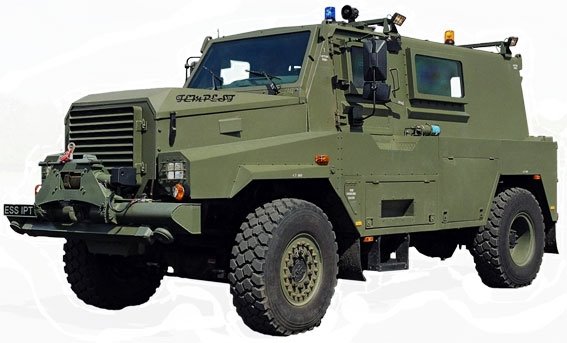
The British version of the Cougar - aka 'Tempest'But, perhaps, an equal scandal is that the replacement vehicles – the Tempest MPVs, on which the US Cougar design is currently based, were not used in Iraq beyond the initial "war" phase of the invasion. The eight purchased have now been returned to the UK, pending despatch to Afghanistan.

It is decidedly ironic – if not tragic - that, having recognised the potential of these vehicles nearly four years before the US forces realised their value, the Army failed to exploit them. Only now, is the MoD buying a hundred to supplement the "Snatch" Land Rovers – with deliveries to start at the end of the year.

All of this, though, simply reinforces the wide-held and accurate view that, when it comes to understanding the equipment needs of our troops, and managing the procurement process efficiently, the MoD is simply not on this planet.

COMMENT THREAD

Press Complaints Commission

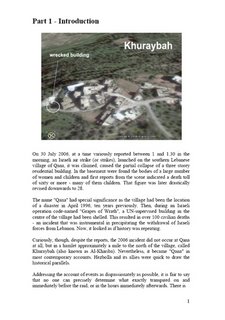
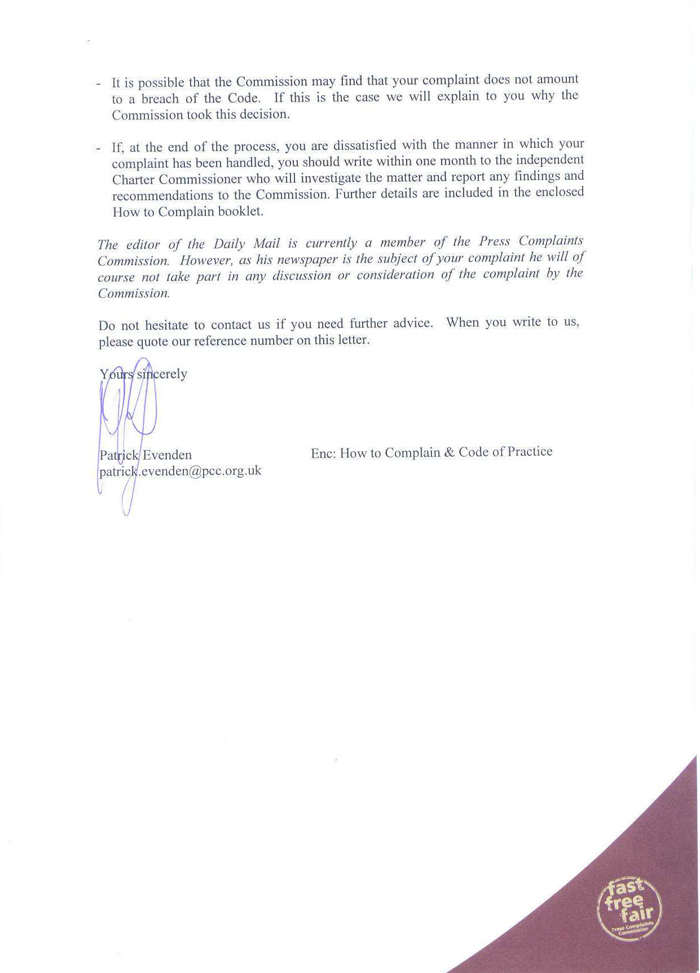
Double-click to enlargeThe immediate furore of the "Qanagate" affair has died down and attention moves elsewhere – that is the way of the world. But, as any old campaigner will tell you, that is when the work really starts.

Publishing the details and stoking up huge – and entirely justified – outrage at the behaviour of the media is one thing but, on its own, it means very little. Nothing has actually changed and, in fact, all we have seen, publicly at least, is the newspapers and agencies harden their positions and go into denial.

Furthermore, in the final analysis, nothing will change until and unless the players are forced into admitting they were wrong and are then forced to make changes.

Past the ten-day wonder phase, therefore, a campaign to achieve change takes on the aspect of trench warfare, pushing, probing and skirmishing, without any great dramatic breakthroughs which will grab the headlines.

To that effect, we prepared our report and, at the beginning of this week, submitted a formal complaint to the Press Complaints Commission. Today we received a response (illustrated), which confirms that we have passed the first hurdle – the complaint has qualified for acceptance and the Commission has agreed to "look at it".

The complaint itself is directed at four newspapers, The Independent, the Guardian, The Daily Telegraph and the Daily Mail, but the Commission has indicated that it will, as requested, "widen the investigation" if it considers it necessary.

This is good news as far as it goes. But, these are early days yet and we have only passed the first hurdle. There are many more and the outcome is by no means certain. Nevertheless, this is by no means the only shot in our locker, and others are also taking up the cudgels.

We will keep you informed of developments.

COMMENT THREAD
An international crisis


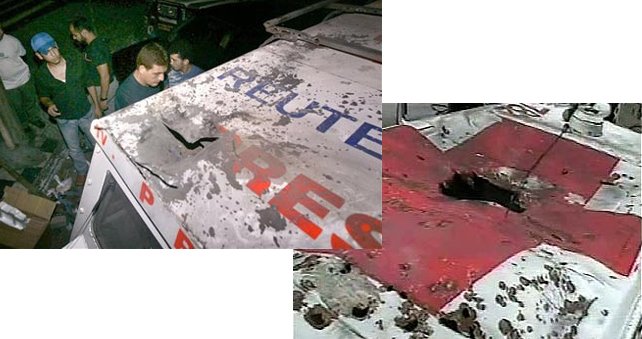
In addition to all the other suspect material produced by the media during the war in Lebanon, not least "Qanagate" and the Beirut bombing photo doctoring, first reported by Little Green Footballs (which now has a comprehensive list of links on the top of the page), we also now have the fake ambulance incident, superbly analysed by Zombietime, with a shorter article here.

And, to add to that, we have the Reuters Land Rover saga, the one that was supposed to have been hit by Israeli missiles. Well, Ynet News has reported on the superb debunking done by Confederate Yankee (and here), demonstrating that, whatever did hit the vehicle, it was not a missile.

All of this, and much, much more points to a crisis is journalism – which is much deeper than these headline issues indicate – as we have tried to show in our other posts, for instance here.

However, you really must give it to the international edition of the Helsingin Sanomat. It has put its finger on a far more serious crisis, which could have massive international ramifications and shake the European Union to its very core.

Sent to us by one of the blog's new friends, Fred Fry International, the report tells us that the European Chemicals Agency (ECA), which is scheduled to begin operations in Helsinki from 2007, is under threat – from a serious shortage of high-class rental housing. This could possibly delay the start of operation.

It seems that the seconded Eurocrats, unused to slumming it in distant lands, are demanding high-class furnished apartments which are currently not easy to come by. There is simply no high-class rental housing market in Finland and the 40 employees of the ECA already in place (with another 300 to come) are seriously unhappy.

Although the office building has already been rented - the former headquarters of the Eläke-Varma insurance company in downtown Helsinki (pictured) – it looks as if the Finnish government may have to be enlisted to help the poor, deprived Eurocrats if the ECA project is to get underway on time.

You have to admit it – this is really worrying. Or perhaps it is just another reason why we find it so very hard to take the EU seriously.

COMMENT THREAD