Wednesday, December 07, 2005

The death of a policy

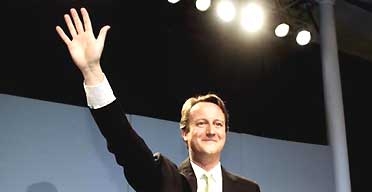
Today, in the House of Commons, the newly anointed Conservative leader, David Cameron, will face his first serious policy challenge – and he will fail.

No, I am not referring to the much-hyped prime minister's questions, but an event shortly afterwards, that will be almost totally ignored by the popular media. This is the annual debate on fishing policy which precedes the December EU fisheries council.

The funny thing is that Cameron will not even be there. The Conservatives will be represented by the shadow fisheries minister Owen Paterson, who is expected to be asked, not least by fisheries minister Ben Bradshaw and probably by a number of his own back-benchers, whether the new leader intends to honour the policy on the repatriation of the Common Fisheries Policy.

This is the policy that was first introduced by William Hague, refined by Iain Duncan-Smith and then brought to its final form in a letter from Michael Howard on 10 June 2004, when he declared that:

We are determined that the next Conservative government will establish national and local control over fishing. We intend to raise this in the Council of Ministers at the first opportunity and I believe we can achieve this through negotiation. However, should negotiations not succeed, it remains the case… that the British Parliament is supreme and we would introduce the necessary legislation to bring about full national and local control.
This declaration was given clothes by a detailed opposition green paper, launched on 10 January 2005 and, as of last night, still on the Conservative Party website, although probably not for very much longer.

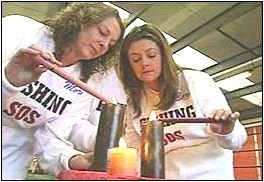
And when, today, expectant MPs of both sides of the House, look to assurances from Paterson that the policy, endorsed by three leaders in succession, is still in place, they will not get them. The "modern, compassionate" Conservatism of the new leader does not extend to the likes of the Cod Crusaders (left) or any British fishermen, their families or those who depend on them.

For those Tories who voted for the man and who are now braying for a change in the Party, they are going to get it – sooner than they think. But it is not only change they will get, but the death of a policy. With that will go the last, best hope of the British fishing industry.

COMMENT THREAD

Tuesday, December 06, 2005

Maybe this time they'll be lucky

The least unexpected political development of this year has finally happened: David Cameron has been anointed as leader of the Conservative Party and we shall wait to see what happens when the media, which has been giving him an extremely easy ride until now, turns on him.

We also await with bated breath the possibility that he might actually come up with an idea for an overall strategy that might, in the fullness of time, result in a policy or so.

At present there is more negative than positive in what he says. In particular, as we know from my colleague’s posting, Mr Cameron will jettison the one clear European policy of Michael Howard’s: repatriation of the fisheries.

He did, however, say that he would take the Conservative MEPs out of the federalist EPP-ED group. It is not precisely an important issue for most people in this country but over in Brussels they are getting agitated.

The point is that back in the glory days before the last European elections the Conservative Party had a cunning plan. They would stay out of the EPP, join up with some free-market, eurosceptic East European members, and, hey presto, they would have a new grouping that would rival the EPP on the right. In the event, as we know the MEPs were marched back into the EPP-ED group. Some of them huffed and puffed and even tried to blow the house down but did not succeed.

So, maybe, this time they’ll be lucky. Or so the EUObserver thinks, in a slightly breathless article, entitled Free-market eurosceptics join forces.

Unfortunately, the author blots his copybook at an early stage by describing David Cameron as a eurosceptic, something, to be fair to the latter, he has never pretended to be. Do these people really think that euroscepticisim consists of rearranging groups within the European Parliament – something that is not certain, in any case, as a number of Tory MEPs will want to stay with their Christian-Democrat chums?

Incidentally, the article also refers to the European Parliament members as EU lawmakers.

The main story is that the indefatigable and touchingly optimistic Dan Hannan has been about his usual business: collecting right-wing free-market, eurosceptic groups and think-tanks from across Europe but also including Israel and the United States, into something called “Alliance for an Open Europe”, initiated by a “Congress of Brussels”.

We wish Mr Hannan luck. He is very good at setting up networks and they do have a great deal of use in that people who have somewhat similar views can talk to each other, exchange opinions and plan future events, though even EUObserver notes that right-wing parties from Eastern Europe, such as the Polish Law and Justice, sometimes have different political attitudes from their western counterparts.

What this particular motley network of variegated participants will achieve, remains to be seen.

But we cannot help feeling that all this excitement is a touch premature and if it is predicated on the notion that Mr Cameron is a eurosceptic who has some ideas about European policy, then it is best not to hold one’s breath.

COMMENT THREAD

The coalition of the emitting

Apologies to those who could not get on the site last night. Blogger has recently upgraded its server and, in the nature of things, one suspect that they had a few glitches to sort, hence the lack of access.

Anyhow, with the attention of Brown’s pre-budget statement – with the realisation dawning that he has steadily been wrecking the economy – and (at the time of writing), as we expect the coronation of Cameron as leader of the Conservative Party, it is an opportune moment to visit Mark Steyn’s column in the Telegraph.

Steyn has been doing something he does well, keeping an eye on what he delightfully calls the "eco-cultists", they being gathered at the Montreal climate conference, from where our columnist suggests the headlines are getting a little "overheated".

Far be it for me to re-invent the wheel, as Steyn's points are his own, and are best read in the context of his whole article, but once again what comes over is that Kyoto, far from being an attempt to "save the planet" is really another dreary exercise in Bush-bashing and an opportunity to indulge in the anti-Americanism, in which the cultists find so much comfort.

But what stands out – apart from the pen-picture of "apparently sane people" walking around "protesting about global warming in sub-zero temperatures" – is the news that, in the past third of a century, the American economy has swollen by 150 percent, automobile traffic has increased by 143 percent, and energy consumption has grown 45 percent. Yet, during this same period, air pollutants have declined by 29 percent, toxic emissions by 48.5 percent, sulphur dioxide levels by 65.3 per cent, and airborne lead by 97.3 per cent.

Despite signing on to Kyoto, European greenhouse gas emissions have increased since 2001, whereas America's emissions have fallen by nearly one per cent, despite the "Toxic Texan's best efforts to destroy the planet".

Had America and Australia, writes Steyn, ratified Kyoto, and had the Europeans complied with it instead of just pretending to, by 2050 the treaty would have reduced global warming by 0.07C - a figure that would be statistically undetectable within annual climate variation. In return for this meaningless gesture, American GDP in 2010 would be lower by $97 billion to $397 billion - and those are the US Energy Information Administration's somewhat optimistic models.

Steyn also hits on the negativity of the "eco-cultists" who would see the destruction of the human race in order to "save the planet", an aspect of "self-loathing" that I have observed with animal rights activists. It seems to me that they do not love animals so much as hate people – although, at times, you can see their point.

The point Steyn makes, of course, is that to maintain and improve the environment, first of all you need a successful economy and, for all their cant, the Europeans have dismally failed in this, leaving the Americans to out-perform them on every front. That, in part, explains their irrational jealousy, but only in part.

But, as always, Steyn has just the words – "Wake up and smell the CO2, guys. Sayonara, Kyoto. Hello, coalition of the emitting," he concludes. Nice payoff: "coalition of the emitting". That is one to savour.

COMMENT THREAD

The pork barrel rolls

Following on from our reports (here and here) on how the EU's Galileo satellite navigation system was running into trouble, after a dispute over sharing out the development and construction work, the project now seems back on track.

According to an AP report, European governments agreed yesterday how they should carve up the jobs and work for the €3.6 billion project, thus ending months of bickering.

The company running Galileo will still be headquartered in Toulouse, France, but Germany's Transport Minister Wolfgang Tiefensee has announced that Germany, the largest sponsor of the project, would host two of Galileo's control centres. German companies European Aeronautic Defence & Space Co., T-Systems, Deutschen Zentrum Luft- und Raumfahrt and Foerderbank Bayern would play a large role in the project through a consortium called TeleOp, he added.

The British, you will all be pleased to know, has been allowed to manage the "administration" from a site in Britain – presumably counting the paper-clips – as its reward for its estimated £400 million contribution to the project.

The EU is now going full steam ahead plans to launch Galileo's first test satellite in December and the full network is still due to go into service in 2008. The first Galileo satellite must be launched by February 2006 for the EU to retain the frequencies allocated by the International Telecommunications Union.

However, the full the 25 member states have not yet agreed to cough up with the additional €700 million further financing, the lack of which was stalling the project but, nevertheless, the EU is already pressing ahead with plans for the launch of the first test satellite, as indeed it must.

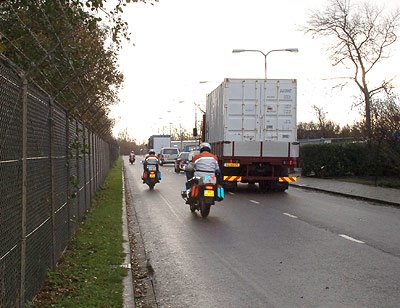
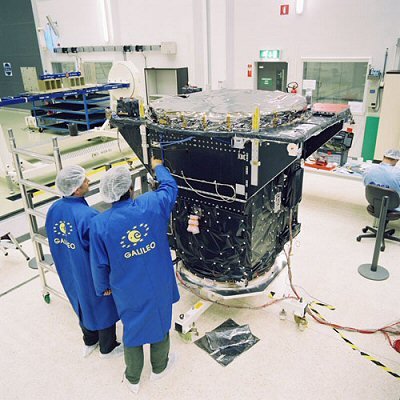
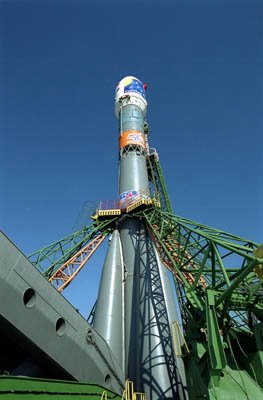
Code-named GIOVE A (Galileo In-Orbit Validation Elements), it left the ESA's test facility at the European Space Research and Technology Centre in the Netherlands on the morning of 29 November. It was taken by road from the European Space Research and Technology Centre (ESTEC) to Amsterdam’s Schiphol airport, where it was loaded onto an Antonov transport plane, destined for the Baikonur Cosmodrome in Kazakhstan, where it will be launched by a Soyuz rocket later this month.

Meanwhile, no doubt with an eye to the profitable military equipment sales to China that it expects to emerge from a successful deployment of Galileo, the French today renewed their calls for the EU to drop its arms embargo on China, again describing the ban as an anachronism, this time during a visit by Premier Wen Jiabao. "We will continue to work for it to be lifted," says prime minister Dominique de Villepin.

COMMENT THREAD

Monday, December 05, 2005

The European history of Europe

In its never-ending desire to educate the recalcitrant masses of Europe (that’s us, dear reader) the euro-elite has put together a new series of historical studies, entitled “The Making of Europe”. It is edited by the French mediaevalist Jacques Le-Goff.

In itself, there is nothing wrong with the idea or the title. After all, there have been numerous history books in the past, called “The Making of Europe”, “The Making of Modern Europe”, “The Making of Feudal Europe”, what you wish. This series, I suspect, is there to show that there has been a seamless “European” history from Rome to Rome. (Republic to Treaty).

It would seem that Greece comes into it somewhere because, as the great doyen of Russian and Soviet studies (and poet, and science-fiction writer, and political analyst), Robert Conquest, points out in today’s Wall Street Journal Europe [subscription only], there has been a row about one of the volumes.

This volume is about democracy and was written by an Italian professor of classical philology at Bari University, Luciano Canfora. In Italian the book was called La Democrazia: Storia Di Un’Ideologia. It has now been published in Italy, France, Spain and Britain. For some reason, the English edition has a somewhat different title: Democracy in Europe: A History.

Why Professor Canfora, who is described as “distinguished” but in the field of classical philology, should have been asked to write a book that is mostly about modern political history is something of a mystery. The mystery deepens when one takes note of the good professor’s political views.

A quick look at the summary and table of contents, provided by the publisher, Blackwell Publishing, leaves one slightly puzzled. For instance, the last two points of the brief summary are:

Considers fascism and its consequences for democracy in Europe during the twentieth century.

Demonstrates how in the recent past democracy itself has become the object of ideological battles.
Um. Interesting. The book considers fascism and its consequences but not, apparently, communism. Perhaps that did not have consequences? Clearly, Professor Canfora does not think so.

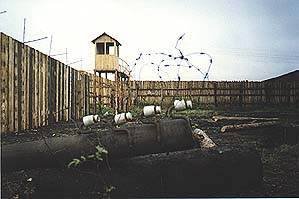
Chapter 9 of the volume is entitled From the slaughter of the Communards to the “sacred unions”. The Paris Commune and its immediate aftermath engulfed parts of France in a very nasty civil war. However, slaughter? A somewhat emotional and one-sided approach.

Moving on to other chapter headings we get the following:

Chapter 13 is entitled: Progressive democracies, people’s democracies, while chapter 14 is The cold war: democracy in retreat. Curiouser and curiouser, as Alice said. So, um, the people’s democracies a.k.a. Soviet colonies, are there in the history of democracy and the cold war was a retreat for democracy. Presumably, it was western victory in the cold war that was the actual retreat.

It appears from Mr Conquest’s article that the book is even more shocking than the brief summary and the table of contents might indicate. Indeed, so rampant is its Stalinophilia, that the German publisher, C. H. Beck refused to publish it and returned the rights to the author.

Needless to say, both Professor Canfora and Professor Le-Goff raised a fuss, accusing Herr Beck of exercising censorship, because a publisher, they insist must honour a contract. Neither of those statements is true. Publishers frequently go back on promises to publish when they actually read the text of the proposed book and censorship is not defined by one firm refusing to publish.

As it happens, Mr Conquest gives a lengthy analysis in his article of what censorship really is. He has to do so because there is no reference to the organization he mentions, Glavlit, in La Democrazia.

“As to the charge that the rejection of the is book amounts to censorship, it is a pity that the author did not cover the Soviet censorship machine – Glavlit – with some 70,000 employees (whose approval stamps appeared on almost everything printed in the USSR, even including bus tickets). Nothing in the least anti-Stalinist could be published. But even the rest had to be intensively checked.

As to books, after two “preliminary” checks, 28 pilot copies were sent to a number of ministries, including those of Defence and Security (MVD) – who also were sent three copies of “artistic, socio-political, children’s and instructional literature”.

After further inspection permission to print was given, with the first “obligatory copies” given to the MVD and the central Book Chamber of the RSFSR.

Several more steps preceded release to the public. And this could all be stopped at any point by Glavlit, which could seal and destroy the whole edition. There’s censorship for you! One feels that censorship as alleged in the Canfora case is a bit different.”

I’ll say it’s different. Glavlit, incidentally, also checked which books were taken out of the Soviet Union. The secret police under whichever nomenclatura dealt with the books that had been brought in.

Several of my childhood memories revolve round boxfuls of books that travelled with my family from Moscow to our home in Budapest. The books were carefully packed the evening before the journey. There was a list of them all in triplicate. One copy had gone to Glavlit for their approval, one had gone to the border gurards and one stayed with the books. Glavlit would have communicated with the border guards, who opened up the boxes and checked every single volume against their list, ensuring that nothing that had not been allowed was being taken out of the country.

I suspect there is nothing about this in Professor Canfora’s history. Professor Conquest wonders whether the chapter on the Cold War, described as democracy in retreat has

“such irrefutable material as, say, theatre’s “distinguished” Vsevolod Meyerhold’s account, from the NKVD prison, of his long tortures before execution”.

One suspects not, though the account (speaking again personally) is harrowing. I don’t suppose there is anything of the no less harrowing account of the appearance of Marshal Blücher after his prolonged torture before his execution.

Well, of course, there is nothing about it. There is nothing about the Gulag at all in the entire volume of the history of democracy, which spends a goodly number of words on attacking the USA “violently”

“for its support of “fascist regimes world-wide””.

Going on, Robert Conquest has this to say about the book’s coverage of recent history in the eastern part of Europe:

“Thus we learn, from Mr Canfora, of the negative role of Poland in failing to support Stalin. Katyn (like Gulag) does not figure in the index. We are treated to a Hungarian Revolution of 1956 in which the West is the main villain. And “hysterically anti-Soviet” opinion (particularly in Poland) is berated. (A useful guide to Stalinophilia is the use of “hysterical”, “frenzied” and “rabid” to describe non-communists.)”

We are all used to the double standard of the clever-dick great and the good (most of whom just happen to be Europhile) that demands prison for anyone who raises the slightest criticism of the accepted view of the Holocaust and shrugs metaphorical shoulders if not disappears in total embarrassment when Communist crimes are discussed.

David Irving is not only in Austrian prison but is, rightly, beyond the pale as far as serious history is concerned. Luciano Canfora who is no less guilty of peddling lies and is probably more consistent in his support for a murderous regime, has his book published in several languages as part of the more or less official history of the making of Europe.

What I find particularly depressing that while in Germany the book has been rejected with numerous writers, including the left wing historian Hans Ulrich Wehler, publicly supporting Herr Beck’s decision; while the Neue Zürische Zeitung published an article by Joachim Güntner, which agreed with Beck’s chief editor Detlef Felken that Canfora is “palliating communism”; not a word has been spoken in Britain.

Blackwell’s has happily published the English version and there has been no controversy. Why not, precisely? Why cannot a left-wing (or right-wing, for that matter) historian say as Herr Wehler did?

“In its dogmatic stupidity he [Canfora] exceeds the products of the GDR in the sixties and seventies.”

Of course, let us not forget, Professor Eric Hobsbawm, whose analysis of twentieth century history is not that different from Professor Canfora’s, is now Companion of Honour and a much celebrated “left-wing” historian, whose tendentious and inaccurate volumes are required reading in most universities. Canfora’s history of “democracy” will sit well on those reading lists.

COMMENT THREAD

The man from Brussels… he say no

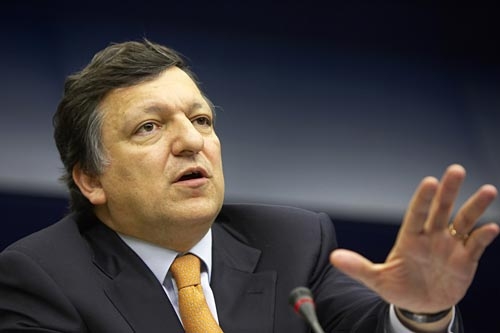
No sooner had Jack Straw formally released the details of the UK presidency's much-trailed budget plan – capping the budget for 2007-13 at €847 bn compared with a previous proposal of €871 bn – then El Presidente Jose Manuel Barroso was in front of the media condemning it.

The new proposals were "unacceptable," and "not realistic" for the enlarged bloc, he said. "This proposal amounts to a budget for 'mini Europe', not the strong Europe that we need."

The plan includes cutting the UK budget rebate by €8 bn and funds for the new member states by €14 bn, as well as proposing a review of all spending – in particular CAP subsidies – in 2009.

Barroso's response has caught even seasoned Brussels-watchers by surprise. The response was delivered at lightning speed – not minutes but seconds after Straw had delivered his proposals. And, with the man from Brussels saying "no" in such an unequivocal manner, it really doesn’t leave Blair anyplace to go.

COMMENT THREAD

Lost in space

I suppose this is an "ill wind" moment: the delays over agreeing the EU budget have had an interesting side-effect as, according to Flight International, the "colleagues" don't have the money (yes) for their grandiose plans to turn the final frontier into an EU domain.

Flight International reports that approval of the funding for the planned joint European Union/European Space Agency space programme is likely to be delayed by several months because EU states have failed to agree a new budget. The programme was supposed to have been agreed at the third EU/ESA space council on 28 November,

However, the meeting did endorse the Global Monitoring for Environment and Security (GMES) strategy, reported last month as an EU plan to build a network of spy satellites.

Nevertheless, uncertainty over EU resources for space has led the European Space Agency to prepare a twin-track budget for its December ministerial council. If the money isn't forthcoming, could we be looking at a fire sale?

COMMENT THREAD

A straw in the wind?

The Middle East Media Research Institute (MEMRI), who were the first to gather information about the oil-for-food scam before Claudia Rossett spread the story far and wide, have found an interesting new document.

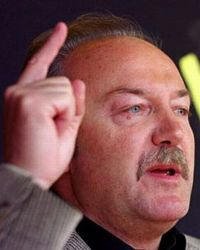
The Iraqi author Fadhil Rashad has called for the trial of George Galloway MP, on charges of robbing the Iraqi people. Here is a taster of what he said on the Al-Jiran website:
"It is a truism that money can blind one to the truth… I know that George Galloway knows the truth, and that he is well aware of the [crimes] that Saddam perpetrated against his own people and against the neighboring countries. However, he turns a blind eye to them, because he wants to make the whole world turn a blind eye to them and to overlook the oil vouchers that he himself received from Saddam.

I want to say in this article: George Galloway, leader of the Respect party - you defend your friend and benefactor Saddam and you will yet be tried just like your friend and benefactor Saddam. I assure you that the Iraqi people will never turn a blind eye to those who robbed them. You robbed from all of the Iraqis what amounts to approximately 20 million barrels of oil [that you received] in exchange for misleading public opinion concerning the crimes perpetrated by Saddam against his people."
One day justice will be done.

COMMENT THREAD

The wages of sin

Reuters today reports that Airbus Industries is close to winning an order of up to 150 A320 passenger jets, in what, it says, “would be a boost for European industry during a visit to France by Chinese Premier Wen Jiabao.”

We are told that sources close to the talks said the deal would include 100 or more A320-family jets and could reach 150. The deal had initially seemed likely to be for at least 70 aircraft but talks continued after Wen arrived in France on Sunday. "We heard the negotiations are still ongoing. We heard it could be as much as 150," a Chinese airline executive said.

Crucially, the Reuters report states that French media commentators see it as a reward for improved political ties with France, which is campaigning with Germany for the European Union to drop an embargo on arms sales to China. Wen has thanked both countries for their support on the embargo, after France on Friday called the embargo an "anachronism".

France is hoping for a cluster of Chinese deals this week, including business with Eurocopter, the world's largest civilian helicopter maker, and Alcatel Alenia Space. One wonders if they are also looking for a contract for these.

COMMENT THREAD

Regime change

The Telegraph offers a robust leader this morning, calling for a regime change in Europe. Well worth a read, although we did get there first.

My colleague will be picking up on some of the points made, in a piece scheduled for today.

COMMENT THREAD

The wrong kind of corruption

An interview is published in the Austrian Die Presse, and re-published on the Romanian information site Focus-Engl, featuring Wolfgang Roth, European Investment Bank (EIB) Vice-President in charge of Central Europe and the EU candidate countries. The interview with Roth is entitled "We Don't Fund Corruption".

The investment arm of the EU pumps lots of money in the new member states. Last year, for example, contracts were signed for loans amounting to €3 billion and €570 million. A great amount of funds are also poured into Southeastern Europe: €461 million has been allotted for the Western Balkans – former Yugoslavia and Albania. Croatia only has received €200 million. Yet the sum allotted for the two candidate member states Bulgaria and Romania is less by €119 million.

When asked why the EIB invested comparatively less money in Romania and Bulgaria than in other EU-entry nations, Roth shot back: "I'm not interested in standing before the European Parliament as a financier of corruption. We were very careful there – many projects were slowed down by corruption."

Like leaves on the line, is this an example of the wrong kind of corruption?

COMMENT THREAD

Sunday, December 04, 2005

Is this the new Holy Roman Empire?

My colleague has already blogged the gloomy comparison (gloomy from our point of view, that is) between European and American economic growth from today’s Business. While the new Sunday Telegraph seems to have slightly pollyannaish aspects, its Business section leads with another story that is likely to send shivers down the spine of anyone who thinks at all carefully about our future.

The title says it all: Top public sector pay soars five times inflation rate.

“Britain's best paid public sector workers last year received average pay rises of 13 per cent - more than five times the rate of inflation and nearly three times more than their peers in FTSE100 index companies.”

The biggest rises were in the Royal Mail, Channel 4 (which is owned by the state) and the regulatory bodies, such as Ofcom and the Financial Services Authority. Not only does the FSA make life difficult for businesses to carry on, it does so earning ever larger chunks of the tax paid out by those businesses. What could be more agreeable?/p>

“Meanwhile, Network Rail, the rail operator set up by the Government in 2002, paid its chief executive £919,000 last year - a 26 per cent increase.

New Bridge Street Consultants, the leading remuneration consultant, has found that the salaries of the best-paid FTSE100 directors are slowing and rose by an average of 5 per cent last year.”

This could be, the article suggests, something of an embarrassment to Gordon Brown as he prepares his Pre-Budget Report. I don’t see why. He has never been embarrassed by details like this before. After all, it has been known for some time that the soaring expense of the public sector has consisted largely of ever higher salaries and ever more people employed with diminishing productivity.

“Since 1998, the Government has hired an additional 680,000 people, taking the total to 5.8m. The spiralling cost of public sector workers has become an increasing source of concern for the Government. Brown recently urged trade union leaders not to campaign for annual pay rises in excess of 2 per cent. Meanwhile, Members of Parliament are seeking a 22 per cent pay rise.

In the year to January 2005 earnings in the public sector rose by 4.7 per cent - compared with 3.7 per cent in the wealth-creating private sector. According to the Office for National Statistics, the average private sector employee now earns less than the average public sector worker. The Government is also under intense pressure to drop its pledge to maintain the public sector
retirement age at 60.”

In a more pollyannaish mood, George Trefgarne, the new City Editor, has informed his readers of two interesting facts.

In his Pre-Budget Report Gordon Brown will tell us that globalization was made for Britain, who can benefit enormously from the historical ties with India and China (one wonders what he means about China – the Opium Wars?) and from their cheap exports.

It seems a little unlikely that a country, where 45 per cent of GDP is spent on the public sector, which is getting ever larger and fatter while the private sector is overburdened by taxes, will benefit from globalization. According to Mr Trefgarne, the business community is in two minds about the Chancellor’s blue-sky thinking:

“Although most businesses will welcome Brown's vision, many are angry at the standstill in the domestic economy and the rising tax burden. The Pre-Budget Report will include another downgrade of growth this year to under 2 per cent, which Brown will seek to blame on the slow growth of the European Union, the high oil price and the flatlining housing market.”

Mr Trefgarne’s other piece of information is about the meeting of G7 finance ministers,

“where a significant breakthrough in trade talks was achieved. Brazil indicated that it could improve access to its goods and services markets if the EU and America reduced their agricultural subsidies. That brings a deal at the World Trade Organisation meeting in two weeks a little closer.”

Indeed. However, it ought to be pointed out that what has been holding up a deal is the EU’s refusal to match America’s offer to reduce agricultural subsidies. Just how little is that little by which the deal is brought closer?

It became clear some time ago that Britain’s economy is heading the Continental way and the superior attitude adopted by the Chancellor of the Exchequer is somewhat misplaced.

Other aspects of our political structure are heading the same way, too. All this is rehearsed in another article in the Sunday Telegraph by Professor Niall Ferguson, who reminds us that Friday was the 200th anniversary of the Battle of Austerlitz, which ended the pre-revolutionary European order for ever.

“By routing the combined armies of both Austria and Russia, Austerlitz enabled Napoleon literally to redraw the map of Europe, conjuring up a new Confederation of the Rhine from the Baltic to the Alps. Moreover, by obliging the Austrian Emperor Francis to renounce the title of Holy Roman Emperor, Napoleon snuffed out an institution that had been at the heart of Europe for more than a millennium. Charlemagne had been crowned emperor by the Pope on
Christmas Day, 800. On August 6, 1806, that empire ceased to exist.”

While numerous historians have seen the Napoleonic order as being far more enlightened than the one he had “snuffed out”, Professor Ferguson does not share that view, pointing out that l’Empereur set up an oppressive system all of his own:

“Napoleon's idea of Europe was double-edged. On the one hand, he overthrew decadent dynasties like the Bourbons of Naples and established what was to become the model for Continental legal systems, the Code Napoléon. Later,in exile, he claimed that he had "wished to found a European system, a European Code of Laws, a European judiciary", so that "there would be one people in Europe".

Yet at the same time, Napoleonic Europe was without question an authoritarian empire. He had no qualms about censoring his critics and imprisoning political rivals. The raison d'être of his rule outside France was simply to pay for his wars. Napoleon liked to portray himself as Europe's liberator as well as its unifier. In truth, he was merely the most ruthless of the "enlightened despots".”

However, the end of Napoleon’s empire did not mean the end of Bonapartism in the legal and political sense, and that, according to Professor Fergusson is what makes it so difficult for the British and the Continentals to understand each other, at least, in theory:

“Napoleon fell; Bonapartism lived on, with the civil code and economic dirigisme as perhaps its most enduring legacies. And how they have endured! Ask yourself what are the biggest differences between Europe and England. The answer is that they have Napoleonic law and economics and we, whom he did not conquer, have the common law and the free market.

Which is why Tony Blair must often feel that Boney's ghost has come back to haunt him. As Prime Minister of the country that currently holds the Presidency of the European Union, Mr Blair not unreasonably expects to play a leading role in European affairs. Yet his efforts to reform the EU's budget have brought him into collision with almost everyone who has an opinion on this
famously baffling subject.”

As most historical generalizations, it ain’t necessarily so. Economic dirigisme was not invented by Napoleon, though he may have codified it. Mercantilism had a long existence in these islands as well but the ideas of free trade caught on here a good dal faster than on the Continent, despite several outstanding French and German theoreticians.

The idea of Tony Blair actually understanding, let alone upholding free trade or common law is laughable. And, of course, as Professor Ferguson points out, things have changed in Britain as well:

“Yet perhaps, on reflection, it is not quite right to ascribe Mr Blair's difficulties to the persistence of the Bonapartist tradition on the Continent. For one thing, I am no longer sure how committed we British really are to our own legal or economic traditions. The sovereignty of Parliament and
the traditions of common law have already been substantially eroded as a result of European integration, which has made the European Court of Justice supreme over our judges. As for the spirit of Adam Smith, as Andrew Neil argued in his excellent Hayek Lecture at the Institute of Economic Affairs last week, that you are more likely to encounter it in Beijing than Britain.”

The other side of his argument is that it is not so much Napoleon’s empire that has been reborn but the Holy Roman Empire, famously described by Voltaire as being neither holy, nor Roman, nor an empire (but an unholy mess, added a much more recent historian in my hearing).

Professor Ferguson plays on those words by pointing out that it is not clear how long the EU will go on being European and it certainly is not united. Perhaps a Eurabian Disunion, he muses.

At this point Professor Ferguson begins to display the usual ignorance of the very clever. Having drawn this witty parallel, he has to prove it and that is not so easy. After all, the Holy Roman Empire had ceased to be a state that legislated for all its members or insisted on centralized control centuries before it was finally abolished by Napoleon.

Parallels with the European Union that is gathering more and more power at the centre do not work, no matter how hard Professor Ferguson tries and how many links he can show:

“In his 1667 treatise De statu imperii Germanici,Samuel Pufendorf described the Holy Roman Empire as "a body that conforms to no rule and resembles a monster". I have often thought that this description could equally well be applied to the EU. Like the Holy Roman Empire, it has a relatively weak legislature - the Reichstag was the Holy Roman Empire's equivalent of the Strasbourg parliament.

Like the Holy Roman Empire, its court is a more important institution - though the Reichskammergericht had a rival in the Reichshofrat, just as the European Court has an alter ego in the European Court of Human Rights. And like the Holy Roman Empire it is always in the process of reforming itself, without ever quite getting there.”

I am rather sorry I am unlikely to hear any of Professor Ferguson’s lectures. They must be highly entertaining and seriously infuriating. What kind of an analysis is that? Does the man really think that the Strasbourg parliament is the EU’s real legislature? What happened to the Commission, that European equivalent of the Napoleonic civil service, that does far more than just obeys its political masters? In fact, they are the political masters. If this is the best our leading historians can do, we are in a sorry state.

The truth, I suppose, is that the EU is a rather frightening amalgam of the two: it is the Holy Roman Empire reborn with a Napoleonic political and legal system. Not having a bumptions little caporal at the head of it, it does not indulge in military conquests. The Holy Roman Empire was not the only state Napoleon destroyed – he finished off France as a serious military power.

Instead, the two ideologies have united and spread well beyond the boundaries of both empires without a shot being fired. Eat your heart out, Boney!

COMMENT THREAD

Amateurs of the press

Having been rather unkind to Charles Moore yesterday, for his schoolboy howler on Defra, my colleague reminds me that this sort of error is not solely the fault of the author.

On any newspaper, there is a hierarchy of sub-editors, editors and lawyers, all of whom are supposedly dedicated to ensuring the highest standard of accuracy. Any lapse, of the Moore variety, therefore, very much represents a corporate failure.

In my time, I have worked for many editors and with many subs. Many times they have picked me up on points of fact, even when I have been writing to my specialisation, and I have had to justify my claims and, sometimes, correct errors.

On the one and only time I managed a front-page "scoop" – fingering a finance officer embezzling funds from the institution that employed him – I had to travel down to London with all my supporting documents and spent a gruelling eight hours with a lawyer, before the paper would agree to print the story.

It is with a profound sense of irritation, therefore, that one sees so often now a succession of factual and logical errors in newspapers that should know better – it is an affront to the other professionals who work so hard to check their fact, and the many other writers who take the time and effort to ensure their copy is as accurate as it can be.

Classic of the error-strewn genre – and a serial offender – is Simon Jenkins, whom my colleague picked up the other day, making an outrageous howler over Bush and Blair and the timing of the bombing of the headquarters of Serbian television during the Kosovo war.

And here he goes again, in The Sunday Times today, entitled "Airy-fairy Blair lies in a French ditch looking at the stars". This is Jenkins analysing the EU budget controversy, to which effect he offers the view that Britain’s original strategy for its six-month European presidency was ambitious but sound: to secure a grand deal on the budget… "the 2002 CAP reform would need tearing up."

Never mind that, even at the time, informed commentators (including this Blog) were arguing that this was impossible, Jenkins then goes on to argue that, with the refusal of France to give inch on CAP reform, "it is puzzling that Blair can have expected otherwise." In other word, even by his own estimation, Blair's original strategy was not sound. Jenkins destroys his own thesis, making his arguments nonsense.

If these logical convolutions make a mockery of good journalism, what price then the dire piece by John Laughland in The Sunday Telegraph where, in a piece about the CAP, he asserts that, "the main lines of the EU budget were drawn up after 1958. EEC negotiators suffered several heart attacks, one of them fatal, as they struggled from 1958 to 1962 to set the CAP in place."

In fact, the main lines of the EU budget were not agreed until the Hague Summit of 1-2 December 1969 and the details were fixed by the 1970 Luxembourg Treaty, from which date the financing of the CAP stems, a settlement that cleared the way for British accession which, until then had been blocked by de Gaulle (who refused to allow Britain into the EEC until the budget question had been agreed).

One would expect someone like Laughland to know this but, since the fact are a matter of record, one would also expect the Sunday Telegraph to pick him up when he got his facts so egregiously wrong.

Elsewhere, Laughland also maintains that, "despite the incoherent 'set-aside' system of paying farmers both to produce and not produce, wine lakes and sugar mountains have returned to the EU in recent years," - yet another travesty. The whole point of the so-called "mid-term reforms" that are just coming into force, is the principle of "decoupling", breaking the link between production and subsidy payment, so that farmers no longer get paid for how much they produce. The claims made are fantasy.

Strangely, Booker, in the same newspaper, tells something of the story of the CAP and you would have thought that, in its own interest, the paper would check for consistency between what are two wholly different and contradictory accounts.

But such is the rank amateurism of not only writers but commissioning editors and their subs that, these days, anything seem to go. Yet, these self-same newspapers have the nerve to complain when politicians get their facts wrong. Picking up on my remark in my earlier posting, why should we take either of them seriously?

COMMENT THREAD

Booker

For some reason, the link to the Booker column has not been published on the main page of the Sunday Telegraph website. For those who are struggling to find it, here it is.

We will be commenting on the stories later in the day.

A high-stakes poker game?

Only a few weeks ago we highlighted what we considered a "grave and important development" – the Bush administration conceding defeat on the ITAR "waiver", under the combined assault of representatives Hyde and Hunter.

This, we predicted, could have grave implications for the UK's co-operation on the F-35 Joint Strike Fighter, causing serious problems for the carrier programme, a view shared by some of the leading commentators in the field. In fact, on this one project, we warned in my publication the Wrong Side of the Hill, rests the fate of the "Special Relationship" with the United States.

Thus, today's report in The Sunday Times is little less than dynamite, although – amazingly – it is tucked away on page three of the business section. Headed: "Britain in battle with US over fighter plane", it reveals that Britain is threatening to pull out of the JSF programme, a move, confirmed by senior defence officials.

This is put down to "rows over the Pentagon’s reluctance to agree to the transfer of technology", and also to likely increases in the price of each aircraft.

It remains a measure of how far defence has slipped down the media agenda that - despiute its profound implications for our defence policy - this is written up as a business issue, the story pointing out that the "could have serious repercussions for BAE Systems and Rolls-Royce, Britain’s two main contributors to the project."

Correctly, the piece comments that "dropping the JSF would stun the defence industry, but a senior official told The Sunday Times it was time to 'think the unthinkable".' "I know how the Americans negotiate," said the official. "They will not do a deal unless they know the other side has a serious alternative. It's like a high-stakes poker game... it's essential to have a Plan B because it's very important not to travel in hope."

The "Plan B" supposedly being worked on is a version of the Eurofighter adapted for the navy. We are told that negotiations on the "Tranche 3" Eurofighter contract, under which Britain will take the last 88 of the 232 orders, is looking at the issues needed to be addressed to make the aircraft fly from a carrier. We are also told that "sources close to the Eurofighter programme say there are no major obstacles to the operation, although some elements of the carrier design would have to be changed."

This is, in fact, complete eyewash. The requirements for carrier operations would require a major and expensive redesign of the Eurofighter. For a start, to cope with the stresses of a catapult take-off and arrester-hook landing, major strengthening of the airframe would be needed. Then, as carrier aircraft perform what are known as "no-flare" landings (basically a "controlled crash" onto the deck), landing gear must be specially strengthened, with knock-on effects throughout the whole airframe.

On top of that, navalised aircraft need special measures for corrosion-proofing, against sea spray, with the substitution of some of the more vulnerable material, which has major weight and cost implications.

As to the carriers, Eurofighter would require a catapult launch, which needs high capacity steam generation, which in turn means that the proposal to power the ships by gas turbines would be unrealistic. Furthermore, major changes to the deck configuration would be needed which, together with power plant and other changes, would dictate an almost complete redesign of the ship.

Together with the costs of converting the Eurofighters, we are looking potentially at adding billions to the bill which is already over £13 billion for the entire package, putting the whole project in jeopardy.

One does hope that this is, as the ST intimates, a high-stakes poker game but, if it is, it is one in which Britain hold few cards. The US would, from all accounts, be quite happy to dump the STOVL version of the F-35, which would indeed leave the UK adrift, with the Special Relationship and our defence strategy in tatters.

COMMENT THREAD

Decline and fall

The Business today reveals that Europe’s economies have taken a tumble in the world competitiveness league tables, while the United States and Asia’s new economic giants continue to prosper.

Its sources were a series of reports, one from AT Kearney, the management consultants, assessing the attractiveness of key cities around the world as a destination for foreign investment. China came second, followed by Malaysia, the Philippines and Singapore. The US came in at number 11, a far stronger position than the UK, which was ranked 28th. Germany and France were 31st and 35th, respectively, largely due to higher costs and weaker business environments.

Thus, despite generally high education levels and infrastructure quality, European long-term competitiveness is being gradually eroded by the high cost and rigidity of the business environment. US workers offer better value for money than those in nearly all other developed countries, including Germany, the UK, Japan and Canada. While France boasts workers with higher productivity per hour than the US, companies are not interested in hiring its workers because of excess red tape.

Another report, this one from Ashworth, shows the US economy is continuing to outperform. GDP growth was pushed up to 4.2 percent last week, and productivity growth could be raised to nearer 5 percent. Annual labour productivity growth was just below 3 percent in the year to the third quarter, a remarkable rate for this stage in the economic cycle.

Furthermore, despite the prophets of doom, third-quarter GDP figures for the US also revealed that, after excluding the effects of the recent hurricanes, corporate profits rose to their highest level relative to GDP since 1966.

Basically, Europe is heading for "basket case" status, with its workforce on the dole, while the rest of the world leaves it behind. And we still want to be part of this?

COMMENT THREAD

Saturday, December 03, 2005

Chinese walls

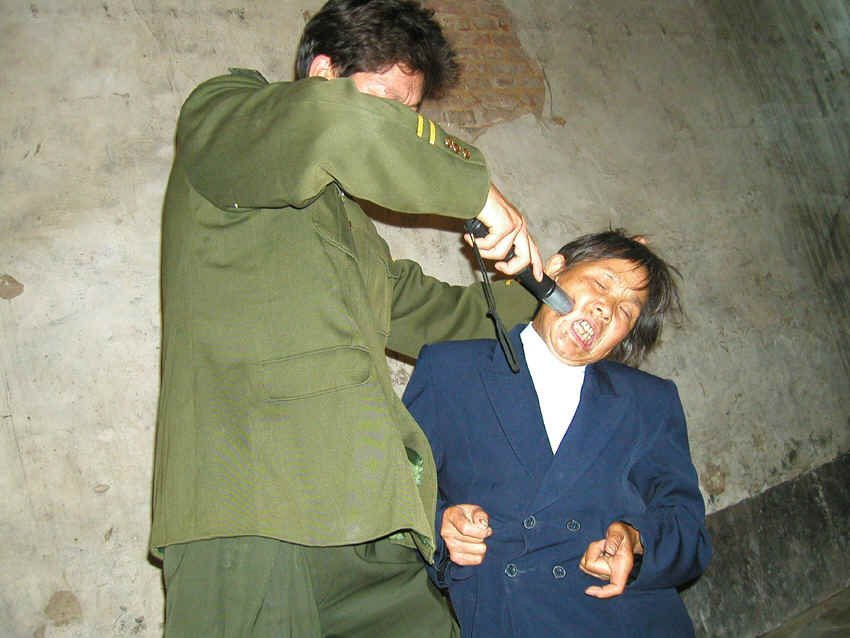
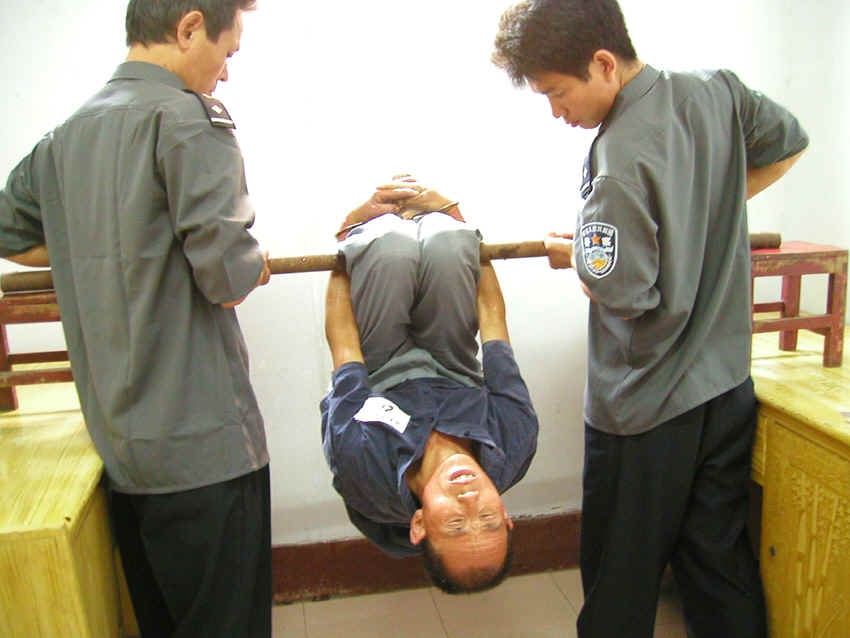
Unnoticed by a large proportion of the British media, the UN has produced a report on China and its use of torture. According to Manfred Nowak, the UN Human Rights Commission’s Special Rapporteur on Torture, the Chinese authorities had not been particularly co-operative during his fact-finding mission. (Well, you can’t really expect them to be.)

As quoted in the Washington Times:
“Mr. Nowak said Chinese authorities had closely monitored and obstructed his work, which included interviews conducted in Beijing as well as in the restive regions of Tibet and Xinjiang. "There was frequent surveillance of my interviews that I had outside prison with victims' family members," Mr. Nowak said.

He and his team were not allowed to bring photographic and electronic equipment into the prisons and their visits to correctional facilities were limited to the working hours of the staff. "As the authorities were generally announced an hour in advance, the visits could not be considered to have been strictly 'unannounced,' " said a press release distributed at the end of Mr. Nowak's visit.”
He had difficulties in talking to victims’ families and many of these were put under house arrest, intimidated or just prevented from seeing him.

Apparently, Mr Nowak had received assurances from the Chinese government that he would have full co-operation from the authorities as they had realized that there was a problem in their judicial and prison system. Beijing maintains that just allowing Mr Nowak in shows their commitment to improving their human rights record.

Alas, their obstruction of his work shows that the commitment may not be what one might term whole-hearted. Mr Nowak did manage to gather almost as much information as certain human rights groups inside and outside China had done and informed the world, on the basis of no evidence whatsoever, that torture was in decline. But it is still widespread.

One hopes this report will not spoil SecGen Kofi Annan’s visit to the People’s Republic of China. It certainly has had no effect on Members of the European Parliament, who are continuing to call for all sorts of sanctions on countries that may or may not (the evidence is weak, to put it mildly) have collaborated with the CIA in the war against terror.

One particularly vociferous MEP has been the Lib-Dim Sarah Ludford, who is also a member of the House of Lords, where she manages not to declare her extremely handsome income from the European Parliament when she speaks on EU matters.

According to Reuter’s, Baroness Ludford was one of those calling on individual member states, the British Presidency and the Commission to hold a huge enquiry into allegations about CIA prisons in some European countries and about terrors suspects being flown out from certain European airports.

She told the European Parliament’s civil liberties committee (no, it was not discussing Italian involvement in the construction of mobile execution chambers):
“I am not reassured that there is sufficient determination by the Council (of EU states) to get to the bottom of these allegations.”
I am sure the good baroness will be delighted to learn that her remarks and general attacks on the United States and its inability to wage a war on terrorists according to what other people might call Queensberry rules (I am sure Baroness Ludford abhors boxing and would not use that expression) has been reported by the Chinese People’s Daily and by the Xinhuanet News Agency.

The People’s Daily, though scrupulously reporting that none of the allegations have been proven yet, was, no doubt, delighted to report the following about our heroine and two of her colleagues:
“Baroness Sarah Ludford from Britain bombarded the US government for its way of launching the war on terror. Washington had made " disappearances a US tactic" and the anti-terror war had opened the "blackest of black holes," Sarah Ludford said.

Helene Flautre from
France said the secret prison allegations, if proven to be true, represented a violation of the UN Convention against Torture. She called for the commission to get to the bottom of the matter as "it was sapping our credibility."

Vittorio Agnoletto, an Italian MEP, criticized the European Commission for not doing enough to probe the prison claims and trying to minimize the impact of the issue. He said there was evidence, including some from the US, to prove that hidden prisoners and torture centers do exist in Europe.”
But not all is lost. The Fragrant Commissar for Truth and Reconciliation, Margot Wallström takes time off in her most recent blog from rabbiting on about snow and sadness caused by people freezing to death in Brussels to wag a finger at corporations who dance to the Chinese pipers’ tune.

No, she is not talking about Italian firms collaborating in the construction of mobile execution chambers. Nor is she mentioning the indecent anxiety displayed by the French government and the previous German one to lift the arms embargo. No, no, no.

The villains of the piece are three American corporations:
“And I was very disappointed to learn that Microsoft has agreed to block Chinese blog entries that use words like “democracy“, “freedom“, “human rights“ and “demonstration.”

It seems like Microsoft is not alone in “bad company“. Google has agreed to exclude publications that the Chinese government finds objectionable. And Yahoo has even gone further. They collaborated with the Chinese government and gave up the name of a writer who sent an e-mail that commented on a party decision. Based on this information, the man received a ten-year prison sentence.”
How long did it take the fragrant one to learn about these matters? The stories have been in public domain for many months. Maybe if she did not spend quite so much time to travel round the world on taxpayer-funded jollies, she would have time to learn a bit more about what is going on.

For instance, she would learn that the real story is, as we and other blogs, have reported, that Chinese blogging is growing and Chinese bloggers are learning to get round the censorship the state is trying to impose on them.
Then, of course, there is the other aspect of that story: the Chinese government is one of the leaders of the move to hand control of the internet over to the UN or some multinational committee (that would certainly include China) appointed by it. This would be fatal to the burgeoning Chinese blogging community.

So, there you have it. Whichever way we turn, the Americans are the villains. Not the Chinese authorities who do their best to oppress the people of their country (and of Tibet), who torture anyone they imprison and who sentence thousands to death after a very cursory trial.

Nor is there a bad word to say about the EU member states that stand ready to betray Taiwan, sell arms to the Chinese, supply them (at a price) with sensitive defence information and collaborate on the construction of mobile execution units.

In this the Fragrant Margot and the no less Fragrant Sarah are at one: none of this matters. Not to them.

COMMENT THREAD

And so to that budget…

With a heavy heart, one trawls through the papers today, knowing – as the Financial Times puts it – that the deal is far from done. "When European leaders get sight of the formal British proposal on Monday, the real fight will be just beginning," it says.

And that is the size of it. For all the histrionics and yards of comment, the current spat on the budget is just the foreplay and it is not until the final European Council of the British presidency that the member states will really get down to business.

Nevertheless, the FT makes a fist of it, reporting that Blair "prepares to share pain of deal", noting that he and British diplomats are preparing for what one official described as "a dreadful two weeks". Without naming it, the FT also records that one tabloid has called his plan "The Great Betrayal", and makes the obvious point that it will need to satisfy numerous heads of state who have their own domestic agendas to defend.

One should never make fun of peoples' names (er… why not) but the Scotsman sums it all up in the reporter's name, their political correspondent who goes by the rather appropriate name of Gerri Peev.

Headlining her piece, "Blair comes under fire for plan to give 15 percent off EU rebate", the paper – in common with most others – calculates that Blair's largesse will cost us, the British taxpayers, a cool £1 billion a year. Needless to say, Blair is denying that the concession amounted to a betrayal, stressing that everyone had to pay for enlargement as it would benefit the whole EU. "The question is making sure we don't pay more than our fair share, but making sure we do pay our fair share," he says.

The paper records that initial resistance from the poorest EU members appears to be thawing, quoting Polish prime minister Kazimierz Marcinkiewicz, saying: "We are nearing a proposal which is not yet ideal but much better than the one proposed informally [of a 10 per cent structural fund cut]."

The Beeb thinks that, despite Blair’s manoeuvring, the UK may not get the deal, quoting the lad Douglas Alexander, the Europe minister as it source, adding a juicy quote from Lib Dim leader Charles Kennedy who – always ready for a sound-bite – warns that Blair is "on a hiding to nothing".

It is left to the Telegraph to suggest that this is all a Machiavellian plot, with Blair and Brown aiming to make France the EU villain, all part of a "dramatic move to isolate France in the EU budget row". The prime minister and the chancellor are insisting that "reform of Europe's bloated farm subsidy regime" - which France opposes - is a top priority for the EU and world trade. Now there's novelty for you.

The Times resorts to a rather understated – even pedestrian – headline, stating flatly that "Discussion over £3bn rebate leaves Blair in a tight spot". Tight spot? Well, that's one way of putting it, except that is how the Blair himself sees it, phrasing which he articulated when he met the leaders of Hungary, Poland, the Czech Republic and Slovakia, prompting a warning from him that they could miss the boat.

Not so much "spots" but "corners" is the Independent line, its headline having Blair painting himself into one, but the Guardian takes a more sympathetic view, citing Blair's claim that the £1 billion rebate cut is a price that must be paid. If Blair was paying it, all very well, but there is the tad inconvenient fact that it we that pick up the bill.

And so much for the reporting. The drag is we go through it all again on Monday when the details of the plan are finally revealed, and then again on 15-16 December when it finally goes to the European Council. Until then, as the FT so rightly said, the fight hasn't even begun.

COMMENT THREAD

What a … (Please fill in the blank)

That great sage, Charles Moore – former editor of the Daily Telegraph – gives us the benefit of his wisdom today… in The Daily Telegraph.

Pontificating as he does, he tells us that policy is the last thing that David Cameron needs, in support of which thesis, we get this gem:

Notice what is not there. This tells you a lot, and is intended to do so. There is nothing that "shadows" the structure of government. The one advantage opposition has over government is that it need not be departmentalised. Governments operate in silos - the Department of Farming and Rural Affairs has its thing, the Department of the Environment has its, and never the twain shall meet, except to clash. The business of government is very largely a power struggle over demarcation.
Er… to my certain memory, we have a Department called the Department of Environment, Food and Rural Affairs (Defra) and, as I recall, when it was set up in 2001, amalgamating the former Ministry of Agriculture, Fisheries and Food (MAFF) with the Department of the Environment, one of the singular points was that, for the first time in history, we had an agriculture ministry with no mention of agriculture or farming in its title.

When we have a supposedly senior political commentator, writing for a major national newspaper, who seems to lack basic knowledge of the departments of state in the present government, is there any reason why we should take him seriously?

COMMENT THREAD

Not the EU budget…

I'll do that later today, I promise – with a review of the media coverage to date. Meanwhile, as great events unfold, we learn from AP that two hundred "youngsters" from across the European Union will come to Brussels next week to debate the future of the Union.

Youth delegates from all over the EU open a three-day meeting on Monday on how to create better opportunities for “young Europeans” and talk about ways youth can be more involved in the EU. The event is part of this year's European Youth Week. An additional 4,000 young people already have weighed in on next week's debates via the Internet.

Did you know it was European Yoof Week? Bet you, you didn't.

COMMENT THREAD

Friday, December 02, 2005

Humbug

"EU slams US for 1,000th execution" proclaims EuroNews, recording the death of Kenneth Lee Boyd, a double murderer who became the 1,000th prisoner to be executed in the United States since the death penalty was reintroduced in 1976 after a nine-year moratorium.

The European Union has condemned the execution and called for the end of the death penalty worldwide. In a statement issued by the British presidency, the bloc said: "We consider this punishment cruel and inhuman. It does not act as a deterrent and any miscarriage of justice, which is inevitable in any legal system, is irreversible."

But they should read this, which makes an interesting contrast with this.

COMMENT THREAD

Laid end to end…

Or so the old joke goes – if all the economists in the world were laid end to end, they still wouldn't reach a conclusion.

Bankers, though, are a different breed and, according to the Telegraph, enough of them on the ECB yesterday rose to the challenge and raised interest rates a quarter point to 2.25 percent - its first monetary tightening for five years.

Explaining the background is Ambrose Evans-Pritchard, in an opinion piece. Being an economist by profession, Ambrose doesn't reach a conclusion – or does he?

Worth a read.

COMMENT THREAD

Tomorrow never comes

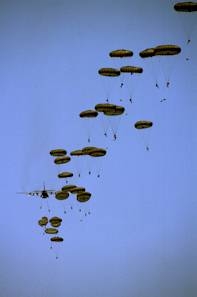
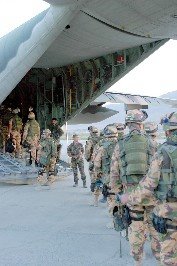
Front page of The Daily Telegraph today is the news that a shortage of RAF transport aircraft is leaving members of the Parachute Regiment without their "wings" as there are no longer enough aircraft or crews to train paratroopers.

The Telegraph puts this down to the RAF becoming stretched by operations, with an RAF official spokesman obligingly admitting that "a lot of courses were being cancelled at the last minute" because operations always had to take precedence over training, but – as always – this is only part of the story.

In fact, the "airlift capability gap" has been long predicted by the RAF, especially with the retirement of its ageing C-130K Hercules transports, and the original plan was to procure a mixture of new C-130J models and the larger C-17 Globemaster transports – both US-built - with a new fleet in place by 2005.

However, the much-denied "Europe First" defence procurement policy then intervened and, in 2000, Geoff Hoon, the then secretary of state for defence, intervened after pressure on Blair from Chirac, to order 25 of the proposed Airbus A400M military transports.

As a result, the C-130 replacement programme was cut back, and the C-17 procurement was limited to four leased aircraft, which have been subsequently purchased, with the addition on one more aircraft, but still leaving the RAF short of capacity.

The problem was that the A400M existed only on paper and, despite ever-more elaborate computer-generated images and plywood mock-ups, the projected first flight has slipped from 2006 to 2008 and the in-service date from 2009 – already too late for the RAF – to a highly optimistic 2011.

As the delays have mounted, so has the cost. Originally estimated at a mere £62 million each, each A400M is now to cost over £100 million each, including design and development costs – the NAO recently putting the total price for the 25 aircraft at £2.64 billion.

On the other hand, brand new, off-the-shelf C-130J Hercules are currently priced at £38-40 million, considerably less than half the price of the A400M, with a 20 ton payload as against the (theoretical) 32 ton payload of the latter aircraft.

Whether or now the A400M has other merits is a matter of considerable debate in specialist circles but the fact remains that the RAF airlift requirement is here and now. An American aircraft is available off-the-shelf to meet that demand but, with the politicians having committed to the European version, available some time in the future, the RAF has to go begging and the paratroops cannot do their training.

But then that is "Europe" for you – pain today and jam tomorrow although, as we know, tomorrow never comes.

COMMENT THREAD

I can't stand it…

If the EU has succeeded in anything, it is in its ability to evoke profoundly mixed emotions – variously suspense, irritation, utter contempt and complete boredom. In the long-running saga of the EU budget, however, it has managed to evoke all of these at the same time – or perhaps this down to our great leader, Tony Blair.

First, there is the suspense: will he won't he give up the rebate? Then there is the irritation - why doesn't he get on with it instead of messing about, pretending that he is going to keep it intact. The utter contempt comes easily, as this man postures and prances, gobbling up the air miles, when we all know he is going to give in when the going get tough. And as for the boredom, well, we seem to have been discussion the budget forever – this is groundhog day to the nth power.

Anyhow, the Beeb is telling us that the UK (i.e., Blair) is prepared to reduce EU rebate – not give it up, mind, but reduce it, and he has waived his “red line” demand that any such reduction could only come on the back of fundamental reform of farm subsidies. In other words, it looks as if The Telegraph, earlier this week, might have been partly right.

But the exact deal seems to be a new scheme. The budget cut is kept in place but the UK will undertake not to claw back its rebate from the "poorer countries" in central and eastern Europe. This reflects the arcane way the rebate is calculated, in arrears, so that member states receive their gross handouts from Brussels and then have to pay some back later to fund the rebate. Hence, it appears to them as if they are giving money to the UK.

No figures have been released yet and, for that, we have to wait until Monday – more suspense.

Needless to say, the Conservatives are having a field day, with Tory Europe spokesman Graham Brady crowing that: "Before the general election there was an absolutely solid pledge the rebate would be maintained, then there was an offer it would be given away but only in return for solid fundamental reform of CAP, and now finally we see part of the rebate with nothing concrete in return at all."

Straw's response is a fascinating exercise in double-speak, denying that the prime minister was negotiating a "significant reduction" in Britain's rebate while saying that: "We have always made clear that we are not going to negotiate our rebate away but we have always acknowledged our responsibility towards the accession states who are that much poorer."

According to Reuters, leaders of seven of the eight ex-Communist bloc accession countries have signed a letter to Blair which states: "We will not be prepared to accept reductions in allocations for the new member states in cohesion policy and rural development." The exception is Slovakia, to which the UK has reportedly promised extra funds for decommissioning nuclear power stations.

Interestingly, if that is the right word - EU Budget Commissioner, the Latvian Dalia Grybauskaite, it not happy, telling Le Figaro: "If the scenarios circulating at the moment become reality, it will be a politically short-sighted budget creating a two-speed system which will divide Europe even more." Polish prime minister, Kazimierz Marcinkiewicz, says the EU must uphold the fundamental principle of solidarity – which, roughly translated, means "givvus the cash".

So will he, won't he? Blair, that is. The suspense is killing me. I can't stand it.

COMMENT THREAD

Thursday, December 01, 2005

EU Prerogative

It seems incredible that we should have to turn to a US-based specialist defence journal to learn of developments which might massively affect our own defence policy, but that is how it is now.

Thus we learn from DefenseNews that the UK presidency is setting up discussions which could lead to crucial changes on the deployment of the European Rapid Reaction Force, short-cutting existing procedures and possibly allowing Javier Solana to make the decision to deploy troops.

The discussions are confronting the obvious problem with rapid reaction forces – that while the mechanics of deploying troops may be rapid, the political decision-making process is often very slow, so that the time between perception of a problem and the actual arrival of forces on the ground may be quite lengthy.

That applies particularly to the EU, with the problems of securing agreement from 25 member states, reflected by an EU official who told DefenseNews, "The whole process has become a huge source of exasperation for many of us. We waste far too much time coordinating [diplomatic] dispatches, expert meetings and formal or informal emergency political consultations — not to mention the need to consult with all the international parties involved — that it takes months just to get the internal political OK. It's got to change or we'll be incapable of responding flexibly to sudden crises and humanitarian emergencies."

That is why defence ministers from the EU member states are being asked to discuss changes to the approval process and the job of injecting speed and flexibility into the council’s decision-making machinery belongs to Javier Solana. In late October, he received approval to examine how to speed up the process and it is his report that may be discussed in December.

Meanwhile, Finland, which has considerable reservations about the militarisation of the EU, has run into trouble with its own parliament, which has rejected a law giving the president sole power to decide on troop deployments as part of European military operations.

Prime Minister Matti Vanhanen announced the withdrawal of the bill after its rejection by the parliamentary committee on constitutional affairs. He said a new version of the bill will soon be presented to the committee. The text would have allowed only President Tarja Halonen or the Army chief to decide on the deployment of troops as part of the European Union’s planned rapid-reaction force.

Parliament said the bill contravened the Finnish constitution, changed in 2000, which confers responsibilities over European affairs to the prime minister and government, in consultation with the president, thus underlining the central fact that to give the president sole right, effectively, to go to war, would undermine democracy.

Interestingly, this may impact on Clare Short's efforts to remove the Royal Prerogative powers from the prime minister, which allow him to commit the nation to war without parliamentary approval. If the deployment of the ERRF is streamlined to the extent that Javier Solana or his successor can order our troops into battle, it is not Royal Prerogative that will be the problem, but EU Prerogative.

COMMENT THREAD

Ersatzs indignation

One does not wish to disagree with the thrust of any publication issued by the Bruges Group – which we actively support – but nevertheless feel impelled to take up cudgels against its latest pamphlet, "Another slice of the Salami: How the European Criminal Code is being introduced by stealth".

Written by Gawain Towler of the EU parliament Ind/Dem Group, he argues that:

A technical decision made by the European Court of Justice has turned the constitutional development of all EU member states on their head. The Commission has taken upon itself the right to overrule both the European Parliament and the Council of Ministers by reference to judgements of the highly partisan and activist European Court of Justice (ECJ). In this way the executive and the judiciary have coalesced to destroy the balance of power within the European Communities.
However, as we pointed out in an earlier post, there is actually nothing new in the thrust of the ECJ judgement, which re-affirms the right of the commission to propose penalties in respect of legislation coming within its areas of competence.

And, as we wrote in that earlier post, it has always been implicit in the EU treaties that member states should adopt appropriate and proportional penalties, applicable to their citizens, for failures to comply with EU law transposed into their own legal codes. After all, if member states adopted the laws but imposed no penalties, the laws would have no effect.

To reinforce this very point, in the draft Council Directive "on Community measures for the control of avian influenza", which was debated in the Commons European Sub-Committee A yesterday, we see in Article 62, headed "Penalties", with the following words:

Member States shall lay down the rules on penalties applicable to infringements of national provisions adopted pursuant to this Directive and shall take measures necessary to ensure that they are implemented. The penalties provided must be effective, proportionate and dissuasive.
And just in case this is thought to be influenced by the recent ECJ decision, take any directive at random, for instance Directive 2002/95/EC on "the restriction of the use of certain hazardous substances in electrical and electronic equipment", and we see very similar wording, viz, Article 8, also headed "Penalties":

Member States shall determine penalties applicable to breaches of the national provisions adopted pursuant to this Directive. The penalties thus provided for shall be effective, proportionate and dissuasive.
Thus, while we counselled earlier that Eurosceptics should enjoy the outrage engendered in the media at the realisation that the EU – in this case the commission - was creating criminal penalties, it should be tempered by the knowledge that, ever since we joined the EEC in 1972, this has always been the case.

Over term, our membership of the "Community" has given rise to thousands of new criminal offences which exist on our stature book only because we were told to put them there. Thousands, if not hundreds of thousands of people subsequently have been convicted of such offences, by British magistrates and judges, sitting in courts under the Royal Coat of Arms.

That is the true scandal, and ersatzs indignation over a technical judgement simply obscures the more important fact that, for decades now, we have allowed the EU free reign to create so many criminal penalties, imposed by British judges in British courts.

COMMENT THREAD

He who casts the first stone…

Following the recent outburst from EU justice and home affairs commissioner, Franco Frattini, over the alleged "CIA jails in Europe", threatening member states with loss of their EU voting rights, perhaps the erstwhile Italian Foreign Minister should be looking a little closer to home for human rights abuses.

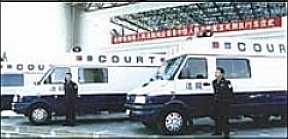
His own country, it seems, has been happily co-operating with the Chinese authorities in developing their notorious mobile execution chambers. Readers will recall that eighteen mobile executions vans, converted 24-seater buses, have been distributed to all intermediate courts and one high court in Yunnan province.

The windowless execution chamber at the back contains a metal bed on which the prisoner is strapped down. Once the needle is attached by the doctor, an act which breaches international medical ethics, a police officer presses a button and an automatic syringe inserts the lethal drug into the prisoner's vein. The execution can be watched on a video monitor next to the driver's seat and can be recorded if required.

The Italian involvement is gleaned from a report just issued by Amnesty International, which complains that "arms export controls in the expanded European Union are dangerously ineffective", and that "EU arms, security equipment and services are contributing to grave human rights abuses and the scale of potential abuse is now enormous".

Amongst the contributions cited are: "The involvement of an Italian joint venture company in the manufacture of vehicles used as mobile execution chambers in China."

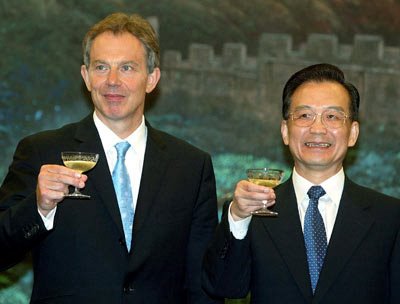
And just to remind you again, here is an extract from the joint declaration of the 8th EU-China Summit, signed by Tony Blair and Chinese premier Wen Jiabao on 5 September 2005:

The two sides underlined their commitment to the protection and promotion of human rights and continued to place a high value on the EU-China human rights dialogue. They underlined the importance of concrete steps in the field of human rights and reaffirmed their commitment to further enhance co-operation and exchanges in this field on the basis of equality and mutual respect, while making efforts to achieving more meaningful and positive results on the ground.
Good to know that our Italian "partners" are so active in helping China protect and promote human rights.

COMMENT THREAD