Thursday, July 06, 2006

Another fine mess…

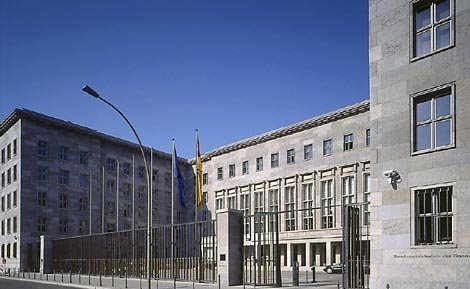
The Federal Financw Ministry in Berlin - home of some very unhappy bunniesThere are not a few people who are entirely indifferent to the idea that our government is steadily delegating its functions to the European Union. Looking at the mess our own administration is making of things, they argue that the EU could hardly do worse and, possibly, its gifted bureaucrats could be better at running the show.

Any such sentiment, however, it quickly disabused by a Financial Times report on "Europe's 14-year struggle to tax its citizens' offshore savings", through its withholding tax directive. This, the paper says – in starkly simple terms – "has flopped".

The whole point of the directive was for member states to recoup tax from the interest on money that their citizens had deposited in foreign bank accounts – the custom being, conveniently, to fail to declare such sums to national (or any) taxmen.

Under the directive, countries holding accounts of non-resident citizens of EU countries are supposed to levy a 35 percent tax on the interest paid on savings held, and hand them over to the relevant national authorities – less their own cut for administration.

The two main holders of such cash have been Switzerland and Luxembourg but, it seems, the bankers have been extremely ingenious in exploiting loopholes in the law. Thus, instead of the expected bonanza, in the first six months of the law’s operation, Switzerland has raised only €100m in withholding taxes on the vast savings held there by citizens of EU member states.

Luxembourg has been just as adroit, collecting a mere €48m in the second half of 2005. Others, such as Jersey, pulling in €13m, Belgium €9.7m, Guernsey €4.5m and Liechtenstein €2.5m.

The main beneficiary of this system was expected to be Germany, which seems to have a huge proportion of citizens who believe that the high-tax social model should only apply to other people. They are believed to have as much as €300bn stashed away in tax-friendly countries and the German finance minister was looking to grab, potentially, several billion euros for his coffers. Instead, its take from Switzerland has been a paltry €20 million.

The trouble is that the directive was so controversial that some EU member states inserted loopholes to maintain their appeal to offshore investors. Other loopholes were created by loose legal definitions, while ambiguity was added with the translation of the original draft law from English to French and back to English.

Now, Dieter Leutwyler of the Swiss Federal Department of Finance – in between wiping the tears from his eyes – is saying that any consultations with the EU over "substantive changes" to the directive could only happen after July 2011 or when both sides agreed to such talks.

At least, when our own government does things as ineptly, there is the somewhat small consolation that it is our own mess.

COMMENT THREAD

Wednesday, July 05, 2006

President "Potemkin" Putin

As usual, it is a little hard to read the tea-leaves as far as President Putin is concerned. Some things seem straightforward. He is determined to make Russia into a great power again the only way he knows how: by making her into a strong power, militarily by preference, as an economic bully if that doesn’t work. And, of course, it is necessary to create a strongly controlled internal regime for the purpose.

To this end he has used the fact that Russia’s oil and gas supply gives the country a strong bargaining power to achieve a greater position than the overall economy of the country would warrant. The pinnacle of that achievement was the extension of the G7 to G8, thus placing Russia among the supposedly most developed countries in the world.

The G8, whose summit will take place in St Petersburg next week, serves little purpose in the modern world and its membership can be argued over. But there can be little argument about Russia’s part. As Yevgeny Volk, the director of the Heritage Foundation outpost in Moscow and the President of the Hayek Foundation in Moscow pointed out in a recent talk he gave at the International Policy Network, Russia does not qualify for G8 membership either by the size of its GDP or GDP per capita. As for economic freedom, Russia comes in at no 122, while the other 7 are all in the top 25.

The trouble is that Putin’s eagerness to establish a single economic and defence area, roughly speaking where the Soviet Union was (though the loss of the Baltic republics has been accepted) has not been greeted with complete elation – not for Putin those referendums where 99 per cent of the population votes for accession to the “elder brother’s country”.

In fact, two of the most important of the former Soviet states, Ukraine and Georgia, have shown themselves particularly independent minded, have withstood the bullying and have received Western support – reluctantly from the EU and most of its members and more enthusiastically from the United States.

As the International Herald Tribune reports, 10 days before the G8 summit, President Bush welcomed Georgian President Saakashvili in the White House. The latter had come from what has been described as a “tense meeting” with President Putin.

Georgia may well play a crucial part in the developing energy and security structure. The country is a candidate for NATO – seriously backed by the United States – and an important part of the transit route for energy supplies that come from Azerbaijan to Turkey and thence to European countries. The plan is for Georgia and others to diversify its sources of energy supplies, not to have to depend too much on Russia.

Inevitably, this causes friction with Big Brother on the border:
“Georgia's role in the wrangling over energy came into focus in January after Russia cut gas supplies to Ukraine over a price dispute, rattling West Europeans, who depend on Russian gas. When explosions in southern Russia later that month severed gas pipelines and a main electricity cable to Georgia,European speculation that Russia might be using energy as a weapon grew stronger. While Moscow said terrorists were behind the blasts, Saakashvili blamed the explosions on a deliberate Russian attack.

"There was nothing new for us in that situation," Saakashvili said, noting that Russia had switched off gas supplies to Georgia during the winter in 2000 "because of Georgia's lack of cooperation on Chechnya." Georgia has since sought to diversify its energy sources.”
On the other hand, Saakashvili has also given a reasonable and not unsympathetic summary of Russia’s predicament:
“"Russia is in the process of defining itself," he said. "They are a resurgent power and they want to know how they can express themselves. Is it at the expense of dominating the policy of their neighbors? Is it by using energy muscle? Or is it, as I would think, to modernize itself, to invest in education and infrastructure, to really make Russian investment competitive?"”
Like most countries, Russia defines herself in opposition to someone else and, usually, it is the West. Presumably, this is what prompted Putin to try to reach out to the various Islamic countries.

With a high proportion of Muslim population (dating back many centuries and caused by various back-and-forth conquests) it makes sense for the leader of the country to try to come to some understanding with Islamic leaders within and outside it. However, Putin has gone further.

He has been suggesting forcefully that Russia should be part of the Organization of Islamic Conference, as a major Muslim power. He has tried to explain to Islamic countries that Russia was their best friend against the West and there has been much talk of traditional Russo-Islamic friendship (not very well noted in the history books).

On a more practical level, Putin was the first non-Islamic leader to try to extend the hand of friendship to the newly elected Hamas in January and he has supported the Iranian regime’s nuclear ambitions as well as selling arms to them. Sophisticated weaponry is Russia’s other great export but whether it is sensible to sell them to Iran is questionable. There is, after all, the strong possibility that some of it may end up in the hands of Hezbollah and other jihadists, many of whom are fighting Russian soldiers in the various Central Asian republics.

Being the Islamic countries’ best friend has availed Russia nothing. Five Russian diplomats were kidnapped in Iraq and murdered, two of them, apparently, on video. Demands by the Foreign Minister Lavrov that the American troops should do more to protect diplomats were met by a cool rejoinder from Secretary of State Rice in an unexpectedly recorded exchange. She did not see why diplomats should be singled out.

Putin’s response to this and to the inconclusive and bloody conflict in Chechnya (which he re-started in 2000 for political purposes and in which the Russian have behaved with as much, if not more, brutality as the Chechen guerrillas) has been to ask the upper house of the parliament, the Federation Council, to pass legislation that would give him the right to send Russian troops abroad in pursuit of terrorists. (No mention of the UN there or of international legitimacy but let that pass.)
“The Kremlin said he had requested the right to defend "the human rights and freedoms of citizens, the sovereignty of the Russian Federation, its independence and state integrity," by using security forces outside Russia.

Under the constitution, Mr. Putin must get permission from the Federation Council, which usually does his bidding, before sending troops abroad.

Federation Council Speaker Sergei Mironov had said two days ago that the chamber was ready to authorize Mr. Putin to use special forces and the agents of the GRU army intelligence service outside Russia.”
It is not clear, whether this means troops to Iraq or just to neighbouring countries like Georgia. Nor is it clear whether the United States will welcome the sudden appearance of Russian special forces in Iraq, bent on their own agenda, which is unlikely to include a peaceful settlement. That, after all, would mean rising oil production in that country, which, in turn would mean falling prices and a deleterious effect on that 7 per cent annual growth in the Russian economy.

Meanwhile there is the G8 summit next week and for that President Putin has been indulging in Potemkin techniques.Some of it is a direct copy, as the Wall Street Journal Europe [subscription only] points out today in its article “Putin-led campaign seeks to revitalize St Petersburg". The second capital, the President’s own birth place has been given a rejuvenating and revivification treatment with many buildings restored and various large companies, such as OAO Vneshtorgbank, the second largest bank by assets, the shipping company OAO Sovkomflot and the long-distance phone monopoly, OAO Rostelekom, encouraged to move there from Moscow.

Tax incentives are bringing in foreign investors but there is no getting away from the fact that St Petersburg is also a city of great poverty and rising crime, particularly racist crime. It has been argued that the income from the various large companies, such as the OAO Gazprom’s oil unit, will not do anything for the city, merely for the company’s own business centre. Clearly, this will provide employment to many local people, which is not to be discounted and that will help the economy of St Petersburg to grow. But the social problems of inadequate housing, education and health care, with old buildings crumbling away, unseen by western visitors, will remain.

President Putin’s other great Potemkin-like endeavour is the large conference of NGOs at which he intends to speak, to tell the world that, despite the legislation put into place early this year, which has forced NGOs to re-register and has tied them all up very securely by red tape and threats of legal proceedings if they step out of line, Russia is a country of freedom for civic activity. Just as in the good old days of the Soviet Union, the large international NGOs, such as Oxfam, Greenpeace and many others, have fallen for the propaganda and will attend the conference.

Others, including the Russian Memorial, who, prudently, will attend one day, have decided to set up their own alternative NGO meeting, “The Other Russia”. This is unlikely to be widely reported, no matter what the attendance might be. In fact, it is likely to have many obstacles put in its way.

COMMENT THREAD

They'll never agree

What a delight European harmony is. Why did the western socialists not realize that with East Europeans in the EU the goalposts of the debate would be moved? Couldn’t hear anything inside the bubble, I expect.

A wonderful story reported by Associated Press in the International Herald Tribune this morning of a row between an independent Polish member of the European Parliament (memo to AP – them is not lawmakers, them is members of the Toy Parliament) about Franco.

It seems that Maciej Marian Giertych, father of Roman, leader of the right-wing and somewhat unappetizing League of Polish Families, decided to depart from the usual script:
“Maciej Marian Giertych, an independent lawmaker and the father of Poland's deputy prime minister, Roman Giertych, said Europe "lacks such statesmen today." He praised Franco and Salazar for preventing the spread of what he called "the plague of Communism" and defending what he said were Catholic values.

"Christian Europe is losing against the Socialists," Giertych said.”
That was a “fascist speech that has no place in the European Parliament” fulminated Martin Schulz, the leader of the Socialist group. That’s as maybe but Herr Schultz had better get used to the idea that there are millions of people out there who do not share his rather easy-going attitude to Communism. They think (such is the wrong-headedness of people) that other, not so bloody, systems may have been preferable.

It is true that few of us in the West would have liked to live under Franco or Salazar. But even fewer would have enjoyed the pleasures of living under Stalin and his East European henchmen. The socialists in the European Parliament refuse to acknowledge this fact and have consistently refused to anathemize Communism in the same terms as Nazism, making it clear that those victims do not matter to the enlightened establishment. They will have a few more rows on their hands.

(Huh, wait till Romania is a member and the Transylvanian question is reopened in earnest.)

News from the front

Sometimes it is hard to tell where precisely the front is in the war against terrorism. I don’t mean the exact geographical whereabouts – as in the Cold War this is always hard to define – but ideologically. Who are our enemies and who are our friends? Do our leaders know the answer to either of those questions?

Here are various items of news that might clarify the issue. Then again, they might not. Firstly, here is an item from Al-Jazeera.

“Police have arrested a director at Italy's military intelligence agency on suspicion of helping the CIA to kidnap a terrorism suspect in Milan.

Officials said on Wednesday that Marco Mancini, a director of a division of the Sismi military intelligence agency, was arrested on charges of collaborating in the alleged abduction of Hassan Mustafa Osama Nasr, also known as Abu Omar, in 2003.”
Abu Omar, who managed to reappear after his ordeal, claims to have been imprisoned and tortured by the Egyptians. This is, at present, the only case in which there is a direct allegation of those famous renderings, which we just know exist but cannot quite prove, as the European Parliament and the Council of Europe insist.

It seems that other Sismi agents either have been or will be arrested. This is the first time there has been a direct accusation of European agents being involved in the supposed CIA operation.

The reasoning is quite convoluted:

“Italian investigators had been wiretapping Nasr before his abduction and accuse him of having ties to al-Qaeda and recruiting combatants for Iraq, according to court documents.

They say the kidnapping broke Italian law and ruined a promising investigation.”
If they were wiretapping Nasr why did the Sismi agents not know this? Or did they know and decided that those investigators will never achieve anything much? Were the agents arrested because they broke the law or because they ruined somebody else’s investigation? Do any of them know what they are doing? (Well, maybe, it is best not to bother with that last question.)

Meanwhile, it is becoming clear that the Americans are moving slowly towards the aim that the European political elite and media have been demanding for some time: shutting down Guantánamo. There is the question of what to do with the inmates (all innocent little hitch-hikers who just happened to be going on holiday in Afghanistan and on the Afghanistan-Pakistan border, carrying arms, ammunition and explosives).

Some of them are citizens of European countries and, presumably, of the EU. Others are citizens of countries that have a very nasty way of dealing with their prisoners.

We now have a report that four of the prisoners are being sent back to Germany. Well, that is what the American government is proposing. They are German citizens, it is saying, reasonably enough, and the German government as well as the entire political class, the media and a goodly proportion of the population, have all been saying that Gitmo must go.

What is the German attitude to this remarkably generous gesture? Hilfe! – is what they are saying. This is not what we had in mind at all. Well, OK, if you ask us very nicely, we might take two of them but definitely not the other two. That’s it. Schluss!

So what is to be done with the other two or possibly all four? Davids Medienkritik has the answer:
“Well, how about keeping them in Gitmo, for another couple of years or so? This would allow German politicians - and their European colleagues - to criticise the U.S. for not closing Guantanamo.”
Or they could do what the French authorities are doing, put them on trial. Six French ex-Guantánamo prisoners (having been arrested as soon as they arrived back in the country some months ago) are on trial for participation in terrorist networks in France and abroad. If convicted they may go to prison for up to 10 years and all accounts of French prisons make one feel that they might plead to be allowed back to Gitmo.

The prisoners and their lawyers are saying that these are really good lads (aged between 24 and 38) if somewhat stupid and went to Afghanistan and Pakistan out of naïve curiosity.
“"I wanted to take some risks," Nizar Sassi, one of the defendants, told the court. "It was cool. It was a chance to live my passion for weapons."

Khaled ben Mustapha said he had gone to Kabul to look for a house for his family, adding: "Going to Afghanistan doesn't make you a terrorist."

A third accused, Imad Kanouni, said he wanted to learn more about religion while traveling.

"Afghanistan was in fashion," he told the court.”
Aaah, bless their little hearts.

Seven released prisoners had been sent back to Russia and have not been heard of since. The eighth one has pleaded not to be sent back. Sensible lad.

It seems that the only country that practises what it preaches is Britain. The ex-Gitmo inmates who came back here are at large, have acquired a flourishing career as media pundits and are being given legal aid to sue the American government.

Officially dead

Sniffy classicists, who have always looked down at the EU as a pale imitation of their beloved Roman Empire, will be delighted. Having pinched the Romans' idea of a single currency, the EU has now decided to embrace Latin, we are told. Finland, which is running the EU for the next six months, is to publish weekly news bulletins in Latin on its special EU presidency Web site.

Leaders of the Unio Europaea, who have had a wretched year grappling with the Constitutio Europaea, will be reaching for their dictionaries at their next shindig in Bruxellae.

The EU's notorious jargon, which baffles all but the saddest Brussels anoraks, turns into poetry when translated into Latin. The miserable Common Agricultural Policy becomes the majestic ratio communis agros colendi, which literally means "common scheme for cultivating the fields."

All I can say is, Tute hoc intristi.

COMMENT THREAD

Stealing our identities

Those beneficent MEPs, it seems, are getting all concerned about our identities, it seems.

This is on the back of a "cross-party group" which yesterday published a report by Professor Martin Gill of the University of Leicester, which declares that "European governments" are not doing enough to fight rising levels of identity theft.

Chief amongst the criticisms, we are told, is a need to enhance co-ordination between police forces, internally, within different "EU states", and between member states and those outside the EU.

The report also suggests that greater public awareness of the issues would help prevent further growth of the "identity theft epidemic" sweeping across Europe.

"Unequal recording of the extent of identity theft across Europe highlights the importance of encouraging united action among Europe agencies," Gill notes, warning that there is "no room for complacency" even among those countries who prioritise fighting identity theft lower than others.

Tory "renta-quote", MEP Christopher Heaton-Harris, then piles in, declaring: "I strongly urge the UK government to raise awareness amongst consumers and businesses of the steps that they can take to protect themselves."

Of all people, Heaton-Harris will know about this subject. He will have queued at immigration like the rest of us, to see the signs segregating "EU citizens" from the others. He too will have a "health card" with its ring of stars, and a driving license that once sported the Royal crown and is now similarly adorned with the that ghastly symbol.

On his desk, no doubt, will be piles of documents referring to us all as "Europeans" and he cannot have failed to note that treasured symbols of our national identity, like the Imperial system of weights and measures, are gradually being eroded.

The report, however, says that one in four people in the UK are affected by identity theft. That is wrong. Actually, it is all of us, and the thieves our out there in Brussels. Perhaps we should "enhance co-ordination between police forces" and run the rogues out of town.

COMMENT THREAD

Tuesday, July 04, 2006

Independence Day

This blog cannot let this momentous day pass without a comment. Today is the 230th anniversary of the proclamation of the 13 states’ independence of Britain and of the monarchy. And, in the circumstances, I cannot think of a better way of celebrating the day than by quoting from the Declaration of Independence:

“We hold these truths to be self-evident, that all men are created equal, that they are endowed by their Creator with certain unalienable Rights, that among these are Life, Liberty and the pursuit of Happiness.--That to secure these rights, Governments are instituted among Men, deriving their just powers from the consent of the governed, --

That whenever any Form of Government becomes destructive of these ends, it is the Right of the People to alter or to abolish it, and to institute new Government, laying its foundation on such principles and organizing its powers in such form, as to them shall seem most likely to effect their Safety and Happiness.

Prudence, indeed, will dictate that Governments long established should not be changed for light and transient causes; and accordingly all experience hath shewn, that mankind are more disposed to suffer, while evils are sufferable, than to right themselves by abolishing the forms to which they are accustomed. But when a long train of abuses and usurpations, pursuing invariably the same Object evinces a design to reduce them under absolute Despotism, it is their right, it is their duty, to throw off such Government, and to provide new Guards for their future security.”

Whatever one’s views are on the Colonists’ Rebellion; whatever one’s views are on the way the United States developed in the eighteenth century and subsequently; few of us can fail to be touched by those ringing words.

COMMENT THREAD

Feeding the European fantasy

For an update on this post, see here.

A Saxon APC - a top-heavy liability that has to goToday, we read in The Daily Telegraph that the Conservatives are concerned that our forces in Afghanistan are under-equipped for their mission.

In a separate piece, we also read that the Army is scrapping 500 Saxon armoured personnel carriers that are unfit for use in Iraq or Afghanistan, but is so short of money that it is planning to replace them with vehicles that are almost 40 years old.

If ever there was a time for saying, "I told you so", it is this. It was two years ago, almost to the day, that I first wrote a piece on this blog about defence equipment plans, noting that the government was planning to spend (then) £6 billion – since increased to £14 billion - on re-equipping the Army with the Future Rapid Effects System.

Presciently, I headed my piece "Another blunder of Eurofighter proportions", introducing a thesis since amplified that the government was preparing to spend huge amounts of money on an untried force structure, all to meet Tony Blair's commitment to providing formations for the European Rapid Reaction Force.

From a limited defence budget, therefore, we were devoting huge sums to feeding a fantasy army while starving our real army, increasingly committed to actual combat, of the equipment and men it needs.

A Panther FCLV - a battlefield limousine for RupertsOne of the first pieces of equipment actually to roll off the production lines for this new, fantasy army is the Panther Command Liaison Vehicle, about which we have written at length.

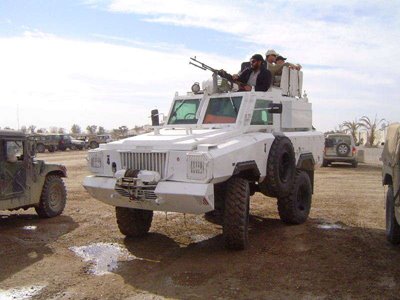
But what is particularly relevant at this juncture – when the Army is desperately short of a protected patrol vehicle - is that the Panther, at £413,000 each, was purchased against a specification so narrowly drawn that it is useable only for its designated functions. Yet, it was chosen in preference to the RG-31. This was not only £150,000 cheaper but is also a multi-purpose vehicle which could easily have accommodated the Command/Liaison role as well as providing an ideal, protected patrol vehicle.

Currently, the Italian-built Panthers are being finished off by BAE Systems, with the additional of a machine gun, radios and other accessories, when they will be delivered to the Army, effectively providing "battlefield limousines" for Ruperts – as officers are dismissively called – while troops are forced to patrol in dangerously vulnerable "Snatch" Land Rovers.

A Canadian RG-31 in AfghanistanHad the decision to buy Panthers, announced in November 2003, been different, we would have had RG-31s rolling off the production lines in British Army colours which, with minor modifications, could be re-fitted as patrol vehicles and shipped out to Iraq and Afghanistan. In the latter theatre, they would be joining the RG-31s operated by the Canadian Army which is so pleased with the vehicles that it has just ordered another 25.

Hindsight, you might say, is easy, but for the fact that the Panther decision always looked suspect and, in the context of a limited budget and an uncertain future, it makes sense to buy a multi-role vehicle, even if it is not absolutely ideal for all of the different tasks for which it might be called upon to perform – more so if, like the RG-31, it is significantly cheaper.

What has happened, though, is that the MoD – under successive governments – has taken its eye of the ball. Obsessed with the idea of constructing a mean, lean, high-tech army, with shiny new toys to impress the European "colleagues", it has neglected the here and now, and the immediate needs of our present-day armed forces, engaged in the messy, bloody counterinsurgency operations for which it is singularly ill-equipped.

Storm Shadow - the million £ bombThis obsession with shiny (and expensive) high-tech toys – and the prestige they bring - is also another fatal weakness of the MoD, their defence industry pals and the warring tribes within the armed forces. This is behind the decision to buy 900 Storm Shadow air-launched cruise missiles at over £1,000,000 each, the introduction of which was brought forward so that the RAF could indulge in a dick-measuring contest with the Americans during Gulf War II, proving that it too had a stand-off munitions capability.

During that war, the RAF managed to launch 27 missiles at a cost of £29.43 million in weapons alone, compared with the 400 or so US Tomahawk cruise missiles, making no measurable contribution to the campaign and saddling us with a massive bill which we are still having to meet. Yet, in simple terms, the £1 billion for these missiles – the bulk of which are now sitting uselessly in RAF stores – could have bought 4,000 RG-31s. It is not difficult to work out which would be of more use in our current situation.

British Army Apaches - at £60 million eachSimilarly, although there is a massive shortage of tactical helicopters in both Iraq and Afghanistan, as we have recently reported, the government has announced its intention to procure 70 "super-Lynx" helicopters for £1 billion, to come into service from 2014. Once again, we see this obsession with "high-tech" kit for the future, when the need is here and now.

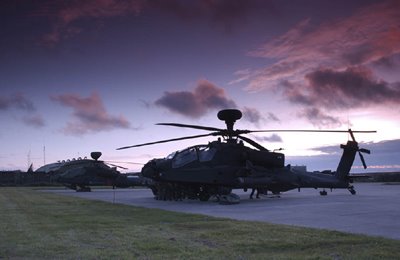
But even the £14.2 each to be expended on these aircraft pales into insignificance compared with the £60 million each paid for the Army’s 67 Apache attack helicopters, a squadron of which is currently deployed in Afghanistan. Undoubtedly, they have their value, as attested by a typically "Boy's Own" piece in the Telegraph recently. However, we saw in the Sunday Times, this weekend, a graphic account of a firefight between British troops and the Taliban.

The journalist, Christina Lamb, recounts that, at the height of the battle, the patrol leader, Major Blair, "was very angry indeed". "Where's the f****** air support?" the major was yelling on the radio to British headquarters at Camp Bastion, reading off a GPS position. Lamb continues with the narrative:

"Two A10s 10 minutes away can be with you for 20 minutes," came the reply. Nothing arrived. "We need air support. Where's the air support?" Major Blair radioed again after sliding on his back in another trench, pulled down by the weight of the kit on the mud. The message came back that the A10s had been called off to Sangin, a village to the north where two British special forces had been killed. No other planes were available because heavy fighting was still going on.
Now, let's do a little sum. An Apache costs £60,000,000. A Hughes 500 – a light, 4-seater commercial utility helicopter - costs £900,000. For each Apache, you could buy over 60 Hughes helicopters.

A Hughes 500 on convoy escort dutiesPurists will immediately say that there is no comparison between the two, and indeed there is not. However, in the hands of the private security company, Blackwater Security Consulting, off-the-shelf Hughes 500s, with two door gunners, are used to devastating effect as convoy escorts. Now ask which would have been more use to Major Blair – one Apache committed to a battle elsewhere, or a detachment of four Hughes 500s, on the spot, spitting out fire from eight machine guns?

And yes, I know you can buy such helicopters off the shelf, but it takes two years fully to train a combat helicopter pilot. But how many redundant or under-used helicopter pilots are there currently in the Armed Forces, and how many civilian pilots are there, who were military-trained? And how long would it take to train a pilot to handle a simple machine like a Hughes 500?

So much for the toys, but what about the political implications? These are graphically put by the Telegraph leader which cites Liam Fox, the shadow defence secretary, who told the Commons yesterday, the cost of succeeding could be very high, but the cost of failure would be intolerable. At stake, he says, is the future of both Afghanistan and Nato, under whose aegis the campaign is being waged.

This theme is amplified by Con Coughlin in an op-ed but, like so many, he misses the point. The Army itself, he writes, might be suffering severe overstretch through a combination of underfunding by Gordon Brown's Treasury and Tony Blair's messianic willingness to commit forces to resolve the world's ills…

Eurocorps - the Fantasy ArmyNo, Mr Coughlin, with the MoD committing £14 billion to FRES, having spent £166 million on its battlefield limousines for Ruperts, having spent £1 billion on Storm Shadow, and billions more on other grandiose European projects – not least committing £30 billion to the Eurofighter - you cannot say there is any underfunding. The real problem is that the Army is suffering from the cumulative effect of bad procurement decisions, which started under the Conservatives' watch but are currently being driven by the Blair government's obsession for European defence integration.

At the moment, it looks doubtful whether the small, under-equipped British force can prevail in a country four times the size of Wales and a border with Pakistan 1,500 miles long, but, as Liam Fox rightly remarked, the cost of failure would be intolerable. Equally, although attention has shifted from there to Afghanistan, the cost of failure in Iraq – where we also have a small, under-equipped force - would be intolerable. Yet, without more troops and more equipment – the right equipment – failure is a distinct possibility.

In fact, failure in either theatre would destroy what little credibility the UK has as a world power. Arguably, to slink out defeated, licking our wounds, would have a greater effect on our standing in the world community than our ignominious departure from Suez. That is what is at stake and the real reason why we are in such a parlous situation is that we have devoted far too much of our energy and wealth to feeding the European fantasy, while neglecting our current responsibilities.

COMMENT THREAD

The two faces of the European Union

This week we had the Finnish taking over the EU presidency from the Austrians. They have declared that their presidency has two major priorities – strengthening the European Union and guaranteeing that it will become a competitive player in the world market. A third priority is the improvement of the EU's decision-making process.

They also complain that, during the past five years, the EU has not achieved the tangible results it expected. One reason has been the lack of coherency in the foreign policy decision-making process. The EU needs to speak with one voice and send one message out to the world.

That is the "high politics" side of the Union, where all the member state bigwigs get stuck in to the great issues of the day, but then there is the other side. This is a conflict, reported by the Financial Times, that has already taxed some of the EU commission's finest legal minds, required hundreds of hours of internal negotiations and exposed a rare split in the otherwise harmonious 25-strong executive body of the EU.

And the issue at stake? Er… nappies. To be more exact, five members states are applying the wrong rate of value added tax on babies' nappies and László Kovács, the EU tax commissioner, has for months been waiting for his colleagues' clearance to launch a legal challenge against

The great Mr Kovács and his advisers argue that nappies are not included on the list of goods exempt from the EU's minimum rate of VAT, currently 15 percent, thus putting the Czech Republic, Portugal, Poland, Hungary and Malta in breach of EU law.

It is therefore the Commission's duty to launch an infringement case against their governments and, in the normal run of things, launching such cases - thousands of which come up every year - is normally seen as a routine matter.

But not when it comes to nappies. The unfortunate Mr Kovács is facing a powerful alliance led by Vladimir Spidla, the EU social affairs commissioner, that is bent on thwarting his ambition.

The FT tells us that Mr Spidla, who hails from the Czech Republic, has secured the support of no fewer than three Commission vice-presidents - Germany's Günter Verheugen, Jacques Barrot from France and Sweden's Margot Wallström - and at least three other commissioners.

Such is the level of dissent that Kovács was forced to take the item off the agenda of last week's Commission meeting at the last minute, the main argument that any move to impose tax on nappies "would send the wrong signal to young Europeans", who are already proving worryingly reluctant to have babies.

There you have it, two extremes that are almost impossible to reconcile. One minute, they are planning to take over the world and, the next, they are worrying about nappies and "young Europeans" having babies.

How the hell are we supposed to make sense of, much less report coherently, such a convoluted organisation - much less take it seriously?

COMMENT THREAD

Monday, July 03, 2006

The lies of Lord Drayson 2

For an update on this post, see here.

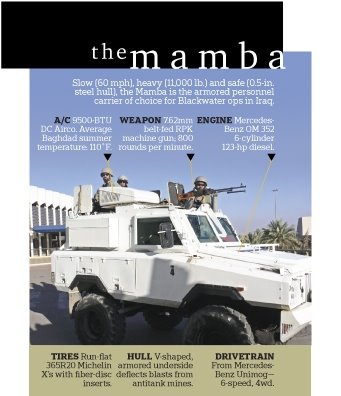
The Blackwater advertising leafletRemember the Noble Lord Drayson telling us on 12 June that, "we had 14 RG-31s in Bosnia, which we took out of service some time ago due to difficulties with maintenance?"

As we now know, these were not RG-31s but Mambas (or, more precisely, Alvis 4 & 8s) and we also know that the "maintenance problems" arose simply because Alvis, their suppliers to the British Army, had ceased supporting these models and spare parts were no longer available from this source.

And now, someone else has found a very good use for them and maintenance does not seem to be an issue. The fleet – or a goodly proportion of it – is now owned by the US Blackwater Security Consulting, which proudly advertise their virtues in their own leaflet (above left), declaring that "the Mamba is the armored personnel carrier of choice for Blackwater ops in Iraq".

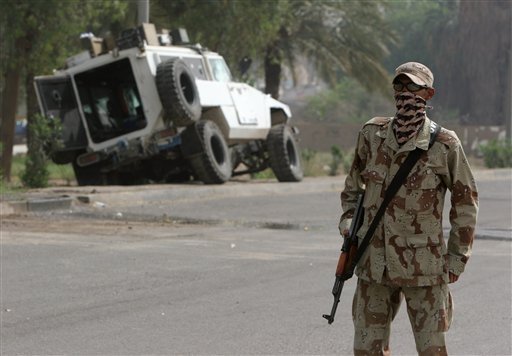
Inbound to Baghdad International to pick up the customersAnd Iraq is where the vehicles are based. Their particular role is to transport diplomats, VIPs and US State Department officials along the most dangerous stretch of road in Iraq, if not the world – the 6-mile shooting gallery of snipers, car bombers and mayhem, otherwise known as the route from Baghdad International Airport to the Green Zone in the centre of the city.

Convoys are frequently ambushed and suicide car bombers are distressingly common and, on at least two occasions, one as recently as 2 May of this year, the Blackwater Mambas have been targeted by roadside bombers. And, in each of those two occasions, the crew and passengers emerged unscathed.

Outward bound, to the Green ZoneThe daily transport routine has been described graphically in The Washington Post, where the Mambas are described in terms "as used by the South African military in Angola". The vehicle, says the Washington Post:

…is Blackwater's primary means of zipping State Department employees and other nations' diplomats to Baghdad's fortified Green Zone. For additional protection, the convoys are shadowed by helicopters with armed guards perched at the open doors scanning for potential attackers.
The American Popular Mechanics journal gives a fuller, "Boys Own" account of the operations, describing in detail how Blackwater contractors must "run the gauntlet", only to recount how, at the end of the mission, the crew found "a new spider mark" from a high-powered round in the windshield of one of the Mambas.

A Mamba damaged by an IED - the crew and passengers escaped unscathedBut what none of the journals realised though is that these are ex-British Army vehicles, sold by an MoD which now equips its troops with the dangerously vulnerable "Snatch" Land Rovers. At least one of our soldiers has been killed while being transported to the airport in a "Snatch" which makes it a cruel irony that vehicles which were not good enough for "our boys" are routinely saving American lives in one of the most hostile environments in the world, carrying them to and from the airport.

Stand up and take a bow, Lord Drayson, the man whose lies are killing our soldiers.

COMMENT THREAD

No European feelings in the World Cup

How often have we been told that in the new Europe, people consider themselves to be European rather than members of any particular nationality? Oh yes? Tell that to the football fans (and the tennis fans and any other kind of fans).

Now that England is out (in the quarter finals as usual) and the hysteria about the wonders of Wayne Rooney and the shopping powers of the WAGs has, inevitably, died one can start paying attention to the championship.

The first thing to note that it will be an all-European line-up to the fourth position. France will be playing Portugal and Germany, Italy. Whom do the Eurocrats support? Surely the best team around. Apparently not.

Former Commission President, now Italian Prime Minister Romano Prodi has been invited to watch the relevant semi-final by German Chancellor Angela Merkel. As a matter of courtesy he would surely support Germany, since national feelings no longer matter.

Alas, Signor Prodi has announced that he will be cheering for the Italian team, not even stipulating that they should all be people untainted by the ever-growing scandal. Absolutely disgraceful.

COMMENT THREAD

Seen in Whitehall

On Friday I was going up Whitehall (from the Royal United Services Institute to the House of Lords, since you ask) and stopped to watch and listen to that day’s demonstration opposite Downing Street.

People in colourful African clothes, a few trying to look sinister in the fatigues most African countries’ militias wear and lots of drumbeat would stop anyone dead on a hot Friday afternoon in Whitehall. But there were other reasons. The hand-painted signs were protesting against developments in DR Congo. Why here, I thought.

The answer was that apart from the odd sign criticizing Joseph Kabila, most were directed at the EU and the UN with slogans like: “EU – UN army out of DR Congo”, Koffi Annan – DR Congo is not for sale”, “Stop the EU-backed lying elections”, “70% Congolese cannot vote – EU out” and the one that appealed to me best of all: “Down with the Belgian slavery supporter Louis Michel”.

Commissioner Michel is in charge of Development and Humanitarian Aid. Given the country’s history, Belgium may not have been the most sensible choice to provide the commissar to fill that position.

COMMENT THREAD

The words glass houses and stones spring to mind

Footballers' wives and girlfriendsFirstly an apology for a prolonged absence (4 days or so) from the blog. Heat, work and computer problems, though not necessarily in that order, account for it.

My colleague has covered in detail the peculiar opinion poll published in the Daily Telegraph today about British attitudes to the United States and Americans in general. However, I was greatly taken by the words “Britons see US as vulgar empire builder”.

Hmm, I thought, unlike the British Empire that was entirely stylish and elegant. Does this sort of thing come out ignorance or hypocrisy? I am inclined to think ignorance, when it comes to the historical background and anything remotely resembling knowledge of the politics in this country, never mind anywhere else such as a big and complex country like the United States. At times I have heard people describe American small towns portrayed by Hollywood directors and stars who have never lived there and, in any case, loathe and despise the ordinary people who do, as being “typically American”.

Hypocrisy is not far absent, though. Vulgar? This from a nation obsessed with WAGs (wives and girlfriends, since you ask) of footballers, Big Brother and Z-list celebrities? A nation and its media that proclaims the boorish antics of footballers like Wayne Rooney to be the “pride of England”?

I could go on but shall, instead, direct attention to a surprisingly good piece by Peter Oborne in today’s Evening Standard [not on line unlike an article about WAGs waving goodbye to Germany – yawn]

Mr Oborne who, incidentally, has a genuine interest in sport, including football, compares the two big stories of the week-end: the two soldiers killed in Helmand Province in Afghanistan.
“The other, given far more coverage, is the English footballing defeat at the hands of Portugal. The first of these stories concerns duty, courage and being ready to make the ultimate sacrifice on behalf of one’s country. The second concerns indiscipline and self-indulgence.”
(At this point I should like to point out that I predicted England crashing out in the quarter final from the beginning of the competitions and even before it, simply because that happens every single time. Next time I shall put money on it.)

Mr Oborne makes a serious point here whether you care or believe that Wayne Rooney’s idiotic and peevish behaviour helped England out of the World Cup competition or not.
“I do not know the background of the two young men who died over the weekend. But the vast majority of the soldiers who have been killed in Afghanistan and Iraq come from similar origins to Wayne Rooney, the footballer whose moment of petulance cost England the chance of playing France in the semi-finals of the World Cup.

They, too, have been brought up in inner cities, sometimes from broken families and often with little or no education. They have few chances in life – one reason why they chose to enter the British Army.

Their training has taught that just a single failure of concentration could cost them their lives or the life of a comrade and that a moment of self-indulgence could see them facing a court martial.

They live in conditions of great discomfort and austerity, away from home, separated from their families, forgotten by their fellow countrymen, earning maybe £300 a week.

Every last member of the England football team earns more in a single day’s work than a British squaddie does do in a year. The footballers have spent the last month in the bosom of their families – the grotesque Wags who have spent their time on extended drinking and shopping sprees.”
And, unlike the squaddies, they do not perform well under pressure. Fair enough, you might say, the market speaks. As far as we are concerned, footballers are worth more than soldiers (who are paid out of our taxes, as are numerous gender and nutrition equality outreach officers) and are of greater interest to us. What does that say about a country, whose people are so ready to describe another nation as being “vulgar”?

Mr Oborne ends his article with the following two paragraphs:
“Yesterday the England team plane, flaunting the slogan “pride of the nation” flew into Stansted Airport. In a few days’ time another plane will quietly fly into Brize Norton military base. The two dead men in that aircraft should be honoured beyond measure because they represent everything that is proudest and most noble about Britain.

By contrast, the England plane carrying our football stars represents the crassest, most materialistic and shoddiest elements of our national culture. Sadly, that is the plane which represents the country we have become.”
But hey, at least, we are not “vulgar imperialists” like the Americans.

COMMENT THREAD

A nation without trust

Bearing in mind that you can demonstrate virtually anything you like with a well-crafted opinion poll, what does one make of the Telegraph's YouGov poll which shows that "Britons have never had such a low opinion of the leadership of the United States".

We are told that, as Americans prepare to celebrate the 230th anniversary of their independence tomorrow, the poll found that only 12 percent of Britons trust them to act wisely on the global stage. This is half the number who had faith in the Vietnam-scarred White House of 1975.

Most Britons, we are also told, see America as a cruel, vulgar, arrogant society, riven by class and racism, crime-ridden, obsessed with money and led by an incompetent hypocrite.

The main news story is backed by an editorial which, to be fair, takes a dim view of this "Yank bashing", declaring that, "To hate America is to hate mankind".

"Of course America occasionally deserves criticism," it intones, concluding that (even) to this day, it is guided by the Jeffersonian ideal that decisions should be taken as closely as possible to the people they affect. It then notes that the EU "of course" is founded on the opposite principle, that of "ever-closer union". No wonder, says the paper, “its peoples sometimes resent their more successful cousins.”

There is, sadly, more than an element of truth in this – that the supposed lack of "trust" is in fact a thinly disguised jealousy. We see this with our military men who, looking at the wealth and scale of US war materiel, compared with their own poverty, seek to make a virtue out of necessity. Unfortunately, in order to maintain their own self-esteem, they seem to end up convincing themselves that their enforced "make do and mend" strategy is somehow superior to the American way. It is then but a small step, openly to despise the American wealth. Clearly, that moral "superiority" is most evident when the fabled British Army is indulging in a "little light entertainment" (above right).

To put the YouGov findings into perspective though, it is instructive to turn to the latest Eurobarometer poll - which, taken last autumn, is not very recent and therefore must be taken with a pinch of salt.

Nevertheless, while only 12 percent trust the US, the Eurobarometer figure for the EU is even smaller, standing at eight percent. Our own political parties fare only slightly better than the Americans, at 14 percent, although – amazingly - 33 percent trust the government and 37 percent the parliament. I doubt, however, whether that figure would stand today.

On the other hand, there is one figure which stands out, which makes a mockery of the whole survey game. As many as 53 percent of respondents "tend to trust the television". Given that this medium – still dominated by the BBC – churns out a relentless diet of anti-American propaganda, revelling in the Guantanamo issue, and lovingly following every twist and turn of the "Rendition affair", to say nothing of the torrent of coverage on Abu Ghraib, it is surprising that the trust factor is still so high.

But what this also says is that a nation which counts amongst its number 53 percent who still trust what they see on television is not a nation whose judgement itself can be trusted.

And, as for the "vulgarity" with which a nation so large and diverse as America is tarred, have any of those people who so willingly use this epithet watched the coverage of the world cup, or even stepped outside their own front doors and looked at the mess in our high streets on a Friday and Saturday night, as our gilded "yoof" indulge in their drunken celebrations?

What might be interesting, therefore, is an opinion poll on the "trust" people have on opinion polls. One might find that we are a nation fundamentally without trust, in which case, the Americans – on balance – are doing rather well.

COMMENT THREAD

Mandelson speaks

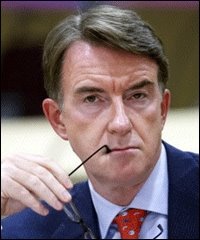
Peter Mandelson…and the Independent listens. The great man has "broken ranks" with his European Commission colleagues, says the newspaper, "with an outspoken attack on the 'rigmarole' of the European Parliament's monthly commute from Brussels to Strasbourg, describing it as "unacceptable".

Burbling onwards, the paper adds that "his comments are likely to intensify debate over the site of the European Parliament, which moves from Brussels to Strasbourg one week in every four. The move costs the European taxpayer an estimated €200m (£140m) each year."

For a paper that prides itself on its internationalism, though, isn't this just a tad parochial? As far as I recall, the fragrant one has been banging on for some time about this, and has been reported widely, most recently here.

But Margot is a foreign person, even if she is the EU's communications commissioner. So clearly, the little Englanders on the Indy don't count her. But when their own darling Peter speaks… well, that's another matter.

COMMENT THREAD

Sunday, July 02, 2006

Of course we do care

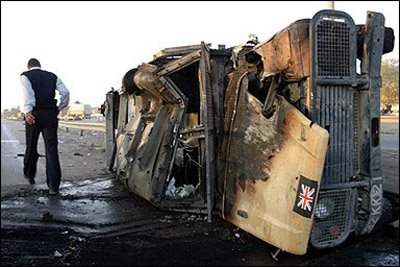
A 'Snatch' Land Rover hit by an IEDTwo weeks ago, alongside Christopher Booker in The Sunday Telegraph, we set ourselves the apparently simple task of drawing to the attention of the wider community the dangerous inadequacies of the equipment supplied to our troops in Iraq (and also Afghanistan), in particular the so-called "Snatch" Land Rover.

We were by no means the first to raise this issue, but if ever there was an open and shut case, this seemed one to tackle and one ideally suited for a campaigning blog like ourselves.

In terms of exposure, I suppose we can call our activities successful, in that Booker did two articles, here and here, and The Sunday Times picked up our posts from the blog. Based almost entirely on our research, it ran last week a front-page story, a focus piece and an editorial. We have also tabled, through our friends and allies in the House of Commons and the Lords over 40 parliamentary question (with more to follow) and the issue has been raised both in defence questions in the Commons and in a debate in the House of Lords.

Then, last week, the issue led in the letters page of the Sunday Telegraph and this week it does so in the Sunday Times, the lead letter being from Andrew Adams, an ex-Captain of the Royal Electrical & Mechanical Engineers, now a chartered engineer, living in Ruislip, Middlesex. He writes, under the heading: "Army needs equipping with a fighting chance":

Thank you for highlighting the risks that British soldiers face when using Snatch Land Rovers.

As a former British Army engineering officer who led Snatch vehicle repair platoons during the last two summer tours of Iraq, I have seen first- hand the lack of protection they offer our troops. They are not fit for purpose - unstable, unreliable, overloaded with desert modifications (such as radios and air-conditioning) and, most importantly, lack sufficient blast protection. In addition, there were insufficient spares within the logistics system to enable us to quickly repair broken vehicles — spares delays of up to a month were common.

I chose to resign my commission rather than face another tour with dangerous "make do and mend" equipment.
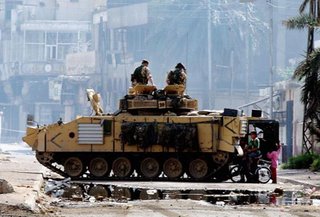
A Warrior road block in downtown Basra - real 'hearts and minds' stuff thisThere then follow six more letters, each making good points, the first of the remainder being from Keith Armstrong of Whitley Bay, Tyne and Wear, who refers to the MoD spokesman, Brigadier Bill Moore, in the Sunday Times piece. He defended the use of "Snatch" Land Rovers on the basis of the effect on civilians of Challenger tanks and Warriors roaring through Basra. Thus does Keith Armstrong write:

Surely Brigadier Bill Moore should be more concerned with the security of soldiers fighting in Iraq rather than their ability to interact with the local community, who currently seem to be taking advantage of our inability to supply the right vehicle. Anyway most of the vehicles have been attacked on main roads, and not in narrow side streets.

The government proclaims what a wonderful job the armed forces are doing on our behalf, but it is trying to have the job done on the cheap.
Malcolm Paton then makes the perfectly reasonable point that, while we are preparing to spend billions on renewing the "independent" nuclear deterrent,

…we have reports of the threat to Hercules aircraft from a lack of fire protection in the fuel tanks. Considering the number of low-level sorties currently flown by the Hercules in dangerous theatres - and the number of fatalities — this has caused great concern.
"My son has just passed out from the Infantry Training Centre, Catterick," Paton writes. "I doubt that our independent nuclear deterrent will be of any comfort to him when he undoubtedly serves in both Iraq and Afghanistan."

It is a measure of the lack of debate in the issue of European defence integration that the man does not pick up on the fact that we are committing £14 billion on the FRES programme, re-equipping and re-structuring the Army so that it can fulfil Blair's commitment to the European Rapid Reaction Force.

This, however, Christopher Booker deals with from the position of his ghetto in the his Sunday Telegraph column, sandwiched in between a worthy, but hardly earth-shattering piece on the latest round of absurdity on the metric rules, and a piece by James Le Fanu on the new diet pill.
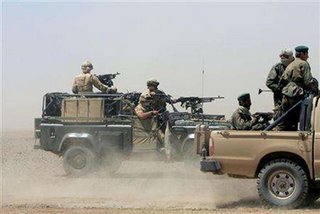
The Army in Afghanistan - unarmoured Land Rovers, with no mine protection in the most heavily mined country on earthHeaded "A fantasy force for which our soldiers pay with their lives", Booker reminds readers that, when he wrote about the Land Rovers two weeks ago, he set the issue in the wider context of our disastrous defence policy, by which our troops in Iraq and Afghanistan are starved of proper resources in order to spend billions on equipping our forces to play their part in the planned European Rapid Reaction Force.
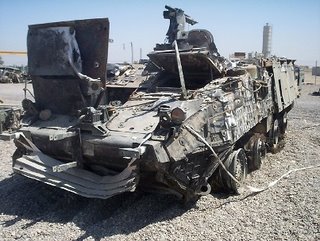
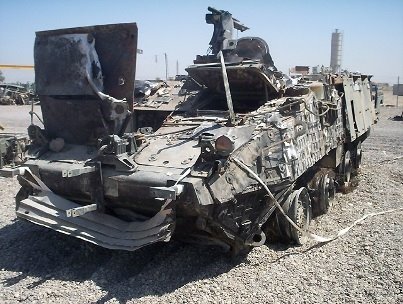
A Stryker after an IED hitThe FRES concept which will form the heart of the ERRF - for which, we repeat, the MoD has allocated £14 billion - will rely on medium-weight, air-portable armoured vehicles, and is reported to be considering vehicles like these. One of these is the Piranha, on which the Stryker, currently used by US forces in Iraq, is based. And, as events have demonstrated, this too is highly vulnerable to IEDs.

To support his argument about the EU plans, Booker refers us to Karl von Wogau document on the "Implementation of the European Security Strategy", which we raised on this blog, having been alerted to its existence by a UKIP member of the Ind-Dem team in Brussels – and example of UKIP actually providing value for money.

A Saxon APC on patrol in BasraAnyhow, returning to the crop of letters in The Sunday Times, Hugh O’Daly of Sheffield writes that the way ahead "is to replace these Land Rovers quickly by bringing in the wheeled Saxon armoured personnel carriers that the army already has in Europe."

O'Daly suggest that additional upgraded protection could be easily added to the sides, if needed, suggesting that, "this vehicle is larger and tougher than the Land Rover and is a modern replacement for the old armoured Pigs that operated in Northern Ireland." He concludes that, "there is no point patrolling towns in Warrior armoured personnel carriers and Challenger tanks, as is happening, as they are too big and heavy for the town streets. In addition they send the wrong message."

Saxon APCs operating with a 'Snatch' Land Rover in BasraYet, as our own readers will know from this blog, Saxons have been deployed in Basra, and for a time operated alongside 'Snatch' Land Rovers (see left). They have since been withdrawn – probably rightly. Despite their formidable appearance, they are actually no more than Bedford trucks with an armoured box on top, which confers little more ballistic protection than the Snatch. They confer no significant level of mine/IED protection and, even in the present configuration, are notoriously top-heavy. With additional protection they would be dangerous unstable.

However, the point about "sending the wrong message" by putting Warriors and Challengers on the streets is a good one. A wheeled vehicle is often chosen because it is regarded as looking "less aggressive" and is thus less likely to provoke civilian reaction. And, in this context, not only is the RG-31 a wheeled vehicle, it is an inch narrower than the Saxon.
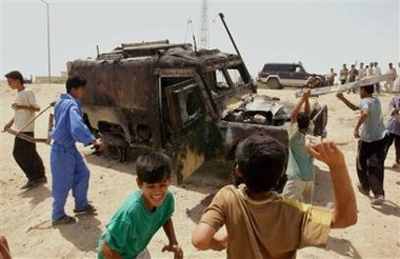
Where children play - another 'Snatch' Land Rover meets its untimely endThree more letters complete the "bag", which can be read from the link provided above, but the last merits special comment. This is from Anthony Philips of Salisbury, Wiltshire, who remarks that "nothing changes":

Almost 50 years ago, when serving in Cyprus, I lost two colleagues in a land mine explosion. The official response was to cover the floors with sandbags and, on frequently used tracks, reverse the vehicles over considerable distances to minimise the danger to front seat occupants.
That speaks volumes for the military mind, which constantly ignores the reality of operational threats and developments in warfare. I recall that, in the Peninsular war, there was enormous resistance to the use of rifles instead of the musket, in the Boer War the High Command initially rejected the idea of issuing khaki uniforms to replace the scarlet uniforms of the infantry and, even in the 1920s, the serried ranks of the Cavalry Corps argued that the tank was a passing fad which could so easily be knocked out by enemy artillery that it was a liability on the battlefield.

The precursor to the RG-31 - the Mamba, see here in Bosnia in 1997, in British Army colours.  This is the short wheel base version, also known as the Alvis 4It is the political dimension, though, that most concerns us, on this blog. In his response to the calls for better equipment, Lord Drayson has sought to denigrate the RG-31 on four grounds: he tried to confuse it with the Mamba (left), inferring that because this vehicle had "maintenance problems", the RG-31 was unsuitable; he argued that the vehicle was "too big" and "lacked mobility" (two halves of the same coin), despite it being smaller than the Saxon, the Warrior and the Challenger. However, as Keith Armstrong put it in The Times, "most of the vehicles have been attacked on main roads, and not in narrow side streets."

Finally, Drayson argues about "profile", regarding the RG-31 as "too aggressive" in appearance compared with the "Snatch" ignoring the fact that, if it is too dangerous on the ground for the "Snatch", the only alternatives are the Warrior and the Challenger.
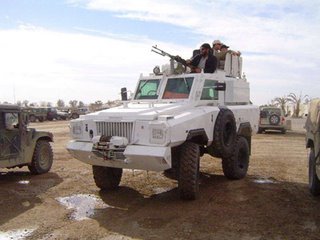
An Mamba/Alvis 4 - probably ex-MoD, operated by the Blackwater private security organisationBut, what Drayson does not argue – ever – is that the RG-31 would not provide additional protection, nor even that it would not provide complete protection, which has been left for others to do. Some argue that, because it would not protect against the so-called "off-route" mine, we should not use the RG-31, an argument as fatuous as saying that, because a Challenger tank is not proof against an anti-tank missile, they should not be deployed. And, surprise, surprise, guess where the ex-MoD Mamabas are (see above).

But the Minister's arguments (or lack of them) indicate that he is fighting a political agenda on political grounds, and it is Booker who has given us that agenda in today's Telegraph.

An RG-31 after taking an IED 'hit' - the crew survivedThe pity of it is that, in two weeks, Parliament packs up its bags for the summer and the "silly season" takes over, so let's just remind ourselves of what this is all about. (left). Nevertheless, the media – and especially the Sunday Times - have got their little bit of mileage out of the story, and the BBC has rushed to the government's defence. The issue will thus peter out, leaving Drayson to breathe a sight of relief while he continues to ignore the welfare and protection of our troops.

But, while the MPs play, as we seen from from the media today, the situation is becoming highly dangerous in Afghanistan while, in Iraq, the MoD is simply reacting by putting the lid on comment and controlling access by journalists.

That leaves us to "bang on" but I am sure that, if we continue at this rate, we will eventually lose most of our readers and become just another lonely voice bleating in the dark. Can anyone out there suggest the next move?

COMMENT THREAD
Indifference

Who cares who wins?I do not normally read Matthew d'Ancona in the Sunday Telegraph but today I made an exception, reading enough of it to get the gist of what he was saying.

Headed, "It's indifference that Cameron now has to combat," d’Ancona is right in one sense, that the electorate did show a massive indifference to the Boy King's supposed charms, a situation admirably summed up in yesterday's leader: "…people have turned against the established parties for a good reason," it opined. "They have reached the correct view that their ballot will not make much of a change, and so use elections as a megaphone to shout at the distant party leaderships."

Reading all that, I feed strangely vindicated, having said as much in my own piece the day before. Generally, people are sick to teeth with party politics – established parties that is.

For a while, at least the nation has had the World Cup to keep it entertained but, I gather, "Inger-land" - that strange country which I know not - lost a game yesterday against somebody or other and is out of the contest. No longer is there a prospect of battling with the Hun, as was the dream of many and, without that motivation, one confidently expects the nation to sink into a torpor which will be sustained throughout the rest of the summer.

I feel this in myself, to a very great degree. Nothing seems quite real – the words on the radio news merge into a low, meaningless drone, the print on the newspapers blurs and the television becomes just a jumble of words and pictures that fail to excite the slightest interest.

Perhaps it is the approach of the "silly season", when we all need a holiday, to come back invigorated, ready to do battle again. But I somehow doubt it. When we get back, the Boy King will still be there, Maude will still be mouthing "faster, wider, deeper", Blair will still be screwing up the country and Brown will still be fulminating in the margins, waiting to take over and make an even bigger mess.

And, oh yes, Finland has taken over the presidency of the EU and there are moves afoot to find a new, dynamic motto for the Union, to give it a fresh, modern look.

Who the hell cares? Indifference rules OK.

COMMENT THREAD

Saturday, July 01, 2006

Remembrance

The Serre front lineNow is not the time or place to rehearse the many controversies about the conduct of the First World War and, in particular, the carnage of the battle of the Somme which kicked off on 1 July 1916, exactly ninety years ago.

What is impossible to forget, though is the sheer scale of death and suffering on that first day, when nearly 20,000 died, many of their wounds while awaiting evacuation. Today, as we have forces committed all over the world, and in particular Iraq and Afghanistan, such carnage amongst our own is unimaginable.

Having visited most of the battlefields on the Somme, often with Nigel Farage who proved a knowledgeable and sensitive guide, even with the passage of time, it is very, very hard to keep a dry eye as you visit the immaculately kept war cemeteries which still, to this day, commemorate our dead.

But what really brought home the horror of the battle was a visit to the Serre sector where the Accrington Pals "jumped off" on their journey to death.

The trenches from which the attack started have been preserved (pictured) and, standing in them, you can look up the hill to the ridge, not three hundred yards distant, where the Germans waited with their machine guns. And, almost exactly half-way is a line of three cemeteries, marking the spot where the troops fell.

It was some long time before I could even speak after that, mute with the thought that, but for an accident of history and birth, it could so easily have been us, this generation, fed into the maw of the guns with no chance of survival.

My grandfather was in the trenches – he would never talk about it – but was invalided out after being gassed, and my father was evacuated with the BEF at Dunkirk. I am the first of three generations that was not forced to go to war, one of a generation that must count itself fortunate for the sacrifice of our fathers and grandfathers.

This, I am conscious of most days through the year, especially so as, ninety years later, we are committing troops to active combat. Remembrance is not just for 11 November each year, but for every day that we ask young men (and women) to die in our name.

COMMENT THREAD

The lies of Lord Drayson

For an update on this post, see here.

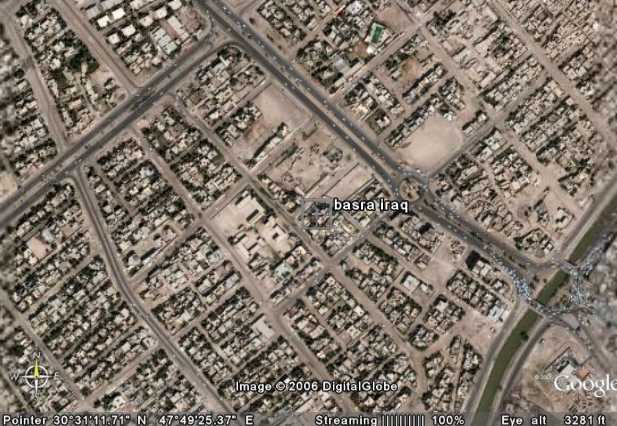
A satellite photograph of Basra - courtesy of Google Earth - Double-click to enlargeIt was the Lord De Mauley who raised the issue of the RG-31 in the House of Lords debate yesterday. Addressing Lord Drayson, he noted that the Minister had said on 12 June, among other things, that:

The Snatch Land Rover provides us with the mobility and level of protection that we need. We had 14 RG-31s in Bosnia, which we took out of service some time ago due to difficulties with maintenance. We have looked at the RG-31 alongside a number of alternatives for our current fleet and concluded that the size and profile did not meet our needs.
1. Foot patrol, Land Rovers and Challenger tanksPerhaps, said De Mauley:

…the Minister could comment on the suggestion made in the press recently that we actually used Mambas in Bosnia, a much earlier and more primitive version. While I accept that the RG-31 is not perfect, being more difficult to dismount from, especially for the commander, wider than the Land Rover and designed primarily to withstand buried mines rather than mines fired from the side, nevertheless in the 21st century almost anything would be better than the Land Rover.

2. Engineers preparing to blow up IEDThe Americans are said to be using RG-31s to considerable effect in their area of responsibility. As a matter of interest, they are also built by a British-owned firm. Even if the Snatch Land Rover did do an adequate job, which unfortunately it cannot against mines, with the operational requirement for deployments to Iraq and Afghanistan, there are only about two dozen remaining in the UK for reserve and training for future battle groups to prepare for a deployment.
3. A 'Snatch' escorting an Iraqi police patrolIn his response, Drayson could do no other than admit to his "error" over the Mambas. "A number of concerns were raised about the Snatch Land Rover in Iraq and its alternatives," he replied:

…the noble Lord, Lord De Mauley, referred to the question mark over the RG-31. The noble Lord, Lord Astor of Hever, said that he has received a number of letters about this. I make it absolutely clear that when I answered the noble Lord's question earlier, the vehicle that I was talking about was the predecessor to the RG-31. It was also called the Mamba and it has been called the Mamba mark 2. The RG-31 offered today is the current version of that vehicle.
4. A Land Rover patrol carrying out a vehicle checkHowever, if one lie has been put to bed, a central one remains untouched. "After giving careful consideration to the matter," said Drayson, "we judged the size and mobility of the vehicle not to be appropriate to the needs of our Armed Forces today." There we have it then – "size and mobility". The RG-31 is simply too big for the mean streets of Basra.

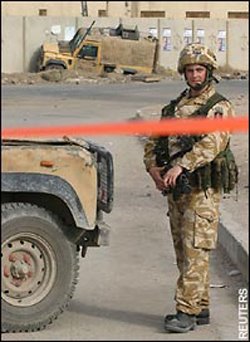
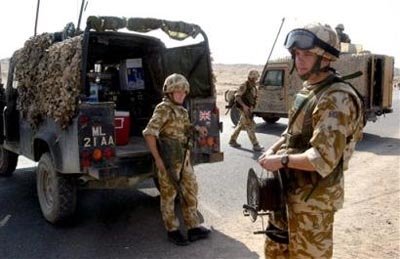
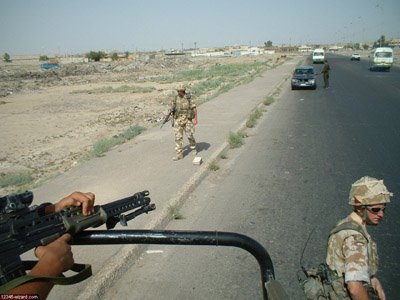
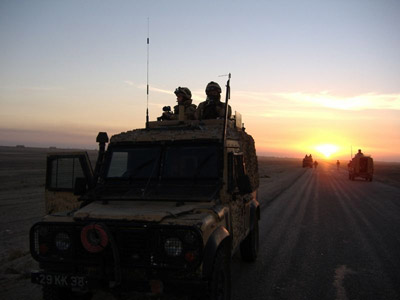
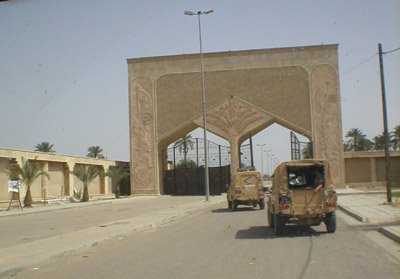
Well, to nail the lie, we have had another trawl through the internet, this time looking specifically for pictures of Land Rovers – and especially the "Snatch" Land Rover - in use by British Forces in Basra and surrounds. We have published here the first ten that we have found, without in any way being selective.

5. Down a side street - but still plenty of room to show off the shortsFirst of all though, we have taken the advice of one of our readers and downloaded "Google Earth" and have since been looking at satellite views of Basra. We have put one of them up here and will publish more over time. To all intents the city looks more American than Arabic, with wide, spacious roads, largely on a grid layout. The detail is sufficient to let you see cars in the streets and judge the scale, and there are very few streets (certainly the main streets) in shot where you could argue credibly that the RG-31 would have difficulty.

6. Iraqi police armoured Land RoversHowever, returning to the Land Rover shots, many of them have been put up on the net by serving soldiers, other are official photographs and some are press shots. None, as you will see, show Land Rovers in any situation where an RG-31 could not easily have been accommodated. With very few have any details been provided but, largely, they speak for themselves. You can fit my narrative to the pictures by placing the cursor over each of them and a numbered caption will appear, linking it to the relevant number in the text.

7. Dusk patrol - three 'Snatches' in viewThe first shot (1) is quite graphic, with the two Land Rovers in shot but with the scale given by the Challenger tank. The road is big enough for two such tanks side-by-side and this is but one carriageway of a dual carriageway road. The Land Rovers are not armoured, but they are clearly being used for the patrol function, with the "dismounts" in the foreground carrying out a foot patrol. The RG-31, only two feet wider than the six foot width of the Land Rover would have no problem at all here.

8. Through the decorative arch... big enough for a tankNext (2) comes quite an interesting shot as this shows engineers preparing to blow up an IED. The scene looks to be out in the desert but, wherever it is, there is plenty of space. Shot (3) is also interesting as it shows a Land Rover escorting and Iraqi police patrol and (4) looks to be an open-topped Land Rover with troops carrying out a vehicle check. The figure in green may be an Iraqi soldier. Again, the road is extremely wide. Two Challengers could drive down this road, side-by-side.

9. A visting we will go - in the yard of an Iraqi police stationShot (5) shows a more relaxed scene, with one of the soldiers showing off the latest Iraqi summer fashion. It is the nearest we get to a side-street, but there is still plenty of room for an RG-31. Yet, this is one of the narrowest roads we have seen, in which there is a direct shot of a Land Rover. As to the next shot (7), this is stunningly atmospheric – a dusk patrol, conveying the romance of the desert, which so entralls many visitors to the region. Three "Snatches" are in the shot, and I suspect even Lord Drayson would have difficulty claiming that the RG-31 was too big for this road.

10.  Home sweet home - parked up for a quick restIn the next shot (9), you can only just see the left front wing of the Land Rover. It is parked in the yard of an Iraqi police station and, through the gates, you can see a wide thoroughfare, more than wide enough to accommodate an RG-31 without disrupting traffic. The final shot (10) shows a Land Rover parked in front of an impressive building, with absolutely no shortage of space. The vehicle out front looks to be a Royal Engineers FV432 conversion.

I cannot believe that Drayson could assert that "careful consideration" had been given to the matter. If there had been, there would be RG-31s on order. This is yet another lie. We have plenty more photographs to come, and another remarkable sequence to follow that, which should totally nail the lies. We will keep going until we do.

COMMENT THREAD