Thursday, March 07, 2013

UK politics: the dishonesty of the "Left"


Left 006-hor.jpg

One of the reasons for blogging is the altruistic desire to spread knowledge. Strange though it may be, I have an old-fashioned sense that one should share information when one is blessed with it, for the betterment of mankind as a whole.

And when it came to the recent horsemeat issue, this was something where I could certainly contribute, having been in the food safety business for thirty years, with a comprehensive overview of food legislation and safety systems.

The sadness is that while you can offer knowledge and insight, there is no way one can – or should - force it on others. But it remains troubling that so many seem to revel in their own ignorance, and make no attempt whatsoever to remedy it. One can take a horse to water, as I am prone to say, but you cannot make it think.

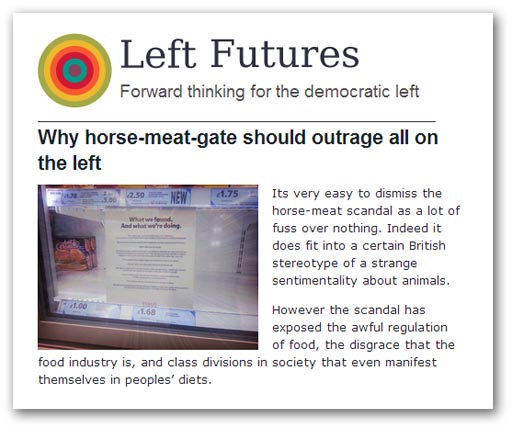
When it comes to cultivating ignorance, though, none seem to cultivate their ignorance more assiduously than the so-called "Left", as in this very recent example by Left Futures, its dissertation faithfully reflecting the views of the Labour front bench.

The horse-meat "scandal" it thus tells us, "has exposed the awful regulation of food, the disgrace that the food industry is, and class divisions in society that even manifest themselves in peoples' diets".

That then is the mantra and, to illustrate the first point, we are referred to the "Any Questions" programme a few weeks ago when Nigella Lawson said she did not know what the fuss was about. She had eaten horse plenty of times in restaurants.

This, apparently, had evoked a response from Helena Kennedy, who had been "quick to point out Lawson’s privileged position", saying "the horse she'd eaten hadn't come from the knackers yard and not been properly regulated like the horse found in this scandal".

Now, if one recalls the early phase of the publicity on this issue, where Findus was in the frame, the source of the horsemeat was tracked to a slaughterhouse in Romania. And there, no one suggested that the slaughter had not been unregulated in what was a fully approved EU-standard slaughterhouse.

In fact, if you want to eat rotten meat, the place to have been might have been the branded 220-strong French restaurant chain Flunch, which was last year caught up in a rotten meat scandal, where the Castel Meat Group had been implicated in "repackaging" spoiled meat and sending it on to its restaurant group customers.

The scandal emerged after a "Peter H", former quality director, had discovered that employees of the company had been selling lots of spoiled meat. He had ordered the meat destroyed but had found that, behind his back, they had continued selling it. When Peter H had challenged the practices, he had been fired, the complaining at the end of 2012 to the veterinary services.

Ironically, as with so many others, Castel Meats claims to have ISO 9000 certification and HACCP plans, the latter being a statutory requirement under EU law. But surely, this must be an example of "poor regulation" about which Left Futures complains, for it is exactly the same legal framework under which horsemeat has been sold as beef.

Interestingly, Left Futures - which exhibits strong europhile tendencies – does not identify the source of its "awful regulation of food", and nor does it suggest where improvements might lie, other than to say: "We have to have proper food regulations to make sure that companies cannot exploit the less well off with sub-standard products".

To support these claims for the less well off, we are earnestly told that the horse DNA "has all been found in cheap meant that many people who are less well off have to buy", something which simply is not true. Not only do we have Davigel, the high-end French catering supplier, there have also been several kebab suppliers, and we have also seen adulterated corned beef.

In fact, the very latest findings from Berlin involved two doner kebabs, corned beef, a fresh meat product and one ready meal. The adulteration is by no means confined to foods eaten by the less well-off. This is a widespread international fraud, involving multiple actors in many nations.

Only by complete disregard of the evidence, therefore, could Left Futures assert that we "should make no mistake". The horse-meant scandal, it tells us, "has class at its core". Its about "the rights of all people, whatever their means, to be able to have the dignity to have decent food".

Now add another lefty mantra – the "cuts". The adulteration of beef with horse-meat "was driven on as a race to the bottom for ever cheaper meat by local authorities. With non-essential budgets being cut from hospitals and schools, procurement departments were handing food contracts to the cheapest bidder".

That, it is then asserted, "made companies look outside the law to get cheaper meat and ended up with unregulated horse in our food-chain".

The libel there is, of course, non-specific, but the inference is that companies producing the end products knowingly broke the law. No allowance is made for the probability that some of those companies were themselves victims of this massive epidemic of fraud, and the flawed regulatory system on which they were unwise enough to rely.

In the simple world of the lefties though, there are no greys. It is all black and white. "Ultimately, they advise us, "the scandal has exposed all the problems in the modern food industry".

What those problems are, we are none the wiser. And we are not left to dwell on the issue. The real message is - poor regulation aside - that "there is a clear class division in terms of diet, with those less well off being forced to eat poor quality food that leads to ill health".

Then, sneaked in at the final furlong is the real message: "Government cuts to services" have resulted "in sub-standard food making it onto the plates of schoolchildren and patients". There you go – you knew it was that all along. Like the europhiles, with their "more Europe" as the answer to every problem, the cause of every problem for the lefties is "government cuts".

We don't need inquiries; we don't need knowledge. The answer was there all along. All we needed to do was to read Left Futures.


COMMENT THREAD

Wednesday, March 06, 2013

Media: cleaping up its act


Tele 005-cle.jpg

Jessica Winch of The Telegraph tells us that payday lenders have been told to "cleap up" their act. The same might be said of a newspaper that is downsizing its editorial staff and, in the interests of "economy", cutting down the number of sub-editors it employs. 

But, like the payday lenders, the Telegraph is only interesting in taking your money for minimum input. It certainly isn't about giving us accurate news.

If you are tired with following the media agenda, though, just ignore it. That's what Bill Whittle says. It gets interesting about 45 minutes in, and those who have been following the ideas here will recognise elements of the Harrogate Agenda. He talks about the "Common Sense Resistance" – the thinking is muddled, but he's getting there.


COMMENT THREAD

EU politics: budget veto on the cards


Welt 005-upr.jpg

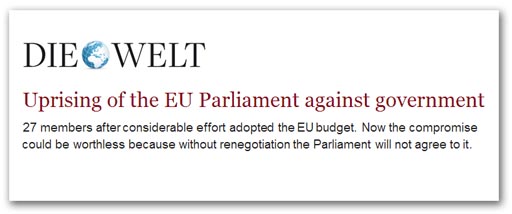
After the shenanigans on bankers' bonuses, it seems that the European Parliament is doomed to stay in the news for, according to Die Welt, MEPs are set to reject the reject the multi-annual budget agreement next week, at their plenary session in Strasbourg.

This, the paper claims as an "exclusive" and that it may be, although the Irish Independent was forecasting problems last week.

Nevertheless, we have heard very little recently about the budget from the British media, even if EP rejection was always on the cards, kicking another of Mr Cameron's great victories into touch.

Parliament president Martin Schulz, we are told by Welt, has had initial exploratory talks with the Irish EU Presidency and the European Commission and has demanded that the Council should agree to a "package of demands". This includes a "mandatory mid-term revision of the budgetary framework" by the Parliament and the EU Commission. There will be an insistence on a "legally binding resubmission" to be enshrined in the Finance Act.

Herbert Reul, Chairman of the CDU/CSU parliamentary group in the European Parliament is also demanding more flexibility in reallocating individual budget items. He wants surpluses to "be transferred automatically into the next financial year".

Another demand is for the reallocation of funds within the budget, and the Parliament thus demands "comprehensive negotiations" with the Council. Negotiations could include aspects that were not part of the Council decision.

The test of whether the EU leaders are ready to return to the negotiating table will come the by the end of the week following the plenary session in Strasbourg, when they meet in Brussels for European Council meeting.

This could be a testing time for the "colleagues" as it was difficult enough for them to reach an agreement in the first place. As for Mr Cameron, the very last thing he needs is for his budget "triumph" to unravel.


COMMENT THREAD

Tuesday, March 05, 2013

EU legislation: blundering in the dark


Reuters 005-bon.jpg

With the Daily Telegraph and other representatives of the legacy media reporting on today's supposed "clash" involving Chancellor Osborne over bankers' bonuses, we confront yet more evidence that the corps of journalists genuinely have no idea how the European Union is run.

Typical of the pack's offering is the Telegraph's headline, "Osborne faces clash over bank bonus cap at talks with EU finance ministers", framing the story in terms that the lame hacks can understand – the "battling Brit" versus the rest of the European Union. 

This child-like pastiche is as far as the media can go, as their lamentable ignorance prevents them understanding what is going on. Even Reuters, whose journalists lay claim to the possession of some brain cells (even if they are rarely used), don't seem to be capable of navigating their way through the Brussels morass. They wrongly assert that Osborne today had a chance to "challenge plans in Brussels to cap bankers' bonuses".

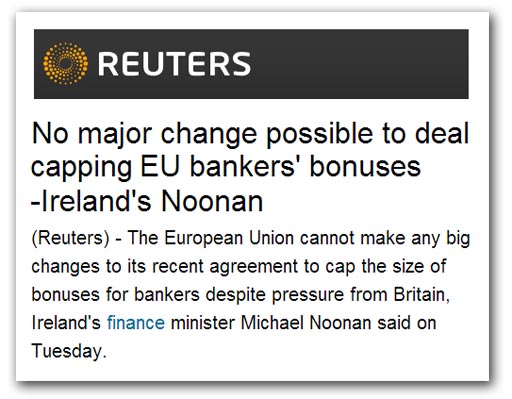
Nevertheless, in another of the agency's reports, we have an apparent corrective to theTelegraph's trivialising biff-bam approach, telling us that Osbonne has no chance of getting a change to the status quo, citing Ireland's Finance Minister, Michael Noonan, as its source. 

Irish ministers, of course, have special status here, as Ireland currently holds the presidency of the EU's Council of Ministers. But what we don't get from Noonan is precisely why Osborne is whistling in the wind. 

Actually, it is quite possible that Noonan doesn't know anything beyond the framework in which he operates. The system is indeed complex, and one finds that even senior cabinet ministers in the British government have a very limited grasp of the EU's procedural rules.  At the highest level this applies, as time and again David Cameron has shown himself ignorant of the EU's procedures. 

But the reason Osborne could not prevail today at the finance ministers' meeting was because there is no procedure which would allow him to do so. The ball did not rest in the Council's court, as the next move belongs with the European Parliament. 

As we discussed on Sunday, this is dictated by the EU's ordinary legislative procedure (formerly known as the co-decision procedure), the nature of which seems to defeat the entire corps of journalists and indeed most of the Member State politicians. 

The journalists' mistake seems to stem from their insistence in treating the European Union as a homogeneous body, instead of a series of (often warring) institutions – and then (in the British camp) to treat the UK as if it were somehow separate from the EU instead of an integral part of it. 

Failing to make the distinction between the EU as a whole and its institutions, the hacks are thus unable to appreciate that we are witnessing a power struggle between the European Parliament – strengthened by the Lisbon Treaty – and the Council of Ministers, representing the Member States. 

This is an interesting development, the subtlety of which evades the average hack, as the traditional struggle was always between the European Commission and the Council (of Ministers). But now the European Parliament (EP) is emerging as a powerful player in its own right, challenging both the Commission and the Council. 

Those, incidentally, who still dismiss the EP as a "toy" parliament, without power, are out of date. The Lisbon Treaty substantially altered the balance of power, and this institution is beginning to flex its muscles and make a real impact on the legislative scene. 

Thus, as we partially explained on Sunday, what we have is the EP's Economic and Monetary Affairs Committee, through its rapporteur Othmar Karas, drafting an amendment to the Commission's proposal, which imposes a cap on bankers' bonuses. 

On Sunday, I was unable to find the original amendment – assuming therefore that it had yet to be formally tabled. But it was there. The reason I could not find it was one of terminology. While the media at large (and the politicians) are referring to "bonuses", the amendment was couched in terms of "variable remuneration".

Once this is understood, the rest becomes clearer. Karas's amendment was actually approved by the Economic and Monetary Affairs on 7 March 2012, but what we see is the cap on bonuses set (as is the current proposal) of no more than the fixed salary, but a requirement that they should not exceed two times the fixed part. 

However, this basic amendment then attracted rival and more severe amendments, not least from the Greens, limiting total remuneration to "three times the salary of the head of the respective government" or no more than "thirty (or twenty) times the average remuneration of the lowest paid five percent of employees". One amendment even capped total remuneration to €500.000 while another banned bonuses altogether, for bank directors. Yet another limited bonuses to 50 percent of fixed remuneration. 

Thus, the EP was facing a situation – which is not untypical – where a series of rival amendments were to go before the plenary, from which only one could emerge, and where no single amendment could command majority support.  Here started the horse-trading that is not in the rule books, and which you will not see written up in the text books. 

At this point, one has to understand that the EP was arguing over the committee report, which was to become the submission to the parliament as a whole, from which was to emerge the parliament's "common position". 

But then the situation became even more complicated, as the Council, alarmed that one of other of the more extreme amendments might emerge – or that there might be no amendment at all – convened a series of "trialogues".

This is what has confused the poor journos, as these are entirely informal talks between the Council officials (COREPER), the Commission and members of the EP's Economic and Monetary Affairs Committee, including Karas.

Officially, these trialogues (sometimes called "trilogues") don't exist formally. They only appear in therules of procedures and the informal guidance as informal meetings. Thus, they cannot make formal agreements. But it was at the final trialogue that the parliament agreed to rationalise its amendments and get behind a new amendment, proposing that bonuses should not exceed fixed remuneration – a 1:1 limit.

And that is why, today, Osborne did not have a vote. There is no formal agreement to vote on, within the framework of the rules. Nothing now can happen until the EP votes on a consolidated amendment which emerged at the trialogue, provisionally set for 17 April. Then, and only then, does the parliament adopt its position - which may or may not include the bonus cap, depending on how the MEPs vote. 

Thus, as today's Council report makes abundantly clear, neither the bonus issue nor any other matter "can be considered as finally agreed until an overall accord on the package is reached".

Under the current procedure, that "accord" requires, in the first instance, the EP position to be agreed and then communicated to the Council. Only at that stage does the amended proposal formally exist - given that it has attracted majority support from the EP. Then, and only then can the Council discuss and vote on whether it agrees with the parliament.

On this basis, the very idea that there would be a showdown today was a complete misrepresentation of the process – an ignorant fantasy on the part of the media. Osborne has gone away frustrated, as was always going to be the case. He must wait his turn.

COMMENT: "BONUSES" COMBINED THREAD

Climate change: the invisible global warming


world-temp.jpg

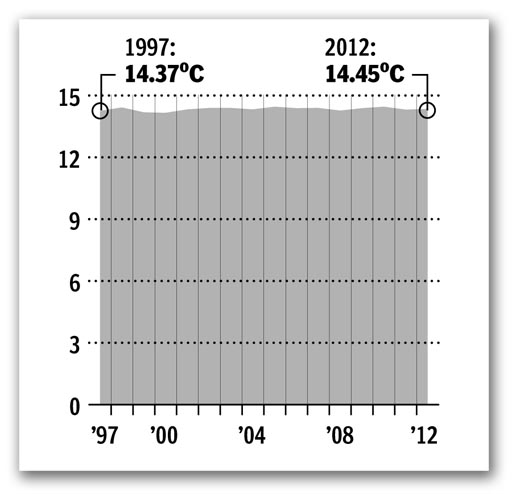
Lawrence Solomon in a recent post charted the "rise and rise" of global warming over the past fifteen years. Based on UK Met Office data, the graphic above shows the global temperatures in degrees Celsius.

And if you think the flatlining represents proof that global warning has stopped, you are very silly people. Those clever scientists at the University of Colorado Boulder have found that the real reason is volcanic eruptions releasing tons of sulphur dioxide into the atmosphere.

So there you are – we still have global warming, but it is being temporarily suppressed by a volcano-induced increase in the "optical thickness" of the stratospheric aerosol layer. This allowed less sunlight to reach the surface, and therefore lowered the temperature.

The only problem is that, it there is global warming, but it isn't showing, that surely means that there can be no detectable effects from the non-existent global warming. And if that is the case, how come all that "extreme weather" is being blamed on global warming?

After all, if the temperature isn't going up, there can't actually be any temperature-induced weather effects, in which case this "extreme weather" can't be attributable to global warming. Or is that too simple for us mere mortals to understand?


COMMENT THREAD

Monday, March 04, 2013

UK politics: the joys of representative democracy


Handels 004-spd.jpg

The "little England" tendency in the British media is in full flow today as the results of the Swiss referendum on executive wages are treated with scanty disdain. We see nothing but bland reports with sparse editorial comment, which includes a "rattled" Economist and no political follow-up worth talking about.

It takes Jon Snow in his error-strewn Snowclog to represent the broadcast media. He observes that the government, "so keen to test public opinion on Europe", would never brook such a test of public attitudes to banking remuneration and working practices in the UK. The Swiss, he says, have often been ridiculed for their love of referendums. Not any more. 

Certainly, in Germany, there is no ridicule. The media give the referendum full coverage, many newspapers offering several stories, while the politicians have been quick to react, sparking a vibrant debate. 

Thus, Handelsblatt led on SPD Vice Joachim Poss, retailing a report from Neue Osnabrücker Zeitung, which had him saying, "The referendum is an important step in the right direction to meet the rip-offs in management elsewhere".

Such is the emasculation of the German political classes, though, that Poss, instead of calling on the Federal Government to introduce a new law, called for an EU Directive, perhaps oblivious to Article 153(5) of the Treaty, which makes it clear that the EU cannot legislate on pay. 

But, when it comes to views of the referendum result, though, even the CDU economist Michael Fuchs approves. According to Die Zeit he is happy that salary decisions should not be taken by the state. "The shareholders know exactly what they can afford", he says. 

Green party leader Jürgen Trittin said that Switzerland was "a model for the compensation excesses in the financial sector" and wanted stricter rules in Germany would "stricter rules" are introduced. Sahra Wagenknecht, deputy parliamentary leader of the Left Faction asked Germany to take action. Her country, she said, was "a paradise for executives, undermining the merit principle".

The North Rhine-Westphalian FDP chairman Christian Lindner criticised the multi-million bonuses paid by Deutsche Bank, calling for "a sense of responsibility". That was echoed by economist Michael Huether from the Institute of the German Economy in Cologne. While welcoming the public debate, his view, "instead of more laws, we need more boards of directors and board members who take personal responsibility".

But it is precisely because the "thieves in suits" are devoid of any sense of personal responsibility that the people of Switzerland felt impelled to act. And, it appears, they haven't finished yet

Piggy-backing on Minder's success, the Swiss Young Socialists are campaigning to prevent executives from being paid more than twelve times the wage of their lowest-paid employee. A referendum on this is expected in the second half of this year, the group says. 

That formula would be particularly appropriate to the public sector, with a complete prohibition on performance bonuses, non-contributory pensions and excessive payoffs. 

But what a contrast we are seeing. While the Swiss people are able to force action, we are forced to rely on laborious progress of Mr Pickles, doing very little very slowly. Such are the joys of representative democracy. No wonder the British media, guardians of the status quo, are reluctant to talk about it. 

COMMENT: "BONUSES" COMBINED THREAD

UK politics: the people don't decide


Swiss salaries.jpg

While the EU takes the high ground on Bankers' bonuses, stealing a march on national governments over a populist issue, the Swiss people are exercising their own sovereignty, demanding a new law allowing shareholders to veto executive pay proposals as well as banning excessive bonuses for new and departing managers.

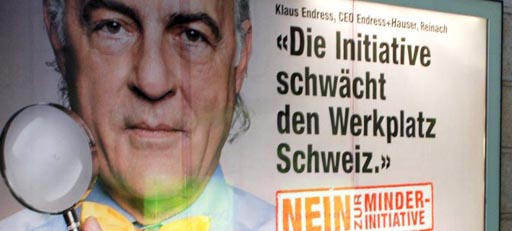
This is the result of the latest referendum where 67.9 percent of Swiss voters coming out in favour of the so-called "Minder initiative", the brainchild of entrepreneur and independent MP Thomas Minder. 

Also called the "rip-off initiative", it prohibits managers (or remuneration committees) deciding their own wages. Shareholders will have to the right to vote on the total of all remuneration of Directors, the Executive Board and the Advisory Board. This also extends to base salaries as well as bonus payments. 

During the voting, supporters had the upper hand in all language regions and both in urban and rural areas, in what was the third highest approval rate ever for a popular initiative. It was driven partly by big bonuses blamed for fuelling risky investments that nearly felled Swiss bank UBS, as well as outrage over a proposed $78 million (£51 million) payment to outgoing Novartis chairman Daniel Vasella. 

Judging from responses to the news of the EU attempt to curtail bonuses, such a move in the UK would be highly popular, where corporate greed has taken on a life of its own, in both the public and private sectors. 

Certainly, that is the case in Germany where 79 percent of respondents to a Handelsblatt Onlinesurvey opted for shareholder control of salaries and bonuses. An almost identical majority voted in a poll held by an online market research company. 

Few things, therefore, better illustrate the parlous lack of democracy in this country where our own politicians oppose mandatory restraint in the private sector and have no plans whatsoever to control the "thieves in suits" in the public sector. 

Whether you approve of the Swiss initiative or not, in that country the people can make the decision as to whether to clamp down on the "fat cats", as opposed to British citizens relying on the "undemocratic" intervention of the European Union in the teeth of the opposition from our own "democratically elected" politicians. 

Of course, if the Harrogate Agenda was in place, we could make our own decisions on this and many other issues, without having to wait for politicians – in Brussels or London – to make up their minds, or not. 

In Switzerland, the Business Federation Economiesuisse fought the initiative with a million dollar campaign, and now regrets the referendum decision. At the same time, however, the Federation has issued an assurance the will of "of course" be respected. 

When we the people can tell our corporates what to do, and get the same response, we can start to claim that we have elements of a democracy. As it stand though, the idea that the UK is a working democracy is a pretence to which we should not subscribe. 

In the meantime, we can expect the "rip-off" to continue, a standing testament to where the power really lies in this country, a country where the people don't decide and the political classes have no intentions of letting us anywhere near the reins of power. 

COMMENT: "BONUSES" COMBINED THREAD

Sunday, March 03, 2013

EU legislation: a confusion over bonuses


Tel 003-cap.jpg

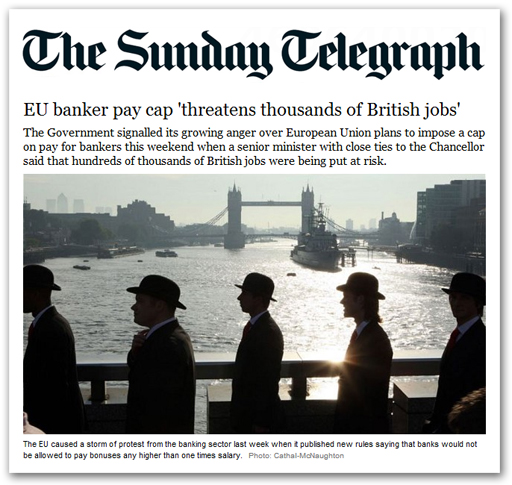
Running in the Sunday Telegraph today is yet another story in which the journalist fails completely to understand the complexities of the EU legislative process, thereby presenting a false impression of what is going on.

This is the bankers' bonuses controversy, which the paper has got so wrong that its headline refers to bankers' pay – which is not in the frame. The issue is about a cap on bonuses, despite the STheadlining: "The Government signalled its growing anger over European Union plans to impose a cap on pay for bankers".

Notwithstanding that the EU probably does not have the power to regulate either pay or bonuses – something which Booker deals with in his column - another crucial issue here is the status of the proposal.

Those with a basic knowledge of EU treaty law and procedures will know that, with very few exceptions, the right of proposal is reserved to the European Commission, which has an absolute monopoly in this department.

And it is here that the confusion starts to descend. The legislative proposal in the frame is an amendment to Directive 2002/87/EC, in the form of COM(2011) 453 final, whicgh was published on 20 July 2011. And a search of the text of the legislative draft shows that there is no reference whatsoever to the regulation of bankers' bonuses.

Strictly, speaking, therefore, there is no "EU proposal" or "plan" to regulate bonuses, insofar as only the European Commission is in a position to make a formal proposal.

Nevertheless, the ST is not the only media organ confusing itself and everyone else, as the BBCtells us that "it seems that the European Union is poised to cap bank bonuses across the 27 members in the trading bloc".

Here, the diffident "seems" is probably appropriate, as we are told that "the agreement was reached during eight hours of intense talks in Brussels between members of the European Parliament, the European Commission and representatives of all the governments".

To suggest an "agreement" though, is at best premature and, in this context, most probably wrong. What we are dealing with, once again, is our old friend the ordinary legislative procedure, where a legislative proposal from the Commission goes simultaneously to the European Parliament and the Council, each of which institutions draw up their "common positions", on which they then vote.

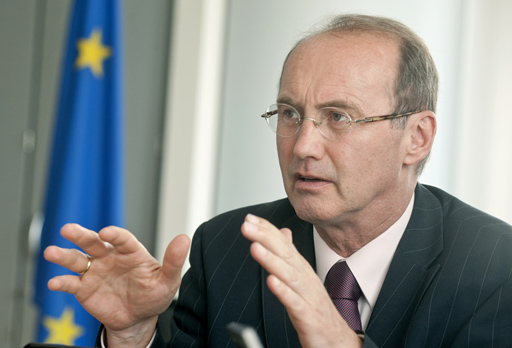
In the case of the European Parliament (EP), the common position was drafted by the Economic and Monetary Affairs Committee, under the guidance of rapporteur Othmar Karas, an Austrian MEP and member of the EPP (pictured below).

Karas 002.jpg

However, the EP's common position was actually drafted on 30 May 2012 – last year -  and, interestingly, the report also does not include any formal amendments calling for the regulation of bonuses. 

Even after this report had been prepared though, for instance on 29 June 2012, Karas was calling for "tougher rules on banker bonuses".

There was, he said at the time, "no cap on bonuses", but he wanted a fixed ratio between the fixed salary and the bonus. "My suggestion", Karas explained, "is to limit the ratio of fixed salary to bonus at 1:1. Bonuses must not be a driver for short-sighted and risky action".

As of 28 February this year, Karas seems to have got his way, after an informal "trialogue" between Commission, Parliament and the Council Presidency.  The details of this "agreement" come in apress release from the European Parliament, and a statement by the Irish presidency. Given the informal nature of the procedure, the Irish correctly refer to a "provisional agreement".

As it stands, there is as yet no formal documentation published, which sets out the agreement. Thus, it is a long way from a formal EU proposal. Officially, its status is of a proposal from the rapporteur, Othmar Karas, which has yet even to be agreed by the Economic and Monetary Affairs Committee. And even with that approval, its must then be voted on by the entire Parliament, with the first reading scheduled for 17 April 2013.

From there, it is far from plain sailing as there are potentially two further readings, with an important twist. If any parliamentary amendment does not have the approval of the Commission (and it is hard to see how this one could), then under the procedure, it requires unanimous approval by the Council. In effect, any Member State – including the UK – has a veto.

Such complexities are very much for the future, but for the present, we are ill served by a media which seems ill-equipped to report on EU affairs and constantly demonstrates that reporting on anything more complex than a TV soap is beyond its capabilities. 


COMMENT THREAD

Booker: disappointingly free


Booker 002-mos.jpg

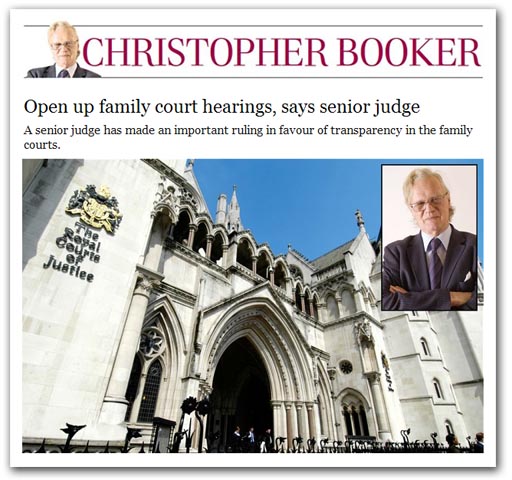
If Booker has been a bit quiet on the stolen children front over the last few weeks, there has been a reason. He has been the subject of his very own "super injunction", bestowed on him by High Court judge Nicholas "Mr Payout" Mostyn, at the behest of Sutton Council.

With criminal proceedings being discussed, on the basis of Booker's supposed "contempt of court", bully-boy Mostyn had demanded he attended court personally to hear the injunction confirmed, so his paper's lawyers had suggested he keep schtum for a while, to avoid inflaming the situation.

On the day, however, we were disappointed to learn that Booker's brief had so schmoozed the egregious Mostyn, to say nothing of shredding Sutton's case, that there was no question of the great man being banged up. Thus we were deprived of the fun of feeding him buns through the bars – in which had been secreted the obligatory hacksaw blades – or springing him by more direct means.

For once, though, Booker has become the story, with his own version of the trial in his column. Inexplicably, there is no comment thread on the column, although the news piece does have comments.

Says Booker, the hearing was the first occasion on which a judge was persuaded to agree to an injunction forbidding him from making any mention of a case. The fact that Mostyn was prepared to listen to the arguments – not that he had any option, as he was being set up for an Appeal Court hearing - and was thus prepared to lift it was "a salutary victory for the freedom of the press".

Giving a glimpse of the real battle, Booker goes on to say that this was "certainly welcome as far as it went". But, he says, the battle to lift the veils of secrecy that shroud the "secret courts" we already have is very far from over. "Behind those veils far too many cruel abuses of justice will continue to flourish unreported".


COMMENT THREAD

Saturday, March 02, 2013

UK politics: UKIP is just like the rest


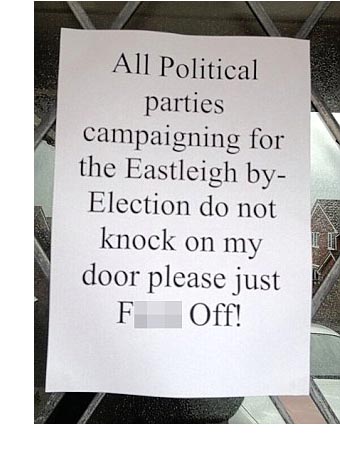
Eastleigh FO.jpgThe post mortems over Eastleigh continue to multiply, leading Raedwald to offer half a cheer at Charles Moore'ssudden realisation that "all parties are the same".

This, in fact, is the dominant theme in many of the comments to the Tory Diary, while the editorial staff remain locked in their intellectual bubble, unable to comprehend what the rest of the world is telling them. 

If they begun to understand the "all parties are the same" meme, they would immediately realise that their call to arms cannot succeed. At the moment, the main attack on the UKIP tendency is to point out that "robbing" the Conservatives of a vote simply lets in Labour or – in the case of Eastleigh – the Liberal Democrats. 

Arguably – and with some justice – the effect of UKIP's intervention in this most recent of by-elections has been to open the gate for Mr Clegg's europhile candidate, excluding an ostensibly eurosceptic Maria Hutchings, who could have strengthened the anti-EU ranks of the Tory parliamentary party. 

But the logic of the situation is unassailable. Just as with the eurosceptic Owen Paterson in post as environment secretary, we are still bound by EU law, so the election of Hutchins to the green benches, instead of a Lib-Dem, would make absolutely no difference. 

Hence, it is not so much that all parties are the same – per se. Manifestly, they are not. One has just to look at Owen Paterson and then Mary Creagh to realise that between the Conservatives and Labour, there is a massive ideological gulf. But the point is, whether it was Paterson or Creagh at the despatch box, nothing fundamental change as long as the UK is a member of the European Union. 

What seems to be happening, though, is that this political philosophy – or anti-philosophy – is becoming strengthened by the antagonism towards the established political parties, so that UKIP is also becoming a reservoir for the protest votes, taking over the role from the official opposition and what was once the Liberal Party. 

The irony here is that, in order to harvest votes from the establishment parties, UKIP too is becoming an establishment party. To be accepted by the media and the political classes – and indeed the electorate – it must ape the very constructs it is supposedly challenging. Rather than taking on the establishment, Nigel Farage becomes part of it. 

Thus, if UKIP supporters, both temporary and longer-term, are looking for something different, they are most likely going to be disappointed. In the unlikely event that Mr Farage is ever in a position to control the British government, it would be on the basis of a compromise with political allies, which could include him ditching his party's ambition to leave the EU. 

But, if Farage did lead the nation out of the EU, this would not necessarily change anything on the ground. To ordinary people robbed of power, it makes little difference whether laws are made in Brussels or Whitehall. The geographical location of those who wield power over the powerless is of academic interest only. 

What Farage offers, therefore, is not the promise of democracy – for power is what democracy is all about – but the prospect of change, without anything fundamental being specified. 

To that extent, what we have in Farage and his party is a British version of Beppe Grillo and his Five Star Movement (M5S) in Italy. Grillo himself has always claimed that Italy's politicians are all the same, but analysts now argue that, "despite its radical appearance and its revolutionary rhetoric, we believe that, over the past three years, the M5S has effectively defended the present system, acting as a force that has quelled rebellion and stabilised the system".

As with M5S and to an extent also Geert Wilders' party in the Netherlands, we see in UKIP a lightning conductor. Of Grillo and his partner in crime, Gianroberto Casaleggio, it is said that they have intercepted the "indignation" expressed by ordinary people at the dereliction of their government and, on the back of this have created a political/economic franchise with its own copyright and trademark, a movement rigidly controlled and mobilised from the top. 

It is also said of them that they have hijacked slogans and ideas from social movements and mixing them with apologies for an "ethical" capitalism, with superficial statements centred on the honesty of the individual/politician/administrator. Thus have they:
… created a confused set of proposals, where neoliberal and anti-capitalist, centralist and federalist, libertarian and reactionary could co-exist. A manifesto for all occasions, cherry-picking ideas wherever they found them and whenever they considered them useful, typical of a diversionary movement.
Just as we see Grillo list his demands which amount to nothing more than "tweaks" to the established order, so we see UKIP threatening to wreck the Conservative chances of winning the next election while offering nothing of any great consequence which would alter the balance of power between citizen and state. 

Effectively, Farage's idea of change is to put himself and his supporters in power instead of Brussels – swapping one set of bosses for another - a prospect some might find so unattractive that they might actually prefer Brussels. 

Either way, the one thing not on offer is any form of government which takes us any closer towards a democratic state, in which event UKIP has much in common with the established parties, which it currently emulates. 

Its great, and possibly only difference is that it has not yet tasted power, and has therefore yet to disappoint its followers as it grapples with the compromises need to retain power and see off the competition. And that, when or if it happens, will bring its own disillusionment as people gradually discover that UKIP is just like the rest. 

COMMENT: "EASTLEIGH" THREAD

Climate change: green fatigue


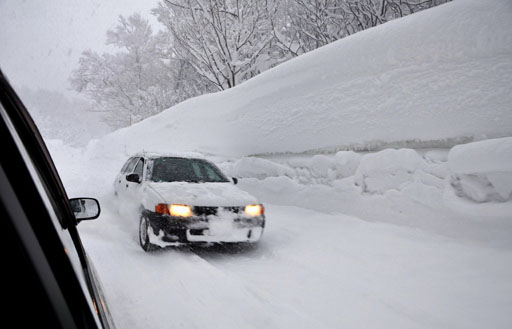
Japan snow.jpg

Communities in Hokkaido and five prefectures of the Tohoku region, we are told, have had record levels of accumulated snow as of 25 February.

In the Sukayu district of Aomori city along the Hakkoda mountain range, the snowpile measured 5.61 metres, a record for all areas where the Japan Meteorological Agency keeps records of accumulated snowfall. Thirteen locations have set records for their snowpiles this winter.

But this is not without cost. The death toll around the nation has hit 67, while 444 have been "badly wounded", according to the Fire and Disaster Management Agency (FDMA). Of the 67 deaths, 52 were citizens aged 65 and older.

Japan, of course, is not alone. Baltimore is set for a two-year record. Chicago has experiencedrecord-breaking snowfall.

Wednesday saw a total of 5.4 inches measured at Chicago O'Hare International Airport. This snowfall total makes the event the largest snowfall of the season for Chicago thus far, making up 28 percent of the 2012-2013 winter snowfall total.

Southwest of the Windy City, a blizzard broke the all-time monthly snowfall record for Wichita, Kansas. The storm dropped nearly seven inches of snow on that city, bringing the monthly total to 21 inches — the most snow the city has seen in any month since records have been kept, according to the National Weather Service.

These were just a tiny few of the records broken, in a winter that had 652 records set in the US, with snow as far south as the Mexican border in Arizona.

But we've also seen a French resort - Cauterets, in the Pyrenees - overtaken the world record for snow at a ski resort, with a massive five metres of snow on the ground – enough to keep the slopes open for business until mid April.

The quantity of snow this year has surprised everyone, and has its drawbacks. Some ski slopes being forced to close for safety reasons and sixty people currently working to clear the resort of the excess.

No amount of clearance will sort out the Russian village of Oymyakon, which hit -70ĀŗC this winter – the land that global warming forgot. But, with so much of the white stuff around, it is thus not a surprise that public concern about environmental issues including climate change has slumped to a 20-year low.

Only 49 percent of people - according to the poll of 22,812 people in 22 countries including Britain and the US - now consider climate change a very serious issue – far fewer than at the beginning of the worldwide financial crisis in 2009.

One reason for the relatively low ranking of climate change is that people often believed it did not directly affect them, says Tom W. Smith, Director of the General Social Survey. But then it could also be that people can see for themselves that the greenie propaganda doesn't stand up.

With "global warming" readily seen as an ironic synonym for snow, the warmists are losing the game.


COMMENT THREAD

Friday, March 01, 2013

UK politics: a wasteland of democracy


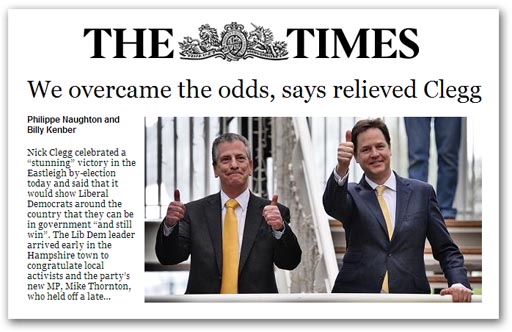
Times 001-cle.jpg

The media are glibly talking of the "humiliation" variously of David Cameron (Independent) and the Conservatives (Telegraph), completely unconscious of the fact that the by-election result represented a humiliating defeat for the political class as a whole.

As Your Freedom and Ours points out, people are not turning out to vote for any of the candidates in any numbers. But, when the lead candidate goes to Westminster on the back of 17 percent of the electorate – not even one in five of the voters – that represents a crashing failure of the political class to take the people with them. 

But then, when we see Clegg stand alongside the new MP and proclaim "we overcame the odds", while The Times talks of a "stunning" victory, the nature of the problem becomes apparent. 

The great divide then yawns into a chasm when Lib-Dem party president, Tim Farron, claims: "This is a staggering result … it will be a turning point in this parliament and that we are in a position to win this seat completely changes the narrative of the parliament".

And while the voters delivered a majority of 1,771 for the Lib-Dems, it is interesting to note that aside from the Lib-Lab-Con-UK matrix, there were ten other parties in the field, including the Monster Raving Loony Party, which collectively polled 2,056 votes. 

Farage talks glibly about the Conservatives "splitting the UKIP vote", but there were over two thousand voters who thought more of the likes of the Beer, Baccy and Crumpet Party than they did of his offer, sufficient to deprive his candidate of a seat in Parliament. 

What is thus very, very clear from this result is that the politicians simply haven't got the message – any more than has the media. They are regarded, collectively, with a mixture of indifference and contempt, with party politics and voting in this country having become a minority preoccupation. 

The result today, therefore, is not a disaster, per se for Cameron and his Conservatives, as some would have it. It is a disaster for the flawed experiment in representative democracy, another nail in the coffin of a failed system. 

As for UKIP, the picture remains muddy. Your Freedom and Ours observes that their plan to become the third party after the Lib-Dims has fallen by the wayside by the latter's victory in Eastleigh. 

They cannot pretend that they are the second party in the country with no MPs and very few councillors. So, despite the undoubted rejoicing in the UKIP ranks and despite the nauseating plaudits that will be heaped on the Dear Leader, the fact remains: after 20 years and in the most propitious circumstances they remain in no-man's land. 

Increasingly though, this is becoming the "no-electors' land" – a wasteland of democracy. And the politicians can't even bring themselves to admit it.

COMMENT: "EASTLEIGH" THREAD

UK politics: Eastleigh by-election


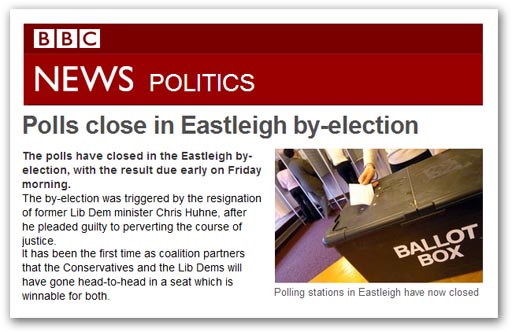
BBC 029-eas.jpg

More than usual hyperventilation has attended this by-election, with some pretty bizarre predictions, even by the rather low standards of British political commentary. For what it is worth, my (private) prediction was that the Lib-dims would romp home, the Tories would come a poor second, Labour third and UKIP would keep their deposit with about seven percent of the vote ... all on a very low turnout of 40 percent.

But then, I was certainly wrong on the turnout, as early reports put the it at 52 percent. This is higher than I expected although low in contrast to the 69.3 percent cast in the 2010 general election. All the same, no one at the beginning of the count was expecting the earlier tosh about UKIP winning to materialise, although there was still some expectation that UKIP might make second place.

As always though, the postal votes were set to play a crucial part, with 14,000 issued, and the Lib-Dems expected to take the lion's share.  Given that most of these votes were in before the latest groping controversy, that vote was expected to be fairly solid.

UKIP had to beat Ray Finch's 2010 performance, when he took 1,933 votes, taking 3.6 percent of the votes cast, losing his deposit. In the 1997 election, the Referendum Party fronted Victor Eldridge and took 2,013, also coming in with 3.6 percent of the votes. Thirteen years had not delivered any appreciable enhancement in eurosceptic sentiment in Eastleigh.

The talk though is of UKIP becoming the reservoir of the protest vote, and in particular capitalising on concerns about immigration. 

And, at just after 2.30 am, the result came through. The Lib-Dems did indeed romp home, coming in with 13,342 votes, against the second comer at 11,571 votes - UKIP.  Second place for Farage's party, nearly a thousand ahead of the Conservatives at 10,599.  Labour trails at 4,088 votes. So much for my powers of prediction.

Mike Thornton's vote of 13,342 votes compares with Chris Huhne's 24,966 in 2010, yet Thornton talks of a Lib-Dem "mandate", having dragged in a pitiful 32 percent of the votes cast, and 17 percent of the electorate of 78,313.  UKIP's great victory amounts to 28 percent of the votes cast, or 14.8 percent of the electorate. 

This is a victory of sorts - bald men fighting over a comb, squabbling over a diminishing quantum, where an MP goes to parliament with a "mandate" of 17 percent of the electorate.  It never was democracy.  Now, it isn't even representative.


COMMENT THREAD

Horsemeat fraud: it's all our fault


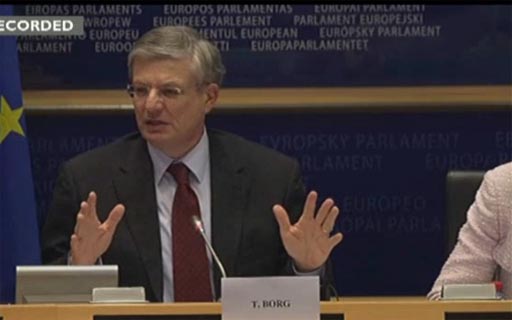
Borg 003.jpg

At last the Polish have admitted the obvious about horsemeat adulteration. They say they have found horse DNA in beef stored at three storage facilities in central Poland, after three samples from 121 tested proved positive. Eighty more await examination. The meat tested arrived there from various suppliers in Poland and abroad, including from the Netherlands. 

From Latvia, we also get an admission that it was common practice to label horsemeat as beef. In Soviet times, massive amounts of horsemeat came to Latvia from Latin America without being publicly mentioned. "We are aware that such practices are consumer deception, however, life is life," explained the head of one slaughterhouse. 

Spreading the network of adulteration further, however, we can add a small consignment of tinned corned beef from Latvia is being withdrawn from the UK, after tests in Germany showed the product comprised 69 percent horsemeat. The product was distributed to Germany, the UK, Belgium and the Netherlands. 

The extent of this fraud, details of which are growing by the day, led on Wednesday to French consumer minister BenoĆ®t Hamon to conclude that the "existing sanctions" are weak and that "there is a form of impunity for this kind of deception". He thus intends to present a Consumer Bill in April, multiplying eight-fold the financial sanctions against fraudsters. 

Under the provisions he will propose, an individual could be fined €300,000, with €1.5 million for corporations, even be extended to 10 percent of turnover. On conviction, fraudsters could also be prohibited from carrying out a business in the same field where their fraud was proved. 

It hardly seems possible, therefore, that yesterday, in an "exchange of views" with the European Parliament, EU health commissioner Tonio Borg expressed much the same intent. 

"Public confidence has been badly shaken", he said. To help restore it, a forthcoming proposal would require every member state to introduce financial sanctions against food fraud, so that "crime does not pay".

He acknowledged that a "growing number" of member states favoured mandatory "point of origin" labelling which currently applies only to fresh beef, but stressed, "Even if we had mandatory labelling it would not have stopped this scandal happening".

"Europe", he said, "has one of the best food safety systems in the world and all the evidence suggests that, unlike in the past, this is not a food safety issue but one of fraudulent labelling".

"When a scandal happens, some jump to the conclusion that the legislative system is at fault and that fundamental change is required but the legislation is sound and fraud only occurs when the rules are deliberately broken". But", he continued, "the EU does not have an army of enforcers to ensure the legislation is enforced. That is the role of member states".

So there we have it. The European Union is perfect. There is nothing wrong with its legislation. When things go wrong, it is entirely the fault of the Member States, and they must take the necessary action. 

"This scandal has caused enormous public mistrust and many people are bog-eyed about the whole thing", says Borg. "That is why we have to improve the deterrents and need better traceability".

And behind all that is the BBC. It's all our fault for expecting cheap, convenient processed foods made from raw ingredients whose prices continue to rise in the global marketplace. It's nothing to do with the EU. It's all our fault. 

COMMENT: "HORSEMEAT" THREAD