Sunday, February 05, 2006

Lest we forget

Flashback: 15 September 2004: A demonstration against the fox hunting Bill, outside Parliament:

Instantly, the police responded with a flail of truncheons. For a moment, they resembled beaters driving birds towards guns. They were scenes more associated with the clash of police and shaven-headed football hooligans or dreadlocked anti-capitalist demonstrators rather than men in flat caps and women in quilted waistcoats.

In a flurry of violence, people were hurt by the impact of truncheons and by the crush of people pushing forward to join the pre-planned sitdown. Archie Norman, the Conservative MP, who had come out to watch the mayhem, was almost hit by a bottle that smashed beside him. Mr Jukes condemned the behaviour of the police officers. "I can't believe it happened - there was no reason for it at all," he said.

"There was a bit of a surge and they only needed to say, 'Steady on lads', but instead they started hitting everyone. "I even saw old men with their heads split open. "There were all these young policemen having fun with their truncheons, waving them over their heads before flashing them down on ours." One of the older protesters injured in the melee was Simon Harrap, the Master of the Hampshire, who said: "It was incredibly heavy-handed."

"We're decent, respectable people and we don't deserve the riot squad treatment," David Jukes, 45, the Master of the Zetland Hunt in North Yorkshire, said as he mopped a bloodied brow.

Standing beneath the stern gaze of the statue of Oliver Cromwell, William Hudson, 27, from Hampshire, had blood from a head wound all over his green T-shirt.

"I saw them hitting the person behind me, they did not seem concerned whether people were trying to go forward or back, everyone was getting crushed, it was very frightening. There is no point hitting people on the head. Why could they not hit our bodies?"
Now fast forward to 3 February 2006:

An Association of Chief Police Officers spokesman said that the protests did not yet represent a serious threat to public order. A Scotland Yard spokesman said: "Arrests, if necessary, will be made at the most appropriate time. This should not be taken as a sign of lack of action."

Scotland Yard says a decision not to arrest protesters was taken because of public order fears. It confirmed that police had received more than 100 complaints from the public about the protesters' behaviour.

Yesterday, more than 1,000 demonstrators staged a second protest outside the embassy. The only arrests made were of two men found carrying cartoons of Mohammed. Police said they had been detained "to prevent a breach of the peace". A man dressed as a suicide bomber, however, was left unhindered, while the police sought to prevent photographers taking pictures.

COMMENT THREAD

Is the worm going to turn?

As so often, it is The Business which best articulates the issues, in this case those surrounding the Mohammed cartoons rumpus, running an article headed, "Cartoons draw a sinister silence" by Fraser Nelson.

Nelson draws the parallel between Nick Griffin, leader of the British National Party, claiming his trial in Leeds last week was the best advertisement for his Party, and the protest outside the Danish embassy in London – which in the event provided a much better evidence that Islam was a fundamentalist religion that threatens British culture.

Griffin, writes Nelson, has sought to convey two messages: that immigration is a threat to British society and that Westminster politicians are too timid to even admit to the problem, far less do anything about it.

Now, with the placards of the London protesters lodged in the public domain, the response of Blair, the prime minister, has been weak and the response of Blair the plod has been pathetic.

But so indeed has been David Cameron who, (according to The Business)has said he wants "to be kept out of this one", with only Dominic Grieve, Shadow Attorney General, calling the Danish cartoons "reckless", after having admitted that he had not seen them.

But with mainstream politicians saying little and doing nothing about what many in Britain see as outrageous behaviour by the London demonstrators, Nelson suggests that they will turn to the BNP. "This is exactly how a far-right fringe party like the BNP enters the mainstream," he writes. "There are no easy political responses to this bizarre cartoon jihad. But staying silent," he concludes, "could be the most dangerous option of all."

Perhaps aware of that very possibility, Inayat Bunglawala of the Muslim Council of Britain yesterday called on Sir Ian Blair, the Met plod commissioner, to press charges against the protestors.

This is reported by The Sunday Times, with Bunglawala cited as saying that "The Metropolitan police should now consider all the evidence they have gathered from the protests to see if they can prosecute the extremists."

He then adds: "It is time the police acted, but in a way so as not to make them martyrs of the Prophet's cause, which is what they want, but as criminals. Ordinary Muslims are fed up with them," stating also that "Lots of innocent Muslims went to the demonstration not realising that it was organised by extremists. They were hijacked by them."

Sir Iqbal Sacranie, the council's secretary-general, expands further on this, saying that, "We cannot have double standards, so therefore any breach of the law should be looked at by the police and investigated. The cartoons have offended every Muslim and the anger of Muslims has to be lawfully expressed. However, this outrage was used by some to induce Muslims into taking part in terrorist violence. We condemn their actions."

The whimpish response from the Association of Chief Police Officers, however, almost beggars belief, their spokesman saying that the protests did not yet represent a serious threat to public order. A Scotland Yard spokesman said: "Arrests, if necessary, will be made at the most appropriate time. This should not be taken as a sign of lack of action."

Obviously sensing a sea change in public sentiment, it now seems that the Conservatives are coming into line, or so at least says The Sunday Telegraph, which goes to press much later than The Business.

Now, it appears, David Davis, the shadow home secretary, is also calling on the police to arrest militant Muslims, saying that the police should take action against what were clearly offences of incitement to murder. "Whatever your views on these cartoons," he declares, "we have a tradition of freedom of speech in this country which has to be protected. Certainly there can be no tolerance of incitement to murder."

According to The Sunday Times, Scotland Yard says a decision not to arrest protesters was taken because of public order fears. It confirmed that police had received more than 100 complaints from the public about the protesters' behaviour.

And, to rub in the partisan approach of the police, yesterday, more than 1,000 demonstrators staged a second protest outside the embassy. The only arrests made were of two men found carrying cartoons of Mohammed. Police said they had been detained "to prevent a breach of the peace". A man dressed as a suicide bomber (pictured above), however, was left unhindered, while the police sought to prevent photographers taking pictures.

Now we wait to see whether the Tories do push the case or whether Davies is just going through the motions, without the support of the Boy King.

Certainly, as far as this Blog is concerned, the Friday demonstrations were the tipping point and many people feel the same. As The Business suggests, anything less than a robust response will provide the BNP with their best recruitment opportunity since the London bombings.

COMMENT THREAD

Saturday, February 04, 2006

Let's be fair to the State Department

As our readers can imagine, it really hurts to write those words but fair is fair. After the disgraceful statement we quoted yesterday, a more sensible comment was made by Sean McCormack (also a spokesman) at the daily briefing.

“While we share the offense that Muslims have taken at these images, we at the same time vigorously defend the right of individuals to express points of view.

Freedom of expression is at the core of our democracy, and it is something that we have shed blood and treasure around the world to defend, and we will continue to do so.”

Still a bit mealy-mouthed and “nuanced” but a good deal better than what our own Foreign Secretary came up with.

Besides, Mr McCormack has managed to land a punch. He called on all those who found the Mohammed cartoons offensive to protest vigorously against anti-Semitic and anti-Christian images.

As we have pointed out on this blog, those images are widespread and considerably more offensive than the Danish cartoons.

COMMENT THREAD

Could he be a secret free-trader?

In response to political pressure exerted not only by the United States, the European countries (mildly) and, even the UN (even more mildly), as well as Egypt and Jordan, Hamas has said yah-boo. In an interview with the Washington Times a leading Hamas official Mahmoud Zahar said that the West could take its aid and “get lost”.

Hamas, he and his colleagues have been proclaiming, will not abandon its struggle against that “illegitimate entity”, Israel.

There would be low-level discussions on technical matters with Israel (presumably ways and means of getting the money that Israel has put into an escrow account) but nothing else.

Previous discussions had led to nowhere (mostly because they were broken off at a to him convenient moment by Chairman Yasser Arafat) and they “had only enmeshed the Palestinian Authority (PA) in "corrupt relationships" with the Jewish state”.

We are talking here of a territory, for the people there have hardly shown themselves to be ready to create a state, in which there is 70 per cent unemployment. Well over half the people live on less than $2 a day, which is the official international poverty line, and the others on not much more.

This, despite the fact that more aid has been pumped into the Palestinian territory per man, woman and child than to any other part of the world. Where the money is nobody knows for sure though informed guesses have been made.

Curiously enough, there has never been any shortage of funds for guns, ammunition, explosives and, most recently, foreign flags to burn.

So what is Hamas going to do after it had formed the government, which, according to Mr Zahar, might take several months?

“Mr. Zahar contends that the Palestinian economy could be sustained by trade and investment with other Arab nations. He said development projects since the 1993 Oslo peace deal had only benefited Israel, while accepting Western aid "with any strings attached" would only harm Palestinian interests.”

Well, goodness me, could the man be a secret free-trader? Of course, it is a little difficult to work out what Palestine will trade at this point but I am sure Mr Zahar has thought of an answer to that. He is simply not telling.

There is also the problem that the nearest two countries, Egypt and Jordan are among those putting pressure on the organization to abandon its terroristic practices, not least because they are a little worried that those practices might spread to their own countries. (Mind you, historical experience tells one that the Palestinians are better off annoying the Israelis than the Jordanians.)

Other Arab countries do not seem to be rushing in with offers but something might come from Syria, though, again, historical experience tells one that Syrian help always comes with strings attached very firmly to it.

Could Hamas have already received money from Iran? Or at least secure promise of funds? It is possible, but as we have written before, there is a limit to what Iran can afford. Apart from anything else, that nuclear programme will be expensive. Buying arms from the Russians and the Chinese is expensive. Keeping Hizbollah going is expensive. (Incidentally, I have seen no reports of demonstrations against the Danish cartoons in Teheran or any other Iranian city. I wonder why not.)

Another possibility was aired by yet another spokesman for Hamas, Abu Kuhri. (I would dearly love to know what position in the organization all these spokesmen occupy.)

“Emissaries from the group, which recently won control of the Palestinian parliament, plan to visit Argentina, Brazil, Bolivia and Venezuela, according to Abu Kuhri, a Hamas spokesman.

Mr. Kuhri was quoted Thursday in the Brazilian newspaper, O Estado de Sao Paulo, as saying the head of Hamas' parliamentary faction, Ismail Haniyeh, might head the delegation. He said the mission's purpose was to change the view that Hamas is a terrorist group "and to demonstrate that the problem is the Israeli occupation."”

While the first summit of Arab and South American leaders last May had issued a declaration, as all these summits do, which “called on Israel to withdraw from occupied territories and criticized U.S. sanctions on Syria, saying they violated international law”, it is not at all clear that anything will come from that.

For one thing, most of those countries are having economic problems of their own. Not even Hugo Chavez of Venezuela has yet made a statement in support of Hamas or offered them any free oil.

Brazil, having hosted the summit, has now sided with the United States and others in trying to put pressure on Hamas. Foreign Minister Celso Amorim said:

“Brazil is ready to cooperate with any Palestinian government which seeks, among other things, the formation and consolidation of an economically viable Palestinian state, which at the same time wants to contribute to peace and recognizes the existence of Israel.”

There are significant Arab communities in South America (10 million in Brazil alone) but these have not been making any demands on Hamas’s behalf so far (or demonstrated about those cartoons). There have been accusations of money laundering for terrorist groups and denials of same by the local communities.

So it may be back to the World Bank after all that brave talk. Its President, Paul Wolfowitz, said in an interview that his organization should go on distributing funds in the territory no matter what. Then again, those funds have to come from somewhere.

For the moment the Palestinian Authority appears to be effectively bankrupt, its employees have not been paid and the money is due on Monday and the customs dues collected by Israel have been placed into an escrow fund with decision to be taken next week on whether to hand the money over and to whom.

COMMENT THREAD

The truth revealed

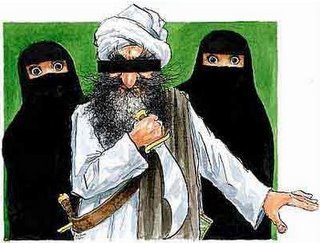
We wondered why the burqua girls in the Mohammed cartoon had such big round eyes…

Now, the truth is revealed. The pictures were actually cropped from a bigger drawing and now, thanks to our own resident Anoneumouse, we can show you what was really going on. Seems it was more like a car-toon.

And, by the way, we've discovered the link between the EU and Islam. Note here from an Islamic clothing catalogue – proudly, it declares: "one size fits all".

COMMENT THREAD

The peace-lovers gather

In an unexpected gesture of solidarity, peace-loving Islamists have now gathered cordially in Damascus to express their sincere love of free speech to their colleagues in the Danish and Norwegian embassies.

According to a Telegraph report, at the Danish embassy, these gentle people took time out to remind the crowds of their commitment peaceful discourse by chanting "God is Great," as they burned the Danish flag and replaced it with another flag reading "No God but Allah, Mohammad is His Prophet". They then set fire to the building in order to demonstrate their solidarity with the Danes.

At the Norwegian embassy, police obligingly provided water from their water cannons for the crowd sweltering under the midday sun, and made available supplies of tear gas to assist them in showing the appropriate emotions. Thus refreshed and fortified, the crowd then politely demolished police barriers and, in the interests of equality, set fire to that building as well.

Meanwhile, according to Reuters the democratic republic of Iran, which has so unfairly been referred to the UN Security Council by a vote of the IAEA – when all it wants to do is deliver high levels of nuclear energy to its impoverished near-neighbour, Israel - has decided to assist the peace-loving bretheren of Islam.

It is formed a committee to review trade ties with countries that have published cartoons of the Prophet Mohammad - peace be to him - in the hope of encouraging European nations to develop their censorship skills to the level practised by the Islamist world.

As the brothers in Nazareth also chanted their support for peaceful expression (left), they were joined by 500 students of Islamic seminaries or madrasas in the eastern Pakistani city of Lahore, who chanted "Down with Denmark". In a novel demonstration of support for the city art gallery, they then called for the authorities to, "Hang the culprits".

In response to this admirable support for the principles of free speech, the Polish financial daily Rzeczpospolita has now published the much-admired cartoons. The Gaza Ladies Sewing Circle has since reported a rush of orders for the Polish flag, noting that their new, improved "flammable version" was selling particularly well.

COMMENT THREAD

Free speech for all

Reuters today, and many others, here, for instance, report on the continuing unrest in Gaza, with Palestinian youths attempting to storm the European Union office in their continuing protest over the Mohammad cartoons, with some about 30 protestors throwing stones at the building.

Also under attack was the adjacent German consulate, where dozens of Palestinians, including teenagers and masked men, stoned the building in Gaza City's Remal neighbourhood. The protesters are also reported to have torn down the German flag, whence they stamped on it and burned it.

About 50 schoolchildren and teenagers gathered at one corner of the street to try to resume the attacks on the two buildings, but Palestinian riot police, armed with batons, pushed them back. The youths threw stones at the police, and then fled.

Meanwhile, we have gathered more examples of peace-loving Muslim communities exercising their right to free speech, here, here, here and here, from which this highly sensitive example of political comment has been culled, published in Al-Yawm (Saudi Arabia) on 30 November 2005 (above).


I rather like this contemporary view of Islam though… (above, left). It's unfair, perhaps inaccurate and a total slur on moderate Muslims. But hey! I'm exercising my right of free speech.

As for our own contribution to the debate - from our own cartoonist Anoneumouse - this is just grossly irresponsible. Everyone knows that Muslims don't drink lager. It is totally offensive, therefore, to suggest that they might actually make anything as useful as this refreshing drink. The bottom half of the cartoon is clearly wrong.

We apologise profusely for any offence we might have caused.

COMMENT THREAD

And why weren't they arrested?

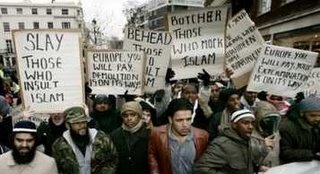
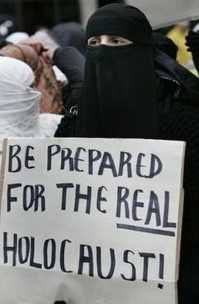
The Times updates us on that Muslim demo yesterday, with the headline, "call for 'holy war' at London demo".

Parading banners that called for the killing of newspaper editors and broadcasters from the BBC who showed cartoons of the Prophet Muhammad, says the newspaper, they marched across the capital from the mosque in Regent’s Park after Friday prayers.

There were sporadic clashes with passers-by over chants praising the four British-born suicide bombers who killed 52 passengers on three Underground trains and a London bus last July 7.

People who tried to snatch away what they regarded as offending placards were held back by police. Several members of the public tackled senior police officers guarding the protesters, demanding to know why they allowed banners that praised the "Magnificent 19" — the terrorists who hijacked the aircrafts used on September 11, 2001 — and others threatening further attacks on London.

The officers said that their role was to ensure public order and safety. Police had closed off main roads to allow the procession a clear route. Protesters screamed: "UK, you must pray — 7/7 is on its way."

And why, Mr Plod Blair, weren't they arrested? Oh, forgot… they were just exercising their right to free speech.

COMMENT THREAD

Friday, February 03, 2006

Danes bring home the bacon (again)

The story of the Danish cartoons of Mohammed, first published in the right-wing (by Danish standards) Jyllands-Posten last September has now reached the stage that even the British media has had to pay attention.

Studiously avoiding the subject for months, while there were riots in Ã…rhus in the autumn, while ambassadors from Islamic countries demanded apologies, while representatives of Muslim groups in Denmark went whingeing to Muslim governments; it managed to demote the story even as more and more papers on the Continent published the cartoons and curious bits of rioting broke out in random parts of the Islamic world.

Even yesterday, as a Day of Anger was called for by, among others, Hizonner Ken Livingstone’s best friend Sheik Yussef al-Qaradawi (mentioned at last today by the Daily Telegraph), no British newspaper considered it necessary to put the story on its front page. (Well, how could it compare in importance with a golfer divorcing and Postman Pat calling on the Queen?)

Still, at least they started reporting the brouhaha and today some of them have put it on the front page. Needless to say, no British newspaper has dared to publish the cartoons.
The BBC with oh so much harrumphing announced that they would broadcast them while explaining why they should be causing such strong feelings. This seemed a little pointless as by yesterday evening there were not many people around who could not work out what the issues were exactly (or, at least, some of them).

In the event, 10 O’Clock News gave semi-darkened shots of the cartoons as they appeared in France Soir (whose editor had been sacked for publishing them) making it impossible for anyone to see what exactly the fuss was about.
Stephen Pollard notes on his blog that the BBC Website carried a despatch by Michael Buchanan about Denmark and reactions to the fuss there, which ended with the following outrageous paragraph:
Denmark's reputation as an easy-going, consensual nation has been severely tarnished in recent days. All the Danes can do now is hope the repeated apologies for the offence caused, by both the government and the newspaper, will end this unseemly row.
It would appear that even the BBC or, perhaps, readers of its website have found this support for censorship hard to stomach and, while the despatch remains sniffy about Danes and about the right to publish cartoons, the quoted paragraph has been removed.

Nor have Britain's politicians exactly shown themselves in an attractive light. As Trade Commissar Peter Mandelson announced in response to the Saudi-inspired boycott of Danish goods that hit one, hit all in the EU.

Having done the one good deed of his political career, he managed to negate it by criticizing the cartoons as "crude and juvenile" and saying that reprinting them was like "throwing petrol on the flame of the original issue". That rather depends, Commissioner, as to what the original issue was.

Meanwhile Jack Straw, the Foreign Secretary, has also joined in the fray, announcing that he was extremely annoyed by the decision of an ever larger number of newspapers to reprint the cartoons.
“There is freedom of speech, we all respect that, but there is not any obligation to insult or to be gratuitously inflammatory. I believe that the republication of these cartoons has been unnecessary, it has been insensitive, it has been disrespectful and it has been wrong.”
Well, he need not worry about the British media. They will do nothing disrespectful. Well, nothing disrespectful to those who are threatening them with all sorts of nasty punishments, even though the chances of those punishments being put into effect are minimal.

You cannot bribe or twist,
Thank God, the British journalist.
But seeing what he unbribed will do,
You have no occasion to.


Just remember, next time you hear comments from British journalists about the wonders of the British media and their own belief in freedom (within bounds, naturellement), you can always ask them this simple question: And what did you do in the War of the Danish Cartoons?

The Finnish Foreign Minister, Erkki Tuomioja took a somewhat different line:
It's evident that all EU countries must together condemn and act against all violence and threats of violence as well as threats of interfering with trade relationships connected with this affair.
Other EU politicians have been reluctantly drawn into the fray by the simple and utterly predictable fact that as violence spread in the Gaza, it turned against the EU, whose office was closed down and whose officials had to escape.

Vice-President Franco Frattini issued a statement, in which he explained that he did not think that those cartoons were a great idea and did nothing for world peace but, nevertheless, he did not think that newspapers or countries should be threatened in any way when exercising their right to freedom of speech.
It is my duty to enter this debate to remind us all that there are delicate issues, particularly in relation to religion and those ideals that are sacred to us. Consequently, I personally regard the publication of the cartoons as somewhat imprudent, even if the satire used was aimed at a distorted interpretation of religion, such as that used by terrorists to recruit young people to their cause and turning them into fanatics, sometimes to the point of sending them into action as suicide bombers.
Let's face it, this is preferable to what our own politicians have been spouting or what Justin Higgins, a spokesman for the State Department said:
These cartoons are indeed offensive to the beliefs of Muslims.

We all fully recognize and respect freedom of the press and expression but it must be coupled with press responsibility.

Inciting religious or ethnic hatreds in this manner is not acceptable. We call for tolerance and respect for all communities and for their religious beliefs and practices.
Quite so. Of course, it is questionable who is inciting religious or ethnic hatred, people who publish cartoons or those who burn flags, storm offices and embassies and carry the sort of placards that Michelle Malkin, among others posts on her blog.

Michelle, incidentally, also points out that the State Department does not speak for America or Americans. Well, neither do the Foreign Office or the BBC speak for Britain or the British people.

Glenn Reynolds on Instapundit says this is a dreadful mistake on the part of the State Department but it might be payback time for lack of European support. Maybe.

In the meantime, the cartoons appeared all over the blogosphere and ever more newspapers, some briefly even in the Middle East have reprinted them. In America the New York Sun did and the Los Angeles Times, apparently, intends to.

The question is surely, why has the story turned to furore now. As my colleague has pointed out, the reprinting of the cartoons is more in the nature of refusing to be bullied than a stand for freedom of speech. I actually think it is a bit of both as editors of newspapers suddenly realized that special deals are not conducive to their own ability to publish what they see fit.

One blogger has pointed out that the cartoons did have an indirect effect on British politics by possibly swinging that famous vote over the Religious Hatred Bill (still a threat to free speech, as Pub Philosopher insists):

Home Office minister, Paul Goggins, was forced to admit that anyone publishing the cartoons in the UK would be liable to prosecution under the new law. So, insulting, abusive or reckless criticism of religion is OK but threatening language is not.
Think of that. This is the only country in Europe, possibly in the West that is heading towards a state of play when a newspaper can be prosecuted for publishing cartoons. The country of John Milton and John Locke among others. Have these people no shame?

Let us just recall the sequence of events in the last couple of weeks. The story had rumbled on for months with both the editor and the Danish Prime Minister steadily refusing to apologize, though making noises about not liking to upset people.

Then a couple of weeks ago a Norwegian newspaper reprinted the cartoons and there the government did apologize.

The next thing we knew was a Saudi inspired boycott of Danish goods, which in turn led to the "Support Danish goods" campaign that spread like wildfire around the internet. Of all the Danes involved in this saga, the least impressive was the Director of Arla Foods who called on the government to apologize as the cartoons clearly insulted millions of Muslims and that really hurt him. Why not just say he was worried about his company's profits? Honesty is always the best policy at times like this.

Arla also announced fantastic losses in the Middle East but neither that nor the possibility of profit warnings announced a few days before prevented them from buying the American company White Clover.
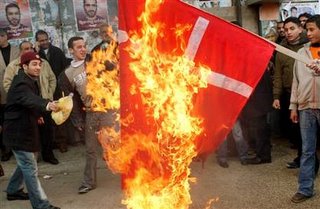
And suddenly there were riots. As one Egyptian blogger asked who was promoting them? In Gaza they not only stormed EU offices but burned Danish and Norwegian flags. (Now, I suppose, they have to burn French, German, Spanish and various other flags, though not the Union Flag.)

Can you walk into a store in Gaza and say "I'll have three pounds of rice, a large tub of hummus, five pounds of olives and a couple of Danish flags to burn"? Then again, many of the flags seem to be home-made, which must be a help to the women's sewing circle but where did the extra sheets, paint and patterns come from?
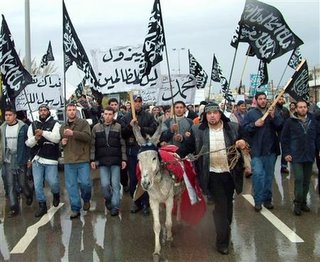
The Gaza riots seem to have been promoted by sub-groups of Fatah (our old friends the Al-Aqsa Martyrs' Brigade appear to have played an important part). There may be a certain amount of one-upmanship here as they may have been chagrined at being seen as moderate.

Then again, if I were a Hamas politician faced with the need to start clearing up rubbish and running various other projects while the budget goes into free-fall, I, too, might think that a bit of rioting and flag-burning is just the thing to take the people’s minds off their real problems.

Could the same kind of thinking apply to many of the organizers in other Muslim countries? Increase the number of external enemies and nobody will notice that most Muslims’ worst enemies are their own governments.

For it is not precisely true that the insult is unbearable. In the first place, though Islamic art supposedly forbids the depiction of human beings, nobody outside the Arab culture (and often not within it) has lived up to it. What of the exquisite Persian miniatures, Ottoman paintings or Mughal illustrations?

Nor has Mohammed never been depicted before (he was only a man, after all), though maybe not quite in the way the cartoons did. But then, as several Middle Eastern and other Islamic commentators have noted, by rioting, burning and screaming abuse, Muslims seem to have proved the essential truth of those cartoons.
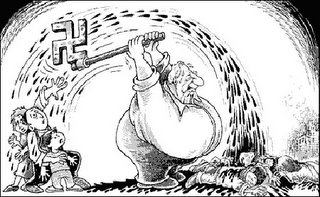
Finally, before we get too excited about hurt feelings, we might look at some of the recent Arab cartoons, collected by Tom Gross. Many of them would have been published with great glee in Der Stürmer. Others are slightly more modern. What of this depiction of Auschwitz with Israeli flags replacing the Nazi ones? I can think of a couple of western publications that would cheerfully republish them without worrying too much about hurting anybody’s feelings.

Stephen Pollard reproduces a rather nasty and, let's face it, inaccurate cartoon on his blog. And so it goes.

On the plus side, there have been some calls from Islamic leaders to stop the attacks. Not too many and they are all tempered with explanations about Muslim sensitivity. And some journalists and bloggers (like The Big Pharaoh I mentioned above) have been pleading with Muslims to "grow up" and stop pretending that a set of cartoons can in some mysterious way undermine their religion.

But it seems that more and more western politicians and journalists are digging their heels in. What started as a minor row in a small country that has a remarkable record of standing up to totalitarian bullies, has developed into a real fight over basic cultural tenets.

COMMENT THREAD

Muslim outrage gathers pace

According to the Financial Times, and many more, angry protests over newspaper cartoons of the prophet Mohammad continued to spread globally on Friday as Muslim leaders and politicians in Europe expressed mounting concern that the outrage could destabilise the multicultural continent. Meanwhile Mr Jack Straw today launched a fierce attack on the decision by some media to republish cartoons of the prophet Mohammed.

Says Mr Straw, republication of the Mohammed cartoons has been "insensitive", "disrespectful" and "wrong."

And the cartoon illustrated? Oh, just a little number dashed off for the Jordanian newspaper Ad-Dustur (October 19, 2003). It shows the classic Auschwitz view but, instead of Nazi emblems we have Israeli flags. The sign reads:"Gaza Strip or the Israeli Annihilation Camp" (Courtesy of Tom Gross).

Of course, that’s not insensitive, and how could it be disrespectful or wrong? It is just an expression of free speech.

COMMENT THREAD

March of the morons

Following on from my post on the Type 45, in which I remarked how the coverage affirmed the retreat of the media from reporting intelligently on defence issues, yesterday in the House of Commons there was a major debate on defence procurement.

The issue itself is of huge significance, not only because it involves massive public expenditure, much of it wasted – an issue that concerns all of us, even those of us who are adverse to "toys" – but also because it is on the adequacy or otherwise of procurement decisions that the whole capability of our armed forces rest.

The debate itself, the transcript of which runs to 82 A4 pages and over 43,000 words, represented a huge investment in time of dozens of MPs and their staffs, the minister and his staff and – from first reading – raised matters of great public interest.

While we are all quick to condemn and deride our politicians, you can imagine that not a few are more than a little disconcerted that, despite the expenditure of such huge effort, the debate merited not a single mention in the media. The Telegraph Commons Sketch, for instance, witten by that incurable lightweight Andrew Gimson, devoted its space to a jokey account of the earlier Defra debate - this in a newspaper that found space for a full page on the account of some boring divorce case.

It would be wrong, however, to single out just the Telegraph for this neglect. The whole of the MSM is as bad. But, if the media do not take the time and effort to report serious issues, can they then be surprised that MPs – to whom publicity is lifeblood – devote their time to more newsworthy items. When it comes to "dumbing down", the media are in the vanguard of the march of the morons.

We are at least fortunate that so many MPs are indeed focused on such issues – no thanks to the MSM – and we will be posting a detailed report of the debate later today.

COMMENT THREAD

Intellectual debate?

From The Daily Telegraph leader this morning:

Those Muslims who cannot tolerate the openness and robustness of intellectual debate in the West have perhaps chosen to live in the wrong culture.
Intellectual debate? Yea… Right.


COMMENT THREAD

Cartoon wars

So, after beef wars, and bra wars, we now have "cartoon wars", an entirely Danish issue in November, that has snuck up to occupy centre stage in a way that no-one could possibly have predicted – and we certainly did not.

Strangely though, it is only The Times and the Israeli blog Israpundit that have adopted the "cartoon wars" moniker, despite its obvious attractions and the possibility that, with armed men who might or might not finally take over the EU office in Gaza, and/or carry out their threat to bomb it and other EU member state buildings, it might become a real war, of a sorts.

So frenetic has become the issue that The Times is reporting that western governments are appealing for calm, conscious that Friday prayers today could trigger a storm of Muslim anger, escalating the situation beyond control.

And while Danish, Norwegian, German and French papers have published some or all of the offending cartoons, no British newspaper has yet bitten the bullet, although the BBC broadcasted them on its main evening bulletins – albeit as glimpses to illustrate the story - while the Channel 4 News, The Spectator and The Guardian have shown them on their websites.

Even the editor of the Jordanian Al-Shihan newspaper was drawn into the fracas, suggesting Muslim anger was unreasonable, and then sacked by his publisher after he had run the cartoons - the second editor to suffer such a fate. But the point he made was difficult to argue: “What brings more prejudice against Islam, these caricatures or pictures of a hostage-taker slashing the throat of his victim?”

But what continues to amaze is the range of "actors" being drawn in. Blair is distancing himself, saying it would be wrong of him to tell the media what to do – not that that has stopped him in the past. Peter Mandelson has intervened, and all sorts of Muslim worthies are getting stuck in.

A spokesman for the Muslim Association is picking on the BBC, saying it is “inciting racial hatred and not conducting a serious debate on freedom of speech,” and a senior figure in Hizb-ut Tahrir has said: "It's become open season by media to insult Islam."

Behind all this, though, there is perhaps a glimmer of a backlash from the non-Muslim communities. This is not so much a question of "freedom of speech", still less of insulting Islam. Who cares? It seems more a reaction to being bullied – the response to a group that thinks it can tell people what they can and cannot do, that same group that seems to feel it can ignore our rules, conventions and constraints, yet it expects us to respect theirs.

You may gather this Blog's response from the fact that we have published two of the offending cartoons, albeit one slightly modified by our own in-house genius, Anoneumouse.

COMMENT THREAD

Thursday, February 02, 2006

There is another way

The media focus on the Blair speech this evening in Oxford centres on British ambivalence towards the European Union, and his view that the time is right for Britons to embrace Europe.

"Europe has emerged from its darkened room, it has a new generation of leaders, a new consensus is forming,” he is cited as saying by Reuters, reflecting the general “take” on his speech. “Yes, there is still a debate to be had, but the argument in favour of an open Europe is winning."

But that is the "up front" message. The sub-text is more important and I do not know which scares me most. It is a toss up between Blair's overwhelming ignorance of the nature of the European Union he professes so much to love, or his absolute, dogmatic rejection of the Eurosceptic case, and his determination that, come what may, we are staying in "Europe".

Turning to the latter, this comes at the end of what is a long speech by modern standards – over 4,000 words – where he tells us that we are part of a mythical construct he creates during his speech, a "new Europe". "We are part of it," he says, "in at the ground floor. It's where we should have always been. Now we're there, we should stay there." Taking no prisoners at all, he continues:

There is no other way for Britain. Britain won't leave Europe. No Government would propose it. And despite what we are often told, the majority of the British people, in the end, would not vote for withdrawal. So we are in it. And it is changing. And in a way we have sought and fought for. The manner in which we originally joined the European project has dogged us for too long. From now on, let the manner of our staying in define us.
Note the definitive sentence, unequivocal in its meaning: "So we are in it". It has an air of finality that says, like it or not (and I really don't care which) we're in it for keeps. And, although he confidently declares that the British people "would not vote for withdrawal", there is not even the slightest hint that he is prepared to put that assertion to the test. Our ruler has spoken.

As to his lamentable ignorance of the construct, this is the defining issue, as he bases his vision for the future on his knowledge of the European Union of the past, and its origins – to which he devotes the first part of the speech.

"From the beginning," he says, bemoaning the focus in institutional reform, "the drive in Europe was always for more institutional integration." That much is true, but Blair goes on to say that, although this was not just natural but necessary at the outset, "it is worth recalling: the political vision of a single market was articulated first; the change in powers then fashioned to deliver it."

Therein lies his fatal misunderstanding of the very nature of the beast. It was never the case that there was a "political vision" of a single market. The original Salter/Monnet design was not a "single market" but a customs union, for the same reason that Bismark elected for one – his zollverein. In order to administer common external tariffs, a central government was needed. In Bismark's case, this was his instrument for uniting Germany, in the case of the founding fathers of the EU, it was their instrument for uniting Europe.

In other words, what Blair calls a "single market" was and remains a means to an end, using economic mechanisms that had as their ultimate objective, political union – the process that academics call neo-functional integration.

But, based on his fundamental misunderstanding of the nature of the "project", Blair's thesis is that, as was the "single market" considered first and the rules then devised to make it work, so too should a "new Europe" operate in the same way.

Give people "a Europe-wide programme to beat organised crime coming in from Europe's borders and they will support it," he declares. "People will not buy more Europe as an end in itself. They will ask; why and what for? But answer those questions well and they will buy it as a means to an end they understand."

The trouble is that all too many of us understand that in the "real" Europe, the Europe of the European Union, there is only one core policy – political integration. Everything on offer is designed either to sweeten the pill, or smooth the process towards that ultimate goal. Blair might think that we can "co-operate" – and he uses that word often - to produce "a Europe-wide programme to beat organised crime", but the colleagues will always measure it in the light of how far it progresses the integration agenda.

Co-operation, of course, is not on that agenda. The transition of powers from member states to the commission, via the "gateway" of the Council of Ministers, might need co-operation, but it is the co-operation of the damned. Once the powers are given away – in perpetuity - co-operation is no longer needed. The commission is in a position to instruct, demand and sanction. Co-operation becomes compulsion.

Therefore, it does not matter whether there is a "new consensus", as Blair asserts. This just means a different set of people at the table, but the game goes on as before – the steady attrition of the power of the member states, and its gradual accumulation by the commission. Like it or not, "Open Europe" is not winning - it does not even exist. The pace might have slowed a little, and the direction is more uncertain, but the integration agenda remains.

But that does not mean we have to accept Blair's prescription. He may be blind. He may be ignorant. And while, in his ignorance, he can assert that "there is no other way for Britain," he is wrong. There is another way.

COMMENT THREAD

Victory in Europe

Following the despatches from the front by our intrepid reporters, datelined 24 January, this Blog can report that the war is over. After stiff resistance by Poland, parties meeting in a railway carriage just outside Versailles have agreed that reduced VAT rates on hairdressers and restauranters, and even minor construction works, can continue until 2010.

A reporter from EU Observer, who did not witness the ceremony, bravely filleted the press release from the former warring parties, produced in the run-up to the armistice. Austrian finance minister Karl-Heinz Grasser, after the talks with his Polish counterpart Zyta Gilowska and EU tax commissioner Laszlo Kovacs in Vienna, was cited as saying: "It's a victory for Europe."

Our reporters, covering the exuberent street scenes, throughout the capitals of Europe, say "it's just wild out there". There has been non-stop celebrating and street parties galore. Said one of our front-line staff, "Heaven knows what would happen if they reduced VAT on underpants."

Commissioner Margot Wallstrom, referring to her communication from her command bunker in Brussels, told a BBC reporter, "Citizens expect Europe to offer them prosperity, solidarity and security...". We have delivered on our promise to deliver. "Plan D", she said, "means more than 'democracy'. It also means 'delivery'.

Shortly before she left for the clinic, Wallstrom told EU Referendum, "For us, in the Commission, this is VD-Day".

COMMENT THREAD

A retreat from defence

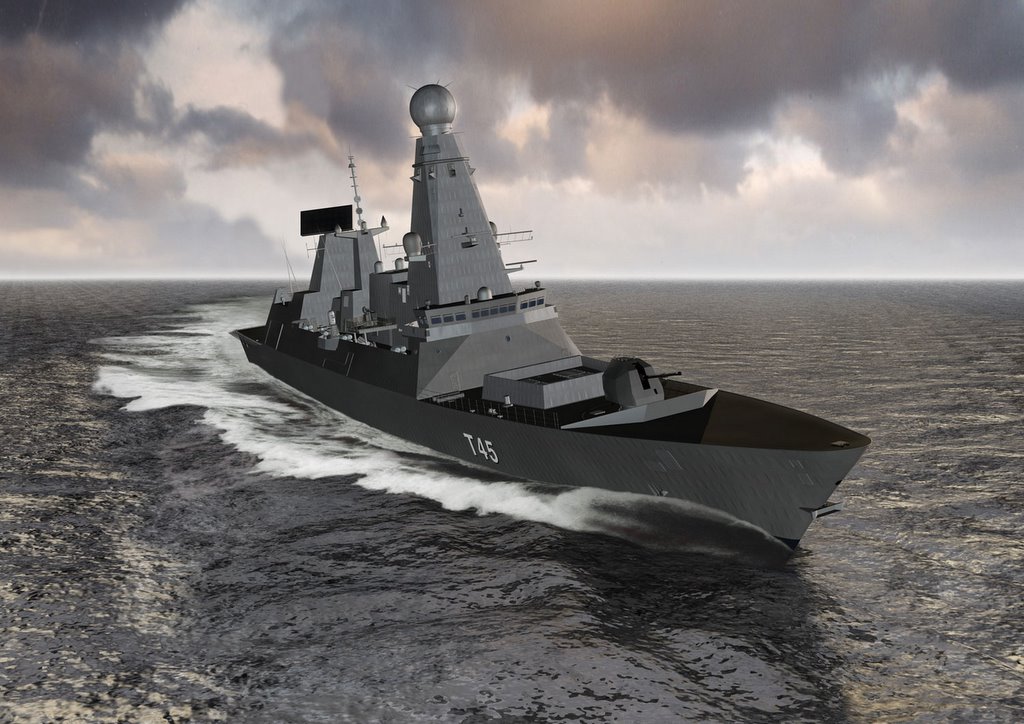
So it came to pass that yesterday, 18 months behind schedule and hugely over cost, that the first of the Type 45 Destroyers HMS Daring was launched on the Clyde, to fanfares and applause, in front of an audience of 11,000.

But, if the most expensive white elephant in the history of the Royal Navy has just been launched, you would have got no hint of that from the media, and especially from The Times, which headlined, "Navy launches deadliest and most expensive warship". And, according to The Times, it was "on time and within budget".

Even within the framework of its own story, The Times could not manage to be consistent, declaring in the first line that HMS Daring was "the first of the Royal Navy's £6 billion fleet of six Type 45 Destroyers", then stating further down that it had "a price tag of £605 million".

It then went on to state that the Type 45s "will be the most powerful, advanced and deadly warships in the world when they come into service in 2009", something which is simply and demonstrably not true.

For sure, it will have a highly advanced anti-aircraft system, based on the costly French-built PAAMS missile and British designed Samson radar, but very little else. It will have only a very limited land attack capability, mounting a 4.5 inch gun, and – apart from its single helicopter - an anti-submarine capability that amounts to no more than a self-defence system, and no anti-shipping capability.

Compare and contrast with the US equivalent, the DG Arleigh Burke class, which, in addition to its perhaps not quite as effective anti-aircraft capability (with nearly double the number of missiles) has a significant land attack capability - being able to launch Tomahawk cruise missiles - an anti-shipping capability and world-beating anti-submarine warfare equipment.

And not only is it truly a formidable, multi-purpose warship, it comes in, as the Australians found, at £400 million less than the £1 billion price tag for the Type 45.

But if The Times report was useless, it was matched in fatuity by the BBC, although it did manage to confine its hyperbole to describing HMS Daring as the UK's most powerful destroyer – which, when it comes into service, will be true, as it will be the only type of destroyer we have. The BBC too bought the "price tag of £605 million" line, but later giving the total programme cost for the six ships as £5.5bn.

The Sun, totally out of its depth, reported the cost as £6 billion – but for eight ships, not six, describing HMS Darling as "the deadliest ship ever built".

Even the dour Scotsman described it as "one of the world's most advanced warships" and then went on to call it a "multi-role ship", which it clearly is not in any realistic sense of the world.

As for The Telegraph, it called the ship, "the most powerful frontline warship since the Second World War", but at least limiting the description to "the world's most advanced air defence ship," then – for heaven's sake – calling it a boat, claiming that, according to BAE Systems, its builders, its "hugely powerful radar and missile system, has left American visitors to the yard 'shaken and shocked'". I think not.

It took Jane's to point out that this class of ship should have been in service in 2000, delayed by the abortive French-Italian co-operative venture, which cost us a small fortune when we had to refit the obsolescent Type 42s which should have been replaced.

The average MSM reader, however, will walk away thinking that Britain has been well served, not realising that, in a Navy that is shrinking faster than a bank balance in the hands of a shopaholic, we cannot afford the luxury of overpriced, effectively single-purpose ships. We could have had far more capable, multi-purpose ships, for a saving on six vessels of £2.4 billion – the price tag for a new carrier.

If we had a grown up media, these issues would have been raised but instead, in its infantile, pathetic way, all it has been able to do is affirm that its has retreated from reporting intelligently on defence issues.

COMMENT THREAD

Wednesday, February 01, 2006

State of the Union

We do not consider it necessary to analyze President Bush’s State of the Union Address, or the preposterous behaviour of the Moonbat Mom Cindy Sheehan (soon to be a senatorial candidate if things go the way one wishes them).

Nor is it necessary to analyze the reactions to it – much as one would have predicted: those who suffer from “Bush derangement syndrome” hated it, sensible Dems liked some but disliked other aspects, Republicans and those on the right mostly liked it. Well, what do you expect?

Most of the speech was devoted to the international situation and the developments in Iraq (after three successful elections and talks on a coalition government, the President can afford a certain amount of pride). It is, we think, worth quoting a couple of paragraphs to remind our readers that being a strong power or wanting to be a strong power carries certain responsibilities:

“In a complex and challenging time, the road of isolationism and protectionism may seem broad and inviting, yet it ends in danger and decline.

The only way to protect our people, the only way to secure the peace, the only way to control our destiny is by our leadership.

So the United States of America will continue to lead.
….
Every step toward freedom in the world makes our country safer, and so we will act boldly in freedom's cause.

Far from being a hopeless dream, the advance of freedom is the great story of our time.

In 1945, there were about two dozen lonely democracies in the world. Today there are 122.

And we are writing a new chapter in the story of self-government, with women lining up to vote in Afghanistan, and millions of Iraqis marking their liberty with purple ink, and men and women from Lebanon to Egypt debating the rights of individuals and the necessity of freedom.

At the start of 2006, more than half the people of our world live in democratic nations. And we do not forget the other half -- in places like Syria and Burma, Zimbabwe, North Korea and Iran -- because the demands of justice and the peace of this world require their freedom as well.”

Obviously, I do not know who wrote the speech, who edited it and how much input the President had. But at its lowest one can say that he recognized resounding words when he saw them. We hear a great deal about the man’s stupidity, tongue-tiedness and about Blair’s superior understanding of the language and its use. I, for one, would like to hear words of this kind from Tony Blair or his self-appointed successor, the Boy-King of the Conservative Party.

COMMENT THREAD

Mutatis mutandis

David Frum writes on the American Enterprise Institute website today about the new Canadian government’s first challenge in international affairs: how to deal with the newly elected Hamas led government in the Palestinian territories.

Of course, reading the paper one realizes that the real challenge is not in Ramallah but in Ottawa, where, predicts Frum, officials will try to persuade the new Prime Minister that business should be as usual in order to “retain credibility”, “influence the terrorists to stop being terrorists” and “help the people of Palestine”.

Most of the arguments in favour of dealing with terrorists and mass murderers (not least of their own people) who have not the slightest intention of changing their spots, are specious. We have heard them all before. Appeasement did not even work with IRA/Sinn Fein and there, at least, some indication of a change of policy was granted. With Hamas there is none.

So what’s Canada to us, you might say. Well, mutatis mutandis, can you not hear the same arguments being used by officials in the EU and various European countries?

COMMENT THREAD

A cause for celebration

On 1 July 1916, the British Army launched its "great offensive" in what became known the Battle of the Somme. It is famous chiefly on account of the loss of 58,000 British troops, of which third were killed, on the first day of the attack.

It is also the battle in which the "Pals" were slaughtered, local regiments which had been formed in response to Kitchener's call to arms, not least the Accrington Pals – a regiment lodged in my memory as I have visited the site in Northern France where they met their untimely deaths.

The site is isolated but well preserved and what is so chilling about it is that you can see the "jump-off" trenches at the start line and then look up to the crest of a hill, on the brow of which were the German lines, not more than a few hundred yards distant. And, exactly between the two is a row of neat, walled cemeteries, marking the point at which the "Pals" fell. Under the hail of machine-gun fire and artillery, that is as far as they got.

We do well to remember this slaughter and, if I had my way, I would make it compulsory for all schools to bring their children to these sites – and in particular the moving memorial at Thiepval (pictured above) to show them what sacrifices were made – real sacrifices – for our freedoms.

It would also put into perspective somewhat the front page of The Telegraph today, which dedicates half the page to a single photograph, against a black background, of Cpl Gordon Alexander Pritchard, the 100th solider to be killed in Iraq.

The Telegraph is by no means the only newspaper to afford such lavish treatment to the death and, while we can agree that every death is a tragedy, there is something maudlin and excessive about the coverage, which bodes ill for this nation if this is representative of general sentiment.

This is one hundred deaths in three years, compared with, say, 3,500 road deaths each year, a large proportion of whom were testosterone-driven young men who seem willingly to slaughter themselves for the temporary thrills of the tarmac. These are senseless deaths, whereas the 100 soldiers who died did so in a noble cause. Their deaths had meaning.

Anticipating the howls of protest at my brutal attitude, let me recount an experience I had as a young man when, with a group of my fellow officers, I was taken to visit an operational RAF station. When we walked into the Officers' Mess, mid-afternoon, we were somewhat startled to see a frenetic, uproarious party in progress, with drink flowing like water. Inquiries soon revealed the reason. A pilot had just been killed in a crash and his friends and colleagues were celebrating his passing.

As a young pilot officer, I too was flying jets and knew it was dangerous. In fact, I knew more than most. Having worked on an airfield before joining the RAF, I had experienced that loathsome moment when an aircraft had dropped out of sight at the end of the runway, to be marked by a pall of oily smoke and the death of a fine young man.

But we knew what we were doing. We did not embrace death but we were aware that it was our companion, and took it in our stride. Unfortunately – I thought at the time – I failed the flying course, an event that probably saved my life as, with the best will in the world, I would never have made anything more than a second-rate pilot. My chances of survival would have been slim.

It ill-behoves the media, therefore, and the rest of us, to indulge in maudlin sentiment at the death of one soldier, because he happens to be the 100th, or for whatever reason.

These fine young men were soldiers. They were volunteers. They knew the risks and were nevertheless prepared to do their duty. That we still have such young men, in a society that seems so increasingly rootless and without values, is a cause for celebration.

COMMENT THREAD

A dangerous place

A disturbing report was published in the Jerusalem Post yesterday, suggesting that Iran has already enriched enough uranium fissionable material to manufacture at least one or two atom bombs

Their source is Rafi Eitan, a former Israeli intelligence chief who believes that Ahmadinejad "would not have dared come out with his declaration that Israel should be wiped off the map," unless he already had the means to do so. Eitan was involved in the secret planning and implementation of the attack on the Iraqi Osirak nuclear reactor in June 1981.

Although he is now eighty, Eitan is still active and still in touch with the intelligence community, so it would be unwise to ignore completely his views. Furthermore, other sources report rumours of an Iranian "experiment" in March. But one does wonder.

Putting various strands together, for Iran to pose a credible threat to Israel, it must not only have a functioning bomb, but also a reliable means of delivery. And here, not all the pieces are falling into place.

The most likely delivery vehicle is the Shahab 3 missile, a much modified version of a North Korean missile, developed with Russian and Chines technical assistance. There are later versions, running to the Shahab 6 series, but only this model seems to have the reliability to pose a credible threat.

Then, although the distance between Tehran and Tel Aviv is just under 1,000 miles, at the limit of the missile's range, firing from either the western provinces of Ilam or Khuzesatan, close to the Iraqi border, would shave 200 miles off that distance and bring the missile well within range.

However, what is interesting is that the Iranians have opted for a uranium rather than a plutonium bomb, which means that they can refine the material without recourse to a nuclear reactor (the latter being the only source of Plutonium). The down-side of this is that a uranium bomb is heavier (and also produced a lower explosive yield).

Using uranium would also simply the design, enabling the relatively crude "gun" arrangement of the type employed in the first atomic bomb dropped by the Americans on Hiroshima on 6 August 1945. Bit what must be remembered about that bomb is that it weighted in at 9,700 lbs, with a length of 10 ft and a diameter of 28 in. It also contained 140 lb of uranium.

Clearly, such a crude weapon could not be delivered by an intermediate-range missile like the Shahab 3, which has a maximum payload of a ton and serious dimensional limitations.

To enable missile delivery, the Iranians would have to produce a much more compact implosion device, which could be engineered to fit the limited warhead space of their missile.

However, the first design of this type was the American "Fat Boy", used on Nagasaki, and that weighed in at 10,800 lbs, with a length of 10 ft 8 in and a diameter of 60 in.

With all their skills and experience, the resources of the nation and no outside restriction placed upon them, it than took the Americans until 1966 to produce a lightweight implosion bomb, the B61 (pictured left). At 700 lbs, a length of 10 ft and a diameter of 10.75 in - with the actual nuclear device considerably smaller, this is the sort of development needed before the Iranians could fit out their missile. And, bearing in mind that this is a plutonium weapon, a uranium weapon would be heavier.

The technology required to produce this bomb is fearsome, not least the highly complex array of conventional explosives needed to trigger it, and to produce it would stretch Iranian capabilities and resources to the limit. Furthermore, such is the complexity that the Iranians would at least on live test to prove the design.

Even then, there have been doubts expressed as to whether the warhead dimensions of the Shahab 3 are sufficient even to accommodate a lightweight bomb, which raises further questions about Iranian preparedness.

Despite Rafi Eitan's concerns, therefore, an Iranian nuclear strike – or the acquisition of deliverable bombs - may be less than imminent, which raises questions as to why Eitan has gone public with his fears.

This could, of course, be part of the war of words, aimed at speeding up the reference to the UN Security Council, but it could also be part of the process of preparing Israeli and world opinion for a strike shortly after the Israeli general election, which is to be held on 28 March.

Whatever the truth, it looks like the possibility of an early Israeli strike cannot be ruled out, making the world of much more dangerous place than it was even a few months ago.

COMMENT THREAD