Showing posts with label Type 45 Destroyer. Show all posts

Monday, November 13, 2006

The Beeb strikes again

It seems there is no limit to the amateurism of the Beeb, its website offering so-called background information on yesterday's tragic attack on an Army patrol boat.

"What kind of boats do British forces use?" the piece asks rehetorically, using a Q&A format often adopted by the Beeb. Answering its own question, it tells us: "Patrolling the Shatt al-Arab is a risky job for troops because the waterway is too narrow and shallow for large, well-armoured vessels. Instead British forces use so-called 'rigid raider' launches, which can carry up to a dozen troops."
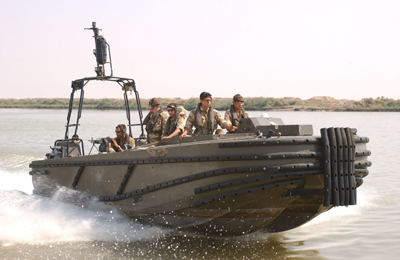
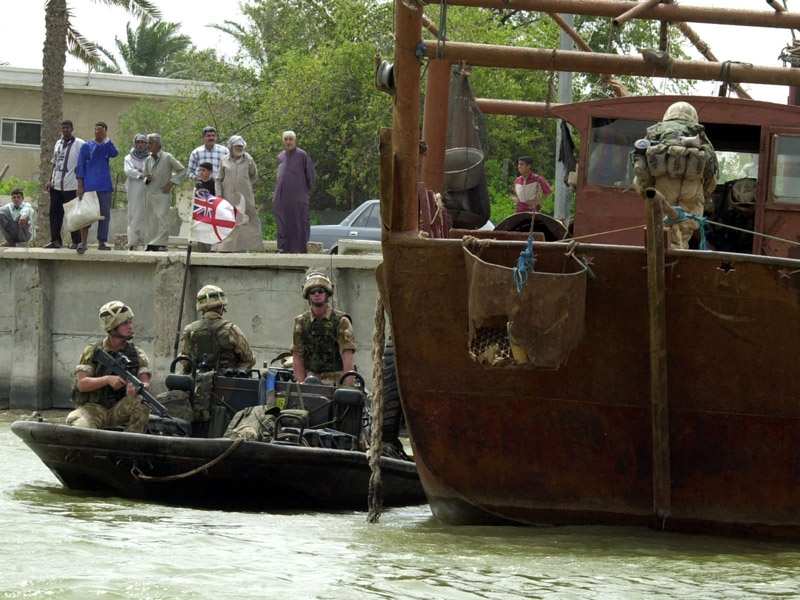
From our piece, readers will be aware that the Army operates two main types of patrol craft, the "Rigid Raider" and the "Combat Support Boat". We have published pictures of both but the BBC, in its news report, offers only one, a picture of a combat support boat (right), attributed to "PA" but actually taken by an MoD photographer in August 2003 (they can't even get the attribution right).

This makes the Beeb piece inaccurate. Another word is "wrong". For sure, this is only a matter of detail, and technical detail at that, so does it really matter? In isolation, possibly not. But it does display is a casual sloppiness on the part of the author and his or her employing organisation. Just a few minutes on Google identifies the MoD site and a few more minutes gives you pictures of the boats in use in Iraq. Doing those checks is what being a professional is all about and, while we all make mistakes, the Beeb is taking our money for its "services".
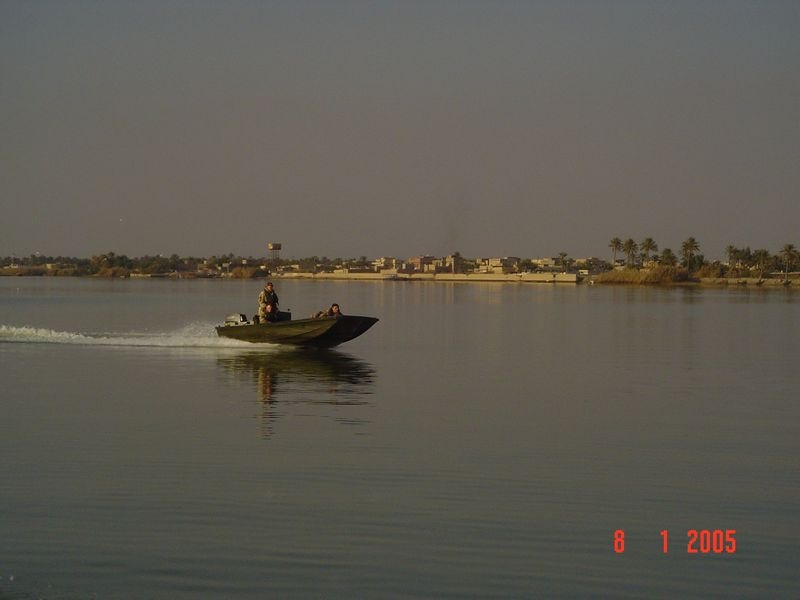
Furthermore, the error does not stop with the boat type. Says the Beeb: "Patrolling the Shatt al-Arab is a risky job for troops because the waterway is too narrow and shallow for large, well-armoured vessels." Yet, the pictures we showed yesterday are of a wide waterway, navigated by substantial craft. The one left, featuring a rigid raider, also shows a wide waterway. (See also picture at the end of this piece, which also depicts a rigid raider.)

With such a casual regard for truth and accuracy, one really does have good cause for wondering whether the Beeb can or should be trusted on other things. And it is not just a question of what they are getting wrong, but what they are missing or, in their amateur way, failing to understand.

In this context, we now have a number of more detailed reports of yesterday's incident. A number of them, based on agency input, tell us that two of the soldiers killed were from 45 Commando Royal Marines and one each was from the Royal Signals and the Intelligence Corps.

It is The Times, though, with a piece by Michael Evans, defence editor, which gives us important detail – not offered at all by the Beeb and many others.

Evans tells us that the military personnel had been engaged in a routine patrol of the river, travelling in two boats, looking for suspicious craft and monitoring movements along the bank from where mortar rounds have been fired in the past. It was as the boats approached a pontoon on the waterway on the west side that an improvised explosive device detonated, probably by remote control. Shia Islamic terrorists were suspected of carrying out the attack.

The crucial information here is that the boats were part of the defensive effort against the continued mortar attacks, one of which, on the Shatt Al-Arab Hotel in early October killed a soldier from the Royal Army Medical Corps. And, as we know, the Basra Palace complex, is beside the waterway, which makes it prone to attack from that direction.

That the insurgents were able to target the boats suggests that the movements of the vessels were known and predictable. It is not inconceivable that the mortaring and this attack were linked, the one setting us the site for a later ambush of the patrol.

That said, hindsight is a wonderful tool and it is easy to be an armchair general. But the point is that each and every death of a British serviceman is exploited by the anti-war groups, and adds to the unease of the general population about the conduct of the war.

As we pointed out earlier, if Blair is to keep troops actively engaged in southern Iraq, he must have at the very least the tolerance of our population. To ensure that, every effort must be made to protect our troops from harm.
On the basis of what we know, we cannot be assured that that is the case and it will take only a few more incidents like this before the pressure for a full-scale withdrawal becomes unstoppable.

But, without good information on what is happening out there, we are all at a loss: the quality of debate and understanding will suffer. For that we need or should be able to rely on the British Broadcasting Corporation. Instead, we have is a collection of amateurs who - amongst other things - want to tell us, without qualification, that the Shatt Al-Arab is "narrow and shallow".

We are not being well served.

Et tu, Scotsman?

It seems the Scotsman has also caught the "amateur" disease with a piece so off the wall that, if we weren't dealing with such a serious subject, it would actually be funny. It writes:

Around Basra, it is too narrow and shallow for large vessels such as frigates, necessitating the use of so-called "rigid raider" launches. These typically carry up to a dozen Royal Marines or soldiers, and have only light arms for protection.

This leaves them vulnerable to attack, especially when they slow down to go under the many low bridges that criss-cross that part of the Shatt Al Arab and are open to the public.

One insurgent tactic has been to push small children to the front of the bridges, and then throw missiles over them - meaning it is virtually impossible for coalition troops to return fire for fear of hitting the youngsters.

The British troops carry out the dual role of protecting British bases in Basra while another detachment works from Umm Qasr, protecting the strategic port which is the supply lifeline for UK troops in the area. The marines and navy personnel also guard against water-borne terrorist attacks on offshore oil-pumping stations and merchant shipping.
Er… the frigate is above right. There is nothing in between that and a "rigid raider" (above left)? And what about the use of helicopters?

I suppose an equivalent is, "We can't get a tank down these roads, chaps, so we're going to have to use bicycles". From where do they get these people?

COMMENT THREAD

Thursday, October 12, 2006

The march of the amateurs

We have spent considerable time chuntering that the MSM does not give any space to defence procurement. Now, however, equipping the armed forces is at last on the agenda and we are beginning to see some articles on the issue. But, if the Guardian is any guide, they might as well not bother.

In a piece headed, "British military bites the bullet", with Mark Oliver
asking, "Is the British military underfunded, or just spending badly," we find that the years of ignoring the subject, combined with the inherent ignorance and laziness of the MSM, produces something so distorted it is hardly worth reading.

The one thing Oliver does not do is answer his own question - to which the answer is "yes" - yes, it is underfunded and it (or the MoD) is spending badly. But there is a strong European element to the mis-spending, which The Guardian does not even begin to address (although it does mention the Eurofighter and the Type 45 Destroyers), so I thought it would be helpful to put together some examples of Euro-wastage. These are just some of them:

read more...

COMMENT THREAD
Wednesday, September 06, 2006

Dying of ignorance

A crop of letters in the Telegraph today (double-click to enlarge), under the heading, "Armed Forces deaths are the result of a lack of equipment", attests to the fact that the this blog is by no means alone in its view of the MoD's procurement performance – not that we ever thought we were.

But a recurrent theme in the debate is the issue of "underfunding". For instance, Telegraph correspondent James Heitz Jackson of London sees a direct correlation between the overstretch and underfunding imposed on our armed forces and the deaths of service personnel.

This is a charge made by former soldier Michael Moriarty in the "comment is free" section of the Guardian last week. Moriarty actually claims that soldiers are paying with their lives for the MoD’s incompetence, declaring that, "escalating commitments, budget squeezes and big equipment programmes have left Britain's forces fatally overstretched". He argues that:

Iraq and Afghanistan are stretching our forces - the army in particular - beyond the limits of the assumptions on which their funding is based. This situation has arisen through a combination of the government's enthusiasm for use of the armed forces to support its foreign-policy aims and the failure of defence chiefs to adequately highlight the limitations of military force and to demand that the government properly resource its military ambitions. There is a real risk that the armed forces could fail in their politically appointed tasks, with terrible long-term consequences for both them and Britain's world standing.
Des Browne, defence secretaryThis has had defence secretary Des Browne rushing to the ramparts with what he thinks is a rebuttal, denying that British troops are ill-equipped and that the defence budget is insufficient.

At the heart of Bowne's rebuttal is his claim that the Afghan operation is fully funded from the Special Reserve and, therefore, the defence budget is not threatened by operational costs. Furthermore, he claims, the annual defence budget has risen by five billion pounds over the last five years - well in excess of inflation.

One has to say that this sort of charge and counter-charge gets us nowhere. It is little more that the "yah-boo-sucks" type of exchange that you can get any day in any school playground, lacking as it does any detail upon which to chew.

The Eurofighter - white elephant extraordinaireActually, both are wrong and both are right – and neither has got to the key point. Yes, the defence budget has increased, and yes British forces are underfunded. And the reason both are right is that the money is going on useless projects like the Eurofighter, the Type 45 Destroyers and the Storm Shadow (the million pound bomb) – none of which are any use to the troops committed in either Iraq or Afghanistan.

But there is another all-important issue which neither of the proponents seem to have recognised. That is the value for money issue, which must also be assessed with regard to the tactical need.

Taking the second point first, outside a very narrow group of military specialists, there is very little debate as to what precisely is the right type and mix of equipment needed for counter-insurgency operations. Yet this issue is too important to be left to the specialists and – especially – the military establishment, which has a glorious and virtually unbroken record for getting it wrong.

Red coats and muskets - left to the military establishment, one somethimes thinks, these would still be frontline equipmentWhether it was the introduction of the rifle in the Napoleonic wars – which was strenuously resisted – the change from red tunics to khaki in the Boer War, and the tardy issue of machine guns, or failure to develop a suitable tank (or armoured personnel carrier) during the Second World War, the record is dismal.

One of the current, most vibrant arguments at the moment is the role of armour in counter-insurgency, one that came to the fore in the battle for Fallujah (see here and here), which has had the US military reappraising the role of Main Battle Tanks (MBTs) and committing to a major programme of upgrading their Abrams fleet to improve its survivability in urban warfare.

Similar thinking is influencing the Israeli military. Before the Lebanon war, it was a given that the IDF would halt production of the latest mark of its Merkava MBT.

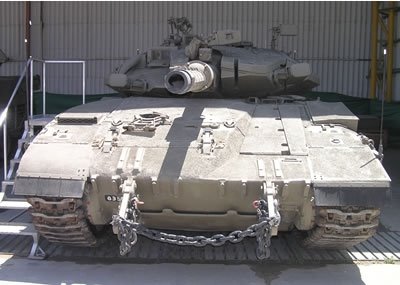
A Merkava Mk 3The view now – according to DefenseNews - is that the tank acquitted itself well in the recent fighting, not only in its primary role but in support missions such as escorting infantry, delivering supplies and even extracting battlefield casualties. The tank, therefore, is expected to evolve into a multi-purpose vehicle and its continued production looks assured.

Not only is the tank version undergoing a transformation, however, the Israelis are funding a project to develop the Merkava chassis into a dedicated armoured personnel carrier, called the Namera, building on their experiences with the Puma and its limitations.

All this is happening though at a time when the British Army is undergoing a major transformation, cutting back on its heavy armour and planning to replace much of its capability with medium-weight, wheeled armour, under the aegis of the £14 billion FRES programme, all to fit in with the EU concept of the European Rapid Reaction Force.

One can only marvel at the thought that the two armies which are most actively engaged at the sharp end with so-called "asymmetric warfare", in deadly counter-insurgency campaigns are opting for more and heavier armour while the British military establishment, imbued with the ethos of European integration, is going the other way.

A Namera APCBut, if the choice of equipment is suspect, what about the costs? One of the main disadvantages of the Israeli Namera, we are told, is the cost – at a cool $750,000 each. But that, in sterling, is £398,631 (at current exchange rates) yet this compares with £437,000 each for lightly armoured Pinzgauer trucks.

No one is saying that the Namera would be the most appropriate equipment for the British Army in Afghanistan – although I suspect that some commanders would not turn them away if they were offered them – but surely the MoD can do better than spend nearly half a million for a truck that offers little if any better protection than that afforded by a "Snatch" Land Rover.

Then, as we have reported before, while there is a crying need for tactical helicopters in both Iraq and Afghanistan, the MoD is committed to buying the " future Lynx" at an average cost of £14.2 million each, which means that they cannot be brought into service until 2014. Yet, the US Army is quite content with the well-proven Kiowa variant, at less than £2.3 million each.

The 'Panther' - at £417,000, more expensive than the NameraAll this and much more (such as the near £200 million on 400 useless Panthers – which cannot be used in Iraq - see also here) suggests that, not only is the MoD buying the wrong equipment, it is also paying far too much for what it does buy – the worst of all possible worlds. It also suggests that the problem is much more complex than the simple issue of "underfunding".

On the one hand, we have committed far too much on equipment that is of no use for the current campaigns and, on the other, much of what we do buy for the respective theatres is either overly expensive, under-performing or too late – or any combination of the three.

Echoing Booker's lament in his column last week: "Oh, for a properly clued-up media and an Opposition worthy of the name," we urgently need a properly informed debate both in Parliament and in the media.

Steve Bell in The GuardianWe have no great hopes of the former and, as for the latter, even if there were journalists around who were capable of understanding the issues, the likelihood is that they would not be allowed to write even half-way detailed stories (as we found to our cost here). Their editors, wedded to their dumbed-down diet of political soap operas and Diana-esq, human interest stories, can rise to the occasional cheap quickie - after the event – (or the occasional cartoon) but would judge detailed analyis too "boring" for their precious readers.

Thus is the public condemned to ignorance and, as we keep pointing out, the consequences are all too evident. Ironically, during the early '80s, when the killer disease AIDS made its appearance, the Department of Health advertising slogan – to increase awareness – was "don't die of ignorance". Decades later, this looks to be the fate of many of our soldiers. The horrible reality, though, is that it will not be their ignorance which does for them – but ours.

COMMENT THREAD
Tuesday, August 29, 2006

The scum that they really are

We see that Daniel Hannan, the eurosceptic's eurosceptic, is in full flood in The Daily Telegraph today, holding forth in an op-ed about the terrors of the European Union.

"The European Union is a solution in search of a problem," he writes. "Whatever the question, the answer is invariably 'more Europe'. War in Lebanon? We need to be able to deploy an EU army. A breakdown in the World Trade Organisation talks? Let's have a more integrated European economy. People voted against the constitution? They obviously thought it didn't go far enough."

I suppose we should not be ungracious. Never mind that this is the man that staked his political reputation on the Boy King Cameron taking the Conservative MEPs out of the federalist EEP group in the EU parliament – only to have his new leader renege on the promise, leaving Hannan high and dry – and still a member of the federalist EPP.

We should quietly forget this little embarrassment and be grateful that thus highly paid MEP is not too busy to earn a little more money telling us what we already know – that the EU in reality only has one policy and that is political integration. And, in seeking to achieve this, it has become past master at exploiting situations of concern, in this particular case concern about terrorism.

This is a phenomenon we have called the "beneficial crisis", about which we have written many times on this blog, like here, here, here, here and here … and er… here and here. Not, of course, that Hannan could ever bring himself to use that phrase. It was coined by the Booker/North team and associating himself with anything we did would soooo damage his credibility.

But, as I have just said, I should not be too ungracious. The fact is that what Hannan has written cannot be said too often – especially for our American friends, some of whom still labour under the impression that the EU has some purpose other than integration for the sake of it.

But what one should really query is why The Daily Telegraph actually bothers to print this sort of stuff – unless, of course, it was a slow news day and it needed something to fill its pages.

The point is that the newspaper itself – as reflected by its editorial line – obviously does not believe it, otherwise it would be pointing it out more often, instead of trying to excise any reference to the EU as often as it can get away with it.

What occurs is that the Telegraph is vaguely aware that some of its readers are vaguely eurosceptic so that, every now and again, it throws a token piece into the pot to keep them happy, and the advertisers coming back to but more space. It is probably as simple as that – for all its high pretensions, this newspaper is a business like any other, there to make money for its owners.

What sticks in the craw though is the pretension. For instance, yesterday, the paper ran a robust editorial demanding that the MoD should "Equip soldiers properly". "We've said it before, and we'll no doubt say it again," the paper intoned. "British troops are as brave, willing and deadly as any in the world. But they are let down by poor procurement and an inefficient MoD."

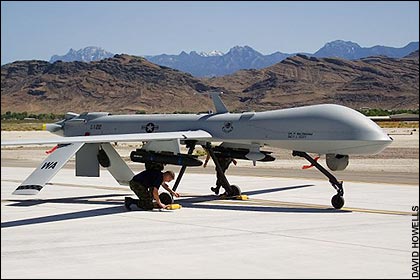
It then preens itself on reporting that "our forces" in Afghanistan are short of ammunition and are to be supplied with drones bought off the shelf from America (pictured above), because of the inadequacy of our own kit. British weaponry, it seems, is not suited to the rough conditions of Helmand province.

It then goes on to declare that:

The reason for this is that, deep down, our generals are still gearing up to fight the Cold War. Our defence procurement is Euro-centric, designed to protect the Continent from a modern conventional attack. As such, it is ill-suited to the theatres in which our soldiers are commonly deployed.

What use is the Eurofighter, the most expensive item in the history of the MoD, in the Afghan campaign? What about our new nuclear submarines? Are they, perhaps, to be dismantled and carried across the Hindu Kush by mule train, and then reassembled in mountain lakes to take on the Taliban?

The purchase of drones is a welcome, if belated, development. Far more needs to be done if the British Army is to be properly suited to out-of-area deployment. We need modern military computers, guided satellites, air- and sea-lift capacity. And the best way to secure these things is to buy them from the Americans, so as not to have to duplicate the research and development costs that have already been sunk into them.

Sadly, our political leaders, for ideological reasons, prefer to participate in costly and inefficient European consortia than simply to purchase what we need from across the Atlantic. And our top brass, partly because they can see which way the wind is blowing and partly out of sheer inertia, are too ready to go along with them. It is the young British soldier, "wounded and left on Afghanistan's plains", as Kipling put it, who is left to pay the price.
Er… excuse me! This we have been saying for some considerable time, not least in my CPS publication last year called the "Wrong Side of the Hill" (and more recently here), when I pointed out that the British government was expending billions on European equipment which was more expensive and less effective than US counterparts.

And where was the Telegraph then? Did it even publish a story on the paper, or refer to it at all? And, when one of the biggest wastes on money we have seen in recent times – the Type 45 Destroyers – celebrated the launch of the first of its class, what did we get other than a gushing eulogy that could have come straight out of the MoD's publicity pack.

Similarly, when it comes to the purchase of "drones" – funny how the paper cannot bring itself to call them UAVs – I recall writing many pieces about the urgent need for this equipment, in both Iraq and Afghanistan, most recently here. But I cannot recall at any time the Telegraph calling for such equipment. The best it has been able to manage of late, is another gushing piece which could have – and almost certainly did – come straight out of the MoD press pack for gullible journalists.

And, as for the desperate (and ultimately successful) campaign we ran to get improved armour for our troops, to supplement "Snatch" Land Rovers, where was the Daily Telegraph?

And has it ever bothered to report the story of the Panther, that useless and extremely expensive pile of Italian junk, on which the MoD is spending nearly £500 million, when it could have spent less money on decent (and effective) vehicles for our troops? It had an opportunity last year but, of course, blew it.

What all this goes to show it how low grade the media really has become. Over a year ago, I was talking seriously to senior journalists in the MSM about the deficiencies of British Army equipment, stressing that there was a crying need for publicity before troops were unnecessarily killed. My efforts were in vain and now, with the latest tally of 14 troops killed in Afghanistan, we have the Telegraph preening itself over its concern for "our" forces.

As a final note, in the paper today there is a story – curiously not on-line – where it notes with glee that "the American billionaire seeking to open a super casino at the Millennium dome" is facing a "fresh controversy" after one of his companies put misleading information on its website. This it picked up from a political blog and rushed into print with it.

But isn't it odd how this same newspaper, so purient about others’ transgressions, is quite happy to post faked photographs on its website while it, and the rest of the media, is unwilling to debate its own transgressions.

Even until relatively recently, I used to believe the media had some authority and credibility. Now, increasingly, I see them for the scum that they really are.

COMMENT THREAD

Monday, August 14, 2006

Part 7 - Act 4: Caught in the act!

To this Act, originally of one scene, we have added another, both of which conform to the descriptive title, "caught in the act". In each case, the intended video sequences look natural enough and it is only when you see the full, uncut footage that you realise what is going on.

Scene 1


For this short first scene, the investigative work has been done for us. In the early stages of the investigation, this blog was very much doing the running, posting evidence of staging as we uncovered it. But then the German television station NDR (Norddeutscher Rundfunk) ran a short piece of footage, repeated on the German Zapp video magazine. Thus has subsequently been uploaded onto the "U-tube" site and the link to the video is above.

The video shows raw footage taken at Qana on 30 July and, unlike our work, which relies on making inferences from material assembled from different sources, this single piece actually showed "Green Helmet" staging a scene in front of the camera and giving directions to the camera operator.

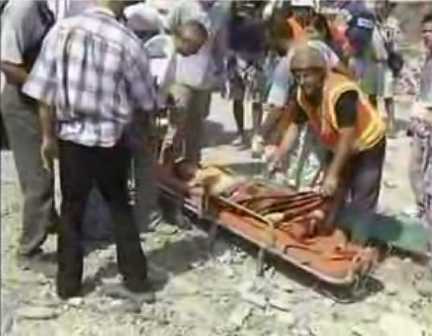
Briefly, because the full scenario can be seen on the video link, the Act starts in the area above "Stretcher Alley", where a body in a stretcher is being loaded into the back of an ambulance. Interestingly, in the right foreground is that familiar figure, the man in the pale green shirt, watching the proceedings while "Green Helmet" is in the centre of the picture, his orange jacket just visible, slightly to right of centre.

As the sequence develops and the stretcher is loaded, "Green Helmet" is told that there is a television crew filming. In this shot, he walks towards the camera, giving directions to the crew, an unmistakable circular motion with his finger, instructing the operator to "keep on filming".

Such is the deceit of the man that he then seeks to disguise the instruction by continuing his hand upwards, pretending to adjust his glasses.

Once he has the crew's attention, "Green Helmet" returns to the ambulance and an empty litter is produced. The body - which we later see to be that of a young girl - is then withdrawn from the ambulance and transferred, completely unnecessarily, to the empty litter. Once this process is complete, "Green Helmet" then obligingly clears onlookers out of the way and beckons the camera operator to come closer.

As the camera continues filming, "Green Helmet" then pulls down the blanket covering the body to give a clear shot and a close-up opportunity.

Interestingly, in the previous "grab", we see the actions being witnessed by a man in the background dressed in a white helmet and blue flak jacket, with a "press" label on the front. In this frame, he has turned away, but he and the rest of the onlookers must have been well aware of what was going on.

In the final frames of the sequence, we see the camera zooming in for a close-up. As the subtitle indicates - added by the "Zapp" magazine, roughly translating the German - this is the abuse of a dead child.

Crucially, it also shows "Green Helmet" to be opportunistic and totally without scruples. He knowingly exploits the camera presence to displaying his grisly trophies. His actions betray a media awareness that strongly supports a contention that the man knows exactly what he is doing in front of a camera and contradicts any suggestion that the poses we see in the previous parts are merely spontaneous displays by a concerned rescue worker. We see here a cold, calculating man and nothing at all spontaneous in his actions.

Scene 2

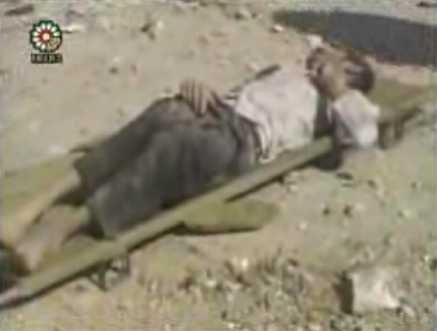
The same cynicism and calculation is seen in this second scene. What you are meant to see is the first frame, where the television camera lingers on the abandoned body of a man, as scene pregnant with pathos, so laden with symbolism that even the hardest of hearts could not fail to be moved. The Arab TV station which showed this scene, however, was perhaps too enthusiastic for its own good. In a long clip, of over seven minutes, it then went on to show this separate sequence, starting at 6:45 minutes.

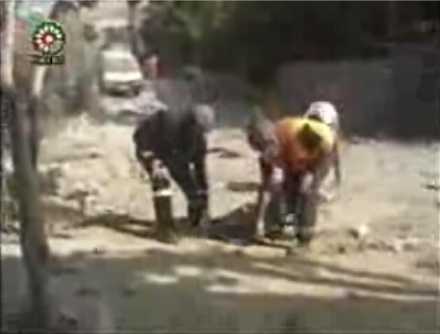
The sequence opens with "Green Helmet" leading a stretcher party towards "Stretcher Alley", comprising himself and two others. As he does so, he spots the camera and stops the party in its tracks. Facing the camera, he appears to give the operator a signal while he and his colleagues lower the stretcher to the ground. There can be no mistaking the deliberation in the act - "Green Helmet" is quite clearly looking directly towards the camera.

Thus we see the party lay the stretcher on the ground, "Green Helmet" all the time keeping his gaze on the camera. There is no verbal sound track to this film (it is overlaid with Arabic music) so we cannot tell if "Green Helmet" gives an order - not that we would have understood it anyway. But what happens next cannot be spontaneous.

With extraordinary rapidity, the three stretcher-bearers disperse. The "man in black", or so it seems, heads off at the run in the direction whence he came. The young man breaks left at high speed and "Green Helmet" heads at similar speed in the direction of the camera. The indications are - and the effect certainly is - that they are trying to get out of camera-shot.

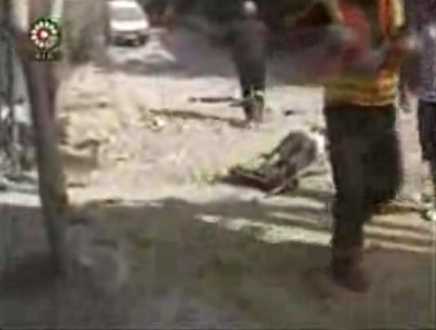
No more than a few seconds into the sequence and their high-speed dashes are paying off. All the figures are now nearly out of camera-shot. The "man in black" looks as if he is about to run all the way back to the wrecked building - that is the direction he is going. The others, we cannot see as they run past the camera out of view.

Now we are but a fraction of a second from the pathos - another iconic shot, showing the abandoned body. "Green Helmet" is just out of view, the young man has disappeared and the "man in black" is now so far up the road that he will not appear in any close-up shot. And a few seconds of a close-up shot is all it will take to make a powerful point.

Context, of course, is everything. And innocent explanation would be that the stretcher party had arrived at its destination. The "man in black" was rushing off to pick up another body and the other two were rushing forward to take on other vital tasks.

However, we know exactly where this is, from the footage of "White Tee-shirt's" camera run. This is the middle of nowhere. It is some distance from the wrecked building and even the staging area, and well short of "Stretcher Alley" and the ambulances. There is no activity here and, if for some reason "Green Helmet" and his team had suddenly tired and decided to take a rest, they would surely have remained with their burden. There can be no explanation for their behaviour, other than they are determined to get out of camera-shot to give a clear view of the body.

Once again, the showman scores.

Scene 2 added 24 August

back to the contents page

COMMENT THREAD

Thursday, July 27, 2006

Rethinking our role

A Type 23 frigateMulling over the implications of the Israeli situation, our activities in Iraq, Afghanistan and elsewhere, and following on from my post about the need for new thinking, my deliberations were given a new focus by an e-mail from a reader.

He had been to a presentation on UK Maritime Trade Operations in the Gulf/Middle East and offered a "few interesting facts".

In the Red Sea, Arabian Gulf/Indian Ocean and Persian Gulf area, he was told, there are generally about fifty coalition naval vessels (mostly frigates and destroyers) dedicated to security and anti terrorist operations.

To put this into context, this is twice the number of frigates/destroyers left after the Hoon cuts and more than twice the number sent to the Falklands in 1982. They are supported by submarines, maritime patrol aircraft (including RAF Nimrods) and various shore based facilities, as well as tankers and other support vessels.

Twenty of these vessels are kept in the Persian Gulf itself, with four on station at any time of the Iraqi coast. Furthermore, there are similar operations performed by NATO warships in the Mediterranean, while vessels carrying equipment, ammunition and other stores for UK forces have to be escorted by the Royal Navy. This includes ships carrying materiel stuff to Pakistan for use by UK forces in Afghanistan.

The increased operation tempo, combined with the cuts of the last few years, means that it is not just the Army (and elements of the RAF) which are suffering from overstretch. The Navy is also suffering badly as well, particularly since the UK has other commitments. As a result, nine-month deployments are becoming common, with an adverse effect on morale.

This is not helped by the uncertainty over the future carriers and the seventh and eighth Type 45 Destroyers but, more to the point – like the Army and Royal Air Force, they are largely equipped to fight a different sort of war from that which it is present undertaking.

It is all very well having the hugely sophisticated and expensive Type 45s, geared to knocking advanced fighters and bombers out of the sky, or massively costly aircraft carriers to support the European Rapid Reaction Force, but much of the Navy's work is in low intensity tasks such MIOPS (maritime interdiction operations – i.e., challenge, board and search potential smugglers) or deterring piracy and other forms of maritime crime.

For this, we are told, there is an urgent need for a number of fast, armed patrol vessels. Such vessels need a flight deck and hangar for an embarked helicopter, plus accommodation for a number of Marines/Special Forces - perhaps an upgraded River Class offshore patrol vessel, or even this little Italian number (below).

An Italian Commandante patrol vesselIn the longer term, this might be cheaper than keeping high-tech, multi-role frigates on station, such as HMS Kent (type pictured, top left) which was recently the lead RN ship in the northern Gulf. On the other hand, additional, dedicated patrol vessels might allow the UK to take a more active role in stopping the oil smuggling which is undermining the Iraqi economy.

What all this again points to is the need to re-orientate our thinking, and address the actual tasks confronting our armed forces, rather than fantasy tasks, perhaps in pursuit of EU foreign policy objectives, some time in the unforeseeable future.

This, to some extent, was what Liam Fox was getting at when he delivered his speech on defence in June, but the real debate has yet to start. Unfortunately, it seems, the Boy King is tiptoeing away from any such thought. As always, the debate will have to start without him.

COMMENT THREAD

Thursday, May 04, 2006

Assault on batteries

waste batteriesThere was a time, once, when the UK was the world leader in recycling lead acid batteries – the type you have in your cars – recovering over ninety percent of discards. The system worked without any costs to the taxpayer or consumer and with minimal regulation, providing a good living to the small number of scrap merchants who specialised in the trade.

Then, along came the EU with its battery directive – building a web of regulation, red-tape, inspectors and controls. Scrap merchants went out of business and, to cover the regulatory costs, battery sellers had to impose a charge on consumers. Almost immediately, the percentage of batteries recovered fell to around sixty percent and batteries started appearing in hedge-backs and other fly-tipping sites.

Having failed totally to learn the lesson of this disaster – or even understand that there was a lesson to learn, the EU is back in business with a new battery directive, extended to cover a wider range of products. The directive will, according to the IHT, cost battery producers some €200 million and €400 million a year, placing an obligation on them to collect and arrange the cycling of their products.

By this means, the EU hopes it will encourage the recovery of the annual 158,000 tons of batteries sold to the domestic market, starting in 2012, when a quarter of all batteries sold must be collected, leading to 2016, when the target will rise to 45 percent.

Like all EU recycling initiatives, this one is producer rather than market-led, and will prove a disaster, leading to the sort of problems like this in the US – where the greenies have over-regulated their system in the interest of "saving the planet".

Needless to say, the mindless loons in the Toy Parliament are expected to approve the measure within a couple of weeks and, soon thereafter, it will come into law. They will never learn.

COMMENT THREAD

Sunday, April 16, 2006

Hostage to fortune

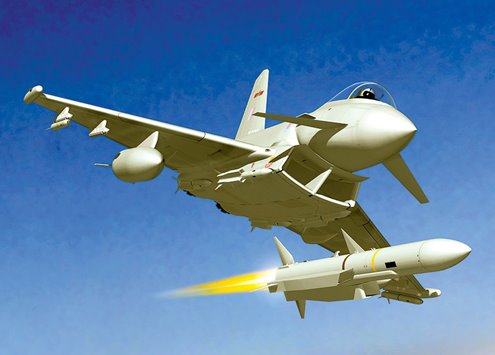
A Eurofighter launching a Meteor missileThe UK may be about to lose the remaining vestiges of control over another huge tranche of its defence industry, leaving us even more reliant on European companies.

That will be the outcome if, as The Business reports today, BAE Systems is about to sell its €1.5 billion share in European missile company, MBDA.

Following out on the heels of the planned sale of its 20 percent Airbus stake , this will mark a further retreat from Europe, as BAE Systems seeks to reinvent itself as an American company, primarily serving the US defence market.

Currently MBDA is jointly owned by EADS and BAE Systems, each holding a 37.5 percent share, with the Italian aerospace company Finmeccanica holding the remaining 25 percent. EADS is expected to buy up the BAE Systems shares and it is also believed to be interested in buying up Finmeccanica's 25 percent.

Crucially for the UK, MBDA supplies vital weapons systems to the UK, including the Meteor air-to-air missiles which will equip the Eurofighter (pictured above), the SCALP ED/Storm Shadow air-launched cruise missile, the Brimstone "fire and forget" anti-tank missile and the Aster missiles that will equip the Type 45 Destroyers.

Although BAE Systems had little control over the design of these missiles (one of the reasons why it is losing interest in working in multi-national conglomerates) and the UK less so – with the design authority of key components vested in German and French companies – the withdrawal of British share ownership would place total control in the hands of European-owned firms, with much of the manufacturing carried out offshore.

Following on from my publication, The Wrong Side of the Hill, we now seem to be moving to the end game where the MoD, and thus the UK, is totally reliant on European suppliers for the bulk of its high-tech weaponry and thus, inevitably, hostages to the Europeans, should we ever wish to use them.

Meanwhile, the Boy King is looking at glaciers in Norway.

COMMENT THREAD
Thursday, February 23, 2006

The ultimate indignity

Not a murmur could be heard when the British Army decided to buy Austrian-built MAN trucks for its supply fleet, or Italian-built Panther liaison vehicles. That the new army is to be supplied with Swedish-designed armoured vehicles, fitted with French-built guns firing ammunition manufactured in France is a mere detail.

Who cares that our anti-battery radar is made in Germany, that the air-to-air missiles to equip the four-nation Eurofighter are French designed, as indeed are the missiles fitted to our Type 45 destroyers? And what does it matter that our new "bunker-buster" missiles are German, as indeed is the Royal Navy's mine-counter-measure equipment?

Why should we be bothered that we no longer have a capacity to design and manufacture even the rifles with which our troops go to war, that the bullets they fire are contracted out to foreign firms and the shells are made in Germany, while the troops themselves will fight in Chinese-made uniforms?

But there are limits chaps and, according to The Scotsman, those limits have been reached. "Shock! Horror! Probe!", screams The Scotsman: "Scots super-regiment to be kitted out in foreign kilts".

And right behind the newspaper is Jeremy Purvis, Borders MSP, who says, "The kilts are clearly going to be sub-standard. Now there will be different cuts and shades on parades and it will be an embarrassment. The ceremonial Scottish wear of kilts and trews should absolutely be made in Scotland."

In detail, it appears that the British Army has lowered the standards required of ceremonial kilts for the new amalgamated Scots regiment so that they may be manufactured from cheap tartan made abroad. In "an effort to drive down costs", the Ministry of Defence has announced it is putting the contract to produce tartan for the amalgamated Royal Regiment of Scotland up for tender.

It is also, says The Scotsman, lowering the standards of the tartan's quality to allow other companies producing cheaper, lower-grade cloth to compete against the expertise of Borders textile companies. The MoD has launched a competitive tender allowing any manufacturers to compete for the contract of 5,000 kilts, estimated to be worth £300,000, for the new regiment.

And there you have it. It is perfectly all right to have our armed forces totally in hoc to foreign suppliers, to such an extent that we cannot so much as put a foot ashore on a foreign land without their governments' agreement. But even think about having Scottish regiments in foreign-made kilts and all hell breaks loose.

COMMENT THREAD

Wednesday, February 22, 2006

A MARS away…

In DefenseNews this week, we see a story headed: "No UK Shipyards Picked for MARS Program", a headline – or anything like it - I guarantee you will not appear in the MSM.

Very few people, in fact, will know anything of the MARS programme and many would be puzzled by the reference to shipyards, believing that it somehow related to an aspect of the space programme.

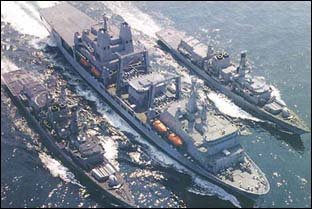
However, we are dealing with yet another of these awful acronyms which, in this case means "Military Afloat Reach and Sustainability", a £2.5 billion MoD project for replacing and upgrading the support fleet which keeps the Royal Navy supplied while at sea, examples of which are ilustrated.

What brings this project to the forefront is that, after a delay in the decision to award development contracts – which we reported last October - the MoD's Defence Procurement Agency (DPA) has now announced its selection of three companies to compete for the role of project integrator on the project.

Crucially, no British military shipbuilding company has been selected, the companies announced, reports DefenseNews, being the British project management company AMEC and two US giants: KBR, an offshoot of Halliburton; and Raytheon Systems. The UK shipbuilders BAE Systems and the VT Group were rejected. But then, so were the French-owned Thales UK, Maersk and Houlder Offshore.

The appointment of "project integrator", in itself, gives no clues as to where the ships will be built. The "integrator" is a fairly new development in defence procurement, involving a company which essentially acts as a surrogate purchaser for the MoD, pulling together all the disparate parts of a project and delivering the completed systems to their user – in this case the Royal Navy.

The "systems" we are looking at here is a complete fleet of logistic ships for the Royal Fleet Auxiliary, although the numbers and types so far have not been defined. But it is expected that about eleven ships will be built, ranging from oil tankers to sophisticated forward aviation support vessels and joint sea-based logistic ships able to support expeditionary forces ashore.

And while it has not been which companies will build the ships, the strong suspicion is that they will be built offshore. Lord Drayson, stated on 15 February that British warship yards seeking the orders would have to achieve efficiency levels similar to commercial rivals overseas.

This, in effect, is a strong signal that these ships will be foreign-built, following the precedent set by the order of a fisheries protection vessel last year by the Scottish Executive, which went to a Polish shipyard in preference to a local Scottish firm.

Industry analysts say that, while BAE and VT have greatly improved efficiency, they cannot offset the substantial advantages commercial builders find in low-wage economies like Poland and Romania. In 2002, BAE delivered two 30,000-ton fleet tankers to the Royal Fleet Auxiliary for £110 million apiece. This time, the DPA has set aside only about £80 million for each of the 25,000-ton oilers.

This very much underlines the thinking set out in the recent Defence Industrial Strategy, which opened the door to less complex vessels like auxiliary and support vessels going overseas to reduce costs.

If, as expected, the construction does go offshore, to one or more European yards, it will mark yet another step in the gradual Europeanisation of our military supply programme.

The problem for us, on this blog, it that rational arguments can be expounded for this, and many other defence procurement projects being resourced offshore.

In this case, particularly, there is no question that Polish or other European yards would be able to build these ships far more cheaply than our domestic yards. Further, our remaining military shipbuilders are undoubtedly stretched by the current Type 45 programme and the coming carrier project, so it could be said that there is little spare capacity for this project.

Nevertheless, whatever the individual justifications for specific projects – each one of which may be valid taken in isolation – there is definitely an observable and undeniable trend.

Basically, the evidence that we have offered on this blog is that government is committed to Europeanising the equipment of our armed forces, in pursuit of which - whenever possible – it will purchase European-built (or designed) equipment, even where a domestic supplier is available or a non-European product is considerably cheaper or better-performing.

There are, however, exceptions to this rule, and these seems to be: i.) where there is no suitable equipment available from a European supplier; ii.) where the equipment is part of an overall "heritage" system, when changing over to a European supplier would cause massive disruption, technical difficulties or vastly increased expense; and iii.) where a European venture has failed to deliver and the equipment is urgently needed.

If the MARS ships do go to European yards, therefore, it does seem as if we will be looking at more of the same, the continuation of a real, but much denied policy of Europeanisation.

COMMENT THREAD

Friday, February 03, 2006

March of the morons

Following on from my post on the Type 45, in which I remarked how the coverage affirmed the retreat of the media from reporting intelligently on defence issues, yesterday in the House of Commons there was a major debate on defence procurement.

The issue itself is of huge significance, not only because it involves massive public expenditure, much of it wasted – an issue that concerns all of us, even those of us who are adverse to "toys" – but also because it is on the adequacy or otherwise of procurement decisions that the whole capability of our armed forces rest.

The debate itself, the transcript of which runs to 82 A4 pages and over 43,000 words, represented a huge investment in time of dozens of MPs and their staffs, the minister and his staff and – from first reading – raised matters of great public interest.

While we are all quick to condemn and deride our politicians, you can imagine that not a few are more than a little disconcerted that, despite the expenditure of such huge effort, the debate merited not a single mention in the media. The Telegraph Commons Sketch, for instance, witten by that incurable lightweight Andrew Gimson, devoted its space to a jokey account of the earlier Defra debate - this in a newspaper that found space for a full page on the account of some boring divorce case.

It would be wrong, however, to single out just the Telegraph for this neglect. The whole of the MSM is as bad. But, if the media do not take the time and effort to report serious issues, can they then be surprised that MPs – to whom publicity is lifeblood – devote their time to more newsworthy items. When it comes to "dumbing down", the media are in the vanguard of the march of the morons.

We are at least fortunate that so many MPs are indeed focused on such issues – no thanks to the MSM – and we will be posting a detailed report of the debate later today.

COMMENT THREAD
Thursday, February 02, 2006

A retreat from defence

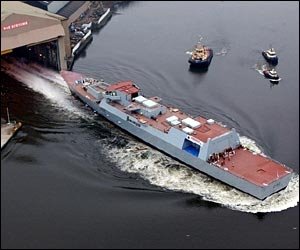
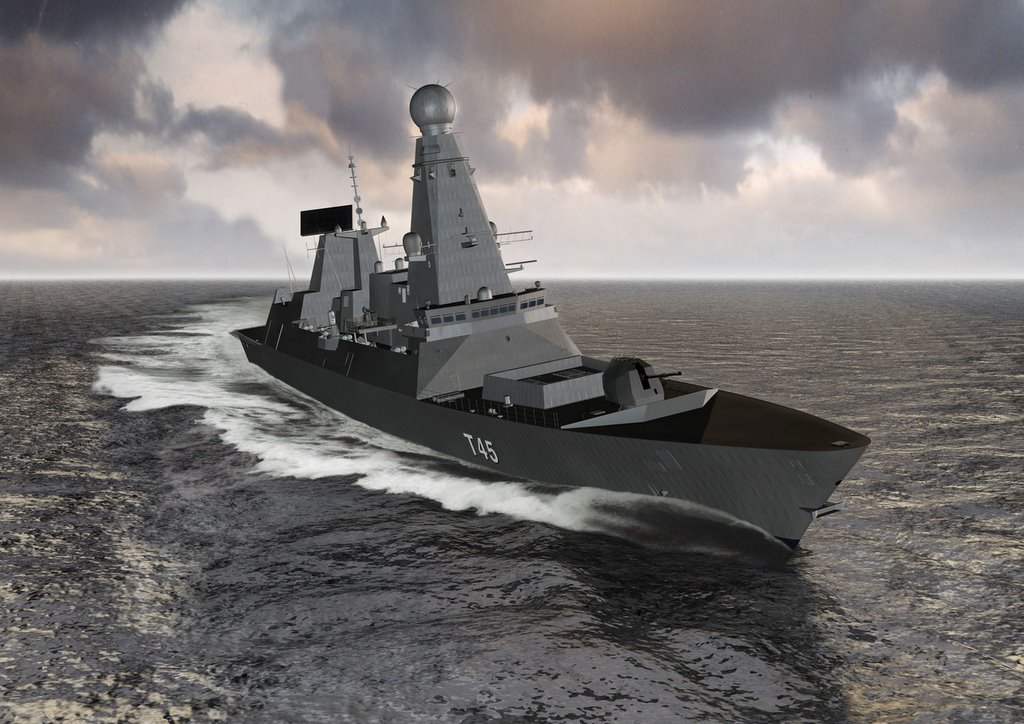
So it came to pass that yesterday, 18 months behind schedule and hugely over cost, that the first of the Type 45 Destroyers HMS Daring was launched on the Clyde, to fanfares and applause, in front of an audience of 11,000.

But, if the most expensive white elephant in the history of the Royal Navy has just been launched, you would have got no hint of that from the media, and especially from The Times, which headlined, "Navy launches deadliest and most expensive warship". And, according to The Times, it was "on time and within budget".

Even within the framework of its own story, The Times could not manage to be consistent, declaring in the first line that HMS Daring was "the first of the Royal Navy's £6 billion fleet of six Type 45 Destroyers", then stating further down that it had "a price tag of £605 million".

It then went on to state that the Type 45s "will be the most powerful, advanced and deadly warships in the world when they come into service in 2009", something which is simply and demonstrably not true.

For sure, it will have a highly advanced anti-aircraft system, based on the costly French-built PAAMS missile and British designed Samson radar, but very little else. It will have only a very limited land attack capability, mounting a 4.5 inch gun, and – apart from its single helicopter - an anti-submarine capability that amounts to no more than a self-defence system, and no anti-shipping capability.

Compare and contrast with the US equivalent, the DG Arleigh Burke class, which, in addition to its perhaps not quite as effective anti-aircraft capability (with nearly double the number of missiles) has a significant land attack capability - being able to launch Tomahawk cruise missiles - an anti-shipping capability and world-beating anti-submarine warfare equipment.

And not only is it truly a formidable, multi-purpose warship, it comes in, as the Australians found, at £400 million less than the £1 billion price tag for the Type 45.

But if The Times report was useless, it was matched in fatuity by the BBC, although it did manage to confine its hyperbole to describing HMS Daring as the UK's most powerful destroyer – which, when it comes into service, will be true, as it will be the only type of destroyer we have. The BBC too bought the "price tag of £605 million" line, but later giving the total programme cost for the six ships as £5.5bn.

The Sun, totally out of its depth, reported the cost as £6 billion – but for eight ships, not six, describing HMS Darling as "the deadliest ship ever built".

Even the dour Scotsman described it as "one of the world's most advanced warships" and then went on to call it a "multi-role ship", which it clearly is not in any realistic sense of the world.

As for The Telegraph, it called the ship, "the most powerful frontline warship since the Second World War", but at least limiting the description to "the world's most advanced air defence ship," then – for heaven's sake – calling it a boat, claiming that, according to BAE Systems, its builders, its "hugely powerful radar and missile system, has left American visitors to the yard 'shaken and shocked'". I think not.

It took Jane's to point out that this class of ship should have been in service in 2000, delayed by the abortive French-Italian co-operative venture, which cost us a small fortune when we had to refit the obsolescent Type 42s which should have been replaced.

The average MSM reader, however, will walk away thinking that Britain has been well served, not realising that, in a Navy that is shrinking faster than a bank balance in the hands of a shopaholic, we cannot afford the luxury of overpriced, effectively single-purpose ships. We could have had far more capable, multi-purpose ships, for a saving on six vessels of £2.4 billion – the price tag for a new carrier.

If we had a grown up media, these issues would have been raised but instead, in its infantile, pathetic way, all it has been able to do is affirm that its has retreated from reporting intelligently on defence issues.

COMMENT THREAD

Sunday, January 29, 2006

Another one down

Sneaked out without, it seems, any announcement by the Ministry of Defence, yet another important contract has gone to a European supplier, this one in preference to a product developed by our own BAE Systems.

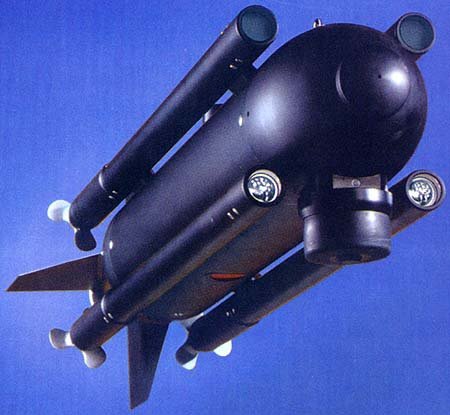
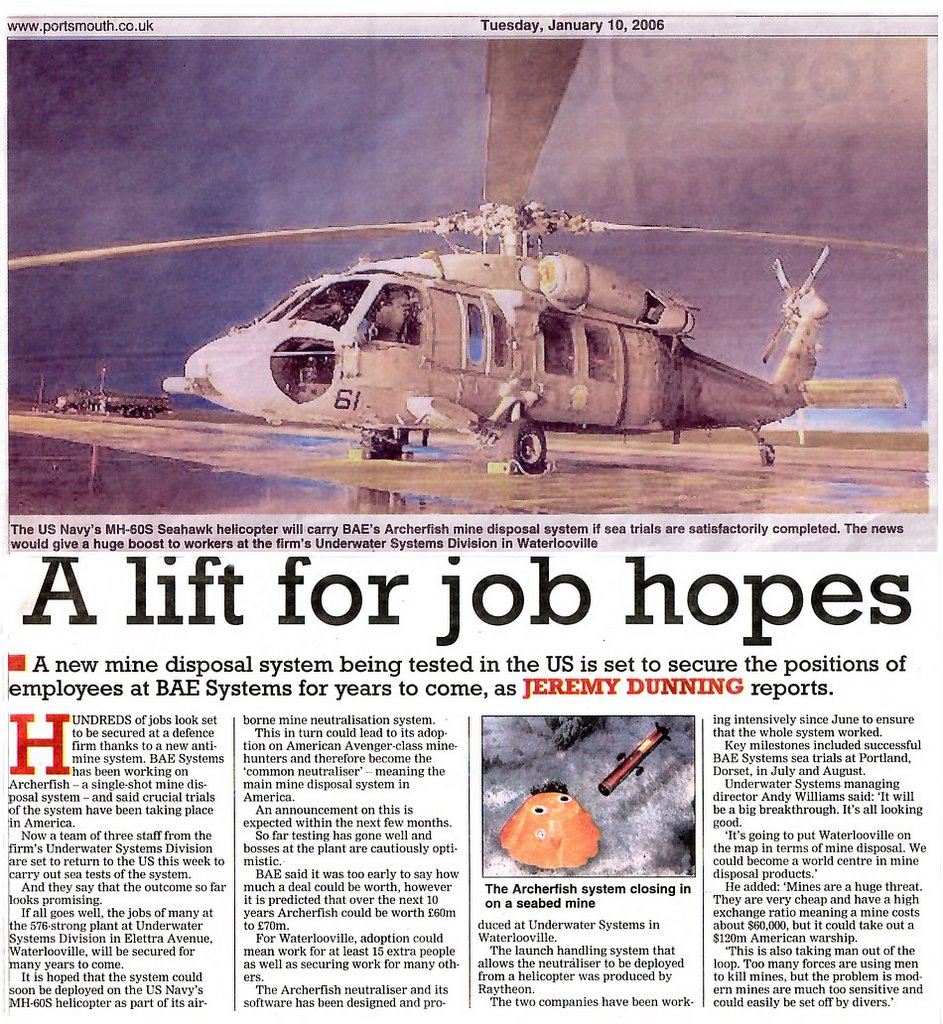
The contract in question is for an advanced mine disposal system known as Seafox (pictured above), worth "in excess of £35 million". It is to be built by the Bremen-based Atlas Elektronik GmbH, announced by the company and its British partner on 9 January this year.

Seafox, we are told, is an expendable, remotely-operated underwater vehicle that includes an explosive warhead used to neutralise the target sea mine. It is launched from the parent ship and guided to the mine using a combination of an on-board sonar and television sensors. Delivery and installation will commence early in 2007 and will continue over a period of three years.

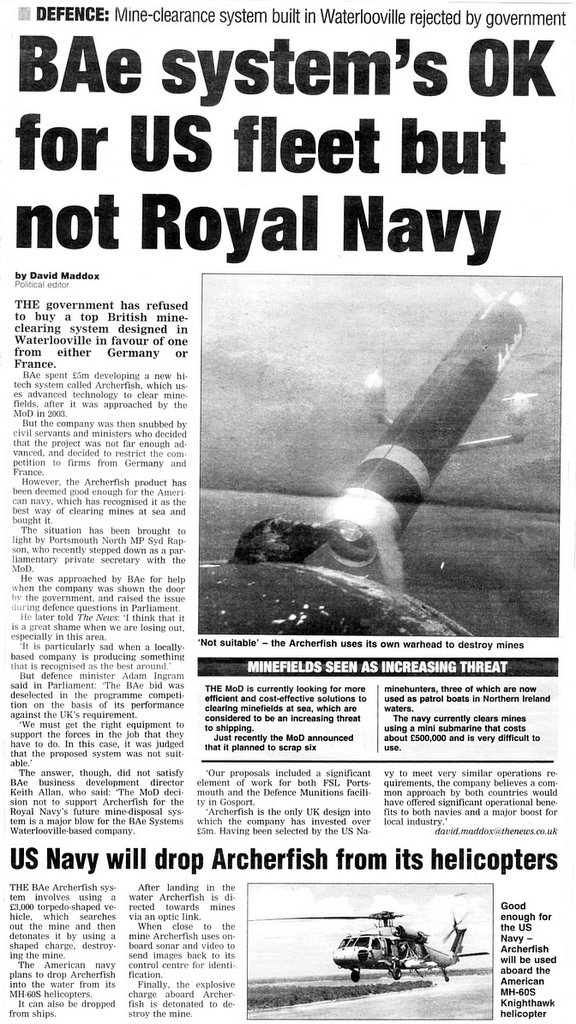
The award was given in preference to BAE Systems "Archerfish" design, which was developed privately by the company in partnership with Raytheon Integrated Defense Systems, at a cost of over £5 million. The innovative nature of the weapon was recognised during 2003 when it won a top gold award in the BAE Systems Chairman's Award for Innovation.

The ultimate accolade, however, came the same year, when Archerfish was selected by the US Navy, with the award of an $18 million programme to equip its Airborne Mine Neutralisation System programme, developing it for operations from the MH-60 helicopter.

The system was still being evaluated by the MoD in 2004 but it was dropped shortly afterwards. In January 2005 Labour MP Syd Rapson (Portsmouth, North) in whose constituency the weapon was being developed, challenged minister of state for defence, Adam Ingram, about the programme, saying: "The Americans have grabbed it with both hands … We have lost a brilliant invention, and export potential for this country."

Offering no details, Ingram simply dead-batted the complaint, saying that Archerfish had been "deselected" in the competition "on the basis of its performance against the UK's requirement" – a requirement that has never been revealed.

The award to Atlas Elektronik, however, underlines another irony. At the time of the competition, the company was owned by BAE Systems. In 2005, however, BAE Systems decided to sell it, a sale that was held up when the German government refused to allow the French-owned Thales conglomerate to purchase it outright, this being considered against the national interest.

Eventually, at the very end of December, the company was sold to ThyssenKrupp and the European defence conglomerate EADS, each owning 60 and 40 percent respectively and, just over a week later, the MoD awarded the Seafox contract to it.

Needless to say, nothing of this has found its way into the national media, although the local Portsmouth papers have covered it fully – and rather well – following the defence aspects as well as the employment issues (click on illustrations to enlarge).

This of course, is merely the latest in a long line of contracts that have gone to European manufacturers, including the infamous missile system for the new Type 45 destroyers.

By coincidence, the first of this class, HMS Daring, is to be launched – weather permitting – in three days time, and event celebrated by Sylvia Pfeifer in the Sunday Telegraph. Not for one moment would you get any hint of what a disastrous project this has become from the gushing Mz Pfeifer but then, as with the Archerfish project, we have long given up expecting adult reporting on defence issues from the MSM.

COMMENT THREAD

Thursday, December 22, 2005

A lucky chancellor

One of the things us defence wonks have been wondering about is how Gordon Brown is managing to pay for all the goodies he is buying the Armed Forces, especially when his MoD colleagues are wasting so much money on sub-standard European kit.

Not least of his woes is that the much-delayed Eurofighter is now rolling off the production lines and, for every gleaming machine that arrives on the doorstep, he must sign a cheque for a cool £65 million. But with Saudi Arabia prepared to buy 48 of the aircraft, with an option to purchase another 24, potentially worth £10 billion, Gordon will hardly be able to believe his luck.

While the purchase is obviously good news for BAE Systems, even though its partners EADS and Finmeccanica take two-thirds of the dosh but, according to Janes Weekly, it is even better for the chancellor,

The delivery of first 24 aircraft is to be drawn from the Royal Air Force's production run of 89 Tranche 2 Eurofighters, a £4.3 billion ($7.5 billion) contract for which was signed in December 2004. This means that our Gordon can manage his cash-flow that little bit better by delaying the evil day when he has to pay the bill for the RAF's new toys.

Of course, the MoD stresses that the RAF will receive additional Tranche 2 airframes to offset this transfer, and that the Saudi Arabian deal will have no impact on its commitment to sign a Tranche 3 deal to take the UK’s total Typhoon purchase to 232 aircraft. Leave it a bit, though, and that order will evaporate, many – as the Financial Times observes - expecting plans for the remaining aircraft to remain mothballed.

With a bit more luck, he might even be able to afford the extra £7 billion that Blair has given the EU to go towards its £7.6 billion annual administrative expenses.

COMMENT THREAD

Sunday, November 27, 2005

The government gets away with it

Looking at the print edition of The Sunday Times this morning, I could not help but feel a little smug on seeing the headline, "Carrier delays put navy's air defence at risk". After all, I did this story on 29 October, nearly a full month ago.

At least, I thought, the paper did run the story, albeit tucked into the gutter on page 8, leaving the front page to a photograph of the rowers who plan to cross the Atlantic in the nude.

Referring to the online edition for a link, however, put a different perspective on the Times's "scoop". It had been replaced by a much, much more important defence story, headed: "MoD probe into naked marines' initiation fight", the writer slavering over the details of "naked marines" shown "reportedly cheering as two new recruits are ordered to fight each other."

Being far too serious, the carrier story had been relegated to three short paragraphs at the end, the only new fact surviving being the news that the overall cost of the ships is predicted to climb from £2.8 billion to as much as £4.2 billion.

In a week where there have been important, even sinister developments in the (lack of) defence of our nation, the government must be counting its blessing that the media is so utterly useless on defence issues, and so easily distracted by by trivia.

It is to Booker in his Sunday Telegraph column, therefore, that adult readers must turn for some serious defence news – having got past the front-page story on sex slaves, which no doubt had readers enthralled.

Booker weaves together the pieces that have appeared on this blog, writing that last week moved up by several notches the slow-motion catastrophe unfolding over Britain's defence policy, ending our "special relationship" with the US and committing us to total dependence on our EU partners:

First, EU defence ministers confirmed their moves towards creating a "European defence industry", which is in practice committing Britain to waste billions of pounds buying equipment from our EU partners, when we would formerly have bought superior and cheaper equipment made in the US or Britain.

Second, President Bush had to cave in to the US Congress's wish to end the release to Britain of sensitive technological information, on the grounds that we can no longer be trusted not to pass this on to other EU countries or China. This spells an end to such joint Anglo-US defence projects as the F-35 joint strike fighter.

Third, the Ministry of Defence provided "non-answers" to questions put by MPs, including the Tories' front-bench spokesman Gerald Howarth, on the recent decision, revealed in this column, that we are to lose our last explosives-making facilities, making us wholly dependent on explosives imported from abroad. The MoD refuses to say where all the explosives for Britain's Armed Forces will in future be made.

Meanwhile the National Audit Office covered up for the MoD by producing a joke report on various recent defence projects. It congratulated the MoD for bringing in on time the Javelin anti-tank missile, without admitting that this has been available since 1996, and that we only bought it from the US after wasting £109 million on a Continental version that did not work.

The NAO approved the Army's biggest ever truck purchase from the German firm MAN, without pointing out that the trucks failed to meet specification and that better vehicles could have been bought from two US-British consortia. The report congratulated the MoD on "saving £157 million" on its order for a French missile for the Eurofighter, without pointing out that it could have saved £900 million by buying the US equivalent.

The NAO also fell for MoD spin that it had "saved £145 million" by reducing the efficiency of its three planned Type-45 destroyers, equipped only with French anti-aircraft missiles and costing £1 billion each. It did not explain that we could have followed the example of the Australian Navy by buying US-designed ships, British-built and equipped also to fire cruise and anti-submarine missiles. Complete with missile systems, these would have cost only £600 million each, saving £1.2 billion for much more capable ships.

Finally the Queen gave Royal Assent to the MoD's scrapping of our last county-based infantry regiments, to be merged into new "large regiments" to fit the British Army to the needs of the "European Rapid Reaction Force".
Not a good week, concludes Booker. "But the Government gets away with it, not least because defence now arouses so little interest," he adds. How appropriate that the Sunday Times is so quick to prove his point.

COMMENT THREAD
Friday, November 25, 2005

Failure equals success

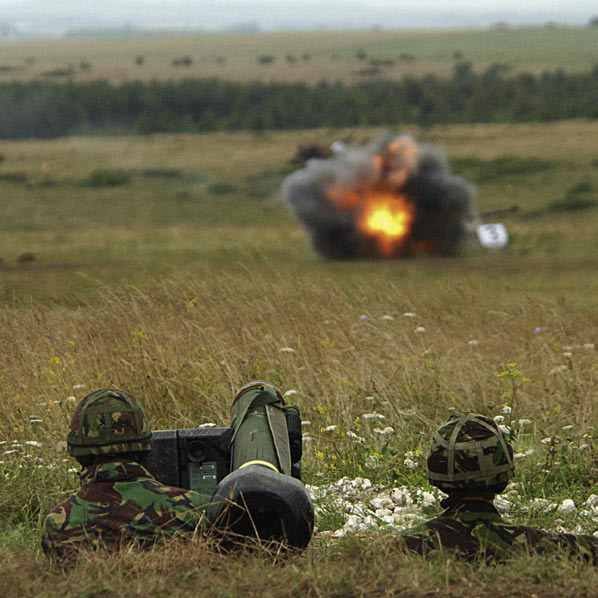
It is rather fitting that the National Audit Office "Major Projects Report 2005", published today, should have on its front cover a large colour photograph of a Javelin missile blowing up a tank.

In a report, pre-empted by Lord Drayson in a "puff" published by The Telegraph TEXT on Wednesday, the MoD is applauded for getting a “grip on spiralling costs”, with the over-all forecast cost on the 20 biggest defence projects falling by £699m in the year to 31 March.

One of the examples of this new-found "grip" is the very Javelin missile, which is featured at length in the report and merits two further large colour photographs. In July 2005, according to the NAO, the Light Forces Anti-Tank Guided Weapon also known as Javelin entered service with the Army some four months before the expected delivery date of November 2005 approved at Main Gate. Training was completed before the in-service date was declared and the equipment is fully operational.

All this sounds ever so good, but for the fact that its introduction represents the ultimate failure of European defence manufacturing and a massive waste of money by the MoD. Thus, as we pointed out in August, the “success” of the MoD on this missile is simply an example of New Labour and its "spin" machine – and the NAO has fallen for it, hook line and sinker.

The Javelin is in fact a US-designed weapon, produced by Raytheon/Lockheed Martin, first issued to US forces in 1996 but ordered for the British Army only in January 2003, to replace the 20-year-old Milan missile. It was not the MoD's first choice of weapons system, as the preferred weapon was the Euromissile MR Trigat.

However, by June 1999, substantial delays had been experienced in the missile development. The UK had become dangerously exposed as existing stocks of the Milan missile were running down, the government was forced by July 2000 to withdraw from the project, writing off £109,314,000 in development costs, then to buy the off-the-shelf US system – which, in any event, had better performance than the proposed MR Trigat.

But equal sleight of hand is being deployed with other projects. We are told that the MoD has "saved" £145 million on the Type 45 destroyers, albeit at the cost of "reduced capabilities", which is regarded as reflecting "greater realism on the part of the acquisition community." Those "reduced capabilities" are the omission of the sonar suites from the new destroyers, which means the ships have no anti-submarine capability.

Yet, as we reported, also in August, we are spending £1 billion per ship, to include the French-made PAAMS missile system, while the Australians are buying the US-equivalent Arleigh Burke DDG-51 class – which they are building in their own yards – for a "mere" £600 million each.

Worse still, while the Type 45s are restricted to anti-aircraft warfare only – which makes them virtually redundant if there is no air threat – the DG51s can be armed with ASROC anti-submarine missiles or with Tomahawk cruise missiles for land attack. In other words, we are buying less for more and, because we are reducing capabilities still further, this is regarded as a success.

Then there is the European Meteor air-to-air missile intended to equip the Eurofighter, on which the government is "saving" – i.e., not spending - £151 million by reducing the number of missiles it will but. But, once more in August (that was a busy month) we reported that the US equivalent Raytheon missile was available as a package for £500 million and, instead, the MoD had opted for Meteor at a cost of £1.1 billion, now increased to £1.4 billion. Thus, saving £151 million on an overspend of £900 million is regarded as a success.

There are other savings as well – for instance, the MoD has cut £1.4 million from the ASTOR (Airborne Strand-off Radar) system, but only by not incorporating the originally specified flight refuelling system, which drastically limits range and endurance. Another £1.8 million is saved on the truck fleets, by buying MAN trucks, but again that has a price. The vehicles are unable to meet defence planning assumptions and are not equipped for all climatic conditions.

Effectively, failures are being dressed up and paraded as successes and, not only has the NAO swallowed it, so has today’s Daily Telegraph which dutifully reports: "MoD cuts equipment orders to save £700m", without one hint of criticism.

Of course, there is always the Conservative Party but one somehow doubts whether the current defence team will make a fuss. By such neglect does our current government get away with it.

COMMENT THREAD