Thursday, April 25, 2013

EU politics: Crisis for "Europe"


Guardian 025-tru.jpg

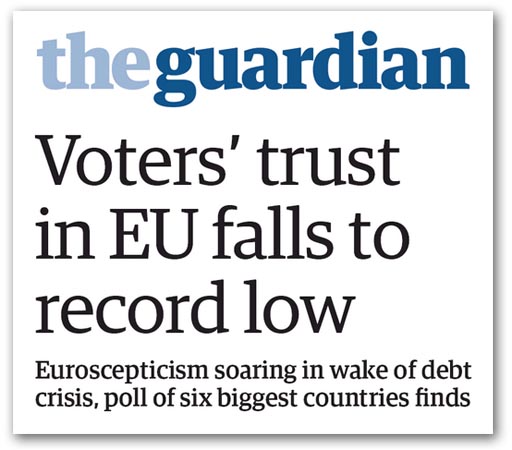
It must be of some significance that the loss-making Guardian - a fountain of British europhilia - today decides to feature on its front page the results of a Eurobarometer survey telling us that public confidence in the European Union has fallen to historically low levels in the six biggest EU countries.

With a degree of profound weariness, one also observes this newspaper telling us that the survey result raises "fundamental questions about its (the EU's) democratic legitimacy", as if it had any democratic legitimacy to start with – which it doesn't. 

Strangely, though, we also have a situation where this Eurobarometer survey does not seem to have been published, with the Guardian, in collaboration with other leading newspapers in the other five countries, claiming exclusive rights – even though none of the others give the story the same prominence as the British counterpart. 

Thus we have to trust the europhile Guardian accurately to inform us of a survey which is about – oddly – trust of the European Union, with the further handicap of the data having been analysed by the European Council on Foreign Relations (ECFR), which also has not published any details. 

With that, we are led to believe that, "Euroscepticism is soaring to a degree that is likely to feed populist anti-EU politics and frustrate European leaders' efforts to arrest the collapse in support for their project". 
Guardian 025-sur.jpg

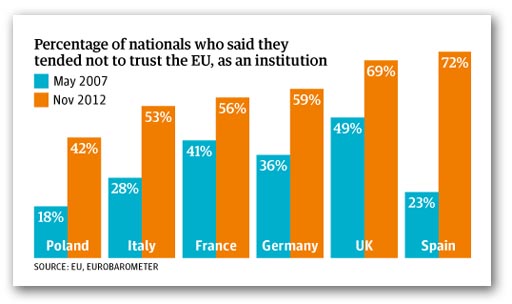
As to the detail (above), in Spain, trust in the EU – however measured and analysed - fell from 65 to 20 percent over the five-year period while mistrust soared to 72 from 23 percent. In five of the six countries, including Britain, mistrust prevailed over trust by sizeable margins, whereas in 2007 – with the exception of the UK – the opposite was the case. 

Five years ago, 56 percent of Germans "tended to trust" the EU, whereas 59 percent now "tend to mistrust". In France, mistrust has risen from 41 to 56 percent. In Italy, where public confidence in Europe has traditionally been higher than in the national political class, mistrust of the EU has almost doubled from 28 to 53 percent. 

Even in Poland, which enthusiastically joined the EU less than a decade ago and is the single biggest beneficiary from the transfers of tens of billions of euros from Brussels, support has plummeted from 68 to 48 percent, although it remains the sole country surveyed where more people trust than mistrust the union. 

In Britain, the mistrust grew from 49 to 69 percent, the highest level with the exception of the extraordinary turnaround in Spain. 

Citing José Ignacio Torreblanca, head of the ECFR's Madrid office, the Guardian goes on to tell us that, "The damage is so deep that it does not matter whether you come from a creditor, debtor country, euro would-be member or the UK: everybody is worse off". And thus we learn that: "Citizens now think that their national democracy is being subverted by the way the euro crisis is conducted".

And now we get input from José Manuel Barroso, who said on Tuesday that the European "dream" was under threat from a "resurgence of populism and nationalism" across the EU. "At a time when so many Europeans are faced with unemployment, uncertainty and growing inequality, a sort of 'European fatigue' has set in", he complains, "coupled with a lack of understanding". 

What is then rather worrying is that Mr Barroso then asks, "Who does what, who decides what, who controls whom and what? And where are we heading to?" Frankly, if he doesn't know, who on earth does? 

All of this, though, is enough to get Raedwald's juices flowing, as he notes – from the tenor of theGuardian's comments - a more serious malaise, in that the Left seems to have fallen out of love with the EU. 

The problem, however, is even greater than it at first seems, judging from the ideas offered by the writers from the six leading newspapers to help redefine the union. 

What strikes one from these is the poverty of ambition, as the ideas range from stopping the Strasbourg shuttle, to providing a Eur-app to having a Europe FC United. Then we have a suggestion that the launch of a European Army is a good idea (a plan dating from the 1950s), and the invention of "a new division of power", to deal with the "democratic deficit".

Startlingly, from Adam Leszczyński, of Gazeta Wyborcza, in Warsaw, all we get is that, "Europe needs a leading idea that could provide Europeans with symbols and aims evoking emotions, attachment and solidarity". But, adly for the poor dear, he does not know what such an idea could be. But "if we do not find it, every crisis will threaten this impressive building with destruction", he says. 

It's time to move in the demolition contractors, methinks. 

COMMENT THREAD

Water: profiteering - "out of control"


Mail 023-wat.jpg

The Daily Mail is playing catch-up, so to speak, following in the wake of the Express in highlighting the money-grubbing behaviour of water companies.

In this case, though, the Mail brings something new to the table – a study commissioned by the trade union Unison which finds that almost a third of an average water bill – more than £100 a year – goes on profit, compared with nine percent in the energy sector. 

The research, conducted by the New Policy Institute (NPI), finds that water bills have risen more than twice as fast as pay over the past decade in an industry which is now "out of control". And a 3.5 percent increase in the average annual bill this year – a hike of £13 bringing the total to £388 a year – has brought charges to treble the level since privatisation in 1989, well above increases in the rate of inflation. 

NPI also says that water bills have soared by 64 percent in the past ten years compared with 28 percent for average earnings – although in some cases the increase has been higher. In ten years, we've experienced a near-doubling in charges from Yorkshire Water – presumably to fund the CEO's million-pound salary and pension fund. 

If the average bill had done no more than keep up with earnings, and the rise had been confined to a "mere" 64 percent, it would now be an £71 a year lower. For some it would mean we would be nearly £100 better off. 

Assessing why this situation has arisen, NPI reckons that the high prices are due to a lack of competition in the industry. But, given that all price hikes have to approved by the water regulator, Offwat, its role must also be explored. 

Nevertheless, the facts alone give Dave Prentis, Unison's general secretary, something of a platform. He says: "This private monopoly is the worst of both worlds. Since privatisation, private equity firms have swooped in to grab a lucrative slice of the water industry pie, but households, taxpayers and employees are losing out". 

Unsurprisingly, Prentis then says, "The time has come to think again, with all options on the table. We need a root and branch review to make sure the industry is run in the interests of consumers not profits". But that, of course, is precisely what the regulator is supposed to be doing, which again suggests that Offwat should be looked at. 

Turning to the actual report, it brands the water companies "a very odd industry indeed", one "whose ownership is opaque, whose consumers are powerless and whose profits are high yet which is also unable to finance key investment without government help".

And there's the rub. This is an industry which has been starved of capital investment but, after 24 years of rising prices, we are no better off. Instead, this "very odd industry" celebrates "stable cash-flows and sizeable dividends", to say nothing of their captive consumer base which it has no hesitation in milking. 

Strange it is that this should have been another part of the Thatcher legacy – selling us back our own property, only to make us pay three times more for the end product. 

COMMENT THREAD

Wednesday, April 24, 2013

Justice: the scandal of secret courts


Mail 023-jai.jpg

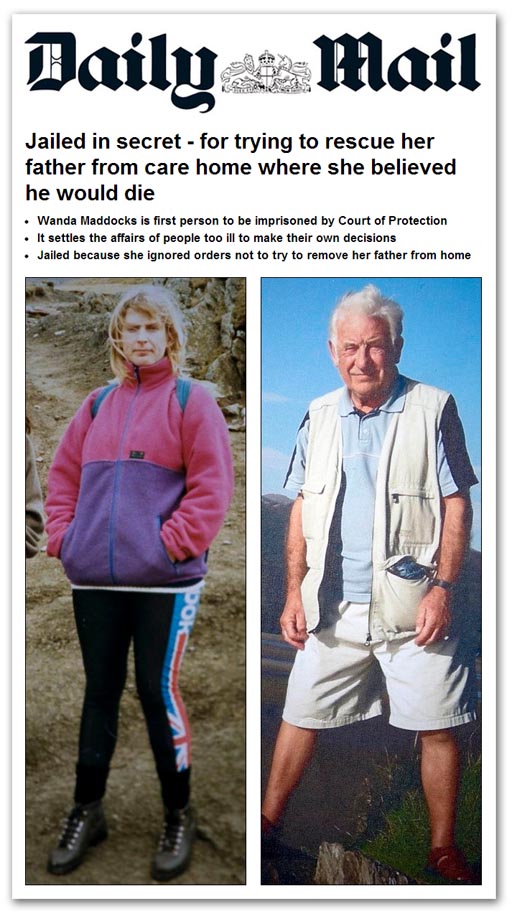
Secret courts is something of a campaign issue for the Daily Mail, which has now extended its remit to cover the secretive behaviour of the Court of Protection, highlighting the case of Wanda Maddocksand her father John.

In fighting for her father, Wanda found herself convicted and sentenced to jail in her absence, and without even the benefit of legal representation – only for the fact of the imprisonment to be kept secret on the order of Judge Martin Cardinal. He would not even allow Wanda to be named. 

Whatever the rights and wrongs of the case, this is wrong. There is never in what passes for a free society for an individual to be convicted in absentia and then jailed. It is even worse when this is done secretly. 

Furthermore, this is by no means the only case. Booker, who adds a commentary to this news report, has been trying to place on the record another egregious case where a son is trying to protect his father from the depredations of the social services. Again, judges are imposing gagging orders, using powers they do not appear to have. 

Thus, the Mail does right to publicise this case, adding to the continuing toll of cases going through the families courts, where unnecessary and unhealthy secrecy is being imposed – for no better reason, it seems, to protect officials from deserved criticism. 

But while one applauds the Mail, there is also a sense of the fatuity of media campaigns. There was a time when even Booker and this lowly author, writing of some outrage, would receive a ministerial call the day following publication, and things would get done. 

These days, officials and politicians appear immune to all but the most strident and intensive campaigns – where virtually the whole press corps joins in and goes into hysteria mode until the issue is sorted. And clearly, this can only happen on a very limited number of occasions. 

As for judges, the arrogance of office is now such that these appointed officials seem to have lost sight of the reason they are appointed – to serve the interest of justice. They are placing themselves above the law, and we are all at risk. 

Thus, it seems to me, that somehow we need to redress the balance. Further, it is self-evident that we cannot rely on the establishment to respond. Ministers have been approached many times, and have yet to act. It is unlikely that they will act. 

Having given this a great deal of thought, it seems we are back in Harrogate Agenda territory, for the second time in two consecutive posts. 

When it comes to our six demands, readers will recall demand four, which states this:
4. no legislation or treaty shall take effect without the direct consent of the majority of the people, by positive vote if so demanded, and that no legislation or treaty shall continue to have effect when that consent is withdrawn by the majority of the people.
This, in itself it not a great deal of use to us, but I have been mulling over an amendment, and have come up with this new text:.
4.no legislation or treaty shall take effect without the direct consent of the majority of the people, by positive vote if so demanded, and that no legislation, treaty or decision shall continue to have effect when that consent is withdrawn by the majority of the people.
The key difference here is the addition of the word "decision", creating a situation where any official decision can be challenged by way of a referendum – a sort of people's judicial review. 

In the Maddox case, this power could perhaps have been used in several different ways, but the one that would appeal most (to me) is the power to challenge decision to appoint Martin Cardinal as a judge. In effect, the power gives people to right to fire officials when they go off the rails. 

In my view, any judge who can go about jailing someone without a hearing, and who sees nothing wrong with keeping his action secret, deserves to be fired. For many reasons, there are many other public officials who deserve to be fired. 

And the very fact that the people, their paymasters, are able to fire them, would be a powerful tool to keep them in check. All of a sudden, an appearance in the Daily Mail would mean something again. At the very least, it would remind them who their masters were. 

COMMENT THREAD

Eurocrash: the Greek destination


Welt 023-dic.jpg

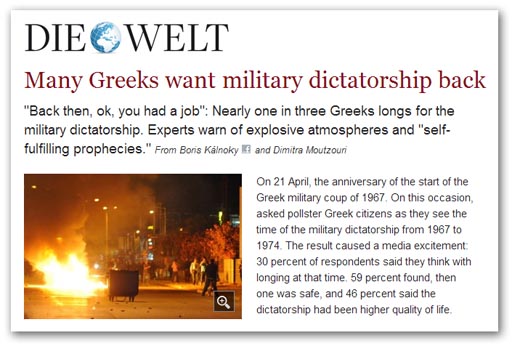
A rather sad reflection of the state of Greece comes from Die Welt, with the results of a recent survey that showed a very substantial minority of the population wanted the return of the military dictatorship.

The occasion was the anniversary of the Greek military coup, which started on 21 April 1967 – a mere 46 years ago and thus within the living memory of many. Thirty percent of respondents wanted the Colonels back, 59 percent thought the streets were safer with them, and 46 percent said the dictatorship had provided a higher quality of life. 

This, of course, was a regime characterised by random arrests, torture and arbitrary justice, yet a significant number of people are prepared to accept that in return for stability, personal safety and prosperity. It goes without saying that. a military dictatorship would be incompatible with EU membership. 

But, if this survey is presented as a choice between democracy and dictatorship, the retort from one respondent, an unemployed 45-year-old, makes the appropriate point. "We have no democracy anyway", he says. 

A choice, therefore, between a dysfunction government and one that works – neither of them democracies – is entirely rational, especially as the current crop of politicians are regarded as crooks, as indeed many are. 

What is sad is that there seems no aspiration to replace the current system with anything which approaches a true democracy. One can only suppose that the word has been so debased, and the concept so tarnished, that few people have any faith in the idea. 

But what we are actually seeing is the effects of a lack of democracy. For too long, people have tolerated corrupt and incompetent politicians, within the framework of a system that denies people power, and thus bears only a passing resemblance to a democracy. 

That, in turn, has led to a widescale retreat from politics, where the political class of "professional" politicians have taken over the running of the government, and the people have allowed themselves to be excluded from decision-making. The trouble is, as we have observed before, if you don't take an interest in politics, it will take an interest in you. 

That, really, is what the Harrogate Agenda is all about. For too long, we have allowed the political classes to define what they mean by democracy, and have accepted what they tell us at its face value. But democracy is actually about people power. One hoped that the Greeks might understand this and start to re-assert their own power. 

Whether they do or not, though, there is a lesson for us. If we follow on the same path trodden by the Greeks, we now have a very clear view of the eventual destination. And it ain't pretty. 

COMMENT THREAD

EU politics: German defence minister gives game away


Guardian 023-mai.jpg

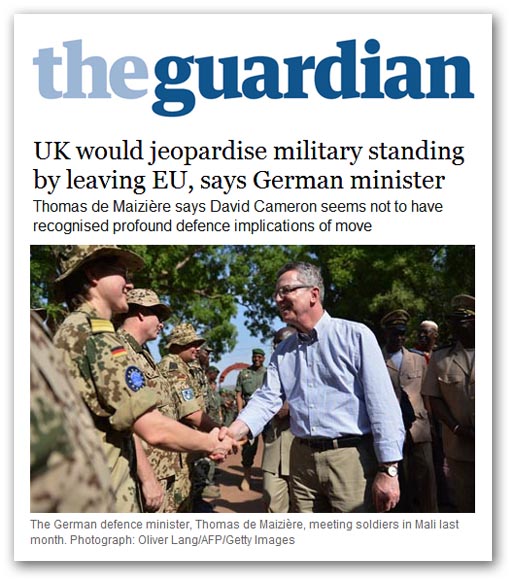
An exclusive interview of German defence minister Thomas de Maizière, for the Guardian highlights an apparent inconsistency, as the minister suggests that a UK outside the European Union would "jeopardise military standing".

Ostensibly, this is an absurd assertion, as the UK would continue to participate in joint military ventures through its membership of NATO, the activities of which are increasingly duplicating EU military initiatives. 

Unwittingly, though, de Maizière is revealing a mindset now prevalent amongst European defence ministers, who are sharing the view offered by this article, effectively conceding that the days of NATO are numbered. 

With the EU Foreign Affairs council just concluded in Luxembourg, with defence ministers present, one can see the writing on the wall, as ministers grapple with plans to reactivate the battlegroup concept – effectively moribund since 2007 – prior to a major defence council in December, when we expect to see significant developments in the EU's Common Security and Defence Policy. 

On the other hand, with NATO operations in Afghanistan winding down, the glue that binds the North Atlantic Alliance is melting away. The United States is looking east, with North Korea currently dictating defence priorities, drawing further away from NATO and reducing its European presence. 

Behind the scenes, what we are also seeing is a gradual insitutional merger between the EU and NATO. So deep is the "strategic partnership" that the European components of NATO are becoming completely integrated with the EU military structures, to the point where they are inseparable. 

In the fullness of time – and now not very far distant – we will witness a restructuring of NATO, comprising EU elements, the non-EU European elements and the North American elements (US and Canada). But the heart of the NATO will become its 21 EU members, who will be the driving force. 

It is in that context that de Maizière's comments must be seen. He asserts that, "If Great Britain leaves the EU, it would be a great disappointment to us. It would weaken Nato, it would weaken the British influence within Nato. I think from a military point of view the disadvantages for Great Britain would be bigger than the advantages".

De Maizière is effectively saying that full participation in NATO (as it is about to become) will be dependent on membership of the EU, the latter having engineered a reverse takeover. NATO, at a European level, becomes "EUNATO".

Increasingly, we can also see the United States channelling its initiatives via the European Union, quite deliberately in an attempt to keep Britain within the EU, with the United Nations also dealing with the EU as the partner of record. 

All this will be (and is being) designed to convey precisely the impression de Maizière has given theGuardian. This is more that the usual FUD, and represents a structured attempt to undermine UK independence. 

When it gets to the stage that even military co-operation with the United States is channelled through the EUNATO complex, Britain will no longer have the option of bilateral relations with the US. The UK will be locked in to the EU, whether it likes it or not. 

However, what de Maizière omits to tell us is that there is provision for actors to take part in EU institutions without being members of the EU. This is typified by Norway being a participant in European Defence Agency initiatives. Thus, the UK outside the EU could still elect to take part in EU defence ventures, on an ad hoc basis, losing nothing by being outside the fold. 

But then, you do not expect the "colleagues" to tell the whole story. It would spoil their game and reduce the impact of their message.

COMMENT THREAD

Tuesday, April 23, 2013

Transport: the EU repeats "stupidest act"


BBC 023-rai.jpg

Ever since Directive 91/440/EEC of 29 July 1991, the EU (as it is now) has been interfering with the provision of rail services in the United Kingdom. 

That was the Directive which required that a distinction be made between provision of transport services and the operation of infrastructure, with separate management and accounts for each of the two activities. The Directive also required railway undertakings and their groupings to pay for the use of railway infrastructure.

It was this Directive which led to the John Major's bodged privatisation in 1992, and the separation of the running of the railtrack from the train companies which used it, described by Simon Jenkins - asBooker later recorded -  as "the stupidest act of John Major's government".

With that, though, the EU had not finished. It produced additional directives and, after the publication of its "Roadmap to a Single European Transport Area" in March 2011, it followed through, culminating with the publication of its "Fourth Railway Package" in January of this year. This was aimed at "completing the Single European Railway Area to Foster European Competitiveness and Growth".

It is now a sign of the times that the House of Commons Transport Committee is brought into play to comment, but not on Whitehall's plans for the railway system – we have ceded the power to determine strategic legislation on transport to the EU. Thus, we get the Committee examining and reporting on the plans of our supreme government in Brussels - in particular the fourth railway package.

And it is from its report that we learn of MPs' disquiet over the EU's plans. Far from learning from its "mistakes" over the separation of infrastructure from operations management, the Commission is repeating them, seeking to increase the degree of separation. To that effect, it is proposing "common rules for a governance structure", in an attempt to make sure systems are completely separate.

Having already split our system, though, these additional requirements will have relatively little impact on the UK, but there are other changes tucked away in the current "package". Not least of these is extending the powers of the European Railway Agency, changes which are also intended to speed up the introduction of the European Rail Traffic Management System (ERTMS).

Little has been said of this enormously ambitious system, the implementation of which extends into 2024, about which there is a UK implementation plan but very little reliable cost information, with estimates of up to £6 billion.

Unsurprisingly, there is only one mention of ERTMS in the Transport Committee report, and that under "interoperability", with a reference to the "costly" standards. These are the subject of ongoing EU legislation, dated as recently as January 2012.

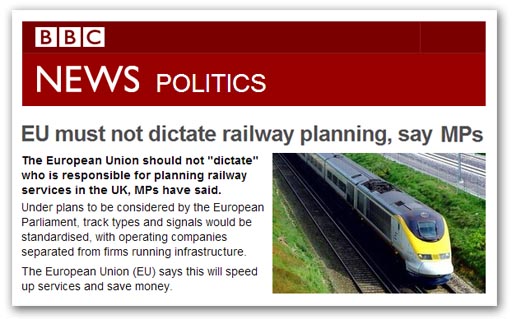
The devil is in the detail here, and that is not what you will find in the legacy media. In fact, apart from one report - by the BBC, and that at an incredibly superficial level (illustrated above) – the national media seems to have ignored the Transport Committee report.

Thereby is illustrated the harm done by ceding power to the EU. Because strategic planning of rail systems is now an EU competence, there is scarcely any UK political input and next to no public debate.

No one but a few specialists really know what is going on, and a whole tranche of government has become invisible to the media and the general public. Because the anonymous officials in Brussels are dealing with it, it is no longer our concern.

COMMENT THREAD

EU politics: ripples from the AFD


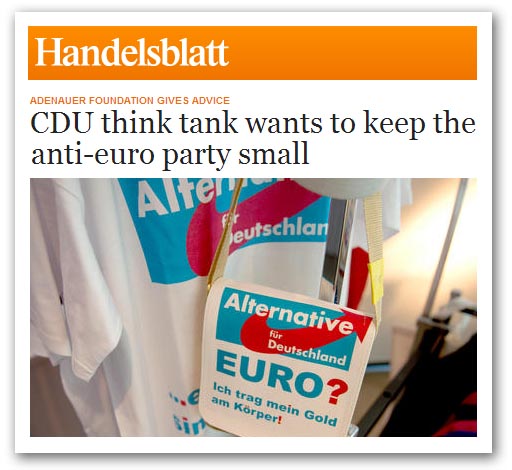
Handels 022-cdu.jpg

The perturbation from the launch of the AFD continues to dominate German politics, withHandelsblatt now reporting on an opinion poll that claims 19.2 percent of respondents would vote for the party.

The CDU, on the other hand, had lost a point to hit 38 percent, with its coalition partner the FDP unchanged at five percent. The opposition SPD stood at 26 percent, the Greens were on 15 percent and the Left Party was on six percent. 

This means that neither grouping could form a government and all parties are keen to neutralise the AFD threat. Enter, therefore, the CDU-affiliated Konrad Adenauer Foundation, which has issued a detailed report, taking a closer look at the party, making recommendations on how to deal with it. 

Above all, the Foundation says, it is very important not to underestimate the AFD, as the party had quickly gained significant media attention and a great deal of interest. This also shows that "new populist movements" can have a considerable impact and can quite quickly record political success. 

In the view of the Foundation, therefore, concerns of citizens about the future of the euro should be addressed more fully in the policies of the federal government and there should be "extensive efforts to explain the policy towards the indebted euro countries, the guarantees given by Germany and the development of European institutions".

On the other hand, the Foundation warns that "single-issue parties such as the AFD benefit from ongoing public debate. But many of the supposedly alternative political demands have long been debated between the parties in the Bundestag and it is questionable whether many voters really share the "pessimistic analysis" of the AFD about the situation in Germany. 

According to research carried out by the Konrad Adenauer Foundation, citizens are more satisfied with their personal material situation, even if they are starting to worry about the overall situation".

No one should shy away from a substantive discussion about the AFD, the Foundation then counsels, especially as the party had no more to offer than a "mini-programme and seemingly simple solutions". Moreover, the AFD competes over their single issue with other parties such as the liberals. 

But there is also advice about accelerate the disenchantment with the new party. Its founding congress has clearly shown that it has failed to implements its own self-proclaimed goal of "more democracy". Its rigid process of dealing with nearly 200 applicants who had registered for the election of its Board was very far from ideal. 

Thus does Handelsblatt put the boot in, but you would not think so from the coverage ofSuddeutsche. It actually rails against Handelsblatt pushing the AFD, overstating its share of the polls. 

The 19 percent support, reported, it says, was based on a flawed question which flattered the party, making the survey "unfortunate" and "suggestive", blatantly violating the rules governing survey institutes. 

Whether exaggerated or not, though, the AFD – for the moment – is punching above its weight. Says columnist Wolfram Weimar, the Left-right insults them as reactionary. The Liberals vilify them as nationalistic. The Union ostracises them as irresponsible, the Greens joke about " protest professors" and the Pirates brand them the "D-Mark grandpas". They have provoked the partisan establishment, and have shaken the political scene within a few weeks. 

And, for the time being, you can't ask more than that. 

COMMENT THREAD

Monday, April 22, 2013

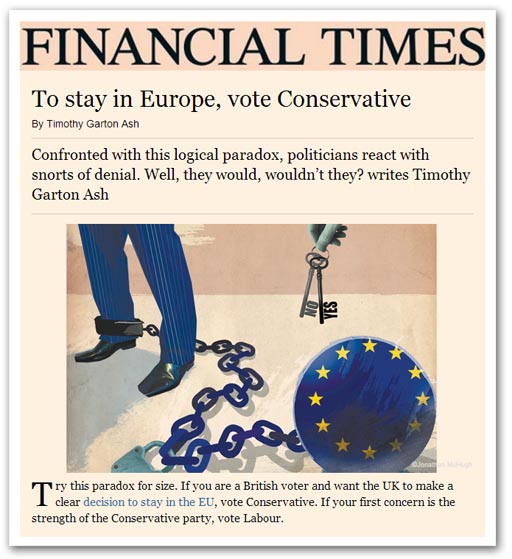
EU politics: to stay in Europe, vote Conservative


FT 022-gar.jpg

Timothy Garton Ash in the Financial Times has been doing some ruminating about referendums and the Conservative Party. And to cut a long story short – the bigger the cut the better in the case of Garton Ash – he argues that the most certain way of staying in the EU is to vote Conservative.

His reasoning is that, sooner or later, there will be a new EU-wide treaty, with further powers transferred to Brussels, which will trigger the "referendum lock" in the UK.

With a Labour/Lib-Dem coalition in place (a likely outcome at the next election), he thinks that a Conservative party under a new leader urging a "no" vote, backed by UKIP and a mainly eurosceptic press, would prevail. A Labour-led government probably could not reassure enough of a class of voters called the "worried nationalists" to enable it to win a "yes" vote during the next parliament.

On the other hand, a Conservative-led government in power would go through the motions of renegotiation. Small successes could be wrapped up in big, colourful boxes for presentation to voters and Mr Cameron would then have support of the two main opposition parties and much of British business.

Thus, even while his own party might split, and UKIP would – of course – be against him, under Mr Cameron and the Conservatives, a "yes" vote would be more likely. Only the Tories could reassure the "worried nationalists".

However, Garton Ash is basing his assumptions on a referendum being held in the next parliament. If a referendum was delayed beyond 2020, a different situation would pertain.

For a start, in 2015, a defeated Conservative party would almost certainly dispense with Mr Cameron and could well select a robustly anti-EU leader. Come the election in 2020, a Conservative victory might still have that leader supporting a "no" vote in a referendum.

But a Tory defeat in 2020 could mean the party – according to the Garton Ash recipe – also supporting a "no" vote in any referendum held during the 2020-5 term. And in both cases, in or out of power, the Tory-led "no" campaign would win.

On this basis, it would seem that the best option for leaving the EU is to vote for Labour at the next election. Then, if a referendum is delayed until after 2020, either Labour or the Tories will do. It becomes a win-win for the "no" vote.

And while that might be speculation, there is certainly less uncertainty in the post-2015 term. A Conservative Party in power, with the support of campaigns such as Business for Britain, would most certainly go for the "yes" vote. Thus, if a vote for UKIP at the next election is likely to let in Labour, some might argue that this might be the best way of securing an EU-free nation.

COMMENT THREAD

EU politics: "feeble", but not in the way intended


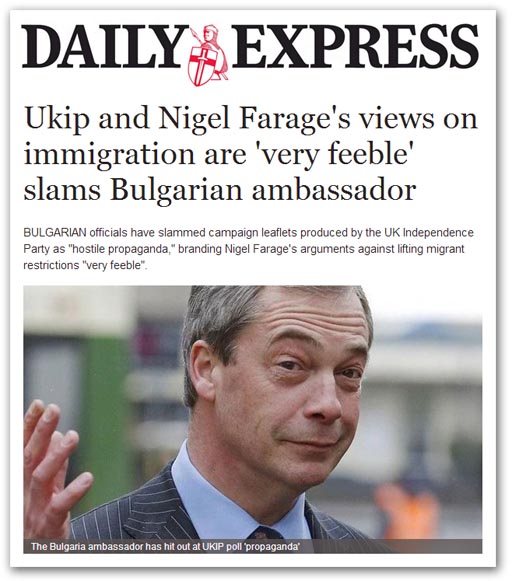
Express 022-far.jpg

I would not go so far as to say that I totally agree with Bulgarian Ambassador to the UK, Mr Konstantin Dimitrov, although I did permit myself a smile when I read his comments.

Dimitrov declares that Nigel Farage is "usually very feeble in presenting solid arguments", and suggests that he prefers to "engage in propaganda which deviates markedly from the essence of the debate".

This is all about the Bulgarian and Romanian hordes that are to descend upon us on 1 January 2014, thus provoking UKIP leaflets stating that 29 million Bulgarian and Romanians will have the right to "live, work and draw benefits" in the UK. And, while many will be "fine, hard-working people", the UK may struggle to cope with "another influx" of "people needing jobs, housing schools, hospitals and benefits".

Mr Dimitrov detects an "element of hostility in certain political quarters" over the issue of immigration. But he believes the UKIP's message "… is not the reflection of the prevailing mood of the British people towards the Bulgarian people but it is very disappointing and very discriminatory in certain aspects".

"We react firmly, politely, but very strongly against these assertions and the atmosphere created by this propaganda," Mr Dimitrov goes on to say, asserting that UKIP's pamphlets are "absolutely unacceptable in a European country".

Doubtless, though, the Bulgarian ambassador's intervention will delight Farage and his supporters. Verging very closely on external interference in a domestic election, it will again confirm that foreigners are seeking to influence internal matters which are none of their business. 

However, it is rather sad that Mr Farage decided to say that Bulgaria and Romania "do not belong in the European Union", adding that, "these two countries are racked with corruption and organised crime. They should never have been allowed the join the EU since early stage".

One might think that, for those of us who wish to depart from the EU as soon as possible, it is not our place to decide which countries should belong to the EU. It is not so much that Bulgaria and Romania don't belong – being racked with corruption and organised crime has never been a bar to entry, or Italy and Greece could never have joined. The issue, surely, is that Britain does not belong in the EU. 

As to potential immigration, supposedly such small numbers of Bulgarians and Romanians areactually looking for work in the UK, that the BBC would have it that you cannot safely estimate real numbers of how many will come. Despite this, the Telegraph translates the percentages into 350,000 people. 

It is there that Farage has a really serious problem for, to exclude those potential 350,000 incomers, he must junk the "freedom of movement" and other provisions of the EU treaties. But this would mean accepting the return of upwards of two million Britons currently resident in EU member states. 

Not until UKIP can solve that problem can its immigration policy really be considered credible, the lack of which solution suggests that Mr Dimitrov may actually have a point, even if it isn't the one he intended. Seeking to exclude immigrants, while expecting other member states to accept our emigrants, is rather feeble.

COMMENT THREAD

EU politics: the enemy in plain sight


BfB 022-web.jpg

In the manner of Business for Sterling, which was part of the battle to keep the UK out of the single currency, elements of the business community have now gathered together to create a campaign to keep us in the European Union.

Nothing terrifies the corporate sector more than the idea of an independent Britain, with a free people able to think for themselves and chose their own leaders. Thus are the corporates seeking to divert attention from leaving the EU by pushing the renegotiation meme. 

Run "by business for business", the group is headed by Matthew Elliott, one-time "no" campaign wannabe, and has adopted an overtly europhile stance. Based on the belief that "the Government is right to seek a new deal for the EU and for the UK's role in Europe", it expresses the view that,
… far from being a threat to our economic interests, a flexible, competitive Europe, with more powers devolved from Brussels, is essential for growth, jobs and access to markets.
Business for Britain, it says, "is absolutely not about leaving the EU". What unites our supporters, it claims, "is an agreement that the status quo in our relationship is not working and that the Government is right to seek a new deal for the EU and the UK’s terms of membership". 

Thus, we are told, "Instead of pushing the debate to the extreme corners of  'In vs Out', we should be having a sensible discussion about what is right and what is wrong in our current arrangements. Resisting renegotiation will push public sentiment further towards Out and fast-track an EU exit".

The group is therefore "urging all political parties to join in committing themselves to a national drive to renegotiate the terms of Britain’s membership of the EU".

Unable overtly to support membership of the EU in the light of growing public hostility, corporate business has thus shifted its ground to support the unattainable objective of renegotiating the EU treaties, thereby hoping to weaken the pressure for an exit. 

This is exactly the false-flag type operation that has typified the europhile Open Europe and it is no surprise that a leading member of the Advisory Board, John Hoerner, former CEO of The Burton Group, is also a supporter of Open Europe. Similarly, both co-chairmen, Alan Halsall and John Mills, count themselves as supporters. 

It is obviously attempting to position the out campaign as one of the "extreme corners", and place itself as hosting "a sensible discussion" – the classic strategy for marginalising the "out movement", and making the platform indistinguishable from the European Movement. Effectively, it becomes indistinguishable from the EM clone, Business for a New Europe, with a virtually identical pitch. 

Needless to say, the new group is being given a free pass by the media, with gushing pieces in theTelegraph, the Mail and the Express, and – predictably – a warm welcome from Conservative Home.

It never was the case that the establishment was going to stand back and let the people leave the EU without a fight.  It is thus running true to form, fudging the debate, and dressing corporate interest in the clothes of jobs and economic prosperity. 

T'was ever thus, of course, but at least we have five hundred of them broken cover. More of the enemy is in plain sight. 

COMMENT THREAD

EU politics: give us some money!


AFD 022-cas.jpg

The saga of the AFD continues to entertain, with FAZ reporting that the new party is chronically short of money.

Actually, the party has collected at least €580,000 but the trouble with being a fully-fledged political party is that you need millions to fight a campaign. Bernd Lucke reckons that he needs to raise at least three million euros, and then he has to complete with the SPD and CDU, which have over €20 million each available to them. 

The main sources of funding from the AFD are donations. However, large donations have not materialised and the highest sum so far contributed has been €5000. Thus, the party must bake small rolls, says FAZ.

In a way, I feel quietly vindicated when it comes to the Harrogate Agenda. One can see the attraction of going high profile and hoping the funding catches up, but the risk of failure is high. Better, I think, to set up the systems and the financial base first, and then to start building the campaign. 

COMMENT THREAD

Sunday, April 21, 2013

Harrogate Agenda: workshops

Workshop 022.JPG

My apologies for not following through last week, as I had promised, with an account of our workshop plans. The launch of the AFD took precedence, an event not without relevance to us.

What intrigued me more than anything about that launch was that, even with the high powered brains behind this anti-euro party, they still hadn't defined their main objective – whether they should go for the abolition of the single currency or shrink the eurozone to a smaller, northern currency union. 

A certain lack of direction also seems to apply to the Italian Five Star Movement, where contradictions and tensions seem to be evident and, of course, we have witnessed considerable incoherence with our own UKIP. 

Yet, an essential preconditions for a successful political movement are clarity of vision and the consistency of the message delivered – the two going hand-in-hand. And it is for lack of these that – most likely – the AFD initiative and others like it will eventually fail. Either that, or they will evolve into something different, and then possibly develop the essentials of success or be absorbed into another movement. 

With the Harrogate Agenda, though, we feel we have developed a clarity of vision in our six demands, but the delivery of our message cannot be left to chance. Although simple to express in brief, the detail is complex and easily misrepresented, as is the reasoning behind the six demands. 

Going back through historical examples of successful movements, one of the common attributes is the intensive training programme. Certainly, the Labour movement set great store by education, and other less savoury movements also directed much of their energies to training their supporters. 

Here, much the same must apply. There is a limit to how much people can absorb through pamphlets, books, web material and even videos. This may be the electronic age, but there is still no substitute for face-to-face contact, and formally structured training sessions. 

As much to the point, to multiply our capabilities, we need recruits who can learn and spread the message via this medium, so we see the idea of running a series of workshops not only as the best mechanism for teaching people about the Harrogate Agenda, but also as a means of training the teachers. 

Possible formats encompass half-day, one-day and weekend sessions, with a series of talks, initially comprising an exploration of the background to the Harrogate Agenda, and a detailed examination of the six demands. But we would then move on to sessions on strategy and tactics, teaching people how to take the Agenda forward. 

Currently, the plan is to trial the first workshop this autumn, and to have a workable product available for roll-out early next year, to local audiences. And once we have a stable format, we will be ready to teach our recruits how to replicate the sessions to their own audiences. 

This will involve training in public speaking, confidence-building, the use of visual aids such as powerpoint, and pointers on the organisation and marketing of the sessions. 

With that, we believe workshops will be the best and most effective way of building up a knowledgeable cadre of supporters, going for depth rather than breadth. In the early stages, we would sooner have ten, a hundred and then a thousand trainers with in-depth knowledge of the Agenda, than many thousands with a slight acquaintance of the issues. 

These will be our advance guard – the multitude will follow. 

COMMENT: HARROGATE AGENDA THREAD

UK politics: the opinion poll beckons


Observer 021-opi.jpg

Political attention is now turning to the forthcoming local elections but, so little discretion do local authorities have in the way they run their affairs, that the votes will have little relevance. In the main, we are simply voting for the people who will do the bidding of our superior governments – national and supranational.

It is no surprise, therefore, that the elections tend to be treated as a large-scale opinion poll, in anticipation of which the Observer has published its own poll. This finds Labour on a mere 35 percent with the Tories "still in the doldrums" on 29 percent. 

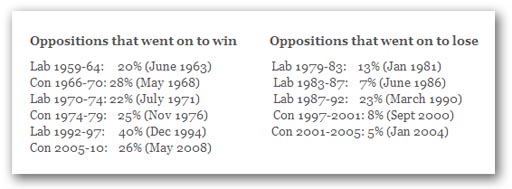
Labour's shrinking lead was the subject of a recent piece in the New Statesman, whence it noted Peter Kellner's observations that no modern opposition had ever won a general election without being at least 20 points ahead at mid-term (below). 

statesman 021-win.jpg

By this measure, the Tories should romp home at the general, but New Statesman argues that the right is divided and the Lib-Dem vote is likely to collapse in Tory-Labour marginals.

The "right", in this context, is taken to include the bulk of UKIP voters and, with the current poll putting its support at 17 percent, the greater effect of the UKIP vote is expected to drag down the Tory vote and open the way for Labour. With displaced Lib-Dem votes going to Labour in greater numbers, one can therefore expect Labour to do better than the modest poll lead indicates.

Another distorting factor is the turnout which, if it follows present trends, should be at an all-time low for the forthcoming local elections, and possibly also for the general. And recent observations suggest that low turnout tends to favour those who are best able to organise the postal vote – most often the incumbent.

Despite the uncertainties, though, the media still has difficulty in widening out the elections beyond the two party (plus one) system, thus like The Sunday Times reporting in terms of wins for the establishment parties.

This paper thus has details of an analysis carried out Colin Rallings and Michael Thrasher of Plymouth University, suggesting that Labour will gain 350 council seats, while the Tories will lose 310 and the Liberal Democrats 130. Nevertheless, they concede that, with UKIP in the field, this is the "most unpredictable local contests for years".

The Sunday Telegraph, on the other hand, goes for a more lurid projection, suggesting that the Tories could lose as many as 600 of the two thousand-plus seats up for grabs. It takes the Sunday Mirror to talk up the role of UKIP, retailing fears that many of the Tory votes will go to UKIP, putting the overall losses at 500 seats.

A guessing game on the number of seats won or lost, however, seems to be the extent of the media sophistication. One can understand, therefore, why the Italian Five Star Movement is moving towards the idea of direct democracy, restricting the powers of elected representatives.

Until something more fundamental such as this is on the agenda, the elections will increasingly become an empty numbers game – and one that attracts less and less interest and excitement. Even the politicians, it seems, are having difficulty drumming up enthusiasm, and if they can't get worked up, it is unlikely that the rest of the population will follow.

COMMENT THREAD

Booker: EU stares bankruptcy in the face


Booker 021-mil.jpg

According to Article 310 of the Treaty of the Functioning of the European Union, the annual budget of the EU "shall be in balance", which means that expenditure must not exceed revenue in any one year. This, effectively means that the EU cannot go into debt and must meet all the payments in the year that they come due. 

However, this is the EU we are talking about, and there is always a way round such tiresome limitations. What the Commission does is defer payments through a system called RAL (reste à liquider). This is a process of taking on commitments which, although they will come due eventually, have not legally been translated into payments – i.e., no invoices have been submitted. 

A commitment, says the Commission, is "only" a pledge to make a money transfer in the future. It only becomes "outstanding" when an invoice is approved for payment. Until then, it doesn't have to be shown in the books. 

The sum of the commitments reflect policies agreed at EU level, with corresponding amounts "foreseen" in the legal acts of the respective spending programmes, such as the seventh research framework programme, "Lifelong learning", the European regional and social funds, rural development, the European Return Fund, and the Instrument for Pre-Accession Assistance. 

By any measure, the sums involved are huge. As it stood at the end of 2011 the RAL amounted to €207 billion and, by the end of 2012, it had grown to €217 billion. 

Previously, the Commission has squared the circle by bumping the commitments to the end of the multi-annual budgetary period, but payments are now being deferred beyond that, all in expectation of continually increasing payments from member states. 

However, it was already getting worried by the extent of its commitments in 2011 and when, last year, the member states refused to increase the budget and (so far) have yet to agree to an amendment budget for last year, there is now a very real prospect that the EU will not be able to pay its bills. Technically, it will be insolvent. 

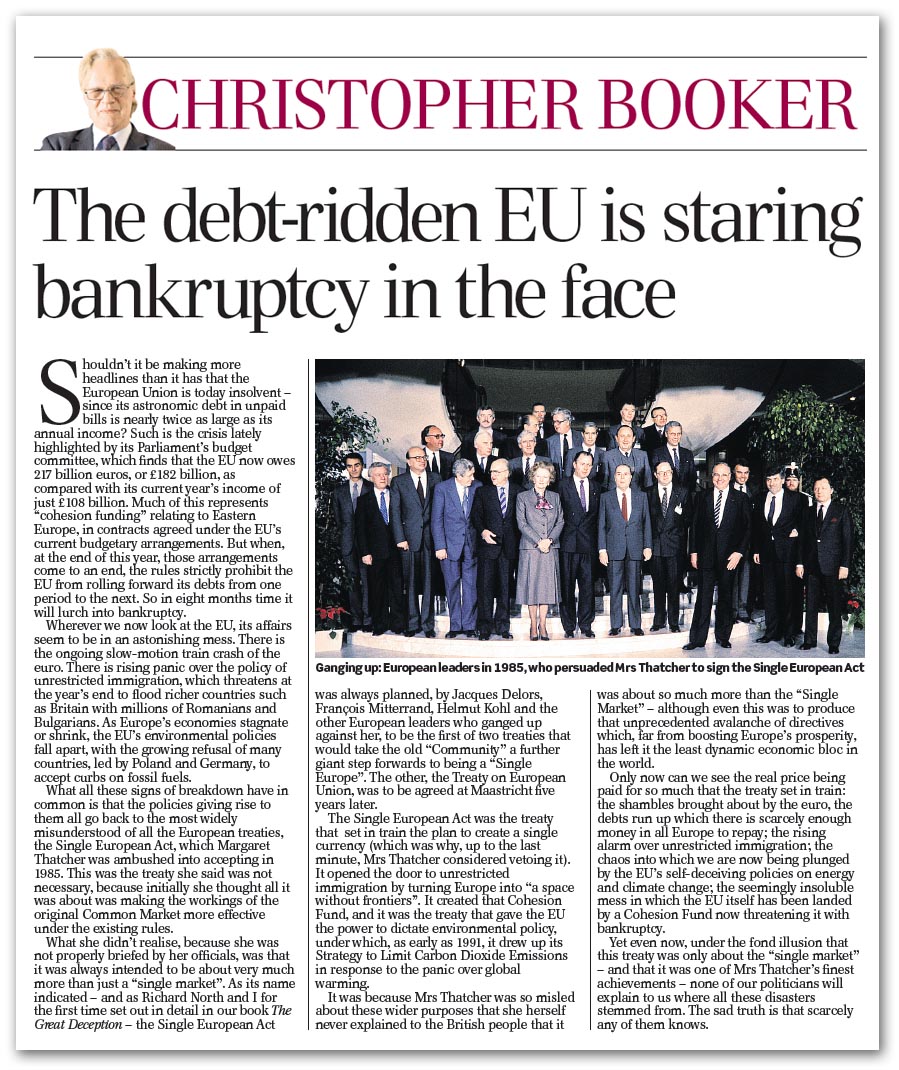
Thus does Booker ask in this week's column whether this should be making more headlines than it has that, since its astronomic debt is nearly twice as large as its annual income. 

This, though, is by no means the only problematical area for the EU. Wherever we now look at the EU, Booker writes, its affairs seem to be in an astonishing mess. 

There is the ongoing slow-motion train crash of the euro. There is rising panic over the policy of unrestricted immigration, which threatens at the year's end to flood richer countries such as Britain with millions of Romanians and Bulgarians. As Europe's economies stagnate or shrink, the EU's environmental policies fall apart, with the growing refusal of many countries, led by Poland and Germany, to accept curbs on fossil fuels. 

Yet, few people appreciate that all these signs of breakdown have something in common: that the policies giving rise to them all go back to the most widely misunderstood of all the European treaties, the Single European Act (SEA), which Margaret Thatcher was ambushed into accepting in 1985. 

This was the treaty she said was not necessary, because initially she thought all it was about was making the workings of the original Common Market more effective under the existing rules. 

What Thatcher didn't realise, because she was not properly briefed by her officials, was that it was always intended to be about very much more than just a "single market". 

As its name indicated – which Booker and I set out for the first time in detail in our book The Great Deception – SEA was always planned, by Jacques Delors, François Mitterrand, Helmut Kohl and the other European leaders who ganged up against her, to be the first of two treaties that would take the old "Community" a further giant step forwards to being a "Single Europe". The other, the Treaty on European Union, was to be agreed at Maastricht five years later. 

In fact, the SEA and Maastricht were originally intended to be one treaty, as framed by Spinelli, and the split was only made on the advice of Mitterrand.  But the SEA was every bit as important as Maastricht, not least because it included the plan to create a single currency (which was why, up to the last minute, Mrs Thatcher considered vetoing it). 

This treaty also opened the door to unrestricted immigration by turning Europe into "a space without frontiers". It created that Cohesion Fund, and it was the treaty that gave the EU the power to dictate environmental policy, under which, as early as 1991, it drew up its Strategy to Limit Carbon Dioxide Emissions in response to the panic over global warming. 

It was because Mrs Thatcher was so misled about these wider purposes, Booker argues, that she herself never explained to the British people that it was about so much more than the "Single Market" – although even this was to produce that unprecedented avalanche of directives which, far from boosting Europe's prosperity, has left it the least dynamic economic bloc in the world. 

Only now can we see the real price being paid for so much that the treaty set in train: the shambles brought about by the euro, the debts run up, which there is scarcely enough money in all Europe to repay; the rising alarm over unrestricted immigration; the chaos into which we are now being plunged by the EU's self-deceiving policies on energy and climate change; the seemingly insoluble mess in which the EU itself has been landed by a Cohesion Fund now threatening it with bankruptcy. 

Yet even now, under the fond illusion that this treaty was only about the “single market” – and that it was one of Mrs Thatcher's finest achievements – none of our politicians will explain to us where all these disasters stemmed from. The sad truth, Booker concludes, is that scarcely any of them know.

COMMENT THREAD