Friday, February 08, 2013

EU regulation: let them eat horse


As the horsemeat scandal enters its second month, and seems to be intensifying rather than fading, not a few people are asking how it is possible that such huge quantities of burgers and other meat products could end up contaminated. After all, horse meat has a very obvious smell, different colouration and fat conformation, and surely would be recognisable to anyone making the products. 

While this would most certainly be true in the domestic kitchen, what people do not always appreciate is that things are very different on the industrial scale. The quantities are so huge and the speed of processing so high, that it is impossible to check all the ingredients going through the system.

What is more, even lines which predominantly use chilled meat will also use a proportion of frozen blocks, at anything up to 25kg weight, which - as graphically illustrated by the video above - is used without defrosting. And in that state, the people handling it will have no idea what it actually is.

The insertion of frozen meat into the process is in fact vital to keep the mix temperature down – otherwise, the cutting, grinding and mixing will overheat the meat and lead to undesirable changes. Thus insisting only on the use of chilled meat, and perhaps running an inspection belt, is not a practical option.

Thus, the detection of product contamination, especially cross-species substitution (either accidental or by way of deliberate fraud), requires a pre-production checking regime, possibly augmented by post-production sampling, at the pre-delivery stage and throughout the distribution chain, right up to point of sale, with laboratory testing for rogue proteins.

However, since the food scares of the late 1980s and '90s, we have seen a sea-change in regulation, both in scale and type, with the introduction of predictive control system, known generically as Hazard Analysis and Critical Control Points (HACCP) and paperwork auditing.

HACCP in particular, has been adopted with enthusiasm by the EU and incorporated into basic Food Safety Regulations, as the primary mechanism of control.

The knock-on effect of this is that both physical checks during processing have been scaled down, with greater reliance of the paperwork trail, while regulatory visits tend to focus more on determining whether HACCP regimes are in place, with extensive paperwork audits, rather then on physical inspections.

Under these regimes, it is not unknown for official inspectors to carry out their work without ever leaving the offices of the companies they are visiting, while end product testing also has been progressively abandoned, in favour of cheaper paperwork audits. That has been matched by reductions in regulatory manpower and testing budgets.

Another development has been the introduction of the "Due Diligence" defence into food law, where retailer can claim immunity from prosecution provided they can show they have taken "reasonable precautions" to ensure the safety of the food and its conformity with relevant standards.

This is achieved by insisting on a rigorous paper-chain from their suppliers, all attesting that necessary checks have been made, and systems maintained. When it comes to packaged, processed products such as frozen burgers, the supermarkets have used this to such effect that they can effectively absolve themselves of any responsibility for food standards.

However, no one with any deep knowledge in the system can have any confidence in it. Paperwork and sundry records – and even official stamps, so beloved of the EU – can easily be forged or doctored, more so since the advent of computers and high-tech printers.

And, where the value of a product is entirely dependent on its labelling and its paperwork, fraud is an inevitable consequence. That is why, to this day, there is more home-grown organic chicken sold in London than is produced in the entire UK.

Here lies the central deception in the system. Most people in the business know it is flawed, but no one will rock the boat. The supermarkets operate what is known as "plausible deniability". As long as they have the paperwork to say they are in the clear, they are happy. And if the supermarkets are happy, everybody else is happy.

But it is into this uncontrolled space that it appears the criminals have moved in and flourished. Actually, the criminals were always there, but with the centralisation of the meat inspection service, and its detachment from the local authority base, the intelligence network has broken down, marking the final degradation of the food surveillance system.

As a result, in the early 21st Century, food standards are probably less well-policed than they have been for the bulk of the second half of the last century. And, since food safety and food standards are exclusive EU competences, there is no immediate (or any) chance of improvement.

There are too many vested interests to permit change, and the last thing the EU is ever going to do is admit that it got it wrong. Thus, for us mere plebs, the word from Brussels is stark and simple: "let them eat horse".

COMMENT THREAD

EU budget: the theatre comes to town


Welt 008-mer.jpg

Even with the supposed victory announced this morning, nothing actually has yet changed. The €960-billion "cap" on the seven-year, multi-annual budget, is nothing but a starting gambit, representing the position agreed by the European Council. 

The British media, as usual, have been playing planting a flag on the story, the journos attempting in their tediously superficial way to turn it into a biff-bam story that their editors back home can understand.

David Cameron was set up to be the hero of the hour, girding his loins to launch another of his famous vetoes unless he came back with a deal. Hollande was cast the Bad Guy by the British, although the German media focus was on European Council President, Herman Van Rompuy.

Nevertheless, while Mr Cameron prattled about "cuts or veto", it must be remembered that there is another party to these negotiations – the European Parliament. Die Welt understands this, referring to it as the "invisible partner" – brought in by the Lisbon Treaty.

Thus, while the pics are of Merkel, Cameron and the other EU "leaders", and the talk is of a great "victory", the man once dubbed as a Concentration Camp guard, President Martin Schulz, is the man with the final say. It doesn't matter what the "leaders" decide. If Schulz is against the deal, Parliament will most likely reject it.

As it stands, Schultz and many of the "colleagues" would prefer a breakdown, rather than the Cameron deal where the Council appears to have agreed substantial cuts. In the event of a breakdown, a default budget kicks in – based on the previous year's funding plus inflation.

Since that is more than the current deal on the table, the Parliament could live with a crisis budget, leaving the "colleagues" to manage the funding on a year-by-year basis, foregoing some of the multi-annual programmes. This is certainly what the French seem to be predicting and would go for, as it would protect CAP spending at the expense of programmes such as research.

Some of the more sanguine players might push for a settlement, but the European Parliament can be mercurial and difficult to predict. Many would like to see Mr Cameron robbed of his glory, and there would be no better way to do it than to unpick the deal in the European Parliament.

With these additional possibilities thrown into the mix, this makes the theatre all the more entertaining, but no more informative. Whatever the deal, it isn't a deal until Mr Schulz say "yes" – and that might take some time.

COMMENT THREAD
Thursday, February 07, 2013

EU politics: muddying the big picture


Gay 007-uki.jpg

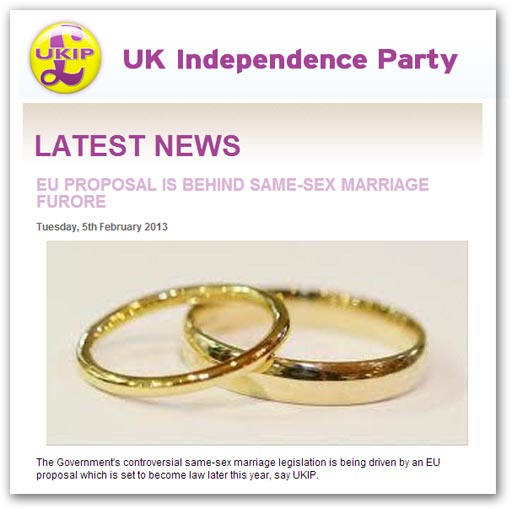
UKIP has made an interesting contribution to our understanding of the European dimension of homosexual marriage – and thus to the way we are governed - with a press release headed "EU proposal is behind same-sex marriage furore" (illustrated above).

Rightly, they draw attention to the cross-border anomalies – specifically in terms of freedom of movement and the recognition of "civil status" documents – which has been the subject of considerable exploration in the European Parliament (where two detailed reports have been drawn up by the services, one in 2010 and another in 2012 - all on the back of the so-called "Stockholm Programme".

However, it is perhaps going a little too far for Nigel Farage to assert via his party's press release that a particular report, which he identifies as the Berlinguer Report, is driving Mr Cameron's "controversial" same-sex marriage legislation.

According to UKIP, this "EU proposal" is due to be voted through the EU Parliament this November and is set to become law later this year, making all marriages and civil contracts conducted in any EU country legally binding in all other member states. 

Paragraph 40 of the Report, we are told, would mean that any member state would have to grant "all social benefits and other legal effects" such as legal recognition, tax breaks and benefit entitlements to a married couple, even if such a marriage did not exist in their own legal system. 

Says Mr Farage: "Now we know why David Cameron has launched this highly contentious and disruptive legislation, apparently out of the blue". He adds:
If a couple were to marry in Belgium, Spain, Portugal or Sweden where same-sex marriage is possible, the EU will say that they have to be given the same legal rights in whichever member state they then chose to live – even if that state itself opposes the introduction of same-sex marriage. In essence the Berlinguer Report seeks to establish an EU-wide right to same-sex marriage.
Farage then goes on to say:
It's no surprise that the Prime Minister has kept quiet about this, even at the expense of cohesion in his own party. He has a hard enough time trying to force his own backbenchers to swallow both his dedication to keeping Britain in the EU and his wish for the state to interfere in the definiton (sic) of marriage. To suggest that the two issues are in fact interconnected would have caused complete uproar.
Although this press release is repeated verbatim by Roger Helmer on his blog (below), and accepted uncritically by some of his followers, sadly, there are a few slight problems with citing the Berlinguer Report as the "smoking gun".

Gay 007-hel.jpg

Firstly, it is a European Parliament "own initiative" report, which means it has no legislative status, as Helmer (and UKIP) might have realised had they looked it up on the Legislative Observatory. There also, they would have found that it was responding to a European Commission Communication COM(2010) 171 final on "Delivering an area of freedom, security and justice for Europe's citizens".

This, we are told, is the "Action Plan Implementing the Stockholm Programme". The clue to its status is fairly easy to decipher. It is described as a: "non-legislative basic document".

Another possible problem with suggesting that the Berlinguer Report "proposal" is "is due to be voted through the EU Parliament this November and is set to become law later this year" is that it was published in September 2010 and voted through in the European Parliament on 23 November 2010 - i.e., over two years ago.

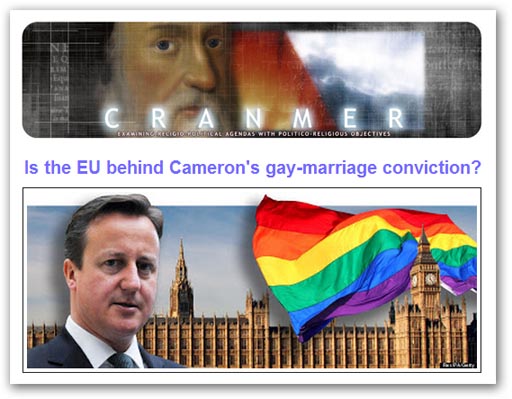
Despite this, the theme is picked up by Cranmer (illustrated below), who is cautious enough to ask the question, without jumping down from the fence. Strangely, what he claims is the report is a Commission document - a "roadmap" setting out an indicative timetable for a "Legislative proposal on mutual recognition of the effects of certain civil status documents".

Gay 007-cra.jpg

This gives an "expected date of adoption", which of course refers to the date the Commission might adopt a legislative proposal – the start of a long uncertain process, not the end of it.

As to the fabled "paragraph 40", this was highlighted by European Dignity Watch on 12 November 2010, which seems to have "inspired" the UKIP press release. Here we have Dignity Watch state:
Paragraph 40 wants to give civil documents, including marriage, to be given de facto legal effect throughout the EU by requiring Member States to grant "all social benefits and other legal effects attached to it". This could mean that Member States would be forced to indirectly recognize same-sex unions as equal to marriage even if such recognition does not exist in the respective country's legal system.
And here we have UKIP recycling the two-year-old statement, stating:
Paragraph 40 of the Report would mean that any member state would have to grant "all social benefits and other legal effects" such as legal recognition, tax breaks and benefit entitlements to a married couple, even if such a marriage did not exist in their own legal system.
The actual Paragraph 40, however, does provide some credence to the  Dignity Watch assertion, for it "stresses the need to ensure mutual recognition of official documents issued by national administrations", and "strongly supports plans to enable the mutual recognition ofthe effects of civil status documents" (my emphasis).

That really is the interesting bit. It seems that – should legislation ever be issued to that effect - the UK would have to pay qualifying couples relevant benefits including same-sex married couples, as long as the marriage took place in another EU member state which recognised the status.

However, while this illustrates the way the EU can ramp up the pressure towards homogeneity in social affairs, even where it has no direct legislative competence, there are as yet no publish plans to turn this "support" into law. Nor is there any indication that the precise issue of benefits will be included in any proposal that does emerge.

This, then, is not something which is going to get Mr Cameron storming the ramparts to get same-sex marriage through the Westminster Parliament so quickly. The UKIP scenario is far too tentative to be a "smoking gun". 

Real life is far more complex, as we see from our own pieces. The place to start looking is the Council of Europe, although, as UKIP indicates, it is the concert of the different bodies which ramps up the pressure and has the final effect.

COMMENT: "GAY MARRIAGE" THREAD

Fisheries policy: widening the circle of ignorance


MEP 006-fis.jpg

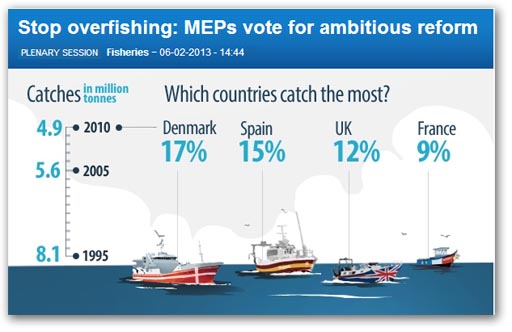
The European Parliament yesterday voted for its "common position" on the European Commission's Common Fisheries Policy (CFP) reform proposals, adopting an agreed text by 502 votes to 137. 

This is a terribly boring way of putting something that has the BBC proclaiming: "Euro MPs back large-scale fishing reform to save stocks", which may be (almost literally) correct, but not technically so. 

One thing is for certain though. We are recording the first of the first. It is the first time MEPs have been allowed to vote on the CFP, after it was converted to "co-decision" (now known as the ordinary legislative procedure) by the Lisbon Treaty. With that, approval become a joint responsibility of the European Parliament and the Council.

It is also the First Reading, which has been followed by a vote, but the MEPs have not approved "the package", as the BBC puts it. They have agreed a 336-page report which includes 60 substantive amendments amounting to nearly 180 pages of text.

It is this which forms the Parliament's "position" and separately, as can be seen from thelegislative observatory, the Council has also conducted its own debates, and will have produced its own "position".

The procedural detail is necessary here, in order to be able to understand the greater drama to come. In short time, the two "positions" must be reconciled through a series of negotiations (called trilogues). The end result must be a draft "common position", jointly agreed by the two institutions, which must not deviate so far from the original proposals that the Commission decides to pull the plug.

This is where it gets interesting. There are so many amendments, and substantive differences between the Parliament and the Council, that it is very hard to see how the two sides are going to be reconciled. Both  are going to have to compromise, but we have no track record on which to base assumptions as to whether that will happen. This could go through smoothly, or it could end up in a cat fight, with the draft legislation failing to become law. 

All that fun is to come.

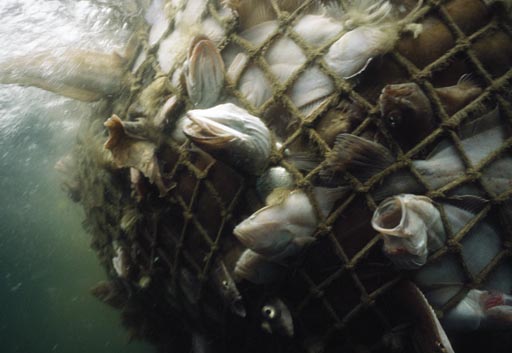
However, if the proposals pass in their current (or any) form, they will presage another long-term disaster, to add to the long-running train wreck which is the CFP. Despite glad claimsthat the aim is to "restore fish stocks and return profitability to fishing communities", the reform "package" will do neither – even though the headline issue of "discards" is being tackled, preventing in due course unwanted fish being thrown back into the sea. 

discards 0685734.jpg

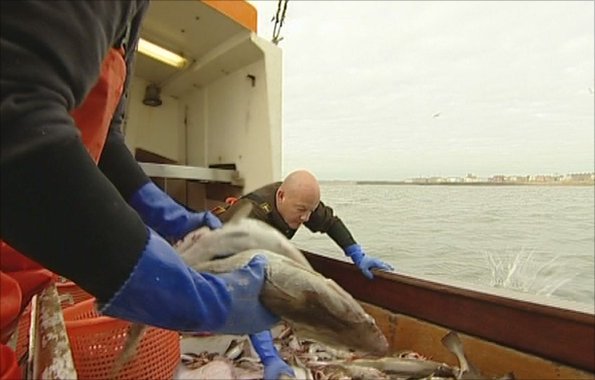
The big problem is not so much the discards (those are the symptom), but the system of quotas that produces them. If the fishermen have quotas for different species in a mixed fishery, and they bring up fish for which they have no quota when fishing for another species, then they cannot exploit the over-quota fish commercially. They must be discarded, whether at sea or once they have been landed.

Here, there is no relief in sight for, while there is to be a different way of calculating the quotas, which are to be based on Maximum Sustainable Yields (MSYs), rather than the Total Allowable Catch (TAC), the difference is more cosmetic than real. Both are still systems of limiting fishing effort based on imposing pre-emptive tonnage limits on target species.

In fact, contrary to the thinking which allows for fixed MSYs to be be imposed, actual yields from any fishery are infinitely variable and rarely predicable. In any properly managed fishery, MSYs are thus far too insensitive tool by which to control the fishing effort. Specifically, the capacity of a fishery is primarily determined by the food supply, and the more sensitive regimes rely on a series of different techniques to keep fish stocks and food supply in balance.

Such regimes do not rely on laborious annual sampling of fish populations (which is notoriously inaccurate, and often out-of-date by the time the data are collected and processed), and contentious methods of stock estimations.

Instead, one sees a great reliance on real-time monitoring, including continuous measurements of food stocks, fish condition and population structures, backed by extremely flexible and rapid programmes of fisheries closures when stocks start to fall outside acceptable parameters. 

fish-dead-689664-sw.jpg

On the other hand, in a marked divergence from EU-based regimes, when food is short, the fishing effort is often increased. This is to keep the population in balance with the food supply, maintaining a smaller, healthy population, rather than larger numbers struggling to survive. Similarly, when the population structure becomes unbalanced, juveniles may be targeted - an anathema to EU planners.

What we found when we studied such things was that, when employing the wide range of tools needed for effective fisheries management, use has to be tailored specifically to the conditions of each fishery. The effect is then to end up with a series of management regimes, unique to the geography and biology of their regions, each tailored specifically to the conditions in the water.

In our researches, however, I interviewed senior Commission officials responsible for fisheries policy. Quite candidly – albeit in private – they admitted that their centralised system simply does not have the legislative and administrative capability to devise tailored regimes for each fishery, and then to monitor and regulate them.

Furthermore, any such decentralised scheme would confound the very concept of a commonfisheries policy. In European Union terms, this would be politically unacceptable. The Commission must work on the basis on centrally dictated fishing effort, which necessarily requires a quota system. The politics come before performance.

For sure, the current system can be better-managed, and there are some attempts to ensure that this is the case, but these are superficial "tweaks" compared with the fundamental flaws which remain in the system, unchanged. 

fishing_129684k.jpg

Needless to say, Roger Harrabin, "environment analyst" for the BBC, sees things differently. He says the vote yesterday was "something of a victory for citizen power, following organised lobbying of MEPs by ordinary people, as well as by high-profile celebrity chefs and environmentalists".

In fact, it was no such thing. Instead of being managed by the Council, where the ignorance about effective fisheries management was confined to a small group of Commission and Council officials, with national ministers let in to play once a year, the net effect of the changes is to give more players a part in setting a fundamentally unsound policy. All the EU has achieved is to widen the circle of ignorance.

Sadly, however, they have also bought themselves time. With the full changes – if they are finally approved – not to be implemented until 2020, it will then take time to assess the effects. By the time it is realised that nothing very much has changed and the CFP is still a train-wreck, new players will be in the field. The Commission can then start all over again, with a new line in propaganda.

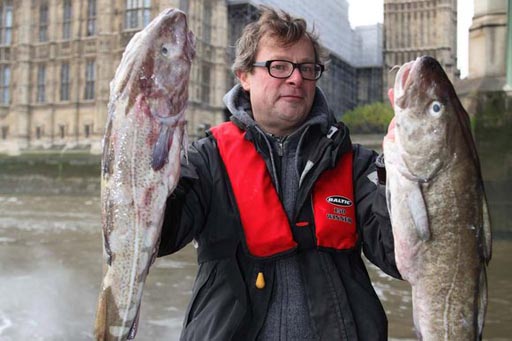
For the time being, though, they can revel in laudatory headlines from idiot chefs (one pictured above), who will be long gone by the time the effects of their stupidity become apparent.

COMMENT THREAD
Wednesday, February 06, 2013

EU politics: the soft centre at the heart of darkness


CoE 006-gay.JPG

Yesterday's vote on gay marriage brings to light to the knowledgeable (which excludes the majority of MPs) the extraordinary role of that little-known institution, the Council of Europe (CoE), and the role of a scarcely known mechanism known generically as "soft law".

Looking briefly at the CoE, this is based in Strasbourg, and even to visitors it often attracts little attention. Apart from the fact that it has a better staff restaurant – and some useful overspill facilities - we didn't take a great deal of notice of it when we were in Strasbourg. Even though it was connected to the European Parliament by a bridge, and we often passed through it on the way to our offices, it was just "there", a relic of the past, of little importance.

To look at it in that way was and in a mistake. The Council of Europe (CoE), bearing the same ring of stars which was later stolen by the European Union, is a powerful institution in its own right. Its problem is that it is entirely under the shadow of the EU, but it should not be underestimated. It acts in a very different and much more subtle (i.e., less visible) way.

For a start, the Council of Europe, itself a treaty organisation, is a treaty factory, having brokered 214 treaties including its founding statute which came into force on 3 August 1949. 

What might surprise people, as well as the sheer number, is the breadth of these treaties. In additional to the Convention for the Protection of Human Rights and Fundamental Freedoms – to give it its full title - (and its various protocols) we have such things as the European Convention on Social and Medical Assistance and the European Agreement on the Abolition of Visas for Refugees.

We also have the European Social Charter, the European Convention on the Control of the Acquisition and Possession of Firearms by Individuals, the European Convention for the Protection of Animals for Slaughter, and even the European Agreement on the Restriction of the Use of certain Detergents in Washing and Cleaning Products.

More recently, we have the Council of Europe Convention on Laundering, Search, Seizure and Confiscation of the Proceeds from Crime and on the Financing of Terrorism, the Council of Europe Convention on preventing and combating violence against women and domestic violence, the Council of Europe Convention on the counterfeiting of medical products and similar crimes involving threats to public health, and the European Landscape Convention.

Careful study of the list, and an examination of the recitals of many EU directives indicates that much of the EU law, about which we and our politicians complain, owes its origin to Council of Europe treaties and their protocols. Perversely, even if we left the EU, we would be bound by many provisions which cause friction, unless we also abrogated many of the CoE treaties.

But, to cast the reach of the CoE (or the EU for that matter) simply in terms of its treaties and (in the case of the EU) its formal laws, is entirely to miscast the way the international system works. What is emerging as the system matures and become more complex is a phenomenon – well known to international lawyers as "soft law", which is increasingly dominating our lives.

The EU agency Eurofound defines soft law as is "the term applied to EU measures, such as guidelines, declarations and opinions, which, in contrast to directives, regulations and decisions, are not binding on those to whom they are addressed".

Despite that lack of legally binding effect, says Eurofound, soft law may impact on policy development and practice precisely by reason of its lack of legal effect – rather, because it exercises an informal "soft" influence. Member States and other actors may undertake voluntarily to do what they are less willing to do if legally obligated. Soft law, therefore, is sometimes presented as a more flexible instrument in achieving policy objectives.

In the CoE context, it was Recommendation CM/Rec(2010)5 which has cast as "soft law" by the European Parliament Directorate-General for Internal Policies, which nevertheless called it "a significant soft law commitment on rights of LGBT persons". The EU Agency for Fundamental Rights(FRA) thought the recommendation provided "useful guidance" to EU Member States for improving the respect, protection and promotion of LGBT rights.

While soft law may not be legally binding, it often creates powerful political pressure, to the extent that it can become politically binding, in a sense. To read through the background to Recommendation CM/Rec(2010)5 tells its own story, giving a strong impression of this being the tip of the spear, with a huge momentum behind it.

As to its effect on Mr Cameron, I am warming to the view that the Recommendation was indeed pivotal in bringing the gay marriage to Parliament yesterday.

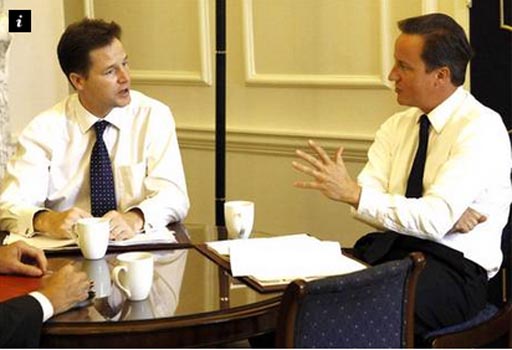
Looking at the sequence of events, we have already established that there was no intent to introduce homosexual marriage in the coalition work programme of June 2010 and we can see from the media record that, as late as September 2010, Cameron was in talks with his deputy prime minister (pictured below), having refused to consider same-sex marriages.

Inde 006-cle.jpg

Then, in December 2010, we see new that gay rights campaigners planning to file a case with the European Court of Human Rights as part of an "Equal Love campaign", arguing that they are being discriminated against because of their sexual orientation.

Then, strengthening the effect of Recommendation CM/Rec(2010), we start seeing numerous instances throughout Europe where it is being considered an exemplar or amplifier of Article 8 of the ECHR (right to a family life).

Politically, this placed Mr Cameron in an incredibly weak position, as he had committed in opposition to scrapping the Human Rights Act. Now, potentially, he was facing an dangerous challenge from the ECHR which could force him to overturn his policy on gay marriage.  The political effects of that could have been devastating.

Thus we see, in March 2011 the government for the first time giving a commitment to implementing Recommendation CM/Rec(2010)5, the outcome of which meant that Cameron had to introduce homosexual marriage.

Making a virtue out of a necessity, he thus made implementing the Recommendation the centrepiece of the British Chairmanship of the Committee of Ministers, at the Council of Europe. And the rest, as they say, is history.

In all this of course, no one can put their hand on a law or other directive, which forced Mr Cameron to introduce homosexual marriage. But the sequence of events, and the circumstances, provide powerful evidence that the "soft law" of Recommendation CM/Rec(2010)5 was indeed the "tip of the spear" which backed him into a corner, driving him to put his signature on a new Bill.

Soft law indeed it may be, the soft centre at the heart of darkness, but just because it is "soft" doesn't mean it doesn't work. A smothering pillow is soft, especially when compared with the casing of a bullet, but it can be just as deadly.

COMMENT: "GAY MARRIAGE" THREAD

UK politics: a contrast in priorities


Parl 030-deb.jpg

Last month's debate on "Europe", led by William Hague, seen addressing the opposition benches.

Commons 006-gay.jpg

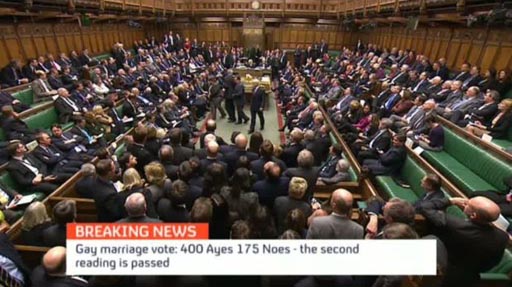
Last night's debate on "gays" ... the difference being, of course, that there was a vote.  MPs are allowed (nay, encouraged) to vote on whether homosexuals can call themselves married, but not on who governs us - even the idea of a debate being actively discouraged for causing "uncertainty". 

Little did they know it though, the MPs were actually voting to implement Council of Europe  Recommendation CM/Rec(2010)5, to fulfil a commitment made by HM Government last year, while holding the Chairmanship of the Committee of Ministers.

Completely unaware of the real reason for their presence, they were led by the nose, oblivious to the fact that the same "debates" have been taking place all over Europe, to exactly the same agenda.

EU politics: back to Brussels where "real" men and women are


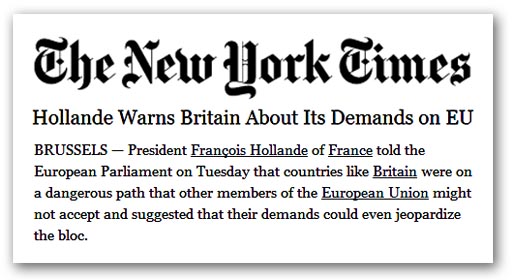
NYT 005-hol.jpg

While most of the British legacy covers the mighty British Parliament descending to the level of considering whether persons of the same sex can call themselves "married", papers such as theNew York Times are covering other aspects of the British decline.

To be fair – although I don't see why - the loss-making Guardian is also covering the territory, telling us that French President François Hollande is doing what French presidents do best – making life impossible for the Rosbifs over the EU budget. 

Actually, one need not get too excited about this. Hollande was in Strasbourg speaking to the European Parliament on his home turf – and it would be too much to allow a little thing like an impending European Council to have a dampening effect on his speeches. "Diplomacy", it appears, is for little people. 

For what it is worth, Hollande is playing his usual tune: the EU "is more than a marketplace" and France would oppose British proposals for deep cuts to the budget, as he doesn't want his farmers rioting in the streets of Paris (I made that last bit up, of course). 

Meanwhile, some Dutch MPs are getting deliciously uppity, with CDA leader Sybrand Buma demanding of Prime Minister Rutte that his government claw back some powers from Brussels. 

To judge from Burma's list, he's just as clueless as Cameron – but perhaps also more realistic. He's purely for the repeal of modification of some directives, which would not need treaty revision. But some of the legislation is implementing international standards, so he's barking up the wrong tree. 

All this, though, is only "noises off", with the main action reserved for Thursday when Van Rompuy reveals his very bestist and absolutely final master plan which is going miraculously to break the logjam and have the "colleagues" leaping to their feet in admiration, breaking into a rendition of "Ode to Joy".

Failing that, Mr Hollande's farm subsidies are toast, which means he probably will be as well, which mean that he had to get is barbs into the Robifs just to cover his back. 

Perhaps if our MPs could tear themselves away from "gay marriage" for a few moments, they might actually notice something of what is going on, but since they can't do anything about it anyway, they might just as well make long speeches about gays bedding each other, and let the grown-ups get on with the real work. 

The big joke, of course, was that the grown-ups weren't at work today anyway. Staff of the EU institutions were on strike yesterday over proposed cuts in pay and conditions. The aim of the strike,we were told, was to send a message to the heads of state and government that "real" men and women work for the EU. 

That, at least, is some relief. Presumably, we can assume that there will be no pressure for gay marriages in the European Quarter of Brussels. 

COMMENT THREAD

Tuesday, February 05, 2013

EU politics: gay marriage – required by "Europe"

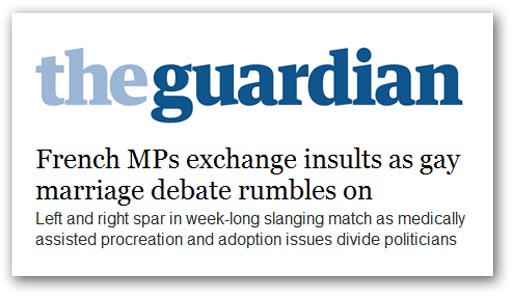
Guardian 005-gay.jpg

Acute observers have noticed that David Cameron is not alone in his obsession with homosexual marriage, with the French National Assembly last week having approved the most important article of a bill to legalise same-sex marriage, and the political fall-out continuing (above).

Same-sex marriage has already been legalised the Netherlands, by Norway and in Germany, where the constitutional court has recently strengthened the rights of homosexual couples, giving them a same tax benefit as heterosexual married couples. That country, rather like Britain, is currently "mired in an escalating debate on the status of homosexual partnerships".

Given the Europe-wide interest, which also includes Spain, Belgium, Sweden, Portugal, Iceland and Denmark, it is not untoward to ask whether there is an EU dimension in all this. The answer is "not directly". There is, however, a very strong "European" dimension and a UK link. But to find it you have to go not to Brussels but to Strasbourg and the Council of Europe (CoE). 

Home 004-coe.jpg

The clue is in the tidied-up screen grab above, where the Home Office tells us of the Council of Europe and its work, which "includes promoting gender equality and more recently lesbian, gay, bisexual and transgender (LGB&T) equality".

There also we find that United Kingdom assumed the Chairmanship of the Committee of Ministers of the Council of Europe for six months from 7 November 2011 to 14 May 2012, whence we cut to the statement of priorities for the UK chairmanship, in which Minister for Europe David Lidington declares:
… the Government has repeatedly made it clear that human rights are central to its foreign policy. We aim to be an example of a society that upholds human rights and democracy, and we are committed to strengthening the rules based international system.
For the detail of those fine aspirations, one has to go to the formal statement, where the preamble tells us:
The United Kingdom is proud to be assuming the Chairmanship of the Committee of Ministers of the Council of Europe from 7 November 2011. As a founder member of the organisation and the first country to ratify the European Convention on Human Rights, the UK takes the responsibility of the Chairmanship, which it last held in 1993, very seriously. We see it as an opportunity for the UK to play a leading role in the vital work of the Council of Europe in promoting rights, democracy and rule of law across the continent.
Within this, we then find that the "overarching theme" of the Chairmanship was "the promotion and protection of human rights", with a "particular focus" on developing practical measures in a number of areas, one of which (of six) was, "combating discrimination on the grounds of sexual orientation and gender identity".

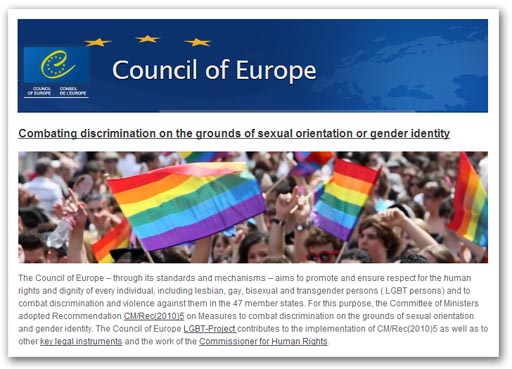
Coe 005-lgb.jpg

Meanwhile, things had already been warming up in Strasbourg, which now has its own dedicated LGBT project. On 31 March 2010, this had got accepted "Recommendation CM/Rec(2010)5 of the Committee of Ministers to member states on measures to combat discrimination on grounds of sexual orientation or gender identity".

Amongst other things, it referred to the ECHR and "other international jurisdictions", which "consider sexual orientation a prohibited ground for discrimination and have contributed to the advancement of the protection of the rights of transgender persons", and then recommended members (including the UK) to:
1. examine existing legislative and other measures, keep them under review, and collect and analyse relevant data, in order to monitor and redress any direct or indirect discrimination on grounds of sexual orientation or gender identity; and

2. ensure that legislative and other measures are adopted and effectively implemented to combat discrimination on grounds of sexual orientation or gender identity, to ensure respect for the human rights of lesbian, gay, bisexual and transgender persons and to promote tolerance towards them;
This is not quite the smoking gun, but this is to be found in the same document, viz:
23. Where national legislation confers rights and obligations on unmarried couples, member states should ensure that it applies in a non-discriminatory way to both same-sex and different-sex couples, including with respect to survivor's pension benefits and tenancy rights.

24. Where national legislation recognises registered same-sex partnerships, member states should seek to ensure that their legal status and their rights and obligations are equivalent to those of heterosexual couples in a comparable situation.
Although these were framed as "recommendations", they were headed "Right to respect for private and family life", which makes them, effectively, the CoE official interpretation of Article 8 of the ECHR. To all intents and purposes, it has the effect of treaty law – certainly as far as the UK is concerned. 

The EU Agency for Fundamental Rights (FRA) thought that the Recommendation provided "useful guidance" to EU Member States for improving the respect, protection and promotion of LGBT rights.

The LGBT lobby in the Council of Europe, however – which had acquired its own website was also able to invoke Protocol 12, explained in detail here, which set out in Article 1&2, that:
1 The enjoyment of any right set forth by law shall be secured without discrimination on any ground such as sex, race, colour, language, religion, political or other opinion, national or social origin, association with a national minority, property, birth or other status.

2 No one shall be discriminated against by any public authority on any ground such as those mentioned in paragraph 1.
This effectively, by solemn international treaty, requires parties to permit same-sex marriage, with all the attendant legal rights afforded to heterosexual couples.

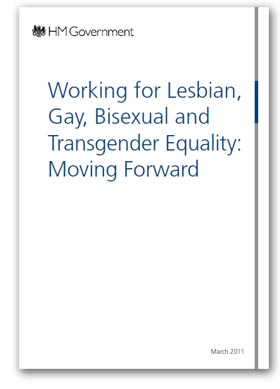
HMG 005-lgb.jpgOn the UK front, homosexual marriage was not on the coalition work programme published in June 2010, and it did not - as a formal or even published government aspiration, pre-date Recommendation CM/Rec(2010)5.

Even by the end of of 2010, there was no publicly expressed expectation of imminent legislation on same-sex marriage, with campaigners instead planning on launching a legal challenge in the ECHR.

It was not until March 2011, in anticipation of the UK's Chairmanship of the CoE in November 2011, that HM Government then published a report, "Working for Lesbian, Gay, Bisexual and Transgender Equality: Moving Forward" (cover pictured right). 

There, on page 12, doffing a cap at Protocol 12 and, specifically, to implement  Recommendation CM/Rec(2010)5, was a commitment to, "work with all those who have an interest in equal civil marriage and partnerships, on how legislation can develop". 

The actual "smoking gun" was on Page 14, with a commitment to:
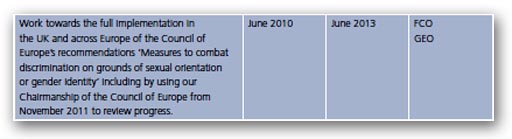
Work towards the full implementation in the UK and across Europe of the Council of Europe's recommendations 'Measures to combat discrimination on grounds of sexual orientation or gender identity' including by using our Chairmanship of the Council of Europe from November 2011 to review progress.
This, naked in tooth and claw (to coin a phrase) is Recommendation CM/Rec(2010)5 and the timetable set for "full implementation" in June 2013, with responsibility delegated jointly to the Foreign Office and Government Equalities Offices (see below). And why is the FCO involved? That is because it involves international commitments via the CoE. 

LGBTE 004-coe.jpg

And that is the real reason as to why Mr Cameron has invested so much political capital in the cause of "gay marriage". Although we have not ratified Protocol 12, we have accepted unconditionally Recommendation CM/Rec(2010)5, and undertaken to implement it by June 2013.

Having made that commitment for the Chairmanship of the CoE, Mr Cameron has no choice but to see it through. In June, there is another Committee of Ministers to consider a report on the implementation of the Recommendation, when he is to be called to account for his earlier commitment.

Mr Cameron has no intention of disappointing his LGBT colleagues in Europe.  Being the good European that he is, he will do what it takes to get his Bill through Westminister.

COMMENT THREAD

Fisheries policy: time to calm the rhetoric


Quantus.jpg

When Booker and I started working together back in 1992, we spent a lot of time on agriculture and fishing, these being the victims of the two most fully-developed EU policies – and the most catastrophic. 

Part of our reasoning was that these industries were the "canaries down the mine". What happened to them could be taken as an example and a warning of what was to happen to the rest of us.

What I certainly didn't bargain for, more than 20 years later, was how completely the two industries would disappear from the popular media, so much so that the depredations of the EU would seem like history, unattached to current reality, while contemporary hacks and politicians would know next to nothing of the background.

Reflecting the almost complete lack of understanding of the fishing industry is the tendency in any fishing dispute to "fly the flag", as in the current "Mackeral War", supporting our own against the "johnny foreigner" - the Faroese and the Icelanders.

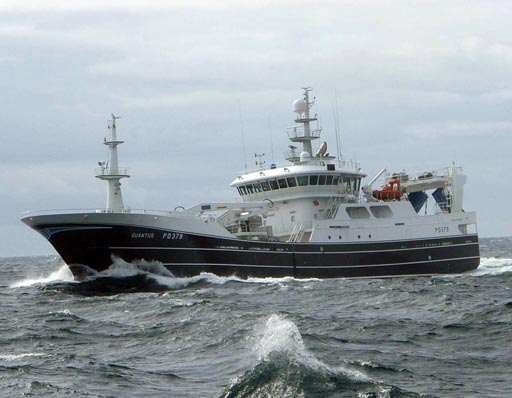
In so doing, however, this is standing up for the Scottish pelagic fleet which, contrary to the image of the hard-pressed, struggling fishermen, is a tiny exclusive "club" of multi-millionaire owners, running modern, 2,000-ton plus, super-trawlers, with starting prices of £20 million.

This is also an industry writ through with criminality, of which last year's "black fish scandal" is reckoned to be only the tip of the iceberg, where thousands of tons of illegally caught herring and mackerel were landed, at a value variously estimated at up to £100 million.

Record 004-wha.jpg

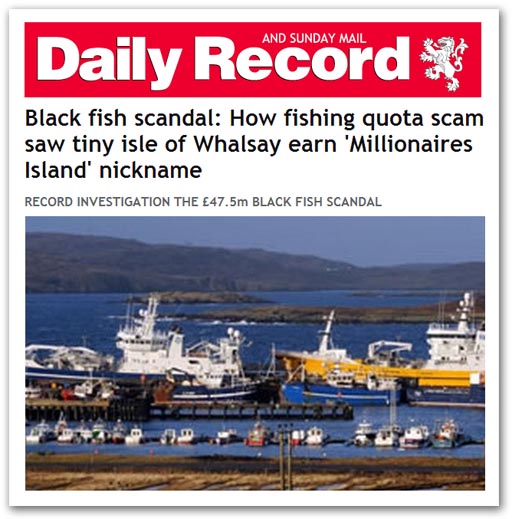
Then, 17 skippers, mostly from the Shetland island of Whalsey admitted to specimen charges, covering the landing of illegal catches worth £47.5 million, after living lives of luxury, splashing out on "holiday homes and flash cars".

This is an industry driven by greed, and one which, unlike the whitefish fleet, has profited hugely from the EU's Common Fisheries Policy (CFP). Unsurprisingly the Scottish Pelagic Fishermen's Association (SPFA) with its 27 member vessels has been vocal in its support of the EU, even while the rest of the fleet has been driven into bankruptcy.

Multi-millionaire Association Chairman, Alex Wiseman, and co-owner of Kings Cross pelagic vessel, weeps tears for The Sunday Telegraph. "This is our way of life, and if you suddenly tell us we can only catch a small fraction of what we previously relied on, then you will kill us all off", he says. "People won't go bankrupt overnight, but they will sell up, and businesses owned by the same family for generations will fold. It's really frightening".

Yet Wiseman was one of the 17 skippers successfully prosecuted in the "black fish" fraud, a highly sophisticated operation that involved not just the skippers of Shetland and north east pelagic trawlers, but the vessel's agents and the fish factory itself, described by presiding judge Lord Turnbull as "an episode of shame" for the industry.

The pelagic industry generally has also been guilty of the notorious practice of high grading, discarding hundreds of thousands of tons of fish to optimise the value of the catches brought back to port. 

This is a practice that is supposed to have been banned, but is still routinely carried out on a colossal scale. White fish skippers fishing three hours steaming North West of the Butt of Lewis, in an area called the Horse Shoe, and the Sulesger Bank, are currently reporting major problems. Some have struggled for 10-12 hours to retrieve nets after scooping up tons of rotting mackerel from the sea bed, dumped by pelagic boats. Others have lost their bag ends altogether.

But, despite landing record catches, with the value of fish landed in Shetland increasing to a new record of over £90 million during 2011 and records set in Peterhead, the pelagic skippers still want more. Theirs is the industry which is the most voluble in demanding sanctions against the Faroe Islands and Iceland, despite the potential adverse effects on the British fish-processing industry.

In thrall to this tiny, but wealthy sector of the Scotish fishing industry, we have thus seen Scottish fisheries minister Richard Lochhead picking up the call for sanctions, even though the predatory behaviour of Norway and the EU renders their imposition problematical, to the point where they could hardly be applied.

One also needs to remember that, at the heart of the Mackerel dispute is the fact that these fish have moved north into Icelandic and Faroese waters. The effects of this were spelled out yesterday in the Irish Times. There,  Sigurgeir Thorgeirsson, Iceland's chief fisheries negotiator spoke of some 1.5 million tons of mackerel moving into his country's waters last summer, consuming an estimated three million tons of food.

"We have quite a greedy guest in our coastal zone", says Thorgeirsson. "A six-year-old mackerel arrives weighing 300g and its weight rises to 500g from eating krill, crustacea, herring and even sand eel". The mackerel invasion is even being blamed for a marked decline in the number of seabirds, including the much-loved puffin.

Thus, the Icelandic and Faroese governments both maintain that catching mackerel in their coastal zones is vitally necessary to restore the ecological balance. But such is the greed of the Scottish pelagic fishermen that they would have these countries, which depend on their fishing industries, prohibited from fishing in their own waters, so that they can maintain their own quotas.

From a broader perspective, in terms of jobs and value, the processing industry, with considerable capacity in Grimsby, is worth far more to us than a few wealthy Scottish boat owners. But, if they need to keep up the repayments on their over-sized boats, the best option is for their beloved EU to negotiate a share of the Faroese and Icelandic quotas.

If they are to have any chance of that, however, ministers would be best off calming down their rhetoric, and recognising that the Scottish pelagic fleet is not the centre of the universe. The Faroese and Icelanders have right on their side – and their track-record should tell ministers that they do not give in to bullies.

COMMENT THREAD

Monday, February 04, 2013

Media: plumbing the depths


Mail 004-ric.jpg


Quite a jolly story about Richard III in the Daily Mail, but one is a little perturbed to find he was buried "in a grave around 680 metres (2,231 feet) below ground level". How on earth (to coin a phrase) did they find him?

Actually, I think this is the curse of metric again. The word "metres" seems to have the effect of switching off that part of the brain that records measurement, so that numbers become totally meaningless. Or perhaps it was because the skeleton had its feet missing, so they had to replace them with metres.

Interestingly, the Mail also runs a piece by the same author (Damien Gayle) about finding signs of life buried beneath the West Antarctic ice sheet. The depth is put at "HALF A MILE" (in caps), and is instantly recognisable.

If the other story had had Richard III buried half a mile deep (close), Gayle would instantly have seen it to have been nonsense. And, amusingly, in the Antarctic piece, he talks about water being blasted in at "fifty gallons a minute" – equivalent to 800 glasses of water. Clearly, he needs to be sent to a re-education camp.

COMMENT THREAD

Huhne pleads guilty


Mirror 003-huh.jpg

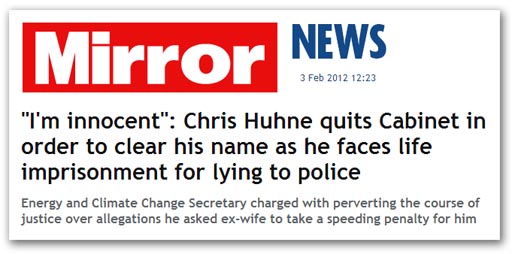
Flashback to 4 February 2012 - exactly a year to the day ... Huhne is cited in the Mirror, calling the Crown Prosecution Service's decision to press charges "deeply regrettable". He stressed that he would be staying on as an MP, declaring: "I am innocent of these charges and I intend to fight them in the courts and I am confident a jury will agree".  

Presumably, they'll bang him up, now that he is a self-admitted liar. The maximum sentence for perverting the course of justice is life imprisonment, which is not long enough for this man. But then, this offence does not necessarily mean that the offender does time. A suspended sentence and community service is a possibility. But at least he's resigned from parliament. I wonder which euro-consultancy he'll get.

And now we have a "louse and flea" by-election.

EU politics: simply not true


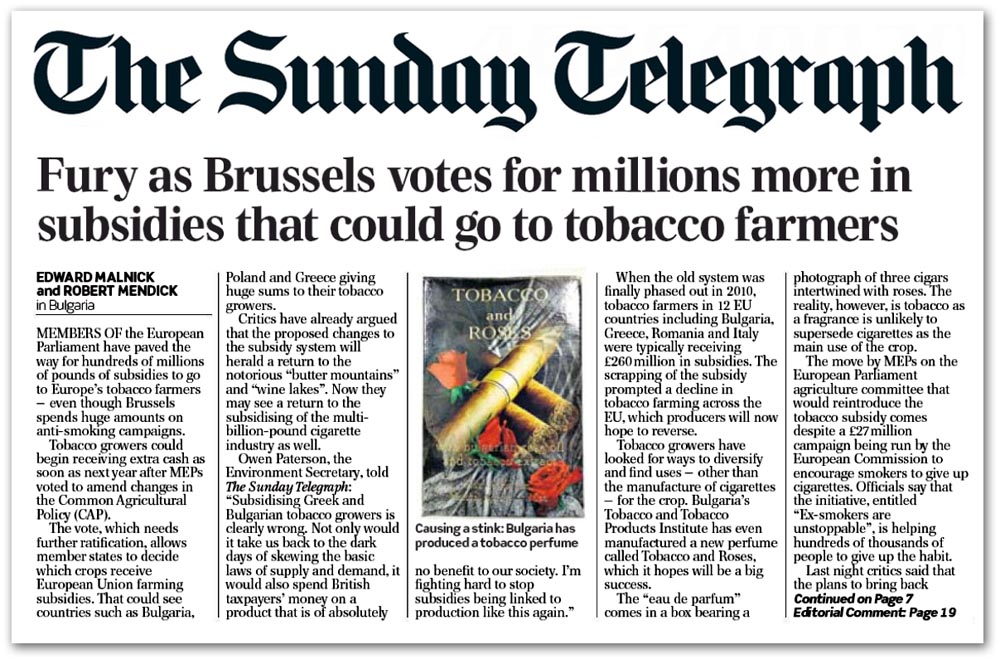
Tel 003-tob.jpg

"Members of the European Parliament have paved the way for hundreds of millions of pounds of subsidies to go to Europe's tobacco farmers — even though Brussels spends huge amounts on anti-smoking campaigns", write Edward Malnick and Robert Mendick for the Sunday Telegraph.

However, this is a carry-over story from last week, when Andrew Gilligan wrongly asserted that the European Parliament agriculture committee had "passed" reform provisions for the CAP – one of which was the restoration of tobacco subsidies. 

This latter claim is being attributed to Owen Paterson, who is concerned that there is pressure in the Council of Ministers to reinstate production subsidies, reversing the so-called MacSharry reforms. He fears that, with the European Parliament offers amendments to like effect, a combination of Parliament and Council could overturn the Commission's proposals, and set the CAP back two decades. 

He thus condemns the amendments as "disappointing, retrograde, backward-looking" and in some respects "ludicrous", but it is a very far cry from there, to claim, as Malnick and Mendick have done this week, that MEPs have "voted to amend changes in the Common Agricultural Policy".

To claim this is simply wrong, but that two weeks running the Sunday Telegraph has published exactly the same erroneous claim tells you a great deal about its journalists, their research capabilities and their concern for the truth. 

What the journalists have done is mistake the procedural role of the European Parliament agricultural committee, where on behalf of the Conference of Presidents, it has approved the tabling of amendments to be considered and voted on by the full Parliament, in plenary session – probably some time in March. 

There is a huge difference between this procedural function and the approval process. The committee itself has no powers to approve or reject amendments tabled. It simply acts as a processing body, to present them to the Plenary for a full vote. It is the full parliament that then approves or otherwise the amendments and, as we pointed out last week, there are still many hurdles before any amendment becomes policy. 

In fact, most amendments are rejected at the first reading. As here, they are usually grandstanding by MEPs for domestic purposes, to show their constituents that they have been active on their behalf. Each amendment is worth a press release, with the hope of favourable headlines back home. 

With these proposals, though, there is an additional hurdle, the EU budget. With agreement stillevading EU leaders, that is a considerable problem. If the funding is not there, the entire proposals will have to be withdrawn and rewritten by the European Commission. 

That deal has to be reached by Thursday, so we will know pretty soon whether there is another crisis in the offing. 

In the meantime, the Sunday Telegraph insists on parading its ignorance, adding to its errors with aneditorial telling us that it is "puzzling" that "the EU's representatives should even be considering reintroducing financial support for the growing of tobacco, which was withdrawn in 2004".

Bizarrely, the editorial ventures that, "It is possible that the MEPs who voted in favour of the amendment were not fully aware of what they were doing", when in fact no MEPs have yet had an opportunity to vote on the amendment. The people who are not aware of what they are doing, it seems, are Telegraph journalists. 

COMMENT THREAD