Showing posts sorted by relevance for query No land no hope. Sort by date Show all posts

Saturday, January 29, 2005

No means no… maybe!

Under the header, "No! No! No!", redolent of Thatcher’s famous Commons speech when she denounced Delors’ megalomania, the Telegraph leader rejoices at the results of its YouGov poll showing that the voters would say no to EU constitution by two to one.

The poll details are worth reading, not least because the questioning is quite sophisticated, and shows that – on balance – the "no" vote is firmer than the "yes".

For the Telegraph, it sees good news in that "British voters have lost none of their common sense." With the poll replicating the question that will appear on the ballot paper, it confirms the trend of every recent survey.

The paper accepts that not everyone who expressed a view will be entirely au fait with the details of the constitution, but it argues – rightly in our view – that most people have a fair grasp of what the constitution is about.

They know, for instance, that it transfers more powers to Brussels. They understand that it entrenches many of the things that they already dislike about the EU. And they feel in their bones that they would rather be governed by their own elected representatives, whom they are periodically invited to turf out, than by an unaccountable apparat.

The Telegraph also counters the wishful thinking of the Europhiles – and the commission - who consistently argue that greater familiarity with the constitution will diminish the hostility towards it.

Says the Telegraph, to the extent that people read the document, their disquiet will be vindicated. It notes that, two pages in, they find that "this constitution shall have primacy over the laws of the member states" (Articles I-6). A few lines later, they learn that "member states shall exercise their competence to the extent that the Union ceases to exercise, or chooses no longer to exercise, its competence" (I-12).

Next comes an enormous list of areas where Brussels is to have jurisdiction: transport, energy, public health, employment, social policy, immigration, asylum, justice, home affairs, trade, competition, agriculture, fisheries, foreign affairs and defence (I-13 to I-16). Having read thus far - still no more than four pages into the text - people will doubtless be asking themselves what is left for the nations.
If people will have their fears allayed by reading the document, the Telegraph suggests that there is a simple way to settle the matter: distribute a copy to every household in the land. The Spanish government, to its credit, is sending out copies in advance of its referendum next month. If Tony Blair refuses to do the same, people will draw their own conclusions.

With that, the Telegraph now turns to the "bad news". A "no" vote, it says, will not kill the project. It notes – as we have been saying consistently on this Blog – that large parts of the constitution are already being implemented, before the first ballot has been cast.

The Telegraph identifies the fields of criminal justice and foreign policy, but we would also add defence – which is galloping ahead, and space policy, which has significant ramifications.

And, as we are all now noticing, there is no legal basis for these things, but that does not trouble our Euro-masters in the least. They have never let referendums stand in their way before, and they do not intend to start now.

Tony Blair, the Telegraph concludes, has described the vote as a once-in-a-generation opportunity to settle Britain's relationship with Europe. For once, that is no exaggeration. "If, as we hope," it says, "our poll is eventually borne out, it will not do to make a couple of cosmetic changes and then carry on as before. No means no."

With that, though, there is a growing problem for the "Yes-no" campaign – which is in favour of the European Union but against the constitution. As more and more people look at the constitution, they will see in it things they do not like, but will then be told or learn that they were in the existing treaties.

The problem for the "Yes-nos" is to distinguish between the new and the old, and then to explain why, if the new is so objectionable, why the existing is acceptable. Unless they can answer that, "no" will not mean "no" because, with or without the constitution, the political integration will continue apace, as indeed it is doing at the moment.

Monday, January 01, 2007

No land, no hope, no glory

On 1 January 1999, more than 30,000 people joined a street party in front of the European Central Bank in Frankfurt to celebrate the launch of the euro and the first economic union in Europe since the Roman Empire. A band struck up a stirring tune to mark the historic day. Curiously, it was not Beethoven's "EU Anthem" but Land of Hope and Glory.

Eight years later, with Slovenia's rats joining the sinking ship, how different it all is. There is neither land, nor hope, nor glory and, it seems, even the French are turning against the project.

That much the Sunday Times told us yesterday, with an account of how a French diplomat who spent the festive period at his weekend home in rural France was astonished last week when a man in a DIY shop presented him with a bill in francs, rather than in euros, with the excuse: "I am sorry, monsieur, most of my clients prefer it that way."

Actually, it has never been any different, so I don't know where this "French diplomat" has been. Ever since the introduction of notes and coins on 1 January 2002, French shops have continued with dual pricing and, in some instances, show the prices only in Francs in the shop windows.

Nevertheless, we are told that hostility towards the single currency is growing as a wider malaise over an expanding Europe takes hold, making our diplomat "very pessimistic about the future" – and this blog very happy indeed, especially as the LibĂ©ration newspaper noted in an editorial last week that the euro has been a far cry from the "very great federating power" that Hubert VĂ©drine, the former French Socialist foreign minister, imagined for it.

"It has not had the effect of an integration lever that its founding fathers dreamt of," the paper wrote. "At a time when the European project has broken down ... you have to be a Slovene to feel any enthusiasm about joining the eurozone."

In another editorial today, the writer notes that it is the three that stayed out — Britain, Denmark and Sweden — that have prospered. In Britain, public opinion is granite hard for sterling, to the extent that no serious politician proposes joining the EU currency, and the lobby group set up to campaign for it has folded (only to be replaced with Open Europe).

And, with the advocates having concentrated on claiming that monetary union was inevitable, they are now on a loser. Remove the sense of inevitability and the entire construct collapses, says the paper. Yet that fool – albeit a dangerous fool – Geoff Hoon is saying that Britain will have to reach a compromise with the 18 EU member states that have already ratified the constitution.

That's the thing about these Europhiles – even when their beloved construct is in its grave, and rotting flesh is peeling from its carcase, they will still be mooning over it... necrophiliacs, one and all, they are.

COMMENT THREAD

Saturday, April 13, 2013

EU politics: nothing worth cheering about


Munich agreement 3.jpg

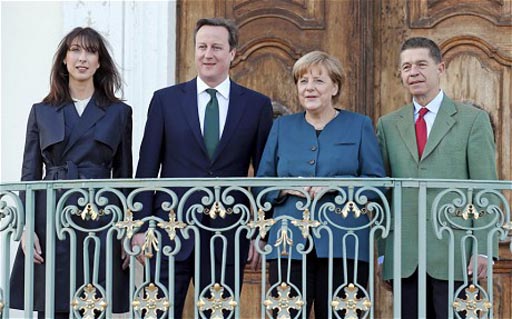
One might have thought that, if Mr Cameron's weekend jolly to Frau Merkel's schloss was at all important, the German press would have been all over it. But as far as I can see, only Die Ziet is taking it seriously enough to offer a report.

Reading the report, you can see why so few bothered. It is an amalgam of the same old, same old: the British prime minister wants Angela Merkel's support for EU reform but, as always, is at pains to assure the German chancellor that the Britain will continue to participate fully in Europe and has no intention of leaving the EU. 

Whatever is agreed at this meeting, you can bet your sweet life that there will be no crowds waiting at the airport for Mr Cameron's return. There would be little point in his waving a piece of paper – nobody is in the least bit interested. 

Actually, I tell a lie. Andrea Leadsom MP is brown-nosing in the loss-making Guardian, burbling about "eurosceptics" in the Conservative party being "willing to compromise over their demands for European Union reform". There is no one in the party, she says, who wanted Cameron to "lay down the law" to Britain's EU partners and that compromise was "essential".

Elsewhere, we get a report that the Tories are planning to build a "secret alliance" with the AFD. Given that this new German group is pro-EU and anti the euro, it fits exactly with the official Tory view. 

All these less than scintillating developments are doing, therefore, are reinforcing the europhile credentials of David Cameron, who seems to have abandoned any attempt to woo the outers, and is thus no longer concerned to capture the lost ground from UKIP. 

That much in itself is something of a development. In the past, Tory leaders at least used to pretend that they wanted the eurosceptic vote. But now, Cameron seems not to be concerned in the slightest that his party is haemorrhaging support, even to the extent seemingly being prepared to throw away the coming local elections. 

In truth, though, there is very little Cameron can do. Despite comments to the contrary, Die Zeitmakes it very clear that Merkel will not countenance a treaty renegotiation, and nor will she consider treaty amendments until her re-election is safely in the bag – should that happen. 

Thus, says this paper, Cameron's only real option is to put a "yes/no" referendum to the country, without first having sought treaty revisions. And since there is no chance of him even considering that, he is left with the wholly unconvincing ritual of talks with European leaders about reforms that are never going to happen. 

Missing from the feast, of course, is Ed Miliband. The earlier presumption that he would follow in the path of Mr Cameron has not materialised. There is no sign at all that he is prepared to commit to an EU referendum. 

Munich agreement 2.jpg

Perversely, it is almost exactly 25 years from Margaret Thatcher's Bruges speech, and 75 years since the Munich agreement, when Chamberlain returned to Heston Airport to wave his infamous piece of paper, neither of which anniversary of our former prime minister lived to see.

Thus do we return to a strange no-man's land, where the actuality of a referendum is receding and the "Europe" issue is still no closer to a resolution. Let us hope that we do not have to wait for the hundredth anniversary of Munich before we see a prime minister returning from a meeting with a German chancellor with a piece of paper worth cheering about.

COMMENT THREAD

Monday, October 22, 2007

Government by consent

How particularly apt it was for Philip Johnston in The Telegraph this morning to cite Thomas Rainsborough MP:

I think that the poorest he that is in England hath a life to live, as the greatest he… I think it's clear, that every man that is to live under a government ought first by his own consent to put himself under that government; and I do think that the poorest man in England is not bound in a strict sense to that government that he hath not had a voice to put himself under…
Johnston's piece, headed, "Beware, constitutions can change your life," goes right to the heart of the matter, stating boldly, "The controversy over whether the EU treaty is really a constitution by another name misses the point. This is not an argument about Europe's constitution; it is about ours." He then goes on to argue that:

…the transfer of power and sovereignty over the past 40 years has transformed what Walter Bagehot called the "great entity" of the British constitution, characterised over hundreds of years by its continuity and simplicity. It is often said that we have no written constitution. We do. It is contained in dozens of statutes but has never been codified into a single document.

This is a subject whose importance is too easily ignored. It seems as dry as dust, arcana of interest only to political anoraks or academics. Yet it goes to the heart of who we are as a nation. It defines our liberties and the relationship between people and the state, the governed and the government.
The man is dead right and, in agreeing to subsume the very heart of our constitution to the European Union, Brown has torn asunder the basic fabric of that constitution. Already damaged by the Treaty of Rome and successive treaties, with this current treaty, it is no more.

And that, dear readers, brings us to the "poorest he". This treaty has been agreed by a government with no mandate, no permission, no authority, no consent, transferring the powers of our government to an alien entity in Brussels. Thus, to paraphrase Rainsborough, "we hath not had a voice to put ourselves under".

That being the case, we "are not bound in a strict sense" to this government. It is not our government. It acts without our consent. To it we owe no loyalty, no obligations and no duties, only those which it can extort from us by dint of the brutal force which underwrites the power of the State. But that which we give is not given willingly, or at all, other than under the threat of force.

That Brown has no right to do what he is doing is summed up in a short letter from Booker, in the same edition of The Telegraph, who declares that which forms the very basis of our relationship with the state, that "we entrust our liberties to our MPs and expect them in return to do what they promised to do when we elected them". Booker continues:

In fact, the one right our MPs have not got is to give away those "liberties" we entrust to them. For three centuries, it has been central to our constitution (under the Declaration of Right) that power ultimately belongs to the British people. It is only entrusted to MPs for the duration of a Parliament.

Under the law of the land, MPs are not entitled to give away powers that do not belong to them.
And so we move to Roger Bootle, who tells us that "[the] EU treaty threatens economic freedom", this commentator telling us to:

… forget the idea that this treaty is minor and forget the protection afforded by the so-called "red lines". That protection may well not survive the first onslaught in the European courts. What matters is the political will across Europe to forge a European state. As many a European politician has been honest enough to admit, this treaty bears a striking resemblance to the recently abandoned Constitution and as such represents another major step along the road to surrendering national sovereignty altogether. If that result were to emerge, quite apart from the political implications, it would have major economic consequences.
He adds that,

...the danger is that, bit by bit, the considerable economic freedoms we in the UK still enjoy – to regulate the labour market, set taxes and set interest rates – would be eroded and we, along with the rest of the EU, would be governed by a single economic policy.
Bootle thus sum up the essence of the treaty process. The agreement of the document is only the first stage – the pain comes later, as the enemy (aka "colleagues") begin to use the powers so carelessly given to them.

That, in fact, is the worst of it, because one cannot even be sure that Brown and his acolytes even know what they are doing, or have any real idea what they are surrendering. One has this vague idea that our leaders are possessed with some greater knowledge, but this hardly seems to be the case.

There is no better evidence of this than the commentary, again in The Telegraph that Brown's high-profile pledge to find an "extra 500,000 British jobs for British workers", given at the Labour Party conference, is likely to be illegal under European law.

So obviously and transparently is this in breach of EU law (as enshrined in the 1957 Treaty of Rome text) that I do not think we even blogged it at the time – perhaps we should have, although I think we took it as the usual, meaningless rhetoric that one hears at Party conferences.

But, as the House of Commons library (rightly) points out, that European law stipulates that workers from EU member countries must "enjoy equal treatment" when applying for jobs. "Both direct and indirect discrimination against migrant workers from the EU is prohibited," says the library report.

However, time and again we see our rulers (and wannabe rulers – remember Howard on immigration?) who come up with statements of intent, which clearly breach the law of our central government in Brussels, to which they have signed up. It really does make you wonder whether they know what they are doing.

That aside, there is clearly a growing constituency of informed commentators who do understand what the government is doing, and who do appreciate the implications of this new treaty. In that, there is some hope. The intellectual arguments are not going Brown’s way, and there is more than usual unease about his course of action.

That unease must, in due course, be translated into action – not least by the Conservatives, some of whom do realise what is at stake. This current situation is not tenable and, whether the bulk of our population know it or not, we are fighting for the very survival of our nation.

COMMENT THREAD

Sunday, June 18, 2006

How Blair is killing our soldiers


According to the official MoD website, as at 28 May 2006, a total of 113 British Forces personnel have died, or are missing presumed dead, while serving on Operation TELIC since the start of the campaign in March 2003. Of these, 84 are classed as killed in action, including as a result of hostile action.

Of those 84 dead, at least 23 – more than a quarter – have been killed riding or patrolling with unarmoured or lightly armoured "Snatch" Land Rovers, the most common cause of death being the improvised explosive device (IED), better known as the "roadside bomb".


The incidents that I have been able to cull are as follows:

14 August 2003: Two Queens Lancashire Regiment soldiers wounded and one – Captain David Jones – killed in bomb attack on a converted Land Rover military ambulance in Basra.

18 November 2003: MoD spokesman Charlie Mayo reports two man crew of one Land Rover injured in one of four booby trap bomb attacks over previous seven days.

17 April 2004: Two Territorial Army soldiers shot in Basra and another soldier lost a leg when his Land Rover was hit by a rocket-propelled grenade.

18 April 2004: Three PWRR soldiers injured, one seriously, in roadside bomb attack on Land Rover in Amarah.

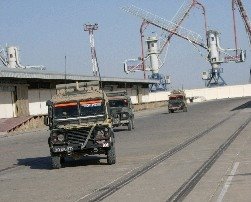
Another Land Rover patrol - note the confined spaces26 April 2004: One soldier injured by roadside bomb attack on six vehicle supply convoy in south east of Basra. Witnesses said the injured soldier was evacuated by helicopter.

28 June 2004: Fusilier Gordon Gentle, 19, from Glasgow, died when a bomb exploded next to his Land Rover in Basra. Two others were injured.

9 August 2004: Five soldiers from Prince of Wales Royal Regiment were injured and one – Private Lee O'Callaghan – was killed in attack on vehicles in Basra. Two Land Rovers were set on fire after militiamen fired rocket-propelled grenades at the patrol.

The aftermath of an attack - note again the confined spaces28 September 2004: Two soldiers – Corporal Marc Taylor, Royal Electrical & Mechanical Engineers, and Gunner David Lawrence, Royal Artillery – killed when military convoy ambushed south-west of Basra. The two soldiers killed had gone to the aid of injured colleagues whose Land Rover was hit by a rocket propelled grenade (RPG).

2 May 2005: One soldier injured and Guardsman Anthony John Wakefield 24, from the 1st Bn Coldstream Guards, killed during routine two vehicle armoured Land Rover patrol in Al Amarah.

29 May 2005: Lance Corporal Alan Brackenbury of The King's Royal Hussars killed from an improvised explosive device in Kahla, near al-Amarah. He was in an armoured Land Rover, one of three vehicles heading to a liaison meeting with representatives of the Iraqi security forces. Four other soldiers were injured in the explosion.

16 July 2005: Two soldiers injured and three killed - Second Lieutenant Richard Shearer, Private Leon Spicer and Private Phillip Hewett - all from the 1st Battalion the Staffordshire Regiment, during three vehicle armoured Land Rover night patrol in suburb of town of Al Amarah, 160 miles north of Basra.

And another burnt-out wreck - and confined spaces, once again5 September 2005: A roadside bomb killed two British soldiers travelling in an armoured Land Rover in southern Iraq. The device exploded as a convoy passed through a mainly Sunni Arab district five miles east of a British army base known as Shaiba. The two dead soldiers were from the 2nd Battalion Royal Regiment of Fusiliers, based in Lisburn, Northern Ireland.

11 September 2005: Three soldiers were injured and Major Matthew Bacon was killed when an Snatch Lanbd Rover was hit by an IED in Basra.

20 November 2005: Four soldiers injured, one very seriously, in bomb attack on routine two vehicle armoured Land Rover patrol in northern Basra. Sergeant John Jones of the 1st Battalion The Royal Regiment of Fusiliers died in the attack.

31 January 2006: Whilst on a routine patrol in Umm Qasr, the vehicle that Corporal Gordon Pritchard was commanding was struck by a roadside bomb; he died instantly. Three other soldiers were injured, one seriously, in the same incident and received medical treatment at Shaibah medical facility.

28 February 2006: Two British soldiers were killed and another injured when their Land Rover was blown up by a roadside bomb while on patrol in the Iraqi town of Amara. The three soldiers were from 2nd Battalion The Parachute Regiment attached to the Royal Scots Dragoon Guards. The improvised explosive device is believed to have been hidden in an abandoned car which exploded when the soldiers passed on routine patrol.

And the all too common tragic result16 April 2006: Lt Richard Palmer, 27, of the Royal Scots Dragoon Guards was killed when his Land Rover was targeted by insurgents using an off-road mine near the town of Ad Dayr. Lt Palmer's unit, which was attached to a Danish battle group, was on vehicle patrol with the Iraqi army when it was attacked.

13 May 2006: Two British soldiers died after a roadside bomb attack in southern Iraq. The soldiers, from the 2nd Battalion Royal Anglian Regiment, were on routine patrol in an armoured Land Rover just outside Basra when the device exploded. The roadside bomb exploded as the patrol approached a bridge just north of Basra. A third soldier was injured in the same incident.

28 May 2006: A British Army patrol from 1st The Queen’s Dragoon Guards (The Welsh Cavalry) was attacked by a roadside bomb in the Al Jezaizah district of North West Basra. The explosion hit an armoured Land Rover patrol on a routine task in support of the Iraqi Security Forces. The incident killed two members from A Squadron: Troop Leader Lieutenant Tom Mildinhall and Lance Corporal Paul Farrelly.

Collectively, the Land Rover incidents are the single most common cause of death for our soldiers in Iraq, yet - in our view - they are largely preventable. In today's Sunday Telegraph, based on research carried out by this blog, Christopher Booker explains why they are allowed to happen.

"One reason why British troops continue to be killed and injured in southern Iraq", he writes, "is that they are expected to patrol in lightly-armoured Land Rovers which give them no protection against roadside bombs and rocket-propelled grenades." He continues:
Meanwhile their American counterparts walk away unscathed, even when their RG31 armoured patrol vehicles are hit by the same explosives, because these are designed to protect them against precisely the same dangers. Yet the Ministry of Defence has not seen fit to equip the British Army with the RG31, even though it is built by a British-owned company.
That self-same RG31 is pictured at the top of this piece – taken at Camp Taqaddum, Iraq on 7 January 2006 by a photographer from the 8th Engineer Support Battalion, 2nd Marine Logistics Group. It is resting on its front axle after an improvised explosive device detonated under the vehicle the day before. The IED detonated directly under the vehicle; however, because the vehicle was an RG-31, the blast was pushed outward instead of straight up due to the unique v-shaped undercarriage. Of the five service members in the vehicle, two received concussions and two others received minor burns.

Before continuing with Booker it has to be said that the government's procurement minister, Lord Drayson, does not agree that the RG31 should be used, or that there is anything wrong with the "Snatch" Land Rover. In the House of Lords on 12 June this year, in response to a question by Lord Astor of Hever, this is what he said:
My Lords, I do not accept that Snatch Land Rovers are not appropriate for the role. We must recognise the difference between protection and survivability. It is important that we have the trade-offs that we need for mobility. The Snatch Land Rover provides us with the mobility and level of protection that we need.

We had 14 RG-31s in Bosnia, which we took out of service some time ago due to difficulties with maintenance. We have looked at the RG-31 alongside a number of alternatives for our current fleet and concluded that the size and profile did not meet our needs. Size is important in the urban environment. The RG-31 cannot access areas that Snatch Land Rovers can get to.
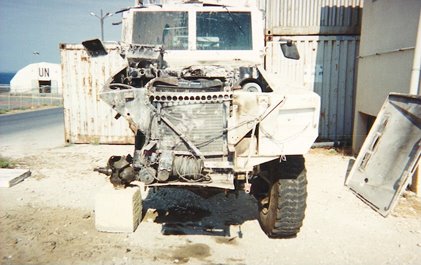
Another survivor - a mine-damaged UN RG31You may accord to Lord Drayson's statement any value you wish but it is germane to note that the vehicle is widely used in the world's trouble-spots, to which effect, one of its enthusiastic users, the United Nations, reports:
The RG-31 "Nyala" mine and bullet-protected vehicle (MPV) with high mobility ease of handling and good crew comfort has been successfully deployed with the UN in Bosnia and Lebanon. It has become the MPV of choice of the UN and other peacekeeping and security forces and is finding favour with nongovernmental organizations requiring vehicle with nonaggressive appearance to protect their personal against the threat of landmines.
More to the point, in addition to the United States which has purchased 148 for use in Iraq, the Canadian forces have bought fifty for use by their detachment in Afghanistan, with an option for another 25, having previously deployed three as part of their contribution to the International Security Assistance Force in Afghanistan.

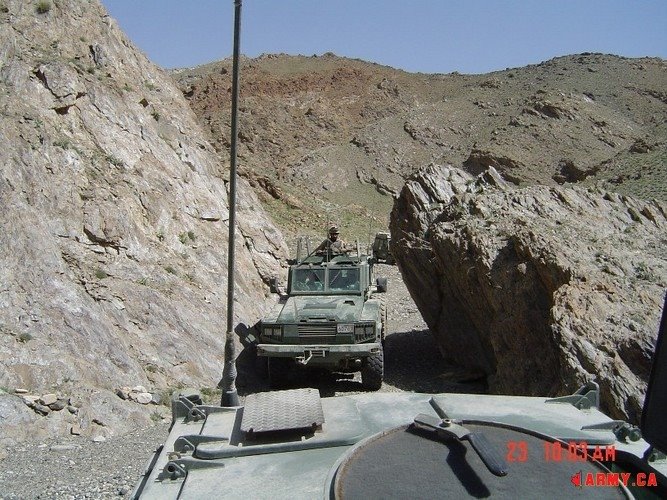
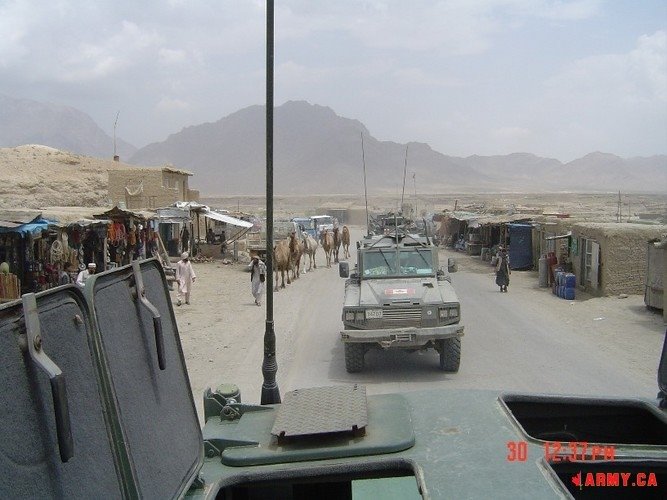
A Canadian RG31 in Afghanistan - and in confined spacesThe vehicle was selected after a tightly-fought contest with other mine protected vehicles and, in the view of one commentator, won the contract because: "Familiarity aside, the RG-31 had advantages that all but ensured victory in the CF's APV contest – proven performance in a range of climates and terrains, relatively small size."

Known variously as the "Mamba" and "Nyala" in Canadian service (the two are, in fact, different although very similar vehicles, the latter being the RG31), it has attracted the enthusiastic plaudits of its users. Says one:
Having spend lots of time in both the Mamba as a Recce Driver on Palladium Roto II and the Nyala as the Engr Recce Sgt on Athena Roto III, I can't think of a more well rounded, safer and rugged vehicle.
and another…
Almost every contingent I worked with would have given their left arm for a Nyala, including those riding around in open top G-wagons. Open top vehicles bristling with weapons are no deterrent or concern to a pressure plate IED or a Spider Device initiated by a Cell Phone or FRS from a safe distance. The only CF Troops in the Kandahar area that require open top soft skins already have them. So if you really want to ride around in one, start doing your application for the farm.
Lord Drayson offers no explanation as to what the "difficulties with maintenance" were, although it is hard to understand why they should have been intractable, since the vehicles used (Mambas) had running trains based on the widely-used Mercedes Benz Unimog and the design employs many readily available commercial parts.

Another Canadian RG31 patrolAs to the importance of size, and Drayson's claim that, "the RG-31 cannot access areas that Snatch Land Rovers can get to," once again you can judge for yourself from the photographs provided. Altogether, we prefer the explanation that the Army is being short-changed, fobbed off with cheap, second-hand Land Rovers, designed for security operations in Northern Ireland and totally unsuited for Iraq.

Returning to Booker, he writes:
This is a small but chilling example of the extraordinary shambles the MoD is making of Britain's defences, thanks not least to the way Tony Blair is trying to pursue two totally contradictory policies at the same time, This has not been properly appreciated because media coverage of defence has become so scrappy that we have lost sight of the overall picture.

We hear, for instance, about prosecutions of British soldiers for supposed "human rights abuses", the abolition of ancient regiments and some of the more ambitious defence projects on which the MoD is spending tens of billions of pounds, such as the Eurofighter or the two giant aircraft carriers planned for the Royal Navy. But no one fits all the pieces of this jigsaw together.

On one hand, as we saw yet again with his recent visit to Washington, Mr Blair tries to keep in with the Americans, by committing thousands of hard-pressed and ill-equipped British troops to fighting the insurgencies in Iraq and Afghanistan. Bush and Blair still like to talk of keeping alive the Joint Strike Fighter project, the last major example of Anglo-US collaboration on military hardware.

On the other, as we saw again with his subsequent visit to President Chirac, Mr Blair has stealthily agreed to Britain playing a key role in the planned European Rapid Reaction Force. For this he and the MoD have been prepared to restructure the British Army, scrapping the old regiments, and to commit colossal sums to buying every kind of European equipment, as well as those giant carriers we are to build with the French. All this is to meet the "Helsinki goals" agreed by EU leaders including Mr Blair in 1999, by which an integrated European defence force is to be brought about.

For the MoD, the top priority has been to get on with meeting those Helsinki commitments, co-ordinated by the European Defence Agency in Brussels, headed by a former senior MoD official Nick Witney, which will enable us to play our part in creating that EU expeditionary force. To this end the MoD has been prepared to spend billions on EU-made missiles, ships, trucks, artillery and armoured vehicles, not to mention a French-led project to build unmanned aircraft which Blair discussed with Chirac earlier this month, following Britain’s withdrawal from a similar joint-project with the US.

But what this has left is a British Army starved of proper resources for its current tasks, so overstretched that it must rely on thousands of territorial soldiers, its morale sapped by the dangerous lack of proper equipment and by the MoD's insistence on enforcing the European Convention on Human Rights in situations to which it was never intended to apply.

The real problem is that all this has been so hidden away behind layers of stealth and deception that no one ever asks any longer that fundamental question: what are our armed forces for? Behind the scenes, the driving force of national policy is to fit us to play our part in building up a European expeditionary force, capable of operating anywhere in the world. But no one can explain the purpose of such a force, for essentially it has only one: to promote the cause of European integration.

This leaves us, in an increasingly darkling world, with forces ill-designed to protect any national British interests. Indeed, so dependent are we now becoming on equipment bought from our EU partners, including our most basic guns and ammunition, that it will soon be inconceivable that we could operate without their consent.

Meanwhile our armed services, which until recently we still prided ourselves on being the most professional in the world, are being asked to perform dangerous tasks, knowing that they no longer have much practical support from a Government bent on exploiting them politically, for purposes they find it increasingly hard to understand.

When the final charge sheet is drawn up against the way Mr Blair governed this country, one of the most damning charges will be the way in which he destroyed its armed forces. Yet the remarkable thing will be how almost nobody at the time noticed it was happening.
Booker's final comment hits the nail on the head. We have tried to get senior Conservative MPs interested in this issue with very little success. And, apart from Booker and The Business, it is proving impossible to get the media interested.

Well, people, this is an opportunity to test the power of the blogs. We have not done this before, but I would ask other blogs to link here and for readers to print off this post and send it to their MPs, with their own comments. This is truly a matter of life and death. Our view is that our troops are being needlessly exposed to danger and they deserve better. We hope you agree.

COMMENT THREAD

Friday, March 11, 2005

Losing faith in Europe

Taking the temperature of the EU constitution debate in Holland, Andrew Browne of The Times has been to Maastricht and finds that the Dutch are losing faith in Europe.

One of the people he interviewed was Frederick Brom, who declared that he was opposed to the EU harmonising everything. "In the EU, everything becomes the same, and that’s a real pity. When I go to France, I want to eat French cheese made by a farmer in his cellar, but with hygiene standards, everything becomes the same."

That is an interesting comment, not least because it transcends political dogma and gets down to the real practical consequences of European integration. To the despair of the Europhiles, who inhabit their own cloud-cuckoo-land of idealism, it is sentiments like this, amongst ordinary people, which I believe are eventually going to bring the "project" down.

Interestingly, my own route to Euroscepticism was driven by a similar sentiment when, as a recently qualified health inspector in 1972 I found that the (then) EEC poultry meat hygiene directive disqualified me from practising the craft for which I had just qualified, making me subordinate to veterinary surgeons, irrespective of whether they had any qualifications in food hygiene – all because there was no equivalent of the British health inspector system on the continent.

Browne calls this "cynicism", which he says has taken root in one of the EU's founding members, although I would call it realism. Nevertheless, he paints a word picture of European flags fluttering in the freezing wind outside the bars. In the marketplace, he writes, shops do brisk business in euros and the monument of metal Euro stars stretches skyward above the slogan: “We must move beyond nation states.”

Maastricht, that small Dutch town on the borders of Belgium and Germany, does of course have special significance in the history of the Union, the town where the treaty that gave birth to the euro was signed. It displays its European credentials proudly.

But, writes Browne, while the symbols remain in place, a strange thing is happening to the people who live here: they are starting to sound Eurosceptic. He cites “a grey-haired woman, as she scuttled along the cobbled pedestrian streets, lined with traditional Dutch gabled houses”, saying: "It's just too bureaucratic, too big. The EU and the people are too far apart... It gets bigger, bigger, bigger."

With the Dutch government having announced that a referendum on the constitution will take place on June 1, in an extraordinary about-turn, such sentiment may mean that he Netherlands may scupper the EU constitution. A recent poll showed that 42 percent of Dutch would choose to vote "no", against 28 per cent who plan to vote "yes", making the Netherlands the only founding member of the EU in which opinion polls suggest that the constitution will be rejected.

Other commentators whom Browne consults include a troupe of actors enjoying a midmorning rest outside a cafĂ© in the main square in Maastricht – just your ordinary, everyday Dutchpersons. Nevertheless, they too have their grievances against the Union. Says Oda Selbos "with flowing red hair": "The euro is a big issue. Everything has doubled in price. When you went to Spain, it was nice to have a different currency. I want to have my guilder back."

Particularly exercising the Dutch is the ratchet of the growth and stability pact, which has forced the government to impose strict controls on public borrowing, causing considerable resentment when German and France seems to be able to break the pact provisions with impunity. This has special resonance as the Dutch are now acutely aware that they are the highest per capita contributors to the community budget.

Voters, Browne tells us, also have concerns about the economic impact of the euro. He talks to Xavier Schilling, an insurance manager, who says: "A lot of people in Holland at first thought the constitution was a good thing. Now they worry because the economy is not doing that well."

There is also widespread opposition to the decision to commence entry negotiations with Turkey. If she joined the EU, this would give 70 million Muslims the right to live and work in Western Europe. These fears are being given voice by the maverick politician Geert Wilders, whose opposition to radical Islam, Turkey and the constitution has propelled him ahead of the Government in the polls. Writes Browne:

In a recent speech in Rotterdam, Mr Wilders said: "The political elite wants to admit Turkey to the Union, an Islamic land of millions, that will have an enormous influence on the federal superstate. Because of the new European constitution, Turkey will have more influence on Dutch legislation than the Netherlands itself. It can't become crazier than this."
As with the UK though, the Hague government is relying on other member states – particularly France and Germany - ratifying the constitution before the voters go to the polls, when they hope their people will feel too isolated to reject it.

But Maurice de Hond, the Netherlands' most prominent pollster, said that the referendum is likely to become a protest vote about the direction of the EU. "People are voting about everything but the constitution," he said. "They are voting about the euro, about the ten new countries, about Turkey, about the Government. Turkey is a big issue and a much clearer issue than the constitution, which they have never read."

Browne concludes with some interesting observations: European leaders are now asking themselves what will happen if a country votes "no", he writes. It is generally accepted that, if France says "no", the constitution is effectively dead; and, if Britain says "no", the UK will have to renegotiate its relationship with the EU.

But what if the Netherlands, always one of its biggest cheerleaders, says "no"? One Dutch politician said: "If Britain rejects the constitution, Britain has a problem. But, if the Netherlands rejects the constitution, then the constitution has a problem."

Thursday, September 08, 2005

Drinks all round, chaps

Commenting on the disgraceful episode of the internet giant Yahoo helping the Chinese authorities convict a dissident journalist, a Telegraph leader goes some way towards making up for the paper’s bad taste on the Garland cartoon.

Yahoo, it writes, stands accused of helping Beijing to send a dissident journalist to prison for 10 years. The company is said to have supplied the authorities with computer records proving that Shi Tao had posted on the internet an internal government document banning the Chinese media from commenting on last year's 15th anniversary of the Tiananmen Square massacre.

It is easy to understand, says the paper, why Yahoo should have wished to co-operate with the Chinese government. The company recently invested some £550 million in the Chinese internet sector. It had its shareholders to consider, as well as its undertakings to abide by Chinese law. It continues:

Why, the company may have asked itself, should Yahoo have felt any duty of confidentiality to an individual customer who was knowingly breaking the law of the land - no matter how offensive that law may appear to Western eyes. From a strictly legalistic point of view, Yahoo may have felt that it had no more duty to protect Mr Shi than to shield a pedlar of child pornography from the consequences of publishing his filth on the internet in Britain.

But the affair still leaves a foul taste in the mouth. The Chinese government is one of the most oppressive regimes on Earth, clinging to power by the ruthless suppression of any sort of dissent. Western companies - and Yahoo is by no means alone in this - have shown themselves much too ready to ingratiate themselves with this odious regime, in the hope of cashing in on the vast Chinese market.
One could remark, rather sourly, that the company is only following to the footsteps of others, who also add hypocrisy to their many sins. Note, for instance, this extract from the joint statement of the 8th EU-China Summit, signed by Tony Blair and Chinese premier Wen Jiabao:

The two sides underlined their commitment to the protection and promotion of human rights and continued to place a high value on the EU-China human rights dialogue. They underlined the importance of concrete steps in the field of human rights and reaffirmed their commitment to further enhance co-operation and exchanges in this field on the basis of equality and mutual respect, while making efforts to achieving more meaningful and positive results on the ground.
It seems, however, that the only "concrete" steps are locking up journalists in concrete cells. No wonder Blair doesn't look like he is enjoying his champagne.

COMMENT THREAD

Monday, April 04, 2005

Passing of a great man

There are worse ways of going than sinking gently during Easter week, surrounded by caring people and knowing that you have achieved much and that the world outside will be mourning your passing.

The Polish Pope is not, as it happens, the last of the twentieth century giants to go. People have mentioned Queen Elizabeth II, who is a very great lady and who has served her country and her people well. But her virtues have been largely negative.

Just listen to what the same people say: she has never put a wrong; not a shadow of a scandal; never upset anyone. All very admirable but all rather negative. It is her constitutional position and, more to the point, her training and the fact that she succeeded to the throne at such an early age, that have created her particular public personality.

In the fight against the second monstrous regime of the twentieth century we can name at least three people at the top and one of them is a British Prime Minister. Does nobody remember the role Margaret Thatcher played? The third is, of course, President Ronald Reagan.

Interestingly, all three, President Reagan, Pope John Paul II and Prime Minister Thatcher, survived assassination attempts, in itself a sign of their importance. Who would bother to go after any Commission President or, for that matter, Prime Minister Blair, whose personal security far surpasses anybody else’s in this country or, possibly, the entire western world?

There is an apocryphal story about Stalin. Soon after the Second World War someone wondered out loud what the Pope will say about something or other, to which old Joseph Vissarionovich is said to have replied: “How many divisions has the Pope?”

This crude and entirely characteristic comment (even if it was never made) has been quoted ad nauseam. But the truth is that the Polish Pope turned out to have had far more divisions than Stalin’s successors.

Many of us remember the surge of hope that went through people who lived under Communist dictatorships and those, who, in the West, had been trying unsuccessfully to tell the leaders about that evil system on that October day in 1978 when the white smoke went up and the announcement was made: the new Pope was to be Cardinal Karol Woytyła. Those hopes were not disappointed.

Cardinal Woytyła had, in his youth, opposed Nazism, was friends with Jewish writers and thinkers, had stood firm against Communism while many of his colleagues were making various deals and was also, importantly, a writer and a poet himself and a man who had been so enamoured of the theatre that he had even contemplated becoming an actor. Despite all the later controversies, he was a man for all seasons and a man for our season.

There is no question about the role Pope John Paul II played in the destruction of Communism and revival of true Europeanism in many countries of the former Soviet Empire.

He was also the man who went to the Holy Land, who spoke to Jews as a friend (not that common among Popes in the history of the Catholic Church), reached out to Muslims, worked tirelessly and, one must add, apparently fruitlessly, towards religious reconciliation.

It is interesting to read the various tributes paid to Pope John Paul II. President Bush extolled his commitment to freedom while SecGen Annan talked of his love of peace, forgetting as is his wont, about freedom.

The Queen, as behoves the Head of the Anglican Church, spoke of his work in trying to bring the two denominations together. Prime Minister Blair and President Chirac waffled on about social justice, a meaningless concept.

Michael Howard, who seems to have made his statement before Blair did, spoke of the Pope’s support for freedom and opposition to totalitarianism. Unexpectedly for a practising Jew, he also spoke of him as a man who upheld Christian values, something that Blair and Chirac ought to have laid more emphasis on.

As in 1978, so in 2005: reactions to the Polish Pope tell you all you need to know about the speakers.

John Paul II’s achievement went further even than strong support for people who were fighting totalitarianism. When he became the Pontiff it was fashionable to say, as it is now in Europe newly enamoured with the ideology of empty secularism, that churches no longer mattered, spiritual and religious values were a thing of the past, the papacy was a historical relic.

Is that so, one wonders. The Polish Pope filled his position with real and urgent meaning; he reaffirmed the importance of spiritual values. In his wake a British Prime Minister and an American President announced firmly that there were certain inalienable truths they believed in. Instead of making unnecessary deals with the enemy, they fought the battles and won.

In death the Pope has served people one more time, by showing up the empty futility of the various politicians and, above all, the meaningless posturing of the eurocrats with their “European values”, which may be a source of great feelings of superiority to them, but are of little interest to the rest of the world (Europe including) whose eyes are once again fixed on the Vatican and will go on being fixed on a certain chimney, waiting for the smoke.

I hold no brief for those who say that Christianity should have been mentioned in the European constitution. It is probably no secret that I do not think there should have been a constitution at all. But, even if for some bizarre reason I thought that there was nothing wrong with that ghastly document, I would still maintain that religion should play no part in it. (But then, neither should detailed rules for the economy or the environment be part of a constitutional document.)

On the other hand, “European values” without religious and historical underpinning are meaningless and sway with the wind of fashion. This truth Pope John Paul II proved most triumphantly with his life and work.

Think of the supercilious “European” and, I am sorry to say, British reaction to the Terri Schiavo case, as convoluted a problem as anyone could imagine. I have no desire to go into the rights and wrongs of it and hereby warn our readers that I shall ignore all comments on the case itself.

However, I was rather shocked to see respectable commentators in the media sneer at those Americans who maintained that Ms Schiavo’s feeding tubes should not be removed and she should not be allowed to die of hunger and thirst.

Instead of arguing the various medical and philosophical pros and cons, newspapers such as the Financial Times, a great upholder of “European values”, proclaimed that only in the United States, land of the bug-eyed religious fanatics, could people maintain that human life is sacred whether its owner is severely disabled or not.

So, um, let me get this straight: European values mean opposition to capital punishment even if the person in question is a mass murderer or has tortured and murdered children but they also mean a clear understanding that severely disabled people can be put to death on the medical profession’s say-so?

That is the logic of all those pronouncements and that is the sort of thinking that many people find difficult and why Pope John Paul II, with all the controversial statements, has remained a man to be admired.

So what of the future? Nobody can even pretend that the Pope’s death and the choice of his successor are matters of little import outside the Vatican. Indeed, even John Paul II’s admirers have been somewhat nauseated by the amount of mawkish and sentimental coverage his life and death have received in the British media. If it were not in bad taste, I could call this the Dianafication of the Pontiff.

Still, we can take comfort from the fact that Blair’s dreary election spin will have to be muted for a while. (Did I, incidentally, really see Gordon Brown announcing that education was going to be at the heart of the putative next Labour government’s policies? Do I hear the words day and groundhog?)

We can take further comfort that the equally dreary eurocrat spin on the constitution will be semi-muted for a while.

But what of the next Pontiff? Clearly, we can make no predictions. There is talk, as my colleague has pointed out, of an African Pope. That would make sense. Just as in 1978 the battle lines were in eastern Europe where the church was both persecuted and strengthened by the persecution, so it is Africa where much of this happens now. And the battle lines go beyond the church itself.

The Nigerian Cardinal Francis Arinze, who is being mentioned as a possible candidate, is an expert on Islam. The Polish Pope knew all about Communism. There is an inescapable logic here.

Furthermore, many of the problems John Paul’s successor will inherit do have to do with the developing countries and, particularly, with Africa. An African Pope will be able to turn his attention to them with a greater confidence and will be able to contribute more than any number of Commissions for Africa and reports thereof.

There are other arguments and the Vatican will have its own logic. One point that has been mentioned is that while Christianity in general and Catholicism in particular are strong in many parts of the world, it is Europe with all its “European values” where people feel rudderless. That would indicate the need for a European Pope, though what he might be able to do is hard to see at this stage.

In the meantime, we can speak, for once without a hint of sarcasm, of the passing of a great and good man. May his successor continue and enhance his work.

Thursday, December 15, 2005

Give them the tools

Amid all the pointless bleating about aid to Africa, accompanied as it is usually with all sorts of pseudo-scientific dampeners on anything that might be helpful as well as hysterical demonstrations by the anti-globalizers, it is always interesting to hear from African analysts.

One such is the Ghanaian Franklin Cudjoe, Director of the think-tank Imani, in Accra. Yesterday all the editions of the Wall Street Journal carried his article: "Africa needs freer markets – and fewer tyrants". As readers have to subscribe to the WSJE on the net, Mr Cudjoe and his staff have made the piece available on their website.

His argument is very straightforward and one that he and numerous of his colleagues have used before: aid that feeds corrupt and oppressive regimes in Africa is not only not helpful, it is counter-productive. As he rightly says, most of Africa is extremely fertile. It ought not experience famine. Why is that situation so prevalent?

Niger is little-blessed by nature, but it has also spent its postcolonial era trying various forms of failed government, with Marxism reigning longest. A quarter of the population - 2.5 million people - faces starvation.

Yet more temperate southern and eastern African countries are on the edge of famine, too, with 10 million affected in southern Africa alone. Again, we find the same economic profile: Zimbabwe, Malawi, Zambia, Mozambique, Swaziland and Lesotho all lack economic freedom and property rights; all have economies mismanaged by the state; all depend on aid.

All these countries have a history of utopian schemes that failed to produce everlasting manna. State farms, marketing boards, land redistribution, price controls and huge regional tariffs left few incentives or opportunities for subsistence farmers to expand. Despite torrents of aid, these cruel social experiments could not turn sands verdant or prevent the granaries of southern and eastern Africa from rotting.
In particular he mentions Ethiopian Prime Minister Meles Zenawi, a member of the Tony Blair's "Commission for Africa" and a man who has clearly learnt to mouth the sort of platitudes that go down well with the trendy protectionists of the rich west (naming no names but Zac Goldsmith springs to mind, among others).

Mr Cudjoe, not being a scion of an ultra-rich western family, has a different view of Mr Zenawi:

Ethiopia's Prime Minister Meles Zenawi believes that allowing Ethiopians to own their land would make them sell out to multinationals. He seems to have overlooked a basic market principle: It demands a willing seller and a willing buyer at an agreed price. If that price is worth selling for, the farmer might have some money to reinvest elsewhere; if that price is worth buying for, the purchaser must have plans to make the land profitable. If there is no sale, owners might have an incentive to invest in their own land and future, having, at last, the collateral of the land on which to get a loan.

After decades of socialism, Ethiopia's agricultural sector - the mainstay of the economy - is less productive per capita than 20 years ago when Band Aid tried to defeat famine. Although 60 percent of the country is arable, only ten percent has been cultivated. Ethiopia is entirely dependent on donations; but instead of grasping reality, Mr. Zenawi, a member of Tony Blair's "Commission for Africa," is forcing resettlement on 2.2 million people.
Do Mr Blair and Mr Brown know this interesting fact about their colleague, Mr Zenawi?

Nor does Mr Cudjoe spare some of the well-meaning westerners.

Meanwhile, Prof. Jeffrey Sachs, the UN's Chief Advisor on the Millennium Development Goals, believes Africa needs more cash for an African "Green Revolution" - a pale imitation of the very different Asian agricultural revolution of the 1960s and '70s. The equivalent of "some €40 per villager" (roughly $50) in aid, Prof. Sachs says, holds the key.

His Green Revolution would spend that money to improve agricultural infrastructure, soil nutrients, water quality and seeds ability to survive harsh climates and insects, and better agricultural infrastructure. These, however, are precisely the benefits that come from property rights, which also inspire the motivation to invest in, improve and preserve the land - motivation that does not come from aid, central control and state serfdom.

Prof. Sachs is right about tougher seeds but not about more aid. By his own calculation, "out of every dollar of aid given to Africa, an estimated 16 percent went to consultants from donor countries, 26 percent went into emergency aid and relief operations, and 14 percent went into debt servicing." He could not account for how much of the remaining 44 percent got siphoned off by corrupt officials, nor could he explain why $400 billion dollars of aid over the last 30 years has left the average African poorer.
And what of the European Union and its obsession with GM? Mr Cudjoe thinks it helps to keep Africa in extreme poverty:

The one thing that could give us drought-resistant and highly productive seeds is biotechnology. Experience shows that genetically modified (GM) crops could increase yields by 25 percent and cost less than Green Revolution techniques. But GM produce faces bans from rich countries, especially the EU, using unscientific "biosafety" protocols under the guise of environmental protection.

This kind of hysteria made Zambia, Angola and Zimbabwe reject famine aid because US or South African maize could not be certified GM-free. Africans therefore have to hope that the US, Canada and Argentina win their case against the EU barriers to GM crops: The World Trade Organization is due to rule early in 2006.
No different really from the obsession with DDT that has killed millions of Africans as nothing else seems to get rid of the malaria mosquito.

Perhaps someone should produce a more truthful film than "The Constant Gardener", showing us who the real villains of the story are: the western lobby groups and NGOs who make it impossible to use science to eradicate the deep-seated problems of Africa; the corrupt politicians and officials who steal the money donated in aid; the socialist governments who impose failed "utopian" solutions that result in famine in fertile lands; and, last but not least, the governments that take the drugs given to them by those supposedly evil pharmaceutical companies free or at cost price and slap so many regulations and taxes on them that they never reach the suffering population.

COMMENT THREAD

Monday, September 21, 2009

Consequences

It is difficult to know what precisely has changed since last July when it was learned that a group of senators in the Czech Upper House were planning to refer the constitutional Lisbon treaty back to the country's constitutional court – a process which could delay ratification for between three and six months.

However, The Times is getting rather excited about this, having picked up some gossip from last week's informal European Council meeting in Brussels, held to prepare for the G20 meeting in Pittsburgh on 24-25 September.

The issue was, apparently, brought up at that meeting when "EU leaders" were said to be "furious" at the delay, which means that the treaty could still be unratified by the time the UK goes to the polls, even if the Irish roll over and vote "yes" in their referendum.

With Mr Cameron somewhat on the rack over the treaty, one can only suppose that he is hoping for a "no" vote out of the Irish, which will enable him to park the issue, claiming the treaty is dead in the water, making a UK referendum irrelevant.

But if the Irish fail to do the decent thing, and the Czechs manage to hold out, this puts Cameron in something of a quandary. With the treaty not ratified, he will be obliged to honour his promise and hold a referendum. He will then be in the awkward position of supporting the "no" campaign, in the middle of trying to establish his own administration.

If this prospect might be unattractive to Cameron, we are told that it horrifies most EU leaders, not least the poison dwarf, Nicolas Sarkozy, who has warned Prague that it faces "consequences" if it does not swiftly follow an Irish "yes" (they hope) with its own ratification.

The outburst apparently followed a private warning from Jan Fischer, the Czech caretaker prime minister, that he had little control over president Václav Klaus, and could not force him to sign the ratification document.

Nevertheless, Sarkozy was not a happy bunny, declaring darkly that "... if the Irish say 'yes', there is no question that we will accept to stay in a no-man's land with a Europe that does not have the institutions to cope with the crisis." Asked about what could be done to persuade Klaus to sign, he added: "It will be necessary to draw the consequences — but those will be the subject of another meeting."

What precisely Sarkozy could then do, he was perhaps wise not to specify, as one rather gets the impression that Klaus is rather enjoying tweaking the tail of the "colleagues", and is trying to hold on until after the British election. Cameron is unlikely to gain quite the same degree of enjoyment.

Over the next few weeks though, little do the Irish realise quite how much power they have – although it makes their referendum choice that much more difficult. Do they stuff the "colleagues" with a "no" vote, or stuff the next English prime minister by voting "yes"? Either way, of course, there will be consequences.

COMMENT THREAD

Sunday, June 10, 2007

In the interests of us all…

The Six Day War caused shock waves throughout the world, the effects of which can still be measured today, forty years later. But while the Sinai campaign captured the headlines – and the largest area of territory – no greater feat of arms was there than the capture of the Golan Heights, which concluded on this day, those forty years ago.

Three years later, in 1970, I stood on the heights, looking downwards into Israel proper, after having climbed up from the base, viewing the wrecked and abandoned Syrian armoured vehicles which were still there, exactly where they had been left (pictured - a T-34/85 and Russian-built BTR-152 APC).

Then looking east towards the Golan Plain, along the road to Damascas, where the minefield warning signs were still present, one did not need to be an expert military strategist to appreciate the nature of the IDF's feat.

Moreover, such is the terrain that no one could ever guarantee that such a feat could be repeated, and it was thus no surprise at all to hear, almost unanimously from the Israelis with whom I spoke, that this stretch of land would never be relinquished. From the heights, anyone could dominate the whole of northern Israel, and the risk of allowing an enemy that advantage was simply too great.

It was with something of a sense of shock, but more with profound disbelief, therefore, that I saw reports in the media, that Israeli prime minister Ehud Olmert had made secret approaches to Syria to sound out the possibility of returning Golan in exchange for comprehensive peace, with Syria severing of all ties to Iran and regional terror groups.

No independent confirmation of that move has since been forthcoming, but the latest report suggests that Syrian president Bashar Assad has not responded. This may mean that the message claimed to have been sent was not actually delivered, but it may be that Assad simply is not interested in a peace deal.

One would like to think, though, that Assad - like anyone who has stood at the top of Golan and looked down towards Israel - is fully conscious that, whatever a prime minister struggling for his own political survival might offer, this is one deal the Israeli people would never accept. In short, Assad may have had the greatest difficulty in believing that the offer – if it was made - was genuine.

For all of us, it is perhaps best that it is not. Only the wildest of optimists could rest with the view that, should the Heights be returned to Syria, the crazies would avoid the temptation of exploiting their commanding position, and lobbing more than a few Katyushas and other missiles in the general direction of Israeli habitations.

Such a deal, therefore, could be nothing but a precursor to another Middle East war and one which Israel would have to fight to win, rejecting any idea of a cease-fire until the deed was done. That bloody prospect is something no one but the crazies would want to contemplate. In the interests of us all, therefore, we must hope that the Golan Heights remain in Israeli hands.

COMMENT THREAD

Wednesday, August 27, 2008

There is no hope

In the dim mists of days bygone, one used to read the leaders of the great broadsheets and nod in appreciation of their sagacity and wisdom, confident that, whatever else was wrong with the world, at least here were a group of writers that knew what they were talking about.

And yes, I know, this probably harps back to a time that never existed and I am looking back through rose-tinted mists to an era that fits alongside Bobbies who you could trust, red Routemasters that you could hop on and off, trains that ran on time … er …

All the same, just when you think the standards of our modern leader-writers could not get worse, they get worse – witness the utterly fatuous leader in The Daily Telegraph today (where else?) on Home Information Packs.

Headed, "High time to scrap Hips", the importunate writer intones that Hips have come to symbolise much that is wrong with this Government, going on to tell us that they were originally supposed to include a home-condition report but:

When it became apparent that buyers would not rely upon a survey produced by the vendor, the Government sought to give the scheme a spurious veneer of environmental legitimacy by insisting they contain information about energy-efficiency levels. Inevitably, those opposed to Hips are now denounced for being "anti-green".
As a certain Lady said, though: "No! No! No!"

The information about "energy-efficiency levels" – as everybody seems to know except this leader-writer - comes to us courtesy of Directive 2002/91/EC of the European Parliament and of the Council of 16 December 2002 on the energy performance of buildings.

This was noted, amongst others by Christopher Booker, many times, not least in The Daily Mail last August when he wrote:

Last week, yet again, there were front-page headlines over the ongoing farce of Home Improvement Packs. Almost every housing expert in the land wants to see them scrapped.

But how often do ministers honestly admit to us that the reason they cannot abolish HIPs is because we must comply with an EU directive requiring all homes sold to have an "energy performance certificate" (an edict issued by Brussels five years ago to fight "global warming")?
Completely unconscious of the reality of our new government in Brussels, this airhead leader-writer then prattles on about, "A law that cannot be enforced is a bad law," noting that a joint report from the National Association of Estate Agents, the Law Society and the Royal Institute for Chartered Surveyors has called for fundamental changes to Hips. "Far better in our view," then says our leader-writer, "would be to get rid of them."

Far better, we might add, if we had leader writers who knew what they were talking about, but then that is probably asking too much.

COMMENT THREAD

Sunday, April 25, 2010

The "ash" crisis continued

Regular readers may have surmised, from the relatively light blogging last week, that I have been otherwise engaged. And indeed I have, working flat out on the "ash crisis" for the Mail on Sunday. The piece I originally wrote was for the features desk, but was snaffled by "news" and appears in heavily truncated form here (spool halfway down).

What I have done, therefore, is publish below the original, early version of the piece as submitted and worked on by my editor, the seriously impressive Laura Collins. Even then, there are updates to this piece, but rather than mess around with it, I'm putting it up, "as is" and will then write another post, updating it and exploring some of the issues arising, and other developments. So here goes:


At 11o'clock last Tuesday morning a flight took off from a small Bedfordshire airfield and climbed into the empty skies above Britain. It flew up the country's east coast, several times - each a clear, level run. It landed at Prestwick at half past one, refuelled and repeated the exercise this time flying back down the west coast.

Aboard were Met Office and Facility for Airborne Atmospheric Measurement (FAAM) scientists, tracking and measuring volcanic ash density through aerosol layer. They studied the engine on landing, stripping it back and testing. Shortly after the blanket flight ban that had paralysed the air industry since the eruption of Eyafjallajokull two weeks ago, was lifted.

By the time that announcement was made 22 British Airways flights were already entering the 'no-fly zone.' Thousands of miles away and many hours earlier they had set off 'confident' that their planes would be able to land at Heathrow and Gatwick.

It was a bold move but it wasn't a gamble. They had sent up their own test flight two days earlier. They had measured the density of the volcanic ash at cruising altitude. They had examined the engines and conducted borescope inspections.

They had established the facts. They had data - which, The Mail on Sunday has discovered, is more than the Civil Aviation Authority (CAA) had when it issued the blanket ban six days earlier.

But then BA - along with Lufthansa, Air Berlin and Finn Air, all of which sent up test flights - had at their disposal something absolutely vital that the CAA and the Met Office did not: planes.

Hard to believe, but the fate of our aviation industry last week hung on just one aircraft, a BAE 146. It is the only plane in the London Volcano Ash Advisory Unit's armoury capable of sampling air at the necessary. And until Tuesday it was grounded, stripped of its instruments, undergoing a paint job.

While technicians worked round the clock to reassemble the aircraft the government was forced to rely on a much smaller, German registered turbo-prop aircraft, a Dornier 228. With its limited range and performance it plodded through the skies unable to deliver key data. Even then, it was only to fly on Sunday 18 April, four days after the ban had been imposed. Academics thus had to base conclusions on theoretical models, insufficiently bulked out with data gleaned from flights.

Lifting the ban last week National Air Traffic Service (NATS) admitted that: 'The information about how aero engines could cope with adverse ash conditions only became available yesterday.' ie Tuesday. It was no coincidence that the BAE 146 had finally got off the ground. Nothing could illustrate more clearly that, while the disaster was natural the mishandling was entirely man-made. And the decisions that led to this costly shambles actually go back years.

We have looked into the protocol followed, the agencies involved and the resources at their disposal and it is hard not to conclude that it wasn't volcanic ash that threatened to bring the air industry to its knees but decades of neglect, underfunding, poor planning and layers of bureaucracy that underpin the government and Europe-wide response to it.

This, despite the fact that the ink had barely dried on a contingency plan drawn up by the International Civil Aviation Organisation (ICAO) in September 2009.

So what went wrong and why?

Starting with the events last Thursday, as the cloud of ash from the Eyjafjallajokull volcano was creeping towards the UK the first people in the hot seat were not the air traffic controllers but a team of eight scientists working for the Met Office in an obscure office called the London Volcano Advisory Centre (LVAA).

These specialists don't spend all their time working on volcanic ash mapping and forecasting but are called in on an emergency basis. Their job was to provide the aviation industry with forecasts on the spread of the ash and to warn pilots of where it was unsafe to fly.

Their tool in this instance was a computer model called NAME and, as they ran their simulations, it became clear that first the northern part and then the whole of the UK was going to be covered by the ash cloud. Closing down airspace, or even advising it, was not in the job description. The LVAAC could only pass its forecasts onto the National Air Traffic Services (NATS).

In the early stages of a volcano eruption there is very little hard data available. Models have a good track record of predicting ash dispersion. Nevertheless it was at this very early stage that things started to go wrong. For while computer models have good short-term accuracy with time and distance, uncertainties and modelling errors build up and they get less and less reliable.

Furthermore these models cannot provide the all-important detail of particle density - how many dust particles there are in the air - which has a direct bearing on whether it is safe to fly. To an extent, satellites can fill in some of the gaps and there is ground-based measuring equipment which can also be used to measure particle density but the equipment is thinly scattered and the results unreliable. To get the detail required teams have to fly up into the path of the dust in specially equipped aircraft and collect physical evidence.

And here what happened and what the ICAO recommended start to diverge for reasons we shall address. The ICAO recommends three clear phases of response: Alerting Phase, Reactive Phase and Proactive Phase. Nowhere does the ICAO suggest closing airspace completely - rather it talks of rerouting flights and taking a pragmatic approach based on continued measurement of the ash present in the air.

And therein lies the problem. The information needed to make a true judgement was not available because the aircraft were not available. Unable to establish what was a safe threshold for ash particles in the atmosphere and unable to navigate through the variety of manufacturers' own design parameters the 'easy' option was to put it at zero.

During and after the Second World War the RAF had a large fleet of aircraft which could be used to sample volcanic dust, but this was progressively whittled down until 1964 when the last meteorological flight was disbanded by the Macmillan government.

The UK capability, however, remained high, as a number of V-Bombers had been adapted for air sampling, mainly to measure nuclear fallout in the case of war. But as these were progressively retired the capability was not replaced.

That left a small RAF-operated meteorological research flight which by 1980 comprised just two aircraft - a converted Canberra jet bomber and a highly equipped C-130 Hercules transport, nicknamed by its crew, 'Snoopy.' Under the Thatcher defence cuts two became one - the single Hercules which survived until 2001 when, to reduce costs, Blair's Labour government sold off Snoopy, ending military involvement in operating meteorological aircraft.

After a gap of four years a single BAE-146 was acquired, primarily as a research aircraft for civilian projects, to be used anywhere in the world. And so it was that the fate of so much rested on this solitary plane. It is hard to square this reality with CAA Chief Executive Andrew Haines's assertion that Britain had 'led the way,' in establishing the new safety threshhold for the volume of ash particles in the atmosphere that led to the ban being lifted. Arguably the safety threshold announced on Tuesday was not new it was merely the first one properly established.

Across the rest of Europe things were not much better. Theoretically a fleet of 24 aircraft was available, including the British pair, but not all were suitable. One in fact was a microlight. Only five fast jet of the type needed were actually on the atmospheric research agencies' inventory.

Because until two weeks ago Volcanic Ash was not nearly such a hot topic as, say, Climate Change. Money has been thrown at climate change research and monitoring - the British Met Office has received over £200million for that purpose - while other meteorological services have been starved of funds. The LVAAC depends on Eurocontrol enroute charges for its funds - a sort of toll paid by the airlines that fly through its space. That is clearly not enough.

The blanket ban was, then, governed as much by what we did not know as what we did. And while there is no European law governing just what to do in the event of a volcanic eruption affecting the skies in this way we are bound to our fellow European states by historic treaties which prevent us from being able to close our skies unilaterally and make the prospect of opening them unilaterally problematic.

But with shared responsibility comes no real responsibility - or accountability. As dissatisfaction over the past few days grows the European Commission has claimed it occupied only a 'side-line' observational role in all of this. This is misleading. The contingency plans may have started with the United Nations body of the ICAO but they were agreed upon by a galaxy of authorities including the European Union, the EU aviation control agency, Eurocontrol, the British government and all the other EU member state governments plus their safety agencies.

According to International Air Transport Association (IATA) Director General and CEO, Giovanni Bisignani, the crisis management was characterised by, 'no risk assessment, no consultation, no organisation and no leadership. Governments have not taken their responsibility to make clear decisions based on facts.'

If we are to learn anything from this fiasco guilt must now be shouldered where appropriate and an honest reassessment of priorities made. The ICAO likens the volcano watch service to an airfield fire service. You hope you'll never have to use it, but it should be well equipped and its people well trained, just in case.

Instead, as we have discovered, successive governments have sold off our 'fire engines.' The plethora of agencies involved are doing their best to throw up a smokescreen that rivals Eyjafjallajokull, but the truth is that what we have witnessed over the past two weeks and what kept planes out of the sky for so long was not volcanic ash but generations of neglect.

ICELAND'S REVENGE THREAD