Wednesday, July 26, 2006

A culture of denial

It was in April that the EU - led by a triumphal commissioner for information and society, Viviane Reding – launched its top-level .eu domain. And of course, with the world media watching, it was all a wonderful success as "Europeans" rushed to register their names.

Only a few days later, however, the truth began to emerge. The launch had been a mess, with a series of front registrars buying up domain names in order to "wharehouse" them and sell them later for a profit.

According to one source, the practice of warehousing was flagged back in April by Internet monitoring service Ipwalk, which reported that a total of 1.6 million .eu domain names had been registered, but a disproportionate amount (75,000) by Cyprus. It population is only 800,000 yet it had registered more domain names than France, population 60 million. This week, Ipwalk reported that, following EURid's decision on suspension, the number of .eu registrations in Cyprus plummeted from 85,000 to 12,300.

Viviane Reding crowing at the launch of the .eu domainAlso at the time, Bob Parsons, CEO of GoDaddy.com, was particularly voluble in his complaints to EURid, which handled the sale on behalf of the commission. He said his company tied to warn EURid of the potential for abuse, but its cries "fell on deaf ears." What makes this a typical EU story, though, is his comment that so many complaints were filed that EURid simply stopped responding to them.

Then, as the EU soaked up the publicity and the glory for a "successful" launch, all further complaints, in the classic EU fashion, were staunchly denied. EURid spokesman, Patrick Linden declared, "We verified that each registrar was an individual legal entity," although he did acknowledge that some might "have played the system".

Now – once the media interest has died down – the truth comes out. EURid has had to suspend over 74,000 .eu domains and 400 registering companies are been taken to court after a review of the system had revealed what was known at the time – that a small number of companies had registered several hundred phantom companies in order to manipulate the system.

All the 74,000 domains registered by the 400 registrars are now in the hands of just three companies - Ovidio Ltd, Fausto Ltd and Gabino Ltd, which have been waiting to clean up, after EURid failed to make the necessary checks before the domain went live.

Furthermore, this is only the start of the review and many more "phantoms" are expected to be discovered. Bob Parsons now complains that EURid's action appears to be a case of shutting the stable door after the horse has bolted.

It now appears that Parsons' comments were spot on, even if they were denied at the time. But, even after having been comprehensively caught out, EURid is not planning to take action against companies which may have set up scores of subsidiary registrars. "We don't plan to do anything as long as there has not been a breach of the contract each signed with us," says Linden.

There we have it – the classic EU culture of denial, followed up in each case by tardy and inadequate action, all accompanied by a refusal to accept responsibility for failure. Where have we seen that before?

COMMENT THREAD

Tuesday, July 25, 2006

One day they will get it right - part 2

The speech was billed as ground-breaking. The Conservative Party was going to come up with an exciting new idea on how to solve poverty in Africa and bring those countries into the modern world. Even more importantly it was going to underline (underline, I tell you) David Cameron’s “commitment to a changed Conservative agenda”. Wow, I thought, finding it a little hard to remember what the previous Conservative agenda was with regards to Africa.

Anyway, off I went to the Globalization Institute’s summer reception, where Andrew Mitchell was to deliver all these exciting new and original ideas. (Andrew Mitchell is the Shadow Spokesman on International Development, by the way, in case you have missed this enormously important fact.) And just in case you want to know more about the accuracy of what is reported by Central Office, let me tell you that they are wrong in one respect: the speech may have been delivered at the Foreign Press Association but it was not to the FPA but to the Globalization Institute.

Mr Mitchell spent the requisite 5 minutes previewing all the exciting new ideas the Conservative Party was going to produce in the next few months, then went on to the subject of his choice: African poverty and what we are to do about it.

He began by telling us astonishing pieces of information that most of us knew anyway:

“Over the last 50 years, the world has been getting freer, fairer, more open, and richer.

Global inequality has declined.

India and China have lifted millions of people out of poverty.

Once desperately poor countries in South East Asia are now economic world leaders.

But Africa has been left behind.

It remains a continent mired in poverty.

Africa's share of world trade has declined from 6% 25 years ago to less than 2% now.

Take out South Africa, and it's just 0.6%.

The EU, the US and Japan cling stubbornly to their massive and economically irrational protection.This hurts their economies, and those of the rest of the world.

But even in the face of this injustice, there is a lot that the people of Africa can do to help themselves.”

And then, out came the great idea: ta-da!!!!! A Pan-African Trading Area.

As a friend said to me afterwards, if this is what African countries should be doing, why aren’t they, already. The answer is, of course, that tariffs give the various dictators of the African continent the second largest single tranche of their income, the first being aid money.

Not that Mr Mitchell does not have a point and it is good to hear at least one Conservative striking out into new direction and point out that actually the salvation of Africa has to be achieved by Africans. We can help but cannot do it for them. (This is something many eurosceptics and, even, europhiles have to learn. Abolishing the CAP is a good idea; free trade is a good idea; but that is only a help not a solution.)

Numerous African analysts, such as Franklin Cudjoe of Imanighana, have written about the stupidity and iniquity of the African tariff system repeatedly. So, it all sounds like a wonderful idea. There is just one snag. Just exactly how are we going to achieve it?

Let us suppose, there is a Conservative government after the next General Election and Mr Mitchell is the Secretary of State for International Relations. Let us suppose, that the Pan-African Trading Area is still part of the Conservative policy. Exactly how is it going to be put together? What if the governments of Africa do not want to create such an Area and cannot see all those benefits? After all, the benefits are to the people and African governments are not known for being interested in the welfare of their people. Will Mr Mitchell decide to invade them all to create an imperial trading area? I think not. But what else can he do?

It’s not as if he could even propose free-trade agreements between Britain and various African countries as we have long ago given away our right to negotiate international trade deals to the European Union. Nor can he suggest cutting back aid to the absolute barest minimum or even less, as most of it is now handled by the EU. And, in any case, his leader, the Boy-King is committed to that idiotic UN idea of contributing 0.7 per cent of GDP in aid.

Another problem raises its rather ugly head. As Hernan de Soto demonstrated a few years ago and historians of Russia many years before him, before you have democracy and economic development, you must have clearly defined and legally enforceable property rights. Which African country has them?

How will that trade develop and who is going to invest in countries where the government of some other strong-armed bandit can simply take away one's hard-earned money?

Clearly, these problems are very difficult to deal with and I do not blame Mr Mitchell for not doing so. But I do wish he stopped treating us all as if we were all backward three-year old children. There was no need to produce a trite, superficial, badly argued speech and pretend that it was an exciting new policy statement. It did not go down well with the audience.

COMMENT THREAD

Ideas above his station

For an update on this post, see here.

Prime minister Tony Blair is grandly telling anyone that will listen – not least the Guardian that he hopes a plan to bring about a ceasefire between Israel and Lebanon would be ready within the next few days.

Speaking with all the authority he can muster, in what the faithful Guardian describes as "his strongest comments yet on the crisis," Blair has called the latest surge of violence in the Middle East a "catastrophe" for Lebanon and urged both sides to call a ceasefire.

This is the man who last year spent £2 million last year on air travel as he jetted off around the world, playing the world statesman, the man who loves to be pictured with "his" troops to demonstrate how important and powerful he is.

Yet, as Israel and the US together struggle to find a way through the morass, with Condoleezza Rice declaring that, "It is time for a new Middle East," both parties are entitled to look askance at this preposterous little man.

In the manner that Joseph Stalin is famously said to have asked an adviser, dismissively, "How many divisions does the Pope have?", they might ask, "How many helicopters do you have?"

It is this "helicopter test" which perhaps illustrates the yawning gap between Blair's rhetoric and his performance. Having committed troops to Iraq and then Afghanistan, without a thought for their equipment, his government has been told in no uncertain terms that more equipment is needed, especially heavy-lift helicopters.

So it was that yesterday, secretary of state for defence Des Brown triumphantly announced that he was going to send another two Chinooks to Afghanistan.

We now learn from the Scotsman, though, that troops will be waiting another three months before they hear the sound of whirring blades. As we remarked earlier, so depleted is our helicopter force that Browne is having to scavenge one from the Falklands and has managed to "tease out" one from the UK. But the first is not due to arrive in Afghanistan until September and it will take until October for the second to arrive.

Thus it is that the great actor on the world stage can only muster a couple of helicopters when the chips are down, and then the cupboard is bare. From a great nation, when we could field an army of millions, how the mighty have fallen. But, for Mister Blair, as long as he can prance and posture, he does not seem to register that he has ideas somewhat above his station.

COMMENT THREAD

Put up or shut up

Israeli foreign minister Tzipi LivniThat seems to be the response of the Israeli government to the various European foreign ministers and international personalities who are busy imitating headless chickens at the moment.

A number of them went to Israel over the week-end and spent some time telling Israel that a cease-fire might be a good idea but as to how it could be achieved and what would happen afterwards, none of them came up with an answer. At least, Secretary of State Rice, obviously with the President’s agreement, made it quite clear that the United States did not think that a cease-fire that did not include all the participants, including and especially Hezbollah, was anything to go on about.

Meanwhile, as the International Herald Tribune puts it:
“Support is growing for the creation of an international military force to stabilize the Lebanese border with Israel and to bring an end to the fighting. But there is no agreement on the size, mandate or mission of such a force and little enthusiasm around the world for sending troops.”
Not all that useful, really. The United States has already made it clear that it will not be sending any troops and one cannot blame them when one remembers the last time they were in Lebanon. NATO has said that it had not been asked, despite the hints dropped by Israeli politicians, and, in any case, was already stretched too thin.

France has decided to forego the privilege of intervening on Hezbollah’s side and announced that calls for an international force were “premature”. Germany has agreed to send some troops but only if definitely asked by both Israel and Hezbollah.

The great European foreign policy panjandrum, Javier Solana, has announced that “several European states” were ready to provide “all possible assistance” but did not specify who they were and what that assistance might consist of.

A thoroughly frustrated “senior European official” came up with a bitterly funny comment:
“All the politicians are saying, 'Great, great' to the idea of a force, but no one is saying whose soldiers will be on the ground. Everyone will volunteer to be in charge of the logistics in Cyprus.”
Unexpectedly, the new Israeli government that had been discounted by so many commentators because it is not led by a politician with an extensive military experience (some experience Olmert had, like most Israelis, but he is no Sharon), is acting tough with the “international community” and, in particular, the Europeans, whose representatives emerged looking rather sheepish from the round of talks this week-end.
“For the moment, at least, Israel is laying out an ambitious view of what the force would do. Israel wants it to keep Hezbollah away from the border, to allow the Lebanese government and army to take sovereign control over all of its territory, to monitor Lebanon's borders to ensure that Hezbollah is not resupplied with weapons and to help implement a UN Security Council resolution calling for the dismantling of all nongovernmental militias, including Hezbollah.

The 2004 resolution also calls for the expulsion of all foreign fighters, including any Syrian advisers and Iranian Revolutionary Guards, who have helped train Hezbollah since it was established by Iran in 1982.

Livni laid out the goals in a meeting on Sunday with a British Foreign Office minister, Foreign Minister Frank-Walter Steinmeier of Germany and Foreign Minister Philippe Douste-Blazy of France, telling them that Israel's goal was to disarm Hezbollah and that either the Israeli Army or an international force would have to do it, officials familiar with the meeting said.

The Europeans, including Britain, France and Germany, envision a much less robust international buffer force that would operate with the consent of the Lebanese government to support the deployment of its army in the south. Such a plan would mean that Hezbollah, which is part of the Lebanese government, would have to consent to its own disarming and the protection of Israel, a situation that European officials see as far-fetched.”
Far-fetched to the point of absolute impossibility, as is the idea of an adequate international
force.
"The Europeans want us to stop, and we wonder how badly they want us to stop," an Israeli official said. "It's unacceptable for them to say cease-fire and then wash their hands of the consequences. If you're not part of the solution, then don't complain."
Exactly. Put up or shut up. Everyone is good at criticizing Israel (and at times it deserves criticism like any other country) but nobody has the first idea of how to deal with the overwhelming problems that country faces day after day. And, let us not forget, the enemy they are fighting is our enemy as well.

Meanwhile the Lebanese Prime Minister, Fouad Siniora will lead an extensive Lebanese delegation to Rome where they will meet Romano Prodi and proclaim the need to stop Israeli aggression and to liberate the whole of Lebanon. It is not quite clear who they want to liberate it from since, at least nominally, Hezbollah is not a foreign force.

Prodi has already called for an end to Israeli attacks but, like everyone else, has not managed to come up with any solutions to the rather difficult situation.

According to Gulfnews:
“U.S. Secretary of State Condoleezza Rice called for the meeting, which includes ministers and diplomats from Britain, Italy, Spain, the United States, Germany, Canada, Russia, Finland, Saudi Arabia, Turkey, the European Union, the World Bank, the United Nations.

Israel and Syria have not been invited to attend.”
Neither has Iran, by the looks of it, and Hezbollah has already refused any cease-fire that might involve its disarmament. Then again, Deutsche Welle gives a different list of possible participants:
“Italian government sources told AFP that Israel could also be present at the high-level gathering, which will include representatives from Britain, Egypt, France, Jordan, Saudi Arabia, Spain as well as the United Nations and the World Bank. Egyptian Foreign Minister Ahmed Abul Gheit said he would use the meeting to demand an end to the fighting, which has killed more than 360 people in Lebanon, along with at least 37 Israelis.”
According to the same news item, “the United States increasingly estranged from European and Arab allies”, for which there is no evidence as nobody wants to intervene in Lebanon and, as we have pointed out before, Arab support for Hezbollah has not been forthcoming. Even the calls for cessation of Israeli military activity have been somewhat half-hearted.

Did I say headless chickens?

COMMENT THREAD

The Fluffy Fragrant Commissar

It is some time since we have written about the fragrant Commissar, Margot Wallström and her battle for popularity – for herself and the institution she serves and receives a handsome income from, the European Union.

Our readers will recall that in pursuit of said popularity and a cuddly image she was the first Commissar to start her own blog. Unfortunately, it is so dull (whether because it is written by a committee or because she manages to excise anything of any interest from it is unclear) that our original intention to shadow it was abandoned. Neither my colleague nor I could read through that bilge regularly every week.

Interestingly, this seems to apply to others as well. At the beginning of the Margot blog, I used to get e-mails from our readers, encouraging me to go in there and do my worst with the fragrant Commissar. It is some time since I have had one of those, which makes me wonder how many other people have given up reading all that fluffy bunny fragrant stuff.

The comments on individual blogs are few even though she posts only about once a week and some of these are clearly planted to tell everyone how wonderful it is to hear Margot's story. But even the various minions in the Commission and the European Parliament who had been urged to become involved in the debate that used to rage in the comments section, have largely given up, as have most eurosceptics who used to have a great deal of fun attacking the fragrant Margot.

The last of those statements ought to make the lady truly happy. She is not attacked as much as she used to be and there are no more furious arguments. Everything is going her way. Right? Wrong.

Another thing our readers might recall is the fragrant Margot's tendency to travel round all sorts of exciting and beautiful places, often with tropical beaches, no doubt spreading the good word about the European Union. Every now and then somebody would point out to her that those lovely holidays …. oops fact-finding tours …. was not quite what she was receiving her handsome salary for.

Obviously, she has taken some of it to heart. She has spent a short time in Scotland where she and the egregious Jack Mcconnell answered questions from students in Stevenson College. (No, she does not explain where it is, all of Scotland, presumably, merging into one in her mind.)

Apparently, the students came armed with all sorts of questions but we are not told the details of that or of the answers they received. One lad, obviously with a great future, complained bitterly about the fact that the media reported only bad news about the youth of today. What about some good news, he asked, though again, we are not given examples.

The obvious answer is that the media reports what it thinks is news. It is frequently wrong about that but that is the thinking. Ordinary, every day things are not news, be they good or bad. As it happens, we get plenty of stories about young people which are not particularly negative but, in the final analysis, very little young people do is of interest to anyone outside their own family. Come to think of it, very little older people do is of interest to anyone except their friends and relations. Why waste time reporting it?

That is not the view the fragrant Margot took. She used this rather disingenuous question to bewail the fact that the media is interested only in bad news.
“The background is of course that good news rarely make headlines and that the media prefers to report on conflicts, problems and confrontation to things that go well.”
As one person pointed out in the comments section, the media does not report the various conflicts either. How much do we actually know about what is going on in DR Congo, for instance? Even in the Middle East, unless Israel or the United States is involved directly, we hear little in the media about the superabundance of bad news.

What bothers the fragrant Margot, needless to say, is the fact that the media does not report good news about the EU. She seems convinced despite all evidence that all she needs to do to bring the increasingly more disenchanted Europeans round to supporting the European project is to continue with the famous charm offensive. Just tell them we have achieved this, that and the other and they will never notice the truth.

Let's face it, compared to the "founding fathers" of the European Union, the fragrant Margot and her various colleagues are not even also rans. Monnet would not have bothered with charm offensives. Create the structures, integrate the national ones and the hearts and minds will follow. LBJ, of course, put it a lot more crudely than that.

Nor has the fragrant Margot clearly understood Spinelli's intentions when he tried to promote the idea of a "European identity". The problem with Margot (and her colleagues) is that they have no clear idea what a European identity might be apart from the fluffy bunny stuff that she sometimes manages to produce.

They are, one and all, faced with the insoluble contradictions of their position. On the one hand, the European Union is there to promote European values and culture; on the other hand those values and culture have been at their strongest in the many, small and large, units of statehood that promoted different ideas. Entrenching European ideas by negating the basis on which they existed is something of a cul-de-sac, intellectually speaking.

On the one hand, the EU is an absolutely essential body because of all the nasty things that Europeans have done to each other since time immemorial but, in particular, in the twentieth century (though it is best not to enquire too deeply into what happened or we might find that a supranational government is not the solution); on the other hand the EU is absolutely essential because it is the political personification of all the wonderful things that Europe is (those lists never include any of the nasty stuff, which just kind of happened).

Faced with the need to perform some very clever mental contortions all Margot can do is perform her fluffy bunny act and talk about such wonderful achievements as the reduction of roaming charges across European borders. Never mind the fact that telephone companies are gradually reducing roaming charges, anyway, in order to make their packages more attractive; never mind the fact that many of them will now use the excuse of EU interference to put up domestic charges; this is good news week for the EU.

COMMENT THREAD

It's the Sun wot done it

For an update on this post, see here.

The Sun story todayThe truth of the saying, "success has many fathers" comes alive today in The Sun, which runs the story today on the government’s U-turn on armoured vehicles for Iraq.

"British soldiers," says The Sun, "are finally getting bomb-proof patrol vehicles in Afghanistan and Iraq after warning that their lives were in peril. Ministers acted last night after a Sun campaign to beef up their protection."

Yeah, right.

Anyhow, we now have the transcript from Hansard in which Des Browne tells the Commons about the new armoured vehicles. Here it is:

The Secretary of State for Defence (Des Browne): If I may be permitted, Mr. Speaker, in that regard I can announce today the conclusions of an urgent review into protected vehicles for operations, particularly in Iraq. We have identified three complementary ways forward, two of which build on and accelerate work that is ongoing, and the third is new. They will be funded from an acceleration of existing funding and, in part, from substantial new funding from the Treasury for Iraq and Afghanistan. I have set out the details in a written statement. Briefly, we are ordering 100 new Vector vehicles, 70 FV430 vehicles beyond the 54 already ordered, and about 100 new Cougar wheeled armoured vehicles for both theatres.

Michael Gove: The Prime Minister recently underlined the threat to our troops in Iraq from Iranian-backed militias and Iranian-supplied weapons. I am delighted that the Minister has today announced that we are going to upgrade the armoured vehicle fleet available to our troops to protect them from that threat. However, the wheeled armoured vehicles that he has ordered will not be ready for deployment until the end of this year. What consideration was given to the procurement of battle-ready RG31 protected patrol vehicles?

Des Browne: We gave serious consideration to all the vehicles that were available. Thanks to the work that we were able to do with the Americans, and thanks particularly to significant work that my hon. Friend Lord Drayson was able to perform, we were able to identify about 100 Cougar vehicles to which the Americans were prepared to allow us to have access. We chose those because up-armoured, with electronic counter-measures added and with Bowman radios fitted, we believe that they would be the best protected mid-range vehicles in theatre. We made an objective decision to choose them instead of the RG31s. Had we chosen the RG31s, we would have had to fit ECMs and Bowman to them and possibly to up-armour them. In any event, the earliest possible time that we can get them into theatre is in the context of the six-month period of the next two roulements for Iraq and for Afghanistan. It physically could not be done any more quickly with any vehicle.
The mean streets of Basra - this is what Drayson must be thinking aboutWe are still uncertain as to precisely which vehicle is being ordered. The Sun and the BBC both show a three-axle vehicle, while the ILAV has two. This, however, is nerd territory, although we cannot wait to hear how the minister reconciles his earlier claim that the RG-31 was too big with his decision to buy an even bigger vehicle. I wonder how that will go down in the back streets of Basra.

It will also be interesting to see whether anyone challenges the decision to buy the Panther, asking whether, if the RG-31 had been selected instead, these could have been reconfigured and diverted to Iraq. The MoD must be keeping their fingers crossed, hoping that they lose no more Land Rovers between now and the arrival of the Cougars.

COMMENT THREAD

The Suez crisis

Tomorrow is the fiftieth anniversary of the Suez Crisis, the picture alongside having a familiar aspect. But for the grainy black-and-white quality, it could easily represent what is happening today.

Even the BBC today, though, acknowledges the seminal role this Crisis had in the formation of the European Union, happening as it did at a crucial time in the negotiations over the Treaty of Rome – something we discussed in an earlier post.

It was also, possibly, the last (and first) time in history that the French, British and Israelis co-operated in a joint venture, and without the approval of the United States. How different things are today, when the US is the staunchest ally of Israel and France one of its strongest critics.

COMMENT THREAD

You can always trust the BBC

Flag burning in SwedenAfter a prolonged gestation period, the government has come up with draft regulations amending the planning laws which prohibit the flying of the EU flag without specific planning permission.

Pursuit of illegal flags has provided harmless entertainment to the Eurosceptic community, much to the annoyance of the EU commission, and there can be little doubt that the primary purpose of what will become new regulations is to allow the ring of stars to be flown more freely.

However, you would get nothing of this from the BBC report. An incidental effect of the regulations will be to remove the prohibition on flying multiple flags, and the requirement that they should be flown from vertical flag poles. And guess what the BBC majors on?

Still, the regulations will at least provide more opportunities for less harmless entertainment (pictured).

COMMENT THREAD

Monday, July 24, 2006

I got it wrong

The Iraqi Light Armoured Vehicle - aka the CougarHaving just listened to defence questions, it appears that – contrary to my earlier report - the MoD is NOT buying RG-31s. Defence secretary Des Browne announced he was sending 70 up-armoured FV 432s, and 100 "Cougars", procured "through US military sources".

My confusion about the "Cougars" arises from the fact that the name is used informally for the RG-31s and the price range cited would not have covered the larger vehicle also used by the US Marine Corps, also called the Cougar, used by bomb disposal officers.

But, Browne's response to Michael Gove, who asked why RG-31s were not being bought, indicates that what we are actually getting is a batch of vehicles from the Americans, intended for the Iraqi Army, designated as the Iraqi Light Armoured Vehicle, based on the same chassis as the larger Cougar.

The vehicles, it appears, will be drawn from the batch of 378 ordered from BAE Land Systems (but actually manufactured by Force Protection Inc), which had an option to bring the contract to 1,050 units. It is obviously the speediest way of getting additional armour into theatre.

An Iraqi Army armoured Land Rover, destroyed by an IEDHowever, it comes to something when the MoD is reduced to buying equipment destined for the Iraqi Army. One has to wonder how the Iraqi's will feel about having to wait for their equipment when they too are driving around in armoured Land Rovers - with the same tragic results experienced by the British Army – and are expected to take on increasing responsibility for patrolling from the British.

As relevant, the size of these Cougars makes an absolute mockery of Drayson's contention that the RG-31s are too big. Just short of nine feet high, it is exactly nine feet wide and over 20 feet long, weighing in at 15 tons. The RG-31 is a shorter, a foot narrower and nearly two feet lower. While the RG-31 is built on a light truck chassis – originally the Unimog – the Cougar is built on the chassis of a commercial articulated truck chassis.

Make no mistake, though, these are superb vehicles and will considerably enhance the protection afforded to British troops – and they will take the pressure off the hard-pressed Warriors. But patrol vehicles they are not and, if the RG-31 was going to be restricted in the areas it could go, this applies to a much greater extent to the Cougar.

An FV432 - a 60s vehicle, to be up-armoured and upgradedThe up-armoured FV432s will also add extra protection – the Israelis use the US equivalent M113 – and it will give commanders an additional armoured option, again taking the pressure off the Warriors. However, it is interesting to see that, in Lebanon, the IDF is using converted Centurion main battle tanks for their front-line APCs.

Altogether, therefore, this shows the MoD in shambles. Reluctant to take on one new vehicle, it has ended acquiring two more, neither of which is optimal. Nevertheless, it is an improvement, for which we should be grateful.

COMMENT THREAD

Corporate manslaughter

For an update on this post, see here.

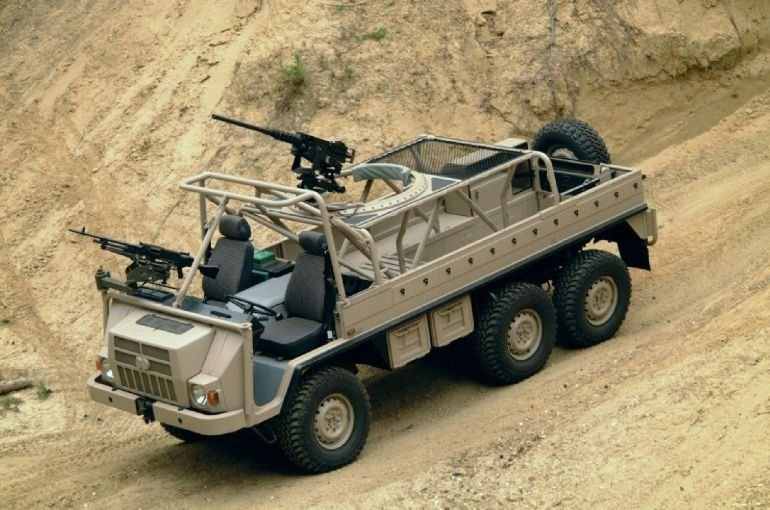
The 'enhanced' PinzgauerThe secretary of state for defence today confirmed the MoD's intention to supply troops in Afghanistan with Pizgauer Vector armoured vehicles, which we have already dubbed "coffins on wheels".

It says something for this issue that the only previous media coverage was an uncritical piece in the Sunday Telegraph which neglected to point out that this vehicle offers virtually no protection to mines – in what is one of the most heavily mined countries in the world.

The unarmoured PinzgauerIn our view, it is criminal negligence to purchase a vehicle, the design of which puts the driver over the front wheel. And, while the danger is not immediately obvious from the pictures of the armoured vehicle, a view of the unarmoured vehicle, kitted out as a gun truck, demonstrates the point with clarity.

Cone of destruction from a mine blastShould the vehicle run over a mine, the driver is positioned right in the centre of what is called the "cone of destruction", an illustration of which we have taken from a technical manual on mine protection. A photograph of the type of damage caused shows quite how vulnerable drivers are. Furthermore, what applies to mines also applies to a greater or lesser extent to IEDs.

What is utterly amazing is that, while the MoD have conceded the point in Iraq, with its decision to buy Cougars, it is still pursuing the Pinzgauer option for Afghanistan. Yet, while the Cougars cost £258,000 each, the Pinzgauers cost £437,000. They are not only coffins, but very expensive coffins.

Interestingly, last Friday, the Telegraph ran a piece on the government's intention to enable the prosecution of companies for manslaughter if they are suspected of causing a death through management failings. A new offence would apply to corporations, including public bodies, and introduce unlimited fines.

In our view, if or, as is more likely, when troops die in a Pinzgauer as a result of a mine explosion, "corporate manslaughter" provisions should be applied to MoD for procuring such a dangerous vehicle. But second in line should be the media who have the power to raise such issues but who seem to prefer expending their energies prattling about bagpipes.

Additional post on the Pinzgauer here.

COMMENT THREAD

A shed load of money

Mobiles - a gift for VAT fraudstersA few days ago, we picked up a story about VAT fraud, in which we reported that it was costing the British taxpayer some €3 billion a year (just over £2 billion).

That is not just a figure, but real money taken out of the system which then has to be made up from other taxes – or borrowing – so we are talking about a serious problem.

However, an article in The Independent on Sunday this weekend suggests that the problem is much, much more serious than that, citing figures from the Office for National Statistics and Customs. This organisation says that fraud-related trade grew from £1bn in the first quarter of 2005 to £7.4bn between January and March this year. Such is the epidemic of fraud that revenue losses for 2006 could be as high as £10bn.

Now, given that scale of fraud, you would think that the government would be moving heaven and earth to reform the system which allowed it to happen – but not a bit of it. VAT is an EU tax and any changes to the system require the approval of the commission, which – as we reported in our previous piece (link above) is mulling over changes.

Thus, for want of being able to take direct action to stem the fraud, the British government is left trimming at the edges, in the hope it will have some impact. But its latest stratagem, it appears, is causing serious grief to bona fide traders who deal in mobile phones – the commodity at the centre of many scams.

The problem is that up to 1,000 traders in the mobile phone and computer-chip industries have been told individually that their VAT repayments are under "extended review". Normally, repayments are made within 30 days of a claim, but Customs is currently withholding refunds for three months or more and such is the burden on cash flow that traders are warning Revenue & Customs that they risk driving firms out of business.

Earlier this month the Federation of Technological Industries held an emergency meeting attended by around 400 members, where it was revealed that traders were now owed millions of pounds in VAT repayments.

It is not until October that the new, so-called “reverse-charge” system for VAT in the computer-chip and mobile phone markets comes into force, where VAT will be chargeable only at the point of final sale, removing VAT cash as a factor in transactions, and thus wiping out the fraud potential.

By then, of course, rogue traders will be moving on to other commodities and the whole cycle will start over, bleeding money from the legitimate economy, some of it into organised crime and some – or so we are told – to funding terrorism.

It seems absolutely inconceivable that any government would tolerate this state of affairs, but such is the grip that the EU has on the affairs of our nation, that the issue gets down-page coverage in the business section of the Independent. Thus do we lose shed loads of money and it isn’t even treated seriously by the media.

And where, might one ask, are the Boy King's not-the-Conservative Party and all those serious political bloggers ?

COMMENT THREAD

Sunday, July 23, 2006

What turned the tide?

For an update on this post, see here.

The Army's new 'Rupert wagon' - aka the Panther - did this turn the tide?The funny thing is – in a definitely non-humorous sense – that the decision, yet to be officially announced, to buy RG-31s for the British Army in Iraq represents a another major U-turn by the government.*

Yet, because this is a cause not espoused by the "chattering classes", it will probably go unnoticed by the bulk of the media and certainly by the self-important political blogs.

In their eyes, this is much less important than the detail of how many lovers John Prescott bedded, or other political "gossip", that can be dredged up to entertain the political groupies.

British RG-31s for Iraq - courtesy of the blogosphere?To an extent, however, the government's U-turn on RG-31s is a much more important event for bloggers (many of whom did join in the fray), but I am not going to be triumphant about. It also reflects the work done by Christopher Booker, who raised it several times in his column.

It also owes much to the political intervention of the Conservatives, especially Lord Astor and Gerald Howarth, and also to back-benchers like the steadfast Ann Winterton and shadow minister, Owen Paterson, who was representing a constituency interest. Even a Lib-Dem MP, Mike Hancock, played a role.

Undoubtedly, the publication of the story in The Sunday Times helped enormously, and the fact the issue was then picked up – albeit in a spasmodic way – by others in the media, elevated it into a political issue that demanded the attention of the secretary of state for defence.

All this notwithstanding, even judged by the recent performance of this government, this is a remarkably speedy U-turn, which has us wondering precisely what it is that made the difference.

'The Snatch Land Rover provides us with the mobility and level of protection that we need'Readers will recall that, as recently as 12 June, the defence procurement minister, Lord Drayson, was adamant that the Snatch Land Rover was exactly what our forces in Iraq needed. "The Snatch Land Rover provides us with the mobility and level of protection that we need," he told the House of Lords.

Furthermore, he set his face against the RG-31, dismissing it as an option, declaring that its "size and profile did not meet our needs" and claiming that there were maintenance issues.

For sure, the day after the Sunday Times publication – on 26 June - we got a spirited attack by the Conservatives, forcing secretary of state for defence, Des Browne, to review of the situation. But we rather downplayed this, suspecting – as one does – that it was just another cynical attempt to kick a politically sensitive issue into the long grass.

That suspicion was reinforced on the 29 June, when Drayson maintained his stance, again telling the Lords that, "After giving careful consideration to the matter, we judged the size and mobility of the vehicle (the RG-31) not to be appropriate to the needs of our Armed Forces today."

The 'off-route mine' - first a barrier and now a facilitator to new equipmentWhat is then especially interesting is that we also saw what appeared to be an MoD-inspired propaganda campaign suggesting that a new threat from off-route mines was so great that new equipment would not make any difference. Yet, it is this very threat which is now being used as the basis for justifying the purchase of the RG-31s.

Talking to those involved, however, what appears to have proved the turning point was Booker's piece last week plus my post, where we pointed out that, while the officers were to be equipped with their Panther "battlefield linousines", troops were to remain equipped with their lightly armoured Land Rovers.

In particular, it seems, my jibe about "Rupert wagons" struck home. The implications suddenly dawned that we would have a situation where, totally contrary to the fine traditions of the British Army where officers lead from the front, officers would now direct operations from the comfort of their better-protected vehicles, sending their troops out to die.

Already, we understand, there have been situations where senior NCOs have refused to lead patrols in Snatches, without specific written orders spelling out the implications and, as we know, some officers have been extremely reluctant to order their men to patrol in these vehicles. But, officers in their "Rupert wagons" creates the makings of a mutiny, while the likes of The Sun would have a field day if troops were then killed. Mind you, with the provision of RG-31s, the situation will be reversed – if Panthers are ever deployed in Iraq. The men will be much better protected than their officers.

Furthermore, I don't think the MoD has thought this through. Since WWII, the British Army has always gone for the "common platform" option, with multi-purpose light utility vehicles – currently the Land Rover – used for functions ranging from troop transport to command vehicle.

On an active patrol, the common platform lends anonymity to officers, who are known to be targets for insurgents. But, in a mixed convoy of, say, Land Rovers or RG-31s and a Panther, driving around in the Panther is like carrying a notice saying "I'm an officer – shoot me". And, protected though it is, the Panther is not proof against an RPG-7.

Anyhow, as one of our forum contributors has pointed out – and we ourselves have noted - RG-31s are not the whole answer. To defeat the insurgents requires a range of equipment and tactics, the former including light tactical helicopters and UAVs – of which there are critical shortages in both Iraq and Afghanistan.

Troops in Afghanistan - 'tactically withdrawn'With news that British troops are set to be "tactically withdrawn" from isolated military outposts in Afghanistan following a series of sustained attacks from Taliban fighters, this is not only a question of force protection but whether the Army can effectively prosecute the war against the insurgents.

Without the right equipment and numbers, the only option is to withdraw them to the safety of their main bases, which rather defeats the object of deploying forces in these theatres. If we are going to do the job, then we need to do it properly, which means having the right kit – an issue to which we will continue to devote our energies.

* Once announced, the RG-31s turned out to be Cougars produced by Force Protection Inc.

COMMENT THREAD

Booker

Picture from the Sunday Telegraph today - the joys of photoshopFor some strange reason – conspiracy apart – the Sunday Telegraph has chosen not to upload the Booker Column onto its website this week. That is a great pity as, with three good Euro stories – including the background to the Anchor butter affair, these should have been given some prominence. Therefore, we have published the whole column here, the first story headed: "Mandelson fixes it for Anchor":

In a bizarre episode which has highlighted an extraordinary internal blunder by the European Commission, it seems the Sunday Telegraph (and, therefore, this blog) may, unwittingly, have helped save the New Zealand butter industry. Last week our front-page carried a shocking report that the Commission had suspended New Zealand's right to export nearly a third of its butter production to the EU.

This high-handed action had precipitated a serious crisis for New Zealand, since 14,000 tons of butter, with a retail value of £50 million, were already in transit or in bond, and would all now have to be destroyed.

The Sunday Telegraph's story, passed on through me from my collaborator Dr Richard North's EU Referendum, mentioned the name of Peter Mandelson, as EU trade commissioner – who immediately responded with a fierce denial that he had been in any way involved in this decision, stating that it had been taken by the Commission's agriculture directorate.

This in itself was remarkable. The ban directly flouted the special arrangements allowing New Zealand to export butter to the EU, negotiated when Britain joined the Common Market in 1973, and these had been confirmed under WTO rules as recently as 2001 by Pascal Lamy, Mr Mandelson's predecessor as trade commissioner (and now head of the WTO). If Mr Mandelson was not consulted on such an important EU trade issue, why not?

The story now became more curious still. Under the treaty, all New Zealand butter exports to the EU go through Fonterra, a London firm which uses the brand name Anchor. A German company, aggrieved that it was not able to import directly, raised this "monopolistic practice" with the European Court of Justice, which ruled last December that the arrangements must be changed.

But in its provisional judgement the ECJ also emphasised that, until new arrangements were in place, the existing ones must stand. When the ECJ confirmed its judgement two weeks ago, the Commission's agriculture officials made two crashing errors. First, they imposed an immediate ban, ignoring the ECJ's insistence that the existing arrangements must remain.

Second, they failed to consult with Mr Mandelson's department, even though, on a major international trade issue, it should have been centrally involved. When, therefore, Mr Mandelson's name was mentioned in the Sunday Telegraph, his officials went into overdrive - as a result of which, on Wednesday, they were able to announce that the ban had been lifted.

Those 14,000 tons of Anchor butter can continue on their way into British shops and New Zealand’s exports are safe for the future (to the huge relief of the New Zealand press): all because Mr Mandelson was so stung at being wrongly blamed for the blunder that he has now got it rectified.

******

Few actions of John Major's government have drawn such criticism as the decision, when the railways were privatised in 1994, to split ownership of the track from that of the trains running on it (hence Railtrack). Last week the Tories' transport spokesman Chris Grayling admitted that this had been a mistake, suggesting that they should be reintegrated.

This inevitably revived the question raised several times in this column over the years as to what part was played in this decision by a 1991 EC directive, 91/440, ruling that track and trains in the EU must be put under separate management, transposed into UK law by the 1992 Railways Regulations. I could never track down final proof that one thing led to the other, but I recently thought I might have found the "smoking gun" in a paper published by the Institute of Economic Affairs from Professor John Hibbs, who at the time was a senior official of British Rail.

Professor Hibbs recalled being summoned to Number Ten to advise on the privatisation, and said that he urged the selling off of British Rail to regional companies, each with its own track and trains. He was given to understand that "John Major favoured the idea" but that "Malcolm Rifkind,as minister of transport, had turned it down because of an EU ruling that operations and infrastructure had to be separated".

I raised this with Sir Malcolm Rifkind, who recalls that he personally favoured keeping track and trains in the same ownership. But the Treasury disagreed, on the grounds that this would not allow for competition between operating companies.

It may well be that Sir Malcolm is personally let off the hook, but Professor Hibbs is adamant that the EC directive played its part in shaping the attitude of Rifkind's officials and the Treasury, and that this was what he was told by Number Ten, when they rang him, following his visit, to explain why his advice could not be taken.

Certainly the way in which our railways were privatised conformed with the directive, which we were the first country in the EC to pass into national law. The problem the Tories now have to resolve is whether they can ignore that reading of the directive, if and when they ever get the chance to undo the mistake made by their Party 12 years ago.

******

Last January I wrote here that Mr Prescott's plans to introduce Home Information Packs were a "disaster waiting to happen". I had been led to this view by a reader, Philip Collings, formerly the IT director of Railtrack, who, after analysing the Government's scheme, was so convinced it would fail that he set up a website to explain why.

In recent months so many experts have joined the chorus that the Government last week bowed to their arguments, by withdrawing one of two key components of HIPs, the compulsory "home condition report", for reasons outlined here six months ago.

But the chief reason why Yvette Cooper, the minister responsible, was pushed into this highly embarrassing U-turn was alarm in the Treasury (where her husband Ed Balls is a minister) that HIPs would plunge the housing market into chaos. A collapse in house prices would deal a devastating blow to the UK economy (valued at more than £3 trillion, domestic property is now the largest single asset underpinning its strength).

Among several reports analysing how this might come about was one compiled by my property consultant son Nicholas, showing how the introduction of HIPs in three phases, with a 70 percent shortfall in the number of inspectors needed to compile the home condition reports, would produce a hopeless mismatch of supply and demand, lasting up to 18 months This, when the Bank of England is warning that homes are overvalued by 30 percent, would lead to a massive downward "correction" of the market (his report is available from
in2perspective.com).

But the Government is still having to persist in a cut-down version of its cockeyed HIPs scheme, thanks to an EC directive making it mandatory for homes to be marketed with an "energy efficiency certificate". When I reported this last January, Ms Cooper wrote denying that this was why the Government was introducing HIPs. Yet she now admits that this is why HIPs cannot simply be withdrawn altogether.

As usual, the Government has indulged in "gold-plating", going considerably further than the directive requires by forcing anyone who sells or rents out a home to pay £200 for a few virtually meaningless sheets of paper. But even in their reduced form, this means that HIPs will introduce needless complications into buying and selling. They may have reduced the chances of plunging the housing market into chaos - but don't rule it out.
This last story is especially interesting as it points up the hitherto unnoticed EU dimension in the home condition survey. Once again, the elephant in the room has deposited a huge pile of ordure in our midst, and no one wants to admit it.

COMMENT THREAD

It's a start...

For an update on this post, see here.


"Bombproof vehicles for troops in Iraq", says The Sunday Times this morning. More than 100 new heavily armoured patrol vehicles have been ordered by the government to protect British troops in Iraq against roadside bombs, writes Michael Smith.

The move, to be announced this week, follows the review ordered by Des Browne, the defence secretary. The latest vehicles will be upgraded versions of the armoured Cougars, says The Sunday Times, as used by US marines in Iraq. They will have additional armour, making them the most protected vehicles of their kind in the world.

Browne, a former chief secretary to the Treasury, asked his former boss Gordon Brown to provide the tens of millions of pounds to rush new vehicles to Iraq, a senior defence source said yesterday. Snatch Land Rovers, says the ST, cost about £50,000 apiece (actually, £60,000). The new vehicles cost about eight times as much but carry more troops. Ministry of Defence (MoD) officials, we are told, were ordered to bypass their complex procurement system and buy the best vehicle available.

From there, the Sunday Times gets a little muddled. From the price, it seems they are talking about the RG-31 – which is occasionally called the Cougar. But the paper says they are built in America by BAE Systems, which is not the case. The body shells are built in South Africa by a company owned by BAE Systems, and they are finished by General Dynamics in Canada.*

Nevertheless, the paper says they came closest to fulfilling the requirement for a protected vehicle, but despite surviving a number of bomb attacks in Iraq it was still deemed to have insufficient armour. It cites the MoD source saying that, "Browne accepted the arguments in favour of the Snatch Land Rover but ruled that the new range of roadside bombs meant that the situation had changed."

We understand that the MoD aims to have the "Cougars" in Iraq by the end of the year.

Interestingly, The Daily Telegraph carried a piece yesterday about blogs, noting that, "the most visited blogs are devoted to political gossip and comment. Once regarded as the home of amateur, 'wannabe' journalists, they are increasingly setting the political agenda."

Although we can't aspire to the heights of writing political gossip, this decision might just be an example of this phenomenon.

* Later information indicates this is wrong. The vehicles now seem to be a variant of the Cougar produced by Force Protection Inc.

COMMENT THREAD

Saturday, July 22, 2006

Give us your money

The EU's new weaponYou really do wonder at the extraordinary mindset that inflicts the commission apparatchiks in Brussels, to the extent that it is no mere hyperbole to suggest that they must truly inhabit another planet.

Not least of this strange sect of aliens is "EU regional policy chief", Danuta Hübner. According to epolitix, she is wingeing about the "penny pinching" of member states in fixing the regional policy budget at €308bn for 2007-13 - far less than had been hoped for by the commission – while suggesting that private money must be used "if Europe's regions are to contribute to meeting ambitious EU targets for creating economic prosperity".

Why on earth she thinks that private entrepreneurs should rush to the aid of the EU, or believe that "ambitious EU targets" are any concern of theirs, is not explained. It is sufficient – or so it seems – that Hübner believes she hasn't been given enough money so private capital must fill the gap.

But, for an organisation that has spent most of its life pouring out a torrent of legislation that has suppressed private enterprise and turned running small businesses into a nightmare, it really does take the biscuit to find one of these ghastly apparatchiks declaring, "we also want more entrepreneurship, more innovation...", and then putting out the begging bowl for more cash.

Rather than borrow the begging bowl tradition from an ancient eastern culture, therefore, we would prefer Hübner to indulge in another, more useful (in her case) activity – ritual suicide, along with the rest of the "colleagues".

COMMENT THREAD

The EU strikes again

Despite the earnest guff we hear from all corners - and particularly the EU - about "saving Africa", once again we are hearing from The East African Standard in Nairobi a tale of woe about how EU rules are damaging the vital trade in fresh-cut flowers from Kenya.

Strangely, it was in August 2004 - almost two years to the day – when we first wrote about this issue. Then it was rules covering the "traceability" of export consignments, creating such a vast burden of red tape that the smaller growers could not cope with it.

Then, in August 2005, we wrote about how EU inspectors were failing to enforce their own rules on pesticide usage, to the detriment of local workers – in a situation where the "soft power" of the Union could have been a force for good.

And now the problem is EU Directive 2000/29/EC that demands flowers be subjected to 100 percent inspection at the EU entry point.

The complaint comes from Erastus Mureithi, chairman of the Kenya Flower Council, who is seeking government intervention in addressing what he says is a non-tariff trade barrier that threatens entry to U markets. "Although the directive is meant to ensure that member states do not allow the importation of harmful pests/diseases in to union, it is a non-tariff barrier since the pests are known to be present within the EU", he says.

What he wants is a relatively simple solution, that the EU should extend accreditation to Kenya Plant Health Inspectorate Service for flower inspections at the point of exit, similar to arrangements in place now fruits and vegetables, so that the inspections can be done in Kenya, saving the growers the costs of high-priced inspections in EU countries.

From this and previous posts one gets the impression that the greatest obstacle to Kenya's commercial development is the EU and, even if the inspection problem was solved (unlike the others), another is looming.

On the table at the moment are negotiations for the continuation of trade arrangements with the EU which currently exempt Kenyan horticultural produce from duty which would otherwise be imposed at a rate of 8 to 11 percent.

Freedom from duties is indeed vital to the Kenyan economy, where the horticulture sub-sector earned the country $400million, accounting for 14 percent of the country's total exports. Last year, the flower industry commanded 31 percent share of the EU market, providing 100,000 jobs directly and 1.5 million indirectly.

But the continuation depends on the country successfully negotiating a favourable Economic Partnership Agreement with the EU, which must be concluded by January 2008. Yet, again according to The East African Standard, Kenya could well become a victim of its own success.

The negotiations, which will gradually involve all members of the 79-state Africa, Caribbean and Pacific (ACP) Group is aimed at replacing the Cotonou Agreement. But the new arrangements will apply to what are known as the less-developed countries (LDCs) and such is Kenya's prosperity that it no longer qualifies as an LDC. It is now ranked as a "non-less-developed country".

On top of that, the country also faces WTO pressure to turn the Cotonou Agreement, which gives all ACP countries preferential access to the EU, into a reciprocal agreement, where subsidised EU exports can also enter ACP countries freely

With these complications comes uncertainty and Kenya Flower Council members are getting anxious about whether the negotiating deadline will be met. Erastus Mureithi warns that, if it is not, the consequences will be grave.

That is the reality of EU relations with Africa. Away from the "feel-good" crap of "making poverty history", it is a dog-eat-dog world, where countries like Kenya are being given few breaks and are having to fight for their economic survival, against the very organisations that so publicly claim to help them.

As always, it is the hypocrisy that stinks.

COMMENT THREAD

Friday, July 21, 2006

No problem

The Commission has decided to suspend disciplinary proceedings against Germany for consistently breaching the EU budget rules that were put in at her own request.
"It said that Berlin was on course to bring its budget deficit - the gap between its revenues and spending - back within EU limits next year.

Europe's biggest economy has broken EU budget rules for the past four years. It's something which has proved embarrassing for Germany, and infuriating for Brussels."
We are told by the BBC that various reforms (such as the proposal to raise VAT from 16 per cent to 19 per cent, making it the highest in the EU) will deal with the problem. That we shall see. But, in the circumstances, the Commission will not be able to discipline any smaller country either.

COMMENT THREAD

How will they communicate?

Omar BakriIn today’s Evening Standard, a newspaper that is, alas, incapable of understanding the importance of the web, underneath the large spread about Hanan Fostok demanding that the RAF or the Royal Navy (she is not fussy) bring out her husband, Omar Bakri, from Lebanon, there is a delightful little piece that may be of interest to our readers.

First, let me remind all of them who Omar Bakri is. He is the one and only “preacher of hate” who has left this country, not because he was deported as the government and the Home Office kept huffing and puffing about, but because he was scared and he ran. He ran all the way to Lebanon, where he was arrested but, apparently, released.

Bakri was born in Syria and is wanted by the government of that country for plotting the government’s overthrow in 1970. This is a dispute I am happy to sit out except to note that Bakri must be worried about all sorts of things – Israeli bombs, Israeli soldiers, Lebanese enemies and, last but very much not least, another Syrian invasion.

The man was given asylum here and both he and his family lived entirely on benefits. In fact, his family still does so. I am not even sure that there is only one family. So he had no job while he was here. What did he do with his time? As the leader article in the Standard puts it quite fairly:
“This is the man who blamed the British people for the terrorist outrages of 7 July last year, claiming that murderous attacks on innocent civilians were a justified response to an elected government’s foreign policy. He also praised the hijackers who inflicted the carnage of 9/11. As spiritual leader of the extremist Al-Muhajiroun group he was responsible for stirring up hatred and disseminating lies with the power to spur on young men to commit further terrorist acts.”
Bakri, in short, is one of the exponents of the most violent and extreme Islamism. Just the chap our boys should be risking their lives to save.

The fun piece underneath the long and self-righteous whinge by Mrs Bakri (apparently people treat her and her family as that of a terrorist) there is a lovely little article, entitled “Foreign Office at odds with Downing Street over Israel bomb blitz”.

That the Foreign Office is frequently at odds with Downing Street is nothing new; that it (snigger, snigger) considers its own views to be of importance is a given; that it is persistently Europhile, anti-Anglosphere, anti-American, pro-terrorist and anti-Israeli is so well known as to induce nothing but complete boredom. The question I have is how will they communicate their displeasure with the Prime Minister of this country and the behaviour of another country, namely Israel? Not by satellite phone surely?

The whole story reminds me of that glorious episode in “Yes Prime Minister”, where Jim Hacker stands up to the Foreign Office and, with the help of his old university friend, the Israeli Ambassador, wins.
Who can forget the ending of the episode when Hacker, having done what he was told not to do by the Foreign Office and Sir Humphrey, that is, sent an airborne division as a gesture of good will to St George’s Island, pretends that he did it because of a warning from the weaselly FCO chap, Luke, that had been carefully hidden somewhere in a 128 page report.

He then decides to reward Luke for his “perspicacity” by making him Ambassador to Tel Aviv, so he can explain to the Israelis why Britain always votes against them in the UN (even when specifically instructed by the Prime Minister not to do so).

Luke is appalled. After all the Israelis know that he is on the Arabs’ side. “I thought you were on our side,” – Hacker tells him silkily.

I don’t know whether Tony Blair ever watches “Yes Prime Minister” but I imagine neither he nor the Israelis will lose any sleep over the FCO’s huffing and puffing. Kim Howells, the junior minister, who had been told that the Foreign Office “had repeatedly urged Israel to act proportionately”, is going to the region today.

We are back to the same question. How will he communicate with London? The satellite phones have been stolen and even the EU is unlikely to have reduced roaming charges in Lebanon, though probably they have done so in Israel. Perhaps, some Israeli soldier will lend him a satellite phone and, I hope, demand it back as soon as Mr Howells has finished his conversation.

COMMENT THREAD

The wrong kind of results

If you are a lorry driver, you can't do this...We didn't need Le Figaro to tell us that the European Union was mounting a "vast charm offensive", homing on "feel-good" consumer issues in an attempt to regain its "legitimacy" in the eyes of "European citizens".

Thus, in recent months, we have seen proposals to cap mobile roaming charges, on the introduction of child-proof lighters, the regulation of artificial sun-tanning studios, standards for sun tan cream, controls on credit card charges, or rules for airline fare price declarations in advertising – to say nothing of safety regulation of hair dyes.

...but you can do this...All of this is quite deliberately designed to overcome the negative image of the EU, brought to the fore with the rejection of the EU constitution by French and Dutch voters as the commission attempts to promote a "Europe of results", demonstrating that "Europe is useful to people".

But the inherent dishonesty of this marketing strategy is that it is so singularly one-sided, failing ever to highlight the down side of the mad regulatory machine, whether it is the estimated €3 billion annually lost to the UK Treasury to VAT fraud, the €1 billion a year to be wasted on translation services, or the £1.7 billion cost arising from the ban on lead solder, adding ten percent to the price of a personal computer and other electrical appliances.

...and this...But, as we know, the imposts do not always have a direct financial cost. As often , it is the aggravation factor, the latest of which comes from The Scotsman which is telling us that the EU's working time directive, now applying to lorry drivers, is leading to a shortage of trucks to be used for floats at this year's Edinburgh Festival Cavalcade.

This year, the event celebrates its 30th anniversary and the organisers need around 80 flat-bed trucks to carry performers through the city centre for the parade. But several haulage firms are believed to have been unwilling to allow drivers to take part because of the EU's directive, which means they can work no longer than 40 hours a week.

...and this...Because drivers would be behind the wheel for the event, and also need to prepare their vehicle for it, taking part would use up around five or six of the hours that they are legally allowed to work in a week. And several companies are believed to be cautious about letting workers use up their entitlement when they are not working for them. Now several groups of performers have been left scouring the city looking for people to drive floats and at least four trucks are still needed.

Such is the perversity of this law that truck drivers could quite happily spend their weekends on a variety of arduous tasks, ranging from rock climbing and hang-gliding, to motorcycle racing and off-road rallying, but the moment they sit behind the wheel of a carnival float with a view to taking a leisurely and pleasurable jaunt round the streets of Edinburgh, the EU rules kick in and create the problems.

...and even thisIt is even the case that a truck driver can spend unlimited hours at the wheel of a private car, driving to and from work, but waiting at a depot for his truck to be loaded or unloaded counts as "work" within the terms of the working time directive.

No wonder a separate report in The Scotsman complains that EU red tape is "crippling business". That is the real outcome of the commission's "Europe of results". But you won't hear any EU apparatchiks talking about the effects. They, I suppose, are the "wrong kind of results".

COMMENT THREAD

Those Rolls-Royce minds

The myth used to prevail that the British civil service was the best in the world, the crème de la crème being the "Rolls Royce minds" of the Foreign Office.

What price therefore the story in The Telegraph today about how thieves ran up a £600,000 bill on the Foreign Office's satellite phones

The details come from a National Audit Office report which retails "an astonishing catalogue of errors" which allowed the thieves to carry on using the phones for up to a year before officials discovered what had happened.

It all started when ten satellite telephones were sent to Iraq in September 2003 but diplomats in the country were not told they were coming, there were no records on whom the phones were issued to and there was nowhere to store them securely.

In a further lapse, the phones were activated in Britain before they were sent, which meant that anyone could use them. The three phones vanished in early 2004 and the first bills started to arrive in July that year. The first phone was barred in August but had already run up a £10,365 bill, the second phone appears to have stopped working in March last year, by which stage £115,963 of calls had been made.

Then, in the last couple of months, the thieves are believed to have set up premium rate phonelines on the tiny Wallis and Futuna Islands, in the South Pacific. They then used one of the satellite phones to call the numbers - which cost £5.94 a minute - running up a £290,000 bill. The final phone was turned off in June last year when alarm bells finally rang about the £594,370 bill that had been run up.

The worst of it all is that in September 2004 a junior official had "raised concerns about the high cost and usage of satellite phones in Iraq" but senior officials failed to take any action.

For sure, this is nothing by comparison to some of the more egregious failures of the MoD, but it is still a hell of a lot of money. By my reckoning, that is two RG-31s, with enough left over to buy every soldier in Iraq a couple of pints and a packet of crisps.

And this is the Foreign Office on whom we rely to manage our relations with the EU. No wonder we so often get taken to the cleaners by France.

COMMENT THREAD

And now... the European Army

The EU Army on displayI'm sorry, I really didn't mean to do another "toy" post so soon, but I really couldn't resist this one – Reuters at its best.

The Agency reports that French and Portuguese troops from a European Union Force have been performing military exercises in the Congolese capital Kinshasa. These are part of the contingent of 1,000 soldiers sent to the Democratic Republic of Congo ahead of this month's presidential and parliamentary elections.

Soldiers parachuted into their Kinshasa base from helicopters before special forces teams performed a simulated hostage rescue and the force illustrated how it could quickly deploy men and armoured vehicles. "We have tried to show you that we are credible and ready to fulfil our mission," German General Karlheinz Viereck, commander of the EU mission, told the audience after the display at N'Dodo airport.

Accompanying the Reuters' story is the picture shown above – presumably one of the "armoured vehicles". I thought I knew most of the equipment used by European forces, but I haven't the faintest idea what this is. To me, it is reminiscent of an old corporation dustcart, not dissimilar to the one seen in the 1971 feature film when the Dads Army platoon hitch a ride back to Walmington-On-Sea from their manoeuvres (thank you Anoneumouse). As a piece of military hardware, it definitely lacks that "wow" factor.

I only hope that the Africans who watched the display were able to contain their mirth when they watched this machine trundle into view. However, I suspect many of them would have been too busy wetting themselves even to hear General Viereck's pompous little statement, much less take it seriously.

COMMENT THREAD

Thursday, July 20, 2006

Foreign policy? What foreign policy?

Israeil airstrikes on Lebanon - The BBC goes into overdriveIt is hard to decide which part of the British media that is more nauseating: the likes of the BBC, which puts out what is effectively Hezbollah propaganda (the website is, in fact, better) or the ignorant snootiness of the likes of Simon Heffer, known affectionately as the Hefferlump.

Let us set aside the BBC (as well as the Independent, fond though I am of Robert Fisk’s lunacies). In fact, given the choice examples of British coverage that Stephen Pollard supplies on his blog, it might be a good idea to ignore much of it. It is not a question of them taking an anti-Israeli line and supporting terrorism – they are entitled to that. They are not, however, entitled to equate the two. And they are not really entitled to write and pronounce with quite so much ignorance. On the other hand, several of their European brethren are equally bad and ignorant.

Let us concentrate on the Hefferlump who does not, as it happens, take the side of the terrorists. He is simply not interested enough in what goes on in the big bad world. The piece, entitled “A third world war looms - but Britain has no foreign policy” can best be described as a sort of curate’s egg. It is good in parts. Very few parts. Then again, judging by the largely inane comments posted by his readers, the bad parts have their fan club.

Margaret Beckett - an embarrassmentLet’s get the good bits out of the way first. It is undoubtedly true that Margaret Beckett is an embarrassment as a Foreign Secretary but so was Robin Cook with Jack Straw coming up close behind. And don’t get me on the subject of Douglas Hurd or Malcolm Rifkind.

In fact, the only half-way decent post-war Foreign Secretary we have had (actually the ones before the war were not that much better but it was a different world and you could get away with a lot more) was Ernie Bevin, who, as Mr Heffer reminds us, “spent his life as a trade union leader before, at a late age, entering government”.

In a way Beckett does not matter as Blair has been his own Foreign Secretary since soon after 1997 (probably since Cook’s ethical foreign policy collapsed around the government’s ears). Nothing particularly unusual in that. This country has had a number of prime ministers who, either formally or informally, conducted their own foreign policy. Margaret Thatcher did so periodically, others all the time.
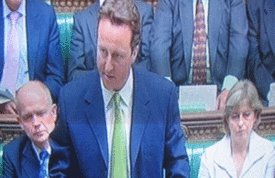
The Boy King at PMQsHeffer is also correct in delivering a glancing blow to the Conservative Party, who appear to have no collective views on what is going on in the Middle East. As Tim Montgomerie pointed out on the Toryboy blog, Cameron did not raise the subject during the last PMQ before the summer recess. Judging by some of the comments, large parts of the Conservative Party think there is nothing wrong with that, one little lad (well, I have no idea of his size) even pointing out that this is all happening a long way away and has nothing to do with us.

The Conservative Party has, I believe, has a Shadow Foreign Secretary. He is believed to be the brightest of the bunch around the Boy-King. Have we heard any pronouncements from him on matters international, apart from the benighted EPP?

Blair acting the courtier to BushAnyway, back to the Hefferlump. I very much fear that he is one of those blessed baa-lambs that I have referred to in a previous posting. He seems not to have read or listened to that exchange between Bush and Blair, unexpectedly caught on the mike, in any detail. Yet it is very short and even Mr Heffer could have found time for that, though he seems to have been put off by that jocular “Yo!” used by the President.

Instead we get the usual stuff about the “master-servant relationship”, Bush’s poodle, yadda-yadda-yadda. Instead of which Blair must take “a more critical line with America” as the latter’s policies have been a disaster and we have been branded by it all, yadda-yadda-yadda.

It seems Mr Heffer has not noticed that, as we pointed out and as Fraser Nelson has written in this week’s Spectator (in case Mr Heffer is too grand to read blogs) Mr Blair does have ideas for a policy and he is always trying to foist it on President Bush. These ideas are all to do with multilateral activity and transnational organizations. They have failed in the Middle East and President Bush has, rightly, rejected them.

UN Peacekeepers in LebanonThere are already UN peacekeepers in southern Lebanon. They have been there ever since Israeli troops moved out. They have not prevented Hezbollah from arming itself, stockpiling more arms from Iran or from lobbing thousands of rockets into north Israel (described as the northern part of occupied Palestine by the Speaker in the Iranian Parliament).

Another thing about Mr Heffer is that he has really important friends:
“As a former Foreign Office minister put it to me this week, American diplomacy is now a contradiction in terms.”
Well, of course, the Foreign Office and its political masters have done so superlatively well in the diplomacy stakes in the last few decades that they are entitled to sneer at the Americans. The history of our negotiations with the rest of the EU would be instructive reading on that score.

Mr Heffer and the former Foreign Office minister might be too grand to listen to my recommendations but I do really think they should read an article in yesterday’s Wall Street Journal Europe, entitled “Lebanon poses risky calculus”. It’s long but not too long and it analyzes President Bush’s and Secretary of State Rice’s reaction to the Lebanese crisis.

Unlike the last time events took this turn and Warren Christopher rushed off to win a cease-fire deal (and much good that did in the region), the present administration takes the view that long-term changes are necessary.
“Instead, when Ms. Rice ventures to the region as early as this week-end, administration officials say that her mission will be to build support for the effective crippling of Hezbollah, which has popular backing across southern Lebanon and has two ministers in the country’s government. The U.S. officials also hope the crisis could end up limiting the influence of Hezbollah’s chief sponsors, Syria and Iran.”
The article discusses the various problems that this policy might throw up, not least the possibility of a long-drawn-out battle on the Israeli-Lebanese border that could, quite conceivably, unite that famous Arab street against Israel and the United States, intensifying, if that is possible, anti-Western feelings.

Nevertheless, pace the Hefferlump and his friend the former minister, this is a sensible and imaginative policy, that is already bearing some fruit in the fact that outside Europe and the UN there have been relatively few voices that described Israel’s reaction as “disproportionate”.

Both the Australian and Canadian prime ministers have made it quite clear that they supported Israel’s right to self-defence and the word has gone round that Hamas and Hezbollah are acting as agents of Iran and, to a lesser degree, Syria.

As Michael Rubin wrote, while the original Gaza attack called forth condemnation all over the Middle East, the opening of the second front in Lebanon, had a very different effect:
“No longer subject to Syrian occupation, Lebanese officials spoke freely. The Middle East Media Research Institute translated many reactions. "Lebanon ... is not willing to be the spearhead of the Arab-Israeli conflict," former President Amin Gemayel said. "Hezbollah will have to explain itself to the Lebanese," Druze leader Walid Jumblatt told Le Figaro.

The independent Beirut daily Al-Mustaqbal quoted Lebanese Communications Minister Marwan Hamada saying, "Syrian Vice President Faruq al-Shara gives the commands, Hezbollah carries them out, and Lebanon is the hostage."

Nor did the wider Arab world rally in unanimity toward Hezbollah. "A distinction must be made between legitimate resistance and uncalculated adventures undertaken by elements [without] ... consulting and coordinating with Arab nations," the official Saudi Press Agency opined. Egyptian Foreign Minister Ahmed Abul Gheit included Hezbollah rocket attacks in his condemnation of terrorism.

Even the Arab League, which seldom misses an opportunity to denounce Israel, offered only muted criticism. True, League Secretary General Amr Moussa condemned Israel's "disproportionate attack," after the July 15 meeting, but rather than just slam the Jewish state, Saud al-Faisal, the Saudi foreign minister, chided Hezbollah's "unexpected, inappropriate and irresponsible acts."

Delegates from Bahrain, Egypt, Jordan, Kuwait and the UAE backed Mr. al-Faisal. Ahmed al-Jarallah, editor of Kuwait's Arab Times, condemned both Hezbollah and Hamas in an editorial that same day, writing, "Unfortunately we must admit that in such a war the only way to get rid of 'these irregular phenomena' is what Israel is doing."”
In Lebanon itself the reaction has been mixed, as Al-Jazeera reports. Some of the politicians are wringing their hands, trying to explain that it is not fair that their country should be attacked, as they cannot possibly control Hezbollah.

Others, justifiably, bemoan the fact that once again they are getting caught between warring factions with Hezbollah being blamed for its provocative actions.
“There is anger at Hezbollah among many Lebanese who believe that its operation to capture soldiers on Wednesday invited Israel's military response, and some believe that Hezbollah is not acting in the interests of Lebanon.

Said Goksel: "If this carries on like this Hezbollah will turn up as the villain in this. This is not going to be healthy for this country. Forget national dialogue. Hezbollah has made it clear that it is not interested in internal politics."

But besides being a militia, Hezbollah is a political party popular with Lebanon's Shia community, and while much of Hezbollah's infrastructure can be destroyed, support for Hezbollah is likely to remain among the Lebanese Shia - the country's largest group.”
Even when other governments, such as the Iraqi called for Israel to stop “destroying Lebanon’s infrastructure”, there has been a distinct coolness about Hezbollah.

Some of this might be due to the despicable and deplorable American diplomacy. Who knows?

There are other issues here. Hezbollah, as Michael Rubin says, makes Arabs nervous because it is seen rightly as Iran’s tool.
“Even as Arab states routinely condemn U.S. foreign policy, they embrace the American umbrella. John Mearsheimer and Steven Walt, respectively of the University of Chicago and Harvard, may argue that "the Israel Lobby" perverts U.S. interests; but Arab leaders understand that the only countries the U.S. military has fought to protect in the Middle East were Kuwait and Saudi Arabia.

The tiny Gulf emirates are defenseless without U.S. protection. There is hardly a state on the Arabian Peninsula that does not train with the U.S. military or welcome a small U.S. presence. But with U.S. congressmen proclaiming the defeat and vulnerability of U.S. troops in Iraq, and the Islamic Republic drawing closer to its nuclear goals, Tehran's stock is rising at U.S. expense.

The signs of Arab unease have been growing over the last 18 months. Jordan's King Abdullah II first raised alarm. In a Dec. 12, 2004 interview with Chris Matthews, he warned that the rise of Iranian-backed Shiite parties in Iraq could give rise to a Shiite "crescent" stretching from Iran to Lebanon. Abdulaziz Hakim, the leader of the Supreme Council for Islamic Revolution in Iraq, called Abdullah's comments "ridiculous," but the remarks resonated in Arab countries.

True, the Shiites might account for only 10% of the world's Muslims, but in the volatile region stretching from the eastern Mediterranean to Iran, the Sunnis and Shiites are near parity. That Shiites predominate in the oil-producing regions not only of Iran and Iraq but also in Saudi Arabia accelerates the fears.

Satellite stations throw fuel on the fire. A July 12 political cartoon in the Iraqi daily al-Mutamar depicted a man pouring gasoline labeled sectarianism into a satellite dish.”
In other words, he says, the Arab leaders are acknowledging that they can live with Israel and need the United States but Iran frightens them. Their apparently sane attitude proceeds from that rather than any real change of heart about Israel.

I am not sure this is such a great problem. After all, most alliances in history, as Mr Heffer’s friend the former minister would know, are formed by nations and countries that fear someone else more than each other.

Nor is that the complete story. As the article in this Sunday’s Business, which we have already quoted, points out, the Palestinians are being abandoned.
Fighting to the last Palastinian?This is nothing new and is, in many ways, unfair on the Palestinians, who have been used as proxies by the various Arab states and leaders against Israel. I have never quite understood why the Palestinians accepted their role of everybody’s eternal victim. All those who preached the great crusade were willing to fight to the last Palestinian. When there was trouble, the latter tended to find themselves alone.

When the Hamas led PA found itself without donations from the West, the Arab response was very patchy and reluctant.

After all, the highest level of casualties inflicted on the PLO (later transmogrified into the PA) was not by Israel but by King Hussein’s Jordanian army in 1970 –71. Looking at what happened in Lebanon once the PLO decamped there, one might say that the King had been justified to exert all means to protect his country. And it is not over yet, as far as Lebanon is concerned.

It would seem that the Arab states and leaders have decided that it is not just Iran they are going to find hard to live with but also the permanent instability caused by the Palestinians and their various political organizations.

At each crisis, newspapers publish short interviews with assorted Arab shopkeepers, lawyers, students, anyone they can find, who shout their support for whoever is fighting Israel and the United States (usually the Palestinians) and their disgust with Arab leaders who will not support the fight. Each time there are doom-laden predictions about those leaders losing their credibility and, possibly, their lives.

Not only have these predictions not come true, but this time the opposition to Hezbollah and its behaviour is out in the open. Of course, I am careful not to make any predictions and if the fight is prolonged there might be some political realignments.

About the worst thing that can happen, I am sorry to say, would be a premature cease-fire administered by an incompetent UN peacekeeping force that leaves everything in the same position. We can then assume absolutely that the whole cycle will start again with Hezbollah a little better armed each time and with Iran a little nearer to that nuclear bomb.

Meanwhile, what of the EU? Well, some countries have been condemning Israel and calling for multilateral peacekeeping forces. In France, one politician, as the Dissident Frogman relates, has called for France to intervene against Israel. At the risk of possibly annoying Mr Heffer with my language (not that he would condescend to read a blog) I have to admit to thinking: “Yo! Bring it on!” I am afraid it will not happen. The French will not be facing the Israelis any time soon.

The EU, as Dan Bilefsky, something of a cheer-leader for that organization, sadly wrote in yesterday’s Trib, has not acquitted itself well. As ever, faced with a crisis, it had nowhere to go, though Javier Solana was flown by the RAF to Beirut, where he, presumably, went through his usual hand-wringing procedures. He did then go on to Israel and Egypt but nothing much has come out of it all.

Mark Leonard - out of his depthAs ever, Mr Bilefsky asked Mark Leonard, the wonder boy of the NuLab Europhile establishment. Mr Leonard was very upset:
“The EU is based on consensus and has a hard time responding during crises. And it is now floundering because all the previous givens and consensus on the Middle East have become obsolete.”
Dear me. Did Mr Leonard not tell us at length that the EU was a spectacularly unusual and successful institution, who was quietly influencing many countries “from Russia to Rwanda” and who was uniquely capable of dealing with the modern world, unlike those outdated nation states.

Now he tells us that it cannot deal with something so predictable as fighting between Israel and Hezbollah on the Lebanese border. What does it tell us about Mr Leonard and the Centre for European Reform that they actually believed the unstable situation of the last few years was a given and a consensus?

It seems likely, though one must not put it any higher, that Hezbollah and its patrons Iran and Syria miscalculated. They were clearly hoping to provoke Israel into a war. They are not very particular about the way they use civilians (especially Maronite Chrisitans) as shields. They were clearly hoping that the mounting casualties, most Hezbollah but some Lebanese, would bring the world in against Israel.

This has not happened. The UN may be huffing and puffing but otherwise, Hamas and Hezbollah are getting support from France, some European and a considerable proportion of British media, the BBC, Robert Fisk, Tariq Ali, George Galloway, the usual crowd of demonstrators in American cities and the moonbat blog The Daily Kos (kind of). There is also half-hearted support from Russia that is unlikely to lead to anything. As for the EU, one can only surmise that Hamas and Hezbollah leaders took it at its own estimation.

COMMENT THREAD