Showing posts sorted by relevance for query Geert Wilders. Sort by date Show all posts

Wednesday, February 11, 2009

Statement from Baroness Cox and Lord Pearson of Rannoch

We have received the following joint statement from Baroness Cox and Lord Pearson of Rannoch, the joint sponsors of Geert Wilders's invitation:

Joint press statement from Lord Pearson of Rannoch and The Baroness Cox

The Koran and Freedom of Speech – Her Majesty's Government bans Geert Wilders from the United Kingdom

Would this have happened if Mr Wilders had said "Ban the Bible"?


Our western society, and indeed the majority of peaceful Muslims, are being intimidated far too much by violent Islamists. On this occasion, the British government is guilty of appeasement.

We do not agree with Geert Wilders that the Koran should be banned – even in Holland where 'Mein Kampf' is banned. We don't want it banned but discussed – particularly by the majority Muslim community; and specifically as to whether it may promote or justify - or has promoted or justified - violence. We are therefore promoting freedom of speech.

Geert Wilder's 'Fitna' film (available on the web) is not a threat to anyone. It merely suggests how the Koran has been used by militant Islamists to promote and justify their violence.

They react in fury and menace to our intention to show the film and have boasted that their threats of aggressive demonstrations prevented its previous showing in the Mother of Parliaments. This was not the case – the event was postponed to clarify issues of freedom of speech. The threat of intimidation in fact increases the justification for the film to be shown and discussed in Parliament and by the British and international press.

Indeed, any alleged threats associated with Lord Ahmed of attempts to prevent the showing of the film would themselves be a confirmation of the film’s message and the need for it to be shown.

The subsequent action by the Home Office to try to deter Mr Wilders from coming to the UK has, we believe, been rightly condemned by the Dutch foreign minister, and is a further example of the appeasement policies of the British government in giving in to the threats of militant Islam.

We intend to show and discuss the film with members of the British Parliament and the press as previously indicated, with or without Mr Wilders.
The press conference remains booked: "The Koran and Freedom of Speech" A screening of Fitna (2008 – 17 mins) plus a Q&A with Geert Wilders MP (Holland).

COMMENT THREAD

Well, now we have a problem

It is no longer just the Dutch; we, too, have a problem. Actually, there is nothing new about lack of freedom of speech in this country. What do you think those draconian libel laws are for? The latest development is going a little further as well as, we suspect, breaking EU rules.

This afternoon I was told that the meeting with Geert Wilders, the Dutch parliamentarian and general trouble-maker, in the House of Lords was going ahead. It was to be a private meeting at which Mr Wilders was given an opportunity to explain his point of view to invited MPs and Peers, despite the threats made by Lord Ahmed of bringing many thousands of rage-filled Islamists along.

(Lord Ahmed is, incidentally, awaiting sentencing for dangerous driving, to wit causing the death of another motorist as he was texting and receiving messages while speeding along the motorway. If Jack Straw's new rules are brought in, he may lose his peerage, if imprisoned as at least one other driver in similar circumstances has been. Then again, pigs might fly.)

It seems, however, that the Secretary of State for Home Affairs (yes, the wretched Straw Jacqui Smith again) or his minions do not think that members of the House of Lords should have the right to invite people to give them presentations.

As Reuters reports:
A Dutch member of parliament facing prosecution because of his anti-Islam remarks said on Tuesday that Britain had refused him entry to the country as a threat to public security.

Geert Wilders had wanted to show a short film, "Fitna," which accuses the Koran of inciting violence, in the British parliament, but said the British authorities had told him he was excluded from the country.

"The secretary of state (minister) is satisfied that your statements about Muslims and their beliefs, as expressed in your film "Fitna" and elsewhere, would threaten community harmony and therefore public security in the United Kingdom," Wilders told Dutch television a letter he had received from the British government said.

Wilders faces prosecution by an Amsterdam court for inciting hatred and discrimination.

Britain's Home Office (interior ministry) declined to comment on Wilders' exclusion, but a spokeswoman said the government opposed all forms of extremism.

"It will stop those who want to spread extremism, hatred and violent messages in our communities from coming to our country," she said.
Uh-huh! What's the state of play on Abu Hamza a.k.a. Captain Hook? And what of Lord Ahmed who not only goes around causing death of innocent motorists through dangerous driving but threatens to disrupt meetings in the House of Lords through violence? That, of course, is not extremism.

However, the situation can become quite awkward. Mr Wilders has not been found guilty of anything (unlike Lord Ahmed) and is a parliamentarian in another EU member state. Does the Home Office have the right to exclude him from the country?

It seems that the Dutch government is not happy.
Foreign Minister Maxime Verhagen said the Dutch government would press Britain to reverse the ban and said he "deeply regretted" that a Dutch lawmaker had been barred access.
By the way, the second invitation to Mr Wilders came from Lord Pearson of Rannoch, whom this blog admires unreservedly for all his work.
Lord Pearson, who invited Wilders to show "Fitna" at the House of Lords on Thursday, said he was "very surprised that the British government should ban a European citizen — and an elected Dutch MP at that — from coming to this country."

He called his government's decision "weak and unacceptable in the extreme."

Pearson said he took exception to some of Wilders' statements but wanted to show his film "precisely to uphold his right to freedom of speech, even if we disagree with what he's saying."

He added that he would do his best to help Wilders to show his film in the UK, despite the ban.
I am putting my money on Lord Pearson. Faites vos jeux, mesdames et messieurs. Rien ne va plus.

UPDATE: Mr Wilders has announced that he will travel to Britain despite the ban. Will he be arrested and deported? Dutch politicians of all stripes remain unhappy, as well they might be.

COMMENT THREAD

Thursday, July 03, 2008

More on Geert Wilders

Front Page Magazine follows up the story of Geert Wilders and the Jordanian attempt to extradite him.
In a brazen attempt to stifle free speech in the West, a Jordanian court recently summoned twelve European citizens to answer criminal charges of blasphemy and inciting hatred.

Among those sought by the court is Geert Wilders, the Dutch liberal politician who made the anti-Islamist film, Fitna. Released last March, the Dutch MP’s production caused an uproar in Islamic countries, since it equated Islam with violence. Now a Middle Eastern court would like to prosecute Wilders for the “crime.” (Ironically, a Dutch court dropped charges against him for inciting hatred against Muslims with his film the day before the Jordanian court issued its subpoena.)

The Jordanian court’s move is only the most ambitious attempt to silence debate about Islam. Until now, the preferred strategy has been to file civil lawsuits in western courts to intimidate critics. The latest version of what may be called the legal jihad is even more disturbing.

In one subpoena, issued in early June, the Jordanian court ordered ten Danish newspaper editors to travel to Jordan for the “crime” of having republished the “Mohammad cartoons” last February. The cartoons, first published in 2005, were also greeted with disturbances in Muslim lands. Seventeen Danish newspapers republished the controversial cartoons as a response to the discovery of an Islamist plot to murder Kurt Westergaard. Westergaard, a caricaturist, drew the most famous of those cartoons in the form of Mohammad wearing a bomb-shaped turban, for which he is also included in the summons.
It is, of course, outrageous to have courts issuing summonses on behalf of groups with an obvious political agenda, in this case, something called "Messenger of Allah Unite Us", for something done in other countries where it is not a crime. We would never do such a thing in our civilized European Union, would we now.

If, as is presumed, the Jordanian court will try to issue an international arrest warrant, the people in question will have to rethink their future travel plans. As they all seem to be under police protection because of threats from other peace-loving, free-thinking groups and individuals, such as the man who butchered Theo van Gogh, this may not be such a big problem.

However, the boycott on Dutch and Danish goods has restarted, having been interrupted by, would you believe it, business considerations:
The boycott campaign actually began late last February but was suspended due to the losses Jordanian importers were incurring that had large stocks of unsold Danish and Dutch products.

The boycott, however, was resumed June 10. One million posters containing the logos of banned Dutch and Danish products will eventually hang in Jordanian businesses under the title “Living Without It.” The boycott will also be spread by television and radio ads, t-shirts, and bumper stickers.
As I recall the supposedly widespread boycott of Danish goods in the Middle East did very little damage to that country's economy and, in fact, encouraged other people to buy more lego and Danish cooking utensils.

It seems logical that all the businesses in question have to do is sit back and say: "Do your worst but don't expect any trade with us in future." Or words to that effect. Instead of which they do what businesses do best: they shake and shiver. Oh and grovel.
Dutch and Danish companies were instructed they could get their products off the boycott list if they, essentially, betrayed their nations’ values and their countrymen. The affected companies, according to The Jordan Times, were told to denounce the Dutch film and the Danish cartoons in the media both in Jordan and in at least one publication in their own country, support the Jordanian legal action taken against Wilders and the Danish newspaper people as well as the creation of an international anti-blasphemy law.

Several companies have already complied. When informed of the stipulation that requires a denunciation be published in a Dutch newspaper, a spokesman for a Dutch food company that exports to Jordan said his company “…would print it if needed.”

But such groveling will only buy these companies a little time, as another Dutch company discovered. It had immediately distanced itself from Wilders and Fitna after the film’s release last March but still had products placed on the boycott posters.

The Dutch government did not fare much better in its appeasement efforts. One Dutch embassy official in Jordan said he was surprised his country was included in the boycott in the first place since his government had already printed statements in the Jordanian press distancing itself from Wilders’ film.

And, naturally, the Jordanian blackmailers’ demands have not stopped. Only last week, Dutch and Danish companies were told to put the boycott posters up in their own countries if they did not want their products blacklisted.

Perhaps to further intimidate Holland’s and Denmark’s populations, the Jordanians are also claiming their boycott campaign is causing these countries huge financial losses of over four billion Euros in four months. A Danish official, however, says that is ridiculous since his country only exported about $50 million worth of goods to Jordan in 2007.
Somebody remind me again why we are supposed to listen to businessmen on matters political. It's just as well that some unnamed Danish official has kept his head in all this hullaballoo.

Friday, October 16, 2009

Geert Wilders in town


Attendant on the meeting organised by the Lord Pearson were some jovial young chaps in the street.

They were making the most of their right to freedom of speech, cheerily waving banners saying "Shariah is the solution, freedom go to hell" and "Geert Wilders deserves Islamic punishment". They then kindly advised us all of the superiority of Sharia law, playfully suggesting that those who did not agree should have their heads detached from their bodies.

Our tireless constabulary patiently mediated, to ensure that these young chaps were given every opportunity to express their views – something previously denied to Mr Wilders - and the BBC diligently recorded their message for onwards transmission to a wider audience.


The Home Office, meanwhile, said a final decision would be made on whether to appeal against the Asylum and Immigration Tribunal's decision to allow Mr Wilders into Britain to purvey his hateful creed, the man whom the Muslim Council of Britain has so wisely described as a "relentless preacher of hate".

Our gifted co-editor was there, and has beamed the photographs to us. She will report on the meeting later.

COMMENT THREAD

Friday, March 28, 2008

Freedom of speech is a European value but ...

Though Geert Wilders’s film Fitna, which is less than totally complimentary about Islam, the Qu’ran and, above all, terrorism committed in the name of Islam, is now available on the internet, I am actually finding it hard to link to it. Some of our readers might have better luck, though, as Charles Johnson on Little Green Footballs points out, some of the scenes in this 15 minute film might be harrowing.

In other words, I am not in a position to pass judgement on the film. It may not be particularly accurate and it may confuse Islam with Islamism. Other people who have seen it, think that it is hard going but not particularly offensive to anyone who is not out there wanting to be offended and is threatening to kill anyone who suggests that Islam is not the most tolerant religion under the sun.

In any case, the suggestion that almost all recent terrorist activity has been carried out by Islamists who quote the Qu’ran to justify their behaviour is hardly contentious.

As Robert Spencer on Jihadwatch details, the protests in the Muslim countries have started already, because, as we know, Pakistan, Iran and other countries of that kind know all about freedom of speech and respect for other religions.

England Expects discusses the BBC article on Geert Wilders and the omissions in it, such as the fact that Mr Wilders’s name was on the piece of paper that had been skewered to the body of Theo van Gogh (spelling Mr Towler/Harvey!), the murdered film-maker.

The various protests by the Muslim countries and, inevitably, the Organization of the Islamic Conference (OIC), another expert on freedom of speech and tolerance, has acquired an unexpected and somewhat confused supporter. Yes, dear readers, you have guessed it – the European Union, that embodiment of European values, among which freedom of speech always seems to come high. (Though, as I have already pointed out in what is still a half-finished posting, the concept of freedom of speech is an inadequate and unhelpful one, easily destroyed.)

The Iranian Foreign Ministry has called on Britain, the Netherlands and the European Union to ban the film and has spoken particularly harshly about this country because the website that is hosting the film, LiveLeak, is based here.

The film is described as “dirty” and provocative whose intention is to insult and, no doubt, hurt Muslims. This should not be allowed, the Iranian Foreign Ministry maintains. And if it is, there might be violence as Muslims yet again display their rage at being so insulted.
LiveLeak issued a statement Thursday saying there was no legal reason not to allow Wilders to post the film. It said the site's policy is to remain unbiased and allow freedom of speech. Some in the Muslim community rejected the film as nothing more than dangerous anti-Islamic propaganda.

"This film is a direct attempt to incite violence from Muslims and help fan the flames of Islamophobia," Arsalan Iftikhar, a contributor to Washington-based Islamica Magazine, told CNN on Thursday. "Any reasonable person can see this is meant to spit in the face of Muslims and insult our religion."

Iftikhar said he doubted the film would spark the same type of violence that followed the publication of the caricature of Mohammed, but he called on Muslim leaders to react peacefully.”
As the film is on the net, it might be a little difficult for imams to travel round some Middle Eastern countries with fraudulent versions of it as Abu Laban did with the Danish cartoons as we wrote here, here and here.

Meanwhile, what has been the EU’s reaction? Well, not very helpful to those of us who believe in freedom and prefer to think that if we must have governments, they should be there to protect our liberties from those who are threatening them.

Dutch Prime Minister Jan Peter Balkenende said Thursday that the film equates Islam with violence.

"We reject this interpretation," Balkenende said in a statement. "The vast majority of Muslims reject extremism and violence. In fact, the victims are often also Muslims."

Slovenia, which holds the rotating EU presidency, said Friday that it supports the Dutch government's position and believes the film does nothing to promote dialogue among religions.

"Mutual tolerance and respect are universal values we should uphold. We believe that acts, such as the above-mentioned film, serve no other purpose than inflaming hatred."

Well, if the Slovenian government can direct me to examples of that “mutual tolerance and respect” and explain how many other parts of the world think of them as “universal values” I shall be very happy.

It would also be quite useful if some of these politicians would explain how suppressing our liberty could possibly help the Muslims who are fighting for theirs.

I mean, these people wouldn’t be afraid, would they? After all, you know, some of those alleged believers in mutual tolerance and respect go around demanding that all those who insult Islam be executed, massacred or exterminated.

In the circumstances, I can’t resist it: here is a not very well known clip from that wonderful film with Judy Garland and Mickey Rooney, “Babes on Broadway”. It is sort of appropriate. Enjoy! But have a hankie at the ready.

UPDATE

LiveLink has announced that it has had to take the film down because of threats to its staff. This appears to be a victory for the forces of terror and censorship as well as the pusillanimous politicians of the EU and SecGen Ban Ki-Moon, who, inevitably, condemned the film. On the other hand, the film has already been seen by millions of people and is still available on many other internet addresses. Here are some more links.

Monday, February 23, 2009

We shall see

Geert Wilders, the man whom the Home Secretary deems to be a greater threat to Britain than many hate-spilling imams and known terrorists, is visiting several American citis this week and going to Washington DC on Friday. Undoubtedly, there will be threates of violence. After all, the best way of proving that Wilders's arguments in "Fitna" are wrong is by doing just what he says Islamists do - threaten violence.

We shall see how the American authorities on various levels will react.

UPDATE: He has made it as far as New York City as this account by Phyllis Chesler shows. As ever, I wish she would not make ignorant comments about Churchill but it can't be helped. Americans seem to be insane on the subject. (And you don't often hear me say things like that.) Still, the fact that Geert Wilders has been able to speak freely in the United States shows that things are not as bad there as here and also proves something I have been saying for some time. This country needs a new Bill of Rights (just as soon as we are out of the EU) with that all-important First Amendment incorporated very high up.

Tuesday, July 01, 2008

Holland asserts the importance of free speech

Reuters reports that:

Dutch prosecutors said Monday that they would not take action against a politician who angered Muslims worldwide with a film critical of the Koran because he is protected by the right to free speech.
People may have been offended by some of the things Geert Wilders, leader of the Freedom Party may have said in his anti-Koran film or in interviews, but that did not mean that he did not have have the right to say it.

Mr Wilders is still under protection because of the various threats (not to be taken lightly in Holland) by people who believe in free speech, honest, but think it should be linked to "respect".

Interestingly, the article points out that:

The film sparked calls for boycotts of Dutch products in some Muslim countries, but did not lead to the kind of violence that was directed against Denmark in 2006 after newspapers there published cartoons that featured the Prophet Mohammad.
Hmm, one wonders why that is so. Could it be because no Imam has travelled round the Middle East with fraudulent evidence, inciting violence?

UPDATE: In the meantime we have received a link to a Dutch blog, which points out that Geert Wilders's problems have not gone away. The Dutch government is merely washing its collective hands.

Wednesday, January 21, 2009

We have a problem

Well, to be quite precise, Netherlands has a problem but as we are all one big happy family these days, what affects them, affects us. Maybe. I hope not.

Geert Wilders, the Dutch parliamentarian and general troublemaker, of whom we have written before, is to be prosecuted for anti-Islamic statements in his film "Fitna" (here is what we wrote about that) and articles in the newspaper De Volkskrant. It seems that he linked Islamism with terror and violence and there were more than 40 complaints. Not, I assume, from the victims of that terror and violence, most of whom are Muslims.

Last July we wrote that the Dutch prosecutors sensibly took the decision not to prosecute him. Now the Court of Appeals has overthrown that decision.
The Court of Appeal said it "considers criminal prosecution obvious for the insult of Islamic worshippers" after Wilders compared parts of their faith with Nazism. The ruling, posted on the court's Web site today, overturns a decision by the prosecutor last year not to charge Wilders.
I am looking forward to the prosecution of all those who compare Israel to Nazi Germany, the fighting in Gaza to the Holocaust and all Jews to members of the SS, as well as the prosecution of all those who scream that Hitler's work must be finished and all Jews should be sent back to the gas ovens. But I will not hold my breath.

Michelle Malkin wants to know where President Obama stands on this. I am more interested to know where Prime Minister Brown stands, since he is here. Come to think of it, where do other European leaders who are endlessly extolling "European values" stand?

COMMENT THREAD

Friday, February 13, 2009

Only one choice

Having been writing solidly for nearly ten hours on diverse matters, suddenly to break off and look at the array on Google News is like looking at a foreign language. You know it means something, but the text blurs into meaninglessness.

The choice though, is of only one subject - Geert Wilders. And the treatment of him by this country – my country – somehow makes me feel as if I am not only looking at a foreign language but living in a foreign country. Is this really England from which he was turned away? Is this the same country which so egregiously, for so long, permitted the hate-filled preaching of Abu Hamza, before finally doing something about it?

Philip Johnston has a go on it in The Daily Telegraph, him and many more right across the spectrum. Johnston thinks that the refusal to admit the oddball Dutch MP to Britain yesterday "marks a further retreat from this country's traditions of free speech."

I agree. Any right-thinking person would.

Over and above the loathsome behaviour of our government, however, is the attitude of Her Majesty's "loyal opposition". I nearly fell off my chair when I read this. To judge from some of the comments, I was not alone.

Did we not hear so very recently from that quarter, a strident dissertation about the "privilege of freedom of speech", enjoyed by Members of Parliament, this being "in truth the privilege of their constituents." Well … Mr Wilders is an MP. Or does freedom of speech apply only to Conservative MPs and their constituents?

The funny thing is that there are two parts to the parliamentary democracy that underpins our freedom of speech – MPs on the government benches and MPs on the opposition benches. Both must be effective. It looks as if, in this country, we have to do without either.

Perhaps Mr Wilders, in being turned away, had a lucky escape. We, unfortunately, are not so lucky. Time for the tumbrels.

COMMENT THREAD

Thursday, October 15, 2009

Our dilemma

Having written about Geert Wilders and his various travails several times, long before the topic became trendy, we were pleased to hear the news that the ridiculous ban on his entry into the UK, imposed by the then Home Secretary, Jacqui Smith, in February has been overturned.

Actually, Philip Johnston is not entirely accurate in his comment about the Appeal Court. It was the Asylum and Immigration Tribunal that ruled against the ban, arguing that "that there was no evidence a previous visit had caused problems and said it was more important to protect freedom of speech".

The Home Office thinks otherwise, as the BBC reports:
Following the tribunal's decision, a Home Office spokesman said: "We are dis appointed by the court's decision. The government opposes extremism in all its forms.

"The decision to refuse Wilders admission was taken on the basis that his presence could have inflamed tensions between our communities and have led to inter-faith violence. We still maintain this view."
They obviously do not consider freedom of speech important, the right to discuss matters important and equate extremism with an ability to get other people angry. They are also considering whether to spend more of the taxpayers’ money to appeal against the Tribunal's decision.

So far, so good. Freedom of speech has been confirmed and legality upheld. Written judgement will be handed down next week and, in the meantime, Mr Wilders will be giving a press conference in London tomorrow. It is sponsored by Lord Pearson of Rannoch but is not a UKIP event, no matter what anybody might think. I shall be there and shall report on it.

The question is to what extent the decision was based on the notion of EU free movement. In other words, did the Tribunal make the right decision, using EU law to overrule the Home Secretary? If so, we are faced with a dilemma. Not on whether to support the decision – we do that unreservedly; the real problem is how to convey the idea that it should be our government making the rules and not the EU, when our government is so utterly stupid and feeble. And don't tell me we can throw them out. Have you seen what is waiting in the wings?

COMMENT THREAD

Monday, April 07, 2008

Those wonderful tranzis

It is, perhaps, just as well for my peace of mind that the transnational organizations, its members and supporters, collectively known as tranzis are really quite as ghastly as they are. Otherwise, I may well find myself supporting one or more of them, particularly after reading yet another rant by a soi-disant eurosceptic in favour of such freedom loving states as Russia or China.

The problem, as I see it, is lack of real political principles. Just as the europhiliacs rant about the beauty of integration and transnational governance, for want of any ideas, so many eurosceptics (well, soi-disant ones, as I mentioned above) go on about the nation state as some sort of a holy entity, regardless of whether it is a nation, or how the state came about.

What that leads to is a support for any state that is in existence at the moment of discussion. Not a happy thought for those of us who envisage the European Union becoming a state to all intents and purposes very soon. After that Britain’s desire to free herself from the shackles will be internal EU matter, according to this argument, not to be interfered with or mentioned by outsiders.

Luckily, most Americans have a slightly different view of the world, as do committed Anglospherists in other lands.

Equally luckily, whenever thoughts of that kind enter my head I come across a few stories about those wonderful tranzis and recover my equanimity.

Let us start with an editorial in the Wall Street Journal, written by Roger Köppel, who is owner and chief editor of the Swiss weekly, Die Weltwoche, the only eurosceptic publication in the German language, as I was once told by one of its editors. It is an unusual publication in its political orientation and courage in breaking away from the herd.

It is, therefore, not surprising that Roger Köppel is less than impressed by the Social-Democratic Foreign Minister of Switzerland, Micheline Calmy-Rey. Mme Clamy-Rey has decided to break with the Swiss tradition of neutrality and try to turn the country into “a moral superpower”.

Like many politicians, when she discusses morality, she really means the trendy political and social views of the left-leaning, unaccountable and unbalanced tranzis. Mr Köppel puts it more politely:
It is a morality, however, that is firmly anchored in the left-liberal mainstream that seems to have lost its moral compass. She shares the aversion of Europe's general public toward the U.S. and Israel. There is an emotional resentment of globalization and a belief against all evidence that, in the end, only broad-based development aid can improve the lives of the poor.
Among her other achievements is the nomination of the old Marxist, friend of Fidel Castro and co-founder of the Muammar Qaddafi Human Rights Prize (I wonder why Peter Simple never thought of that one), Jean Ziegler to be an adviser on human rights to the UN.

Her other actions include marching across the North Korean border in red sneakers (I missed this one) “to make a statement that no one understood” and generally make a nuisance herself whenever an American politician was around.

Recently she managed to photograph herself with Iranian President Ahmadinejad as she visited the country, allegedly to discuss transparency in Iranian nuclear development. In fact, she undermined the West’s rather feeble attempts to have some kind of sanctions against that country and handed the Iranian leader a propaganda coup.
Although Ms. Calmy-Rey claims she harshly criticized the president for his policies, such as stoning adulterers, the prevailing impression was that she let herself be manipulated as a useful idiot by a brutal regime.
Mr Köppel is concerned, rightly, with the harm this slightly batty female does to Switzerland’s image and reality. One cannot help feeling, however, that another tranzi nutter is not quite what the world needs.

So it is once again time to have a look at that untalented circus, the tranzi to end all tranzis, the UN, the organization that some eurosceptics set up as the arbiter of international law. Thanks to a posting on Little Green Footballs, entitled “UN Human Rights Council: Officially a Self-Mocking Joke”, we find this:
Islamic countries have succeeded in hijacking the United Nations Human Rights Council and perverting its intent (even more than it was already perverted).
I am glad Charles Johnson added that last bit in brackets. Otherwise I might have had a serious fit from all the laughing the comment would have generated.

He links to an article in the International Herald Tribune, entitled “Arabs, Muslims battle US, Europeans over free speech at UN”.
Arab and Muslim countries defended Tuesday a resolution they pushed through at the United Nations to have the body's expert on free speech police individuals and news media for negative comments on Islam.
In itself this is not much of a story. The UN can do no policing because, contrary to some opinions, it has no rights to do so. Of course, it can make grand pronouncements as Ban Ki-Moon did, when he denounced Geert Wilders’s film “Fitna” that remains widely available on Youtube.

Of course, as Claudia Rossett points out, the SecGen’s condemnation and efforts to censor internet films are selective. We have heard nothing from him on the subject of the psychotic mouse, Farfur, or his pathological cousin, the Nahoul, the killer bee, or any others of that delightful cohort that is Hamas’s answer to Blue Peter. (One of the most recent films shows a little darling boy killing President Bush and announcing that the White House has become a mosque.)

One cannot help being amused in a rather grim way by the genuinely Orwellian task given to the UN’s expert on free speech to police negative comments on anything at all. But that’s the UN for you. They probably use the word Orwellian without ever understanding what it means.

The expert in question is a Kenyan, Ambeyi Ligabo and his job is to report to the UN about suppression of free speech by dictatorships and repressive governments. One can’t help feeling that the man has his work cut out. It hardly seems fair that there should be this resolution that adds to his burdens.

Not only must he report on curtailment of free speech now but also on the exercise of free speech if it is done to criticize Islam.

The resolution was introduced by Egypt and Pakistan, two countries well known for the freedom of expression they allow, to that wondrous body about which we have written on numerous occasions, the UN Human Rights Council and was passed 32 - 0.

Ahem, one says to oneself. Whatever happened to the Western countries who maintain that freedom of speech is a value to be cherished? The United States has, quite rightly, refused to be a member of this farcical body. But what of the European countries?

Well, they seem to have abstained. One would not want to be seen to be too extreme in defending the idea of freedom, would one?
Slovenia's ambassador, Andrej Logar, speaking on behalf of the European Union, warned that Ligabo's role as an independent expert was shifting from protecting free speech toward limiting it.
Yes, well, that’s the way it crumbles, cookie-wise, as they kept saying in that wonderful film, “The Apartment”. After all, Slovenia, too, condemned Geert Wilders’s film.

Just for the record, these countries represent Europe and the West in general on the UNHRC: Canada, Finland, France, Germany, Netherlands, Switzerland, United Kingdom, as well as the Czech Republic, Poland, Romania, Russia and Ukraine.

One can understand why Russia thought it was best not to interfere with other people’s censorship of expression. But what were the others thinking of? Wringing one’s hands after the resolution had gone through is hardly sensible.

Oh yes, and, naturally enough, we are paying large amounts of money for this bizarre show to go on.

Wednesday, February 18, 2009

Waffle, waffle

If anybody is interested in reading real ministerial waffle, they are welcome to have a look at the short debate that followed a Private Notice Question in the House of Lords on February 12.

The Question:
To ask Her Majesty’s Government what is their justification for denying Mr Geert Wilders entry into the United Kingdom.
was put down by Lord Taverne, not one of the usual suspects and, indeed, most of those who took part in the debate were not that either. I did rather like the beginning of Lord Pearson’s intervention:
I suggest to the Minister—perhaps he will correct me if I am wrong—that a man is innocent until he is proved guilty.
The Minister did not reply to that, or to Lord Pearson’s further point that none of this would have happened if Mr Wilders had suggested the banning of the Bible, or to any of the various points made by the noble lords and ladies. His excuses were various: he could not respond on hypothetical point; he did not know how the matter came to the attention of the Home Office (a very good question asked by Lord Peston); he had not had time to be briefed; and, anyway, he really did not know anything that had anything to do with the subject.

So there we are. Now we know.

Tuesday, March 06, 2012

Dutch eurodoom

Taking a break from his prolonged break (in blogging), Klein Verzet brings us a "bit of news" – a report, he says, that "will blow up the eurozone".

This shows that the Netherlands would benefit financially from leaving the euro and returning to the guilder (75-pages available here). It was commissioned by Geert Wilders and produced by Lombard Street Research.

The bottom line is that the euro has damaged the Netherlands' prosperity. For example, the Dutch economy has grown an average 1.25 percent per annum since the euro was introduced, compared with three percent each year in the twenty preceding years.

Yet over the past ten years, the economies of Sweden and Switzerland, which are not members of the eurozone, have grown 2.25 and 1.75 percent respectively, the report states.

Leaving the euro now will cost up to €51 billion, but that would be more than offset by the €75 billion saved by not propping up the single currency, Wilders says. Predictably, he wants a referendum on the issue – which, of course, will not happen in the foreseeable future, as it might give the "wrong" result.

COMMENT THREAD

Friday, November 24, 2006

Another coalition in the making

The Dutch election results have produced yet another political impasse. They are becoming the norm in Europe, which may be quite a good thing. Against all predictions, the Christian Democrat Party under the Prime Minister Jan Peter Balkenende has remained the largest party in the parliament but has no outright mandate to form a government.

Balkenende will have to negotiate with his opponents in the Labour Party (who are somewhat disappointed by the results) and a. n. other, possibly the old-fashioned Socialist Party under the former Communist Jan Marijnissen, who has already ruled out (for the time being, anyway) the possibility of going into a coalition with the CDA.

As Balkenende put it:
It's a very complicated result. Of course you can imagine I'm very happy with the results for the Christian Democrats, we've made enormous progress during the last months, we've had an excellent campaign and the most important question was, which party will be the largest party in the Netherlands, because you can take the lead from that information.

So I really hope I can go on as the prime minister, but that depends on the new coalition and that is really a complicated situation at the moment. Nonetheless, we will have meetings of the main political groups in the parliament tomorrow (Thursday) and then the whole process will start as far as building the new government is concerned.
As yet we do not know whether has begun and on what terms.

Interestingly enough, and again despite predictions, a high number of votes went to the smaller parties at both ends of the spectrum, including the anti-immigration Partij voor de Vrijehid (Party for Freedom), led by Geert Wilders, the man who has to live in permanent hiding after threats made by the murderer of the film-maker Theo van Gogh. They have nine seats, more, as Mr Wilders pointed out, than the Green Left.

Before anyone asks, it does not look as if Europe, the European Union and that pesky referendum had been high on any party's political agenda.

It looks like months of negotiating and log-rolling is in store for the Dutch people, who have shown themselves to be somewhat dissatisfied with the ruling consensus.

COMMENT THREAD

Friday, March 11, 2005

Losing faith in Europe

Taking the temperature of the EU constitution debate in Holland, Andrew Browne of The Times has been to Maastricht and finds that the Dutch are losing faith in Europe.

One of the people he interviewed was Frederick Brom, who declared that he was opposed to the EU harmonising everything. "In the EU, everything becomes the same, and that’s a real pity. When I go to France, I want to eat French cheese made by a farmer in his cellar, but with hygiene standards, everything becomes the same."

That is an interesting comment, not least because it transcends political dogma and gets down to the real practical consequences of European integration. To the despair of the Europhiles, who inhabit their own cloud-cuckoo-land of idealism, it is sentiments like this, amongst ordinary people, which I believe are eventually going to bring the "project" down.

Interestingly, my own route to Euroscepticism was driven by a similar sentiment when, as a recently qualified health inspector in 1972 I found that the (then) EEC poultry meat hygiene directive disqualified me from practising the craft for which I had just qualified, making me subordinate to veterinary surgeons, irrespective of whether they had any qualifications in food hygiene – all because there was no equivalent of the British health inspector system on the continent.

Browne calls this "cynicism", which he says has taken root in one of the EU's founding members, although I would call it realism. Nevertheless, he paints a word picture of European flags fluttering in the freezing wind outside the bars. In the marketplace, he writes, shops do brisk business in euros and the monument of metal Euro stars stretches skyward above the slogan: “We must move beyond nation states.”

Maastricht, that small Dutch town on the borders of Belgium and Germany, does of course have special significance in the history of the Union, the town where the treaty that gave birth to the euro was signed. It displays its European credentials proudly.

But, writes Browne, while the symbols remain in place, a strange thing is happening to the people who live here: they are starting to sound Eurosceptic. He cites “a grey-haired woman, as she scuttled along the cobbled pedestrian streets, lined with traditional Dutch gabled houses”, saying: "It's just too bureaucratic, too big. The EU and the people are too far apart... It gets bigger, bigger, bigger."

With the Dutch government having announced that a referendum on the constitution will take place on June 1, in an extraordinary about-turn, such sentiment may mean that he Netherlands may scupper the EU constitution. A recent poll showed that 42 percent of Dutch would choose to vote "no", against 28 per cent who plan to vote "yes", making the Netherlands the only founding member of the EU in which opinion polls suggest that the constitution will be rejected.

Other commentators whom Browne consults include a troupe of actors enjoying a midmorning rest outside a café in the main square in Maastricht – just your ordinary, everyday Dutchpersons. Nevertheless, they too have their grievances against the Union. Says Oda Selbos "with flowing red hair": "The euro is a big issue. Everything has doubled in price. When you went to Spain, it was nice to have a different currency. I want to have my guilder back."

Particularly exercising the Dutch is the ratchet of the growth and stability pact, which has forced the government to impose strict controls on public borrowing, causing considerable resentment when German and France seems to be able to break the pact provisions with impunity. This has special resonance as the Dutch are now acutely aware that they are the highest per capita contributors to the community budget.

Voters, Browne tells us, also have concerns about the economic impact of the euro. He talks to Xavier Schilling, an insurance manager, who says: "A lot of people in Holland at first thought the constitution was a good thing. Now they worry because the economy is not doing that well."

There is also widespread opposition to the decision to commence entry negotiations with Turkey. If she joined the EU, this would give 70 million Muslims the right to live and work in Western Europe. These fears are being given voice by the maverick politician Geert Wilders, whose opposition to radical Islam, Turkey and the constitution has propelled him ahead of the Government in the polls. Writes Browne:

In a recent speech in Rotterdam, Mr Wilders said: "The political elite wants to admit Turkey to the Union, an Islamic land of millions, that will have an enormous influence on the federal superstate. Because of the new European constitution, Turkey will have more influence on Dutch legislation than the Netherlands itself. It can't become crazier than this."
As with the UK though, the Hague government is relying on other member states – particularly France and Germany - ratifying the constitution before the voters go to the polls, when they hope their people will feel too isolated to reject it.

But Maurice de Hond, the Netherlands' most prominent pollster, said that the referendum is likely to become a protest vote about the direction of the EU. "People are voting about everything but the constitution," he said. "They are voting about the euro, about the ten new countries, about Turkey, about the Government. Turkey is a big issue and a much clearer issue than the constitution, which they have never read."

Browne concludes with some interesting observations: European leaders are now asking themselves what will happen if a country votes "no", he writes. It is generally accepted that, if France says "no", the constitution is effectively dead; and, if Britain says "no", the UK will have to renegotiate its relationship with the EU.

But what if the Netherlands, always one of its biggest cheerleaders, says "no"? One Dutch politician said: "If Britain rejects the constitution, Britain has a problem. But, if the Netherlands rejects the constitution, then the constitution has a problem."

Tuesday, January 27, 2009

Not all is lost

It would appear that support for Geert Wilders in the Netherlands is growing and even his political rivals are speaking up for him. Michael van der Galien explains the political background and traces the developments.

COMMENT THREAD

Sunday, October 18, 2009

Done it at last

A longish piece on the Geert Wilders's visit, that demo and other matters to do with freedom of speech over on Your Freedom and Ours.

Wednesday, February 25, 2009

It's official - the law is different for them

Two recent cases of fatal accidents in which the perpetrator had been sending and receiving texts prior to crashing into a stationary car and killing its driver have come to notice. One was that of the waitress, Philippa Curtis who killed Victoria McBryde on the A40 near Wheatley in Oxfordshire. She was given 21 months in prison and was banned from driving for three years.

The judge used suitably tough language even though Ms Curtis sounded shattered by her experience (as well she might be):
Judge Julian Hall said it had been "folly and madness" to use a phone while driving and it had been "disastrous" for Curtis, Ms McBryde and her family.
Ms McBryde's family are campaigning for tougher penalties for people who use mobile phones particularly to send and receive text messages (try doing that while keeping your eye on the road).

Let's not get overexcited. The second case concerns that pillar of the Establishment, Lord Ahmed, last heard of strenuously trying to prevent the Dutch politician Geert Wilders from making his case in the House of Lords and succeeding with the help of our own special idiot of a Home Secretary.

Incidentally, Lord Ahmed sees nothing wrong with him inviting controversial speakers to the House, as David Pryce-Jones points out on his blog.
Two years ago, Lord Ahmed invited Mahmoud Abu Rideh, a Palestinian previously detained on suspicion of fundraising for groups associated with al-Qaeda, into the House of Lords. It was his parliamentary duty, he told critics, to listen to what Abu Rideh had to say.
He has also hosted a book launch for a well-known anti-Semitic writer, Israel Shamir also known as Jöran Jermas. But freedom of speech goes only so far with the noble peer and in this he seems to be supported by those brave souls in the Home Office.

However, the latest news is that Lord Ahmed has finally been sentenced for his dangerous driving during which he sent and received text messages and at the end of which he killed a man. Precisely the same sort of behaviour that earned Ms Curtis 21 months in prison.

So, if a barmaid gets 21 months and a three-year driving ban, a peer of the realm who is much in the public eye and ought to be an example to many people, not least Muslim young men, gets ... 12 weeks.

Well, you see, he had finished texting a little while before the accident, though, as the judge pointed out, he had actually been conducting a long conversation with a journalist via his mobile phone's texting facility (or possibly his Blackberry but that hardly matters). And anyway the chap who was killed had been drinking. Well, yes, the vehicle was stationary but ... ah well, you know, these things do happen and we can't have the first Muslim peer going to gaol for a long time and possibly losing his peerage.

Actually, he is not going to prison for even that long as he will serve half the sentence on licence. Well, one wouldn't want to inconvenience his lordship too much, would one. He has also been banned from driving for a year and ordered to pay £500 of prosecution costs. His solicitor seems to think this is all a terrible injustice.
Outside court Lord Ahmed's solicitor, Steve Smith, said he thought his client had been used as a "scapegoat" by those attempting to drive home the message about not using a mobile phone while at the wheel.

He said he was launching an immediate appeal against the sentence.

He said: "I've been with him. He's very philosophical. He's approaching it with great dignity."
Goodness, I am so glad that he is exhibiting great dignity in the face of the terrible injustice of a six-week gaol sentence for killing a man through careless and dangerous driving.

COMMENT THREAD

Thursday, June 04, 2009

Preliminary results

While we, in this country, obediently refuse to publish even exit polls and the turn-out is still described vaguely as "low" (how low? lower than ever or just the same?) over in the Netherlands they are cheerfully announcing exit polls.

Voter turn-out there was about 40 per cent, which is normal for Euroepan elections.

On the basis of those exit polls Geert Wilders's Freedom Party is predicted to come second with 15 percent of the vote and four seats in the Toy Parliament; prime minister Jan Peter Balkenende's Christian Democrats are predicted to take five seats with 20 percent of the vote.

UPDATE: It seems the turn-out was actually 36.5 per cent down from 39.2 per cent last time.

COMMENT THREAD

Sunday, April 07, 2013

EU politics: protest in the air


Welt 007-ske.jpg

UKIP may be preening itself on its polling results, demonstrated today in the Opinium/Observer poll. It is up one point from a fortnight ago, with 17 percent, as against Labour on 38 percent (unchanged), the Conservatives unchanged at 28 percent and the Lib-Dems dropping one point to eight percent.

However, the sudden rush of popularity (insofar as it is real) may be less to do with the approval ratings of Mr Farage (who is mercifully unknown to most of his putative voters), as to a growing, and Europe-wide disillusionment with established political parties. 

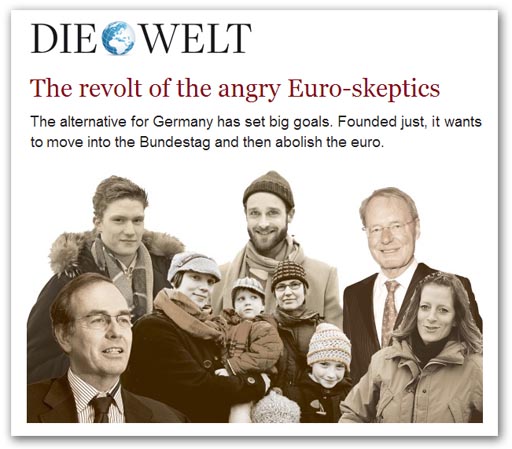
Even in very conventional and staid German politics, the winds of change seem to be blasting through the system. No sooner did Die Welt report its own opinion poll telling us that Merkel's CDU/CSU grouping was well ahead in the polls, with "no sign of a mood for change", then up pops a poll on the AFD which has a potential 24 percent of the vote at the general election. 

Unlike UKIP, though, the new party fares better with the young than the elderly, and with supporters of the Left. This is very much in keeping with other eurosceptic movements on the continent and in the Scandinavian bloc, where Denmark and Norwegian sceptics have a decidedly Leftwards tinge. 

The German movement, though, is very much looking to working within the existing political system. Founding member Bernd Lucke says his party firmly supports the Basic Law (constitution), declaring: "We are not ideological. 

In Italy and Holland, in Grillo an Geert Wilders, we also see anti-EU/internationalist sentiment coalesce around parliamentary parties, with the main effort directed to winning seats in the respective parliaments. The same applies to Austria, where the minority Freedom Party has dominated radical politics. 

Possibly more interesting, though, are the "wildcat" extra-parliamentary movements in France and Spain. 

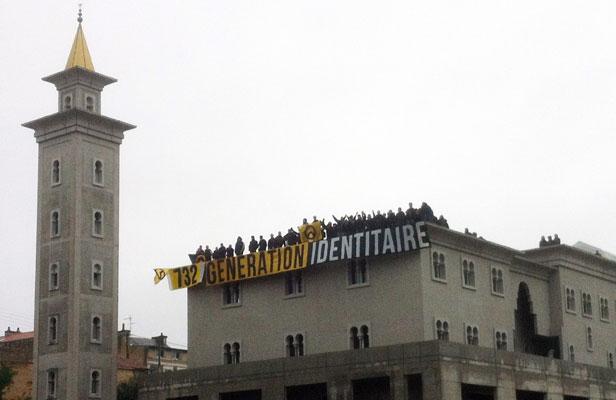
In France, we are seeing the emergence of the "Génération Identitaire", young, angry and on the rise – and now spreading to Germany, where there are 39 regional associations. At the end of March, the French grouping was out in the streets of Paris as part of a 300,000-strong protest demonstrating against gay marriage. 

Strongly opposed to Islam and anti-immigration, some members have sought active confrontation with the police. France's Interior Minister Manuel Valls blamed them for the riots which ensued during the demonstration, and video footage shows activists with "GI" flags in confrontation mode with the police and emergency services. 

With no central direction, they rely on the anonymity of the Internet to spread their "nationalist-right" message, where they speak of the "European Spring" in the manner of the Arab Spring. This is a message of violent uprising against government, their symbol the Greek Lambda, with roots stretching back to 1974. 

The German branch openly expresses its objective as "the preservation of our ethno-cultural identity, which is now threatened by the demographic collapse, mass immigration and Islamisation". The aim of the movement, it says, is "a cultural and spiritual revolution which values tradition, home, family, culture, nation, state, order, and beauty". 

article_poitiers.jpg

For the French, one of their activities has been to occupy on 20 October 2012 a mosque in Poitiers, protesting against the "Islamisation" of French society. For more than six hours, 60 protesters held out on the roof of the building, displayed banners and chanting (picture above). And the choice of Poitiers was no coincidence: In 732, Charles Martel defeated a Muslim invading army.

Through their parent organisation, the Bloc Identitaire, alliances are claimed with movements of a similar nature in Portugal, Catalonia, Holland, Belgium (Vlaams Belang), and Italy (Lega Nord). There is no association claimed with Greece, though, where the racist Golden Dawn is mounting both parliamentary and extra-parliamentary opposition.

As for Spain, there were have seen the growing protests under the label of the "Indignados" (often with strong trade union support), but – in response to the power and weaponry of the riot police, we have seen a change in tactics with the emergence of the flash mob, targeting politicians and officials in their own homes.

Calling themselves the escraches, they are copying tactics developed in Argentina, as a means of countering the violent tactics of the junta. As a dispersal tactic, it has similarities to the August riots of 2011, where the police were unable to deal with multiple outbreaks of violence, spread over a wide area.

Quite whether these various episodes of protest amount to anything lasting, or have the capacity to secure long-term change, is open to question. Unlike our own Harrogate Agenda, which wants fundamental change, most of the parliamentary protests seem mainly to oppose specific policies, without seeking revolution.

The revolutionary groups, on the other hand, such as the Génération Identitaire, seem to be seeking revolution, without any clear ideology. The one thing that unites them all, though, is the dislike (to put it at its most neutral) of establishment politicians. That form of unity, the European Union has achieved, but what happens next is not entirely clear.

COMMENT THREAD