Tuesday, October 25, 2005

Dangerous and irresponsible

While the EU's standing veterinary committee in Brussels was doing what it does best – banning something – in this case all commercial imports of live wild birds, another drama was being played out at Defra headquarters in London.

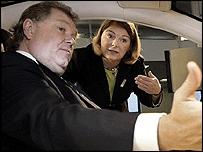
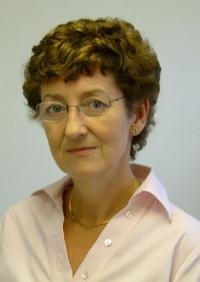
The venue was a private briefing given to MPs by Debby Reynold, Defra's chief vet (left), to update them on department's action on avian influenza but, after a Janet and John summary, one MP at least got down to action and started asking some serious questions.

This was Owen Paterson, shadow junior agriculture minister, who was particularly interested in the fate of not one but two ex parrots, as revealed by the department's own press release issued two days ago and reported on this blog.

Readers will recall that, contrary to media reports, not one but two parrots were sampled by Defra and, unaccountably, the samples were pooled for testing, as a result of which Defra cannot tell which of the two parrots (or both) was actually infected.

More to the point, under questioning, a flustered Debby was unable to confirm the source of the second parrot, saying only that an "internal inquiry" was being carried out to discover why the samples were mixed in what appears to be a typical Defra blunder – of the order of mixing sheeps' with cattle brains.

The significance of this latest blunder, of course, is that, on the basis of the known ex-parrot having come from Surinam where there has been no H5N1 reported, the department has constructed a "working hypothesis" that the infection came from birds from Taiwan in the quarantine facility, despite there being no reports of H5N1 there either.

This hypothesis has already invoked the wrath of Yeh Ying, the Taiwanese deputy director of the bureau of animal and plant health inspection and quarantine, who has called British veterinary experts "irresponsible", and with another ex-parrot involved – of unknown origin – this drives an even larger cart and horse through the department's theory.

Thus, Yeh Ying's comment that: "The British authorities do not have solid evidence while making a statement implicating the possible source of a bird flu virus in another country," is proving to be more accurate than she first imagined, and provides a further demonstration that about the only thing that Defra is any use for is killing animals. Ying, in fact, has got Defra down to a tee… "dangerous and irresponsible," were the words she used.

COMMENT THREAD

One can't help chuckling

I see George Galloway, Respect MP for Bethnal Green (has he been seen in his constituency since his election or has he been spending his time trying to get on the Peace Mom and Jihad Jane act in the states?) is seething with anger.

Well he might do. There he was, certain of having won his battle with the Senate Committee, simply because he used his normal bully boy tactics of shouting, abuse and refusal to tell the truth to the senators’ courtesy. The journalists loved it. A great circus performance.

They were a little less happy when Christopher Hitchens used the same methods on Gorgeous George and destroyed him in a public debate. Since then Galloway has been out of the picture. Jihad Jane Fonda decided he was bad karma and cancelled all their joint appearances. Sean Penn is still recovering from his watery humiliation.

What Mr Galloway had not reckoned on is that the Senate Committee is somewhat different from the Parliamentary Commissioner for Standards, who has been investigating the MP’s financial affairs with glacial speed since 2003. (To be fair, he has been hampered by the case Galloway brought against the Daily Telegraph, the rather eccentric decision given by Justice Eady and the newspaper’s appeal.)

The Senate Committee has gone on investigating various documents and questioning various Iraqi officials in American custody. And they have found a trail of money being paid to Galloway and his estranged wife out of the great oil-for-food scam.

According to Tariq Aziz, former Iraqi Deputy Prime Minister, the moneys were paid over because Mr Galloway was such a great friend to Iraq. Most of us do not get paid for our friendship but let that pass.

Mr Galloway is now huffing and puffing and challenging the Senate Committee to charge him with perjury. Is he sure they won’t?

COMMENT THREAD

Feta complis

Back in February, my esteemed colleague wrote a somewhat acerbic commentary about the EU Commission's decision to allow the word "feta", a specialized cheese made out of goat's or sheep’s milk, to have a protected status.

Surprise, surprise it was to be protected as a Greek name, where, the Greeks say, it has been produced for 6,000 years and, at that point, Denmark had decided to appeal the decision in the ECJ, supported by Germany and France.

Now it has come to pass that the court has delivered its judgement which, according to the Scotsman, has gone in favour of Greece. This confirms that Greek feta is entitled to a "Protected Designation of Origin", with only cheesemakers in certain areas of Greece allowed to use the name "feta".

"[Feta is] from a defined geographical environment with specific natural and human factors which is capable of conferring on that product or foodstuff its specific characteristics," the Court said. "The interplay between the natural factors and the specific human factors, in particular the traditional production method, which requires straining without pressure, has thus given feta cheese its remarkable international reputation."

The ruling has caught out a UK food producer; Judy Bell, who runs Shepherds Purse Cheeses near Thirsk, in North Yorkshire. She has been calling her product Yorkshire feta and now faces a major and expensive rebranding exercise.

Despite her disappointment at the ruling, though, said she was not surprised by the ruling, which is probably just as well – the ruling was almost certainly a Feta complis.

COMMENT THREAD

Going down…

In its six-monthly economic forecast, the EU Commission is cutting its growth estimates for the eurozone. This year’s forecast drops from 1.6 to 1.3 percent while, for next year, the Commission is predicting 1.9 percent instead of the 2.1 percent growth it was offering last April.

The forecasts are to be published on 17 November, according to Bloomberg in a report which will blame the surge in oil prices and high unemployment for the low growth. Crucially, the eurozone will now lag behind the US economy for 14 of the last 15 years.

Pre-empting the publication of the report, EU monetary affairs commissioner Joaquin Almunia, spoke last week in Brussels, saying that there was "no room for complacency." He could just be right.

COMMENT THREAD

Standing over the gap

A nasty little row is brewing between the US and Spain following a decision by the US State Department to delay the sale of 10 Spanish-built C-295 military transports to Venezuela.

Since the aircraft, produced by the CASA subsidiary of EADS, have a number of US components in them, including radar and optical systems, these require US export licences under the International Trade in Arms Regulations (ITAR) before they can be sold to a third-party nation.

The US has not prohibited the sale but is scrutinising the application, something which is infuriating the Spanish and is likely to spur efforts by European arms makers to escape US export controls. A handful of European companies are already advertising some of their wares as "ITAR-free".

In some ways, though, the US move is an "own goal" in that the Europeans are increasingly conscious that the best way to become ITAR-free is to stop buying American-made parts.

This has, to some extent, been behind the determination to equip the Eurofighter with European-built Storm-Shadow cruise missiles and Meteor air-to-air missiles. It was felt that, should the aircraft be fitted with US-built ordnance, their export potential could be limited.

Last April, France's Alcatel Space, which has made it company policy since 2002 to build ITAR-free communications satellites, launched its first ITAR-free satellite on a Chinese rocket.

However, on the C-295 order, US State Department officials are unrepentant, saying a meticulous look at the applications is warranted "given the increasing authoritarian direction of the Venezuelan government," adding that it was likely that the sale of the aircraft would be prohibited.

Moreover, the prohibition is likely to stick as EADS is a US defence contractor and is currently, in conjunction with Northrop Grumman, hoping to bid for the multi-billion dollar USAF air tanker contract.

Nevertheless, more European weapons makers are actively purging US content from all of their equipment with export potential, actions actively encouraged by the EU Commission which is anxious to reduce its reliance on American equipment.

One way out of the impasse, of course, would be for the Spanish to withdraw the sale of its C-295s to Venezuela, which is becoming increasingly aggressive towards the US. Selling military equipment to a nation hostile to the USA, and in its back yard, is not perhaps the most tactful thing to do.

For the UK, though, this is more than problematical as the long-smouldering row over ITAR is progressively increasingly the distance between European and the US, forcing it to make a clear choice between competitive suppliers and reinforcing its “Europe First” procurement policy.

More and more, Britain’s traditional role of forming a “bridge” between the US and Europe coming under strain, a situation which, in my recent paper on UK defence procurement policy - The wrong side of the hill - I likened to standing over the gap between the two halves of Tower Bridge, just as the bridge starts to open.

COMMENT THREAD

Monday, October 24, 2005

French education

One does not want to write endless stories that show our closest neighbours, just across the Channel, in a bad light but then they should not behave in a bad way.

France remains the one former imperial power that has found it difficult to shed that role. Partly this is because the French empire dissolved rather more painfully for the mother country than the British did. Other European powers lost their empires during various upheavals.

It is still hard for the French to come to terms with the mess that was their Vietnam war, which produced many of the subsequent problems of South-East Asia; it is even harder to come to terms with the savage Algerian war that had led up to that country’s independence. Its scars are there to this day both in Algeria and France.

As we have seen in the Côte d’Ivoire, the Middle East and Rwanda, France still hankers after an imperial role and goes to great lengths to preserve its power and influence in former colonies and dependencies. This rarely works. If all else fails, Francophonie is armed to the teeth as the Hutus were in Rwanda.

The truth, however, is hard. So, to avoid having to deal with it the French government did what it always does when there is a problem: it passed a law. This law requires that school textbooks should be changed to portray France in a positive light in its colonial past and, especially, in its behaviour in North Africa.

The Algerian war was remarkably savage on all sides, with the French behaving before and during it in such a way that, once again, they would not have passed those famous Copenhagen criteria.

Then, with General de Gaulle deciding that the time has come to withdraw, despite his earlier promises, about one million French colonists and, more to the point, the harkis, the Algerians who had fought with the French, were abandoned to their fate.

While the French pieds noirs largely escaped to France, the fate of the harkis was terrible. The fact that the Algerian FLN politicians fell out with each other in a nasty way was no consolation to anybody. But, one presumes that none of this will appear in the new legally required text books.

The law was passed in February but has become public knowledge recently, when a number of historians have petitioned to have the law repealed. The Education Minister, Gilles de Robien, announced that no textbook will be changed and President Chirac has reportedly called the law a “screw-up”. There have been protests from the Algerian government as well.

The problem is that the law stands until it is repealed and eventually schools and publishers of textbooks will have to obey it. Such are the rules of the centralized French educational system.

COMMENT THREAD

Confusion compounded by confusion

While the news on avian flu has been largely dominated by the discovery of an ex-parrot, as Monty Python would have it, struck down by the H5N1 virus, it has largely escaped attention that the UK no longer has the power to take unilateral action and must go cap in hand to Brussels for permission to ban further imports of pet birds.

This was confirmed this lunch time when the presenter on BBC World at One asked chief vet Debby Reynolds "...if Europe doesn't agree, is there any way that Britain could act on its own?" Her answer was blunt, and to the point: "No".

But, as we pointed out in our last substantive post on the issue, this is by no means the only thing being missed by the media at large, in what has developed into a classic health scare.

Media speculation, however, is not helped by the lack of detail in the official communications, such as the DEFRA press release on the ex-parrot, which talks of the "highly pathogenic H5 Avian Influenza virus" being found in the unfortunate bird.

But the release then goes on to announce that the "closest match is a strain identified in ducks in China earlier this year," adding, "it is not so similar to the strains from Romania and Turkey. It is not a strain that the Veterinary Laboratory Agency has seen before."

To compound the confusion, we also learn that the tissues from two bird samples were pooled in a single sample, so we are not actually talking about a single ex-parrot. Says DEFRA, "It is not possible to say whether both or only one of the birds was infected with the virus at this stage." Duh!

The Department's "working hypothesis" is that any infection in the birds from Surinam is likely to have arisen in the quarantine system, most likely in the facility in Essex where the Surinam birds shared airspace with the birds from Taiwan.

This hypothesis has invoked the wrath of Yeh Ying, the Taiwanese deputy director of the bureau of animal and plant health inspection and quarantine. She has called British veterinary experts "irresponsible" for saying a South American parrot picked up the infection from Taiwanese birds in British quarantine.

"The British authorities do not have solid evidence while making a statement implicating the possible source of a bird flu virus in another country," she said. "It's very dangerous and irresponsible."

It would help, of course, if the authorities made it clear to the media – and others – that the H5N1 description does not apply to a single virus, but a group of increasingly divergent sub-types or "clades", as Booker sought to do in his column yesterday.

Reports, he wrote, that the "lethal H5 strain" of the virus has reached Britain, via a now-dead South American parrot are so vague as to be meaningless. Millions of birds in Britain have been exposed to the "H5 strain". Even the more precise term "H5N1" does not name a distinct virus but a group of linked sub-types, only one of which has so far proved lethal to humans - and that has never been identified outside Hong Kong, Thailand and Vietnam.

He adds: "The H5N1 group has been around in densely populated areas of east Asia for at least 10 years; and, contrary to popular misconception, the tendency of viruses is not to become more virulent but the opposite (for the sound evolutionary reason that it hardly promotes survival to kill off your host)".

For those who can wade through the impenetrable thicket of scientific jargon, one of the most revealing accounts of the state of play can be found in a paper published by the US Center for Communicable diseases. Amongst other thing, this states that, while "H5N1 viruses from human infections and the closely related avian viruses in the 2004-2005 outbreak… belong to a single genotype," genes from the 2004 and 2005 outbreak "showed two different lineages of HA genes." These are termed clades 1 and 2. A further "clade 3" has also been identified, making three distinct subgroups, with human infection so far being confined to clades 1 and 3.

The fascinating finding here is that Viruses in each of these clades are distributed in "non-overlapping geographic regions of Asia" – in other words, they form distinct viral populations with their own separate distribution (shown on the map here). And, as can be seen, Taiwan is so far free from any isolates.

All this suggest, as we have tried to indicate, that this is far from the black and white picture of the spread of a single "killer virus", inexorably creeping towards the UK, poised to kill millions. In fact, we are dealing with the patchy, almost random distribution of a group of viruses with different characteristics, presenting different (and poorly understood) levels of threat.

In fact, from past history, it may not be any one of the viruses that presents the greatest threat, but DEFRA – which brought us the destruction of 11 million animals in the Food and Mouth epidemic – and the EU Commission which so expertly administers, amongst other things, the Common Fisheries Policy.

With such skill and expertise around, we had better hope that, indeed, the H5N1 viruses do present a great deal less of a threat than some of the more excitable commentators have indicated.

COMMENT THREAD
The twin has it

The other Kaczynski twin, Lech, has won the Polish presidential elections. With a turn-out of 50.6 per cent (something to do, perhaps, with the plethora of elections the Poles have had to go through recently), his share of the vote is predicted to be around 52 or 53 per cent.

His rival, Donald Tusk, has conceded.

The run-off between the two has brought into prominence the peculiarity of East European politics. Both candidates were on the right, both mildly critical of the European Union and both, basically, Atlanticist in their foreign policy ideas.

However, the division in most East European countries and, especially, on the right of the political spectrum is often between those who are more inward looking, almost obsessive about their country’s history and, inevitably, its woes, and those who look outwards, wanting their country, in this case Poland, to be part of the western world.

Kaczynski represents the first of these and Tusk the second. In parliament the two parties, Law and Justice and Civic Platform will have to form a coalition but the President wields a good deal of power. As the International Herald Tribune put it:
“He is commander-in-chief of the armed forces, has a major voice in influencing economic and foreign policy and can veto legislation.”
Kaczynski has promised to defend Poland’s interests vigorously against Germany, Russia and the EU. How he intends to do the last of these, while demanding more money, remains to be seen.

Poland has been having various problems with Russia as we described on this blog in several postings. President Kwasniewski played a crucial role in Ukraine last year and the previous government took a strong line over the oppressions in Belarus. There have also been diplomatic falling-out with Russia but the issue seems to have been resolved. On the other hand, Poland relies very heavily on Russian gas and that may, should President Putin decide to take the gloves off, put something of a dampener on Kaczynski’s policies.

The EU has already made it clear that it is not going to intervene in matters it considers to be bilateral, that is relationship with its immediate neighbours.

As far as Germany is concerned, Kaczynski has spoken of reopening the question of WWII compensations. This is a tricky policy. So many years after the war, a new generation of Germans may not be all that amenable to blackmail. Furthermore, there have been recent publications on Polish behaviour towards the Jews during the Nazi occupation, which did not please the Polish authorities. It might be best not to stir up too many hornets’ nests.

Kaczynski’s proposed domestic policies are different from Tusk’s, the latter being an economic liberal, advocating “an economy with minimum bureaucracy and a transparent, flat rate of income tax”.

The President-elect, on the other hand, having promised to deal with the corruption of the former Communists, many of whom have been in position of power, is also in favour of “cutting taxes and sharply reducing state costs while increasing family benefits and retirement contributions”. It remains to be seen whether the maths will add up but it was a powerful slogan in a country with high and growing unemployment.

There is also the question of what Kaczynski has termed “moral revival”, a popular concept with some parts of the Catholic Church, though not the hierarchy, and the rural population. Again, we have to wait and see what he will actually mean by that but the notion of reversing certain cultural developments in a country, whose youth has travelled widely in the West, seems fraught with difficulties.

COMMENT THREAD

Oxygen thief

Sir Digby Jones, Director-General of the CBI, will be speaking to his organisation’s annual Manufacturing Dinner in Birmingham tonight. Given the drastic decline in our manufacturing base, it should be very thinly attended.

According to the CBI’s own press release, he is going to use the opportunity to tell "European Union leaders to accept the case for economic reform if they are to deliver wealth and prosperity for their citizens in the era of globalisation."

It is difficult to believe that a statement of such utter fatuity could actually escape from the portals of what claims to be an organisation representing industry. Leaders of governments – EU or otherwise – do not and cannot “deliver wealth and prosperity for their citizens".

Governments are wealth-takers and the best – and only – thing they can do is get off our backs and let people get on with creating wealth. If the director general of the CBI cannot understand this, he is more than a waste of space. The man is an oxygen thief.

COMMENT THREAD

It never rains but it pours

Piling on the agony, the Financial Times this morning retails figures published by the International R&D Scoreboard, showing that EU member states have fallen further behind in the research league.

According to this source, the increase in corporate R&D investment for 2004-05 was two percent in Europe but seven percent in the US and Asia. South Korea had the most spectacular annual growth - 40 percent - led by Samsung Electronics, Hyundai Motor and LG Electronics. The increase for Japan was a more modest four percent.

Only five years ago, the FT reminds us, member states committed the EU to becoming the world's leading knowledge economy by 2010. In a stark illustration of the difference between aspiration and performance, however, the scoreboard shows that European companies as a whole have not increased R&D investment over the past four years, while their US counterparts are spending 12 percent more on R&D than their four-year average.

Never mind though, BBC hack Angus Roxburgh, writing in the Sunday Herald yesterday, has just the recipe for boosting the EU's popularity.

What Europe needs, he writes, is a landscape dotted with signs saying "project financed by the European Commission". That, he asserts, is something people can understand. It may mean paying more rather than less into the EU's coffers, but that's surely preferable to belabouring us for another 10 years with vapid arguments about institutional reforms that will "bring Europe closer to its citizens".

From which pit of economic illiteracy did this man crawl?

COMMENT THREAD

Sunday, October 23, 2005

He's singing our tune

Writing last night of our growing conviction that the EU is dying, we did not expect an almost immediate confirmation for Europhile extraordinaire Will Hutton in today's edition of the Observer.

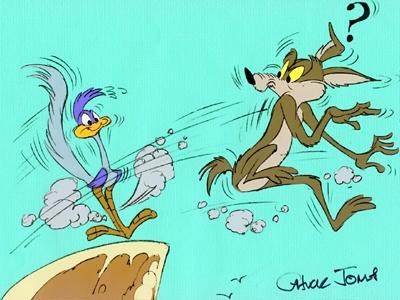
But there, large as life is an article by the same, headed: "Europe is hanging by a thread", in which Hutton equates the European Union to a "Tom and Jerry" cartoon. Tom, he writes, has run over the cliff edge chasing Jerry and his legs are still pumping furiously in thin air; he's yet to plummet to earth to meet some grizzly end. The EU has gone over the cliff edge, its legs are still pumping, but there's no realisation among its leaders or the wider public that a vertiginous plummet is imminent.

It says something for Hutton's unworldliness that he chooses "Tom and Jerry" for his analogy, as this cartoon is set in a domestic environment. Cliffs rarely feature. More famously, the cliff scenes are portrayed in the Loony Tunes "Road Runner" series, where it is more likely to be Wile E. Coyote who takes the fall.

Anyhow, this does not stop Hutton opining about next Thursday's informal European Council in Hampton Court Palace, although once again he gets it wrong, calling it the "routine half yearly European Council". It is anything but routine - this is a special event, outside the normal cycle, called personally by Blair.

Nevertheless, Hutton is right in saying that this meeting is different. "The EU is in an existential crisis over what it is for, where it is headed, how it is to be governed and how to win popular Europe-wide consent," he writes, adding, "Despite the appearance of normality, the crisis is beginning to paralyse the entire operation."

This is strangely reassuring for an entirely unconnected reason. Keeping this blog running with a daily diet of news and views has proved increasingly difficult and, for a while, I thought I was losing my touch. But, as Hutton illustrates, it is EU itself, rather than the news gathering, that is at fault. He writes:

The lack of agreement over everything - from the next seven-year European Union budget, beginning in July, to the stance that should be taken in the world trade talks set to begin in Hong Kong before Christmas - has gone well beyond the usual intra-EU spats.

The No votes in France and Holland on the EU constitutional treaty have left the 25-member EU without a workable system of governance. They have created, particularly in France, a political dynamic that opposes head-on the so-called Anglo Saxon liberal worldview that allegedly wants to dismantle Europe's social achievement and open up every European industry to the full blast of unfair global competition.

This, say the French and their camp-followers, is the not-so-hidden agenda of a lightweight EU Commission and its British ally; they are Trojan horses with the hidden mission of wrecking Europe. The mood is ugly, the divisions run deep.

Meanwhile, he continues, the EU economy continues to languish. By last weekend every member state was to have submitted its plan to contribute to making Europe the world's most competitive, knowledge-based, dynamic economy by 2010 - the so-called Lisbon agenda. This was to have been proclaimed in a blaze of publicity and political commitment that would signal a common European determination to do better. The plans were submitted. But not only did nobody notice, nobody cared.
Then, to the sound of wailing violins, he tells us that the EU "is a fragile and beleaguered creation that could easily fall to earth like Tom" (or Wile E. Coyote), and is only as strong as the collective political commitment of its member states and citizens which is now sharply weakening.

The rest of his analysis need not detain us, but he concludes that, if you are on the side of the EU, you have fight for it. Beset by critics and internal division, without a sense of purpose and momentum, the EU will rot and implode. "Nobody should underestimate the risk…", he adds.

Interestingly, some of that "rot" is conveyed by an article in today’s Sunday Times, which tells us that the "colleagues" are growing increasingly critical of Britain’s presidency of the EU. Blair is under attack for doing too little to lift Europe out of its political crisis since the rejection by France and Holland of the proposed European constitution and critics are saying that Blair has failed to meet the high expectations that he set with his talk of modernisation in a speech to the EU parliament in June. An Austrian MEP, Otmar Karas, even says, "Blair seems to have gone into European hiding. He seemingly has left the stage".

It seems to me that Blair is simply recognising the reality. He does not want serious talks on a whole variety of issues because there is no prospect of agreement or advance. I wonder, though, if he realises that there is only one letter difference between "talks" and "tanks"?

COMMENT THREAD (Combined posts)

How very appropriate

The Fragrant Commissar blogged on Wednesday. The title of her entry is “Recent Comments” and the shortened introductory version of the posting has one word only: “I…”. Overdoing the personal in the political, methinks.

The rest of it is fluffy bunny stuff on how helpful all the comments have been with no responses at all to the more serious and critical questions. The lady is wearing us out with sheer boredom. Is this how she rose to prominence in Sweden?

COMMENT THREAD

French punishment

Once again we are indebted to some of our readers for this story. According to a report by the International Observatory of Prisons, presumably one of those organizations French politicians and other grandees are always telling Americans to listen to, French prisons are “akin to dungeons in the Middle Ages”.

As the Scotsman put it:

“Hygiene is "deplorable", with inmates crowded into filthy,rat-infested cells, leading to an explosion in the number of prisoners with infectious diseases, the International Observatory of Prisons (IOP)said.

It described conditions as "catastrophic" and condemned the French government for failing to improve matters. "The situation is totally unworthy of our level of civilisation. Conditions of detention are close to those of the Middle Ages," the Paris-based IOP said.”

Oh dear. It seems that Abu Ghraib and Guantanamo are not the worst places on earth, after all.

The organization, which is based in Paris, to add insult to injury, went on:

“French jails suffered from overcrowding, bad hygiene, rising violence and suicide rates of more than six times the national average - France has Europe's highest suicide rate among prisoners. The number of suicide attempts rose 10 per cent last year, while incidents of self-wounding and hunger strikes were up 25 per cent.

Violence and revolt against the prison authorities have also increased dramatically - there was a 155 per cent rise in the number of riots last year.

Eight out of ten inmates suffer from psychiatric problems, but access to medical care is limited.”

Another question springs to mind: if France were applying for EU membership now, would the country pass the test of the Copenhagen criteria with that sort of treatment of prisoners? I think not.

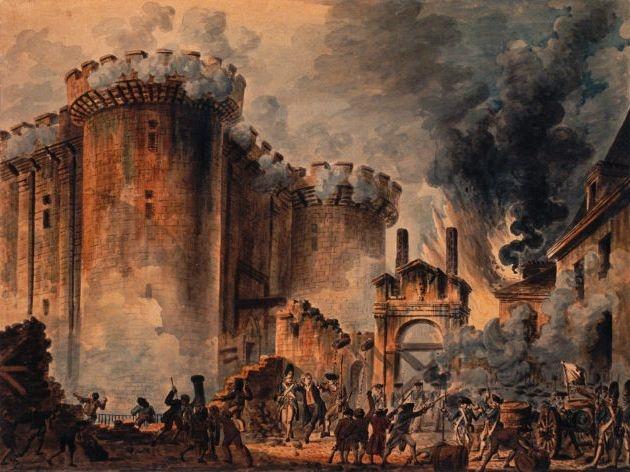
Prisons have figured largely in French history. There was, of course, the storming of the Bastille on July 14, 1789, which released the vast number of seven prisoners. It would have been eight, but the Marquis de Sade had been transferred to the insane asylum, Charenton-Saint-Maurice, on July 4.

Then there was the unfortunate episode of the September Massacres. In 1792, fearing the rapid advance of the Prussian army, fearing even more that many citizens of Paris would welcome them as liberators from the revolutionary government, angry about the lack of food and egged on by the radical propaganda, the mob broke into the prisons where enemies of the revolution were, dragged them all out and murdered them in various rather horrendous ways.

Many revolutions start with prisoners being released by mobs and should one happen now in France, with the prison population filling up 115 per cent of the available space, according to the report, a large number of people would suddenly find themselves at liberty.

Fortunately, for the French establishment no revolution seems to be on the horizon.

COMMENT THREAD

Us and them

One of the most significant developments in ordinary political discourse over the last few years has been the emergence of the term "political elités", used to decribe the ever-widening gap between the nomanklature and us mere peasants. Certainly, in my dim and distant youth, I do not recall this term having any currency.

And, if there was needed any confirmation of the existence of that gap, several articles in today's papers would provide it. Not least, in The Business, there is the forensic dissection of the shameful cave-in by the government over public sector pensions last week, which cements in a two-tier system – one of tax-funded generosity for the apparatchiks and another of penury for us lesser mortals.

The story is also picked up in the Focus section in The Sunday Times, pointing out that public sector workers who retire in good health live two to four years longer than private sector retirees.

Another indicator of the gap can also be found in The Sunday Times, this one describing how the government intends to create VIP lanes reserved for athletes and officials at the 2012 London Olympics. Mere mortals who stray onto this sacred ground will face penalties of up to £5,000 under special powers sanctioned by the government, leaving as many as 55,000 members of the "Olympic family", including ministers, media and corporate sponsors, to sweep past the plebs.

We seem to have been here before, with Moscow's so-called "chaika-lanes" reserved for the politburo as they swept to and from their offices in their luxury Zil limousines.

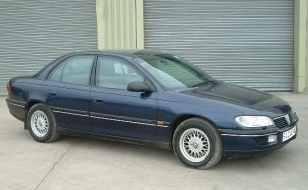
But perhaps the most egregious contrast – also to be found in the Sunday Times – is, on the one hand, a story about how Cherie Blair is to be provided at taxpayers’ expense with a chauffeured armoured car. Use of the car, a bullet-proof Vauxhall Omega (pictured above), is estimated to be costing taxpayers more than £50,000 a year. She also has the use of a Ford Galaxy people carrier as backup.

The Times, incidentally, reminds us that Denis Thatcher, despite the real threat from the IRA, could often been seen strolling along Whitehall to meet his friends at a club or would take the bus using his senior citizen's pass – he, like all other prime ministerial spouses – was not entitled to an official car.

The contrast comes with the story in the same paper about how Lieutenant-Colonel Nick Henderson, commander of the 1st Battalion, Coldstream Guards has resigned after failing to obtain armoured Land Rovers for his patrols. He is understood to have been furious last week after one of his senior sergeants died as a direct result of the failure to supply "armour protected" Land Rovers for his men, forcing them to patrol in unarmoured vehicles. Sergeant Christian Hickey was killed when his vehicle was blown up by a roadside bomb on patrol in Basra late on Tuesday night.

The Ministry of Defence, predictably, is dead-batting this event, stating that "frontline troops cannot have the armoured Land Rovers because they are not unsuitable (sic) for use off-road," despite six weeks previously, Britain supplying a number of the vehicles to Iraqi police in Basra.

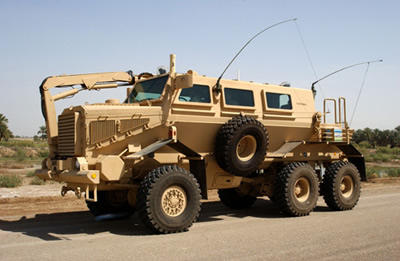
However, as we understand it, Sergeant Hickey was on foot patrol when he was caught by a roadside bomb that he was investigating. Yet the "dumb Yanks" - as too many people delight in calling them - are providing a neat little (actually not so little) machine for dealing with this type of problem, and it ain't an armoured Land Rover, which provides only very limited protection.

Weighing in at 23 tons, this machine is called a Buffalo (above). Designed on principles developed by the South Africans, it has a 30 ft extendible arm to check out suspicious road-side packages and debris, with highly effective armour to protect its occupants if a bomb does go off. Of course, if Tony Blair wasn't wasting our money on buying his wife armoured cars, and he hadn't wasted nearly £6 billion on his "European first" defence procurement policy, we might be able to afford a few of this highly desirable machines.

COMMENT THREAD

Beyond carelessness

"To lose one may be regarded as a misfortune," said Lady Bracknell. "To lose two would look like carelessness."

That much could already be said of the UK Independence Party which, from the heady days of the Euro-elections last year, swept up twelve seats, only to lose Ashley Mote when it was learned that he had failed to declare an impending court case for benefit fraud, and then the egregious Kilroy-Silk following a very public fall-out.

But now, if the story in today's Sunday Telegraph is any guide, the Party is well on its way to losing a third.

This particular MEP is one of the least-known of the ten remaining, a certain Tom Wise (above). He appears to have been contradicting his own surname, having claimed £36,000 from the EU parliament to pay his researcher, Lindsay Jenkins, and then pocketing all but the £6,000 that he actually paid her. When confronted by the Telegraph, he admitted that the extra money was in his bank account, claiming that he had not intended to spend it and was keeping it for his researcher.

However, Jenkins, herself had been unaware that, in claiming her £6000, paid as a monthly retainer of £500, Wise had told the EU parliament that it was six times higher than it actually was. When asked why there was a discrepancy between the amount he was claiming and the sum he had agreed to pay Jenkins, Wise told the Telegraph, "I don't fancy answering."

Wise is a former assistant to Geoffrey Titford and number two in the Eastern Region behind him. Titford recently took over the chairmanship of the Party after the resignation of Petrina Holdsworth. It now looks as if Holdsworth's resignation was not entirely unrelated to today's disclosure as it also appears that Wise's "indiscretion" was known to senior members of the Party who appeared unwilling to act.

Sources indicate that Holdsworth's demand for "greater transparency" in the Party related directly to this issue, as rumours had spread of a gap between MEP's incomes and their actual declared spending. The former chairman's resignation has now been followed by a senior member of the Party’s NEC and more are expected to follow.

Meanwhile, Wise remains a UKIP MEP, but surely not for much longer, the third to be expelled. And, if losing two, "would look like carelessness," we need another Lady Bracknell to suggest a word for the triple loss.

COMMENT THREAD

Saturday, October 22, 2005

A long time dying

What to us was a gut feeling about the EU running out of steam is somewhat strengthened by tomorrow's edition of The Business.

Under the heading, "EU hit by capital flight as red tape proliferates", Allister Heath reports on a survey from Morgan Stanley which claims that Europe's largest companies are planning to make 40 percent of their investments outside the continent this year.

The report, yet to be published, will confirm that high levels of red tape in the EU and "general unfriendliness to investors" is leading to huge capital flight to more welcoming shores. Writes Heath, the news will deal another blow to European workers, who are suffering from high levels of unemployment and sluggish wage growth.

The article cites Eric Chaney, economist at Morgan Stanley, saying: "It is probably fair to say that between one-third and one-half of investment projects by European companies are going outside high-income Europe. A combination of unfriendly government policies, slow growth prospects and high wage costs probably explain this important leak in the macro investment equation."

These are just the sort of statistics that the gnomes of the Berlaymont simply cannot fudge. And no matter how much Barroso prates about relaunching Lisbon, and increasing "competitiveness", etc., etc., it is facts like these that stand as testament to his failure and the growing failure of the "project".

My colleague, however, warns against premature optimism. The EU may be dying on its feet but, like the Soviet Union before it, when it comes to political constructs, it can be a long time dying.

COMMENT THREAD

Not very Nice

At the end of last month, we reported how the giant French defence, electronics and engineering contractor, Thales, had become embroiled in a major bribery scandal.

Amongst other things, it was facing allegations from Michel Josserand, former chief executive of Thales Engineering and Consulting (THEC) that it paid out millions of dollars in bribes and sold chemical weapons to the former Iraqi regime of Saddam Hussein. Josserand has also told police investigating Thales that the company took part in the construction of an Iraqi chemical-weapons plant disguised as a factory that made powdered milk.

Predictably, the company denied everything, even announced that it was going to take immediate legal action for defamation against Le Monde, which reported the scandal, and Josserand. As for the whistle-blower, now working for the European defence contractor EADS, he was threatened with the sack and had gone into hiding.

However, the affair is now taking on a little more substance. According to Reuters, the company has now admitted formally that its communications subsidiary has been placed under investigation by Nice prosecutors, who are conducting a corruption probe.

Although there have been suspicions of bribes in relation to a light tramway contract in Nice, this investigation relates to a suspicious payment at the end of 2004, when a motorway contract was awarded. The subsidiary, Thales Communication, was chosen by motorway company Escota to provide radio equipment for the motorway network around Nice.

The network allows motorists to tune in to a special radio station, Traffic FM, that combines music broadcasts with traffic reports and can be heard only on the motorway.

The news agency AFX goes further than this, with a report that states Thales has apparently admitted an "irregularity" in the radio contract.

There is still no further news of the progress of the original allegations, but files are still with Paris prosecutors, who are also investigating the corruption allegations. But, as the noose begins to tighten around the company, Thales executives must be thinking that the situation is no longer very Nice.

COMMENT THREAD

Friday, October 21, 2005

UNESCO tries to control flow of ideas

The BBC website is rejoicing: Countries turn backs on Hollywood. Gee-whizz, those big moguls in Hollywood are getting their come-uppance by excellent stuff being produced across the world, one might think.

Well, one would be wrong. What the BBC and various other media outlets around the world, though in more measured terms, are getting excited about is the new UNESCO Convention on the Protection and Promotion of Diversity of Cultural Expressions, which had been especially promoted by France and supported by all other members, except Israel.

According to the BBC, the American delegates explained their opposition because the “deeply flawed” Convention “could be used to block the export of Hollywood films and other cultural exports”.

In actual fact, Louise Oliver, the US ambassador to UNESCO, pointed out that the Convention could well be used by dictators to control what their citizens can read or see. Never let it be said that the BBC could get worked up about that sort of censorship.

The Convention’s aim is to “maintain, adopt and implement policies and measures that they deem appropriate for the protection and promotion of the diversity of cultural expressions on their territory”.

As the Washington Post explains:
“Cultural expressions are defined as including music, art, language and ideas as well as "cultural activities, goods and services."”
How it will be put into effect is unclear, as it is not supposed to over-ride existing treaties and WTO rules.

France already subsidizes heavily its cinema to little avail, since French people flock to see American films. Whether it is such a good idea for poor countries in the developing world to spend badly needed money to protect and subsidize their “cultural heritage”, which will be, presumably, whatever particular governments say, is very questionable.

There were some very interesting statements. According to the Washington Post:
“"The American delegate doesn't like to hear the word 'protection,' " Joseph Yai Olabiyi Babalola, clad in the ornate gold robes of his tiny country, Benin, told UNESCO delegates. "Not all countries are equal -- some need to be protected."”
Would anyone care to guess what that would mean in practical terms in Benin? Is it really films the government is worried about, or something else, like books and ideas?

The British delegate, Timothy Craddock, in a peculiarly pompous mood, announced that in his considered opinion the document was “clear, carefully balanced and consistent with the principles of international law and fundamental human rights”. Whatever that may mean.

Interestingly enough, the most popular British film of the last few weeks has been the new Wallace and Gromit one: “The Curse of the Were-Rabbit”. Though it is proclaimed to be proudly British, it was, in fact, made by Dreamworks and, is, therefore, technically an American Hollywood movie. The same is true about most British films, popular or (mostly) otherwise. One wonders whether Mr Craddock is aware of this.

Given the ease with which films and music can be downloaded and DVDs transported around the world, the chances of this Convention having any kind of an effect on the American industry are low. Countries (i.e. the elites and bureaucrats) may turn their backs on anything they like; the people are unlikely to do so, whenever and wherever they can get round the problem. But it is good to see another tranzi organization lining up against freedom and real diversity as opposed to state sponsored ersatz diversity.

COMMENT THREAD

Reinventing the wheel

Never missing an opportunity to miss a point, the former "Vote no" campaign has re-emerged with a new coat of paint and the somewhat unoriginal name of "Open Europe" – so unoriginal that a Google search yields 44,400 entries, including a contribution from El presidente Barroso, headed: "Open Europe – the European Union leading in a globalised world".

Headed by Neil O'Brien, he of the "vote No" campaign, with Rodney Leach as chairman, the group launched itself yesterday as a "new campaigning think-tank", its task "to contribute bold new thinking to the debate about the direction of the EU". We are told that:

Open Europe will make the case for radical reform based on economic liberalisation, a looser and more flexible structure, and greater transparency and accountability.
Their logo comprises two eccentric circles, representing perhaps an unbalanced wheel, but perhaps it is symbolic of the lack of thinking at the heart of Rodney Leach's new toy.

We are told that the champagne and canapés were well received by the small number of guests at the opening – held in the Bloomberg building in the City, amongst whom were – briefly – Michael Howard, unaccountably wearing a black tie, and that not long after Cameron’s victory had been announced in the Tory leadership poll.

Presentations were made by from Rodney Leach, Derek Scott and Oxford Economic Forecasting, the latter having been commissioned to produce a report on the need for EU trade liberalisation and CAP reform, all on the theme of economic reform.

The fantasy bubble, however, was punctured by an intervention from David Heathcoat-Amory, who as the Conservative representative on the EU's constitutional convention, reminded everyone present that the European Union was incapable of reform. Interestingly, Friedman got there first, as did Lady Thatcher.

When Heathcote-Amory declared that what is needed is "a new relationship with the EU", and asked what were Open Europe going to do about that, silence fell upon the room. Leach looked dazed, his composure gone. Eventually, he got back into his stride and talked about the need for a renegotiation and, if that were to fail, then they might have to think about this "new relationship”.

Presumably, that is why they are calling themselves a "think-tank", their first thought being that the government should not agree to the new EU budget "unless there is clear progress towards opening up trade and reforming the EU." And, for their next trick, they are going to launch an "Open up" campaign, asking MPs and MEPs to back a campaign for free trade.

In between, we expect, they will be assuming their more usual position, illustrated above.

COMMENT THREAD

Trafalgar


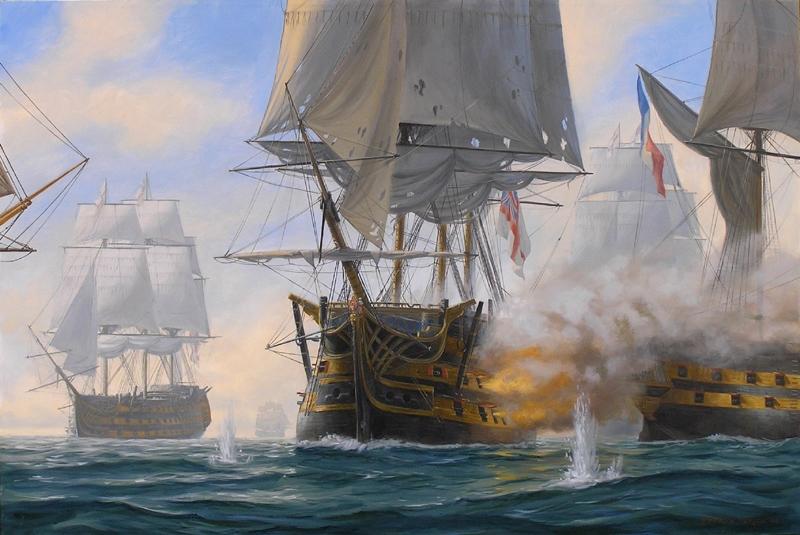
This blog cannot ignore today’s great anniversary: two hundred years since the Battle of Trafalgar, where the combined French and Spanish fleets were defeated by the Royal Navy under Admiral Nelson, who was killed during it.

We cannot go into the details of the battle or its significance to the Napoleonic wars – the Grande Armée remained in possession of most of the Continent.

But the victory killed off any idea of an invasion of Britain and established British supremacy on the sea. It took another ten years but Napoleon was defeated and his oppressive political system was destroyed everywhere except France, where much of what he had established in the legal system, policing and education, has remained.

A great victory, a great achievement and the heroic death of one of England’s greatest heroes. Much to celebrate.

COMMENT THREAD

Running out of steam

Jose Manuel Barroso has issued a "wake-up" call to EU leaders, telling them to "endorse reform or risk economic, social decline", reports AP. Ye Gods! The man has issued more wake-up calls than an alarm clock for hot-bedded shift workers in a doss house.

And as for his new "big idea", announced in the same report - the creation of a multi-billion-euro "solidarity fund" to help workers in the EU hit by job losses blamed on global competition – this was covered in The Daily Telegraph on 11 October, and reviewed by this blog the same day.

That has not stopped Bronwen Maddox of The Times writing about it though. She must be getting as desperate as us when it comes to decent EU news.

Under the heading: "the rising cost of compromise in the EU", however, Maddox gives it her own spin, writing that the price of trying to bridge the gap between the British and French visions of Europe is getting higher.

She also informs us that Barroso's efforts "reflect his urgent attempt to get EU countries to agree on the budget", despite Blair wanting to avoid budget details at the informal European Council later this month, and wanting to talk about cutting red tape instead. But we wrote about that on 11 October as well.

On another front, the Doha round trade talks have stalled again, through French intransigence – as always – and there is no movement on the British rebate. Even, according to the Hindustan Times (but no British papers), the prestigious Galileo global navigation satellite system is still in jeopardy, after funds for the project were blocked, and the great plans for a Euro Army seems to be be struggling as Italy last week chopped its defence budget to a historic low of 0.84 percent of GDP.

There is still, of course, the slow march of integration, through the multifarious directives flowing from Brussels but, aside from that, there is absolutely nothing by way of new or imaginative initiatives coming from that quarter.

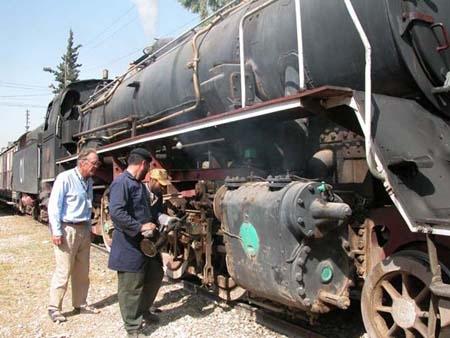
The impression is growing more powerful by the day that the "project" is running out of steam. It begins to look like that train is not going to arrive at its destination.

COMMENT THREAD

Thursday, October 20, 2005

Wheels within wheels…

The second round of the Tory leadership contest is declared and the pundits are in full flow. But the result, although pre-ordained, is not quite what it seems.

Cameron polled 90 votes of the 198, making him the clear winner, but the result fell short of expectations – some pundits having predicting well over the hundred mark. And therein lies the story.

Should Cameron have actually reached or exceeded the magic hundred mark, the pressure on Davis – who polled 57 against his first round figure of 62 - to concede, would have been huge.

This would have led to the "coronation" of Cameron, which would have been convenient but hugely unpopular with the party, which wanted its say in the contest.

But, with Fox coming up strongly, and offering some real policies with hard teeth – not least issues which he had adopted from the Cornerstone manifesto – the Cameron team decided, it the contest was to be kept going, Fox must be neutralised. If they had to go to the party, a tired and increasingly unconvincing Davis would be the best foil.

Far from supporting their man, therefore, the Cameron team have spent the day frantically bolstering Davis, persuading "flakey" supporters to stay with him, rather than defecting to Cameron. To cement in the final choice, some of Cameron's most loyal supporters cast their vote for Davis, to shore up an otherwise collapsing vote and keep Fox out of the race, with the added advantage of keeping their man's vote below the century.

But for this back-room dealing, Cameron's vote could have reached 120 as Davis's collapsed, leaving him trailing behind Fox's 51 votes. The final contest would have been between Davis and Fox.

The Cameroons are jubilant that their ploy has worked. They now feel that their champion cannot help but shine against a demoralised Davis. He is well aware that his position in the finals is entirely due to his opponent, who has saved him from a humiliating defeat.

The game, however, is not entirely over. Although Cameron is regarded as "unstoppable", the Foxites will now be trying to pin down the elusive old-Etonian, forcing him to make policy commitments that he has to carry over into his leadership.

There are three weeks to go before the postal ballots go out – with the majority being returned within 48 hours – so there is little time to make an impact.

Whether the media take part in the game is questionable, or whether they even realise what the game is, but if they could tear themselves away from personalities and start looking at the issues, this could be the most interesting and important phase of the contest.

COMMENT THREAD

"Jeszcze Polska nie zginęła"

Roughly translated, the first line of the Polish national anthem means “Poland is not dead yet”. The text of what has been known as The Song of the Polish Legion or the Dąbrowski's Mazurka then goes on to tell the world that as long as Poles live, Poland will not die.

It is slightly unfortunate that the song was written for the Polish legion that was going off to fight in Italy for Napoleon, he having created a sort of independent kingdom after defeating temporarily the Russians.

But that is all in the past. Since then, the stirring words of the Polish anthem has given the Poles and, through them, other nations succour in times of trouble.

Well, Poland is once again a country and a member of NATO and, unfortunately for itself and others, of the European Union. But, it seems, the old Polish spirit lives on even in these days of peace. That was, at least, my conclusion on reading John Vinocur’s piece in the International Herald Tribune two days ago [subscription only on the net].

Entitled Poland holds to U.S., and EU sways it not, the article analyzes Poland’s attitude, in the wake of a slight electoral swing to the right, towards the European Union.

His conclusions are not surprising. It has always been clear to us on this blog that the new East European members of the EU will not change its economic structure. They may have introduced free-market reforms and low corporation taxes, which have clearly helped their economic development, but they remain client states. It is not easy to proclaim the advantages of a free, low tax economy while you are holding your collective hands out for a greater hand-out from the taxpayer of the high-tax west European member states.

On the other hand, the new member states have, as I claim to have said at a conference in Oxford, long before Donald popularized the terms Old and New Europe, a very different outlook on the world from the old ones. Their view is shaped by forty years of Communist rule, their struggle with it and their distrust of the Big Bear that is not all that far away and with whom France and Germany (and Britain) happen to be very friendly.

As Vinocur sums up:

Last month, the country elected a new center-right Parliament that will hold to what is pretty much both conviction and emotion here: that you stick to the Americans for security, support for your still great notions of freedom emphasis on the place of religion in society, and Polish independence.

You back neighboring Ukraine’s break from dictatorship to democracy to the hilt, and you wish insistently and out loud for democratic change in Belarus, another neighbour still under authoritarian rule.

The EU, rather more coolly, is associated mostly here with both caution and aspirations for prosperity – specifically the cash subsidies that are needed to sustain the Polish voyage to higher living standards.

As for freedom, the Polish mind-set on Western Europe had been indelibly marked by considerable hesitation there to openly support the Solidarity trade union’s rebellion against Communist rule in 1981.

No joke, an Austrian speaker recalled, but his country’s labor officials didn’t recognize Solidarity until 1989!

Well, no joke either, but, while the Thatcher government supported Solidarity, the British trade union movement went on supporting their brothers in the official Polish trade union movement for several years.

Poland, as our readers will recall, led the East European “rebellion” against the Franco-German attempt to dominate the European foreign policy agenda and, in l’escroc Chirac’s famous words, lost a great opportunity “to shut up”. With that one phrase the man wiped out the entire long and expensive French attempt to line the new members up behind France within the EU.

Most East European countries have troops or police in Iraq and Afghanistan. Poland, in particular, has been uncompromisingly Atlanticist in its foreign policy. Successive governments and presidents have made it clear that a European identity in foreign policy was non-existent and not to be relied on.

Furthermore, as we have commented in numerous postings, the EU played very little part in the Ukrainian development last year, and has refused to get involved in Poland’s problems with Russia and Belarus. All these were dismissed as “bilateral matters”, though some of us had assumed that such a concept would not survive the creation of the common foreign and security policy.

As we have pointed out before, however, a common policy requires common interests and there are none. So, the EU continues to create foreign policy structures, make large and meaningless proclamations and promise to send troops (or something) round the world to sort other people’s problems out. Its own backyard, on the other hand, it cannot deal with.

Professor Bronislaw Geremek, member of the European Parliament, former Polish foreign minister and, before that, a courageous dissident, the man who ought to have become President of the European Parliament, told John Vinocur:

The EU is not seen as a valid reference for the security of the country. We’re very sensitive to it at a time when Putin regards the new countries in the EU raising the possibility that Europe will be more hostile to Russia. The EU needs an ostpolitik which it hasn’t yet defined. We know the situation well and can help define a policy in terms of fundamental Western notions.

Or as the old Russian slogan enunciated by the few radicals that actually believed in freedom had it: “За Вашу и Нашу Свободу.” For your freedom and ours.

COMMENT THREAD

France's little Iraq

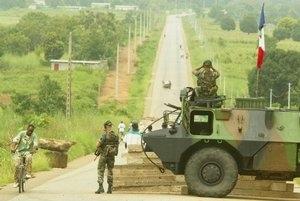
With the Western media focused on Iraq, and only too quick to report the slightest infraction by US troops, a report from Reuters today about the goings-on in the French-occupied Ivory Coast provides a salutary reminder of the less than benign nature of French foreign policy.

The news is of the suspension by French defence minister Michele Alliot-Marie of General Henri Poncet (above), the officer commanding French "peacekeepers" last May when an Ivorian man, named as Mahe, died after being shot by French troops. In addition to Poncet, Colonel Eric Burgaud and an unidentified platoon commander have also been suspended.

At the time of the shooting, the French claimed that dead man was a known highway gang leader who was wanted for crimes including five killings and four rapes. He had been spotted by a French patrol which had pursued and surrounded him, whence he had opened fire and been shot "in self defence".

It now transpires, from a report in Le Figaro, that Mahe was killed in cold blood. The newspaper claims that a platoon had seen Mahe by the side of the road. When the bandit ran, the platoon commander ordered his men after them and they "all opened fire." Some 650 rounds were fired and, badly wounded, the man was left for dead. Some villagers then carried him to the road, where he died. There was therefore no self-defence, the newspaper said, citing several unidentified French officers as its sources.

Le Figaro adds that the original report into the incident was sent to the Ferench headquarters where General Poncet approved it, despite - as one officer claims - being "aware of what happened."

Now, following an official investigation, French Defence Ministry spokesman Jean-Francois Bureau has admitted that: "the facts, as they have been gathered by the command's inquiry, have established that, contrary to what was said at the time, there was no legitimate defence."

Poncet, who is currently based in the southwestern French city of Bordeaux, headed an operation code-named "Unicorn" from May 2004 until June this year, taking charge of 4,000 French troops, supported by UN forces, which had intervened after a failed coup in Ivory Coast in September 2002. He is now being questioned in Paris about an alleged cover-up following the death of an Ivory Coast national in military custody.

Under somewhat dubious circumstances, France sent troops to its former West African colony in September 2002 after a coup attempt against president Laurent Gbagbo during which rebel forces won control of the northern part of the country, despite the reluctance of the Ivorians to accept them, wanting a neutral force.

This is only the latest episode in the unhappy relations between France and the Ivory Coast. This West African country, having been a French colony since 1893, was formally made independent in 1960, although its economic assets and major businesses have since remained largely under French control. The French own 45 per cent of the land and, curiously, the buildings of the Presidency of the Republic and of the Ivorian National assembly are subject to leases concluded with the French.

Resentment of French "neocolonialism" has been behind much of the political unrest in the country, which took a turn for the worst last November when the Ivorian air force bombarded a French base at Bouaké, killing nine French soldiers, after president Gbagbo had accused the French of siding with the rebel forces in an attempt to depose him.

The French army had already fired without warning on unarmed Gbagboist demonstrators in November 2003, seriously wounding three of them and then, on direct orders from Chirac, France responded in what was seen at the time as a gross over-reaction - by destroying the country's entire air force, sparking riots in Abidjan. Some 70 Ivorians were killed and over 1,000 injured by French troops firing on unarmed crowds. In a move which further infuriated the Ivorians, the French chief of the general staff dismissed claims of a "massacre", only admitting that his troops might have "wounded or killed a few people", while "showing very great calm and complete control of the violence."

While the African Union troops now stand alongside the French, the UN has brokered a deal which will keep Gbagbo in power for the next 12 months, until further elections, when the pressure for complete French withdrawal will strengthen. Such is the hatred of the French now that – contrary to the scenes elsewhere denouncing Bush, Ivorian have actually been calling for US intervention. Strangely, little of this has percolated into the Western media and, of the latest episode in want has been called France’s little Iraq, from the BBC we hear nothing.

COMMENT THREAD

UNICEF replies (sort of)

Today's Daily Telegraph carries an indignant letter from David Bull, UNICEF UK Executive Director, which purports to respond to Mark Steyn’s article on Smurficide.

How dare Steyn imply that UNICEF is not entirely accurate and might have a political agenda, fulminates Mr Bull. Everybody knows what a wonderful organization it is and how terrible life is for children in conflict areas (can’t argue with that). The aim of the film is to raise awareness and no, it has nothing to do with Iraq. Or, rather, yes, it does have something to do with Iraq, but it is also about all those other nasty places.
“However, the advert was not connected solely to the conflict in Iraq. Children are always among the first affected by conflict and not just in Iraq but in the Democratic Republic of Congo, Afghanistan, Somalia and many other countries where violence lays siege to childhood. Unicef works to provide assistance and ensure that children have a healthy and protective environment within which to flourish.”
Unfortunately, with all that hand-wringing and self-praise, Mr Bull has no time to deal with the central point of Mark Steyn’s article: why does UNICEF show that the worst massacres are the result of aerial bombing? Why is there no mention of machetes of AK-47s?

Come to think of it, why is there no mention of explosive-packed vans? Or of UN officials raping children in various African countries?

Clearly, one should not be asking such questions as that would introduce certain doubts about the role of that wonderful organization, UNICEF. Can’t have that.

COMMENT THREAD

Who are these men?

This morning, I will be out of play, giving a talk to sixth-formers at a local school on the history of the EU – part of a programme organised by Civitas. If anyone else wants to volunteer, contact me and I'll pass your name on.

Anyhow, as part of my talk, I will be discussing the career of the two individuals pictured here, men I regard as the intellectual "fathers" of the EU. As a change from discussing the Tory leadership (Cameron is going to win today, with Davis a poor second, by the way), I will leave you with a teaser - who are these men?

Leave your answers on the forum. The correct entry, with the most entertaining reason why these men deserve their place in history, gets a free copy of the new edition of The Great Deception, which is out shortly. Mind you, if you know who they are, you've probably read the book already.

Nevertheless, I'll give you one clue: neither man is Jean Monnet so, strictly, Monnet is not the root of all evil.

COMMENT THREAD

Wednesday, October 19, 2005

Volcker astonishes

Paul Volcker, former Federal Reserve Chairman and the man hand-picked by SecGen Kofi Annan (father of Kojo) to produce a whitewash about the oil-for-food scandal, continues to astonish.

Giving his own evidence to the Senate Foreign Relations Committee he made it clear that he thought the UN would not reform itself if there were no financial restrictions. He opposed unilateral withdrawal of funds on the United States’ part but thought that that country and its allies (oh yes, it has quite a few, even if France and Germany are not among them) “should threaten to cut the budget of the United Nations if it fails to end corruption and adopt badly needed reforms”, as reported in the Washington Times.

By stating this Mr Volcker has aligned himself with President Bush and the US Ambassador to the UN, John Bolton. They have both made it clear that there was not support from the administration for
“a House-passed bill that would require mandatory cuts in the U.S. dues payment to the United Nations if it fails to adopt more than three dozen specific reforms in the next few years.”
The idea of an alliance to reform the UN, outlined by Paul Volcker as well as John Bolton, puts the ball right into the court of those countries who wish to “reform” the UN. Would they be prepared to line up with the United States and lay down certain conditions, employing certain not unreasonable threats? And if they are not prepared to do this, just how genuine is their desire to see crucial reforms introduced?

The article, incidentally, gives some of the figures involved in the oil-for-food scam:
“Mr. Volcker said his investigators estimate that Iraq earned about $12.8 billion in illicit payments under the oil-for-food program: $10.2 billion in smuggled oil sales to Jordan, Turkey and Syria, and $2.6 billion from bribes, kickbacks and other related scams. The overall figure is about $2.8 billion higher than a widely cited Government Accountability Office estimate given to Congress last year.”
Not chicken feed. One day we might have some idea of how much went in bribes to such luminaries as various French official and ambassadors to the UN, though, naturally, we are told by the French Government that its “principled” stand over the Iraqi war had nothing to do with all that money changing hands. Quelle blague!

COMMENT THREAD

The world is a safer place

How many times have we heard in the last couple of years that the world has never been in a worse, more dangerous position? Opinion polls even in this country – one of the safest in the world – seem to give responses full of dread and insecurity.

I have always begged to differ. Is this country really less safe than it was in 1940? Is the world really more in danger than it was in 1962 with the two superpowers staring each other down over Cuba? I suggest not.

Come to think of it, is the world really less safe now than it was throughout the seventies and eighties when proxy wars were being fought in Latin America and Africa?

Well, a new report, funded by Canada, Sweden, Norway, Switzerland and Britain, and written by a group of academics, led by Andrew Mack of the University of British Columbia discounts all those fears.

Since the collapse of the Soviet Union the world has been a safer place with fewer people killed in conflict.

The report was issued on Monday, picked up by CNN and then by USS Neverdock. Today the Daily Telegraph has a front- page article on it. According to the summary on CNN:

“Armed conflicts have not only declined by more than 40 percent since 1992,but the deadliest conflicts with over 1,000 battle deaths dropped even more dramatically -- by 80 percent. The number of international crises, often harbingers of war, fell by more than 70 percent between 1981 and 2001, the report said.

Notwithstanding the genocides in Rwanda in 1994 and Srebrenica in 1995, mass killings because of religion, ethnicity or political beliefs plummeted by 80 percent between the 1988 high point and 2001, it said.

The year 1988 was marked by the end of the extraordinarily bloody Iran-Iraq war and the Anfal campaign, in which hundreds of thousands of Kurds were killed or expelled from northern Iraq.”

There is a slight problem in that many of the figures are less than completely accurate. For example, the Telegraph points out that:

“Major conflicts of the past 60 years, including Algeria, Korea, Vietnam, Congo and Sudan have killed between 400,000 and two million.”

One assumes that they mean each conflict killing that many but it could be taken as a rather unlikely total.

The Telegraph also quotes the following telling point about “popular notions that war is becoming more common and deadlier, that genocide is rising and that terrorism poses the greatest threat to humanity”:

“Not one of these claims is based on reliable data. All are suspect; some are demonstrably false. Yet they are widely believed because they reinforce popular assumptions.”

Well, now, is there not a reason for those popular assumptions beyond the usual ability for mobs to believe apocalyptic ideas? How about this: those popular assumptions are deliberately fostered by certain organizations that want to present themselves as the ones to solve these terrible, never-before-seen problems.

Is that not what the UN says, trying to prove that it should have some kind of a world government? Have we not heard the EU produce endless rather badly shaped arguments for accumulation of power in this dangerous world? What about the NGOs, who claim to be the solution to every single catastrophe and who want more power without any responsibility because the world is more dangerous?

Oddly enough, the report does not see it that way. On the contrary, having acknowledged that the end of the Cold War, which, apparently just happened, has had a beneficial effect on world events, it adds:

“In looking at the reasons for the decline of conflicts, Mack noted that most of the wars over colonialism ended by the early 1980s and the end of the Cold War ended the tensions between capitalism and communism. But he said the single, most important factor was the liberation of the United Nations.

"With the Security Council no longer paralyzed by Cold War politics, the U.N. spearheaded a veritable explosion of conflict prevention, peacemaking and post-conflict peace-building activities in the early 1990s," the report said.”

How very odd. First of all, the Cold War didn’t just end. What happened was that Communism collapsed under pressure from the United States with one or two allies like Britain.

Secondly, its immediate effect was the lack of money, training and support given to all sorts of governments, organizations and individual people, who were determined to carry on various wars and conflicts around the world.

Thirdly, the achievements of the UN remain doubtful, enmired as it is in its own problems and corruptions and continuing, as it does, on its anti-American path, first started by the Soviet Union, its allies and hangers on.

Even in the much safer world of today there are a few very dark spots: Rwanda, Srebrenice, DR Congo, Sudan. All of them are results of complete inefficiency and worse on the part of the UN.
So we are back to the same question: how has the greater safety in the world been achieved.

Could it be the result of activity on the part of that group of people we nominated for the Noble Peace Prize with no success: the US Marine Corps? Well, funnily enough where they go in, followed by the rest of the US forces and coalition troops, peace is more or less restored and various forms of democratic life take root. See the Balkans in its post-UN phase, Afghanistan and Iraq. A much better list than the one in the previous paragraph.

COMMENT THREAD

It's an ill wind…

Although we are a tad underwhelmed by the bird flu scare, some people are doing very nicely thank you out of the increasingly strident alarums.

According to Bloomberg, Roche Holding AG, the manufacturers of the anti-flu drug Tamiflu, have reported a third-quarter rise in sales of 20 percent, partly as a result of the demand for the drug.

Revenue rose to 8.82 billion Swiss francs ($6.78 billion) from 7.37 billion francs a year earlier, the Swiss-based company said. That beat the 8.44 billion-franc median estimate of eight analysts surveyed by Bloomberg News.

The company now expects its drug sales to grow at least 10 percent this year and that the operating profit margin will be better than that in 2004. As they say, it's an ill wind that blows nobody any good.

COMMENT THREAD

Half-wits of the world unite…

These days, you always know which side to take, when you read that "environmentalists condemned…". And here they go again. According to the Independent today, "environmentalists condemned the government for starting a court case against the EU commission yesterday to try to raise Britain's carbon emissions allowance."

Readers will recall that at the beginning of this year, the ultimate of bureaucratic absurdities came in - the EU-inspired Emissions Trading Scheme. Under this scheme, key industries are allocated quotas for carbon emissions – drawn from a national allocation - and, if they the exceed them, have to purchase quota from operations who have quota to spare through a convoluted market system.

The problem for the government, as we set out in a previous posting, is that it initially set the total UK limit at 736 million ton of carbon dioxide, under the national allocation plan to cover the 2005-07 period but, after stern words from the CBI, realised that it had under-estimated the limit and had put British industry at a severe commercial disadvantage compared with our continental "partners".

The government thus decided to revise the limit and notified the commission – which is administering the scheme – that it wanted an allocation of 756 million tons. Only then did it find that it had passed the deadline for revisions. Predictably, environment commissioner, Stavros Dimas, he say "no".

So it has come to pass that the UK is arguing the toss in the ECJ, expending yet more taxpayers' cash in the process, while the fatuous Germana Canzi, the "climate change campaigner" at Friends of the Earth, bleats that even the lower allocation is too high, saying that it is "the 10th most generous in Europe." Perhaps it has not occurred to the dim little Germana that we are the fourth largest economy in the world.

And of course, if we really wanted to make a serious dent in carbon emissions, there is one sure way to do it – nuclear power. But then, these half-witted environmental campaigners wouldn’t want that, would they?

COMMENT THREAD