Saturday, August 05, 2006

Qana - the director's cut

This post has been superseded by our latest report . We have left this one in place for archival purposes only.


I have called this post, "the director's cut", as that is what it is. The narrative here is of how the combination of Hezbollah's media management and modern photo-journalism has turned the recording of a tragic event into theatre, in the best tradition of Michael Moore.

As best we can, we have pieced together the jumble of evidence which surrounded the production of the iconic photographs which were published around the world, and put them in perspective. Many of the photographs have been used before, some are new to this site and others are video "grabs". But it is not the pictures, per se, that tell the story, so much as their ordering and analysis. Make of this what you will, but I can assure you that you are not supposed to see them in this light.

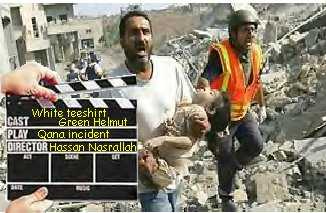
The "story" - for that is what it is - starts here, in the wreckage of the buiding at Qana which is performing the temporary and unwholesome function of a morgue. It is from here, that the bodies are extracted, the essential props of this theatre. And standing on the left of the frame is one of the two star characters of our story, Mr "White Tee-Shirt". With equal accuracy, though, we could call him Mr Hezbollah, for reasons which will become apparent.

Mr "White Tee-shirt" is billed variously as a "rescuer" and "local resident". We see him in many pictures, very much at the centre of events. He has free, unchallenged access to the collapsed building, even though he is not in uniform and has no apparent formal role. But, although we see a lot of him, there is not a single picture of him digging or moving rubble. More often, he is standing around watching, like he is doing here. But for what?

Well, here he is again, this time inside the wreckage and again he is not actually doing anything but watching. But it seems he is doing more than that. We get the distinct impression he is looking for particular bodies. The one in the arms of the Red Cross worker, the body of the "girl in orange" is not one of them. Mr "White Tee-shirt takes no interest in it and shows no emotion.

And it is in this frame that we see the teeshirt (inset) which seems to have writing on the chest. An expert has contacted us and agrees, telling us that it seems to have been electronically blurred to obscure the message it conveys.

Anyhow, it is now clear that the body of the "girl in orange" is not what is wanted. It is unceremoniously dumped outside, and is later stretchered off to the waiting fleet of ambulances. This is what happens to most of the bodies, which are carried up "stretcher alley" by diverse parties of stretcher bearers through the day. As with other casualties, the wrapping is conveniently left open to allow photographers to take pictures as the stretcher passes.

However, there then seems to be something of a commotion. Not one but two bodies of girls have been found. From this Newsnight video grab we see them being manhandled out to the opening of the wrecked building. At this stage, the bodies are not treated with any care or dignity as they are handed to "White Tee-shirt". But it seems evident that he has found what he wanted. And, although, on film he speaks loudly and gesticulates, there is no display of anything that could be interpreted as emotion.

Now, entering stage-right is the second of our star characters, "Green Helmet". Without any ado, he makes a grab for the first of the girl's bodies, which is surrendered by a deferant "White Tee-shirt". In the next frame (not shown) Mr "Green Helmet" cradles the body in his arms, as if to carry it. And here we also see that "White Tee-shirt" seems to have changed his top, his new garment sporting a small logo on the chest (although we now know, courtesy of The Daily Telegraph that this is not the case).

Anyhow, in the next frame, we begin to see the game plan. "Green Helmet" is making a "camera run", carrying the highly photogenic corpse of a little girl, holding it is arms to maximise the shock value and the emotional impact. At this stage, though, he is walking up to "Stretcher Alley" and is reserving his expression. This is sombre but not demonstrably dramatic. Several "snappers" go through the motions and take his picture but the results are little used.

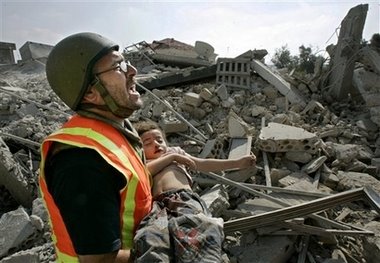
In this frame, though, "Green Helmet" is going up "Stretcher Alley" in full view of the waiting media. Framed against the rubble, with the girl's body in his arms, he displays an intensity of emotion that we have not seen in him before. The combination makes for the iconic shot which is published throughout the world and, ironically, is now available printed on a white tee-shirt.

Out of shot, the route is marked out by Red Cross workers and others, redolent of mashalls on a race route. It has the feel of a highly organised film set, which is precisely what it is. And, in this frame, "Green Helmet" co-ops one worker into the theatre to provide the media with another photo opportunity. Whatever the message though, it is not real. The uniformed worker is merely a prop. "Green Helmet" does not need guidance - he has been up and down this route ceaselessly.

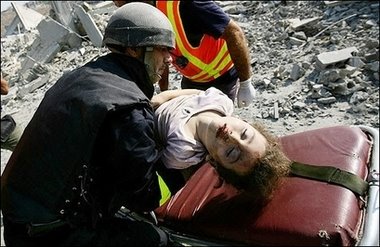
The corpse having served it purpose, "Green Helmet" has no further use for it. He dumps it on a guerney, leaving it in the care of the worker we have called "the man in black". There are other photo-opportunities in the making and, to "Green Helmet", these are his priority. He is off, without even waiting to see the corpse properly secured.

While "Green Helmet" and "White Tee-shirt" could have left together (the corpses were available together at the wreckage), and even carried the two corpses on a single stretcher, properly covered in respect for the dead. But that was never the game plan. With "Green Helmet" having done his camera run, it is now the turn of his partner to show off the trophies. We see him striding out carrying his photogenic corpse, surrounded by snappers and TV cameramen, who are obviously ready and waiting for him.

This and the previous shot, taken as "screen grabs" from a France 2 news broadcast, are hardly iconic material. But, as he approaches the media scrum, "White Tee-shirt" is assuming an anguished expression which intensifies with every stride. His mouth opens and he starts to shout passionately, as he steps onwards, his swiftening stride conveying a sense of urgency. Yet, the urgency is false. He has waited for "Green Helmet" to complete his run before even starting out.

Well into his stride now and emoting freely, "White Tee-shirt is producing iconic material, eagerly captured by the snappers. This picture here makes the Daily Telegraph and many other dailies. Again, the combination of the photgenic corpse and the "raw emotion" make the picture irresistable. It is a stunning performance, even if the result lacks the essential touch of the background wreckage.

Now the strategy becomes clear. Round the corner and on top of the rise formed by "Stretcher Alley" is the "fiercely competitive" media, coralled like sheep in a pen, waiting for the next photo-opportunity to be presented to them. And Hezbollah is about to lay on the performance of a lifetime, a human interest story starring "Green Helmet and "White Tee-shirt" in a bravura display of raw emotion.

First of all, here comes "White Tee-shirt" for a solo performance. But, while the snappers do their business, he hasn't quite got it. The stride is too purposeful. He looks soulful but his head hangs and there is no passion or drama in the pose. The rubble is bit too messy and amorphous and there is nothing to draw the eye to add contrast to the sole figure marching up the litter-strewn slope. As a picture, this simply doesn't hack it.

By now, "Green Helmet" has got in position for a dual shot, although from this angle you can only just see the crown of his helmet over "Tee-shirt's" left shoulder. Even then, the pose is magnificant - head thrown back in anguish, the corpse cluched to the bosom and a soulful expression all combine to give just the note that is needed. Many editors find this is just right and rush to print it.

Perhaps in the this one, "White Tee-shirt is overdoing it slightly, but it isn't a lot different from the previous frame. What really spoils it is "Green Helmet" peering round "Tee-shirt's" shoulder, as he strides along to catch up with is co-star in order to take an equal role in the drama. But his presence at such an awkward angle breaks up the symmetary of the pose and creates a distraction. Nevertheless, Nicolas Asfouri for AFP-Getty Images labels the pic, "A man screams for help as he carries the body of a girl killed in the Israeli strike on Qana on July 30", and it gets used by Newsweek, amongst others.

As a dual shot, this next one is unusable. Look closely at "Green Helmet" and - although he most certainly isn't - he appears to be smirking. The combination of the exertion and trying to present the appropriate gravitas is proving too much for the man. But, if the effect is grotesque, "Tee-shirt" is strutting his stuff. So out come the scissors (or the crop button) and "Green Helmet" is history. The result is perfect for the front page of The Independent.

But everything is coming right. Without moving from their positions, all the snappers have to do is let the stars come to them. Now the angles are right, the pair complement each other and the expressions are spot on. With an imaginative caption "man screaming for help...", it goes straight on the front page of The Guardian. This is award-winning stuff, except the prize should really go to Hezbollah.

With the pics in the bag, the corpse is so much dead weight. "Tee-shirt" dumps it on the gurney, leaving it to the good offices of "the man in black" to strap it in and organise the load. Nevertheless, it provides a poignant photo-opportunity and the snappers do not miss out. The trouble is that the shadows are wrong and the face of "Green Helmet's" corpse, the one he was in such a hurry to deliver, is partially obsured. This does not really score as a top-rate picture.

Neither is the next, but as a picture, it is worth a thousand words. The starring duo, having got what they wanted from the corpses, putting on their display of raw emotion and all the rest - to the delight of the assembled media - have completely lost interest in their props. The man in black is left to struggle unaided with the burden, heading over rough, wreckage-strewn ground to the ambulance. This can be seen in the distance over his left shoulder, past the nearer, more modern-looking vehicle. "White Tee-shirt" as gone on ahead, without offering any aid and, although in the picture, is not looking at the gurney. He has other, more pressing things on his mind, as we will see shortly.

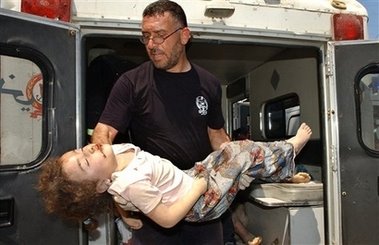
For all his trouble, the "man in black" is at least rewarded - he gets to pose with one of the bodies discarded by the stars. A noble figure standing at the back of the ambulance, the tiny figure in his arms, there is a certain majesty and gravity to the man. Nevertheless, he clearly lacks the star quality, the ability to project raw emotion, a deficiency that will forever condemn him to looking after the props after they have been discarded and playing the bit parts after the stars have left the scene.

Even then, one of the stars could not resist a repeat performance. It was obviously hot work running up and down the hill, and back up again, so off comes the trade-mark helmet, the radio, the flack jacket and the fluorescent waistcoat. "Green Helmet" au naturelle now poses once more with his prop. But he is only going through the motions when it comes to projecting emotions once more and he lacks conviction. But hey! The front pages are already in the bag, so this is just one for the scrap book.

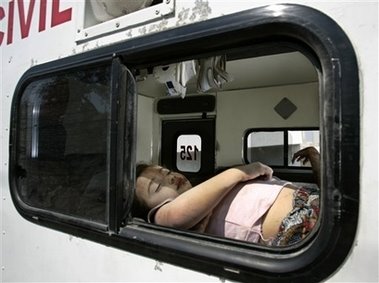
And at last the body of the poor mite that was once a pretty child is laid rest temporarily in the back of the ambulance. Even then, her mortal remains are publicity fodder, providing a poignant reminder of the tragedy, without the artifice of poses. This is the only natural pose in the whole sequence, but it lacks the drama the editors need. The picture ends up as a filler for internet archives.

While the dead rest at last, we now see why "White Tee-shirt" was so anxious to get away. He has to return home to be interviewed by a France 2 reporter. He starts by showing the reporter round the house, well furnished and far from modest. This is no poverty-stricken man, embittered by deprivation. Even by European or American standards, the house is well-furnished and comfortable.

But what is so evident are the pictures of Sheik Hassan Nasrallah - even a calendar. This is not a dwelling - it is a shrine to Hezbollah, the party of God. But "White Tee-shirt" is not Hezbollah, oh, no! That is what he tells the young reporter, saying that it is the Israeli aggression that is radicalising Muslims and driving them into the arms of Hezbollah.

Make up your own mind. Is this a Hezbollah member, or a mere supporter? This is a Hezbollah stronghold, a town from which the IDF claim over 150 missiles have been fired. And our "White Tee-shirt" has a house full of Hezbollah material and is not a member - was not all day driving that agenda forward? Was he simply an ordinary joe, overcome with emotion at the death and destruction around him, of which he was entirely innocent?

These issues are, of course, not addressed by the media, either on the ground or back in the comfortable, air conditioned editorial offices, thousands of miles from the action. There, pictures of death are a commodity. It doesn't matter under what circumstances they were gained, and to what purpose the actors paraded their emotions. Another forest-load of dead trees conveyed the story and a few dead children were exploited to provide pictures and add drama.

Against all that, does it matter that we were sold a lie? Ironically - and unintentionally - The Independent headline articulates the question: "How can we stand by and allow this to go on"? But I suspect they were not thinking what we are thinking.

COMMENT THREAD

Friday, August 04, 2006

Back to the real world

It had to happen. We had to return to the real world of shenanigans in the European Union. Naturally, foreign policy will remain one of our issues but for the moment, let us concentrate on another hullabaloo in Poland (if you can call it the real world).

It all started a few days ago, when President Lech Kaczynski, tired perhaps of his fruitless row with a German left-wing newspaper, announced that the EU should start discussing the re-introduction of capital punishment. Just to remind all our readers, abolition of capital punishment is a pre-requisite of EU membership (as well as of Council of Europe membership). Having abolished it and joined the EU, Poland now finds that even if there were a vote in the country for its reintroduction (and it is not clear that this would happen) the government could not do so without the EU’s say-so.

Both the Law and Justice Party and the League of Polish Families maintain that reintroduction (or, at least, the possibility of it) of capital punishment, like tightening anti-abortion rules, is part of the Catholic Church’s teaching. Sadly, the Church does not agree on capital punishment.
“Father Piotr Mazurkiewicz from the Catholic University of Cardinal Stefan Wyszynski in Warsaw argues that such an idea runs in a different direct than the present values of the Catholic Church.

’There is a traditional teaching of the church in which the capital punishment is part. The teaching has been altered by John Paul II and now the Catholic Church supports the forces aiming to eliminate capital punishment. So we can say this initiative is going the opposite way to the teachings of the church. This kind of initiatives have political reasons- it is not going from religious motives or ethical ones but from political ones.’”
Unsurprisingly, the whole subject was dismissed by the European Commission, sometimes erroneously described as the EU “Executive” (it is, as we know, both the executive and the sole source of legislation in the EU):
“The European Union has brushed off a call from Poland's conservative president, Lech Kaczynshi, for the 25-member bloc to consider re-instating capital punishment. "The death penalty is not compatible with European values," European Commission spokesman, Steffan de Rynck, was quoted as telling reporters on Thursday.”
The most obvious explanation for it all is the nearness of another Polish election and the need to position oneself that both members of the ruling coalition realize. So, it is not clear whether they will include restoration of capital punishment or a referendum on it in their manifesto. Or, for that matter, how they are going to finesse that with the threat of expulsion from the EU (all those sponduliks are hard to discard).

In the meantime, without pronouncing on the rights and wrongs of capital punishment itself (I do not propose to acknowledge any comments on the subject on the forum, as this is not part of the blog’s remit), one can speculate about the notion that the death penalty is not compatible with “European values”.

For almost all of Europe’s history the death penalty was in existence and was considered to be perfectly compatible with European and diverse national values. If there was a discussion it was about methods of administering the penalty and, above all, the crimes that deserved it. The idea that there is something wrong with the whole concept is relatively recent (though there were always individuals who held that view). What is Steffan de Rynck’s definition of “European values”, one wonders.

A seriously unimportant jokey posting

Our blogress at workWe have had a good run in the last couple of days, thanks to the sterling work done by my colleague (pause for applause and boos from sundry members of the forum who are fighting a valiant battle in defence of the MSM). There is a little bit more to come and, of course, the story will almost certainly resurrect itself.

We have helped to plant seeds of doubt in some and strengthened doubts in others about the MSM reporting of the Middle Eastern conflict, in particular of the war in the Lebanon. Even those of our readers who prefer to believe what they see on TV or read in the newspapers (because journalists would never lie or allow themselves to be manipulated by an unscrupulous organization like Hezbollah, no, no, no) will, I confidently predict, find themselves questioning future reports, despite themselves.

Now, let us take a break and spend a little time worrying about a seriously unimportant problem. While trying to follow the American media and blogosphere I came across a couple of times the word "blogress" as in female blogger. Clearly, this nomenclature is of some interest to me.

However, when I quoted it to my colleague (him of the Green Helmet Guy fame), his response was that a female blogger should be called "blogette". Naturally, I prefer "blogress" with its obvious link with the word "tigress" (the tiger is my sign in Chinese astrology). Still, this is a good opportunity for more input from our readers.

Alright, explain this one!

For an update on this post, see here.

To and fro go the arguments as to whether the pictures were staged. We have largely concentrated on "Green Helmet" but we also had a look at "White Tee-shirt" (pictured right) in the previous post. This is the man the Guardian and the Telegraph both chose (with many others, including The Independent) for their iconic representation of the Qana incident.

Now, however, we have found two more photographs of "White Tee-shirt", both of them with him working in the wrecked building. This first one (left) has him looking at bodies, but the interesting thing is his tee-shirt. Look at it closely, with an inset as large as I could make it without losing definition (also, slightly larger above). The garment appears to have writing across the chest.

The second photograph of this pair has a Red Cross worker to the fore, holding the body with which "White Tee-shirt" (background) is to make his "camera run". There is another inset, with the picture expanded as large as it will go without losing definition. Again, look at the tee-shirt. Once again it looks like there is writing across the front.

The marking is not distinct, but it is there is two separate photographs, each showing the torso at a different angle. Can it be shadow of folds in the shirt?

Now we have a scene that we have seen before. This is a video grab which shows the bodies of two girls, still in the wrecked builing. The one that "White Tee-shirt" is holding is taken off him by "Green Helmet" who uses it for his "camera run". The one to the left is then taken by "White Tee-shirt" for his. But look at his tee-shirt. There is no sign of any writing on the front – just a discrete logo on the left of the chest. Our man also looks rather clean and well-groomed.

Here now is the iconic "camera run". This is the one captioned, "man screaming for help…". There is urgency in his pose, anguish in his face and he is running, with "Green Helmet" alongside (presumably having already done his own camera run. Look now at the close-up of the tee-shirt (below left). Again, there is no sign of writing on the front – just the neat, discrete logo.

OK… let's put is altogether. "White Tee-shirt" is part of the rescue party – frantically digging for survivors (they hope) and recovering the bodies. There is a frenetic air about the operation – eye witnesses say there was chaos and there is the ever-present fear that the building will collapse further.

But, after the Red Cross worker takes the body of the child, with "White Tee-shirt" present, and before it is given to "White Tee-shirt" to take it out of the building, it seems that our iconic figure may have changed into another tee-shirt. Has he changed into fresh attire, ready to make his "camera run", whence he is photographed "screaming for help"?

Now, NewsMax, reports that news photographers saw aid workers wrapping furniture in body bags hours after the Qana attack then loading the "corpses" into ambulances for the benefit of television news cameras. Crucially, we are also told that "Hezbollah officials at the site prevented the photographers from documenting the fabrication". This is from sources at the scene who asked not to be identified.

Can people believe that the reporting (and especially the filming) of the rescue was not stage-managed by Hezbollah officials? And, as for "White Tee-shirt's" loyalties, look at this report from France 2. At 4.27 minutes into the report, we see the interior of "White Tee-shirt's" home. It is a shrine to Hezbollah.

As one of our forum members remarked – what more do you need – a director's chair with "Hezbollah" on it?

COMMENT THREAD

Thursday, August 03, 2006

"Vital to telling the story"

For an update on this post, see here.

It is the Jerusalem Post that makes the running this morning on the dismal conduct of the MSM, pointing out that, "Large sections of the international media are not only misreporting the current conflict in Lebanon. They are actively fanning the flames."

On the "fringe", as far as the MSM are concerned, are another two powerful pieces today (here and here) which demonstrate that the debate is by-passing the dead tree sellers, leaving them stranded in the quagmire of their own foetid mindset.

No better example of this mindset can be found than in the self-regarding Daily Telegraph "clog" (as in "corporate blog"), written by Shane Richmond.

In the first of a what he tells us is a three-part piece, under the group heading "disturbing images", he ponderously explains "the decision-making process behind using images of death and injury online and in the newspaper."

Already out of date with the casualty figures – Richmond still using the "54 civilians, 37 of them children" legend - the man gravely informs us that illustrating stories such as Qana "raises a dilemma". To what extent, he asks rhetorically, "is it acceptable to show dead bodies and how graphic can those photographs be?"

The Telegraph dilemma - which one should we use?In shedding "a little light on the process behind choosing an image", we are informed that the Telegraph tries "to avoid explicitly showing dead bodies…". The choice of picture depends on the story, what other images are available and - in some cases - consultation with the editor of the paper. "If the story merits it, or if the picture is the best image for the job, then we will sometimes publish a picture which may shock some readers," writes Richmond.

In the Qana incident, he continues, "the story was particularly powerful because so many of the victims were children. The most striking images of the day showed dead children and it was impossible to tell the story adequately without showing bodies."

Richmond then gets to the nub of the issue. There were "subtle distinctions to be made in the type of picture chosen". He asks us to compare two images (above left). One was used on the website (and on the front page of the paper). The other wasn't.

Emoting to order?The one not used was the uniformed Red Cross worker carrying a child's body. It is discarded because he is displaying no emotion. The other picture – no less than "White Tee-shirt" - "is reacting very emotionally to what is happening." So, proclaims Richmond, "not only does that make for a more powerful picture but it also takes some of our focus away from the body. Of course, there is no getting away from the fact that the man in this picture has a dead child in his arms. But that was vital to telling the story."

Raw emotion - or Oscar-winning performance?So, the mighty Telegraph reached out and published the "emotion" which was "vital to telling the story".

But nowhere, so far, do we see Richmond ask the fundamental question – was the picture genuine? That, it seems, does not matter. As long as it is a "powerful picture" and it tells the story the paper wants to convey, that is good enough. Never mind that "White Tee-shirt", as our other pictures show, seems to be able to turn his emotions on and off at will. He served the Telegraph's purpose. Or did the Telegraph serve his?


* * * *

STOP PRESS

"26 rockets fired at North on Thursday" reports the The Jerusalem Post.

Tell me about it.

COMMENT THREAD

Questions

It seems to me that the MSM is about as accurate and incisive in its critiques of this blog as it is in reporting the news.

It starts with the AP "rebuttal" which homes in on the "date stamp" issue, but addresses none of the other points raised and then, curiously, does not actually say that the timing attributed to the photographs were wrong.

Several readers have written to me, however, saying look at the shadows, some offering their own analyses, which are very plausible. If you look particularly at the "Green Helmet" sequences which I have posted, there definitely seem to be indications that the shows are longer on some shots than others, suggesting a longer time-frame than the context would indicate.

The photographs are up and posted for all to see and from which to draw their own conclusions. You do not want any more gruesome pictures from me, so I have posted a picture of one of those vile, blood-thirsty Israeli soldiers that so many have written to tell me about.

As to the MSM, second into the fray was Roy Greenslade of The Guardian, who plays the typical left-wing trick of dismissing me as a "right winger" and there fore not worth listening to. He also puts us down as "churning out anti-EU rants", which means he cannot have read this sequence. But then, stereotyping is so much easier when you ignore the facts.

And into that frame comes Jefferson Morely at the Washington Post, who rushes to brand me as a conspiracy theorist, that being his comfort blanket which allows him to ignore the central message of the sequence of posts we have been running.

Morely's great claim to fame is that I have branded "Green Helmet" as a Hezbollah official, without a shred of evidence, going only on "gut instinct". What Morely does not want to address though is that this man is clearly more than a "rescue workers" which the media so decorously brand him. He behaviour on site, and the reaction of others to him – as well as the media – clearly demonstrate him to be in a position of authority. Yet none of the British or US media want to name him, or describe his function. Why is that I wonder.

Perhaps, Morely, like many of his colleagues, don't want to admit that there is plenty of evidence (see here and here) that Hezbollah actually control media access and proceedings at disaster sites in Lebanon. If they did, in the context of "Green Helmet" being demonstrably "in charge" at the Qana site, the likes of Morely might have to admit that my "gut feeling" was not too wide of the mark.

But the real issue that Morely avoids is that my postings are primarily directed at the conduct of the media. He writes that North says he is just trying to "raise questions", which he kindly agrees is "certainly a legitimate goal". But he doesn't answer any of mine. Instead, he asks his own: "What is it about the photos from Qana that made Israel's supporters prefer fantasy to fact?"

Well, Mr Morely, in return, another question. "What is it about the photos from Qana that make you so confident – apparently – that they were all an absolutely genuine record of the events during the rescue efforts?"

It is unlikely, however, that Mr Morely will answer my question. In truth, he and the others are not really interested in an obscure blog written in a back street of Bradford. What really worries him is Rush Limbaugh and all the other "right wing" sites that have really put this issue on the map.

So, until we get some answers, we will continue what we have been doing… asking questions.

COMMENT THREAD

Wednesday, August 02, 2006

Stretcher Alley

This post has been superseded by our latest report . We have left this one in place for archival purposes only.

'Stretcher Ally' QanaThis, of course, is not just about Qana – the issue is far more profound. It is about how the media reports great events, its bias and spin, selling us an "agenda" whilst all the time telling us it is presenting the objective truth. But here we have some more photographs which throw into question that objectivity.

The first photograph, taken from the Jerusalem Post, shows up the pathway from the collapsed building, used by the rescue workers to carry the Qana victims to the fleet of ambulances. You can, in fact, see a stretcher party working its way up the slope. For reference purposes, we will call this "Stretcher Alley".

Now we see a sequence of "screen grabs" from a video taken at the scene, looking down the slope of "stretcher ally", reportedly from Aljazeerah. The camera initially pans round the scene and you can see from the angles that the cameraman is standing to the right of the ally. Note the screen grab (right), which shows the building in the background and, of especial significance, the triangular piece of wreckage projecting from the ground. We will come back to that.

The camera returns to the ally and focuses on "Green Helmet" marching purposefully up the slope, flanked by co-workers. The interviewer ignores the others and makes a bee-line for "Green Helmet"' He is clearly the "head honcho" so he is buttonholed for a prolonged interview. "Green Helmet" speaks in a high-pitched voice, excitable, gesturing behind him, to where the action seems to be. Crucially, having walked up the slope, he pants from exertion.

Into view then comes a stretcher party, coming round the base of the building at the bottom of the slope. They come from the left - that, we can assume, is the direction from which the casualties are being recovered. As they start up the slope, the interviewer and "Green Helmet" pause to look at the group. then "Green Helmet" dashes off down the slope to intercept the party and the camera concentrates on the group.

As the camera focuses on the stretcher party, and it is clear that they are uniformed Red Cross workers, with a posse of photographers in attendance – two of which we can see in the frame. Although the picture is blurred, note that the leading stretcher-bearer is wearing his helmet at a slightly raked angle. The cameraman on the right has taken a shot and is changing camaras to get another shot.

Now, fully in view of the cameras up the hill (which we see in other shots, "Stretcher Alley" having been staked out by the media), the stretcher party starts to walk slowly up the hill. Then, for no apparent reason (that we can discern), it suddenly comes to a stop. The workers put down their load, with one of the photographers hovering close by, over the stretcher. We can only guess, but perhaps they have been asked to stop by the photographers.

The sudden stop gives the photographer the opportunity to take a close-up picture of the victim. Now, this is a highly charged sitation, at a disaster scene, with all the tragic implications. But of more concern to the lead stretcher bearer is his appearance. He adjusts his helmet, putting it on straight, nice and neat for the cohort of camera crews and still photographers further up the hill. There is no sense of urgency and no rush. The pace is leisured.

All nice and tidy for the photographers now, and the photographers having completed their work, the stretcher bearers now resume their journey, ready to provide further photo-opportunities to the media. They they progress in a leisurely fashion presumably, towards the ambulance. In the sequence, they are then joined by "Green Helmet" who hovers around self-importantly. All the time, there is no sense of urgency or rush.

Now we switch – to the iconic photograph used by the Guardian on its front page. This is of "White Tee-shirt" carrying the body of the dead girl, escorted by "Green Helmet". By reference to the triangular piece of wreckage and the building in the background, we can position the scene – it is definitely on "Stretcher Alley", further up the long slope from where "Green Helmet" was interviewed.

While most of the casualties are being stretchered up this slope, this is different, and – unlike the earlier scene, "White Tee-shirt" is running. The caption given has him "screaming" for help. And here come the questions.

Why is "White Tee-shirt" (and "Green Helmet") running? Could they have run all the way up the slope, when "Green Helmet" was panting with exertion having walked up the slope – or has he just started running. And to whom is "White Tee-shirt" screaming for help? He is several hundred yards from the recovery site, and is on his way to the ambulance. For what purpose does he want help?

Now we have the final "iconic" shot – "White Tee-shirt" again. Over his left shoulder is the triangular piece of wreckage, but the camera angle is different. From what I can work out (and would welcome observations) he looks to me further down the slope, which would mean that this photograph is taken a few moment earlier. He is not running, and he is not "screaming", but shows enormous anguish. And "Green Helmet" is nowhere to be seen – although we know he is close by.

These shots were widely published – clearly their emotive impact was recognised by hundreds of editors. But nowhere do we see these graphic shots on video. Why not? Would filming have shown that the shots were staged?

COMMENT THREAD

This should do it

Perhaps the strain of having to deny what my colleague has been demonstrating about the agencies’ coverage of Qana has affected them but Reuter’s has come up with a useful story about the EU and the Middle East.

As our readers will recall, the EU was left to look for a role in the Middle East and to try to create some kind of a common policy that will show the nasty brutish Americans (and, I suppose, the Israelis) that soft power is what works in the modern world.

Sadly, they are not having much luck. In the first place, they seem to be all over the place, with the Foreign Policy High Panjandrum, Javier Solana, explaining that the Spanish Foreign Minister, Miguel Angel Moratinos, a former EU Middle East peace envoy (clearly a man who is used to success in his negotiations), who is going to Damascus, will be speaking to Baby Assad “doubtless on behalf of all of us, including myself”. Says who? Not in my name.

Actually, not in Germany’s name either. The German Foreign Minister, Frank-Walter Steinmeier, will also be speaking to Syriran officials and suggesting that
“the Middle East Quartet - the United States, UN, Russia and EU - plus possibly Egypt should play a role in peace efforts”.
This is the latest idea the various European politicos have come up with: to draw in the two sponsors of Hezbollah, Iran and Syria and get them to exert pressure on the organization. As Reuter’s puts it quite sapiently:
“But beyond making Syrian and Iranian leaders feel respected, it is not clear what the Europeans can offer to persuade Damascus or Tehran to lean on Hezbollah guerrillas to stop firing missiles into Israel or accept eventual disarmament.”
That is not entirely correct as far as Baby Assad is concerned. The EU can offer him a deal on the whole question of Rafik al-Hariri’s assassination and on a possible economic agreement. To be fair, the EU and its members cannot deliver on the first and Assad will continue to be badgered on the subject, though this does not affect him too much.

In any case, these are very weak inducements for a complete reversal of policy. There has to be something else and the Europeans do not have anything else.

Then there is Iran, which has been moderately successful in diverting attention away from its nuclear programme but less successful in uniting that famous Arab street behind Hezbollah. By and large there have been calls for an immediate cease-fire, a few demonstrations, but fear of Iran apparently remains the strongest feeling in the Middle East. Even the Israeli raid on the Bekkaa Valley has not drawn the Syrians into the fray. As for Egypt, Jordan and the other countries, they are staying out. We shall see what tomorrow’s emergency meeting of the OIC will produce.

What of the Franco-Iranian axis? Philippe Douste-Blazy has been trying to explain his previous comment about Iran being a stabilizing factor in the region. What he really meant, he told the journalists, was that:
Iran has a share of responsibility in the current situation, so Iran can play a role in its solution, and can therefore contribute to stabilisation in the region.
It certainly does have a share of responsibility in the current situation. Rather a large share, in fact, and many people believe that the smaller Iran’s role is, the more likely there is to be a solution.

COMMENT THREAD

What do the French want? To be in charge

It seems that France will not attend Thursday’s emergency UN meeting to discuss the deployment of an international force in southern Lebanon, even though the country is mooted as potential leader of such a force.

This is not simply the usual French temper tantrum but a more or less sensible stand. There is no point in sending an international force before a cease-fire. Of course, there is no suggestion as to how such a cease-fire might be achieved.

Prime Minister Olmert insists that the Israelis carry on until a viable international force is in place. Hezbollah is saying a great deal but nothing about any cease-fire or disarmament. Everyone else is insisting on a cease-fire. The Americans think there might be some purpose to an immediate international force.

French Foreign Minister, Philippe Douste-Blazy, last seen hobnobbing with his Iranian counterpart, is very forceful:
“France does not want to fall into a trap that would lead to the existence of a force without a prior political agreement.”
An unnamed French diplomat was even more open:
“We will not send a force to Lebanon to continue the work of the Israeli army.”
Fair enough. What will they send a force to Lebanon for? And when? Jean-Marie Guehenno, the U.N. undersecretary-general for peacekeeping, who insists that the Security Council will not referee between France and the United States, while clearly taking the French side, told Le Monde:
“"For a force to be deployed, the fighting must stop," he said. "It will be much easier to find the troops if the fighting has stopped."

He said it could be months before a force of 10,000 to 20,000 troops would be ready for deployment.”
None of this is surprising or, even, particularly unreasonable. The question is: what is to be done in those months while the troops are being organized.

State of play

There is a good summing up of the state of play in Frontpagemag.com.

The Jerusalem Post also takes up the cudgels. Have a good look at the photograph in the piece. You will see more of that in our next post.

And Haaretz has some interesting news about the body count, which seems to be declining.

Also, has anyone thought about the "body bags". How often have you seen transparent polythene used, which so conveniently allow the photographers to film the victims? Can anyone recall any other disaster scene where transparent bags have been used?

Faustablog is also worth a look. It raises some interesting questions.

COMMENT THREAD

Now I feel better

I've been attacked by Roy Greenslade is his Guardian blog. I should, it seems, stick to what I know best… "churning out anti-EU rants".

And, while majoring on the "time stamps" (ignoring the other evidence), Greenslade (like others of this blog's critics) has not noticed that none of the agencies have declared that the "time stamps" are actually wrong... merely that time stamps in general could be misleading. Nor have any of the agencies volunteered their own time lines.

I must have got something right.

COMMENT THREAD

Game, set and match

For an update on this post, see here.

A perfectly natural pose, not staged in any wayWell, I never. The news agencies that stitched up the photos at the Qana site have all huddled together and got AP staff writer David Bauder to issue a story rebutting lil ol' EU Referendum. And the imaginative title? "News agencies stand by Lebanon photos".

To engineer this massive intellectual feat, Bauder – who contacted this site asking us to ring him in New York at our own expense to answer his questions, but did not respond to our e-mail offering this blogger's telephone number – relied on the one post, but clearly did not bother to read the others, and particularly the latest, which already anticipated the points he was to make.

Another completely natural pose... this one from Al ReutersThus does Bauder concentrate his fire on the one point of several, where he claims this site rests its case of "chicanery" on the part of the agencies on the "time stamps" that went with captions of the photographs. Laboriously, he details the timings, and then sets outs our case, that the events depicted were staged for effect, "a criticism echoed by talk show host Rush Limbaugh when he directed listeners to the blog on Monday."

"These photographers are obviously willing to participate in propaganda," Limbaugh is cited as saying. "They know exactly what's being done, all these photos, bringing the bodies out of the rubble, posing them for the cameras, it's all staged. Every bit of it is staged and the still photographers know it."

Yet another completely natural scene - not a hint of 'staging'The "straw dog" thus set up, AP's Bauder then sets about rebutting it, declaring "information from its photo editors showed the events were not staged, and that the time stamps could be misleading for several reasons, including that web sites can use such stamps to show when pictures are posted, not taken." Note, however, the use of the word "can". He does not say that the "date stamps" are wrong.

Nevertheless, an aggrieved "AFP executive" is then wheeled on, saying, "he was stunned to be questioned about it." The MSM being questioned? Shocking, I tell you, shocking!

And now for the AP 'specials': #1 - completely unstagedThen al Reuters is brought into the fray. In a statement, it says that it categorically rejects any such suggestion and then Kathleen Carroll, AP's senior vice president and executive editor, puts the boot in. "It's hard to imagine how someone sitting in an air-conditioned office or broadcast studio many thousands of miles from the scene can decide what occurred on the ground with any degree of accuracy," she says.

# 2 - also unstagedAir conditioning? I wish.

But Carroll hasn't finished yet. "In addition to personally speaking with photo editors", she says – who tell the absolute, unvarnished truth - "I also know from 30 years of experience in this business that you can't get competitive journalists to participate in the kind of (staging) experience that is being described." Photographers are experienced in recognizing when someone is trying to stage something for their benefit, she adds.

And #3 - couldn't be more natural... rescue workers do this all the timeNow administering the coup de grace, Patrick Baz, Mideast photo director for AFP, is trundled up to the front. "Do you really think these people would risk their lives under Israeli shelling to set up a digging ceremony for dead Lebanese kids?" he asks. He is not "stunned". He is "totally stunned". And he "can't imagine that somebody would think something like that would have happened."

So, all the agencies are agreed - none of the photographs have been staged. Game set and match!

But then, you really have to give it to AP - they really know how to look after their staff. Thank you, Little Green Footballs. And this in the National Journal rather puts the claims into perspective. Anyone remember this gem from the NYT?

COMMENT THREAD

Tuesday, August 01, 2006

Where is that European foreign policy?

Erkki TuomiojaNow is the time, surely, for the European Union to display the effectiveness of soft power, to speak with one voice, to show that it has a strong presence on the international scene. But then, we say that every time there is an international crisis (and they do come thick and fast) and every time we look around and see nothing.

Once more we have to point out the bleedin' obvious: there can be no common foreign policy if there are no common interests.

Still, let us have a look at what the Europeans have been up to. The presidency of the European Union rests with Finland at the moment (and I bet they wish it didn’t). Thus, it fell to Finnish Foreign Minister Erkki Tuomioja to chair the emergency session and to come up with some pointless platitudes.

The EU, he told reporters, must make a united stand, even if it means breaking with the United States on the issue of what is to happen in southern Lebanon. Of course, if the EU paid a little less attention to what the United States is doing, in order to stand up to it, and a little more attention to what is going on in the region they are talking about, that famous common foreign policy might emerge. Or not.

Breaking with the American stance, which is, roughly speaking, that Israel has a right to defend itself and that the problem must be solved on a more long-term basis than just an immediate cease-fire that is unlikely to be kept by Hezbollah, in any case, presumably means speaking up against Israel. Does that mean that the united stand and strong voice will be for Hezbollah? Well, up to a point.
“It is unacceptable for Israel to continue with its current policy. The words of Mr (Prime Minister Ehud) Olmert and his plans for further military attacks (are) concerning and we have this message to him: it is unlikely to bring military success, it will only fuel the support for Hizbollah and other extremists in the region.”
Well, that’s as may be. So far, support for Hezbollah has been muted in the region, many Arabs and Arab governments fearing the organization’s sponsor, Iran, more even than hating Israel. In any case, what precisely, does Mr Tuomija suggest?

It seems that the EU is about to put pressure on Israel, otherwise its credibility will be in question (don’t snigger, please) to have a cease-fire and then get involved in a long-term political solution. Or so EU External Relations Commissioner Benita Ferrero-Waldner told Reuters.

Yes, but what then? How is the EU going to ensure that the cease-fire is maintained and that Hezbollah is disarmed? Are they going to send in troops to maintain peace on the border? Are they going to sit back and say, well, it will all turn out all right at the end and wring their hands when it does not?

Italian Foreign Minister, Massimo d’Alema, has no doubts on the subject:
“Either there is a ceasefire and an effort by the international community, or there is war. ... The international community does not intend to participate in war.”
How nice for the international community, which has no troops with which to participate anyway. Unfortunately, Israel does not have that choice.

As it happens, the EU is not alone in calling for a ceasefire. It would appear that the Organization of the Islamic Conference intends to do the same, according to the Malaysian Foreign Affairs Ministry. The Malaysian Prime Minister Abdullah Ahmad Badawi is the present chairman of the OIC and he has called an emergency meeting for August 3. Crisis? What crisis?

Meanwhile the various European countries have been making statements.
Italy, France, Finland, Poland, Sweden and Spain are considering sending troops to Lebanon. EU candidate Turkey and Muslim Asian state Indonesia have also said they may contribute peacekeepers.
Given the Italian Foreign Minister’s comments, Italy may not be considering these matters all that hard. In any case, the international force, the only thing according to Israeli Prime Minister, Ehmud Olmert, that will bring about that much coveted cease fire has to be under UN auspices. Or so everyone seems to agree. The trouble is that the UN has no auspices. The Security Council met yesterday to discuss matters and adjourned sine die to analyze at leisure what the political standing of that international force will be.

German Chancellor Angela Merkel seems unable to make up her mind whether Germany will send troops if asked by all sides and as part of an international force or whether the country’s armed forces are severely overstretched. The latter is more likely to be true.

Britain and the United States have already ruled themselves out of the game, in this case that of “What’s the time Mr Wolf?”. Poland has troops in Iraq and Afghanistan and is unlikely to produce any significant numbers for yet another far-off war. (And who knows how long the Polish government will be in place?)

Then there is France. There is always France. There is a strong possibility that any international force would be led by them, having been so spectacularly successful and humanitarian in sundry African countries.

According to Haaretz
“The force must be larger than the current UN Interim Force in Lebanon and be more than the 10,000 suggested by UN Secretary-General Kofi Annan, French Defense Minister Michele Alliot-Marie said in an interview published on Tuesday. Military officials in France have said the new Lebanon force should be 15,000-20,000 strong. "There is no question of it being a UNIFIL Mark Two," Alliot-Marie told Le Monde daily.

"It must be a very large international force with very precise missions. It must be well-armed, have substantial firepower and armor. It must be credible and capable of making itself respected by everyone," she added.
So where are those numbers of troops going to come from, especially as, according to Mme Alliot-Marie, the international force must be given the right to fire if it should be seen as necessary? Which country is going to send troops into that quagmire (I use the word advisedly)?

There is even some doubt as to what France can contribute despite Mme Alliot-Marie’s fighting words:
“Only countries with real military know-how should take part in the force, which should avoid becoming a kaleidoscope of nations that would lose its effectiveness, she said. Military experts say France, which already has some 13,000 service personnel deployed abroad, could send around 5,000 troops to Lebanon, but the French daily Le Figaro said Monday that military planners felt the country was reaching its limit.

"It won't be easy. We've reached our deployment limit now, not so much in terms of numbers of personnel but in terms of command capacity," the paper quoted one officer as saying.”
Iranian Foreign Minister Manouchehr Mottaki, right, shakes hands with his French counterpart Philippe Douste-Blazy, left, at the Iranian Embassy, in Beirut, Lebanon, Monday, July 31, 2006Meanwhile we have seen another very fine example of French diplomacy. The Syrian, Iranian and French Foreign Ministers are supposed to meet in Damascus. The last two have already met and shaken hands in Beirut.

Philippe Douste-Blazy was full of praise for Iran and her role in the Middle East:
“Iran is a significant, respected player in the Middle East which is playing a stabilizing role, French Foreign Minister Philippe Douste-Blazy said earlier Monday in Beirut. "It was clear that we could never accept a destabilization of Lebanon, which could lead to a destabilization of the region," Douste-Blazy said in Beirut.

"In the region there is of course a country such as Iran - a great country, a great people and a great civilization which is respected and which plays a stabilizing role in the region," he told a news conference.”
One can argue about the great civilization, in particular its timing, but there can be no argument about the “stabilizing role”. Iran has made no secret of its support for Hezbollah, for Shi’ite militias in Iraq or of its desire to obliterate Israel.

On Sunday Reuters published the following:
“Iran's hardline forces should get ready to take revenge on Israel and the United States for the offensive on Lebanon, the head of the Revolutionary Guards was quoted as saying on Sunday.

"The Basij and Revolutionary Guards should prepare to get even with the Zionists and Americans," Yahya Rahim-Safavi was quoted as telling Islamic militiamen by the conservative Fars news agency.

The Basij are volunteer Islamic militiamen.

"The timing of the this will be announced by the leader," he added.”
Later on, Fars, the Iranian news agency that has access to the hard line military units, announced that those quotations were being withdrawn, though it is not clear by whom.

Meanwhile, the EU has condemned unreservedly the strike at Qana, naturally enough without bothering to investigate the growing number of questions about it, and all attacks on “innocent civilians” (though not Israeli ones, who are, presumably never “innocent”). And to add to the convoluted picture, the European Parliament has supported the Finnish Presidency’s call for an immediate cease-fire. No, since you ask, they have no idea how it can be achieved or what might happen afterwards.

In any case, that famous united stand is as elusive as ever. While the EU has issued a draft statement, which calls for an immediate cease-fire, Britain, Germany and the Czech Republic have promptly rejected it, announcing that they, too, would like to see a cease-fire but do not want a definite timeframe.

Just another crisis in the creation of the strong European voice on the world stage.

COMMENT THREAD

We need to know the truth

For the agency "rebuttal", see here.

There are two wars being played out in the Middle East. One is a shooting war, where soldiers fight, where aircraft drop bombs and civilians die - on both sides.

But the other war, where no one dies, is probably more important in the grander scheme of things. That is the propaganda war, where the losses or gains of any one side can be negated by a deft photo-call and where the outcome of a campaign can be determined not by force of arms but by international politicians who can - if they so desire - impose a settlement that awards the fruits of victory to whomsoever the please.

In this second war, the shock troops are the journalists, photographers and television crews. They supply the raw material - the bullets, if you like - which shape opinions and give substance to the debate. We cannot all be there ourselves, so we rely on that information. We need it because we are not there, because we haven't smelled the death and the terror, because we have not seen the corpses with our own eyes. But, since this is the material that will shape our opinions and, through us the opinions of our politicians, we are entitled to ask whether it is accurate and unbiased. That we are not there does not disbar us from asking - it makes the asking all that more necessary.

Newsnight - frame 3And in this war, this second war, we have been offered the iconic figure of "Green Helmet" who, a number of our readers suggest, is Abu Shadi Jradi. His pain as he carries the body of a dead girl sums up the outrage of the Qana incident and conveys to us the horror of a war which all good people want to end. We are being asked to share that pain and, overtly in many cases, to condemn those whom we are told caused it.

But we, in turn, are entitled to know whether that "pain" is real and even if it is, whether it is being used to manipulate our thinking and turn our sentiment one way or another. On the other hand, no one is entitled to demand our uncritical acceptance of that which we are shown - that we should necessarily and always accept it as the unvanrished truth.

It is in this context that we are asking: "what is the truth"? We ask it because we have done something we were not supposed to do... we have put all the separate photographs that we can find of one sequence of events. And they simply do not stack up. Some we have shown before, some are new to this blog, and the sequence starts with the first three photographs above. These purportedly show the recovery of the body of a girl from the wreckage of the building in Qana, prior to its transmission to a waiting ambulance.

Sometime in between the wreckage and the ambulance, however, we get the iconic picture, the one that has been reproduced in newspapers thoughout the world. This one, we can see, is near the wreckage of the building but, was it posed? We do not know but, in viewing hours of video footage, we have not yet seen the scenario filmed. That, in itself is possibily noteworthy, given the number of TV cameras that were around. Virtually everything on the scene was being filmed - yet no-one seems to have filmed this.

What we do see on the videos are harrowing scenes of bodies being laid outside the building and others being brought out and handed to first aid and other workers, who then convey them to the ambulances or other vehicles. There seems to be a relatively well-organised division of labour, where the rescue workers recover the bodies and then hand them on outside the building for transportation.

This might be what is happening here. "Green Helmet" is carrying the girl's body, still within sight of the wreckage, running towards a Red Cross worker. It looks as if he is about to hand over the body - it certainly looks like it, and the receiver has his arms out as if to take the load. But it could be that the Red Cross worker is simply directing "Green Helmet" to a waiting stretcher, or some other location.

Anyhow, we do not see the outcome of this scene, but what we are shown is a transfer to the hands of another worker and the body being placed on a "guerney". This is still in sight of the debris so we know it must be in close proximity to the collapsed building. We can see that it is at the bottom of the mound of debris, on a relatively flat surface and it is likely that the "gurney" itself has been wheeled to the position.

By reference to a new (to us) photograph, we see that this transfer did take place on film, but the "gurney" is used to transport the bodies of two victims, the other also the body of a girl, which looks rather like that transported by the man we call "White Tee-shirt". So far, so good. The next stop, logically, is the ambulance. There could be no other reason for loading the bodies on the gurney.

What then do we make of this photograph? "Green Helmet" is carrying the girl's body but we have no reference point and there is no sign of debris. It could be anywhere in the vicinity of the building - but it is unlikely to be that close. The area seems relatively flat and, to the bottom-left of the picture is a glimpse of a smooth, debris-free path. Where does this photograph fit into the overall sequence? Why is "Green Helmet" still carrying the body?

And if the above photograph might be anomalous, what about this one? The wrecked bulding is nowhere in sight - there is no debris and the picture shows a wide street. Again, there is no reference point - by which we can measure the distance to the collapsed building, so it is not possible to judge where we are relative to it. There is, however, no sign of an ambulance or other vehicle, and no other workers. Once again, therefore, why is "Green Helmet" carrying the body, why is he on his own, and how does this picture fit into the sequence?

To add to the puzzle, though, we see this. The man is, as far as I can tell, "Green Helmet". But gone is the helmet, the fluorescent waistcoat, the radio and the flack jacket. And he is carrying the girl's body, with no sign of the gurney or the "man in black" who was in charge of it. What is happening here? Is this really consistent with the other photographs?

Now we see the girl's body in the ambulance. There have been some perfectly sound questions about our reliance on the datelines offered by the agencies so we will not rely on the timing. We do not know for certain whether this picture was taken before or after the others. We can assume this is the last in the sequence - that would be a logical assumption, but still an assumption. We do not see the doors closed and the vehicle drive off.

Nothing here is conclusive evidence of the shots being posed. I think it is fair to say, however, that there are unanswered questions and good reason for suspicion - and this is but one sequence. We will also look in more detail at the others.

COMMENT THREAD

The "Green Helmet" mystery continues

For an update on this post, see here.

'Green Helmet' in TyreI think you would struggle to get a better summing up of the situation in the Middle East than that provided by the Guardian this morning.

Under the headline, "There is no ceasefire. There will not be any ceasefire?", it reports that an international drive for a ceasefire in Lebanon halted yesterday amid sharp differences at the UN security council, Israel's rejection of any truce in the near future and a Hezbollah warning that it would oppose the deployment of a multinational security force.

Condoleezza Rice said she was convinced a sustainable ceasefire could be achieved at the security council this week but Israel signalled dissent hours after she left Jerusalem for Washington. Olmert shrugged off international pressure, saying, "The fighting continues."

Then, late last night Israel's cabinet approved a wider ground offensive after military chiefs pressed for an expansion of their operations to take forces several miles deeper into Lebanon than their current border missions.

On the diplomatic front, Israel, backed by the US, is insisting that the multinational force be put in place before it halts its operations. France and other countries which could contribute to a proposed 20,000-strong force are determined that a ceasefire and the framework for a political agreement between Israel and Lebanon must precede deployment.

'Green Helmet' inspecting the crater at QanaIf there was ever of picture of a total stalemate, that it is, but the one thing the MSM does not want to entertain is any suggestion that the Qana incident was staged by Hezbollah. However, Israel Insider is but one of hundreds of sites that are expressing well-founded doubts about whether the whole affair was deliberately set up. If this is ever substantiated, it will destroy Hezbollah more certainly than the IDF.

From our stance, what is especially interesting is that sometime after dawn a call went hour to journalists and rescue workers to come to the scene. And come they did, in droves. Says Israel Insider, while Hezbollah and its apologists have been claiming that civilians could not freely flee the scene due to Israeli destruction of bridges and roads, the journalists and rescue teams from nearby Tyre had no problem getting there.

That certainly seems to have applied to our mystery man, "Green Helmet", as the Yahoo site has him in Tyre on the Wednesday (pictured above left), acting as part of a fire crew. This is captured by AP /Lefteris Pitarakis, in a photograph with the following caption:

People gather at the rubble of a destroyed building minutes after an Israeli airstrike on the centre of the coastal city of Tyre, Lebanon, on Wednesday.
We also have another photograph of him in Qana (above right), also from the Yahoo site, this time in the crater caused, we are told, by the Israeli bomb. There, once again, he is at the centre of the action, his authority to be there undisputed.

Newsnight - frame 1He was also depicted on the BBC Newsnight together with "White Tee-shirt". At the beginning of a sequence, the body of the girl in our first post on this issue is handed to "White Tee-shirt", whence "Green Helmet" appears from out of shot and grabs the body preparatory to carting it off. What again seems to be evident again is the undisputed authority of the man. He calls the shots and no one argues.

Newsnight - frame 2Nevertheless, there seems a certain discrepancy in this sequence as it purports to show the body being removed from the collapsed building. "Green Helmet" is all kitted up and we see him photographed in all manner of poses, carrying her. But we also see him without his helmet and kit, putting her in the ambulance.

Newsnight - frame 3It stretches belief to breaking point to argue that, on his way to the ambulance, he took off his helmet, his fluorescent waistcoat and his flack jacket just in order to pose for the cameras putting the body in the wagon – especially as we have the body being placed on the "guerney" – which means the scenes are totally inconsistent. Beyond speculation, we don't have the answer to these inconsistencies, but they cannot be dismissed lightly or ignored.

We remain convinced that knowing the identity of "Green Helmet" and something about him could help significantly in understanding what went on at Qana.

Meanwhile, on an entirely domestic note, to our amazement, we did over 115,000 hits yesterday, as against a normal average of just under 2,000. Welcome though they were, we would have preferred a happier note on which to sail past our million hits mark, some two months earlier than expected. However, as long as you keep reading us, we will keep posting. We thank all our readers, and look forward to our next million hits.

COMMENT THREAD