Tuesday, July 11, 2006

"The BBC's impartiality is utterly unfettered"

It seems that the money extorted from owners of TV sets is insufficient for the BBC’s grandiose plans. They have to take out loans. Nothing wrong with that, especially as they assure us that they go for the cheapest money. However, there is a problem, as we have written before in the dim and distant past, if the loan comes from the European Investment Bank, which, according to its own website is “an autonomous body set up to finance capital investment furthering European integration by promoting EU policies”.

Nor is it a question of one loan. There was a report of a loan of £25 million back in 2002 and they seem to have received another £25 million at the end of March, as discussed at the culture, media and sport select committee hearing on the BBC annual report today.

It seems that at the beginning of June the Beeb applied for another loan of £75 million, which is still being considered by the bank.

At the committee meeting Philip Davies the genuinely eurosceptic MP for Shipley asked rationally enough:
“How does the BBC claim to report on matters of the EU objectively when it has received loans from this particular institution?”
He referred to the BBC’s nickname of Brussels Broadcasting Corporation. I am told by one who was present that the Chairman Michael Grade and the Director General, Mark Thompson, were both rattled by Mr Davies’s question and comment.

Mr Grade replied that the BBC has been exonerated of institutional bias about the EU but he had not been briefed about the loan and will look into it.

Mark Thompson made a ringing pronouncement:
“None of this money would go anywhere near the news division. I want to give my absolute assurance that the BBC’s impartiality is utterly unfettered by this.”
How very reassuring.

COMMENT THREAD

Let's see now

For an update on this post, see here.

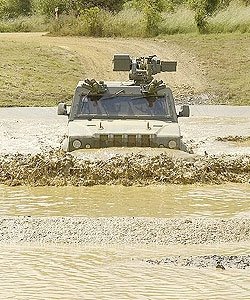
A Dingo armoured vehicle after being nit by a mineAccording to DefenseNews, the German Parliament last week approved the procurement of an additional 149 Dingo 2 mine protected vehicles. This is after German forces were attacked three times last week in northern Afghanistan, including a suicide attack that failed to inflict harm on the crew of a Dingo vehicle, but killed and injured several Afghan civilians.

The decision was immediately criticised by Die Welt which complained the additional vehicles were not enough for the prospect of Germany committing itself to more out of area operations. This was echoed by Johannes Kahrs, a Social Democrat and defence rapporteur in the parliament’s budget committee. He believes that 149 vehicles is "too few and, more importantly, too late".

Let's see now. The German Army already has the Dingo in Afghanistan, where it is saving lives and is buying more – only to have the parliament complain that not enough are being bought. The US has purchased RG-31s, Cougars and Buffaloes. The Canadians have bought RG-31s as their patrol vehicle in Afghanistan. And the French have embarked on a crash programme of up-armouring their VBL armoured cars to increase protection against IEDs.

Five countries, therefore, are buying specialist, mine protected vehicles or adapting existing vehicles, to enhance troop protection in hotspots like Afghanistan and Iraq. And the British MoD? Ah… Lord Drayson thinks that "the Snatch Land Rover provides us with the mobility and level of protection that we need."

COMMENT THREAD

Don't do it again and you can keep your pension

Phew, what a relief. It seems that the former French Prime Minister and former European Commissioner Edith Cresson is not doomed to a penurious old age. I’d hate to think that she might have to have survived without her haute couture or her tasteful jewellery, not to mention all those holidays, private dentists, what have you.

After two years of, no doubt, intense discussions the ECJ has ruled on her case and has said that yes, indeed, she was guilty of “a breach of certain gravity” of Article 213 of the EU Treaty by finding a lucrative job for a friend (and dentist).

As our readers will recall, at the time Mme Cresson could not understand what all the fuss was about. Is that not how political deals are done? If it weren’t for the puritanical Brits and Scandinavians, she sniffed haughtily … (She can’t have known much about the Blair government.)

The Advocate-General, Leendert Adrie Geelhoed, recommended in February that she should lose half her pension as punishment but the court in it wisdom has decided that
“The finding of breach constitutes, of itself, an appropriate penalty.”
It does? Well, I am sure there are a lot of fraudsters out there who would like to see this to become a precedent. The very fact that you have been charged and had to appear in court is punishment enough. We need not bother with anything else. Merveilleux.

Oh yes, Mme Cresson gets to keep her entire pension, which amounts to 47,000 euros or £32,000 a year.

COMMENT THREAD

Silence prevails

Ten percent increase in costs - courtesy of the EUIn another life, I suppose I would have found it quite remarkable how little media coverage there has been on the Restriction of Hazardous Substances (RoHS) directive, which came into force on 1 July, one which we described as the ultimate in fatuity.

This is the directive which bans lead and certain other substances in electronic appliances, estimated to cost British industry alone some £1.7 billion and adding ten percent or more to the price of appliances such as personal computers – all to achieve a greater adverse impact on the environment.

Given the sloth and inertia of the MSM, however, one is not in the least surprised – nor even is one surprised at the lack of any serious response form Eurosceptic parties like UKIP, the latter being so engrossed in a protracted and increasingly bitter leadership campaign that it has no energy left to look at the outside world.

But not in China where, according to the Peoples' Daily, the directive poses a substantial threat to $56 billion worth of annual exports from more than 5,000 Chinese home appliance companies.

On manufacturer alone, Guangzhou AC Panasonic, recently announced that a quarter of its 208 suppliers, which provide a total of 7,268 different assembly parts, would be unable to meet the standards imposed by the EU directives. Unless they can upgrade their technologies in time, these suppliers stand to lose their market share.

Those with a suspicious mind might think that this directive has been promulgated with precisely that intention in mind, yet another fiendish non-tariff barrier devised by the "colleagues" to hamper the onwards march of Chinese consumer goods.

But what is remarkable is the apparently laid-back attitude of Chinese official spokesmen. One such, Huang Jianzhong, a senior official from the Ministry of Information Industry, is pushing manufacturers to up their standards, declaring that, "Safe, healthy and environmentally-friendly have become key qualities in the home appliance market."

Liu Wanshan, an official with the State Administration of Quality Supervision, Inspection and Quarantine, then adds that, "Chinese enterprises must substitute these substances with environmentally friendly materials in their exports to the EU."

Not only that, the Chinese government has produced its own version of RoHS, due to take effect on 1 March next year, a regulation is likely to be broader in scope and even more comprehensive than the EU directive. But, far from being a "green" measure, it is intended to work as a barrier to foreign products that have been turned down by the EU market which manufacturers hope to dump on the Chinese market.

Thus it is that the "green" ethos has been corrupted. Given how uncritically supposed environmental "improvements" are accepted by the media and the public, without question, it seems manufacturers are happy to exploit the situation for their own benefit.

And, of course, since profits overall are usually based on a percentage production costs, increased costs are not necessarily a bad thing and long as everyone is forced to play the same game. The fact that RoHS is a major scam, however – ripping off the consumer – might be something the media could follow up. But, as always, silence prevails.

COMMENT THREAD

Is there a journalist in the house?

For an update on this post, see here.

An all-too familiar picture, we are told - a broken-down 'Snatch' Land Rover out on patrol in Iraq, about to be towed back to baseIf there were any halfway decent journalists out there, with editors that would give them the space, they could have a field day with the lead story in DefenseNews this week.

Headed, "BAE Chief: UK Procurement in 'Semi-Paralysis'", it reports how Mike Turner, CEO of BAE Systems, is complaining that Britain’s procurement budget has fallen into a state of semi-paralysis, and only essential programmes are receiving money and approval.

Within the defence industry, adds DefenseNews, shortfalls in the Ministry of Defence (MoD) equipment budget have been an open secret. But now Turner has spilt the beans.

"I believe the MoD is trying to preserve the defence budget for certain priority programmes, and decisions are not being taken which the UK industry believes need to be taken for the benefit of the UK armed forces and the defence industrial base," Turner says. "We have a state of almost semi-paralysis for getting on with programmes unless they are absolutely essential."

As you would expect, Turner's main complaint is about the programmes his own company is running, such as the Astute nuclear submarine and Type 45 destroyer. The Nimrod MRA4 surveillance aircraft also is in limbo, although a contract for 12 aircraft could be announced at the Farnborough air show.

He adds that, "our armed forces cannot continue to be a force for good in the world, as the MoD says they are, without the right level of funding to go with it."

Turner is supported by "a leading industry figure" who says "the problem of underfunding is worse than ever" but, tantalisingly, neither of them say what the "priority programmes" are. However, in the absence of any MoD press release announcing the cancellation of the £14 billion Future Rapid Effects System, it is a pretty safe bet that this is one of them. That alone demonstrates that, above all else, the government is still committed to funding Britain’s contribution to the European Rapid Reaction Force.

This has been our continued complaint on this blog – that the government is pouring money into the European fantasy army and neglecting the here and now – the current needs of our armed forces. Turner's comments seem to confirm this.

Small wonder, therefore, that when BAE systems is finding money tight for projects which are already on the stocks, the Army is not getting any money to replace its dangerously vulnerable (and unreliable) "Snatch" Land Rovers, to say nothing of the rest of the kit it needs to fight an effective counter-insurgency campaign.

With troops actually engaged in combat and at risk, this is becoming a major scandal and one which surely cannot remain out the public view for much longer.

Now, what was that I was saying about journalists?

COMMENT THREAD

Monday, July 10, 2006

Shamil Basayev's death reported

As most of our readers would have seen the Russian media has announced that Shamil Basayev, the most wanted man on the government’s list, has been killed in a special operation in Ingushetiya. The fact that the news comes from the Head of the FSB, Nikolai Patrushev, need not make us think that it is untrue. Sometimes even those guys tell the truth.

The Chechnyan war (or conflict if you are a journalist) is outside the scope of this blog normally, but there is, I think, a need to counter the hysteria that is taking over large chunks of the media and the blogosphere.

It has always been my contention that people who do not know any Russian history should not write about that country. That, of course, is true about any country (and we only need to look at the amount of tosh that is written about the United States in Europe, including Britain). But, somehow, Russia excites the wildest and most ignorant comments. Having read a goodly number of past accounts written by foreign visitors and journalists about that country I can safely assert that this has been true for some time.

The Chechnyan conflict consists of a series of wars, periods of uneasy peace and bouts of quite startling brutality. It has been going on for over 200 years from the beginning of the Russian expansion into the Caucasus and at various times in various degrees involved the neighbouring territories or countries of Ingushetiya and Dagestan. (Among other Russian writers Lermontov and Tolstoy wrote about the area and the wars in the first half of the nineteenth century.)

It is worth recalling, as we survey the quagmire in which the Russian troops have found themselves in the last ten years, that the victorious Russian army of Alexander I, which had chased Napoleon and the Grande Armée from Moscow to Paris between December 1812 and spring 1814 then went home and became bogged down in thirty years of fighting against the Chechen leader of the day, Shamil.

It is also worth recalling that in 1944 the entire Chechen and Ingusheti population was rounded up by the MVD on Stalin’s orders and transported to Siberia, whence relatively few returned. Soldiers, NCOs and officers who had fought valiantly in the Red Army against the Nazis joined their families or what was left of them.

That is part of the background. One must not forget that the war that is going on now was launched effectively by Putin as he was made Prime Minister and designated as successor by Yeltsin. Nobody in Russia or among Russians abroad believes that those unexplained and hotly denied explosions in Moscow apartment blocks were carried out by Chechnyans. There just seemed no point to them. After all, the Chechnyans had got a kind of a deal with the Russian government, negotiated by General Lebed (also since deceased in an air accident).

During this second war (well, second of the recent bout of fighting) Putin has made sure that Yeltsin’s mistakes were not repeated. The media has largely been banned from the area. The few journalists who have managed to get through, have been harassed, attacked, kidnapped, even murdered. Since then, of course, almost all of the Russian electronic media and a goodly part of the newspapers have come under government control.

The organization that was responsible for rousing public opinion in Russia during the first war, the Union of Soldiers’ Mothers, was thrown out of their offices and generally subjected to extensive harassment.

We have little idea of what is really going on in Chechnya and the surrounding area. We do not even know the scale of Russian casualties.

The incomplete information that has come out points to large scale brutality on both sides with little help to the civilian population, which by now consists mostly of very old people and young children with the few women who have managed to escape. At various times well-meaning western organizations have tried to send humanitarian aid to the Caucasus. The destination of the aid has remained unknown.

None of this is meant to exonerate Shamil Basayev who, unlike Aslan Maskhadov, the Chechnyan leader killed some months ago, had not been elected by the people of that autonomous republic, did not wish to negotiate with the Russians and boasted openly his responsibility for a number of atrocities and hostage taking episodes. So the hysterical jumping up and down in glee is justified to an extent.

It is, however, worth looking at some of the details. Firstly, Chechnyan sources are insisting that he was killed as a result of an accidental explosion not by Russian troops.

Secondly, the story, as given out by the Russian media, is once again highly convenient to Putin. Basayev is supposed to have been planning an attack in southern Russia to spoil the forthcoming G8 meeting in St Petersburg. It is possible that he decided to take lessons from the British jihadists of last year. It is also possible that the actual operation was carried out before and announced now to bolster Putin at what was, until now, promising to be a very difficult G8 meeting. Or none of it is true and he died in an accident. Who knows?

Let us, for the moment, assume that the news is true. Basayev has been killed. This is a matter for rejoicing in the same way as the killing of Zarquawi was. Will it bring the end of the bloodshed any closer? That is unlikely, as the Russian intentions have little to do with constructing a working and relatively peaceful society.

Will this mean that the butcher responsible for all those deaths in the Moscow theatre siege of 2000 and in Beslan in 2004? Well, actually, no. Basayev was, on his own boasting, responsible for starting both those bloody episodes, as well as the hospital siege in Budyonnovsk 1994 (another murky episode) and several hostage takings, hi-jackings and explosions.

What actually happened in Moscow and Beslan, both coyly described by the media as “resulting in so-many deaths” and “causing world-wide outrage”. 129 people were killed in the Moscow theatre siege, all but about 6 by the Russian security forces when they stormed the building, shot all the hostage takers (thus there could be no trials afterwards), having filled the building with poisonous gas that killed and incapacitated the various hostages. These were dragged out of the theatre, thrown into various cars and taken to hospitals round Moscow where the doctors were not told which gas had been used. Neither they nor foreign medical teams who stood by to offer help had any idea of what the antidote might be for several days.

There has never been an enquiry and all attempts by survivors to find out the truth or to get some compensation have been brusquely dismissed. Putin announced that the operation was a huge success. Too bad about the people who died but what can you do? Can’t make omelettes without breaking eggs.

Even if we disregard the numerous conspiracy theories that have been circulating in Moscow, the rescue operation has to be seen as a completely incompetent botch-up.

Beslan in many ways was even more appalling, not least because the casualties were higher – over 300 – and because so many of them were children. Nothing can possibly excuse or explain away the hostage taking of a school, the terrorizing of children and their teachers. (There have been some attempts to establish what happened that autumn and a murky story of incompetence and corruption has been partially unravelled.)

Given with what ease the MSM attacks American and, even, British behaviour without ever bothering with evidence, it is extraordinary how mealy-mouthed the accounts of Beslan have been. All we are told is that as a result of the siege 300-odd people died and there was an international outcry, because of who the victims were.

We are not told too often that the Russian authorities refused to negotiate with the hostage takers not simply about their demands (clearly, one cannot do that) but even about supplying food and water and possibly releasing some of the hostages, despite the fact that countries with experience in these matters, such as Britain, immediately offered help. When the ex-President of Ingushetiya did negotiate, some of the children were released. The indication is that the Russian plan had always been to storm the building.

The actual storming, triggered off by a sequence of events we still do not know, was a mess. For some reason local inhabitants, armed with shotguns were allowed to join in. The forces and the civilians rushed in shooting in all directions. It remains unclear how many of the children and teachers were killed or injured by the Russian security forces.

While the siege lasted some of the media was allowed reasonably close but not journalists who knew anything about the background. Andrei Babitsky of RFE/RL who had already been kidnapped once in very mysterious circumstances, was picked up on some trumped up charges by the police and released too late for him to make his way to Beslan.

The redoubtable Anna Politkovskaya was badly poisoned on the flight to southern Osssetia and was taken to hospital in a coma. She barely survived. Of course, this could be a coincidence.

The world-wide outcry was as nothing compared to the Russian one. Both local and national governments were forced into some enquiries and the one surviving hostage taker has just been tried and sentenced to life imprisonment. The miasma of an appalling cover-up, of a complete refusal to find out what really happened before, during and just after the siege, continues to poison the lives of relatives and survivors.

These things need to be said, not in order to exonerate Shamil Basayev - there can be no exoneration for someone like him – but in order to understand why the Chechnyan war is not completely part of the war against terror and why it will not be ended by the man’s death. There have already been far more deaths than in Iraq and there will be many more. Unlike in Iraq, no solution appears to be forthcoming.

COMMENT THREAD

An important point of principle

Reuters informs us today that Britain is being threatened with yet another visit to the European Union Court of Justice.

This time it is over the issue of tax relief on donations to charities based elsewhere in the European Union, with the EU commission having given Britain a final warning over rules that allow tax relief only on gifts to domestic charities. This, says the commission, discriminates against charities located in other member states.

EU Tax Commissioner Laszlo Kovacs has pronounced that, "Gifts to bona fide charities in other member states should get the same tax treatment as gifts made to domestic charities." The commission argues that the discrimination breaks EU rules on the free movement of capital, persons and establishment, forcing foreign charities to set up branches in Britain to benefit from the tax relief on donations.

Small point though this might seem, it is in fact a direct attack on national sovereignty. As the system stands at the moment, a charity is only recognised for tax purposes if it is approved by the Charity Commissioners under rules laid down by the British Parliament. Different countries in the EU have their own specific rules and what may be approved in other countries may not be approved here – and vice versa.

In effect, therefore, what the EU commission is saying is that the British government no longer has a sovereign right to specify which organisations should or should not qualify as charities and must accept other countries' definitions.

Furthermore, while charities in this country are subject to some oversight by the Charity Commission – albeit nominal in most cases – we are thus obliged to rebate taxpayers’ money to organisations which do not come under British jurisdiction and thus over which the government can exert no control. In theory, if not in practice, our government could end up subsidising an organisation which would not qualify for charitable status here, and which is acting against our own national interest.

This is, therefore, not a minor matter. Rather it is an important issue of principle. Did we really think this is what we were letting ourselves in for back in 1972 when we signed up to the EEC? And is this sort of thing really necessary to prevent Germany invading France?

COMMENT THREAD

The fun continues

In today's business section of the Daily Telegraph, Ruth Lea offers an interesting perspective on the benefits of our continued membership of the European Union. If I could get on the internet long enough to post and analytical piece, I would, but problems in accessing the internet continue.

As it is, I can only stay on long enough to post a "quickie", so all I can say it that this is definitely worth a read.

As for AOL, below is the message I have sent to them.

You know, I just wish you corporate people could occasionally tell the truth. It is clearly evident that there is a problem upstream - nothing to do with this end. Yet you insist on doing the Janet and John fault checking as if the fault lies with the user.

Then I have to drag it out of you that there is an exchange fault. Your automatic message on Saturday said that it would be sorted in "a few hours", your help line and Saturday midday said it would be cleared up in 4 hours, and your automated message today is still saying "a few hours". Yet, at this end the service is deteriorating

If you have a problem, we do understand. Shit happens. What we want from you is an indication that you know of the problem, what it is, what you are doing about it and the best estimate of when it will be resolved. Instead, your corporate shit turns a problem into a crisis and giving your customers the run-around simply pisses them off.

All I want from you therefore, is a simple clear message: what are you doing about this problem and when will it be resolved.
Customer is king eh? B******s.

COMMENT THREAD

Target for tonight

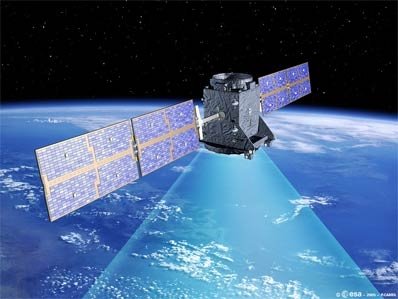
An artist's impression of one of the Galileo satellites in orbitIt is a while since we heard anything interesting about the EU's Galileo satellite navigation system but, in the wake of the Airbus debacle, this story will warm the cockles of every Eurosceptics' heart.

At the centre of the story is the very nature of the Galileo system which, unlike the US GPS constellation – is not free to all end users. The EU intended to make only a very limited signal available free of charge, aiming to charge users for more accurate signals. This is had planned to do by encrypting the signals and then charging users for the key to the codes, so-called Pseudo Random Numbers (PRN) is tecchie-speak.

Now enter the members of Cornell's Global Positioning System (GPS) Laboratory, some very serious tecchies indeed. Irritated by the failure of the EU to provide, free of charge, some of the codes for the signal generated by Galileo's validation satellite, Giove-A, they set up a programme to crack the codes themselves.

From mid-January, it took them two months and, on 1 April published the codes in a GPS magazine. Two days later, NovAtel Inc., a Canadian-based major manufacturer of GPS receivers, downloaded the codes from the Web site in a few minutes and soon afterward began tracking Giove-A for the first time.

Galileo eventually published PRN codes in mid-April, but they weren't the codes currently used by the Giove-A satellite. Furthermore, the same publication labelled the open source codes as intellectual property, claiming a license was required for any commercial receiver.

Professor Mark Psiaki, a member of the Cornell team, was disturbed, fearing that cracking the code might have been copyright infringement. However, the university counsel decided that, while cracking the encryption of creative content, like music or a movie, was illegal, the encryption used by a navigation signal is fair game.

The upshot says Psiaki is that the Europeans cannot copyright basic data about the physical world, even if the data are coming from a satellite that they built. "Imagine someone builds a lighthouse," argued Psiaki. "And I've gone by and see how often the light flashes and measured where the coordinates are. Can the owner charge me a licensing fee for looking at the light? … No. How is looking at the Galileo satellite any different?"

What that means is free access for consumers who use Galileo navigation devices - including handheld receivers and systems installed in vehicles. What it also means is that The EU, in its plans to reap a financial bonanza from licensing its signals, is well and truly stuffed.

But there is a darker side. At the top end of the accuracy spectrum is the Public Regulated Signal (PRS). This is accurate enough to be used for targeting information by cruise missiles and smart bombs. But it was always the plan - or so it was claimed – that the codes for this signal would be restricted, preventing the likes of China using them for warlike purposes.

But, if the Cornell university team can crack the current code, China – as a paid-up member of the Galileo development team, with full knowledge of the systems architecture – should have no problem cracking PRS. If the EU thinks that Galileo is not going to be used by potentially hostile powers for its weapons and command and control systems, it is dreaming.

The question therefore remains as to whether the EU will agree to close down the system if any hostile power looks like using the signal in hostilities against America, or whether the US Air Force will have to shoot down the satellites.

COMMENT THREAD

Sunday, July 09, 2006

This one will have legs

Desmond SwayneYou have to give it to Desmond Swayne for being aware that the Common Fisheries Policy is an issue with the Conservative Party – and note that the Sunday Times, like so many other newspapers, have completely failed to recognise its significance.

This we glean from the Sunday Times article today, which publishes a commentary on Swayne's leaked e-mails, taking a typically trivial approach to the subject, concentrating mainly on the "tittle-tattle" about personalities within the party.

The e-mails in question were from Desmond Swayne, the MP for New Forest West, in his capacity as parliamentary private secretary (pps) to the Boy King. Tagged the "bag carrier", the post-holder is supposed to keep the leader of the opposition up to speed on sentiment within the parliamentary party and it was in pursuit of this activity that the e-mails were sent.

Conveniently, the Sunday Times posts links to all eight e-mails on its own site (link above) but the first one is ignored. It reads:

That Fish has had too much prominence; that we have higher priorities, and that consequently we wave (want?) to downgrade the policy, is something that colleagues will understand. To abandon it completely however, will put some colleagues in great difficulty. It is a totemic issue and the flak will be significant. And what do we gain except that we are left without an effective critique of one of the most disastrous consequences of EU policy? (Also it does not help to have a mince head as the spokesman).
Predictably, the Sunday Times picks up on the "mince head" comment, without identifying the target of the epithet, other than as "a spokesman on European matters".

Tittle-tattle aside, what comes over from the e-mails is the profound concern within the parliamentary party at Cameron's "perceived silence" on the European Union. Senior members are said to be feeling "depression and even dismay" at his stance.

Indeed, says the Sunday Times, Cameron's European policy emerges as one of Swayne's greatest worries. Several e-mails are devoted to the leader's pledge to withdraw from the EPP. Swayne warns that the EPP pledge has backfired and alienated all sides of the party.

He writes about the "depression and even dismay" in the context of concern about European attempts to sneak some provisions of the moribund EU constitution into law, adding, "The feeling of frustration and impotence is compounded by our perceived silence on things European. It is also a prime source of the grumbles in our mailbags." Some MPs believe that the Cameron's silence might push the "army of activists" to defect to the UK Independence Party.

All of this indicates that the Boy King has troubles on the EU front – not least his ditching the policy on fishing – which will not be helped by Swayne’s suggested response. Aware that, "in this vacuum", "stunts" like the Freedom Association's "Better Off Out" campaign tend to thrive, he suggests that:

...we might offer some comfort (or merely diversion) would be to up the ante on the Making Poverty History agenda which would inevitably involve a powerful critique of EU trading policy and stalled reform of CAP.
It is that phrase in brackets that will have activists fulminating – the "diversion" comment. If he is reading the Boy's mind correctly, he knows that his leader has no intention of engaging seriously on EU issues. In writing the comment, Swayne has thus confirmed what many activists either knew or suspected.

Swayne himself has not been available for comment since the e-mails were leaked and the Tory faithful are hoping the story will die down, submerged in the torrent about Prescott. For myself, once the implications of what Swayne is saying have struck home, I believe this one will have legs.

COMMENT THREAD

Compare and contrast

The Business newspaper tells us that G8 leaders have become embroiled in a dispute over competing plans for funding cheap drugs to the Third World. It seems that disagreements over how the programme is to be financed have "dashed hopes" that agreement would be reached at their summit next weekend in St Petersburg.

This was all started by Chirac, with a plan to tax airline tickets in order to provide a fund to buy pharmaceuticals for African States, with special reference to AIDS. France has already imposed a €1 charge on economy class seats and €10 on business class flights for its fund to fight Aids in Africa, and said it has 13 countries willing to sign up.

Now the Italians have weighed in with a rival scheme, which would guarantee subsidies of between $800m and $6bn to pharmaceutical companies for developing cheap vaccines, particularly for pneumonia and meningitis, which kill millions in the Third World. Few African countries can afford to buy these kinds of vaccines.

What is sad about this is that anyone can even think of giving house room to these megalomaniac schemes, especially anything devised by Chirac. No only is the man a crook – a liar and a thief who would have been locked up long ago but for the fact of his presidential immunity – "top down" schemes like his rarely work in Africa. By the time local crooks have siphoned off their cuts, and different countries have imposed their own taxes, there is often little benefit to ordinary Africans.

Now compare and contrast with the scheme highlighted in the Booker column this week.

A small charity called Intercare, based in Leicester, has for 30 years been putting large quantities of drugs surplus to requirements to use in Africa. Thanks to a nationwide network of volunteers, it collects medicines from GPs, which are rigorously inspected by a team of retired NHS professionals - doctors, nurses and pharmacists - and then supplied to 94 clinics in seven African countries.

This is the sort of initiative that does work. It cuts out the middle-men, by-passes the corruption because no money, no government agencies and no NGOs are involved, and ensures that real aid reaches the people who most desperately need it.

That was the situation, but it was to reckon without the mindless intervention of the bureaucrats of our very own Environment Agency. According to their bizarre interpretation of EU waste rules, they have decided that these life-saving medicines are "waste" and must be buried in landfill rather than put to use in Africa.

The drugs are only sent out, to order, when they are in date and in perfect condition, and the operation is approved by the World Health Organisation. It provides 2.5 million Africans in remote rural areas with access to treatment they could not otherwise afford.

However, not only are these cretins in the Environment Agency seeking to put a stop to this work, they are considering prosecuting Intercare for breach of EU waste rules, and the directors have been summoned to an interview under the Police and Criminal Evidence Act.

This very much seems to be the way of things at the moment: seek out those imaginative schemes that actually work – and stop them. Meanwhile, hand the problem over to megalomaniac crooks like Chirac, to enable him to grandstand on the world stage with a scheme that is not only doomed to failure, but will likely fuel the very sort of corruption that has kept Africa on its knees.

The worst of it is that the Booker story is tucked in his ghetto in the Sunday Telegraph, where it will likely be ignored by the great and the good, while the Chiracs of this world grab the limelight with their crooked schemes.

COMMENT THREAD

Corporate lies

With a steadily deteriorating broadband connection, I am able to stay on-line for about two minutes before the connection terminates, with a warning flag coming up telling me that my cable is unplugged – which, of course, is not true. Anyhow, it is making posting very difficult.

Enquiries yesterday with AOL elicited that there was a fault on the exchange, which would be fixed within a "few hours". That was yesterday and now, if anything, the fault is worse. Following a further conversation with an AOL call centre in India, I am told that the problem will be fixed in "four hours". I suspect that AOL's "hours" are a bit like Cornish miles … much longer than any others.

I will post the usual crop of "insightful" comment as soon as the system is back up. Please bear with me.

COMMENT THREAD

Smug

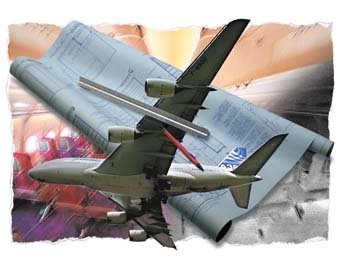
Back to the drawing boardIn today's edition of The Business, on the eve of the Farnborough Air Show, you will find a 2,000-word update on Airbus, chronicling just quite how low the fortunes of this company have sunk.

This is well worth a read, and pointless me regurgitating here. But what it highly entertaining is the analysis of the company's decision to build the A380 "superjumbo". Says the paper:

The ambitious A380 super-jumbo, with a baseline 555 seats, was supposed to fill in the final gap in its range, leapfrogging Boeing’s venerable B747 jumbo, the plane that pioneered long-haul travel for the masses 30 years ago.

But with the A380, Airbus was building the wrong plane. Since the design of the A380 was approved, half a decade ago, the global aviation industry had entered a new phase. Thanks to improved technology, airlines no longer saw the need for giant planes flying long distances. And as hub airports become more crowded, and passenger numbers grow, customers can see the obvious advantage of flying "point-to-point" from regional airports close to home, to regional airports close to their destination.

This had been obvious to Boeing's crystal-gazers years ago. The Chicago-based aircraft maker began work on an all-new widebody twin-jet, offering from 250 to 300 seats, to capture this market. Its B787 Dreamliner, using composite materials and state-of-the-art technologies, will provide big fuel economies at a time of soaring oil prices, and will fit the shape of passenger demand when it comes into service in 2008. The proof is in the sales figures: airlines have ordered more than 350 Dreamliners, enough to offset the plane’s huge development costs.
Now, compare and contrast that analysis with this piece written in January last year (2005) at the time of the A380 launch:

For all that, the A380 is an aircraft that has never left the runway and its first flight is not due to take place until this spring. Commercial service is expected in 2006.

Interestingly, compared with Boeing's alternative, the 7E7 "Dreamliner", there is another "old Europe" aspect to this project. Boeing is going for a smaller aircraft, capable of servicing regional airports, transporting people directly from place to place. The idea is to give passengers a greater choice of starting points, routes and destinations, enabling them to avoid the inconvenience of travelling to the congested, high density "hubs".

Airbus, on the other hand, is going for massive centralisation, putting even more pressure on the central hubs, as its operating carriers will be forced to increase passenger traffic to meet their costs. That rather epitomises the very nature of "old Europe" – an inflexible, centralising construct, divorced from the needs of the people.

As well as the hardware, therefore, we are also seeing an ideological battle and competition between two opposing commercial concepts. My money is on the New World.
The source of that prescient piece? Why, little ol' EU Referendum of course. We mustn't do this too often, but I think we're entitled to feel a little bit smug.

COMMENT THREAD

Saturday, July 08, 2006

The conspiracy continues

For the Pinzgauer "Vector" see here.

For an update on this post, see here.

Des Browne - secretary of state for defenceAnd so to that defence debate held in the Commons last Thursday.

While we have been "banging on" about this on this blog, what perceptive readers will find is that the most significant issue to emerge from this debate is that the process itself transcends the subject matter. The way the subject material was handled actually provides a graphic illustration of how the conspiracy of silence in our Parliament over European Union issues continues.

To develop this theme, we need to look at specific aspects of the opening speech from the secretary of state for defence, Des Browne, a man new to his post and without any background military experience. He was, therefore, wholly reliant on his brief from his civil servants and was thus parroting what he has been told.

The Warrior - track wear and maintenance becomes a major issue with extended useThe touchstone issue, of course – for this blog – is the "Snatch" Land Rover. This subject is first introduced into the debate by way of an "intervention" by Mark Pritchard, the newly elected Conservative MP for the Wrekin. He asks the secretary of state, in respect of the promised review of armoured vehicles in Iraq and in Afghanistan, "whether Warrior armoured vehicles be supplied to the front line, where there is a demand for them, thereby reducing casualties resulting from Snatch Land Rover use?"

Before getting on to our Des Browne, Pritchard's intervention has to be marked down as utterly fatuous and unhelpful. It is a line that has also been pursued by the egregious Sean Rayment in the Sunday Telegraph and needs a little exploration.

The Warrior Mechanised Infantry Combat Vehicles (MICV) are tracked armoured vehicles designed specifically to carry sections of infantry into battle alongside main battle tanks, providing the infantry support without which tanks cannot operate. Moreover, they were designed specifically for the European theatre for action against Warsaw Pact forces.

As such, these are not patrol vehicles – they are troop carriers. Visibility for the troops carried is poor and they are not able to participate in the action until dismounted. Further, as tracked vehicles, they are noisy and uncomfortable – important factors when troops are carried for long periods – and, being built for the European theatre, they lack air conditioning. Being tracked, they are relatively slow and, crucially, require a high level of maintenance, as the tracks wear out very quickly in adverse conditions.

Very recently, we have seen a report from Canadian forces operating in Afghanistan, recounting the enormous toll that operations are exacting on equipment; we have first-hand accounts from British troops in Iraq about how the increased use of Warriors in that theatre is imposing acute maintenance burdens which will shortly reach a crisis point; and there are many public domain narratives which convey the concern of US over the extraordinary toll routine operations in Iraq are taking of mechanical equipment.

A long distance patrol in Afghanistan - hard on wheeled vehicles but harder on tracksWhatever the need for improved armour in both Iraq and Afghanistan, therefore, Warriors are not the answer. We are using them simply because we have them – and nothing else – but, given the huge distances they would have to travel in Afghanistan, they would be a liability. Pritchard, had he taken the time and effort to research the issue, would have known this. But, instead, we get a cheap little intervention that actually misses the point completely – that we do not have a suitable armoured vehicle in either Iraq or Afghanistan for use in counter-insurgency operations.

Turning now to Des Browne, the man responded by agreeing that "we identified a deficiency in capability as regards Snatch Land Rovers and the fully armoured vehicles and thought that it needed to be addressed", reminding Pritchard of the ongoing review. He then went into a long spiel about the IED threat and the use of armoured vehicles.

Improved armour, he said, is part of the solution and claimed that "additional armoured options" will become available to commanders over the next year. This included the "new patrol vehicle", the Vector (the infamous armoured Pinzgauer), which will enter service in Afghanistan in 2007. In addition, said Browne. "we have already upgraded the protection on Warrior, Saxon and the CVR(T), and we are currently upgrading it on the FV430 vehicle." There, the secretary of state seems to be unaware of his own department's decision to withdraw the Saxon completely. Heedless of this, he then continued:

However, Snatch Land Rovers will continue to be an important option. The Army's approach to its role in Iraq and broadly in Afghanistan - although not on certain tasks - requires a low profile and a highly mobile patrol vehicle that allows troops to engage with local people. As people will have seen from their television screens, paratroopers in Afghanistan prefer to walk the streets of towns there with soft hats on. That is not our decision, but a decision made by their commanders in the light of what they are trying to do. It is clear from the pictures relayed back in recent days that that engagement works in a substantial part of the area for which they have taken responsibility. Larger and significantly heavier vehicles, such as Warrior, might be better armoured, but they are not always suitable for the lower profile and less intimidating manner in which the Army often prefers to operate. That, in turn, feeds into the security of our forces, because their relationship with the people with whom they work is an important component of security.

We must remember, however, that equipment - armour and other counter measures - is only one element of protection. According to the experts who have advised me continuously over past weeks, it is only about a third of the story. The rest is down to intelligence gathering, surveillance and proactive operations to disrupt and capture insurgents, and to the tactics that our troops adopt to minimise the risks of successful attack. I am told by experienced commanders that they sometimes choose not to be in a vehicle at all but to walk the streets, which is much safer than being cooped up in a vehicle and provides a degree of flexibility.
What we have to remember, though, is that, of the four major armies in the two theatres, the Americans, the Canadians, the French and the British, the first three have decided to provide entirely new armoured equipment or upgrade existing equipment. Therefore, what we are seeing is Browne telling us that, beyond unspecified "additional armoured options" and the new and dangerous Pinzgauer – which is a troop transport rather than a patrol vehicle – the MoD, uniquely, does not see the need for re-equipment. The fact is that the MoD has been caught short, committing troops to two highly dangerous theatres without suitable armoured vehicles.

Now, you would have thought that an opposition, desperate to score "brownie points", and with a reputation to build and an election to win – whenever it happens – would have made capital out of this. Browne had just presented them with an open goal.

This was left primarily to Liam Fox, who was is next on his feet as shadow secretary of state for defence. But the open goal was ignored. He talked about defence spending, recruitment and retention, the territorial army and the reserves, overstretch and its effect on morale, family accommodation, shortages in the medical services, combat stress, the working condition of troops and the general situation in Afghanistan. But not once in his speech is there any mention of armoured vehicles – not even a passing reference to their deficiencies.

Then, throughout the main part of the debate, this became the dog that did not bark. We were treated to a huge range of issues – even one Labour MP bemoaning the injustices done to the Bevin Boys – the conscripted coal miners during that Second World War – but nothing more on equipment, until it cames to Conservative back-bencher, Ann Winterton. But she went further. She that asked members to cast their minds back to December 1998 during the negotiations on the St. Malo agreement. It was at that time, she said, that the Prime Minister decided that the UK would not join the euro. "In all matters relating to the European Union, there can never be a straight decision. There is always a trade off—that is, a price to be paid. In this instance, the UK conceded and agreed that our forces would be integrated into a European Union defence force".

She continued:

From that time onwards, the Ministry of Defence did not quite know in what direction it would have to commit our armed forces in the future. Would the first priority be to serve the interests of the UK, or to co-operate with the European Union or with the United States of America, or a combination of all three? If the MOD did not know in which direction it was meant to be going, how could members of the armed services second-guess the future? Subsequently, the problems have been exacerbated because the UK is engaged in conflicts in which our troops are committed in Iraq and Afghanistan.

It has been well understood that, moving on from the former cold war scenario, changes would have to be introduced and the concept of the future Army structure came to light with its objective of strengthening the medium sector. It is crystal clear that we are without a whole category of vehicles suitable for insurgency work, and this lack has been shown in both Iraq and Afghanistan. The focus and direction of policy has been to prioritise the future rapid effect system, which is an integral part of the European Union rapid reaction force, but which realistically will not be in operation until possibly as late as 2020. Moreover, the whole project falls into a world of fantasy in which the total package requires airlift, electronics, future technology and state of the art communication at a projected overall cost of £6 billion initially, which ballooned almost overnight to £14 billion.

Those sum are all beyond our financial means and are almost just a wish list, but these plans have resulted in us taking our eye off the ball. Rather than concentrating on what is needed now and for the immediate future to enable our armed forces to meet the challenges of fighting insurgents in Iraq or Afghanistan—insurgents who are highly mobile and armed with cheap but deadly weaponry—we are left in a virtual vacuum. We are expecting our forces to operate Snatch 1 armoured Land Rovers from Northern Ireland, which are clapped out and always overheating and breaking down. The No. 2s are just about acceptable, with a little life left in them yet, while the No. 3s are very few on the ground.

The problem is that we are forced to use these old vehicles because there is no alternative, and because of ongoing long- term commitments the MOD is now virtually broke.


While our armed forces are placing their lives on the line each and every day on behalf of us all, which they are now doing in Afghanistan as well as in Iraq, it is essential that the Government, through the MOD and Parliament, concentrate on providing what is necessary for the present and for the immediate future. The Prime Minister has spent too much time placing European Union integrationist policy first, rather than ensuring that present day servicemen and women have appropriate and adequate resources and equipment.

If we do not provide our forces with the best that money can buy, rather than some of the present outdated equipment, which is hardly fit for purpose, will it be any surprise if we cannot recruit or retain sufficient high calibre personnel? By spending too much time and energy on the future creation of forces which will eventually be totally integrated within the European Union rapid defence force, the Prime Minister and his Chancellor have sold the pass and limited the choices for the future.

Many commentators believe that the Army of today is being starved of resources in order to feed a fantasy army of the future. I hope that they will be proved wrong, and I trust that the MoD will provide the appropriate equipment for our armed services to allow them to perform their valuable and vital duties.
Looked at dispassionately, this was an extraordinary speech. Despite her measured tones, Winterton was effectively accusing the government is so obsessed with European integration that it was neglecting the combat army and sending troops to their deaths for want of the right equipment.

In the remainder of the debate, one more back-bencher, Tobias Ellwood, the Conservative member for Bournemouth East, did mention equipment but when it came to the summing up, there was not a mention of the European issue. Mark Harper, for the Conservatives, noted that Anne Winterton had "raised the issue of equipment" while Adam Ingram, the minister of state for defence, speaking for the government, simply ignored Winterton's speech. As to Europe, he ignored that as well, although he did take the time out to commend all the speakers, saying: "We have not been in party-political point-scoring mode today".

Thus it is that the conspiracy of silence continues. This is the new conservatism of "Dave", where the Conservative party doesn't "do" Europe any more, while the government blithely ignores any references made by errant back-benchers. And so the chaps all patted themselves on their respective backs, congratulating themselves on what a jolly good debate it had been and went off to the bars, or their offices, or toddled off home – or whatever.

The media, in turn, also ignored the debate and the elephant slumbered on quietly in the corner of the room.

COMMENT THREAD

Spring is in the air

Spring is in the airApparently, the joys of spring had a Euro-flavour this year. According to the Spring Eurobarometer, as the sap started rising and the birds started tweeting and the lambs started gambolling… you get the picture … that was the time when we learned to stop worrying and started to love the EU.

Well, that's not quite the picture but commissioner Wallström definitely has a spring in her step as the early results show "an important increase in the support for EU membership among citizens, as well as in the image of the EU." The downside, however, is that "enlargement suffers from weaker support among the public opinion."

According to the survey, the three main indicators covering the general attitude towards the European Union show an unambiguous positive development in the public opinion. Compared to the last survey in the autumn 2005, support for EU membership have increased by 5 points (55 vs. 50 percent), image of the EU by 6 points (50 vs. 44 percent) and perceived benefits of the membership by 2 points (54 vs. 52 percent). In parallel, negative opinions on these three indicators have been decreasing, in particular for the image of the EU (15 vs. 20 percent).

Nevertheless, Finland - currently holder of the EU presidency - still ranks as the lowest in the support league, with a mere 39 percent in favour of EU membership, while the UK is not far behind with 42 percent. Whatever the raving Europhiles might say, therefore – and whatever the Boy King thinks is "cool" – the majority of people in this country do not support our membership of the EU. Furthermore, in only 34 percent of British people does the EU conjure up a favourable image while only 31 percent "tend to trust" the Union as a whole.

One more fly in the ointment is that support generally for the concept of a constitution for the EU has slightly decreased since the last survey in the autumn 2005 (61 percent, -2), coming back to the level reached in spring 2005. Some twenty-two percent of citizens are opposed to the concept of a European constitution and 17 percent do not know. With 62 percent of positive opinions, France is just above the EU average and with 59 percent, the Netherlands are just below.

However, reflecting just how pitifully little "Europeans" actually know about the EU, the Eurobarometer shows that they are "rather satisfied with the way democracy works in the European Union". Satisfaction rate reaches 50 percent (48 percent in the EU 15 and 59 percent in the new Member States, +1 compared to the last survey) while dissatisfaction is at 34 percent (-1). These, it appears, are the most positive scores achieved for this question in the last ten years.

Full details of the survey can be seen here.

COMMENT THREAD

Friday, July 07, 2006

Where has he been all this time?

The Conservatives have a Shadow European Minister. Well, I suppose, if I had given it any thought I would have realized the likelihood of that. But I would never have worked out that his name was Graham Brady because I have never heard of the man.

I have now found out that he is the MP for Altrincham and Sale West and also that, according to his own website he is not too busy with statements or speeches or questions. He appears to have attacked the Lib-Dims for wanting to scrap grammar schools for which one can applaud him but has he realized that it is no longer Conservative policy to support excellence in school education or choice in any shape or form?

Another thing he does not seem to realize is that the European issue is NOT TO BE BROACHED BY ANY CONSERVATIVE POLITICIAN under pain of instant and painful execution. Well, to be fair, it is difficult to be Shadow European Minister and never broach the subject of Europe but Mr Brady seems to have managed so far.

Now, according to the Sun, he has made a statement. Apparently, Britain cannot remain part of an EU that continued to block free trade with other countries. Well, I don't know. Britain has been part of this benighted organization for over 30 years, during which time free trade with other countries, particularly developing ones, has been blocked pretty consistently.

The Sun thinks that this will infuriate the party leaders such as the Boy-King and William "We Must Be At The Heart of Europe" Hague. We may yet see that instant and painful execution. Something with boiling oil in it, as W. S. Gilbert said.

COMMENT THREAD

What are we paying this man for?

For an update on this post, see here.

The Panther 'battlefield limousine'Yesterday, there was yet another defence debate in the Commons, unreported by the MSM, as most of them are.

There were several references to the "Snatch" Land Rover and I will publish a compilation of these over the weekend. But one interesting exchange caught my eye, between Conservative MP for Salisbury, Robert Key, and his fellow Conservative (for Congleton), Ann Winterton.

In his speech, Key – perfectly properly – applauds the work of the Royal Military Police, pointing out that they do a difficult and dangerous job. He goes on:

The strange thing is that, in battle, the RMP are always right out there at the front. They are in front of the armour and the artillery, staking out the forward route in their Land Rovers and so on. They are very lightly armoured, if at all, and they have no protection from mines, small arms or artillery. I know that that is being addressed. I have raised the matter before with the Minister of State. We know that there is a new stream of Panther vehicles coming to the Army later. However, what bothers me is that, in a parliamentary question, I asked who was going to get those vehicles first, and the answer was the training regiments. That is fine, but no mention was made of the RMP. I thought that we were talking about what was meant to be a front-line reconnaissance vehicle.
Ann Winterton responds to the mention of the Panthers, asking, "is my hon. Friend aware that the theatres and situations in which they can be used are limited? They were preferred to the RG-31s, which are much more flexible, have performed extremely well in Iraq and are used by the Canadians in Kandahar province."

Robert Key, in turn, tells Winterton that he is "well aware of both that and my hon. Friend's advocacy of the RG-31s," whence Winterton replies that, "They are cheaper and better." That provokes Key into retorting, "Well, fine, someone must have evaluated them along the line. In any event, those out in the front of the Royal Military Police should have these vehicles, or some equivalent."

Out of interest, I checked up on the number of articles I has posted which referred to the Panther Command and Liaison Vehicle. There have been eighteen, and I have posted the links below, in date order:

17 December 2004
29 June 2005
3 July 2005
10 July 2005
15 July 2005
16 July 2005
17 July 2005
26 July 2005
12 August 2005
21 August 2005
30 August 2005
3 September 2005
4 September 2005
25 November 2005
23 February 2006
20 June 2006
22 June 2006
4 July 2006

Anyone reading these cannot but come to the conclusion that there is something highly suspect about the way these "battlefield limousines", at £413,000 each, were procured. Yet Robert Key, described by some as a "cut-down version of Nick Soames" seems quite happy that "someone" did the evaluation, without seemingly worrying at all whether they got it right.

If that is the best our hon. Friend can manage, one seriously wonders what he is being paid for.

COMMENT THREAD

Berlin will have to decide

Jean-Claude Trichet - at the top of the dung heapAmbrose Evans-Pritchard is always good value when he writes analytical pieces about the euro, and he is in his element today with a feature-length piece headed, "Blame game hots up over eurozone inflation fears".

His theme is the property boom and merger frenzy fuelled by cheap money, particularly in Spain and Ireland, where the "one size fits none" interest rate is fuelling a sizzling property boom from Saloniki to Dublin and a merger frenzy to match the final days of the tech bubble.

Furthermore, merger and acquisition deals in Europe have reached $365bn so far this year, up 73 percent from the first half of 2005, as companies soaked up the liquidity lake generously provided by the European Central Bank - with help of the Swiss, Swedes, and the Bank of Japan.

At the top of the dung heap is the ECB's chief, Frenchman Jean-Claude Trichet who is calling for "strong vigilance" to stop inflation lodging in the system, and signalling an interest rate rise to 3 percent in August by calling for a full meeting of governors, instead of the usual summer teleconference.

Italy in the line as a likely casualty of the ECB's policy, suggesting that it is in much the same mess as Argentina before the dollar peg collapsed. It faces a budget deficit of 4.6 percent of GDP this year, in the context of a public debt of 108 percent of GDP - rising fast.

Yet Charles Dumas, global strategist for Lombard Street Research, says that any attempt by Rome to regain competitiveness by swingeing austerity would be self-defeating: the economy would tip into recession, setting off a calamitous public debt spiral. "It can't be done," he says, predicting that Italy would be forced out of the system.

Ambrose concludes by noting that Germany can throw a lifeline to Italy - and later to Spain when that storm hits - if it is willing to tolerate enough inflation to let these countries grow gradually out of their dire predicaments. He concludes by asking: "Which is more precious for Germany? Price stability, or the survival of a monetary union it nurtured to heal the wounds of the last century?" Berlin, he says, will soon have to decide.

COMMENT THREAD

They'll never agree - part 2

Oh the joys of European harmony. Yet another spat between the Polish President Lech Kaczynsky and a little known German newspaper Die Tageszeitung. The latter, a left-wing rag of small circulation published a somewhat unfunny and definitely unflattering piece on the Polish President.

Apparently, they compared him to a potato and one must assume that there is a history behind that insult, perhaps something along the lines of calling the Irish Spud Murphy in England.

“The offending article in Die Tageszeitung, a small-circulation left-wing newspaper, was entitled "Young Polish Potatoes - Rascals who want to rule the world".

It took a tongue-in-cheek look at the Polish president's alleged dim view of Germany.

The article said Mr Kaczynski often claimed all he knew about his country's neighbour was the spitoon in the toilets of Frankfurt airport.”
Not nice either way but not a patch on what even the mainstream publications (not to mention the BBC) have said about President Bush in most European countries, including Britain. Yet Bush shrugged it all off and went on his round of visits. Other European leaders, such as Tony Blair, get insulted routinely in newspapers in many countries but do not seem to let it affect them too much, particularly if the insults are published in a newspaper few people have heard of.

How different from the home life of the Polish President, or so the media in that country as well as the Civic Platform, the biggest Polish opposition party think. A couple of days after the scurrilous article appeared President Kaczynsky pulled out of a proposed meeting with Chancellor Merkel and President Chirac in Weimar.

Ill-health was cited as reason but the coincidence of timing has been noted, especially as the article was fiercely criticized by Polish government spokesmen, with the foreign minister saying, somewhat inaccurately, that this reminded her of “Nazi-era publications”. Ms Anna Fotyga was born in 1957 but she must have studied history at school. Surely she read what Nazi-era publications were like and who they catered for.

Eight of the lady’s predecessor’s have written an open letter to the President, arguing that his refusal to give the real reason for postponing the meeting shows contempt for Poland’s partners. That, of course, is the argument used whenever the leader of a nation, say the American President, makes a decision that is beneficial to his country. In this case, the benefits are hard to discern.

Bronislaw Komorowski, Deputy President of the Civic Platform put it differently:

“We have lost the opportunity to communicate to the biggest countries in Europe and the world our opinion on the big debate concerning energy security.”
Donald Tusk, the party’s President effectively said that the President’s behaviour was silly and peevish – a far greater insult, I should have thought, than being compared to a very useful tuber:
“If it's true that this odious text was behind the meeting being postponed, that would be dramatic.

Imagine how easy it would then be to push Poland towards total isolation. It would be enough to write an odious article about the president.

"We can't base our foreign policy on emotions and complexes.”
The German government insists that relations between the two countries remain perfectly friendly and “marked by trust” but they refused to comment on the article in Die Tageszeitung as a matter of affirmed policy.

Well, it all adds to the gaiety of nations. Have I mentioned how much I am looking forward to Romania entering the EU and bringing the Transylvanian issue with her?

COMMENT THREAD

Oil smuggling

For an update on this post, see here.

British troops guard oil supplies - while the oil flows through the back doorFollowing on from my piece yesterday, the International Herald Tribune this morning carries a long piece about the oil smuggling racket in Iraq.

Attacks on oil pipelines, which are often attributed to insurgents, it says, are more often part of a racket to force the transport of oil by road, allowing criminal gangs to cream off their cut, and extract protection money from truckers.

Much of the smuggling problem is due to the differential in prices, with oil products being heavily subsidised on the Iraqi domestic market, but the scale and brazen nature of the smuggling beggars description.

Apparently, there are now eight illegal anchorages on the Shatt al Arab, the waterway that runs between Basra and the Persian Gulf. They have names worthy of a Robert Louis Stevenson novel: Hjam Island, Al Tahaddi, Mhejran, Al Zuher. The paper says:

That extensive smuggling trade apparently takes place right under the noses of British, American, Iraqi, Iranian and Kuwaiti authorities operating on ships and on the coast of those same waters. Col. Larry D. McCallister, a commander of the Army Corps of Engineers in southern Iraq, said Iraqi construction workers were regularly attacked while trying to build a new Iraqi coast guard post along that shoreline because they happened to find themselves at a prime smuggling location.

Colonel McCallister said that once the crews recognized their predicament, they negotiated with the smugglers, who eventually agreed to move their operation a short distance up the coast.
Given that the corruption endemic in the system and the huge flow of illegal cash is funding the insurgency and destablising the government, no great improvement in the Iraqi situation will occur until the oil smuggling problem is addressed.

Effectively, the British government is being held to ransom by the oil smugglers, being forced to commit troops to the region for as long as there is political instability and continuing violence. If Mr Blair want a quick exit from southern Iraq, therefore, one of his highest priorities should be sorting this problem out. Instead, it seems, the British authorities – with others – are turning a blind eye.

In a grown-up world, our own Parliament would be debating this, the media would be bringing it to the public’s attention and there would be pressure for it to be resolved. But in this infantile world of ours, such issues are far too complicated and remain undiscussed. We really should be ashamed of ourselves.

COMMENT THREAD

I didn't know that

The ever so 'umble plastic sack - now the target of Mr Mandelson's ireChina exports $300 million (£163 million) of plastic bags to Europe each year – or so says The Times. Isn't it amazing what you learn on this blog!

Anyhow, the reason we are told this fascinating snippet of information is that the EU wants to stop Chinese bags flooding the European market. And it is not because they open sideways.

Our ever-vigilant EU trade commissioner - fresh from his disaster in Geneva at the weekend, when the WTO talks in the latest session of the Doha round crashed and burned - is complaining that the Chinks are "dumping" their bags (i.e., selling them too cheap).

Thus, for the second time in a week – the first being to propose a 30 percent anti-dumping duty on leather shoes from China and Vietnam, including imposing import duties for the first time on children's shoes – our brave commissioner is calling for a tariff of 15.2 percent on the bags. Thailand takes a "hit" as well, with a tariff of 14.3 percent.

This will affect those modern essentials like bin bags and freezer bags, but the commission insists that these anti-dumping duties are needed to protect European plastic bag makers. The crafty Chinese and Thais, it seems, are subsidising their plastic bag producers by means such as free land and tax holidays.

All this leads to another fascinating snippet - the British Retail Consortium says the bag tariff will raise leading UK supermarkets' costs by £61 million a year. This, of course, will be passed on to consumers, to add to the £25 that the children's shoe tariffs will add to the cost of shodding the average sprog.

And, just in case you were wondering… up front in pushing for the tariffs is none other than our gallant allies across the water, the Frogs. What a long way we have come from Mr Monnet's wonderful European Community but, no doubt, he would have wholly endorsed this sensible move as being a key part of the strategy for stopping Germany going to war with France.

I may have written this before, but it is always worth repeating. Aren't we lucky to be members of the European Union!

COMMENT THREAD

Thursday, July 06, 2006

Through "toys" to the truth

For an update on this post, see here.

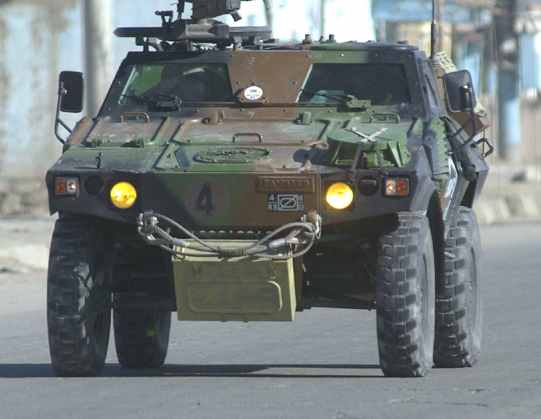
A French VBL armoured patrol vehicle in AfghanistanAlthough my otherwise staunchly supportive co-editor has little love for military "toys", even she recognises that study of the design, provision, and deployment of these highly functional machines gives an unparalleled insight into the military mind (such that it is) and the underlying political and strategic drivers.

In this context, a short press release from an obscure (to British audiences) French armoured vehicle manufacturer, assumes an enormous importance when fitted with the many other jigsaw pieces which we are trying to assemble to make a coherent picture.

The press release in question recounts how, on 19 October 2005, a French VBL armoured car patrolling the environs of Kabul was seriously damaged by an IED explosion. For the Americans in Baghdad and elsewhere, this is a common enough experience, and also to the British is southern Iraq.

But what is instructive is the French response. They immediately put their military research institute (la Section Technique de l’Armée de Terre) onto the problem and, within six months, a contract was given to the vehicle manufacturers, Panhard, to produce fifty armour kits to give lateral protection against IEDs. These are to be fitted in a crash programme to French VBLs in Afghanistan, from July through to December.

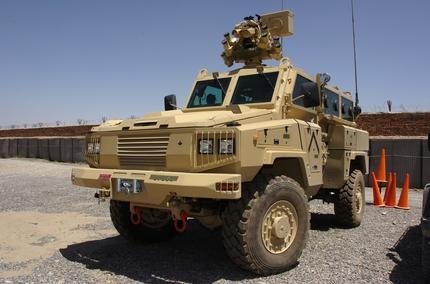
The RG-31... 'too big', 'wrong profile' and 'maintenance problems'Compare and contrast this with the British response to the "Snatch" Land Rover controversy. Rather than an immediate technical response of the like we see from the French, we see, in effect, a two-pronged campaign to oppose calls for better equipment.

On the political front, we get the likes of Lord Drayson down-playing the merits of alternatives, like the RG-31 – arguing that they are "too big", they have the "wrong profile" and that they had "maintenance problems". On the other hand, we see a sustained media campaign – which spills over into the carefully regulated unofficial Army forum – to make out that the particular threat to British troops is of such a nature that improved equipment would not counter it.

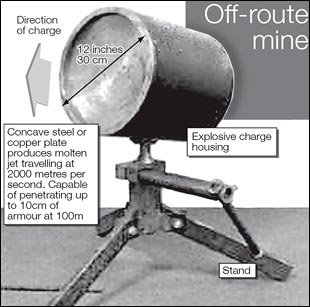
The 'off-route' mine graphic supplied to the Sunday TelegraphThis is both clever and subtle. The "threat" – for which the Sunday Telegraph's Sean Rayment, carefully "fed" by the MoD, has fallen, hook line and sinker – is that the "real" problem is not inadequate Land Rovers but the so called "off-route" mine, crafted by those wicked Iranians. The suggestion is that these are such powerful weapons that no amount of additional protection would suffice and, therefore, we must rely on training and tactics. Rather conveniently, this strategy costs the Treasury little if anything by way of extra funds.

Taken at face value, this is plausible enough for some of the more gullible hacks to believe and, if the troops are not entirely happy about being forced to ride around in sub-standard kit, at least it is sufficient to convince them that the problem has been considered.

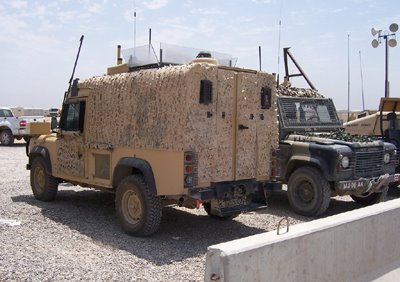
The 'Snatch' patrol vehicle - now it has to be escorted in high risk areasBut the response – and previous events – do invite an alternative construction. In considering this, it is perhaps significant that, while we got a spate of bombings in May and June, there have been no recently reported casualties from Basra. To an extent, this is undoubtedly the result of a change in British tactics – Land Rovers patrols are now escorted front and rear by Warrior MICVs, and patrolling has been curtailed – but there is also a darker explanation.

Basically, the bombings of May-June could be construed as a warning, telling the Army – or the British government - to keep its nose out of affairs that were none of its business. So, as long as the Army does not interfere, it will be left alone and does not, therefore, need better equipment.

Strong support for this thesis comes not from the British press – which is hardly reporting on the affairs in southern Iraq – but from syndicated reports in the US media.

One such – picked up from Myrtle Beach online but carried in dozens if not hundreds of US newspapers – reports on how Iraqi Prime Minister Nouri al-Maliki's first major security initiative, a 30-day state of emergency intended to restore peace to Basra appears to have failed.

What is especially interesting is that the newspaper reports that "travel to Basra is difficult for Western reporters", so the newspaper group has "maintained daily contact with Basra residents, police officers and leaders throughout the month-long state of emergency to track its progress".

The reports thus come from residents, who say little has changed: Shiite militias and tribes still control the city's streets, political factions still fight for control of the city, and Shiite Muslim militias still threaten Sunni Muslims with death. Morgue officials report that the number of people killed in sectarian violence remains unchanged. Militias are still moving freely in the city and residents have given a steady chronicle of continued violence.

Oil tankers impounded by the British authorites in Basra after involvement in smuggling - but this is only the tip of the icebergFrom a report in the Seattle Times, syndicated from the Los Angeles Times, we get another report that says of Basra, "This once-placid port city is looking a lot like the mob-ruled Chicago of the 1920s, an arena for settling scores between rival gangs, many with ties to the highest echelons of local and national political power."

We are told that, according to residents and officials, Basra's sudden political troubles and violence are rooted in a bloody competition for control of millions of dollars in smuggled oil. The report continues:

On the Shatt al Arab waterway and off the coast of the Persian Gulf, boats wait to receive Iraq's smuggled oil, the most visible sign of what many suspect are vast multinational criminal gangs selling subsidized and stolen petroleum products for a premium in Iran, Kuwait and the United Arab Emirates.

"Oil smuggling is one of the biggest issues in Basra," said Furat Shara, the local leader of the Supreme Council for Islamic Revolution in Iraq, a Shiite political party. "It is over the smuggling of oil that there is a conflict among the political parties."

One local official estimated the value of the smuggling trade at $4 billion a year, or about 10 percent of the country's gross domestic product.

Basra is almost free of the guerrilla warfare, car bombings and suicide bombings that characterize daily life in Baghdad, Baqoubah and cities in the Sunni Arab stretches of the country. But this Shiite-dominated southern city and its suburbs have descended into chaos and violence that threaten to unravel the region's modest progress.

"The amount of actual terrorism in Basra is very limited," Iraqi Defense Minister Gen. Abdul-Qader Mohammed Jassim Mifarji told reporters. "The dominating struggle is between armed gangs and political groups."
According to local sources in Basra, smugglers have set up eight makeshift terminals along the coast to store the oil before smuggling it out of the country, a practice employed by Saddam Hussein during the 1990s to circumvent United Nations sanctions. Unemployed fishermen, struggling to make a living as their traditional livelihoods are destroyed by pollution and overfishing, run boats across the Persian Gulf, often to Iran or the United Arab Emirates.

A local schoolmaster, Mahmoud Salman Saadi, says, "Each political party is busy smuggling oil while we are busy looking for a quantity of gasoline to operate our small generators or cars."

Oil tankers on the Jordanian border - officials say that smuggling is 'brazen'Thus, political leaders are more interested in retaining control of the oil-rich port city than in protecting it from militia and tribal violence. Residents complained about the Basra plan almost from its inception. The "state of emergency” seems to consist of nothing more than a few checkpoints, and the occasional high-speed, largely token British Army patrol. This leaves the report concludes, "not only is Basra falling apart, but the means to reverse the trend are disappearing. As conditions deteriorate, the educated middle classes — the people who know how to run the city — are leaving in droves."

Although nothing of this seems to be making its way into the British press – not least because the Army is tightly controlling media access to the city – it cannot be the case that the Army and the British government does not know what is going on. That it is not prepared to intervene speaks volumes of the attitude to the "occupation". We are just going through the motions, waiting for an opportunity to get out without losing too much "face", leaving the Iraqis to the rule of the gangster and the mob. But, as long as the government can continue muzzling an indifferent and largely ignorant British media, it can count on no one knowing until its is too late.

Meanwhile, our troops will continue to ride around in "Snatch" Land Rovers and the propaganda game will continue. And, as long as they do, we will know that the British government has no real intention of living up to its responsibilities in southern Iraq. Thus do we see that, through the study of "toys", we get to the truth.

COMMENT THREAD