Showing posts sorted by date for query No land no hope. Sort by relevance Show all posts
Tuesday, June 30, 2015
UK democracy: everything's fine until it isn't.
Persuading people of the need for radical change isn't easy. The truth of it is, the status quo just isn't awful enough for people to take a risk. If we listened to the left wing you'd genuinely think Britain was a failing state with massive levels of homelessness, destitution and poverty. That was Labour's whole message during the election. The reason they didn't win is because most people know it just isn't true. Life is hard for some but poverty in this country is usually only temporary except when reinforced by welfarism.
We haven't seen much in the way of radical welfare reform aimed at tackling this, but in the end the gesture politics of welfare reform seem to be working after a fashion and it turns out just small tweaks accomplish a great deal. None of it really goes far enough for my tastes. I still think we have an inherent culture of state dependency. But again, it's hardly something worth going to the barricades over.
The left have a really hard time selling us the idea that we're in poverty and destitution and the left seemingly have little to offer but for the same tired socialist ideas or merely a repeat of Blair's so-called "social amelioration" (fire-hosing borrowed money at the poor to you and me). It didn't solve very much. The left are beginning to wake up to the fact that they lack economic credibility. That's why I believe Liz Kendall is the only leadership contender who can prevent Labour being wiped out entirely. But that's all she can really hope to do without any fresh ideas.
It's a fine thing to talk about localism and restoring powers to as many people as possible, but that's a little difficult when everything from fishing and agriculture to waste disposal and energy is dictated by the EU. No council will ever depart from boneheaded recycling schemes in favour of landfill (aka land reclamation) because that power is not within their gift - and is not within the gift of Westminster either. All councils can do is execute their duties within a strongly encoded framework.
Unless councils are sovereign entities the position of counsellor is largely for decoration. I've met a number of now ex councillors, all of whom entered local politics with ideals of public service and reform, only to be confronted with an immovable behemoth that resists reforms, where long standing incumbent councils close ranks to prevent any meaningful change. The notion that we have any collective power over our local authorities is risible.
The slow agglomeration of police forces is a wholly unwelcome development and the scale of councils means money is always concentrated on the district with the most urgent need, at the expense of everywhere else. The idea that money raised locally is spent locally went out of the window years ago. If you pay council tax in Ripon, it's likely to be spent in Harrogate.
All of this has happened very gradually, where local services have amalgamated for their own convenience rather than ours, each headed by officials on gargantuan corporate salaries. Almost everyone is opposed to this development, but councillors haven't been able to stop it. In this the public have been fairly passive. There is a certain apathy about us, but that is a learned apathy.
We're now used to the idea that if you write to a councillor or an MP you won't get a reply. And if you do it's a corporate-speak brush off. From the police to social services to the NHS, where complaints are concerned there is a culture of hostility, defensiveness and denial. You then enter the "f*ck off loop" whereby you're shuffled between departments until you get fed up and go away.We simply resign ourselves to the fact that our lives can be impinged upon by the state and there's nothing we can do about it. Those who try are harassed and bullied by the courts and end up with crippling legal fees and no justice.
The same is true when dealing with corporates too. It's the same when changing your energy supplier or trying to cancel a phone contract you don't want. Everything is bait - and once they have your name on the dotted line, that's it, they can ignore you. Meanwhile, we're creating a status of second class citizen without access to credit. If one of these corporates asserts you owe them money, through mass mechanised corporate scale abuse of the county court system, they can blacken you name for a decade - with no right of appeal - unless you can afford it.
Which brings us on to the justice system. Actually, don't get me started, we'll be here all day. The short of it is that justice is only for those who can afford it. And if you're up against the mechanisms of councils and the state, you can forget about justice altogether. The police and councils investigate themselves and find themselves free of fault.
On a day to day basis, the benign managerialism of the UK works quite well. If you are obedient, pay what you're told, when you're told to pay it, never ask questions and never demand justice, things are fine. Better than ever. But when you ask for what you've paid for, you won't get it. When you need protection you won't get it. When you want justice you won't get it. What you will get though is an ever larger tax bill.
Until we have real democratic control over our councils and Westminster, we will continue to drift toward corporatism where everything is decided before it gets as far as Westminster - and if a law made at the very top level of global governance kills your business, well, that's just too bad.
While I am a euroscpetic, as much as I resent Brussels rule, I resent London rule just as much. London likes to think it is the engine of the economy, but it is the regions that supply it with our young and vital people. In that respect, London is a parasite that sucks the vitality out of brilliant cities like Liverpool and Newcastle. The media follows power thus culture follows and that's where our young people want to be. The result is that London has become its own country while the rest of the country stagnates. Through boom and bust, Bradford house prices have remained more or less static.
What we get from the Tories is the promise of a Northern powerhouse, but what it is in effect is a Northern super-quango, imposed upon Manchester, which like the Scottish parliament will suck more and more powers and budgetary controls away from councils. It is a perversion of the word devolution. We also now learn that rail developments in the North have been shelved. One thing we Pennine folk know all to well is that cross Pennine travel sucks - and always has - but London always gets what it wants. It's little wonder many Northerners want the SNP to succeed with Scottish independence and take the North with it.
Meanwhile we are governed by an entirely self-serving SW1 claque who are in thrall to the fashions and groupthinks of the Westminster bubble - who see themselves as an enlightened elite - who don't trust people with the power to run their own affairs. The only thing that matches their stupidity is their arrogance. A toxic combination.
What we need is real devolution and to shift power away from London. At the very least, Parliament should move out of London. London can survive without it. Why are we cramming more houses into London when Liverpool is turning into our own Detroit?
Under the surface, everywhere we look we're being short changed and ripped off. All the left can offer is the old dogmatic mantras about re-nationalisation - as if the people ever wanted nationalisation in the first place. Our public amenities used to be locally owned and locally controlled corporations. They were stolen and sold off. Now they are merely obscure features in the assets column of a Shanghai hedge fund.
The danger of keeping utilities publicly owned was that government would use them as a means of keeping people unproductively employed to the point of bankruptcy. The railways were famous for over-employing. But that is no longer a danger in most instances. A small CHP plant providing power and heat for large urban area can run on its own with very little human intervention. Why should these things not be community owned? Why should districts not choose their own energy policy? Why should we wait for an EU directive only to have it gold-plated by Westminster and imposed on councils covering massive areas, encompassing several towns in some cases? Why does Keighley answer to Bradford?
Socialism as we knew it is dead. But that does not mean we have a new age of free markets. What we have is corporatism both in consumer markets and local and national government. We can't afford to renationalise even if we wanted to. But we can use the mechanisms of the market to re-municipalise those things which should be under public control. But this would require the one thing that London is most afraid of: Democracy.
Liz Kendall can talk all she likes about returning powers, but such is not in her gift until the left can end their unquestioning devotion to the EU. If we want a radical overhaul of our services and how we are governed, then it must start with Brexit. History is replete with examples of power gravitating toward the centre, holding regions and nations together against their will. In every instance it has failed - and ended in collapse, poverty and war. Now we see the EU pulling in different directions and our serpentine Prime Minister conspires to keep us in at all costs - with no opposition from the party that supposedly represents the workers.
I will throw my vote to anyone who wants to get serious about real democracy. But until I see a mainstream party make the case for leaving the EU and governing for all, not just London, I'll know they're not serious about reform.
Saturday, April 13, 2013
EU politics: nothing worth cheering about
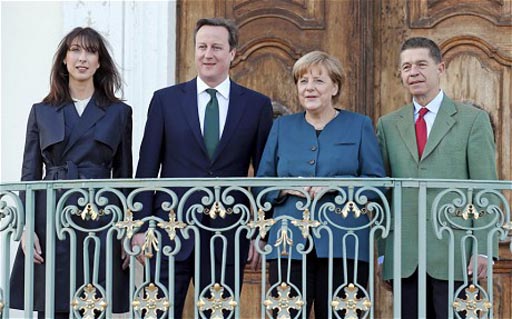
Reading the report, you can see why so few bothered. It is an amalgam of the same old, same old: the British prime minister wants Angela Merkel's support for EU reform but, as always, is at pains to assure the German chancellor that the Britain will continue to participate fully in Europe and has no intention of leaving the EU.
Whatever is agreed at this meeting, you can bet your sweet life that there will be no crowds waiting at the airport for Mr Cameron's return. There would be little point in his waving a piece of paper – nobody is in the least bit interested.
Actually, I tell a lie. Andrea Leadsom MP is brown-nosing in the loss-making Guardian, burbling about "eurosceptics" in the Conservative party being "willing to compromise over their demands for European Union reform". There is no one in the party, she says, who wanted Cameron to "lay down the law" to Britain's EU partners and that compromise was "essential".
Elsewhere, we get a report that the Tories are planning to build a "secret alliance" with the AFD. Given that this new German group is pro-EU and anti the euro, it fits exactly with the official Tory view.
All these less than scintillating developments are doing, therefore, are reinforcing the europhile credentials of David Cameron, who seems to have abandoned any attempt to woo the outers, and is thus no longer concerned to capture the lost ground from UKIP.
That much in itself is something of a development. In the past, Tory leaders at least used to pretend that they wanted the eurosceptic vote. But now, Cameron seems not to be concerned in the slightest that his party is haemorrhaging support, even to the extent seemingly being prepared to throw away the coming local elections.
In truth, though, there is very little Cameron can do. Despite comments to the contrary, Die Zeitmakes it very clear that Merkel will not countenance a treaty renegotiation, and nor will she consider treaty amendments until her re-election is safely in the bag – should that happen.
Thus, says this paper, Cameron's only real option is to put a "yes/no" referendum to the country, without first having sought treaty revisions. And since there is no chance of him even considering that, he is left with the wholly unconvincing ritual of talks with European leaders about reforms that are never going to happen.
Missing from the feast, of course, is Ed Miliband. The earlier presumption that he would follow in the path of Mr Cameron has not materialised. There is no sign at all that he is prepared to commit to an EU referendum.
Perversely, it is almost exactly 25 years from Margaret Thatcher's Bruges speech, and 75 years since the Munich agreement, when Chamberlain returned to Heston Airport to wave his infamous piece of paper, neither of which anniversary of our former prime minister lived to see.
Thus do we return to a strange no-man's land, where the actuality of a referendum is receding and the "Europe" issue is still no closer to a resolution. Let us hope that we do not have to wait for the hundredth anniversary of Munich before we see a prime minister returning from a meeting with a German chancellor with a piece of paper worth cheering about.
COMMENT THREAD
Sunday, January 01, 2012
Happy New Year
If you cannot have the occasional gloat then, frankly, life ain't worth living. But, on the tenth anniversary of the launch of the euro notes and coins, the opportunity is too good to miss.
At the time of the launch the BBC was, of course, crowing, but even the Daily Wail was having a little fun at our expense, covering all the bases, while Toby Helm in the Failygraph offered the unrestrained headline, that the launch would herald "peace and prosperity".
And here we are ten years on with the Daily Wail yesterday talking of riot and revolution. Yet those ten years ago, the euro and the European Union looked unstoppable. And look where they are now.
So this year, we do not need to offer predictions, and nor will we. All we have to do is look at those joyous, confident predictions of a decade ago, and enjoy seeing how wrong they all are – how little the great and the good could get right.
The funny thing is that, in his own way, Duisenberg was right - up to a point. The launch of notes and coins on, following up on the official launch of the currency in 1999 when they celebrated not with Ode to Joy but with a rendition of Land of Hope and Glory, was indeed the start of a new era - but not one the "colleagues" wanted to see.
Even if the euro manages to survive another year, the aura of inevitability has gone. No one will ever be able to say again, with a straight face, that British entry to the euro is "inevitable". The only thing we now see as inevitable is the eventual collapse of the single currency.
But it is too early yet to celebrate. That time will come, when the evil empire crashes and burns – and we can't yet tell when that will be. Thus, all we can do is wish each and every reader a happy new year at a very personal level. It is time for us to look after ourselves and our own, to protect ourselves from the actions of fools and knaves, and to be ready to enjoy the moment when nemesis becomes a reality.
In the meantime, be careful out there.
COMMENT THREAD
Sunday, August 08, 2010
Virtual democracy
In direct proportion to the degree of detachment from the democratic process, the various institutions which lay claim to be part of our government are expending our money on simulating the very process they are so keen to destroy.
Thus, as Booker remarks in today's column , the EU parliament has commissioned an online role-playing game called Citzalia which allows "citizens" to imagine they are participating in the parliament's "important work".
Citzalia is proclaimed as "a world you inhabit and help to create. Using your avatar, you can walk around, network, debate issues of the day, propose legislation."
Not least of the fatuity of this is that the EU parliament does not propose legislation. It is an absolutely fundamental characteristic of the EU that the commission has the monopoly of proposal, one which actually guarantees its laws are "democracy proof". To remove a law requires another law, which only the commission can propose, thus ensuring that no democratic institution can over-ride it.
For want of real democracy, therefore, all we get is "virtual democracy", much the same as we are already getting from the Cleggerons in Westminster. One of its first acts – as you may recall, says Booker - was to open a website on which voters could propose new laws and policies. Last week it was reported that every one of the hundreds of proposals from members of the public had been rejected or ignored.
It is not only democracy that has gone "virtual", however. So has governance in the widest sense. The Cleggeron corpus, Cameron and Cleggy – two prize "C"s who have acquired the label the "Brokeback Two" - have sent a letter round to their Cabinet colleagues reminding them of the need to reduce the public spending deficit.
This was "the most urgent issue facing Britain today", they said, even though during last May's election campaign, Booker listed several hugely important issues which none of the parties wished to talk about. First amongst them was the terrifying size of the government deficit.
This was already increasing, as Booker reported, at £446 million every day, so that by 2014 the national debt would have doubled to £1.4 trillion. The interest alone on that debt would equate to £60 a week for every household in the land.
Since then, of course, the new "virtual government" has been only too happy to come out of purdah on the deficit it inherited, and to talk up all the "tough" measures and drastic cuts needed to reduce it.
Nevertheless, when little Georgie Osborne introduced his budget in June, the small print still projected public expenditure continuing to hurtle upwards, from £668 billion this year to £737 billion in five years' time. In other words, there is little sign that the deficit will reduce by very much.
Not content with this, though, we get Willy Hague's admission that "there is a profound disconnect between the British people and what has been done in their name by British governments". As Foreign Secretary, he was referring in particular to our relations with the EU (without mentioning, of course, the failure of the three main parties to keep their manifesto promises of a referendum on the EU Constitution, aka the Lisbon Treaty).
Another government boast last week was that, for each new regulation, an old one would be repealed. Of course, it added hastily that this would not apply to EU regulations passing into UK law – but in terms of cost and damage to the economy, it is these that make up more than three-quarters of the regulations that matter.
Thus our "virtual democracy" leads to an ever more "profound disconnect" between government and people, says Booker. We "walk around, network, debate issues of the day", even "propose legislation". But as with that computer game, it is an empty charade.
"Behind their hands, our rulers must really be laughing at us", Booker concludes – but then he is writing for a family newspaper. The reality is much more stark, to the extent that people are increasingly opting out of the political process altogether. But when there is no prospect of influencing that process, and the sole contribution of the political classes is display contempt for their voters, there is absolutely no point in wasting life energy on them.
All we can hope for is that they eventually disappear up their own virtual democracy and we can then get back to real politics, where democracy might have some meaning. Until then, I really am not alone in not wanting to know. They can put their virtual politics where the sun doesn't shine.
COMMENT THREAD
Thus, as Booker remarks in today's column , the EU parliament has commissioned an online role-playing game called Citzalia which allows "citizens" to imagine they are participating in the parliament's "important work".
Citzalia is proclaimed as "a world you inhabit and help to create. Using your avatar, you can walk around, network, debate issues of the day, propose legislation."
Not least of the fatuity of this is that the EU parliament does not propose legislation. It is an absolutely fundamental characteristic of the EU that the commission has the monopoly of proposal, one which actually guarantees its laws are "democracy proof". To remove a law requires another law, which only the commission can propose, thus ensuring that no democratic institution can over-ride it.
For want of real democracy, therefore, all we get is "virtual democracy", much the same as we are already getting from the Cleggerons in Westminster. One of its first acts – as you may recall, says Booker - was to open a website on which voters could propose new laws and policies. Last week it was reported that every one of the hundreds of proposals from members of the public had been rejected or ignored.
It is not only democracy that has gone "virtual", however. So has governance in the widest sense. The Cleggeron corpus, Cameron and Cleggy – two prize "C"s who have acquired the label the "Brokeback Two" - have sent a letter round to their Cabinet colleagues reminding them of the need to reduce the public spending deficit.
This was "the most urgent issue facing Britain today", they said, even though during last May's election campaign, Booker listed several hugely important issues which none of the parties wished to talk about. First amongst them was the terrifying size of the government deficit.
This was already increasing, as Booker reported, at £446 million every day, so that by 2014 the national debt would have doubled to £1.4 trillion. The interest alone on that debt would equate to £60 a week for every household in the land.
Since then, of course, the new "virtual government" has been only too happy to come out of purdah on the deficit it inherited, and to talk up all the "tough" measures and drastic cuts needed to reduce it.
Nevertheless, when little Georgie Osborne introduced his budget in June, the small print still projected public expenditure continuing to hurtle upwards, from £668 billion this year to £737 billion in five years' time. In other words, there is little sign that the deficit will reduce by very much.
Not content with this, though, we get Willy Hague's admission that "there is a profound disconnect between the British people and what has been done in their name by British governments". As Foreign Secretary, he was referring in particular to our relations with the EU (without mentioning, of course, the failure of the three main parties to keep their manifesto promises of a referendum on the EU Constitution, aka the Lisbon Treaty).
Another government boast last week was that, for each new regulation, an old one would be repealed. Of course, it added hastily that this would not apply to EU regulations passing into UK law – but in terms of cost and damage to the economy, it is these that make up more than three-quarters of the regulations that matter.
Thus our "virtual democracy" leads to an ever more "profound disconnect" between government and people, says Booker. We "walk around, network, debate issues of the day", even "propose legislation". But as with that computer game, it is an empty charade.
"Behind their hands, our rulers must really be laughing at us", Booker concludes – but then he is writing for a family newspaper. The reality is much more stark, to the extent that people are increasingly opting out of the political process altogether. But when there is no prospect of influencing that process, and the sole contribution of the political classes is display contempt for their voters, there is absolutely no point in wasting life energy on them.
All we can hope for is that they eventually disappear up their own virtual democracy and we can then get back to real politics, where democracy might have some meaning. Until then, I really am not alone in not wanting to know. They can put their virtual politics where the sun doesn't shine.
COMMENT THREAD
Sunday, April 25, 2010
The "ash" crisis continued
Regular readers may have surmised, from the relatively light blogging last week, that I have been otherwise engaged. And indeed I have, working flat out on the "ash crisis" for the Mail on Sunday. The piece I originally wrote was for the features desk, but was snaffled by "news" and appears in heavily truncated form here (spool halfway down).
What I have done, therefore, is publish below the original, early version of the piece as submitted and worked on by my editor, the seriously impressive Laura Collins. Even then, there are updates to this piece, but rather than mess around with it, I'm putting it up, "as is" and will then write another post, updating it and exploring some of the issues arising, and other developments. So here goes:
At 11o'clock last Tuesday morning a flight took off from a small Bedfordshire airfield and climbed into the empty skies above Britain. It flew up the country's east coast, several times - each a clear, level run. It landed at Prestwick at half past one, refuelled and repeated the exercise this time flying back down the west coast.
Aboard were Met Office and Facility for Airborne Atmospheric Measurement (FAAM) scientists, tracking and measuring volcanic ash density through aerosol layer. They studied the engine on landing, stripping it back and testing. Shortly after the blanket flight ban that had paralysed the air industry since the eruption of Eyafjallajokull two weeks ago, was lifted.
By the time that announcement was made 22 British Airways flights were already entering the 'no-fly zone.' Thousands of miles away and many hours earlier they had set off 'confident' that their planes would be able to land at Heathrow and Gatwick.
It was a bold move but it wasn't a gamble. They had sent up their own test flight two days earlier. They had measured the density of the volcanic ash at cruising altitude. They had examined the engines and conducted borescope inspections.
They had established the facts. They had data - which, The Mail on Sunday has discovered, is more than the Civil Aviation Authority (CAA) had when it issued the blanket ban six days earlier.
But then BA - along with Lufthansa, Air Berlin and Finn Air, all of which sent up test flights - had at their disposal something absolutely vital that the CAA and the Met Office did not: planes.
Hard to believe, but the fate of our aviation industry last week hung on just one aircraft, a BAE 146. It is the only plane in the London Volcano Ash Advisory Unit's armoury capable of sampling air at the necessary. And until Tuesday it was grounded, stripped of its instruments, undergoing a paint job.
While technicians worked round the clock to reassemble the aircraft the government was forced to rely on a much smaller, German registered turbo-prop aircraft, a Dornier 228. With its limited range and performance it plodded through the skies unable to deliver key data. Even then, it was only to fly on Sunday 18 April, four days after the ban had been imposed. Academics thus had to base conclusions on theoretical models, insufficiently bulked out with data gleaned from flights.
Lifting the ban last week National Air Traffic Service (NATS) admitted that: 'The information about how aero engines could cope with adverse ash conditions only became available yesterday.' ie Tuesday. It was no coincidence that the BAE 146 had finally got off the ground. Nothing could illustrate more clearly that, while the disaster was natural the mishandling was entirely man-made. And the decisions that led to this costly shambles actually go back years.
We have looked into the protocol followed, the agencies involved and the resources at their disposal and it is hard not to conclude that it wasn't volcanic ash that threatened to bring the air industry to its knees but decades of neglect, underfunding, poor planning and layers of bureaucracy that underpin the government and Europe-wide response to it.
This, despite the fact that the ink had barely dried on a contingency plan drawn up by the International Civil Aviation Organisation (ICAO) in September 2009.
So what went wrong and why?
Starting with the events last Thursday, as the cloud of ash from the Eyjafjallajokull volcano was creeping towards the UK the first people in the hot seat were not the air traffic controllers but a team of eight scientists working for the Met Office in an obscure office called the London Volcano Advisory Centre (LVAA).
These specialists don't spend all their time working on volcanic ash mapping and forecasting but are called in on an emergency basis. Their job was to provide the aviation industry with forecasts on the spread of the ash and to warn pilots of where it was unsafe to fly.
Their tool in this instance was a computer model called NAME and, as they ran their simulations, it became clear that first the northern part and then the whole of the UK was going to be covered by the ash cloud. Closing down airspace, or even advising it, was not in the job description. The LVAAC could only pass its forecasts onto the National Air Traffic Services (NATS).
In the early stages of a volcano eruption there is very little hard data available. Models have a good track record of predicting ash dispersion. Nevertheless it was at this very early stage that things started to go wrong. For while computer models have good short-term accuracy with time and distance, uncertainties and modelling errors build up and they get less and less reliable.
Furthermore these models cannot provide the all-important detail of particle density - how many dust particles there are in the air - which has a direct bearing on whether it is safe to fly. To an extent, satellites can fill in some of the gaps and there is ground-based measuring equipment which can also be used to measure particle density but the equipment is thinly scattered and the results unreliable. To get the detail required teams have to fly up into the path of the dust in specially equipped aircraft and collect physical evidence.
And here what happened and what the ICAO recommended start to diverge for reasons we shall address. The ICAO recommends three clear phases of response: Alerting Phase, Reactive Phase and Proactive Phase. Nowhere does the ICAO suggest closing airspace completely - rather it talks of rerouting flights and taking a pragmatic approach based on continued measurement of the ash present in the air.
And therein lies the problem. The information needed to make a true judgement was not available because the aircraft were not available. Unable to establish what was a safe threshold for ash particles in the atmosphere and unable to navigate through the variety of manufacturers' own design parameters the 'easy' option was to put it at zero.
During and after the Second World War the RAF had a large fleet of aircraft which could be used to sample volcanic dust, but this was progressively whittled down until 1964 when the last meteorological flight was disbanded by the Macmillan government.
The UK capability, however, remained high, as a number of V-Bombers had been adapted for air sampling, mainly to measure nuclear fallout in the case of war. But as these were progressively retired the capability was not replaced.
That left a small RAF-operated meteorological research flight which by 1980 comprised just two aircraft - a converted Canberra jet bomber and a highly equipped C-130 Hercules transport, nicknamed by its crew, 'Snoopy.' Under the Thatcher defence cuts two became one - the single Hercules which survived until 2001 when, to reduce costs, Blair's Labour government sold off Snoopy, ending military involvement in operating meteorological aircraft.
After a gap of four years a single BAE-146 was acquired, primarily as a research aircraft for civilian projects, to be used anywhere in the world. And so it was that the fate of so much rested on this solitary plane. It is hard to square this reality with CAA Chief Executive Andrew Haines's assertion that Britain had 'led the way,' in establishing the new safety threshhold for the volume of ash particles in the atmosphere that led to the ban being lifted. Arguably the safety threshold announced on Tuesday was not new it was merely the first one properly established.
Across the rest of Europe things were not much better. Theoretically a fleet of 24 aircraft was available, including the British pair, but not all were suitable. One in fact was a microlight. Only five fast jet of the type needed were actually on the atmospheric research agencies' inventory.
Because until two weeks ago Volcanic Ash was not nearly such a hot topic as, say, Climate Change. Money has been thrown at climate change research and monitoring - the British Met Office has received over £200million for that purpose - while other meteorological services have been starved of funds. The LVAAC depends on Eurocontrol enroute charges for its funds - a sort of toll paid by the airlines that fly through its space. That is clearly not enough.
The blanket ban was, then, governed as much by what we did not know as what we did. And while there is no European law governing just what to do in the event of a volcanic eruption affecting the skies in this way we are bound to our fellow European states by historic treaties which prevent us from being able to close our skies unilaterally and make the prospect of opening them unilaterally problematic.
But with shared responsibility comes no real responsibility - or accountability. As dissatisfaction over the past few days grows the European Commission has claimed it occupied only a 'side-line' observational role in all of this. This is misleading. The contingency plans may have started with the United Nations body of the ICAO but they were agreed upon by a galaxy of authorities including the European Union, the EU aviation control agency, Eurocontrol, the British government and all the other EU member state governments plus their safety agencies.
According to International Air Transport Association (IATA) Director General and CEO, Giovanni Bisignani, the crisis management was characterised by, 'no risk assessment, no consultation, no organisation and no leadership. Governments have not taken their responsibility to make clear decisions based on facts.'
If we are to learn anything from this fiasco guilt must now be shouldered where appropriate and an honest reassessment of priorities made. The ICAO likens the volcano watch service to an airfield fire service. You hope you'll never have to use it, but it should be well equipped and its people well trained, just in case.
Instead, as we have discovered, successive governments have sold off our 'fire engines.' The plethora of agencies involved are doing their best to throw up a smokescreen that rivals Eyjafjallajokull, but the truth is that what we have witnessed over the past two weeks and what kept planes out of the sky for so long was not volcanic ash but generations of neglect.
ICELAND'S REVENGE THREAD
What I have done, therefore, is publish below the original, early version of the piece as submitted and worked on by my editor, the seriously impressive Laura Collins. Even then, there are updates to this piece, but rather than mess around with it, I'm putting it up, "as is" and will then write another post, updating it and exploring some of the issues arising, and other developments. So here goes:
At 11o'clock last Tuesday morning a flight took off from a small Bedfordshire airfield and climbed into the empty skies above Britain. It flew up the country's east coast, several times - each a clear, level run. It landed at Prestwick at half past one, refuelled and repeated the exercise this time flying back down the west coast.Aboard were Met Office and Facility for Airborne Atmospheric Measurement (FAAM) scientists, tracking and measuring volcanic ash density through aerosol layer. They studied the engine on landing, stripping it back and testing. Shortly after the blanket flight ban that had paralysed the air industry since the eruption of Eyafjallajokull two weeks ago, was lifted.
By the time that announcement was made 22 British Airways flights were already entering the 'no-fly zone.' Thousands of miles away and many hours earlier they had set off 'confident' that their planes would be able to land at Heathrow and Gatwick.
It was a bold move but it wasn't a gamble. They had sent up their own test flight two days earlier. They had measured the density of the volcanic ash at cruising altitude. They had examined the engines and conducted borescope inspections.
They had established the facts. They had data - which, The Mail on Sunday has discovered, is more than the Civil Aviation Authority (CAA) had when it issued the blanket ban six days earlier.
But then BA - along with Lufthansa, Air Berlin and Finn Air, all of which sent up test flights - had at their disposal something absolutely vital that the CAA and the Met Office did not: planes.
Hard to believe, but the fate of our aviation industry last week hung on just one aircraft, a BAE 146. It is the only plane in the London Volcano Ash Advisory Unit's armoury capable of sampling air at the necessary. And until Tuesday it was grounded, stripped of its instruments, undergoing a paint job.
While technicians worked round the clock to reassemble the aircraft the government was forced to rely on a much smaller, German registered turbo-prop aircraft, a Dornier 228. With its limited range and performance it plodded through the skies unable to deliver key data. Even then, it was only to fly on Sunday 18 April, four days after the ban had been imposed. Academics thus had to base conclusions on theoretical models, insufficiently bulked out with data gleaned from flights.
Lifting the ban last week National Air Traffic Service (NATS) admitted that: 'The information about how aero engines could cope with adverse ash conditions only became available yesterday.' ie Tuesday. It was no coincidence that the BAE 146 had finally got off the ground. Nothing could illustrate more clearly that, while the disaster was natural the mishandling was entirely man-made. And the decisions that led to this costly shambles actually go back years.
We have looked into the protocol followed, the agencies involved and the resources at their disposal and it is hard not to conclude that it wasn't volcanic ash that threatened to bring the air industry to its knees but decades of neglect, underfunding, poor planning and layers of bureaucracy that underpin the government and Europe-wide response to it.
This, despite the fact that the ink had barely dried on a contingency plan drawn up by the International Civil Aviation Organisation (ICAO) in September 2009.
So what went wrong and why?
Starting with the events last Thursday, as the cloud of ash from the Eyjafjallajokull volcano was creeping towards the UK the first people in the hot seat were not the air traffic controllers but a team of eight scientists working for the Met Office in an obscure office called the London Volcano Advisory Centre (LVAA).
These specialists don't spend all their time working on volcanic ash mapping and forecasting but are called in on an emergency basis. Their job was to provide the aviation industry with forecasts on the spread of the ash and to warn pilots of where it was unsafe to fly.
Their tool in this instance was a computer model called NAME and, as they ran their simulations, it became clear that first the northern part and then the whole of the UK was going to be covered by the ash cloud. Closing down airspace, or even advising it, was not in the job description. The LVAAC could only pass its forecasts onto the National Air Traffic Services (NATS).
In the early stages of a volcano eruption there is very little hard data available. Models have a good track record of predicting ash dispersion. Nevertheless it was at this very early stage that things started to go wrong. For while computer models have good short-term accuracy with time and distance, uncertainties and modelling errors build up and they get less and less reliable.
Furthermore these models cannot provide the all-important detail of particle density - how many dust particles there are in the air - which has a direct bearing on whether it is safe to fly. To an extent, satellites can fill in some of the gaps and there is ground-based measuring equipment which can also be used to measure particle density but the equipment is thinly scattered and the results unreliable. To get the detail required teams have to fly up into the path of the dust in specially equipped aircraft and collect physical evidence.
And here what happened and what the ICAO recommended start to diverge for reasons we shall address. The ICAO recommends three clear phases of response: Alerting Phase, Reactive Phase and Proactive Phase. Nowhere does the ICAO suggest closing airspace completely - rather it talks of rerouting flights and taking a pragmatic approach based on continued measurement of the ash present in the air.
And therein lies the problem. The information needed to make a true judgement was not available because the aircraft were not available. Unable to establish what was a safe threshold for ash particles in the atmosphere and unable to navigate through the variety of manufacturers' own design parameters the 'easy' option was to put it at zero.
During and after the Second World War the RAF had a large fleet of aircraft which could be used to sample volcanic dust, but this was progressively whittled down until 1964 when the last meteorological flight was disbanded by the Macmillan government.
The UK capability, however, remained high, as a number of V-Bombers had been adapted for air sampling, mainly to measure nuclear fallout in the case of war. But as these were progressively retired the capability was not replaced.
That left a small RAF-operated meteorological research flight which by 1980 comprised just two aircraft - a converted Canberra jet bomber and a highly equipped C-130 Hercules transport, nicknamed by its crew, 'Snoopy.' Under the Thatcher defence cuts two became one - the single Hercules which survived until 2001 when, to reduce costs, Blair's Labour government sold off Snoopy, ending military involvement in operating meteorological aircraft.
After a gap of four years a single BAE-146 was acquired, primarily as a research aircraft for civilian projects, to be used anywhere in the world. And so it was that the fate of so much rested on this solitary plane. It is hard to square this reality with CAA Chief Executive Andrew Haines's assertion that Britain had 'led the way,' in establishing the new safety threshhold for the volume of ash particles in the atmosphere that led to the ban being lifted. Arguably the safety threshold announced on Tuesday was not new it was merely the first one properly established.
Across the rest of Europe things were not much better. Theoretically a fleet of 24 aircraft was available, including the British pair, but not all were suitable. One in fact was a microlight. Only five fast jet of the type needed were actually on the atmospheric research agencies' inventory.
Because until two weeks ago Volcanic Ash was not nearly such a hot topic as, say, Climate Change. Money has been thrown at climate change research and monitoring - the British Met Office has received over £200million for that purpose - while other meteorological services have been starved of funds. The LVAAC depends on Eurocontrol enroute charges for its funds - a sort of toll paid by the airlines that fly through its space. That is clearly not enough.
The blanket ban was, then, governed as much by what we did not know as what we did. And while there is no European law governing just what to do in the event of a volcanic eruption affecting the skies in this way we are bound to our fellow European states by historic treaties which prevent us from being able to close our skies unilaterally and make the prospect of opening them unilaterally problematic.
But with shared responsibility comes no real responsibility - or accountability. As dissatisfaction over the past few days grows the European Commission has claimed it occupied only a 'side-line' observational role in all of this. This is misleading. The contingency plans may have started with the United Nations body of the ICAO but they were agreed upon by a galaxy of authorities including the European Union, the EU aviation control agency, Eurocontrol, the British government and all the other EU member state governments plus their safety agencies.
According to International Air Transport Association (IATA) Director General and CEO, Giovanni Bisignani, the crisis management was characterised by, 'no risk assessment, no consultation, no organisation and no leadership. Governments have not taken their responsibility to make clear decisions based on facts.'
If we are to learn anything from this fiasco guilt must now be shouldered where appropriate and an honest reassessment of priorities made. The ICAO likens the volcano watch service to an airfield fire service. You hope you'll never have to use it, but it should be well equipped and its people well trained, just in case.
Instead, as we have discovered, successive governments have sold off our 'fire engines.' The plethora of agencies involved are doing their best to throw up a smokescreen that rivals Eyjafjallajokull, but the truth is that what we have witnessed over the past two weeks and what kept planes out of the sky for so long was not volcanic ash but generations of neglect.
ICELAND'S REVENGE THREAD
Wednesday, April 21, 2010
Breaching the barricades of bureaucracy
Faced with such pressure, the CAA chairwoman Dame Deirdre Hutton, buckled. Alongside transport minister Lord Adonis, they stood in front of the TV cameras, admitting that the rule book had been rewritten and that, despite the lingering presence of the ash cloud, unrestricted operations were to recommence at ten that evening.
For the first time with any clarity, we then heard from the mouths of the officials the words "risk assessment" and "dust concentrations", plus news that the engine manufacturers had backed off from their stance of "zero tolerance" for ash ingestion and redefined acceptable limits.
Yet it was on Sunday last, the words written on the Saturday, that I was pointing out that the then current safety guidelines for dealing with volcano eruptions made no distinction at all between major or relatively modest eruptions.
Nor, I wrote, did they take into account the dilution effect as the cloud spreads from the original point. The only reference was to generic dust clouds, without any attempt to carry out a risk assessment. Furthermore, it was evident from those very guidelines that the model used was the largest and most dangerous of Icelandic volcanoes, the Katla volcano – way more serious than the relatively modest eruption we are currently experiencing.
Now, with hundreds more millions spent, much heartache and disruption and increasing chaos, ministers and officials have finally come to the conclusion that was evident almost from the start, that the total shutdown of UK aviation was a gross over-reaction, and entirely unwarranted.
Predictably, the about-face has been shrouded by lies and prevarication, the impressions being given that there has been constant dialogue with airframe and engine manufacturers. Yet, we know from talking to them on the Saturday that the flying ban had been imposed without such consultation, or even with the airlines who were so immediately and badly affected.
Ironically, although the EU played a major part in ensuring that a total flying ban was the only response to the eruption, it was partly EU pressure – itself under enormous pressure from Continental operators – that led the way. After one country after another decided to lift their bans, the UK was looking increasingly isolated, more so with BA aircraft en route to the UK being diverted to Brussels and Amsterdam.
What has happened now is what should have happened right at the beginning. Individual airlines are being allowed to make their own decisions as to whether to operate, taking in the best available scientific advice and modifying their operations to take account of the additional risks.
That means that aircraft will be subject to more rigorous inspection and maintenance routines and, if necessary, more frequent component replacement. With the safety issues contained, it comes down to economics – whether it is worth paying the additional costs to keep the show on the road. Clearly, the balance of advantage rests with keeping the aircraft flying.
Asked for his opinion on who was responsible for this debacle, Willie Walsh wisely said that his focus was on the difficult task of bringing his customers back home. In the weeks to come, he said, there will be time enough to look at the issues and decide on what lessons needed to be learnt.
By that time, of course, we will have a new parliament and perhaps a new government. There will be lessons to learn for them both, not least how the health and safety culture has now got totally out of hand. There are others lessons which I will be exploring in a piece which I hope will be published in a major Sunday newspaper, and will hold over until then.
In the meantime though, there is one blessing to be had from this episode. It has driven election politics out of the headlines, with not a mention of the three protagonists in a full hour of Sky News. For that, it was almost worth closing down the whole aviation industry. Their reckoning is yet to come, and if grounding was the fate of the airlines, it would be appropriate for the three main parties to share that fate.
ICELAND'S REVENGE THREAD
Sunday, November 15, 2009
The dominoes begin to fall
We said that Tom Wise was not the only one. Next in line is Mike Natrass, fingered by Daniel Foggo in today's Sunday Times.There are reasons why an increasing number of people will not touch UKIP with a barge pole, and they are beginning to emerge. Behind Natrass are many more, men (largely) who have been running the party as their own private fiefdom, having lost sight of its aims and sold out to their own private greed and ambitions.
Fatally, such is their arrogance that they have been neither cautious nor discrete in the handling of their affairs, leaving themselves wide open to intervention by the authorities. The forces of darkness were always going to be gunning for UKIP, but the current actions of the leadership are equivalent to their standing in no-man's land having painted bull's eyes on their foreheads.
There has grown within that claque a belief of invulnerability, the feeling that "they can't touch us", not least because of the willingness to play the "victim card", as was done with the electoral commission affair, with many willing to believe that poor, innocent UKIP is being picked on.
Well, they asked for it, and the forces of darkness are beginning to close in. One by one, they are set to fall, and they brought it on themselves, betraying the party and the cause in the process. The only hope now is that there will be enough wreckage to salvage, allowing the party to be rebuilt with what is left.
COMMENT THREAD
Labels:
UKIP
Monday, September 21, 2009
Consequences
It is difficult to know what precisely has changed since last July when it was learned that a group of senators in the Czech Upper House were planning to refer the However, The Times is getting rather excited about this, having picked up some gossip from last week's informal European Council meeting in Brussels, held to prepare for the G20 meeting in Pittsburgh on 24-25 September.
The issue was, apparently, brought up at that meeting when "EU leaders" were said to be "furious" at the delay, which means that the treaty could still be unratified by the time the UK goes to the polls, even if the Irish roll over and vote "yes" in their referendum.
With Mr Cameron somewhat on the rack over the treaty, one can only suppose that he is hoping for a "no" vote out of the Irish, which will enable him to park the issue, claiming the treaty is dead in the water, making a UK referendum irrelevant.
But if the Irish fail to do the decent thing, and the Czechs manage to hold out, this puts Cameron in something of a quandary. With the treaty not ratified, he will be obliged to honour his promise and hold a referendum. He will then be in the awkward position of supporting the "no" campaign, in the middle of trying to establish his own administration.
If this prospect might be unattractive to Cameron, we are told that it horrifies most EU leaders, not least the poison dwarf, Nicolas Sarkozy, who has warned Prague that it faces "consequences" if it does not swiftly follow an Irish "yes" (they hope) with its own ratification.
The outburst apparently followed a private warning from Jan Fischer, the Czech caretaker prime minister, that he had little control over president Václav Klaus, and could not force him to sign the ratification document.
Nevertheless, Sarkozy was not a happy bunny, declaring darkly that "... if the Irish say 'yes', there is no question that we will accept to stay in a no-man's land with a Europe that does not have the institutions to cope with the crisis." Asked about what could be done to persuade Klaus to sign, he added: "It will be necessary to draw the consequences — but those will be the subject of another meeting."
What precisely Sarkozy could then do, he was perhaps wise not to specify, as one rather gets the impression that Klaus is rather enjoying tweaking the tail of the "colleagues", and is trying to hold on until after the British election. Cameron is unlikely to gain quite the same degree of enjoyment.
Over the next few weeks though, little do the Irish realise quite how much power they have – although it makes their referendum choice that much more difficult. Do they stuff the "colleagues" with a "no" vote, or stuff the next English prime minister by voting "yes"? Either way, of course, there will be consequences.
COMMENT THREAD
Labels:
Irish referendum,
Vaclav Klaus
Tuesday, August 04, 2009
It hasn't gone away
Much to our disappointment, even when we completely ignore the EU for a while, in the hope that it is one of those bad dreams that will go away of its own accord – it doesn't. Sniffing around the subject (to coin a phrase), we happened on this, where the good citizens of Lisburn are up in arms over a plan to build a giant incinerator on the shores of Lough Neagh, a well-known beauty spot in the area (pictured).
Such is the concern that the Council is backing a public inquiry over an installation, we learn, which is to be provided to burn the estimated 200,000 tons of poultry litter produced annually in Northern Ireland.
The plot thickens when we discover that the applicants, Rose Energy, are proposing the incinerator in response to "new European legislation" which means poultry waste can no longer be used as fertiliser on land and must be disposed of in another way.
Needless to say, people living near the site are concerned about the release of fumes and effluent. But the company insists that this is the only viable option to deal with the EU directive and "are assuring the public that the plant and its operations will be the best and cleanest available."
The interesting thing here is that we are not actually dealing with new legislation. This is our old friend the Nitrate Directive, which readers will instantly recall was promulgated in 1991 as Directive 91/676/EEC.
Here we are, eighteen years later and the law is still working through the system, having its dire effect, and no one even realises its genesis. There is our problem. Everything in the EU tends to work at a glacially slow pace, so slow that even the effects of a law as lunatic as the Nitrates Directive are diluted, as the enforcement takes so long and the attendant costs take so long to accrue.
This very much confounds people like myself and Booker who, when we see the EU legislation come onto the statute books, write of impending disaster and the enormous burden of costs. But when the disaster does not appear to materialise, and we get bored with writing about a catastrophe that never seems to happen, the whole issue disappears from public gaze.
Then, up it pops – an obscure local issue publicised in the local media, with no one joining the dots. The slow-motion disaster is happening.
This is how the EU wins. Watching paint dry is action-packed excitement compared with charting the unfolding disaster of EU legislative action. But just because we're not watching it (and reporting on it), every minute of the waking day, does not mean it isn't happening. It is. It hasn't gone away.
COMMENT THREAD
Thursday, July 30, 2009
Frontline – first impressions

One of the penalties of being exiled to Bradford, 200 miles from the metropolis is that for what is a Londoner, an evening with an early return home becomes a major expedition – requiring forward planning, considerable expense and much exhaustion, not least because one tends to cram in as much as possible into the day to make the trip worth it.
Thus, the Frontline Club talk yesterday, which started at 7 pm began for me at 6.30 in the morning and ended up, after a grueling 400-mile round trip, with me falling into my pit at 5 am this morning, having driven through atrocious weather, a barrage of road works and a thicket of speed cameras, the verdict from which has yet to be delivered.
Inevitably, therefore, such a concentrated diet of impressions takes a considerable amount of digestion before a coherent view can be formed. It says something though, that earlier in the day, I had given a talk about the book to a small gathering at a private lunch and my attempt to give the "short" version, with some insight into the political ramifications, took an hour and a half. Yet there I was at the Frontline club expected to give an overview in 20 minutes and then take part in a panel discussion for an hour or so, covering the same territory.
Originally billed with General Sir Mike Jackson on the panel, he pulled out at the last minute, for reasons unexplained (apparently he has a reputation for that). The meeting was thus chaired by Bill Neely, foreign editor for ITN News, with the panel comprising myself, Kim Sengupta from The Independent and with Deborah Haynes, defence correspondent from The Times standing in for Gen Jackson.
To a packed audience, with standing room only (close to a hundred people), I chose to focus the talk very tightly on just one aspect of the British occupation of Iraqi – the lack of appropriate equipment – which, I averred, contributed significantly to the military defeat. Much to the concern of the management, who discourage the use of Powerpoint presentations, I chose to illustrate the presentation with pictures of key equipment and despite the reservations, it seemed to work well enough.
Memory then is a faulty instrument; players always find it hard to describe the action. But, of the contributions from the audience – including two passionate Iraqi expats – there is and will continue to be that difficulty in unravelling those two separate (albeit linked) episodes of the invasion and the subsequent occupation. Many of the questions were thus focused on the invasion and issues related to that.
That further reinforced by the response today to the launch of the Chilcot Inquiry, where it is clear that Tony Blair is to be the star of the show in what looks as if it will become a media three-ring circus.
As to my general thesis – that the occupation of Iraq was a military failure – there was in fact a strong measure of agreement from the panel and the chairman, and indeed a view that many of the same mistakes are being repeated in the campaign in Afghanistan, about which there was very little confidence expressed. It there was a consensus view, it is most definitely that the Military is paving the way for another glorious defeat.
The impressive Kim Sengupta disagreed that the lack of equipment was the primary factor in the failure of the British, arguing that the root cause was the arrogance in the Military, a belief that they knew it all, and a rooted obstinacy in refusing to learn any lessons from the experience.
A former soldier in the audience added his voice, referring to the retreat from al Amarah - which I had identified as the pivotal moment in the failure of the campaign – saying that the campaign had been lost long before. By then there was no political will to continue with an aggressive prosecution of the counter-insurgency action.
Not disputing any of these views, I made the point that the lack of equipment was symptomatic of that greater malaise. I offered my own thesis - not unfamiliar to readers of this blog – that military equipment is the window into the soul of the Army.
Look at the equipment an army fields (and does not field) and that will tell you how they intend to fight. You do not need to interview the generals as to their intentions – they are revealed in the order of battle, in which context the continued use of the Snatch Land Rover told a story more eloquent than a brace of self-serving memoirs.
The Army, in effect, was telling you its own story, there to see if you understood the language. It illustrated the points made and was symbolic evidence of them.
Chairman Bill Neely neatly put Deborah Haynes on the spot, asking her why the media did not pay more attention to equipment. Her view, if I have recorded it accurately, was that equipment alone was not "very sexy" and it was not until there were "body bags" to go with it, as had been the case with the Snatch Land Rover, that it became a story.
This precisely accords with the impression that I have formed of the way the media thinks. If I did hear correctly, then it is a stunning confirmation of part of my thesis on media behaviour.
Neely himself invited me to explore by broader thesis on the failure of the media, noting that, while I had criticised the British media, I had relied extensively on British sources for my book. My point was that, while much of the information supplied was valuable, I had found that I had not been able to assemble from the British media any sense of a narrative of the conduct of the occupation. I had had to trawl many different sources, the most valuable – in helping me construct a framework – being the Arab press and insurgent sources.
Thus, as far as it goes, the British media offered many reports, but failed entirely in presenting a factual narrative which would put the material in the broader context. In that sense, I told Neely, Sengupta and Haynes afterwards, a rounded account is like a string of pearls. They had provided many pearls (and some dross) but not the "string" with which to bind them into a coherent whole.
Anyhow, those were my first – or at least, abiding – impressions of the meeting. There was much, much more and I hope that, should the video of the meeting become available, I will be able to do a much more comprehensive review of what was a fascinating event.
COMMENT THREAD
Labels:
afghanistan,
al amarah
Friday, June 05, 2009
A sense of proportion
"I find it so distressing to hear lavish praise being heaped upon the procurement of vehicles that are potential death-traps and to listen later to expressions of condolence to the families of those who have perished in them."
Thus said Ann Winterton on Thursday (pictured below right), to a near-deserted Commons debating chamber, addressing on the government benches the minister of state for defence, Bob Ainsworth (below left).
Spoken from the heart, with more than a hint of anger, that went entirely unrecorded by the MSM which 24 hours later was to be engulfed in a "day of drama", precipitated by the sudden resignation of James Purnell. Little did we know that, by the end of the next day, John Hutton would have resigned and been replaced by Ainsworth as the new secretary of state for defence.
Back on the Thursday, Ann could hardly have guessed that she was addressing that man soon-to-be-king, when she complained to Ainsworth about the all-important "protected vehicle fleet" in Afghanistan, using General Dannatt's words to describe it as "unbalanced".
There were, she said far too many other vehicles in service (or about to arrive) without the basic mine protection afforded by the "v-shaped hull", those including the Coyote, Viking, Tellar and Warthog - and the Jackal (pictured above, being driven by John Hutton).
It augers ill that Ainsworth, now in the dominant position, did not get the point. The hon Lady, he said, "must accept that we cannot put all our people into the same kind of vehicles. We have to give them a range of different vehicles of different sizes."
There is no way that Ann was arguing thus. Simply that all military vehicles in a part of the world where mine strikes and IED blasts are tragically common should be suitably protected. It is not part of the case that the choice should be restricted to that which are available – the point being that better vehicles are required to supplement the range.
Ainsworth, though, ploughed on regardless, heedless of this point, picking up the arguments Ann had offered about the Jackal which, she averred, "highlighted the failed concept of bolting on armour, as proved by the American Humvee vehicle."
Repeating the tired and discredited mantra which he had been fed by his advisors, Ainsworth launched into its defence, declaring: "We have to try to mitigate the effect of using a smaller vehicle and that can be done only to a degree. The main protection of the Jackal is its massive manoeuvrability; it does not have to go down the well-trodden path. If the hon. Lady goes to theatre, she will know that it is a very well thought of vehicle among all ranks."
Ann showed her anger once more. "I hope that the right hon. Gentleman does not think I was born yesterday," she responded. "War is bloody and people get killed in it, but what is desperate is the fact that this country has not supported its soldiers in conflict with the right kind of vehicles, which can be obtained, and has instead made major mistakes in procurement."
While we would not attempt to argue that the recent events have not been important, the "drama" embraced so enthusiastically compares poorly with the real-life struggle that lies out of sight and out of mind, ignored by an indifferent media and uncaring politicians – the real world where men and women are dying needlessly because of mistakes made in London by people who should know better – mistakes to which Ann was seeking to draw attention.
The stark peril facing those men and women is underlined by an article in The Daily Telegraph today, but as no more than a curiosity, detached from the political process.
Written by the paper's stringer, Ben Farmer, he records that troops in Afghanistan "are facing a major increase in the number of roadside bomb attacks as a surge of reinforcements has forced insurgents to shun direct attacks".
This is based on a Nato report that the incidence of IEDs has jumped 80 percent and last year killed 172 international troops. Hundreds more Afghan police, soldiers and civilians have been killed and maimed. Then cited is Gen Richard Blanchette, spokesman for the Nato-led forces, who says: "This is very serious business for us."
He adds that the increase was prompted by insurgents changing tactics and an influx of international troops patrolling on the ground, telling us that, "They are using this as a last measure".
The piece also tells us that armies including the British have been forced to abandon lightly armoured "patrol jeeps" and Snatch Land Rovers, and spend hundreds of millions of pounds on heavier, more cumbersome armoured protection. Yet, it then continues, "despite these efforts, casualties have still dramatically risen", with this year 28 British troops having been killed, 21 by bombs.
Had the paper tied in this piece with last Thursday's debate, the issue would really have come to life, as Ann Winterton told of the wasted money, the poor designs and those procurement mistakes, all explaining why the "efforts" in Afghanistan have not met with complete success.
Perhaps, like this blog, Ann was "too strident" and "too sanctimonious", or perhaps she is simply too detached from the real "drama" of politics. After all, how can the unnecessary deaths of soldiers begin to compare with the "tumultuous" events – as they have been described – of the last 24 hours?
One must, after all, keep a sense of proportion.
COMMENT THREAD
Labels:
afghanistan,
police
Tuesday, June 02, 2009
Failure is not an option
In June 2006, Gerald Howarth, shadow defence procurement minister, posted on his own website: "We welcome the Government's announcement that the Vector vehicle will enter service next year." He did, however, add: "It is more manoeuvrable but, according to the Secretary of State, is not much more armoured than the Snatch Land Rovers."Not quite a year later, we reported that the same Gerald Howarth was praising the Pinzguaer Vector, even to the extent of appearing on the company's website (now defunct), giving it his endorsement.
However, to be scrupulously fair – something for which we are not famous – Gerald did later complain that the vehicle was not suitable for Afghanistan, and he did draw attention to then procurement minister Lord Drayson that the driver was exposed by sitting over the front wheel.
Now fast forward to yesterday and we see Gerald in Defence Questions asking: "Does the Minister agree with the former Secretary of State, who described the Pinzgauer Vector as 'an excellent solution to our soldiers' requirements', or does he now accept that, at a cost of more than £100 million, it was a massive defence acquisition fiasco".
And, to give credit where it is due, Gerald also recognised the role of Ann Winterton in drawing attention to the defects in this vehicle, then asking what had been done "to improve the technical evaluation process to restore our troops’ confidence in the acquisition process".
This is real politics, the opposition challenging the executive on a very specific issue, bringing attention to a serious defect which needs addressing and without remedy will cost lives. We would have preferred earlier intervention but at least the system is now working.
As for the government response, this came from Quentin Davies. It can be said that he did not acquit himself with honour – this being his reply:
The hon. Gentleman should wake up a bit, get with it and start to look at the realities of life. The fact of the matter is that those who invest in a portfolio of armoured vehicles, as we are doing - or, indeed, in a range of equipment for any purpose in this world - will want to ensure that they have the best, in terms of meeting different requirements in terms of mobility, capability, fire power, protection and so forth. We will inevitably have some vehicles that are less effective than others; we will inevitably have some successes and some failures; that is what a portfolio policy is all about, by the way. Vector was not a success and it is being withdrawn. Its problem has been its "operationability": it has great difficulty carrying some of the loads that it is required to carry on the Afghan terrain. It has not been able to live up to expectations there, and we will be replacing it with the new tactical support vehicles that we have ordered - the Coyote, the Husky and the Wolfhound -which I have mentioned in the House in different contexts. That is one more example of this steady process of flexibility, improvement and enhancement, which is the policy to which we are committed.It would take far too much space in this post to deconstruct, word for word, Davies's statement but there are three points which can be dealt with. Firstly, the MoD is in denial about the Vector, refusing to admit that the vehicle failed primarily because of its lack of protection. Its load-carrying problems came with the stupidity of adding a great weight of armour in an unsuccessful attempt to improve that protection.
The second point is that Gerald is quite right in drawing attention to the "technical evaluation process". There is clearly something drastically wrong with the process, as a result of which the MoD is consistently – at ever-increasing expense – making the wrong choices on vehicles.
Contrary to perceived wisdom, mine protection and off road-performance are not mutually incompatible. The mistake has been - as with the Vector - to take an existing, non-protected vehicle and then to try to add protection by means of "bolt-on" armour. This can never succeed and degrades the original vehicle with the addition of weight.
The MoD is thus working to the wrong paradigm - to optimise protection without prejudicing performance, the protection must be designed in, not added on.
From that stems the third point. The same false paradigm is being applied to the successor vehicles, not least the Coyote and the Husky. That these are actually Vector replacements come as no surprise. Particularly with the Husky, with a ton and a half load space, this was never a credible support vehicle. It is, in effect, the new Snatch.
As to the effect of this flawed approach, the figures are stark. Approximate figures for deaths in unsound vehicles are: ten in Snatches, fifteen in Wimiks, at least six in Vikings, nine in Jackals and five in Vectors. At 45 deaths, these account for one in four of the total of 165 troop deaths in Afghanistan, almost all of them preventable.
Thomas Harding in The Daily Telegraph points out the hazards of the Jackal, estimating that, in addition to the deaths, at least of quarter of the 100 Jackal fleet in Afghanistan has been severely damaged or destroyed by enemy action. By contrast, in an earlier post, we showed a picture of a Mastiff which had taken a serious explosive strike. Yet, despite the damage, it was easily repairable – not so the Jackals, each costing close on to £400,000. We are thus dealing with a serious equipment issue, as well as the death and injury rate.
Clearly, neither the MoD nor its ministers are up to the job of sorting these problems out. The long-stop is Parliament, and it is beginning to stir. This is the only hope of keeping people alive. We need this system to work – failure cannot be allowed to be an option.
COMMENT THREAD
Labels:
afghanistan
Tuesday, May 26, 2009
A bit of technocratic tinkering
"Three weeks in and it keeps getting worse," writes Richard Littlejohn, everyone's favourite "man-in-pub".As the revelations continue to pour out, though, there is a sense not so much of boredom as numbness creeping in. And the Telegraph, having started it all is rather in the position of the sorcerer's apprentice – as someone recently observed - having started something it does not know how to stop.
Aside from the obvious casualties of the affair, however – with many more to come – the greater loss will be if the opportunity is lost to push for fundamental reform to a political system which has spawned the self-serving culture that infests not only the political classes but also public service as a whole. Ask not what you can do for Britain, is the current ethos. Ask what Britain (aka taxpayers) can do for us.
Already, though, we a seeing that opportunity draining into the sands, as the self-same political classes who have presided over the wreckage of our system, coming together with Elastoplast reforms which they hope will take the sting out of public anger, yet will avoid damaging the status quo.
Yesterday, we had the Elastoplast King and the fatuous proposals from Boris Johnson and today we have some more offerings from HRH Elastoplast. Amongst the delights on offer is a proposal to: "Open up the legislative process to outsiders by sending out text alerts on the progress of parliamentary bills and by posting proceedings on YouTube."
All this and more we get spelt out for us in an "exclusive" piece in The Guardian, with Elastoplast Dave doing grandiose big time. "We need a massive, radical redistribution of power," his headline gushes, as we are told that "public fury at the MPs' expenses scandal points to deep problems in the British political system."
"We mustn't let ourselves believe that a bit of technocratic tinkering here, a bit of constitutional consultation there, will do the trick," says Dave. "No, this crisis shows that big change is required. We do need a new politics. We do need sweeping reform. But we've got to get it right." Cue text alerts on the progress of parliamentary bills.
Some of the offerings do sound attractive though. "I believe the central objective of the new politics we need should be a massive, sweeping, radical redistribution of power: from the state to citizens; from the government to parliament; from Whitehall to communities; from the EU to Britain; from judges to the people; from bureaucracy to democracy," says Dave.
"Daveyboy ...shadap ...you aint fooling anyone," responds one commentator, sporting a label "Pretendingtocare". "Yo Davey! I've got a bandwagon, wanna jump on it?" adds "Chickenonfire". "Maccusi" simply remarks: "Bullshit. Mr Cameron." The Elastoplast has a way to go.
When we hear very precise details about how "Daveyboy" plans on "achieving a massive, sweeping, radical redistribution of power" from the EU to Britain – complete with a timetable – then perhaps it will be time to listen. Otherwise, the point by "GCDay" has particular resonance: "Were there any specific measures or proposals in there? I only skimmed the article but couldn't detect anything like that... ". Cynicism rules in this fair land of ours.
Nevertheless, "Daveyboy" isn't the only politician in reform mode. In The Times, we have a contribution from Chris Mullin, former chairman of the Home Affairs Select Committee, a minister in three departments and an MP for 22 years.
What is uncanny to the point of being sinister is how closely Mullin's recipe for "reform" matches some of that of the Elastoplast King's. Probably more by osmosis than collusion though, the political classes are closing ranks, hatching what they hope will be a package convincing enough to fool enough people that there is to be real change.
Mullin also talks in grandiose terms about the need to "prise the tentacles of the executive from functions that are properly the business of Parliament," using exactly the words and expressing precisely the sentiments that need to be heard more widely.
But if the lion roars, it delivers forth a mouse. The whips, says Mullin, routinely interfere in the selection of select committee chairmen. The time has come, once and for all, he says, to wrest from the whips the power to interfere in the choice of select committee chairmen.
In future they should be chosen by ballot of all backbench MPs, he says. Once chosen, those chairmen should have the final, but not necessarily the only, say in which members sit on their committees.
Next, he says, we need to reduce the powers of patronage available to the Government. How can Parliament function effectively when a large and growing proportion of backbench members are in some way beholden to the Government that they are supposed to be holding to account?
There, we could be venturing into real reform, with a proposal for a proper separation of powers. But if Mullin diagnoses [part of] the problem correctly, he fights shy of going for the only real answer. Instead, weak as dishwater, he tells us that "the place to start is by cutting back on the ubiquitous parliamentary private secretaries (PPSs)". And then, he says, "there may also be a case for a modest reduction in the number of ministers and special envoys".
There is then another 200 words of extruded verbal material, but the message is already clear. Trimming round the edges is all that is on offer. Mullin is not going to be looking at the root causes of the many problems and deal with them.
In the style typical of politicians though, Mullin – having offered us a diet of gruel – dishes up some rich words for his own table. "Only when we have a Parliament that demonstrates itself capable of standing up to an over-mighty executive will the country start taking its politicians seriously again," he says.
Therein lies the truth, but this also illustrates with graphic clarity – far more so than by the allowances scandal – the utter corruption of our political classes. They talk the talk, but when it comes to walking the walk, you will find them with their slippers on, feet up by their fires, watching their taxpayer-funded plasma TVs.
Pic: best I could do ... killer-bunny slippers.
COMMENT THREAD
Labels:
cameron
Monday, May 18, 2009
A most abject failure
Today, there is considerable celebration amongst a small, badly neglected group of people at the Appeal Court ruling just handed down. This has determined that soldiers on operations overseas retain their protection under Article 2 of the European Convention on Human Rights, which safeguards the right to life.The result of the ruling, as The Times records (and others here and here), is that families of British troops killed in war zones may be able to sue the government for a breach of human rights.
That "badly neglected group" who are so pleased with this ruling comprises the relatives – including the mothers, fathers, husbands, wives and even grandparents – of soldiers killed in action, almost all of whom feel let down by the system and deserted by the very people who are supposed to be there to help them.
Amongst them is Sue Smith, mother of Pte Philip Hewett who was killed with two others in a Snatch Land Rover in al Amarah on 16 July 2005, the circumstances of which we have recorded in several posts (such as this one, plus this).
Sue – like many others - has since spent many years battling to seek justice for her son and has a court case pending, suing the MoD for negligence, a case which was awaiting the outcome of this judgement. The way is not clear yet, as permission has been given to take the case to the House of Lords - granted on condition that the Secretary of State for Defence pays the legal costs whether the plaintiffs win or lose. But this is a significant step forward.
Sue's point – which I heartily endorse – is that the Army, for local political reasons, knowingly and with "malice of forethought" sent men out in highly vulnerable Snatches, fully aware that these vehicles provided no protection whatsoever against the weapons that were being deployed against them, in circumstances where there was an extremely high risk that they would be attacked and killed.
This goes way beyond the normal risks of war where commanders at all levels failed in their most basic duties to protect the lives of the troops under their command, when simple, basic precautions and adequate equipment could have protected them.
As with the original decision handed down in April 2008 by Mr Justice Collins sitting at the High Court in London, there will probably be talking heads bemoaning this judgement, arguing that the Courts have no place in the battlefield. Already, some senior commanders are complaining that they will lose control over their own men, as tactical decisions – and orders – are questioned on "health and safety" grounds.
In principle, it is hard not to disagree with these sentiments but the upshot is that the Army and the MoD have largely brought it on themselves. Had they responded intelligently – and decently – to the very real and well-founded concerns of relatives, instead of "dead batting" them and then relying on their presumed exemption from human rights law, none of this would have happened. Not one of the relatives wanted to go to law, but the attitude of the authorities left them with no choice.
In that context, we see a very measured and sensible response in The Daily Telegraph.
But there is another player here, which also failed the relatives – and the men and women who died, and will die. That is Parliament. There will be few, I vouch, who will make the connection with this case, but the fact is that Parliament has a responsibility here.
Uniquely, soldiers, sailors, airmen and marines are bound by law to put their lives at risk and occasionally forfeit them, in serving the interests of the state. In so doing the state – as represented by the government – has a duty of care, moral if not legal. But the primary body charged with scrutinising the government and bringing it to account is Parliament. Given that service personnel are unable to speak openly on their own account, Parliament thus has that special duty to look after their interests.
Unfortunately, almost without exception, where bereaved relatives have gone to their constituency MPs for aid and some succour, they have found them to be useless. For sure, they get the ritual expressions of sympathy and promises of help, but nothing ever materialises.
At another level, never has the defence committee specifically looked at the issue of mine protected vehicles, or force protection in general and, in respect of many of the substandard vehicles used or bought by the Army, the committee has actually welcomed uncritically their introduction.
Then, at the higher political level, there has been an infuriating and utterly irresponsible tendency of the opposition to use equipment deficiencies as a stick with which to beat the government, scoring political points rather than seeking to resolve problems.
To understand why this is so objectionable, one has to get past the Janet and John view of politics – the one that has the secretary of state in total control, making all the decisions and taking responsibility for everything that goes wrong.
Many former ministers will attest to how little power they actually have in office and often how difficult it is to impose even minor changes in their departments. This is especially so with the Ministry of Defence, where there are powerful vested interests, in the civil service, in the military and in the defence contractor lobby. It is rare that ministers can take on the combined weight of their own departments and win, if there is embedded an outright refusal to change. That is real life.
Here, one of the greatest allies a minister has is Parliament – both his own MPs and, especially, the opposition. While his department might seek to frustrate his wishes, when there is a strong sentiment from parliament that things should change, the hand of the minister is immeasurably strengthened. If, however, the MPs insist on turning criticism into party, partisan scoring points, that is of no help at all.
For sure, politicians are there to score points off each other, but in terms of defence – where the lives of service personnel at risk – the duty of MPs as parliamentarians should transcend party interest. Their duty to those at risk comes first. That is why, indeed, we maintain the title of "Her Majesty's loyal opposition".
In all respects, Parliament – at an individual level, with a very few honourable exceptions - has failed to step up to the plate. At an institutional level it has completely failed. This is an abject failure.
So, for want of Parliament doing its job, relatives today are rejoicing that a court of law has done it for them. In the end, we hope justice will be done, but the fact that it will have to come from the courts rather than Parliament is another – and very serious – indictment of that failing and increasingly useless institution.
COMMENT THREAD
Labels:
al amarah
Monday, April 27, 2009
A new one almost every week
"Before we succumb to the oracles of doom, we should formulate a new scientific law: small fluctuations in scientific data produce disproportionate panic in the populace. Climate scares have become like health scares: there is a new one almost every week, and they get less persuasive as they multiply."So writes Felipe Fernandez-Armesto, in the Independent on Sunday of all places, speculating about the quiet sun and the prospects of the world suffering from a cool spell.
He is absolutely right to propose such a scientific law, although there is hardly anything new in it. The dynamics of scares - or "moral panics" as the sociologists prefer to call them – are well understood.
Fernandez-Armesto, however, believes the current cooling trend will "probably be a short lurch", as opposed to the warming which, in accordance with the warmist orthodoxy "is the long-term trend."
One can only hope he is right for, as we have observed on many occasions, the impact of even slight cooling on world agricultural production is likely to be extremely serious - in a system which has little in-built flexibility.
Quite how close to the edge we really are comes with little-noticed reports from Pakistan, which are warning of an imminent wheat crisis. Already, prices of wheat flour and its products are soaring and the Pakistani government is being forced to increase imports to meet the shortage.
Of even more concern is another report which points to greater turmoil to come. This predicts that the GDP growth rate of Pakistan is expected to decline further as the current wheat production target looks set to be missed by 6.8 percent. Initial estimates of wheat production show that only 23.3 million tons of wheat are expected from the current harvest as against the target of 25 million tons.
This decline in production is in spite of the fact that the wheat sowing target was surpassed. The government had fixed the target at 8.610 million hectares, while wheat has been sown on 8.749 million hectares, an increase of 1.61 percent. This shortfall is expected to have a profound effect, driving down GDP growth to two percent - the lowest in the past 38 years of Pakistan's history.
A great deal has been written recently of the political situation in Pakistan, the growing instability and the rise of the Taleban but, at the root of it all is this specific phenomenon. No country which neglects its agricultural base can ever prosper.
In Pakistan, we hear of urgent need for structural changes in the economy and, in particular, of the need for land reforms, without which there can be no leap in agricultural productivity. But so bad has the situation become that yield per acre is not increasing in line with increased population.
Since 2000, the per annum increase in wheat production has been a paltry 0.44 percent, against an approximate 2.3 percent population increase. Unsurprisingly, Pakistan ranks 61 out of 85 countries in the 2008 Global Hunger Index.
Against the underlying problems in agriculture, Pakistan is one of the many countries which can least afford a further decline in production arising from cooler weather. If the current political instability can, in part, be attributed to lacklustre agricultural performance, then it provides an indication of how things might develop if cooling does set in for a prolonged period.
This is a "climate scare" that we do not want to see turn into reality.
COMMENT THREAD
Labels:
climate change,
Pakistan,
wheat
Subscribe to:
Posts (Atom)