Showing posts sorted by date for query "elephant in the room". Sort by relevance Show all posts

Wednesday, May 08, 2013

UK politics: they still don't get it

000Queenie speaks.jpg

Only a few days ago, the media were wibbling about "lazy" MPs being given an extra twelve days "holiday" because there were not enough new laws to debate. 

But one thing missing from the discourse was any mention of that king-sized elephant in the room, the EU. No one thought to mention that the reason our MPs have so little to do is because most of our law-making is outsourced to Brussels and beyond. 

And now, on the day of the Queen's speech, we again get what passes for analysis but, once again, the "limited package" is again seen entirely through the filter of domestic politics. 

Labour's Chris Bryant claims the speech is so thin it is "practically translucent" (a bit like his underpants). But, its "limited nature”, writes James Kirkup, "reflects the simple fact that we are now less than two years from the next general election. More than anything else, that timetable defines and dictates the Government's agenda".

Most of the Coalition's big decisions were made long ago, says Kirkup, and the biggest, on economic policy, was never a matter of legislation. Whatever legislation was needed for major domestic reforms – welfare, schools, the NHS reorganisation – has already been passed. 

All that remains, he says, is delivery, "actually trying to make those changes work, and make them work in a manner that voters see and appreciate".

Yet, as we wrote those few days ago, the European Parliament has rarely been busier, listing on its database 1,301 "legislative acts" so far, for its 2009-2014 session. That is where the action is, we wrote, demonstrating how far the power has drained from Westminster. 

And just by coincidence, in Brussels on Monday, where the eurocrats were not on holiday, the Commission launched a major new initiative under the working title of "Smarter rules for safer food", a "landmark package to modernise, simplify and strengthen the agri-food chain in Europe".

Not least of the measures proposed are those to deal with the fall-out from the horsemeat fraud, but there is a huge range of issues being dealt with, from animal health to the marketing of seeds.

Says the Commission, "the current body of EU legislation covering the food chain consists of almost 70 pieces of legislation. Today's package of reform will cut this down to five pieces of legislation and will also reduce the red-tape on processes and procedures for farmers, breeders and food business operators (producers, processors and distributors) to make it easier for them to carry out their profession".

But, for the Queen's speech, the nearest we get to dealing with livestock is the announcement of a provision which will lead to an amendment to the Dangerous Dogs Act. The real thing is an EU competence, so this need not concern our media. Despite the massive scale of the EU initiative, it has not been reported in the UK by the national newspapers. 

Therein lies yet more evidence that the legacy media is writing itself out of the script. It no longer has any pretensions of reporting the news in any responsible way, while its analytical skills have atrophied to the extent that they are producing little that is actually worth reading. 

COMMENT THREAD

Friday, February 08, 2013

EU regulation: criminal negligence


FSA 008-pol.jpg

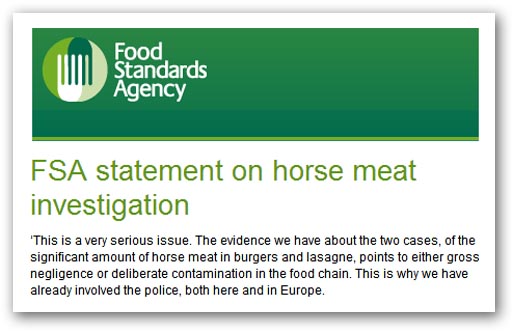
With the latest developments, the FSA reports that it has "already involved the police, both here and in Europe".

That is an explicit admission that imported meat is involved – which we already know, because produce of Irish and Polish origin has already been mentioned in media reports. 

What is not mentioned is the elephant in the room – the EU. The whole of the meat chain, from farm to store, is regulated by EU law, with meat and meat products subject to a stringent and expensive regulatory regime which replaced the British system. 

But what also goes with the territory are the Single Market rules. Produce from an EEA member, with paperwork that conforms with EU requirements, cannot be checked at port of entry. 

Neither, without firm evidence of a problem, are we allowed to check imported meat at the point of sale (or at any point in between, during processing and distribution) on a scale greater than we do meat of domestic origin. This is prohibited under EU law, as discrimination on the ground of nationality. 

Therefore, our system is entirely dependent on the good faith and efficiency of EU member states in policing food standards, to make sure that what is in the boxes is what is on the EU-regulated label. 

Of course, the system does not work, and will never work without the back-up of routine regulatory spot-checks, with special emphasis on imported goods, which are most likely to be substandard. That deterrent effect is lacking in the current system – the crooks know there will never be any checks until it is too late.

But, not only are we not allowed to do this, we are not allowed to know that we are no allowed to do this. The FSA is utterly silent on the root cause of the problem. But this, as with the breast implants, and the hip-joint replacements, is another good example of an EU regulatory failure. 

But if we are never told of it, how will we ever know? The criminal negligence here is in a criminally inadequate regulatory system, one imposed for political expediency rather than efficacy. 

COMMENT: "LET THEM EAT HORSE" THREAD

Saturday, March 31, 2012

Muddying the waters


I am beginning to suspect that the "elephant in the room" syndrome which is so apparent in our media arises as much from ignorance and incompetence as it does any conspiracy to conceal the impact of the EU on our lives.

The EU elephant having been ignored on postal charges and the famous pasties, we now have "Exhibit 1" - this piece in the Daily Wail (illustrated above), which retails alarming tales about blunders and near-catastrophes occurring in British hospitals through poor language skills amongst the staff.

Despite its own piece in January (below) telling us that the EU is not directly responsible for such situations whereby nurses end up on the wards with a dangerously limited grasp of English, the paper continues to focus almost exclusively on the EU involvement.


In fact, what the EU did was prevent the European-qualified medical staff being entered on the UK register, merely because they could not speak English. This did not in any way prevent hospitals insisting that staff displayed a specific level of skill – it simply transferred the responsibility from the national registration authorities to the individual employers.

Blaming the EU in this context is perfectly valid, in disrupting established systems and sowing confusion as to where the responsibilities lie, but that is not by any means the full extent of it.

At the end of the line is that group of increasingly highly-paid NHS executives, who are rewarded to such obscene levels supposedly that they should be aware of such matters, and ensure that they are taken into account. Thus, we not only have the EU dimension but multiple failures of management.

Therein, though. lies is another issue. As the military will tell you, if you are incautious enough to ask, to be effective, an organisation should have a clear chain of command.

But, as is the case now, where we have confusion in our legislature, where some laws are made in Whitehall and others in Brussels, it is not surprising that even highly-paid officials – much less the gifted hacks - get it wrong. There is no longer a clarity of purpose and a clear chain of command.

That was the point we were trying to make a couple of weeks ago. When "everybody" is in charge, no one is in charge. Responsibility shared is responsibility diluted, and while the finger of blame is pointed in one direction, others equally culpable get away with it.

Most often though, unlike this case where the EU is taking the rap, the "colleagues" are able to screw up the system, and walk away without blame – no least thanks to the media which no longer understands how we are governed.

COMMENT THREAD

Monday, March 26, 2012

You don't say


You really have to admire the perspicacity of The Financial Times with its star columnist Gideon Rachman. The west has lost in Afghanistan, he tells us. This is the same Financial Times, I suppose, that told us how wondrous the euro was, and how the UK should be part of it – except this time the paper's columnist has it right. We lost.

He only thing is that, like the US and most of the media establishment, their focus is far too narrow and the timetable is skewed. We lost years ago, and the big problem is the Indian elephant in the room.

But the man says that "it is only the scale of the defeat that remains to be determined" – and there he's right again. The only thing to be worked out now is how it is going to be spun. Everybody seems to agree that there's going to be a civil war, but who is going to take the blame for it?

And then, who really cares? How much do you hear about Iraq these days?

COMMENT THREAD

Saturday, March 24, 2012

Something fishy


The Daily Mail and other media sources, including the BBC have been running stories on the budget proposal to impose VAT on hot take-out food.

Hitherto, things like bacon rolls and hot suasage rolls escaped VAT under our permanent derogation to the VAT Sixth Directive, which allows the to zero-rate most foodstuffs. Now, though, it seems that the preposterous Osborne is planning to bring them into the net, a deed which cannot be undone. The derogation once abandoned can never be restored.

Osborne says he wants to address "some of the loopholes and anomalies" in the tax system, follwing a report from the Office of Tax Simplification last year which called for an end to some existing tax breaks. But this particular proposal is set to cause a lot of grief, so this reason given doesn't really cut it.

As always, though, when you are confronting VAT, you are dealing with the EU and, although our gifted media always ignores the elephant in the room, you can bet your sweet life that, somewhere in here is lurking an EU dimension. And indeed there seems to be just that.

To find it, we have to go back to March last year, when the ECJ ruled on a raft of German cases (C- 497/09, C-499/09, C501/09 and C-502/09, Manfred Bog and others), telling the German authorities that they had to charge the lower rate of VAT on all hot take-out food, instead of the higher rate.

At the time, HMRC said the ruling had no implications for the UK, whence it continued to charge VAT on things like fish & chips and burgers, sold over the counter, but kept as zero-rated foods "which are warm simply because they happen to be freshly baked, are in the process of cooling down and are not intended to be eaten while hot".

However, more than a few VAT consultances and lawyer groups specialising in tax law disagreed with HMRC, such as here and here. They argued that take-out food in the UK should also be charged at the lower rate, which in this country is zero.

By last November, we ended up with the fish and chip shop owners getting together to fight the government on this. They were looking forward to securing a very healthy refund. They also expected to be able to knock around £1 off fish and chips, boosting the trade and stimulating the sale of fish.

The actual amount of revenue at stake has not been specified, but it is likely to run to several billions, if the HMRC lose their case. And what seem to be happening here is that, by harmonising the rate, making it cover all foods without the "freshly baked, etc.," exemption, the tax authoritities believe they can protect their revenue stream.

As long as some hot foods are charged at the lower (i.e., zero) rate, then all hot foods must be charged at that rate. By abolishing the zero rate for ANY hot foods, Osborne can charge the standard rate for them all. This gets HMRC gets off the hook on which the ECJ has impaled them.

Retailers are, of course, hoping that the proposals do not go ahead. Already, the impact of the proposal it such that it has already taken £30 million off the share price of the bakery chain Greggs. But that is small beer compared with what the chancellor stands to lose.

The one thing, though, that you can be sure of is that the media isn't going to tell you what's going on. People might start voting for UKIP for something equally stupid, and that would never do.

COMMENT THREAD

Sunday, March 04, 2012

Ignorance or deception?


Following up on my earlier piece on circuses, Booker today notes that there have been few longer-running threads in his column than that famously invisible "EU elephant in the room".

This is the way that ministers, MPs (and even, alas, too many journalists – says Booker) fail to admit or explain that some controversial policy or law stems not from our own government but from "Europe" and we are therefore powerless to change it. There have been countless examples over the years, from the destruction of our postal system to those fraudulent but EU-approved breast implants.

This, in my view, is an extremely important phenomenon: people are being deliberately shielded from the impacts of our supreme government in Brussels, to which our provincial government is increasingly subordinated.

Interestingly, though, the circus example, although one of the more egregious examples, evoked absolutely no comment on our forum, and very little in the comments to Booker's own comments, which long seem to have been hijacked by a bunch of obsessive climateers – with only a couple of comments on the circus piece.

Despite that, the circus issue is special, not least because the indications are that the government set out deliberately to deceive. And newspapers such as the Daily Wail seem to have bought the spin, announcing that the government was intending to ban circus animals.

On in later versions of the story in The Independent did it emerge that the government had made no commitment to a ban, simply leaving it as a vague aspiration, with no firm date offered for when a ban would be implemented.


Cameron was thus accused of deploying "smoke and mirrors" to avoid imposing an immediate ban on wild animals in travelling circuses (above), while Tory MP Mark Pritchard, who had been leading the campaign for a ban dismissed the announcement as "disingenuous".

"Without a proper commitment to legislation in this Parliament", he said, "any claim to be listening to the will of Parliament is meaningless. This is a classic smoke-and-mirrors tactic by Number 10. Meantime animals continue to suffer".

Not once did any of the reporters, the government, nor in any of the published comments, was the EU dimension mentioned, although – as Witterings from Witney observes – EU activity continues apace.

In this affair, a possible explanation is that animal welfare is a highly emotive subject, and the fact that the UK is being prevented from adopting a ban is potentially very damaging to the EU, hence the reluctance to publicise the EU role. Even the Commission seems wary of admitting its role, forcing the EU Ombudsman to take a hand.

All the same, one really does wonder whether ministers are fully informed. In this case, we are dealing with Defra minister Jim Paice. He is not exactly famed for his intellectual accomplishment, to the extent that some have thought to applaud him when he successfully strings together three words to make a sentence without civil service help.

Certainly, there is the most profound ignorance within the Tory ranks on the role of the EU, evidenced by the recent comment on the fate of Cameron's top aide Steve Hilton. He is regarded as "one of the most imaginative brains in the Conservatives' high command", whose ideas have included scrapping maternity leave, suspending consumer rights legislation

But we are now told that Hilton has been driven out by Europe, after becoming "increasingly frustrated" by the slow progress of the battle against red tape and the endless meddling of Europe in British politics.

As an aside, it is very easy to be "imaginative" in terms of policy ideas, if one has little or no idea of how government works, or the constraints upon it, but if Cameron's top aide is seemingly unaware of them, then the idea of government ministers being equally unaware is not that untoward.

Thus, even now the question of whether ministers are deliberately setting out to deceive, or are just pig-ignorant, remains an open question. I tend towards favouring the latter, but you can never be sure.

COMMENT: "POTENTIAL LEGAL OBSTACLES" THREAD

Thursday, February 23, 2012

The killer of nations


"Greece is like an Arab oil state without oil", writes Patrick Cockburn in The Independent. "It has an overgrown and expensive state machine hard wired with webs of patronage and corruption". This is worth noting as anyone familiar with the writings of Patrick Cockburn, particularly on Iraq, will know that he far from being the worst analyst on the block, and he most definitely has a point here.

The division between Europe and Asia – and the Middle East – is often put in Turkey. Politically and socially though, Greece perhaps has more in common with the Middle East than Europe. In the Middle East, Cockburn says, the state machine is "a crude, unfair but partially effective way of distributing oil wealth and binding recipients to the state through jobs and favours". He continues:
In Greece borrowing took the place of oil. Membership of the eurozone gave the country the same triple AAA credit rating as Germany, enabling it to borrow what it wanted at cheap rates. Euro membership, like oil wealth elsewhere, was a disincentive to political, economic and social change because the money was there to pay off friends and foes … Everybody was happy until the money ran out.
So far, so good. The rest of the piece, as befits the title, "Greece has an overgrown and expensive state machine", deals with the inadequacies of the state, glossing over the patronage and corruption.

But both are a central feature of the state machine and business, to the extent that corruption is most probably one of the main drivers in the economy. And unlike Italy, where the Mafia and other crime syndicates have something of a separate existence, organised crime in Greece is very much part of the state and the major business enterprises.

What is particularly damning about Greece's entry into the EU is that it has opened up the markets and administrative systems of the European nations to a vast nexus of corruption, linking the diverse criminal enterprises, with the tentacles extending into the heart of Brussels.

The tragedy is that, when criminality prevails, the normal rules of economics and governance no longer apply. Competition is distorted, value-for-money becomes a redundant concept and justice takes the back seat to the rule of the mob.

To that extent, corruption particularly is the elephant in the room – another one. No one in polite company wants to say that Greek politicians are a bunch of corrupt thugs – or in the pay of organised crime, itself indivorcible from the business community.

But as long as we continue to pretend that Greece is a normal state obeying the same rules as everybody else, where the rule of law applies, we will continue to be taken to the cleaners. Corruption is the killer of nations. Until or unless it is rooted out of the heart of the Greek establishment, there will be no real progress.

As it stands, money pumped directly into that benighted country simply presents more opportunity for theft on an industrial scale. And, when demonstrators target some of the commercial enterprises (above), they know what they are doing. The real looters (as in Britain) are on the inside.

COMMENT: "LES GRANDES LIGNES" THREAD

Saturday, February 04, 2012

Afghanistan: what to make of it all?


A series of leaks on the progress of the war, and then a report on what appear to be plans for an expedited US withdrawal, have had the media abuzz with stories and analysis, but with no real consensus – a question of heat but very little light.

The first trigger was a Nato report leaked to the BBC, which suggested the Taliban in Afghanistan are being directly helped by the Pakistani security service (ISI), only to be followed by a predictable denial, with the Pakistani foreign minister, Hina Rabbani Khar, dismissing the report as, "old wine in an even older bottle".

As to the US plans, the trigger here was a suggestion by US defence secretary Leon Panetta suggesting that US combat missions in Afghanistan would end in 2013. That, though, was quickly clarified when Panetta said that the US would keep fighting alongside Afghan troops, but would cede the lead role in combat operations.

Thus, US troops would remain "combat-ready" as the United States wound down its longest war, but the troops would largely shift to a train-and-assist role as Afghan forces took responsibility for security before an end-2014 deadline for full Afghan control.

By the time Panetta came up with this reassurance, however, the damage had already been done, with widespread reports, culled from the original leaked report, that the Taliban, "backed by Pakistan", expected to retake Afghanistan when coalition forces leave.

However, despite the flurry of media activity, one is tempted to say "what's new?". I don't think anyone who knows the region and its politics is under any illusions that the Pakistanis work, and have been working with Pashtun and other tribal factions, with Arab support and money, specifically but not exclusively the Haqqani network.

Nor is there anything particularly new about the US military planning gradually to hand over security responsibilities to the Afghan forces, then easing themselves out of the picture. And nor is there any secret that the Taliban expect to have a free run at taking over the country, once the infidels have departed. What else is there to say?

Well, the Canadian National Post has a stab at offering something different, noting that the problem is that ordinary Afghan villagers subscribe to local codes of politics and morality that are profoundly alien and offensive to Western ways.

It tells us that gender equality, religious pluralism, due process - all of these notions are meaningless gibberish to a society made up largely of illiterate goat herders and farmers, who view women and children as property, and non-Muslims as hated infidels. In this world, the real business of public life begins and ends at the local mosque or village council.

Thus we are informed that, if outsiders in Kabul and Washington have money and guns to give, they will take them. They might even permit a school or highway to be built in their district, and appear in a photo-op. But that's where it ends.

Closer to home, we have a superbly robust commentary from Simon Jenkins but, other than to project the view that the UK – alongside the US – might be positioning for a war against Iran, having learnt nothing from the failure of Afghanistan, he really does not have that much new to say.

Matt Cavanagh also has a go, in The Spectator, but he ends up reiterating sentiments expressed in earlier articles, and in particular his piece last November. His conclusion this time is that we now have an opportunity "to move towards a more honest and realistic debate about the Afghan campaign and its prospects of success, in public as well as private".

Considering that we have yet to have an honest and realistic debate about the Iraq war, it is perhaps a little rash to expect anything different of Afghanistan, especially as the view of the UK administration on the conduct of the war seems to be locked in aspic.

This we saw recently from Lord Astor of Hever, defence spokesman in the Lords, who told the upper house that military means alone would not bring about a more secure country, then saying:
We have always supported an Afghan-led political process to help bring peace and stability to Afghanistan, and we continue to encourage all parties to take forward reconciliation. We will continue to engage with our US colleagues on these important matters.
We are not going to get a clearer definition of the UK stance, and while there is nothing new here either, it is useful to note the acknowledgement that a political process is required "to help bring peace and stability to Afghanistan", and that the military alone cannot close the deal.

In assessing current progress, as Cavanagh would have us do, it is useful to refer to the one of the great authorities on the nature of war, Carl von Clausewitz, and one of the most famous miss-quotations of all time: "War is merely the continuation of policy by other means".

This is, in fact, an abbreviated heading in Book One of his famous treatise on the nature of war, whereas the text states something different, and different in an important respect. War, he writes, is not merely an act of policy but a true political instrument, a continuation of political intercourse, carried on with other means.

This, Clausewitz expands upon in the rarely quoted Book Eight where, under the heading, "War is an instrument of policy", he tells us:
It is, of course, well-known that the only source of war is politics – the intercourse of governments and peoples; but it is apt to be assumed that war suspends that intercourse and replaces it by a wholly different condition, ruled by no law but its own.
Clausewitz then goes on to repeat his earlier aphorism, subtly improved, declaring: "We maintain, on the contrary, that war is simply a continuation of political intercourse, with the addition of other means". He then adds:
We deliberately use this phrase "with the addition of other means" because we also want to make it clear that war in itself does not suspend political intercourse or change it into something entirely different. In essentials that intercourse continues, irrespective of the means it employs.
Changing the "by" into "with" completely changes the meaning of Clausewitz's aphorism, making war an overall part of the political process, and not something separate from it.

That, it seems, to me, the Taliban understand – and so do the Pakistanis and other regional players. It is something the colonial British understood, but not their successors or the Americans. While both play lip-service to a political solution, they do tend to treat the military activity as something different and distinct from the political process.

And thereby we find Lord Astor reiterating the reasons why the coalition efforts must fail. On the one hand, the separation of military and political efforts defies sense, failing as it does to recognise the Clausewitz teaching. But, worse still, the flaw is in seeking an "Afghan-led political process", which is still further separated from the military effort.

In the scheme of things, Afghan politics are not played out within the actual borders that none of the players actually recognise, but on a far wider tableau, which takes in the ambitions and aspirations of all the neighbouring states, the former state of Baluchistan (now absorbed into Pakistan and Iran), and of course, the great regional elephant in the room, India.

And that also is nothing particularly new – not on this blog. Unfortunately, the coalition got it wrong from the very start, and it is too late to fix it now.

COMMENT THREAD

Friday, February 03, 2012

A stampede of elephants

You would have thought that, given the huge number of column inches devoted to the diverse and expensive defence procurement failures, the MSM might be interested in this government's proposals for remedying the system, delivered on Wednesday in the form of a White Paper.

The official announcement on the MoD Website makes the ostensible agenda interesting enough, telling us that the "Government" has set out its plans to prioritise investment in Science and Technology, "in order to ensure the UK's Armed Forces continue to have state-of-the-art technology, equipment and support, in a White Paper published today".

Apart from the Financial Times, however (and a small, down-page item in the business section of The Times), the MSM apparently no longer feels the need to comment on such matters – possibly because there is no opportunity any longer to make party political mischief and get a "biff-bam" slanging match going.

As to the Financial Times, it picks on one issue, which is also the focus of much of the specialist press, headlining: "MoD will no longer favour UK companies". The Ministry of Defence, it tells us:
… will no longer give UK companies priority over their foreign competitors when buying equipment and weapons for the armed forces. The only exceptions will be cases where buying British is essential to maintaining national security, Peter Luff, the defence procurement minister, said in an interview. He made clear the MoD would not consider wider employment or industrial economic factors when it assessed whether a piece of equipment offered value for money.
Nevertheless, if the dailies largely ignore that issue, The Spectator gives a spot to Matt Cavanagh, who calls the White Paper the waste of another opportunity. We need clear and unapologetic government backing for a sector which, as the White Paper notes, employs 300,000 people and is a major player in a global market valued at £260 billion, says Cavanagh, adding:
In that respect, the timing of the White Paper could hardly have been worse. Yesterday brought the bad news that India has awarded preferred bidder status for its $10 billion-plus fighter contract to France's Rafale, in preference to the Eurofighter Typhoon in which Britain's BAE has a major stake. The White Paper makes the usual noises about ministers "doing their utmost" to support exports, but privately many in the industry are disappointed by the lack of help — especially given ministerial rhetoric in 2010 around reshaping our foreign policy around trade.

This long-awaited White Paper was a second chance for the government to demonstrate its seriousness about tackling the real problems in defence procurement. Instead we got feeble commitments of support and simplistic rhetoric about "buying off the shelf" in a hypothetical "open market" which, in relation to large defence equipment programmes, simply doesn't exist. Another opportunity wasted — for Defence, and for one of our better prospects for export-led growth.
But what Matt – and everybody else for that matter – is ignoring is not so much the elephant in the room, as a virtual stampede of elephants. These come in the guise of EU Directive 2009/81/EC "on the coordination of procedures for the award of certain works contracts, supply contracts and service contracts by contracting authorities or entities in the fields of defence and security, and amending Directives 2004/17/EC and 2004/18/EC".

To get a taste of what this is requiring, all we have to do is look at the recitals – two, three and four will suffice:
(2) The gradual establishment of a European defence equipment market is essential for strengthening the European Defence Technological and Industrial Base and developing the military capabilities required to implement the European Security and Defence Policy.

(3) Member States agree on the need to foster, develop and sustain a European Defence Technological and Industrial Base that is capability driven, competent and competitive. In order to achieve this objective, Member States may use different tools, in conformity with Community law, aiming at a truly European defence equipment market and a level playing field at both European and global levels.

They should also contribute to the in-depth development of the diversity of the European defence-related supplier base, in particular by supporting the involvement of small and medium-sized enterprises (SMEs) and non-traditional suppliers in the European Defence Technological and Industrial Base, fostering industrial cooperation and promoting efficient and responsive lower tier suppliers. In this context, they should take into account the Commission’s Interpretative Communication of 7 December 2006 on the application of Article 296 of the Treaty in the field of defence procurement and the Commission Communication of 5 December 2007 on a Strategy for a stronger and more competitive European defence industry.

(4) One prerequisite for the creation of a European defence equipment market is the establishment of an appropriate legislative framework. In the field of procurement, this involves the coordination of procedures for the award of contracts to meet the security requirements of Member States and the obligations arising from the Treaty.
Helpfully, albeit in an obscure footnote, the White Paper tells us that this Directive was brought into UK law as the Defence and Security Public Contracts Regulations on 21 August 2011. And thus, let's play "spot the difference". In that self-same White Paper, we learn that:
We are focused on ensuring best value-for-money and delivering the best equipment for the Armed Forces and the security services. That is why this paper sets out how we will use competition as our default position and why we will look at the domestic and global defence and security market for products that are proven, that are reliable, and that meet our current needs. This principle is, though, qualified by the need to take action to protect our technological advantage where essential for national security.

We believe that the best way for the UK defence and security industries to remain strong, with some of the most high-tech and advanced manufacturing facilities in the world, is to be competitive. That is why this Government will continue to support responsible defence and security exports; why we are helping to create the right conditions for companies in these sectors to invest in the UK, and why we will take significant steps to ensure small and medium sized companies can continue to deliver the innovation and flexibility we need. There was strong support for these actions in the consultation responses.
And so we get:
Wherever possible, we will seek to fulfil the UK's defence and security requirements through open competition in the domestic and global market, buying off-the-shelf where appropriate… we will also take action to protect the UK's operational advantages and freedom of action, but only where this is essential for our national security.
This is remarked upon by a trade journal, which remarks that the presumption is to buy on the basis of competition and best value, which may often mean "off the shelf", even if it's from manufacturers in France, the US, Argentina, Israel. Now, the journal observes:
… many procurement people would welcome this focus on value for money rather than preserving British jobs or capability, but it will be interesting to see whether this holds up the first time a UK manufacturer loses out and screams blue murder about jobs, national interest and so on. Look at the fuss about the Bombardier/Siemens train procurement, and that didn't have the emotive aspects that defence always carries.
But of course, it will hold up. British ministers are implementing EU law, and they are always going to obey their masters. And in this White Paper, they are providing an ex post facto explanation of how the procurement system is to be adapted in order to ensure absolute obedience.

This in governmental terms, is not a "wasted opportunity" as Cavanagh would aver. It is simply a statement of compliance, the sub-text, "we shall obey".

COMMENT THREAD

Saturday, January 28, 2012

Euro-blindness


The invisible elephant in the room now strikes the Financial Times with a bizarre report (above) telling us that the UK is to appoint a food ambassador with a mandate to dismantle trade barriers and help British companies take their sausages, biscuits and cereals to Asia and beyond.

"Many SMEs have either been frightened off by the thought of exports, or have never thought of it at all", says agriculture minister Jim Paice, who is fronting a farming, food and drink exports "action plan" put together by Defra and UK Trade & Investment.

The latter bit is OK, but a mandate to dismantle trade barriers? As members of the European Union, we are part of a customs union. We have ceded the power to determine trade conditions (barriers, etc) to the commission in Brussels. Unilaterally, we cannot dismantle trade barriers, or reach agreements with other countries on trade issues.

Thus, when we actually get to the action plan, we find in the foreword, signed by Jim Paice, Lord Green of Hurstpierpoint and Paul Grimwood, the following deathly prose:
Our ambition is to see greater access to overseas markets for British products; businesses viewing exporting as a key route to growth; more SMEs selling to overseas customers; and the sector as a whole focussing more energy on the high-growth emerging markets. We will achieve this by lobbying energetically for the removal of trade barriers; ensuring businesses, particularly SMEs, have access to the right information and support; simplifying food exporting paperwork; and showcasing the exceptional quality of British farming, food and drink.
Despite that, the authors of the "action plan" are a tad confused. They go on to state that the plan "will drive export growth in the farming, food and drink sector by … opening markets and removing trade barriers", even as they then declare that, "Government and industry will work together to achieve this by lobbying for the removal of trade barriers that restrict access to new markets".

In other words, the "ambassador" doesn't have a mandate to dismantle trade barriers. All we can expect is "energetic" lobbying. And who do we have to lobby? Why, the EU of course.

Sadly, though, the action plan does not make this clear until we leave the executive summary and go to page 12 (of 27), when we learn that, "the Government is committed to promoting trade liberalisation through comprehensive multilateral and bilateral free trade agreements, and addressing specific market obstacles – working closely with the European Commission for both".

But how strange it is that the europhile Financial Times can't cope with the idea that lobbying is all that is left to us, and thus develops a case of euro-blindness, giving our man from Defra powers we as a nation no longer have. Not once do we see a reference to the EU in its report.

And thus once again we find those we are most enthusiastic about the EU are also those who seem most keen to deny its effects.

COMMENT THREAD

Wednesday, January 25, 2012

The beat goes on


Today's agenda, the politico-media establishment has decided, is the Court of Human Rights in Strasbourg, hence The Boy toddling off to that French city to make an inconsequential and carefully guarded speech on the subject, about which we are supposed to throb with excitement.

Somewhere, the idea of "sovereignty" will get mentioned – if not by The Boy, then certainly by some hacks, but even as they expostulate, that very thing drains away from the entity loosely described as the British nation.

No one, however, can ever complain that is passage was not recorded, but in the most obscure and secret form, in such a manner that it almost certainly never sees the light of day – the "Written Ministerial Statement".

Two such of interest were promulgated yesterday, the first one from the Minister of State, Foreign and Commonwealth Office (Mr Jeremy Browne): and The Parliamentary Under-Secretary of State for Transport (Mike Penning).

This was "to update the House on the Government's response to the sinking of the Costa Concordia cruise liner, which hit rocks off the Italian island of Giglio overnight on Friday 13 January" – not that it will do so as so few MPs will read it – but the key passage is below, which the point of greatest interest emphasised:
At this time, the cause of the accident remains unknown. We must wait for the results of the investigation by the Italian authorities before deciding whether any action is required to ensure the safety of other vessels. Should the conclusions of the investigation suggest a need for revisions on any aspect of cruise ship design or operation, then the International Maritime Organisation (IMO) will be the forum for agreeing improvements. The development of passenger ship regulations is an iterative process based on practical experience. By applying the lessons from previous incidents the cruise industry generally enjoys an excellent safety record.
Compare and contrast this with what The Boy was saying, now exactly a week ago during PMQs, viz: "if changes need to be made … of course we will make them".

What he actually meant to say, as we now see, is that the British parochial council will go toddling along to the Albert Embankment in London, where the IMO houses its secretariat, to get its instructions.

In due course, i.e., after interminable meetings, the 170 member states (and the EU, which will also be represented) will come to a conclusion (sort of). This then will be adopted by the EU, either in the form of a regulation or (more likely) a directive, which our parochial council will turn into British law.

So much for making changes, which neatly brings us to the second statement of interest, this one on: "PIP Breast Implants and Regulation of Cosmetic Interventions". Here, we are reminded by the secretary of state for health (Mr Andrew Lansley) of his oral statement to the House of 11 January 2012.

Then, he described the immediate action which the Government were taking to address the concerns of women who have received breast implants made by the company Poly Implant Prothèse (PIP), saying that:
… in the light of these events, we needed both to review the lessons that could be learnt, and to consider the wider issues of ensuring the safety of people who are considering cosmetic surgery and similar treatments. I therefore announced two reviews, one to be led by my noble Friend the Parliamentary Under Secretary of State (Earl Howe) which will look at what happened in the United Kingdom in relation to PIP implants; and the second, to be led by the NHS Medical Director, Sir Bruce Keogh, to look at the wider issues of clinical safety and regulation.

One will notice immediately, the complete absence of nay mention of the "elephant in the room" but now, in the written statement that so few will see, it comes out to graze. The review to be carried out by Earl Howe, we are now told, will report by the end of March 2012 and the terms of reference are set out thus:
In the context of current EC directives on the regulation of medical devices and the information generally available at the time on the risks associated with breast implants to review …
Then we find that the review will advise the secretary of state "on what lessons can be learned for application should similar circumstances arise in the future, and on implications for UK input to the ongoing review of the European Medical Devices Directives".

As regards the review to be carried out by Sir Bruce Keogh, this will take into account "the Government's Better Regulation framework and the concurrent review by the EU of current arrangements for the regulation of medical devices".

The purpose, as one might expect, is to "make recommendations to Ministers, including interim recommendations if appropriate, and to inform the UK contribution to the EU review".

That, as "revealed" by written ministerial statements, is how modern government works. On the one hand, a foreign shipping disaster is to be referred to an international committee and, eventually, the EU will reach down and make more laws, which we will adopt without question.

On the other hand, with a domestic medical "disaster", the great and the good are summoned to carry out reviews, the effect of which is "to inform the UK contribution to the EU review". When it has finished its own review, the EU will then reach down and make more laws, which we will adopt without question.

Interestingly, had we by now left the EU, we would still be talking to the IMO, but would be adopting its recommendations directly, instead of via the EU. As regards the breast implants, were we to have joined EFTA and via that the EEA, we would still be waiting for an EU review and adopting any regulations that came from it. Nothing much would have changed.

The key thing, though, seems to be that, as long as the politico-media establishment doesn't actually know (or care) how modern government works, it can go on pretending that The Boy and his ministers are still in charge and, until we give away the Falklands, that the sun never sets on the British Empire.

COMMENT THREAD

Monday, January 23, 2012

A global muddle


One minute we are the lambasting the media for not acknowledging the "elephant in the room", but the very next thing we see is the media fingering the EU for something that is not primarily its responsibility.

Up front are the Failygraph and the Daily Mail. They are complaining about "a draft directive of reforms to make banking safer and rules more uniform", the effect of which is to bring forward mortgage foreclosure proceedings from 180 days in the UK to 90 days.

It takes the Financial Times, however, to identify the legislation involved. It appears we are dealing with the capital requirements directive (CRD 4) "package", which aims "to improve bank safety by making it easier for investors to compare them and allow regulators to impose uniform capital requirements".

The specific proposal (one of several) was actually published in July last year, running to 154 pages, accompanied by a working paper, running to 226 pages, the proposed directive going under the fearsome title of:
Directive of the European Parliament and the Council on the access to the activity of credit institutions and the prudential supervision of credit institutions and investment firms and amending Directive 2002/87/EC of the European Parliament and of the Council on the supplementary supervision of credit institutions, insurance undertakings and investment firms in a financial conglomerate.
This is scheduled to go to the EU parliament committee in April and for its first reading in June, possibly to come into EU law by the end of the year.

But it is the documents which give the game away, telling us that the package implements the international Basel accord on banking supervision, the so-called Basel III agreement. The key objective of the proposal, we are told:
… is to address the shortcomings exposed during the financial crisis, to move towards a single rulebook regulating credit institutions in order to prevent recent problems from reoccurring in the future, and to ensure that risks linked to the issues of financial instability and pro-cyclicality are more effectively contained.
Unsaid is that many of those "shortcomings" were in the Basel II agreement, but the point relevant to this current rush of publicity is that we are not dealing primarily with EU law.

What we have here is an example of global government, about which we have written previously, specifically the secretive Bank for International Settlements in Basel, which hosts the equally secretive Basel Committee on Banking Supervision.

It is this body - in which our own Bank of England governor, Mervyn King, plays a central role – which actually makes the rules. The members of the key sub-committees are not disclosed, the meeting are in private, the rules of procedure are not declared and the voting record is secret. By comparison, the EU is a model of transparency – except of course, that the EU is a major player in this committee, where the real power is held.

This situation, therefore, casts the EU in the role of middle man. It takes the "recommendations" from the Basel committee and processes them into actionable legislation – some as commission regulations and some as directives, for the member states to adopt into their own legislative codes.

The one thing the EU cannot do, however, is make any substantive changes. The rules have been decided on a global scale and the EU is now just the regional authority implementing them – a relationship not dissimilar to that between the EU and the IMO.

In this context, to blame the EU for the result is, to say the very least, otiose. But that is what the media does when it suits it. Possibly, the real reason though is that, like our own MPs and so many others, they no longer have a very clear idea of how we are governed or who actually governs us.

Fortified by their own ignorance, the hacks thus go for the easy shot – and none of us are better informed. Small wonder though that the powers that be are thinking of selling off the Houses of Parliament. If they do, there is certainly no need to replace them.

COMMENT THREAD

Monday, January 16, 2012

Could … if, but probably won't


The EU’s new pension proposals will make us £600 billion poorer, claims Abhijit Pandya in the Daily Wail today, demonstrating the classic scare technique that invariably amounts to nothing – or very little. Such a scare starts with a hypothesis: "if such and such prevails". Then we get the projected consequences, usually vastly inflated, offering a diet of disaster and dismay. And, as here, another scare is born.

"Make no bones about it", warns the hyperventilating Pandya, "this cost will impact significantly on corporate growth plans, on companies struggling in the recession, and most importantly: the pockets of employees". But it won't. Pandya is cribbing from a story that was doing the rounds on and around 5 January, in specialist journals and the like, which say no such thing.

The story itself is based on research carried out by J P Morgan Asset Management, served up in an 18-page report, which suggests that if the solvency requirements applied by EU law to insurance companies are applied to pension funds, there could be a shortfall £600 billion in the capital fund.

This is in fact a worst-case scenario and has been estimated in response to a review of Directive 2003/41/EC of 3 June 2003 "on the activities and supervision of institutions for occupational retirement provision".

Potentially, there are huge problems, but it is early days yet. Says an earlier report, "there is a good chance the worst will not happen", and even if it does, there are ways of restructuring pension plans which would exclude them from the worst effects of any new law.

But this is not good enough Abhijit Pandya. "Could" becomes "will" and his narrative becomes one of the EU "planning to force companies to increase their pensions pools" through new policy "that will cost, according to the bank JPMorgan Asset Management, the UK’s economy an astonishing and extraordinary £600 billion".

I really do get sick and tired or this. There is a complicated story here – rightful concerns about the way the EU is muscling in on the pension business, and creating all sorts of problems and costs. We could use some specialist help here, but instead we get this sort of inane exaggeration which serves no purpose at all.

We should be able to rely on our media to inform us, but it has long ceased to carry out that function – if it ever did. Here, though, we have a newspaper which ignores the elephant in the room when it comes to breast implants but then goes totally over the top when it comes to a report about pensions.

There is no fathoming this industry – there seems no sense or logic to it.

COMMENT THREAD

Wednesday, January 04, 2012

A rural revolution?


This time of year, traditionally the quietest for arable farming, is one of the most active for farming politics, with the annual Oxford Farming Conference pulling together the major players in the sector, under the aegis of the National Farmers Union (NFU).

To celebrate this highly political event, the Conference is funding a research project which is previewed in The Guardian, telling us "US and European dominance in farming [is] under threat", calling for a "significant increase in UK food production to counter threat of losing influence at global level".

This is something of a new one (on me, at any rate), where more usually the farmers talk about self-sufficiency to rack up the money train. But, while the issue is rehearsed is detail in the newspaper, it seems that this is still work in progress, rather than a completed report.

Such as we do know of the project is articulated by Tom Hind, Director of the OFC and Corporate Affairs Director at the NFU. Extruding verbal material of a type typical of the breed, we have him saying, "the forces of globalisation and the market economy have already had a significant impact on agriculture and food, with countries such as Brazil, Pakistan and New Zealand taking increasingly important positions in regional and global markets".

Hind adds that climate change, demographics and the relevance on global corporations are likely to lead to further shifts. Britain, he says, "may be a relatively minor player on the world market but we're becoming more and more exposed to consolidation of input suppliers and competition in key markets, especially our own".

But what is really puzzling is that in an industry dominated by the Common Agricultural Policy, with the EU the paymaster, there is absolutely no reference to the elephant in the room – until, that is, the evening of the penultimate day when a debate tackles the motion: "This House believes British agriculture could thrive outside the European Union".

Proposing is Stuart Agnew, of UKIP, and opposing is Lib-Dim Andrew George, making the only scheduled discussion on the EU. Gone are the heady days of debate about CAP reform, subsidy increases and the mysteries of community politics.

For once, is seems, the NFU, one of the EU's most steadfast and enthusiastic supporters, is looking beyond the narrow, claustrophobic confines of "Europe", and asking if there is life out there. Are we seeing the beginnings of a rural revolution?

COMMENT THREAD

Tuesday, November 01, 2011

Playing the joker

To the complete surprise of virtually everybody, including his own parliamentarians, Greek prime minister George Papandreou has dropped a complete bombshell, calling a referendum to approve the latest EU bailout deal.

According to the Reuters report, Papandreou says he needs wider political support for the fiscal measures and structural reforms, upon which the bailout is conditional.

This is an explanation that does little to dampen speculation as to his real motives – the presumption being that the referendum must be lost. Media sources are already asking whether this is political suicide, although Papandreou seems to be playing a canny game.

He already has a confidence vote in parliament on Thursday or Friday and if he was after an abrupt end to his political career, he could have gone down without making a fight of it. The referendum announcement, therefore, looks like he wants to go down fighting.

Furthermore, this may not be as much of a gamble as might appear. An opinion poll conducted by Kapa Research SA records sentiment finely divided. While some 58.9 percent consider the bailout package has "negative" or "probably negative" implications, 50.1 percent agreed with the need for more European oversight.

Bizarrely, only 48.8 percent see the bailout as an infringement of national sovereignty and 72.5 of the respondents said they wanted Greece to remain in the eurozone.

Rumours from Athens are that the referendum is likely in mid-January, giving plenty of time for negotiations in les couloirs, once Merkel and the "colleagues" in Brussels have got over the shock – they having been kept out of the loop as well.

Meanwhile, some parliamentarians are questioning the referendum's legality under the constitution, which does not allow referendums on economic issues but only matters "of great national importance". The last referendum was in December 1974, on abolishing the monarchy - held shortly after the collapse of a military dictatorship.

Fotis Kouvelis, leader of the small Democratic Left party argues that, instead of a referendum, the country must go to early elections. It's the most honourable solution, he says. But with no party likely to win a clear lead, Papandreou might be gambling on the referendum giving him a new legitimacy, which will extend beyond the January and well into the next year.

But there is one issue – perhaps the elephant in the room – which is not being mentioned: the attitude of the Army. With a possibility of a military coup not being ruled out, we do not know who is pulling the strings.

For one brief moment though, we have a delicious certainty of knowing who isn't. And even now, such has been the shock that we have not yet had a comment from either Berlin or Brussels.

COMMENT THREAD

Friday, July 08, 2011

An absence of history


With a certain amount of indignant squawking, the Failygraph is reporting that "Members of the European Parliament are backing calls to fly the EU's blue flag with yellow stars at sporting events, such as Wimbledon, held in its territory and, most controversially, to have the EU emblem on national team shirts".

The proposals, to be released next week, stipulate that all national sports teams, including football, rugby, cricket and the British Olympic team, would be forced to have the EU emblem appear on their jerseys.

The idea, we have been told, has been dismissed by the Tories as "simply daft", and we are also told it is contained in a report on "The European Dimension in Sport", drafted by Spanish centre-right MEP Santiago Fisas Ayxela which will be presented to the Parliament next week.

The trigger for this is the Commission Communication on Developing the European Dimension in Sport, published in January this year, but - as always, the media forgets (or simply does not know) its history. This initiative goes back much, much further, to the European Council meeting on 25–26 June in Fontainebleau in 1984.


Then, the Heads of State or Government of the Ten (pictured) – which just happened to include Margaret Thatcher - "declared that they wanted to strengthen Europe's identity and image amongst its citizens and throughout the world", and an ad hoc working party on a People's Europe was set up.

The working party was chaired by the former Italian MEP, Pietro Adonnino, and its task was "to propose measures likely to strengthen the Community's identity and promote a Europe without internal frontiers", from which emerged the second Adonnino report, presented to the Milan Council of 29 and 30 March 1985. Embedded in that report was this section:
5.9. Sport

Since ancient times sport has been an important forum for communication among peoples. It is an important part of the lives of a large number of people within the Community. That is why it is all the more regrettable that the enjoyment of international competitive sport has been drastically marred recently by hooliganism. The Committee has therefore considered both of these important aspects below.

5.9.1. The administration of sport is predominantly the responsibility of sports associations independent of government. The Committee proposes that the sports associations be invited to encourage action where it is consistent with their responsibilities, along these lines:

(i) for certain sectors of sport, organization of European Community events such as cycle and running races through European countries;

(ii) creation of Community teams for some sports to compete against joint teams from geographical groupings with which the Community has special links;

(iii) inviting sporting teams to wear the Community emblem in addition to their national colours at major sporting events of regional or worldwide interest;

(iv) exchanges of sportsmen, athletes and trainers between the different Community countries, to be encouraged by programmes at the level of the Community and the Member States;

(v) support for sporting activities especially for particular categories of persons, such as the handicapped. Student sport activities should be organized in conjunction with the twinning of schools and towns.
From this emerged the idea of the Ryder cup, with its European team. Since then, though, the idea has stalled, but sport is now an EU competence under the Lisbon treaty. Thus, armed with new powers, the commission is now seeking to "develop" the principles set out in the 1985 Adonnino report.


This, of course is not the first organisation to use sport as a means of enhancing national identity, as we saw in 1936, when Hitler tried the same thing. Now that the "colleagues" are so keep on fostering their own version of the "European idea", it was always inevitable that they should try the same thing.

What is both salutary and fascinating, though, is to note the extended timescale. Like an elephant (in the room), the Commission never forgets, and its patience is infinite. So what was approved by Thatcher in 1985 comes back to haunt the heir to Heath in 2011, 26 years later – in a treaty he could have stopped, by chose not to.

Like as not, the EU won't get its badges this time, but the idea won't go away. It will keep pushing and probing until it gets what it wants, waiting another 26 years if need be, unless we (or events) destroy it first.

COMMENT THREAD

Sunday, June 26, 2011

Ignoring the elephant

The circus elephant in the room is still at large as the media continue to chew over the bones. Claiming ownership of the campaign to ban the use of wild animals in circuses is The Sunday Express which directs its ire at Cameron for the failure of the government to implement a ban.

It cites a Friday statement which said he was "minded" to outlaw using wild animals but the Department for Food and Rural Affairs, which instead wants a licensing regime, still insists there are "unavoidable legal difficulties" surrounding a possible legal challenge by circus bosses in the European courts. And that's as good as it gets.

Yesterday, The Independent (devoting its front page to the story - pictured) had much the same thing, also reporting Cameron as insisting that he was "minded" to outlaw circuses from keeping wild animals.

According to this newspaper though, Cameron says it is "not right" to still have lions, tigers and elephants performing in the big top. "We are minded to have a ban, but need to clear some obstacles," he told a press conference at an EU "summit" in Brussels.

Nevertheless, says The Independent, "despite Mr Cameron's conciliatory language on implementing a ban – and the promise by Agriculture minister James Paice to 'respect the will of the House' – there were signs last night the Government was prevaricating".

We are then told that the Department for the Environment is understood to be still arguing there are "legal problems" in implementing an outright ban and to be standing by its alternative proposal for a tough licensing regime for circuses.

Now, as our readers are very well aware, these "legal problems" are a matter of EU law, with the government convinced that to implement a ban would be contrary to EU law.

It really cannot be the case that the writer of The Independent piece was unaware of this – at least, one hopes so – in which case the refusal to identify the EU as the cause of the problem is more than a little interesting. This Europhile newspaper has been leading the fray in the media for the adoption of the ban, and it must be acutely embarrassing that its darling EU is blocking the way.

But this inability to report the elephant is not unique to the Europhiles. Even the self-proclaimed sceptic Daily Express was reporting yesterday that "Ministers were against introducing a ban next year, fearing it would attract lawsuits from circus owners and workers".

This paper thus did not mention the EU in its story, taking exactly the same line as the idiot Andrew Pierce in The Daily Mail, which told its readers, "Ministers opposed a ban because of fears that it would leave the Government open to lawsuits from circus owners and workers".

Exactly the same formula was seen in The Scotsman though. It seems that copy-and paste journalism is rampant – as always.


But it is not only the media which is ignoring the EU circus elephant. The RSPCA on its website is demanding action, with David Bowles, director of communications, saying: "Parliament has spoken, and government should listen". Any attempt to delay or avoid a complete ban would be wrong-headed and simply not acceptable, he says, with not a single mention of the EU.

Part of this, undoubtedly, is the insistence on trivialising politics, reducing it to the level of a low-grade soap opera, as does this piece in The Mail on Sunday.

The media and political classes have become so debauched that all they can think and write about is "self". The actual issues are of such little interest that they cannot be bothered to research them properly, much less report them accurately.

That said, I take some flak on the forum for attacking Pritchard - a potential ally. My view, though, it MPs wrote themselves out of the script a long time ago, Pritchard along with the rest, who is at heart just a vain egocentric like the rest - incapable of listening or learning, still denying EU involvement.

Demonstrated with the utmost clarity by this affair is the very simple premise – if we are going to force any changes to the way this country is governed, we are going to have to do it ourselves. We cannot rely on parliament or the media.

COMMENT: ELEPHANT THREAD

Friday, June 24, 2011

The decline and fall


Illustrating why it will never be a serious newspaper, The Independent pronounces with great fanfare: "Victory in the campaign to ban circus animals", claiming: "Government concedes defeat after bribes and intimidation fail to deter rebels".

There has been no "victory", of course. Yesterday's debate was a "take note" motion, which seeks to instruct the government but which has no legislative effect. The government can (and will) ignore it leaving Pritchard with the procedural option of mounting a motion of no confidence – which he isn't going to get.

For the record, the motion reads:
That this House directs the Government to use its powers under section 12 of the Animal Welfare Act 2006 to introduce a regulation banning the use of all wild animals in circuses to take effect by 1 July 2012.
This is more than a little interesting, because Pritchard was not seeking primary legislation – as in a Private Member's Bill – but was seeking to prevail upon the government to use existing welfare legislation to implement a ban. In so doing – as I pointed out in my earlier piece – he has collided head on with the European Union – and the doctrine of the occupied field. Animal welfare is an occupied field.

Herein lies a fascinating development for, having now had a chance to look at the whole debate, one finds that the EU was briefly referred to by Pritchard – and in a lot more detail by other speakers. The circus elephant was very much in the room, circling the backbenches, trumpeting for all it was worth – the nature of which we are going to have to look at in another post.

Nevertheless, I can happily stand by my original view of this MP, but there are an awful lot of people playing games here, on an issue which, in the UK, actually affects only 39 animals.

Thus, while the man pretending to be our prime minister was jetting over to Brussels to save civilisation as we know it, our MPs were battling with EU law, without the first glimmer of understanding, while HMG, impaled on the hook, was struggling to find more and more ways of explaining why it could not act.

The debate was thus a fine study of impotence, ignorance and stupidity, all combined, with the House frittering away its time and passion discussing the fate of less than two score creatures, about which it has the power to do nothing. What a graphic example this is of the decline and fall of a once-great institution.

COMMENT: ELEPHANT THREAD