Showing posts sorted by relevance for query road charging Germany. Sort by date Show all posts

Thursday, January 26, 2006

Filling his satchel

"My department will examine the detailed technical issues about how road pricing might be introduced, including discussions with industry about future developments," says Mr Alistair Darling, transport secretary. "And we are asking everyone to help us to carry the debate forward and consider the choices before us."

But, without having waited for the outcome of that debate – or even noticeably encouraging it – Mr Darling's officials seem already to have made up their minds. Already his department has spent £93 million on the EU’s Galileo satellite global positioning system and now, it appears, they are conducting detailed discussions with a major German firm about implementing Galileo-based road charging systems.

This we learn not from Mr Darling’s department of course, but from an obscure online publication which tells us that T-Systems has announced the foundation of a new subsidiary, Satellic Traffic Management GmbH.

T-Systems just happens to be the IT division of the German telecoms giant Deutsche Telekom. Its new subsidiary has been set up specifically to develop satellite-based road toll charging technology and market it internationally.

Called Satellic, it is based in Berlin and, besides offering satellite-based toll charging technology, the new company wants to spearhead "the development of innovative traffic-management systems,” helping toll operators in their “migration from microwave to satellite technology".

T-Systems itself developed the technology behind the first satellite-based toll system, operated by Toll Collect GmbH and Satellic expects the world-wide turnover in satellite technology applications to be at around €250bn by 2020.

Now we come to the crunch. In Europe alone, says the report, eight countries - the UK, the Netherlands, Poland, the Czech Republic, Slovakia, Belgium, Sweden and Hungary - intend to introduce a road toll charging system and Satellic is already involved in close talks in the UK.

Although no decision on the technology has been made, we also learn that Satellic bases its current product on the US GPS standard, but its parent company T-Systems, as a member of TeleOp, is part of the Galileo project. It hopes to provide IT services for one of the ground control centres, which will be based in Germany. Furthermore, Satellic says its traffic-management services can only be offered with satellite-based technology

A key issue, concludes the report, will be whether the highly-sophisticated satellite technology can be employed while keeping operating costs at bay - a key decision criterion for governments aiming to fill their satchels at minimum cost.

So now we know. All we need is the bit of kit like that pictured above (left) fitted to our cars and Mr Darling can start filling his satchel - at our expense.

COMMENT THREAD

Thursday, March 22, 2007

Back from the brink… sort of

According to Heise online, the EU's Galileo navigation system has been clawed back from the precipice and will live to see another day.

As we left it, the companies forming the development consortium for the system were refusing to incorporate a company which could take the project forward.

This left the EU commission without a formal partner and no entity which could order the satellites needed to set up the system, leaving the commission to consider handing responsibility for the system to a public body – thereby virtually ensuring its demise.

If they are good at nothing else, however, the "colleagues" need take lessons from no one in brinkmanship. Thus, yesterday, the consortium capitulated and the separate companies signed the articles of incorporation of a registered company.

However, this is but one small step, and the problems affecting Galileo are by no means resolved. Forbes cites Michele Cercone, spokesman for EU transport commissioner Jacques "Wheel" Barrot, saying that the consortium's move is a "commitment, not a result".

The transport council is due to meet in Brussels today to discuss the next step, and they will find that the underlying flaws in the commercial model have not gone away. In fact, they may be intensifying.

Reliable information is difficult to get but there are rumours circulating that the German road charging system – the only one in Europe so far that uses satellite positioning data to provide charging information – is running into serious problems. Unofficial reports suggest that the system is having difficulty in processing all the information and that as many as 60 percent of vehicles are escaping charges.

Income from road charging systems using Galileo is a vital component of the cost recovery plan and if they cannot deliver, then the project is in even more difficulty than its critics would have it.

That might explain the outgoing French president's parting shot, recorded here.

Despite the opposition of key EU member states, including Germany, Chirac – out of the blue - is demanding an immediate end to the boycott of arms sales to China. Sales of weapons relying on satellite guidance, some of which would be manufactured by consortium partner EADS, would help to underwrite the costs of commissioning Galileo. With China also favouring its own system, it might help pull it back into the project, also easing the financial crisis.

That much, of course, will not be discussed openly by the commission tomorrow, and it is unlikely that anything of the current traumas will be found in the mainstream media, which has largely ignored the project. But the time is fast approaching when serious financial decisions have to be made, at which point the taxpayers of the EU member states could find themselves having to meet a rather large and unexpected bill.

Brinkmanship may then not be enough.

COMMENT THREAD

Thursday, May 11, 2006

Spy in the (Euro) sky

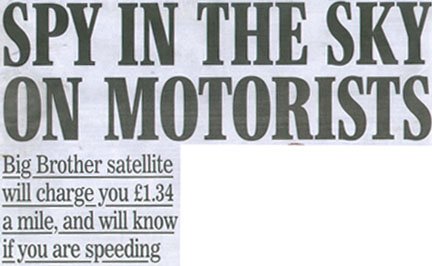
Bursting onto the front page of the Daily Express today is the banner headline (illustrated), "Spy in the sky on motorists" – the paper's "take" on the announcement by the newly appointed transport secretary, Douglas Alexander, that he intends to make satellite-based road pricing his "personal priority".

The government's "big idea" for reducing road congestion is to impose a system of variable charging which could force motorists to pay up to £1.34 per mile at peak times, with lower charges – down to 2p per mile – on less frequented roads.

Predictably – and understandably – the paper picks up on the "big brother" aspect of the system, noting that the technology could be used to "snoop on the private lives of citizens" – a highly justified fear as the system itself relies on being able to record, very accurately, every journey you make in a car.

And, as the Express's strap warns, the same technology could be used for monitoring vehicle speeds, with the spectre of a speeding ticket winging its way to your door every time you go over the posted limit. Further down the line – although not noted by the paper – is the possibility of installing "intelligent" speed limiters, which actually prevent a driver exceeding the posted limits in any area.

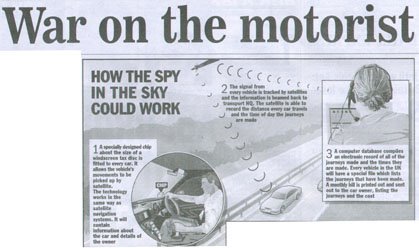
Hillariously, the report author, "transport editor" John Ingham, seems not to have the faintest idea of how the system works, hence a lurid graphic (illustrated) which portrays an anonymous satellite actively tracking a vehicle, "beaming back" the information to a "transport HQ".

For the record, this is not at all how the system works. In fact, it utilises the GPS satellite navigation system and – of very great interest, to which we will refer shortly – this will almost certainly be the EU's Galileo system. This system, in common with the US "Navstar" GPS system, is entirely passive, each satellite in the constellation simply transmitting a time signal. With three or more such signals, a vehicle-mounted receiver can translate these data into positional information and tell drivers where they are.

An on board unitFor a road pricing system, this information is processed by what is called an "on board unit" (OBU) which holds personal and vehicle details in its microchip memory. It continually processes satellite signals to work out positioning, integrates those data with the personal details and then transmits that information via an in-built GMS mobile phone to a receiving station. There, the trip details are recorded and charges are calculated. Generally, the user then receives a monthly invoice, or cash can be withdrawn directly from users' bank accounts.

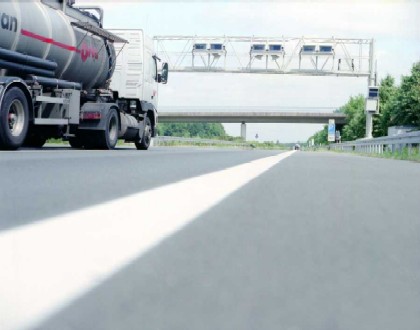
To prevent "free riders", there is also a separate, but linked enforcement system. This involves, typically, road gantries with highly sophisticated cameras linked to number plate recognition software. The German system is also able to take 3-D infra-red images, which can identify the type of vehicle going through.

A German camera gantry used to enforce the toll systemEvery vehicle going under a gantry (or past a free-mounted and sometimes vehicle-borne camera) is recorded and the details are checked with the charging database. It the vehicle is not registered, details are automatically beamed to mobile enforcement units which intercept the vehicle and take the necessary action.

Such a system has been applied very successfully in Germany, through a private company set up to run the scheme, called Toll Collect. Detailed information on the scheme can be found here (64 pages, PDF).

Crucially, though, what makes the system politically acceptable – and feasible – is that it only applies to trucks, and then only to the motorway system. This ensures that the high proportion of foreign trucks transiting the system bear their share of the running costs, the surplus income being used wholly for road maintenance.

Furthermore, the sensitive "big brother" issue does not apply, as there is no problem about truck journeys being recorded. Also, charges are set at a relatively modest level, between 9-13 cents per Km for a three-axle truck, depending on emission levels. That emission "discount" has been highly welcomed as it creates an incentive to operate "green" trucks. Additionally, there is a surcharge for empty trucks, which has seen the number of empty runs reduce by 17 percent, keeping trucks off the road.

However, what Alexander is proposing is in a wholly different league. Given the huge number of private vehicles on British roads – approximately 25 million, as against less than 500,000 goods vehicles – and the extent of the road network, he is setting out to try something, the scale of which has never been attempted before – all in the context where over 30 percent of the DVLA database contains errors.

The government track-record on major computer systems is lamentable and the sheer practicalities of getting the scheme up and running are daunting. Most likely, this would be another spectacular failure.


The Galileo satellite constellationNevertheless, in order to get public agreement, Alexander might attempt to sugar the pill by promising to lower petrol tax. But, according to the Express, fewer than one percent of drivers actually believe the government would do this. The charges would be yet another tax on motorists. Combine that with the "civil liberties" issue of all journey data being recorded and public hostility is almost guaranteed.

But there is also a strong EU dimension. Although the German system currently uses the US GPS signal, the EU commission is determined that any European system should be based exclusively on Galileo (illustrated above), for which use it will be charging national operators. Therein lies the prospect of a lucrative "Euro-tax", with motorists contributing to the EU coffers every time they take to the roads.

Needless to say, the former Europe minister is silent on this aspect and it is not mentioned by the Express. But Alexander is determined to move the debate from "why" to "how". He will have a battle on his hands, not least from the Eurosceptic community.

COMMENT THREAD

Saturday, February 03, 2007

The real big brother

There is an interesting photographic essay here on the enforcement of road charging in Germany. This is the sort of thing from which your average journalist could benefit - but won't.

I didn't realise, for instance, that the enforcement agency can interrogate your OBU, via an infra-red link, using a hand-held monitor. In theory (and practice) therefore, police can carry out real time roadside checks on cars fitted with road charging equipment – without stopping the drivers – to find out where they have been. Unless the drivers are subsequently told, they would be totally unaware that their movements had been checked in this way.

The civil liberty implications of this are horrendous.

COMMENT THREAD

Sunday, April 17, 2005

Booker

This week the Booker column looks at "the biggest issue of all" that can't be mentioned in the general election, that colossal "elephant in the room", the European Union.

Booker opens his column pointing out that the real reason for the collapse of the Rover-Shanghai deal was the Transfer of Undertakings (Protection of Employment) Regulations. These enact EU directives which would have imposed on the Chinese greater obligations towards redundant employees than they could and would accept.

Even the BBC now asks why "Europe" has become the great unmentionable issue in this suffocating election - but it is missing at least half the point. It is true that all parties seem eager to keep the EU out of view (Tory candidates, for instance, were startled last week to be issued with a set of focus-group-tested mantras on this topic and warned not to vary from them by an iota).

The politicians' stock explanation is that discussion of "Europe" should be deferred until the referendum on the European constitution in a year's time. This could prove to be more than just a convenient excuse: with the voters of France and Holland seemingly set to kick the constitution into the long grass, we may find ourselves denied any debate on this issue at all.

There is, however, a more serious respect in which "Europe" has become the black hole in this election. The discussion of many vitally important issues is now avoided because they are in fact no longer the responsibility of our Westminster Parliament. When even the Cabinet Office website admits that half our laws are now made in Brussels, this means that a whole range of policy areas which would once have been at the centre of election debate are off the agenda.

Booker then goes on to offer a list of nine key issues which have effectively been excluded from discussion, because the views of British voters are no longer relevant to how they are handled.

1. The Coming Energy Crisis
Within a few years, with the rundown of North Sea gas and our ageing nuclear power stations (currently providing nearly a quarter of our electricity), we face the prospect of a major energy crisis, which in the electronic age would be far more devastating to economic life than Heath's "three day week" in the 1970s.

Yet no party is prepared to argue the unworkability of an EU-agreed energy policy which pledges that, within 15 years, we will derive 20 per cent of our energy from "renewables", mainly wind. To achieve this - which would entail building 20,000 turbines - is out of the question. No party dares question the EU-Kyoto orthodoxy by pointing out that wind energy is hopelessly unreliable and uneconomical, and that without a new generation of nuclear power stations a crisis is inevitable.

2. The Waste Crisis
Our waste disposal policy is in chaos thanks to the insane complexity of EU waste rules and its diktat that we must replace most of our landfill sites with giant incinerators. This is not going to happen. Thanks to the EU's bizarre definitions of "waste", Britain is prohibiting all sorts of imaginative recycling systems, such as the use of sewage pellets to fuel power stations.

Labour ministers' slavish attempts to comply with ill-drafted EU law are proving increasingly self-defeating: eg the current nationwide wave of fly-tipping, or the fiasco of the EU's ban on burying "animal by-products", from fallen farm stock to old supermarket chicken tikka. Yet neither of the other parties dares question this shambles because they accept the EU's right to dictate waste policy.

3. The Defence Crisis
The Armed Forces face an unprecedented crisis in the provision of their materiel - their planes, ships and vehicles - which is intimately connected to the demands of EU defence integration. The recent award of the Army's biggest ever truck order to a German firm rather than an Anglo-American consortium was just the latest instance of how the politics of EU integration are now overriding military considerations.

The Tories promise to spend more on defence and to reverse the abolition of old regiments. But neither pledge makes sense without addressing the central issue of whether our armed forces should be reorganised and re-equipped according to the needs of EU defence policy.

4. Immigration and Asylum Rules
In January when Michael Howard first proposed a limit on immigration, he was caught out when Brussels officials explained he had no powers to do so. The Labour Government had signed up to directives which prevent Britain deciding its own immigration and asylum policy.

Mr Howard responded that he would repatriate those powers. But although he has continued to make immigration a central election issue, he has carefully avoided getting drawn into further discussion of how he could implement a policy which would be viewed by Brussels and his EU partners as illegal.

5. Road Safety and Traffic Control
Few issues have become more contentious than speed cameras and congestion charges. Even Labour's manifesto admits they will consider a new system for charging road-users. What no party explains is that Brussels now plans to take control of all "road use policy" across the EU, through its proposed Road Safety Agency, including speed limits. Furthermore, among the declared intentions of its Galileo satellite system is a plan for electronic charging for road use of EU roads, including congestion charges; and satellite-controlled automatic "speed limiters", making it impossible for drivers to break the limit even if they want to.

6. Overseas Aid
Tony Blair makes play with his plans to more than double Britain's overseas aid spending to £6.5 billion a year. What he doesn't highlight is the frustration of his ministerial colleagues at the extent to which UK aid priorities are now dictated by the EU, and how inefficiently and corruptly much of it is administered.

A junior aid minister, Gareth Thomas, recently complained at the way EU aid is weighted towards Mediterranean countries, in the hope of deterring emigration - so that Egypt, for example, receives 100 times more per head than the much poorer Bangladesh. The Tories say they would "repatriate" some aid policy, but do not explain how they would do this in face of unanimous opposition from Brussels and EU partners.

7. Foreign Policy
Because it is obscured by headline exceptions such as Iraq, few people, even politicians, are aware how much we must now comply with the EU's common foreign policy. In 28 policy areas we have already handed over our right to decide our own policy, which is one reason why the British Government has appeared to take such a pusillanimous line over such issues as the tyranny of Mugabe, Botswana's persecution of the Kalahari Bushmen and appeasement of the mullahs in Iran.

8. Competition and State Aid Rules
When, with Government support, Peugeot planned a car plant at Coventry which would have contributed more to the Midlands economy than Rover, the deal was scuppered because it took too long for Brussels to approve it under EU "state aid rules". Although the rules are widely flouted by France, Germany, Italy and Spain, Britain is punctilious in its efforts not to use subsidies in a way which might "distort competition". This has also resulted in abandoning such socially desirable policies as the Public and Private Partnerships which helped to clean up scores of former industrial sites and put them to beneficial use.

9. The Growing Deadweight of EU Regulation
When one West Country MP was recently approached by a constituent asking why, as a lorry driver, he was forced by the EU's working time rules to take a 20 per cent cut in wages, the MP had to point out that there was nothing any British politician could do about it.

EU regulations are regularly put at the top of the list by business organisations, from the CBI to the British Chambers of Commerce, as by far the biggest single factor undermining the efficiency and competitiveness of British industry. Despite weak noises from the Tories, no British politician has any practical idea as to how to curb this regulatory blizzard, which is why it is not an election issue.

These, concludes Booker, are just some of the issues which will remain undiscussed at this election, reflecting how much of our government has now passed to the new system centred in Brussels, unaccountable to any electorate. This inflicts endless damage, from the chaos over our new "118" system for directory enquiries to the continuing disaster of our fisheries.

But the more the power to run our country is taken out of our politicians' hands, the more reluctant they are to talk about it. This is why debate will continue to centre round the same obsessive little list of issues - schools'n'hospitals, crime'n'tax - ignoring that ever greater "European black hole" into which our right to govern ourselves is steadily vanishing.

Friday, June 08, 2007

Lost in space?

You can see the "colleagues" are getting a bit worried about their treasured Galileo satellite navigation system.

They've just rushed out a Eurobarometer survey telling us how much "Europeans" love the project, even though less than half of them are even aware of it. So it is that eighty percent of respondents agree on public funding to complete Galileo, despite a price tag of €2.4 billion.

What they have not been told though is that it will almost certainly cost another €1 billion a year for each year of operation – at the very least – or that it may well be used as the basis of a road charging system that will, collectively, cost them even more. Such little details need not trouble the minds of our happy "EU citizens". But then, if the questions were straight, they would not have got the answers they wanted.

As to the more important answer – whether they are going to get the money – it looks like they are going to have to wait. Although the Transport Council of 6-8 June was supposed to decide this issue, we now learn that the EU-27 transport ministers are now set to make only a short statement on the failure of the current concession contract and to ask the commission to go into more detail on the funding options.

Even though the project is already considerably delayed, the member states will then leave it to the October council to decide on its fate, when we are told they will consider how the finance will be obtained and how competences will be shared between the public and private sectors.

Here, there seems to be an even split, with the commission suggesting that the extra funds could be met from the EU budget, backed by the majority of the EU-27 and the EU parliament.

However, the three nations which collectively bankroll most of the EU budget, Germany, the Netherlands and the United Kingdom, would like to see individual states contribute the extra funds to the European Space Agency (ESA), which could then finance and manage the project.

That means, of course, that the Galileo enthusiasts would have to put their money on the table, instead of getting a free ride. It will be interesting to see then how keen they remain on the project.

Behind all this, though, is a major conundrum. It is far from certain whether the EU commission has a legal basis on which it can fund the project, as there is no formal space policy written into the treaty. Are we going to see a sudden amendment to the "mini-treaty" everyone seems to be rushing to agree, or is the project going to be lost in space?

COMMENT THREAD

Thursday, September 15, 2005

A Trojan horse

It is a measure of the level of distrust of the European Union than news of the failure of plans by the EU to introduce a potentially life-saving system can only be greeted with unalloyed relief.

The system in question is known as eCall, which automatically generates an emergency mobile phone call the emergency services, in the event of a car crash, triggered by sensors inside the car. The system informs the services of the vehicle location, thus enabling a rapid response.

However, while the EU commission "agreed" with the automotive industry that all new cars in the EU would be equipped with the technology by 2009, according to Reuters, of the 25 EU member states, only Finland and Sweden have agreed to install the equipment needed for emergency centres to receive the calls. Although Germany is set to sign up soon, that still leaves 22 countries who have not made any plans.

The EU Commissioner for Information Society and Media, Viviane Reding, yesterday told the Frankfurt car show on Wednesday that eCall could save 2,500 lives a year. "This is the life saver," she said, "because it works whether the accident victims are conscious or not."

What Reding did not say, and the EU publicity seems to avoid emphasising, is that to use the service, cars must be fitted with Galileo satellite positioning receivers. Linked to the mobile phone, it is this enables the emergency services to locate vehicles in distress.

But, once the equipment is installed, there can be no guarantee that it will not send signals unbidden, thus enabling the authorities to keep track of unsuspecting motorists. Furthermore, exactly the same technology is used for road charging schemes and automatic speed limiters. Almost certainly, many motorists would be reluctant to have the equipment fitted to their cars if they knew its full potential.

How clever of the commission, therefore, to "sell" the system as a life-saver, gulling the unsuspecting into fitting what amounts to a Trojan horse. Tough really that, once again, the member states have messed up its plans.

COMMENT THREAD