Sunday, June 25, 2006

The greatest enemy

For an update on this post, see here.

A UAV picture of roadside bomb ambush in Iraq
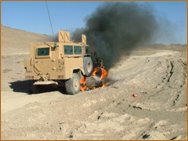
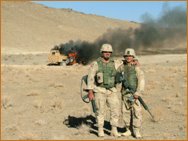
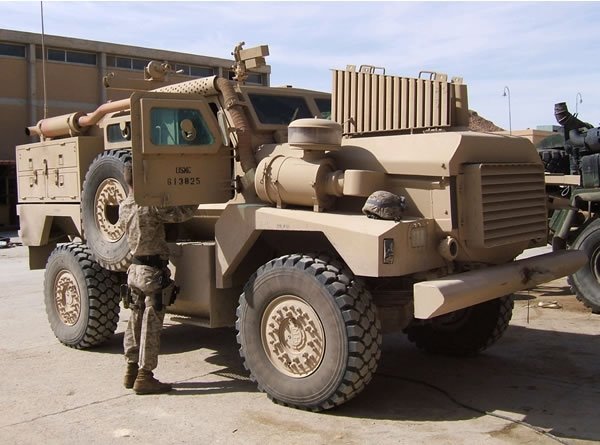
So far this week, we've run an unprecedented five stories on a single topic, the unnecessary deaths of British soldiers from roadside bombs in Iraq, due to the inadequacies of their equipment. We started with this one, with follow-ups here, here, here and here, pointing out that, had the MoD provided our troops with armoured RG-31 patrol vehicles, some of our soldiers, like the more fortunate Americans pictured below, could have survived.

Today, the Sunday Times takes on the issue with an editorial headed: "Pay up and save lives", which we reproduce in full here:

It is of course a hugely sad matter that the toll of British soldiers killed in Iraq has been growing steadily to reach its current total of 113. Every military death is a blow for the country and a tragedy for the family and friends of those who fall victim. So it is reasonable to assume that the Ministry of Defence will do all it can to prevent the deaths or injuries of our troops. including providing them with the best weapons and armour to do such a dangerous job.

Now we learn that British soldiers have been patrolling the streets of Iraq in Land Rovers that offer almost no protection against lethal roadside bombs. Nearly a quarter of British soldiers so far killed in hostile action have been the victims of roadside bombs and were patrolling in these so-called "Snatch" Land Rovers. The vehicles, some up to 20 years old, were shipped to Iraq from Northern Ireland, where they were used to police a very different and much less bloody conflict. Their bodywork and floors offer only thin protection against the improvised explosive devices used by the insurgents. Aware of this, the terrorists have started to target the Land Rovers and the risks of more fatalities are increasing every day.

We would naturally expect the ministry to do something about this. Far from it. The bureaucrats are digging in. It is not as if there is no alternative. The RG-31, an armoured Land Rover built by BAE Systems, is being used by the Americans and the United Nations. Some deaths from roadside bombs can never be prevented but other countries’ soldiers seem better protected.

Complaints about inadequate equipment have dogged the British mission from the start. When Sergeant Steve Roberts was shot two years ago it emerged that the protective vest he should have been wearing was not available. The six military policemen killed by a mob three years ago had antiquated radios and inadequate ammunition. The scandal over Land Rovers not fit for their purpose is just the latest sorry example of Whitehall warriors sending our fighting men badly protected into the field.
This is in a week when the Tory Diary blog has been discussing such vital issues as a new logo for the Conservative Party and an interview between the Boy King and Jonathan Ross.

An RG-31 after a roadside bomb attackThe contrast perhaps speaks volumes for contemporary politics when even a defence debate in the Commons goes unnoticed by the chattering classes. Fortunately, the Sunday Times did not share the values of the "modern compassionate" Conservatives. In addition to its editorial, it has published the Land Rover story on its front page and also devoted a full-page to a focus analysis. The story cites a certain Richard North, "an author and internet blogger" who has been campaigning over the failure to invest in heavily armoured vehicles. He says:

It was an incredibly crass decision to reject the RG-31 and shows yet again the MoD's knack of creating a disaster of every procurement decision. The looked at whether to stick with cheap, second-hand Land Rovers that were not safe to use in Iraq at that time, or buy a vehicle that would save lives. What did they do? They stuck with the Land Rovers.
The crew escape unhurt - the caption to the photo is 'Thank you RG-31'The Times story follows in the wake of The Sunday Telegraph, with Christopher Booker continuing the story he started last week. Moreover, this is clearly an issue with which the public clearly empathise, the two lead letters in the Telegraph supporting the calls for better equipment.

That does not, incidentally, stop the Telegraph's dim excuse for a defence correspondent, Sean Rayment, pursuing his own line that "the policy of using Land Rovers" is due to the lack of Warrior MICVs. This, he admits, is a claim the Ministry of Defence denies, a denial that has substance as no knowleageable person will argue that the Warrior is a suitable patrol vehicle. And, at three times the width of the Land Rover, it most certainly cannot gain access to many areas in urban environments.

Nevertheless, for those who want to understand more about the real enemy which is threatening our democracy, this is a good starting point. Clever Dicks and Tory politicians, it seems (with some notable exceptions) need not bother.

COMMENT THREAD

Saturday, June 24, 2006

Week-end reading material

Though my colleague has explained very clearly what our thinking is on the blog in the future (I just go on posting happily or not so happily my thoughts, hoping to annoy as many people as possible), practical considerations make it necessary for us to make short postings as well as long ones.

There are practicalities for us - we cannot always produce long analytical pieces - and for our readers - they do not want to read long boring articles all the time.

So we intend to do more short snappy paragraphs that link with articles or postings on other sites. This will undoubtedly bring about complaints on the forum, but that's just the way it is.

My first link is with an rticle in the Wall Street Journal. Every Saturday a well known writer lists his or her five favourite books in his (her) own subject. This week it is David Pryce-Jones's turn.

Mr Pryce-Jones has many subjects as he has written widely and extensively, fiction and non-fiction. But he is best known as an expert on the Middle East and, inevitably, Islamist terrorism.

His list is then of the five best books on terrorism and why he thinks so. Read the whole piece and, if you can, follow his advice.

The ministers must lie

For an update on this post, see here.


Not that you would have known it from the MSM but, on Thursday there was a debate in the House of Commons on defence policy. You would have thought that a switched-on opposition could have made considerable political capital from the issue raised on this blog about the inadequate protection for our troops against roadside bombs, but there was not a squeak from the Conservative front benches.

It was left to a Tory back-bencher, therefore, to raise the issue. This was Lee Scott, MP for Ilford, North, who noted that:
The American soldiers and marines in Iraq have access to RG-31 Nyala mine-protected vehicles which enable the crew to survive the blast of an improvised explosive device. Canadian troops deployed in Afghanistan also use RG-31s. British soldiers and Royal Marines need to make do with lightly protected Land Rovers. That is not acceptable.
Traditionally, the minister responds to such points at the end of the debate but, before he could do so, Ann Winterton, another Tory back-bencher intervened. Addressing Adam Ingram, the minister of state directly, she posed a question "about equipment connected with Afghanistan":
As our forces appear to be winning the firefights in Afghanistan, does he expect those who oppose our troops there and in other theatres to revert to the use of improvised explosive devices? If so, what vehicles are our forces to be equipped with to counter the threat?
Because it was an "intervention", Ingram answered immediately and, from this you can see the way questions do not get answered. His response is a classic example of evasion - pure extruded verbal material:
We have been very effective in Afghanistan. We have a potent force in the Apache attack helicopters. We are up against intelligent and capable enemies, whether in Afghanistan or Iraq, and we know that they will continue to look for ways to attack land-based vehicles or air-based platforms. We have a lot of measures in place. The hon. Lady will understand that it is not appropriate to discuss all the detail, but where we identify a threat - be it a new or technological threat - we identify a quick way to deal with it. Sometimes that takes time as we come to understand the threat before developing the technical response. Our focus at all times is the protection of our personnel, whether it involves fixed-wing aircraft, helicopters, land-based systems or maritime systems.
So, don't you worry your pretty little head, dear. "Our focus at all times is the protection of our personnel".

At the end of the debate came the summing up by the parliamentary under-secretary of state for defence – there's glory for you - none other than Mr Tom Watson. He had an opportunity to deal with the Land Rover issue but chose to ignore it. Instead, what we got was:
Firstly, we need to ensure that our people, who do a magnificent job, are properly looked after. Secondly, we need to ensure that they have the equipment that they need to do the difficult and dangerous things that we ask of them. Our success depends above all else on our personnel ...
And then…
They are making a unique and valuable contribution to help to bring peace and security to Afghanistan, Iraq, the Balkans, Northern Ireland and elsewhere in the world. I know that our debate will have reassured them that we have their best interests at heart and are all working to ensure that they have the finest support from the British Parliament.
I am not sure that our personnel will be that reassured, but I suspect not. According to the latest edition of Private Eye, British troops in Basra were distinctly underwhelmed by defence secretary Des Browne on his inaugural visit last month "Smug, sleek and fat - and every inch a New Labour apparatchick" one of them informed the magazine.

The hero of the hour, however, was a young squaddie who, while Browne was meeting and greeting, asked what he knew of the military. "Not much," the minister admitted, "but what do you know about politics?" "Well," said the soldier, "I can lie well".

Clearly, that is an essential attribute for a defence minister. Our picture above is further confirmation of the lie uttered by Lord Drayson on 12 June during the House of Lords debate. "We had 14 RG-31s in Bosnia, which we took out of service some time ago due to difficulties with maintenance." This is an official MoD photograph and the caption reads:
SFOR, Bosnia, April 1997: Alvis 8 Mine Protected Vehicle (MPV) of the Royal Engineers.
The Alvis 8 is the Mamba, an early version of the design from which the RG-31 was developed, and further developed, the current version being the Mk III. To imply, on the basis of a different vehicle, in service nearly ten years previously, that a current type is unsuitable is clearly dishonest.

Furthermore, we are unable to get any confirmation for the minister's claim about "maintenance difficulties". We have in fact been contacted by a soldier who was serving in Bosnia who actually drove the short-wheel-base version. His comments were:
…it was a pretty old fashioned vehicle with a 4 speed manual gear box, a huge delay on the steering, nightmarish brakes that really struggled to get the thing to stop (air brakes but the poorest I've ever come across). All in all it was a real challenge to drive, I got to love it in the end, but it put off many a driver during its time. It had its good points, the separately fuelled heater (easily coped with the Balkans winter), the sound of it, and of course it carried as much kudos as any vehicle in Bosnia
Separately, we learn that decisions to use "Snatch" Land Rovers in Iraq have caused officers "untold anguish and mental suffering" because they knew "how vulnerable they were". One source told us that, "I have seen very senior commanders cry because of the decisions that have had to be made."

Being Army, they have no choice but to use the equipment with which they are provided, and to carry out the tasks assigned. Ministers, therefore, have a special responsibility "to ensure that our people… are properly looked after". But, they are not doing so. All they are doing is uttering cheap platitudes.

But, if they admitted the real reasons why troops were being ordered to use equipment that their officers knew was dangerously vulnerable, there would be a public outcry. Thus, the ministers must lie.

COMMENT THREAD

Friday, June 23, 2006

What next for the Western alliance?

Arguably, the EU-US Summit is not the world’s most exciting occurrence and little was expected from the one that has just taken place. Presumably, this was Bush’s last EU summit for, as I keep saying, Bush Derangement Syndrome notwithstanding, his presidency is due to end on December 31, 2008.

It was, somehow, symbolic that he should arrive in Vienna the day after the horribly mutilated bodies of two American servicemen had been found with the supposed new leader of al-Qaeda, Abu Ayyub al-Masri, announcing that he had carried out the torture and murder personally.

Naturally enough this was not mentioned by the various European politicians, who had been expected to spend a lot of time demanding that Guantanamo be closed. Or so the BBC surmised.

Others preferred to think that there would be problems over the handling of Iran, though there is now a general agreement that the country is itself a problem and dealing with it might be more painful and difficult than it would have been, had the EU3 (France, Germany and the UK) had taken a tougher line at the start of the drawn out and rather one-sided negotiations, several years ago.

The solution may well lie with the people of Iran, who have been considerably more angry and rebellious in the last few months than the British media had bothered to report.

In the event, the final communiqué of 16 pages produced a great deal of well-meaning waffle and little of substance. Much to some commentators’ despair, the press conference appeared to be considerably more relaxed and friendly than the average event of that kind after a European Council. President Bush seems to have disarmed the Europeans in some way or, possibly, there has been realization that these summits (two so far) are not of any use to anybody and the detailed negotiations on many differing subjects will be more important.

President Bush then showed his remarkable good sense by going to Budapest from Vienna, to commemorate the fiftieth anniversary of the 1956 revolution. In actual fact, the commemoration is due in October but the President has explained that he will not have time to go then so, an early visit is better than none at all. He has clearly been bitten by the bug of Hungarophilia.

At the open air meeting by the Castle, Bush has extolled Hungary’s fight for her national and political freedom, adding that Iraq will follow in Hungary’s footsteps:
“"The lesson of the Hungarian experience is clear - liberty can be delayed but it cannot be denied," Mr Bush told an audience at a ceremony on a hill overlooking Budapest from which Soviet tanks had fired into the city.

The Soviet Union had "crushed the Hungarian uprising but not the Hungarian people's thirst for freedom", he said.

Mr Bush praised the new Iraqi PM, Nouri Maliki, saying Hungarians would recognise his spirit.

But, he said, Iraq's democracy was still under threat from "determined enemies".

"Defeating these enemies will require sacrifices and continued patience, the kind of patience the good people of Hungary displayed after 1956," he said.”
It is likely that there were some more practical discussions of the kind that summits do not cover, for instance about the question of entry visas into the United States for Hungarian visitors.

Meanwhile, we saw the usual parade of self-important demonstrators in Vienna, who maintained with quite unbelievable stupidity and ignorance that President Bush was the No1 terrorist in the world. They even imported the Moonbat Mom, Cindy Sheehan, for the purpose. (One would like to know who pays for the lady’s endless criss-crossing of the world. What of the environmental implications?)

The Wall Street Journal Europe published two opinion pieces on the subject of America and Europe (and, even, the rest of the world). Unfortunately, they are both for subscribers only, which is something of a mistake in my opinion. However, the more interesting of the two, Yves Roucaute’s “With Friends Like This”, seems to be a translation of a piece he had previously published in Figaro, which was roughly translated by Joe Noory on No Pasarán.

The less interesting one is by Robert Kagan a far-from-Republican analyst and Senior Associate at the Carnegie Endowment for International Peace. Entitling his piece “On Hating America” he explains quite clearly that, much as he disagrees with President Bush and his foreign policy, he has to admit that the present much-hyped world-wide hatred of America has little to do with either. It did not start with Bush’s presidency and will not end with it.

It is, in fact, a symbol of many frustrations that people feel about their own governments and countries but prefer not to express.

Kagan describes a panel discussion he took part in recently in London about civil conflict and “failed states” around the world.
“The panelists included the son of a famous African liberation-leader-turned-dictator, the former leader of a South American guerrilla group, a Pakistani journalist, a U.N. official and the head of a of a nongovernmental humanitarian organization. Naturally, our reasoned and learned discussion quickly transmogrified into an extended round-robin denunciation of American foreign policy.”
As Kagan tells it, even the panel chairman was moved to protest but one also wonders to what extent he himself was stunned. It is not unusual for right-on anti-Bush, anti-Republican Americans to feel that they have much in common with the critics, only to find that they are lumped together with their enemies as those American imperialists.

The conclusions seemed to be (and, apparently the son of the African dictator was particularly voluble) that failed states were all America’s fault either because it intervened, as it did to sort out the mess in the disintegrating Yugoslavia or because it did not as in the bloody massacres of Rwanda.

What of the governments that steal the money, oppress their people and destroy the economies of those countries? They are not to blame. What of the militias, official or not so official, who massacre other inhabitants? They are not to blame. What of the Islamists who call for terror, send in suicide/homicide bombers, kidnap, torture and murder people? They are not to blame.

It is all the result of American imperialism which started long before America was a particularly powerful country, for, it seems European imperialism is also America’s fault, particularly as described by people under whose rule life has become so bad that even some imperialism is regarded benignly.

Kagan’s summing up consists of contradictions:
“No one should lightly dismiss the current hostility toward the U.S. International legitimacy matters. It is important in itself, and it affects others, willingness to work with America. But neither should the U.S. be paralyzed by the unavoidable resentments that its power creates. If Americans refrained from action out of fear that others around the world would be angry with them, then they would never act. And count on it: they’d blame America for that, too.”
Who provides that international legitimacy? African dictators and their spoilt, corrupt offspring? Latin American guerrilla leaders, with bloody hands? Or those Europeans who refuse to acknowledge that another great fight is going on, in which liberal democracies must defend themselves, and continue to attack the greatest and strongest of those democracies?

It is the latter that are the subject of Yves Roucaute’s article. M Roucaute is a professor of political science and philosophy at Nanterre University and author of numerous books and articles.

His article is uncompromising, starting as it does with the following sentences:
“The old continent is wilting in the global war against terror, just as it did when faced off against fascism and then communism.” When at today’s summit with U.S. President George W. Bush the European Union will once again take its ally to task over Guantanamo, it will expose its own, not America’s, most serious moral crisis of the post-Cold War era.”
Professor Roucaute pours scorn on all the complaints about Guantanamo, pointing out that prisoners of war had always been kept incarcerated, away from their possible friends to prevent information filtering out.

He is not impressed by the accusations of torture:
“But where is the evidence of torture in Guantanamo? The famous incriminating report of the U.N. Commission on Human Rights, whose members include communist China, Castro’s Cuba and Wahhabi Saudi Arabia among others, was based purely on the testimony of released Islamists. Not one member of the commission even visited the camp, under the pretext that they couldn’t question prisoners in private.”
He dismisses the ludicrous docu-fiction “The Road to Guantanamo” that, inevitably, won the Silver Bear at the 2006 Berlin Film Festival. The three “innocent” heroes, who, having allegedly left Britain to go to a wedding in Karachi, somehow or other found themselves first in an al-Qaeda command centre in Kandahar, 1,200 kilometres away, then in Kabul with the Taleban and then on the Pakistani border. Too much stag night celebration, perhaps.

To top it all, they managed to be subjected to all kinds of poorly described torture, none of which left a single mark on their bodies. A tad different from people who come out from other Cuban prisons, the ones under Castro’s regime.

The three Guantanamo suicides do not point the way to anything.
“Did we have to release Nazi leaders after the suicide of Göring? Did we have to close German prisons after the suicides of Rudolf Hess or the Baader-Meinhof group? Should French prisons be closed because 115 prisoners took their lives in 2004 alone? Well, some of them actually should. Many French prisons and detention centres for asylum seekers are truly horrific. But they are of little concern to the anti-American demagogues”
We, too, have written about the horror of the French detention centres. And we, too, have pointed out that the West should look around and see more clearly who the real enemy is.

We are not saying that no American policy or American politician, should ever be criticized. We are, however, saying that the world is divided into those countries that, theoretically at least, believe in freedom and those who do not. We should be fighting for our freedom and trying to spread it to those countries whose people suffer from tyranny. Let us not forget that the courageous Hungarians received no help from the West.

The world is also bedevilled by transnational organizations, whose aim it is to undermine liberal democracies and impose a rule by unelected and unaccountable lawyers and bureaucrats. Their greatest enemy is the United States. We, British and Europeans, should be lining up with the latter.
“The real strength of republics must be measured by the courage to fight for them. On this side of the Atlantic, this strength, once again, is lacking.”
Professor Roucaute is talking of Kantian republics, which European countries ought to belong to and ought to fight for.

COMMENT THREAD

Democracy or stability?

I have to admit that I am struggling with this blog, between offering a balanced spread of stories on EU and related issues in general, and the need to pursue more focused coverage of the defence/foreign policies that we have been following.

Looking at the problem in the round, however, I am coming to the conclusion that we are close to the end game in the battle over European integration, with the "colleagues" perilously close to winning the match, without anyone even realising it. In this particular post, therefore, I want to address this issue and seek the views of our readers on matters which will become apparent through this piece.

Returning to this issue, in terms of my rather bald statement that we are entering the "end game", readers may rightly feel it contradicts earlier assessments published on this blog. Variously, we have argued that the European Union has reached the limits of integration and – with the failure of the constitution - politically, the construct is dying on its feet. It is only a matter of time, we have suggested, before the whole thing collapses under the weight of its own internal contradictions.

That, actually, still probably remains the case. History is littered with the wreckage of grandiose political constructs, but there is nothing to say that that the collapse of the EU will come soon or suddenly. More crucially, in the time available to it, it continues to grow and expand its powers, as does its capacity to cause enormous harm, and damage to UK interests.

Taking that on board, one has to understand that there are two separate models of European integration at work, each with their own advocates, their own power bases and their own agendas. As they interact with each other, we see a confusing interplay of events, which is difficult to interpret and, at any one stage, can attract different conclusions.

Cutting to the chase, though, the two different models can usefully be described – if approximately – by the horrendous labels of "neo-functionalism" and "intergovernmentalism". Both have as their end point the political integration of Europe – effectively a United States of Europe - but each rely on different methodology and have as their end point fundamentally different structures and ideas as to the division of power.

The first of the two, the "neo-functional" model, embodies the "Monnet method" approach, relying on step-by-step economic integration gradually to ensnare the nation states by the classic process of engrenage, thereby bringing them into the maw of a single economic entity that then assumes a political dimensions, emerging as the government of Europe. Crucially, at the heart of this construct is the Commission, comprised of appointed technocrats ruling as benign Platonic guardians, protecting the interests of all the peoples of Europe.

The second, "intergovernmental" model differs in that crucial respect in that, while the objectives are exactly the same, the ruling body is a cabal made up from the leaders of the member states. This, in the current institutional structure of the European Union is the European Council, which sees itself as the heir to the mantle of the "government of Europe" and would prefer to treat the Commission as its civil service, subordinate to it in all material respects.

This is what so few people understand about the European Union – that there are two competing models. There are two separate institutions which aspire to the Crown. They are not complementary parts of the whole, but rivals, competitors which – unseen and unrecognised by most of the world – are fighting out a deadly battle for dominance.

What so few people also understand is that the failure of the constitution represented a massive defeat for "neo-functionalism" and, by default, a victory for "intergovernmentalism", the nature of which is only beginning to become apparent. What it did not represent was a defeat for European integration, which proceeds apace.

To understand this, one has to appreciate that we have been here before. It was in 1952 that a European constitution was formally proposed as the framework for a European Political Community (EPC) which, in turn, was to provide the political structure for a European Defence Community employing its own European Army.

If nothing else, this reminds us that the core ambition of the integrationalists was always to develop what is now called a "European defence identity", under a broader political umbrella. That had as its main aim the projection of a European common foreign policy and through that the re-creation of a new European empire in its own right. This remains the core ambition – the rest is detail, a means to that end.

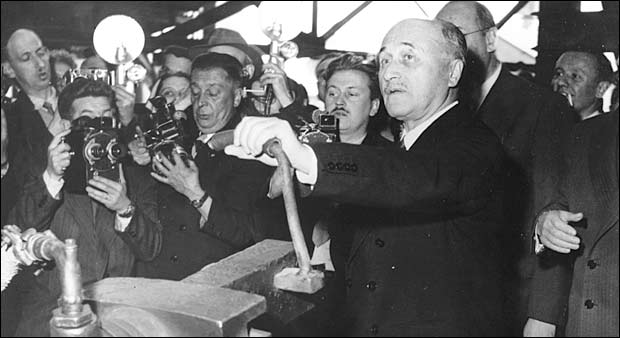
Jean Monnet inspecting the first steel ingot produced under the European Coal and Steel Community regimeThat the EPC was rejected by the French Assembly in 1954 was a major defeat for Monnet and his supporters, which led to a change of tactics and a reversion to the step-by-step "neo-functionalist" approach which had been pioneered in the European Coal and Steel Community. In effect, by going for the EPC, Monnet over-reached himself and the subsequent Treaty of Rome was a more cautious return to the original plan.

While the overall effect of the rejection of the EPC, therefore, was to delay the timetable, it did nothing to sate the appetites of the integrationalists, whose plan re-emerged in the run-up to the Maastricht Treaty when the hope was that the then Community would emerge as a full-blown European Union, complete with a foreign and defence policy along the lines envisaged back in 1952.

However, the member states were not yet (or at all) willing to surrender that amount of power to the Commission and what emerged was an unholy compromise of a three-part treaty comprising three "pillars", the first constructed on the "neo-functionalist" model and the other two – foreign policy and "security", and justice and home affairs – on intergovernmental lines.

Ever since Maastricht, the Commission and its allies have been seeking to demolish this structure and bring all the components into a unified whole, increase their control of the elements. This process is known in Community jargon as "collapsing the pillars". That was what the constitution was really all about. That the Commission and its allies failed is now history, but that has not deterred them trying to salvage their plans. They will continue to do that – and have so far failed - because that is what they must. Their very survival depends on it.

Nevertheless, that has not stopped many commentators – ourselves included in the earlier stages before the process became clearer – claiming that the "European Union" was attempting (and in some cases succeeding) to implement the constitution, without ratification. But, as we tried to point out in an earlier post, that is not what is actually happening.

The trouble is, of course, that the two institutions, the Commission and the European Council, are variously described in short-hand terms, as "Brussels" or the European Union, the latter often as "European Union leaders", which obscures the nature of the battle going on, and fatally undermines attempts better to understand the dynamics of integration.

What is actually happening, though, is something very different. The "intergovernmental" cabal in the European Union are flexing their muscles, introducing elements which were in the constitution – and some which predated it – but in many ways freezing out the Commission and keeping the power within the ambit of the European Council and participating member state leaders.

In this sense, within the EU, all the prime ministers and heads of state (that participate in EU affairs) have two separate and distinct roles. In one, they act in their familiar domestic capacities but, as members of the European Council, they are in effect cabinet members of the putative government of Europe. And it is there that many of the decisions concerning the high-level issues of defence and foreign affairs are made, to be implemented by the self-same "cabinet members" using their own domestic resources.

This does make the process of integration very difficult to understand. The popular perception is of "Brussels" forcing unwilling member states to do its bidding, whereas in the sphere of "high politics" it is the "double-hatted" cabinet members of the European Council using the resources of their own countries in the service of European integration and the projection of European Union power. In the UK, therefore, we may have a prime minister in Blair but, as a member of the European Council, he has a higher loyalty to a different, superior government.
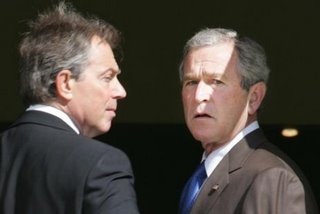
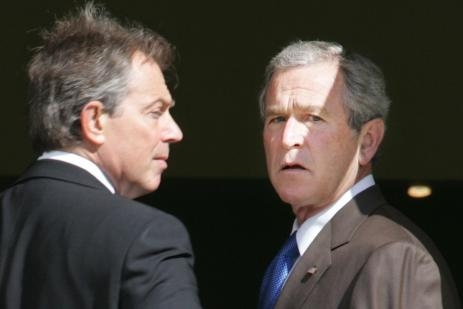
The poodle and his master?Now, in respect of the UK, the understanding is doubly complicated by the perception that Blair serves two masters, the European Union and the United States in the persona of George W. Bush. In fact, in the light of the Iraqi adventure, probably more people see Blair as Bush's "poodle" than as a servant of the European Council.

Here, though, the perception is almost certainly wrong, not least because Blair – apart from the then perceived domestic advantages of joining in the second Gulf War – has continued a traditional foreign office line. This holds that a close association with the US somehow strengthens the UK's influence in the European Union. Although this strategy has spectacularly backfired on this occasion, that is the perversity of the Iraqi adventure.

When it comes to dealing with the current counterinsurgency in Iraq, however, the equation has changed in an important respect. Whatever enthusiasm Blair may have had originally has evaporated. Although he is maintaining troops in southern Iraq, it is clear that this is a token presence which is performing very little useful service in the prosecution of Bush's "war on terror". In effect, Blair is paying lip-service to the US-led coalition, while looking for the first available opportunity to make a dignified exit.

Whatever the words, this is evident from the facts on the ground. The prosecution of the campaign in Iraq requires new types of equipment, different force structures and tactics, all of which require huge expense. The US is making this investment but Blair is simply unwilling to commit anything of what is needed.

This is because such resources as he has available are already committed to the European defence identity and, in particular, to equipping the British component of the European Rapid Reaction Force. And, so different are the equipment, force structures and tactics being devised for the ERRF that they will be useless for dealing with anything else but the nebulous "peacekeeping" tasks for which the force is designated.

The eventual retreat from Iraq by the British, therefore, will also mark a retreat from the US-led coalition and a move more fully into the "intergovernmental" structure of the European Union, where Blair's (or his successor's) foreign and defence policy will be increasingly defined by his colleagues in the European Council "cabinet".

At this point, with or without the EU constitution, the UK will be almost completely absorbed into the political European Union, which will be acting as a "superstate" in all but name. And so entrenched will be the systems and so integrated will be our armed forces and other structures that extraction will be virtually impossible.

Therein lies the point of this post. Although we have referred to Bush's "war on terror", the broader campaign is to achieve the spread of democracy – which is the ultimate aim of the occupation of Iraq. The EU, on the other hand, it committed to a policy of "stability". It is not particularly interested in democracy. It is not a democracy itself, so why should it care?

Thus, we have a choice between "democracy" and "stability", the choice between supporting – and occasionally leading – campaigns and initiatives alongside the United States and its allies, or supporting the foreign policy initiatives of the European Union and its allies. And, as it stands, we are sliding towards the latter, in a contest between two incompatible world visions.

If we are to reverse this, the litmus test is actually Iraq and to a lesser extent Afghanistan. While the cries are for a rushed withdrawal of troops – as soon as can be arranged – the truth is that installing democracy in Iraq is a long-term task which will require a commitment for decades rather than years. As importantly, it requires massive investment and all that goes with it to conduct an effective counter-insurgency campaign, rather than the tokenism in which we are currently engaged.

A scene from the Iraqi electionBy that measure, as I see it, one of the most crucial issues of the day – and the means by which further political integration into the European Union can be avoided – is to pursue a campaign for a more active, effective and longer-term engagement in Iraq, staying there until we have a fully-functioning, liberal democracy. This is not only in the interests of democracy, but in the interests of the United Kingdom itself. Therefore, Iraq, in my view, is not only the crucible of a new democracy, it could also be the salvation of the UK as an independent, democratic nation. On the other hand, a retreat from Iraq is a de facto retreat into "Europe".

So convinced am I of that thesis that I am moving – with my colleague – towards focusing this blog more towards to "high politics" end of the spectrum, with more analytical and discursive posts, and fewer routine news items on EU and general politics. It is that on which readers comments would be welcome.

COMMENT THREAD

Denial is not an option

Karl von WogauLet no one be under the illusion that our recent focus on the headline issue of the deaths of British soldiers arising from inadequate equipment is simply about what my colleague calls "toys".

The central and substantive issues, which are beginning to emerge from our forum discussion, are the very nature of our armed forces, what they should be doing and how they should be structured and equipped – all in the context the pursuit of our national interest.

From this stems the thesis – which we have explored and will continue to explore in future posts – that we are at a decision point, where we must chose between two divergent foreign policy objectives.

On the one hand, there is the prosecution of the "war on terror" in Iraq and elsewhere - the "long war" as Bush puts it - in alliance with the United States and like-minded nations, within or without a Nato operational framework. On the other, there is the development of the capability to act independently from the United States, under the political umbrella of the European Security and Defence Policy (ESDP), again within or without a Nato operational framework, dedicated to a more traditional – if somewhat ill-defined – "peacekeeping" role.

The problem we have in addressing this choice is that the options are rarely stated clearly and, in terms of the European agenda, often denied. Many thus believe there is no choice to be made and we can continue as we are.

We must thank, therefore, the German MEP, Karl von Wogau who has set out the European defence agenda in a remarkably concise form and, this week, presented it to the European Union parliament Subcommittee on Security and Defence – of which he is chairman.

The report, on the implementation of the European Security Strategy in the context of the ESDP represents, effectively, the near-final shape of a European Union defence policy.

Furthermore, its champion, von Wogau, is no ordinary MEP. He is a respected member of the German political establishment, a senior and active member of the EPP – the political group to which the Conservatives still belong – and an arch "federalist" who is at the leading edge of integrationalist thinking. His agenda very much represents the thinking and ambitions of the hard core supporters of European integration.

Insofar as it is possible to sum up the document briefly, its main sections are contained in paragraphs 29 & 30, which are worth reproducing. Intended as an expression of the view of the EU parliament, it:

29. Considers that the EU is in the process of building a Defence and Security Union covering external security as well as various aspects of internal security and natural disaster management with the following elements:

(a) the commitment of the Member States to be able to:

- deploy 60 000 soldiers within 60 days and sustain them for one year for
peacekeeping and peacemaking operations, and to build up 13 battle groups deployable at short notice;
- develop capabilities for civilian crisis management in the areas of police operations, the rule of law, civilian administration and civil protection;

(b) a European structure of command consisting of a Political and Security Committee, a Military Committee, a Military Staff and a Civilian and Military Cell with an Operations Centre;
(c) the European Gendarmerie Force;
(d) the European Defence Agency;
(e) Europol and the European arrest warrant;
(f) common rules for arms procurement and arms exports;
(g) European security research within the framework of the 7th Research Programme;

30. Is of the opinion that the Defence and Security Union should be completed by the inclusion therein of the following elements:

(a) a common system of satellite and airborne intelligence and common telecommunications standards, to be at the disposal of the military, the police and the disaster management services;
(b) the establishment of a common market in the field of defence;
(c) a European budget covering not only the civil but also the military aspects of security;
(d) an EU minister responsible for foreign affairs, assisted by a Deputy in charge of security and defence policy and a Council of Ministers for defence;
(e) a mutual assistance clause;
(f) adequate parliamentary scrutiny by the Parliaments of the Member States and the European Parliament.
That, to all intents and purposes, equips the European Union, in its own name, to act as an autonomous military power, all in the context of threats defined by the European Security Strategy. These include terrorism, the proliferation of weapons of mass destruction, regional conflicts, state failure and organised crime, but also take into account the increasing world-wide competition for sources of energy, as well as natural disasters and the security of the Union's external borders.

To that effect, von Wogau declares that:

…the task of the European Foreign and Security Policy is to protect the citizens of the Union from those threats, defend the justified interests of the Union and promote the objectives of the Charter of the United Nations.
Like it or not, what von Wogau proposes is coming closer to the reality by the day. The European Rapid Reaction Force, the 2010 "Headline Goals", the European Capabilities Action Plan, the planning cell and many of the other components of his "Defence and Security Union" are not theoretical.

For the UK, though, this creates a huge problem. The EU's vision of how to deal with the threats it identifies is so different from the US vision that - in terms of defence structures, resources, equipment and the rest - the two are completely incompatible.

To pursue both would effectively require of the UK to two completely different armed forces, structured and equipped in entirely different ways. The option of maintaining single, all-purpose armed forces, able to pursue both – or able to switch between them – is simply not realistic.

Yet this is precisely what our government is attempting to do and, as we have so many times before remarked, this is Blair's great error. For as long as he fails to recognise the need for the choice to be made, and act accordingly, he will continue to putting the lives of our troops at risk – as we believe is happening in Iraq and could well happen in Afghanistan – while exposing us and our allies to the real possibility of mission failure.

But, with the von Wogau report, at least the issues are out in the open. Now we must respond. Denial is not an option.

COMMENT THREAD

Thursday, June 22, 2006

EU wags a finger

The EU is rather proud of the fact that at its last Council it still refused to give money in aid to the Palestinian Authority because of Hamas’s refusal to recognize Israel’s right to existence or to give up its terrorist attacks (some of which backfire quite literally, as the developing story of the murdered family on the Gaza beach shows).
Instead, the European Council decided to use NGOs for humanitarian purposes. This can be interpreted various ways. On the one hand, assuming the decision is put into effect, this ought to stop people, such as former President Carter (arguably the most unsuccessful incumbent of the twentieth century), complaining that the embargo put on Hamas is keeping money away from schools n’hospitals.

Then again, money seem to be available for arms, ammunition and explosives but that is not something the likes of President Carter want to think about. (We must admit that there has been a little less support for Hamas from the great and the good since they have displayed their civic spirit by fighting their rivals Fatah.)

On the other hand, there is the point that by paying for various social and humanitarian projects in Gaza, the West and the European Union, in particular makes it possible for Hamas to use the money they manage to collect otherwise for … well ….paying their civil servants, which is a large proportion of the population, their various military groups, and, presumably, buying in yet more ammunition to aim at either Israel or Fatah (or their own people, if needs be).

In other words, there is no apparent need for Hamas to develop into a real government that takes responsibility for its people and their welfare in whatever shape or form.

Arab banks have not been lending money to the organization, partly because they do not wish to incur the wrath of the Americans but, more importantly, because they do not trust Hamas either. (I don’t suppose they trust Fatah, given the fiscal record of the late unlamented Chairman Arafat and of his friends and relations.)

Some money has been collected by various Hamas ministers and spokesmen, then smuggled through the border from Egypt. Israel is not happy about it, since it has shrewd suspicion about the use that money will be put to.

Come to think of it, the EU is not happy either, and it is manning the crossing at Rafah. As the Washington Times reports:
“European monitors who have overseen the first Palestinian-controlled border terminal for the past seven months warn of unspecified "consequences" if Hamas officials don't stop smuggling millions of dollars into the territory.

Yesterday, the Gaza Strip's main international gateway was closed after the European monitors said an Israeli security alert prevented them from manning the crossing, officials said.

The Palestinian militant group Hamas said it suspected the Rafah crossing with Egypt was closed to send a message to its government to stop carrying cash by hand into Gaza to sidestep a Western aid embargo. The monitors brushed aside the accusation.”
Well, as they say, you pays your money and you takes your choice. And the money is not incosiderable, though nowhere near what Hamas says it needs to run Gaza and its people, most of whom are employed by the Authority.
“The Islamic militants paid government employees this week for the first time in almost three months after Foreign Minister Mahmoud Zahar carried $20 million across the border. Mr. Zahar's refusal to declare the cash at the Rafah terminal has alarmed Israel and triggered a protest by the European delegation.”
In fact, it was the Egyptian authorities who notified the EU border official about Mr Zahar’s interesting luggage. “But when Mr. Zahar reached the Palestinian side, the foreign minister claimed his diplomatic status granted him immunity from being searched.”
“Mr. Zahar, who later deposited the $20 million in the Palestinian treasury, was defiant. In an interview with a reporter from Israeli Channel 2, he said the Palestinians had a right to smuggle money into Gaza given the international "siege" of the territory.

The EU monitoring spokesman said that the team was concerned by that statement and was awaiting a clarification from Mr. Erekat.

Mr. Erekat said the Palestinian president, who has taken control of the Gaza crossing by deploying his presidential guard, wants to do whatever is necessary to ensure the European monitors remain at the border.”
The Palestinian negotiator Saeb Erekat was named by Palestinian Authority President Mahmoud Abbas to oversee the terminal.

Julio De La Guardia, the spokesman for the EU monitors has pointed out that this is not an isolated incident. “Three weeks ago, Hamas spokesman Sami Abu Zuhri smuggled $807,000 in euros across the border in a money belt.”

The money comes from various Middle Eastern countries, possibly governments, possibly individuals. There is not much the European Union can do except demanding that international standards of transparency be kept to and periodically closing the crossing, producing pictures of miserable looking Palestinians who are stuck at Rafah.

COMMENT THREAD

Barbarossa Day

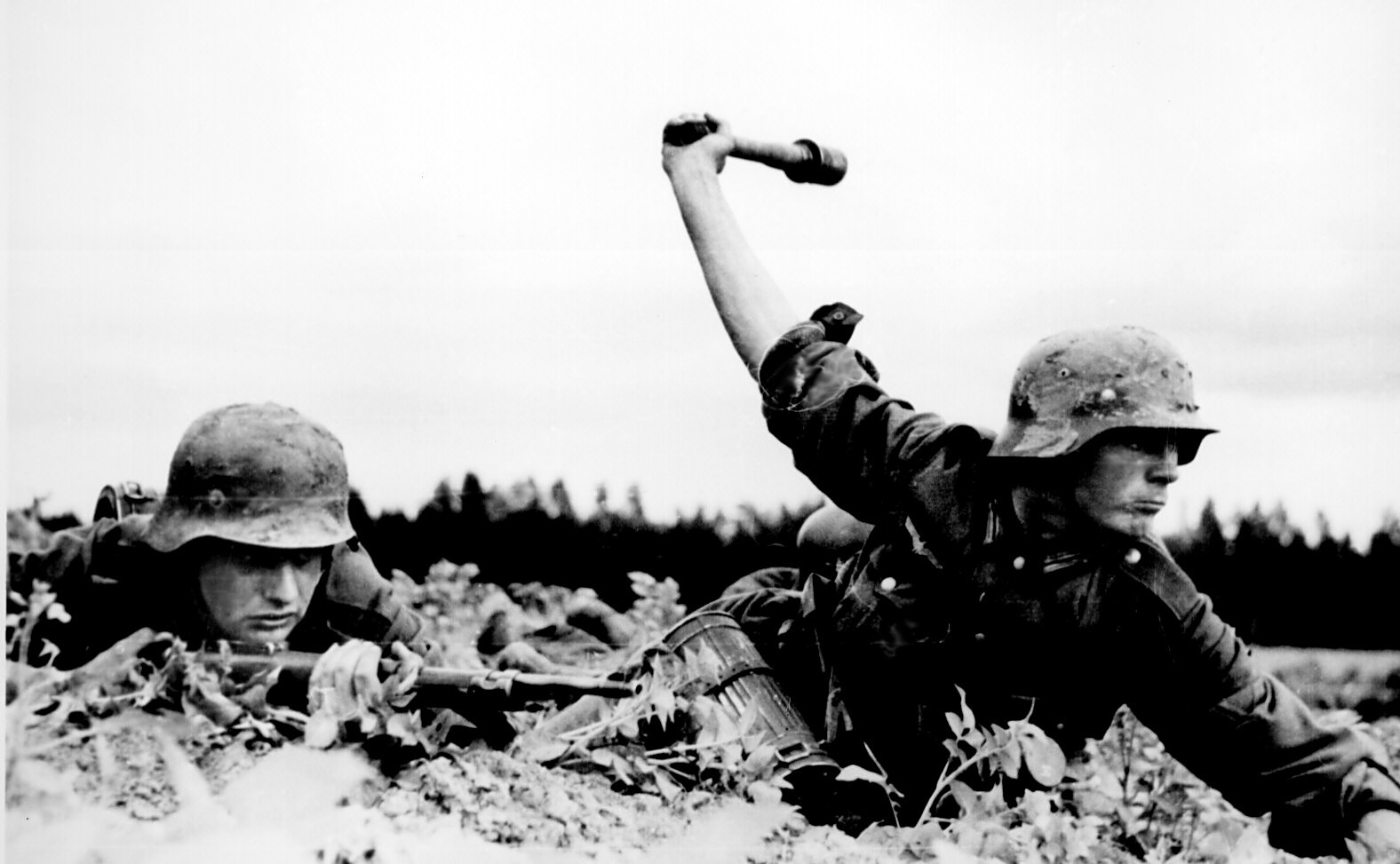
Today is the 65th anniversary of what turned out to be the turning point of the Second World War: the German invasion of the Soviet Union, carried out despite the vows of eternal friendship of the 1939 Molotov – Ribbentrop Pact. It was the start of that monumental battle between the two most monstrous regimes of European history.

Curiously enough, Stalin, who had never trusted anybody in his political career (and probably not before that, either) seems to have trusted Hitler. There are numerous accounts of his refusal to believe the news of the Nazi attack as it was being brought to him. He had, previously, refused to believe warnings sent to him by the British government and his own agents in the West that Hitler was planning an attack and probably in June.

There are various accounts of what happened immediately in the Soviet government and the top echelons of the party but, it seems, that panic set in and there was an immediate decampment from Moscow. Stalin’s greatest fear, shown in his refusal to set up a home guard as the capital itself became endangered during the autumn, was that people might turn against him.

This was not completely wrong. The people of Russia and other states of the Soviet Union are no less patriotic than anyone else but they had suffered considerably more from their own government than others. The propaganda picture of the people of Riga welcoming German invaders does not tell a complete lie. The German troops were welcomed at first in the Baltic states, in Byelorussia (now Belarus), in the Ukraine and even Russia itself.

We have to remember that it is not accurate to say that Germany invaded Russia in June 1941. They did not get to Russia itself for a number of weeks, despite the fact that the troops rolled forward unchecked, the air force had been destroyed and the trains that ought to have been bringing troops to the west were fully occupied carrying prisoners from the newly conquered countries to the east.

When the German troops crossed the border they were crossing from western to eastern Poland, both of which had been devastated by the two separate invaders. They then moved into the Baltic states who had lost around a third of their population into the Soviet gulags, moved on the Byelorussia and the Ukraine, both of which had suffered unspeakably from collectivization and the purges of the late thirties.

The Germans were seen as liberators and their drive to round up and murder the Jewish population was not always unpopular. Though many people, as in other countries, tried to help their Jewish neighbours and friends, many others saw the destruction of the Jewry as a just punishment for the fact that the Communist power, as they thought, had been imposed largely by Jews. Alas, there are too many people in that part of the world who still think that way.

While many in the higher echelons of the German army felt that they should capitalize on these feelings, disband the collective farms and install autonomous local governments, the Nazi ideology prevailed. The Slavs were also described as untermensch and treated accordingly. The horrors of the Nazi occupation of large chunks of the Soviet Union have been described by many.

Stalin’s own reaction was interesting. He first broadcast to the people on July 4. My mother, who was a teenager in Moscow at the time, has told me that his appeal to “brothers and sisters” caused panic. Things were far worse, the Russians reasoned, than anyone had told them if the old tyrant saw them as his brothers and sisters.

This is not the place to describe the subsequent developments of the war on the eastern front but a few aspects might be recalled, as we are often told that the EU is a direct and necessary reaction to the evil nationalism of, well, somebody called the Nazis.

We need to remember Stalin’s refusal to sign the Geneva convention and refusing to see Soviet PoWs as nothing more than traitors. All offers to help them by the Red Cross and the British government were refused. The severe maltreatment by the Germans of the Soviet prisoners cannot be excused but neither can Stalin’s own refusal to help.

We need to remember the lines of Smersh (Smert’ Shpionam – Death to Spies) machine gunners who stood behind the Soviet troops, mowing down those who tried to retreat from the German onslaught.

And we must recall that it was Stalin’s appeal to pure patriotism that made the Russians and many others fight on against all odds and through unimaginable losses until the victory of 1945.

We must also recall the nationalism of many other countries who fought the Nazis and its suppression by the Soviet “liberators”. The story of the doomed Warsaw uprising is just one of several one could recite.

Another 40 years elapsed before the second tyranny was overthrown.

COMMENT THREAD

"Mobility and protection"

For an update on this post, see here.

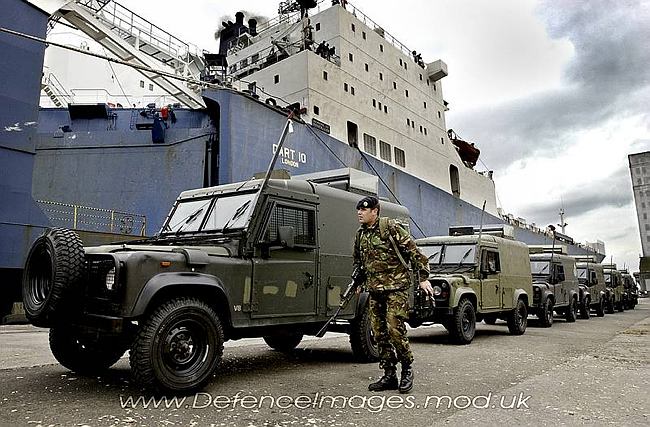
Continuing with our theme of how Blair is killing our soldiers, with this follow up, and this, we have found some remarkable MoD photographs of the despatch from Belfast of the "Snatch" Land Rovers and their arrival in Umm Qasar on October 2003 (double-click to enlarge), with the original MoD captions:

Snatch Land Rovers on the dock in BelfastDateline 11 September 2003: A row of armoured Land Rovers line up in preparation to board a merchant vessel in Belfast Harbour, on the first leg of their journey to Iraq. Bound for Iraq 178 armoured Land Rovers shall be leaving Belfast bound for Iraq. The Land Rovers, all drawn from reserve stock or currently surplus to requirement in Northern Ireland, will give much needed and potentially life-saving protection to army patrols in southern Iraq.

The Land Rovers on arrival in IraqDateline 4 October 2003: 180 armoured Land Rovers arrive at the Iraqi port of Umm Qasar. The wagons were delivered on Dart 10, a chartered roll-on roll-off ship. British peacekeeping troops will use the new batch of armoured Land Rovers alongside the dozens of civilian all-terrain vehicles already in use. Some of the vehicles await collection after being offloaded from the Dart 10 ship.

Snatch Land Rovers on patrol in BasraWith a daub of sand-coloured paint, the vehicles were soon put into use patrolling the streets of Basra and in other British occupied areas in what was to become known as "occupation-lite". But, if the Brits thought they knew counterinsurgency better, this year the light-touch was seen to go badly wrong as violence erupted in the streets and the militias ran riot. But, as lightly-armoured Land Rovers proved to be inadequate for the task, the MoD was not to be moved, hence:
Dateline 12 June 2006: Lord Drayson. My Lords, I do not accept that Snatch Land Rovers are not appropriate for the role. We must recognise the difference between protection and survivability. It is important that we have the trade-offs that we need for mobility. The Snatch Land Rover provides us with the mobility and level of protection that we need.
Yet, having dumped second-hand and distinctly battered "reserve stock" vehicles, and those "currently surplus to requirement in Northern Ireland" into the middle of a shooting war in Iraq, nothing was too much for our gallant lads who were set to joint the European Rapid Reaction Force. For them, the very best in Italian-built chic:
The Iveco Panther Command Liaison VehicleDateline 6 November 2003: Lord Bach. We are pleased to announce that the Ministry of Defence has today signed a contract worth £166 million (including VAT) with Alvis Vickers Ltd, for the manufacture of the Future Command and Liaison Vehicle (FCLV).

The FCLV will perform the command and liaison role and replace the ageing and disparate vehicle fleet within the manoeuvre support brigades comprising elements of the 430 Series, Saxon, Land Rover and Combat Vehicle Reconnaissance (Tracked) fleets. From its planned in-service date of 2006, the FCLV will provide levels of crew protection and mobility commensurate with their roles in an increasingly extended ground manoeuvre area. It will offer protection against small arms, blast and anti-personnel mines.
There we have it – at £413,000 apiece, these are the Rolls-Royce of military SUVs, the very latest in fashion accessories for the image-conscious commander. Meanwhile, the peace-loving Swedes had different ideas:
The Swedish RG32M - called the GaltenDateline 19 May 2005: South Africa's leading armoured and peacekeeping vehicle manufacturer BAE Systems Land Systems OMC has scored another export success with FMV, the Swedish Procurement Agency, confirming a production order for 102 specialist RG-32M patrol vehicles valued at close to ZAR 180 million.
At a mere £152,000 each, the Swedes are well-chuffed to have acquired the latest in mine-protected vehicles for their peacekeeping forces. The picture shows the vehicle being put through its paces by a Swedish motoring journalist, who declared himself "impressed". But such luxuries are not for our troops in Iraq. According to Lord Drayson, "The Snatch Land Rover provides us with the mobility and level of protection that we need."

COMMENT THREAD - JOINT POSTS

Be nice to the French, Gordie

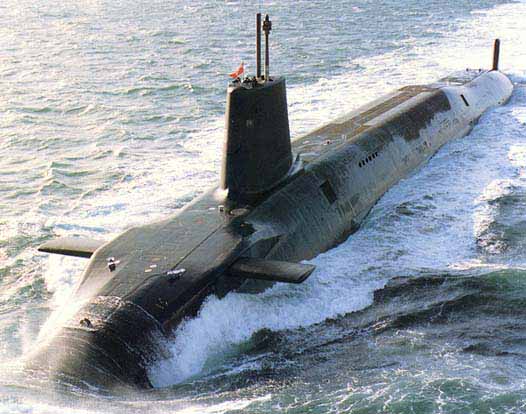
The Vanguard missile submarine - due for replacementYou have to give it to little Gordie. Not even prime minister yet (if ever) and he is already making the "big decisions". And they don't get much bigger than deciding to renew Britain's "independent" nuclear deterrent.

That certainly has got the BBC nicely worked up, and the Guardian too, not least because the estimates of the cost vary from £10bn to £25bn, depending on what type of new missiles or submarines are chosen.

In fact, generally, Mr Brown was very robust about his future defence policy in his Mansion House speech last night, declaring that he would be, “Strong in defence in fighting terrorism, upholding Nato, supporting our armed forces at home and abroad, and retaining our independent nuclear deterrent." For all the world he sounded just like Liam Fox, complete with exactly the same commitment to Nato – thus, ostensibly kicking European defence integration into touch.

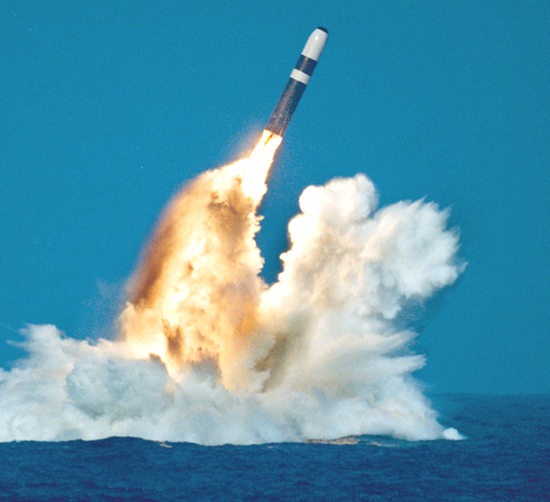
British warheads for the missiles - but French explosivesBut, Brown's declaration will also renew the argument about whether the deterrent is truly independent, not least because the missiles will be made by the US – probably Lockheed Missiles and Systems - and we will be beholden to the US for the supply and then the ongoing maintenance.

As before though, we will be making the warheads – which gives us the notional indpendence, except for one very important difference. As we recorded in November last year, the last remaining military explosives factory in the UK is being closed down, and the production transferred to France.

Included in that transfer is the vital and very special technology for making the conventional explosives which are required to trigger a nuclear bomb, without which we will have no deterrent at all.

If Mr Brown wants his "independent" nuclear deterrent, therefore, he had better not be too robust about his support for Nato. Au contraire, he will need to be very, very nice to the French - or he won't get his bombs. I wonder if anyone has bothered to tell him this?

COMMENT THREAD

Wednesday, June 21, 2006

But we are not like those nasty Americans

It is difficult to follow events in Comoros and there is no particular surprise that the Times labels its time chart as: Comoros chaos. The tiny country has been independent for 30 years and during that time it has had 19 coups or attempted coups (though it is frequently hard to know the difference).

Gilbert Bourgeaud, aka Colonel Bob DenardColonel Bob Denard, a French mercenary whose real name is Gilbert Bourgeaud, who gained a fearsome reputation in the sixties and seventies in Belgian Congo, North Yemen, Biafra and Angola, was involved in four of the most significant ones. (Give the man his due: nothing if not persistent.)

Colonel Denard is now 77 and has Alzheimer’s. He and 26 other mercenaries were on trial in France for their role in the coup of 1995 (there was at least one other since then, possibly more).

According to the Times:
“Denard led 30 mercenaries who landed on the Indian Ocean islands in rubber dinghies on September 27, 1995, and captured M Djohar in his palace.

A week later M Chirac sent a 600-man force that put down the putsch but did not restore M Djohar to power.”
Indeed not, as it seems M Chirac was well aware of the coup that was going to happen and, according to the court’s ruling:
““It is clear that the French secret services knew of the plan for a coup d’état conceived by Robert Denard, both its preparation and execution,” the court said.

“It is also evident that at the very least they did nothing to hinder it and that they therefore allowed it to reach its conclusion. As a consequence, that means political leaders must also have wanted it.””
The plotters were given suspended sentences because of the decision that they were acting, if not under the orders, at least with the full cognizance of some parts of the French government. It is unlikely that l’escroc Chirac will ever be tried for his part in this or any other coup in Africa.

Many discussions go on about the best way of helping Africa and its unfortunate population. As our readers know, this blog believes that the handing out of aid to corrupt and bloodthirsty kleptocracies, as advocated by numerous NGOs and rock stars, is not only not the solution; it is actually a very big part of the problem.

There is another part of the problem and the solution to that seems as far away as ever: it is the activity of the French government and security services. Until they are somehow neutralized, many parts of Africa will remain subject to continuous violent upheavals.

COMMENT THREAD

Another "surprise" from the Court of Auditors

The Court of Auditors in Luxembourg

Another month another report from the Court of Auditors, this time about the EU funds going to the members of the next wave of probable EU enlargement: Romania and Bulgaria.

Our readers will recall that the Commission hummed and haed about those two countries and decided that their legal, fiscal and political structures were not precisely of the transparency and honesty that the EU allegedly requires.

We have no idea what the Romanian and Bulgarian governments think about transparency and honesty in the legal, fiscal and political structures of the EU but we do know what the Court of Auditors thinks about transparency and honesty in the projects funded by the PHARE Programme.

As EUObserver sums up:

“Phare funds are channelled by the European Commission to candidate states in order to prepare their administrations for accession, as well as to boost economic competitiveness.But a large part of the cash ends up in a black hole, the court found in an audit, which covers projects initiated from 2000-2004, involving €511 million of Phare cash for Bulgaria and €1.4 billion for Romania.

"At the time of the audit for over half of the investment projects audited the assets were not, or were only partially, being used for the intended purpose," said Mr Engwirda."Outputs and results lagged considerably behind schedule, sometimes by up to two years," he added.

The court said in a statement that it "criticises" the commission for its "overall management of investment projects."”

I wouldn’t call lagging behind schedule in various projects by up to two years particularly unusual or catastrophic. Have these people not heard of Wembley Stadium?

Do they not know that most projects in Communist and post-Communist countries, if funded and supervised by the state in any shape or form, tend to lag by considerably more than that?

There are some entertaining details, also quoted by EUObserver. Some of them, to do with the jeeps favoured by the Bulgarian border patrol will particularly interest my colleague:

“The report lists a number of non-functioning, half-finished and in some cases apparently useless investments, with Mr Engwirda himself highlighting a €3.1 million bridge linking Romania and Moldova completed in December 2004 with no access road on the Moldovan side.

The Moldovan road has meanwhile been finalised, commission officials noted.

The Bulgarian public prosecutor's office was granted a €1.8 million computer system, but 37 work stations were not used but put in a store room instead, while Bulgarian border police are seemingly not very keen to use EU-funded four wheel-drive jeeps."

The usual fleet of the [border police] is a Russian-built car, costing one third of the price of the car delivered under Phare and with cheaper spare parts," said the report.

A Romanian tourism development area was found to contain "an eyesore, an empty, degraded Olympic-size swimming pool," while a newly-built asylum centre was reported to have an occupancy rate of 7.6 percent.”

Of course, one could argue that the objectives of the PHARE Programme as somewhat skewed but that is not the purpose of the Report:

“15. The overall objective of the Phare programme is to help candidate countries prepare for EU-membership. This involves investments with the aim of strengthening:

(a) the regulatory infrastructure needed to ensure compliance with the acquis communautaire

(b) Economic and Social Cohesion (ESC) through measures similar to those supported in Member States through the Structural Funds, including addressing the effects of restructuring in important sectors of the economy.”

If we were really concerned with the welfare of those two countries (for selfish if no other reasons) we might start by asking ourselves whether “preparing” them for the entirely inappropriate and burdensome acquis communautaire is quite the right way of going about matters. But we are not concerned with anything as silly as that. We are convinced that there is only one way forward for the post-Communist countries in Europe and that is membership of the European Union.

Having decided thus and having allocated quite large amounts of money for the promotion of our ideas, we are faced with our old friend, unaccountability. Neither at the EU nor at the national end is there any kind of supervision of funds. Needless to say, the discipline of the market does not apply.

Every now and then the Court of Auditors produces a report, which, if not precisely ignored, is not taken seriously enough to be acted on.

The Commission does reply each time but each time somebody else is at fault.

“IV. Some of the investment projects audited were indeed not in place or operational at the date of the auditors’ missions. The principal causes of the delays and shortcomings in the implementation and completion of the respective projects were indeed the lack of the necessary administrative capacity of the national authorities on the one hand and on the other hand the delay in making available the required co-financing and other national resources.

However, efforts have been made in order to develop the level of the administrative capacity to ensure effective implementation and completion of the investment projects, within the time limits set in the programming documents.

Equally, continued efforts are being made in order to raise the awareness of all actors involved (national authorities, local authorities) that at the time of programming, further funds and human resources must be earmarked and made available to ensure the proper management and sustainability of the investment projects, after they are completed and put into operation.”

But not fiscal discipline or accountability for the money spent. Other problems are acknowledged but they have all been dealt with according to the Commission response.

“VII.
First indent - The implementation of Phare programmes has been affected by the weakness in the administrative capacity of Romania and Bulgaria in many areas, generating delays in the implementation of some projects. Nonetheless, the Commission would like to stress that since the programming year 2000, the administrative capacity of the Bulgarian and Romanian authorities has improved, although not to the extent desired, and in the framework of the multi-annual programme 2004-2006, specific attention has been given to this issue. In addition, a comprehensive overview of the Phare staff dedicated to the projects by Implementing Agencies has been required and presented to the Joint Monitoring Committees in 2005 and taken into account in the programme 2005. In 2006, a specific statement on administrative capacity has been required with each project fiche.

Second indent - Rules and practices regarding co-financing for Phare have been enhanced in the last years. Parallel co-financing has been discouraged in favour of joint co-financing and the reporting requirements for co-financing have been significantly improved as well.

Third indent - The catalytic effect of Phare money in activities led by international financial institutions has been assessed as far as possible. This also helps to avoid overlap with existing projects financed from sources other than Phare.”

Until the next report.

COMMENT THREAD

Canaries down the mine

For an update on this post, see here.

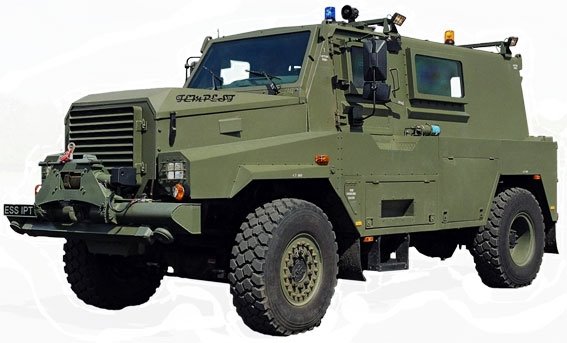
The British version of the Cougar - aka 'Tempest'According to the Rt Hon Adam Ingram MP, minister of state for defence, "we take all measures possible to ensure the safety and security of our troops deployed in Iraq". This is in response to an MP who had passed on a constituent's letter (a former serving soldier) expressing concern about "the safety of so-called armoured Land Rovers".

On the face of it, Ingram's statement is an out-and-out lie, except that in the weasel words that flow so easily from the civil service, to be signed off by their ministers, there is an important qualifier, in the use of the word "possible".

To the ordinary person, that word might encompass every measure known to man, certainly anything technically feasible, but in the dark halls of Whitehall, it would also include the issue of "affordability". Straight out of "Yes Minister", you can almost hear their honeyed words: "There is nothing allocated in the budget, Minister, so acquiring enhanced protection for our troops is not possible".

From there it is an easy step to write to the public, grieving relatives, worried parents, MPs and the rest, telling them: "…we take all measures possible". In strict terms, it is not a lie – but then it is not the truth either.

However, as we research this issue more deeply, inevitably the labyrinthine complexity emerges and what seems at first sight a straightforward black-and-white question of providing better armoured vehicles for our troops merges into complicated arguments about tactics, procedures, training and capabilities.

It is in this grey area that ministers are able to operate, obfuscating the issues and confusing readers of their letters, in which manner does Ingram soothingly declare, "mitigation measures are not just about equipment – all our forces undergo a comprehensive package of pre-deployment training to ensure that they are as prepared as possible for the specific operational environment they will encounter".

The sub-text, of course, is that it is not just about spending more money. In fact, implies the minister, our superb training, etc., etc., will prevail. Carefully does he avoid telling us, however, how any amount of training will protect a soldier in a lightly armoured vehicle from the blast of a concealed IED, triggered by an unseen operator.

It is here, therefore, that we pick up on the emerging story, broached in our two previous posts, here and here, which – on the basis of what we have so far found out - seem to show up the British at their very best and their very, very worst.

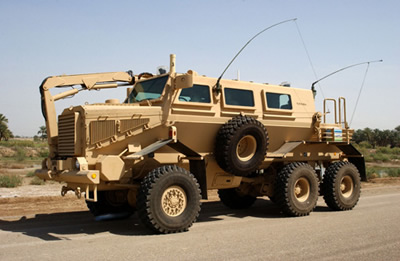
The Buffalo mine clearing vehicleBy way of background, we need to explore what is currently happening in the US-occupied areas of Iraq, where the scourge of the IED accounts for a full 68 percent of the battle casualties. To counter this threat, the Americans have been, since 2004 and now in increasing numbers, deploying new equipment, the Buffalo mine clearance vehicle (right) and the Cougar HEV/JERRV series (below left), together with the RG-31 series.

Bear with me briefly on the technicalities, but the basic strategy is, acting as a team, these vehicles are sent out onto the roads of Iraq to hunt out mines and IEDs and to destroy them. Then, as a final stage before the any particular road is cleared to allow ordinary patrols down them, the Cougar travels down it in a process known as "route proving" – on the basis that, if there is anything there, the mine protected vehicle will take the hit and the crew will survive.

Now, the thing is that this technique seems to have been pioneered not by the Americans but by the British in Bosnia, as early as 1999-2000. This is why the Mambas were purchased. But, even more intriguingly, it was there that the greater threat of the "penetrator mines" emerged, which led the development of British-funded counter-measures and the order of eight Cougar mine protected vehicles, in what is known as the Tempest project.

This, incidentally was in December 2001, in what appears to be the very first order for such vehicles, more than three years before the US forces placed their orders. Furthermore, the vehicles were upgraded to protect against the new mine threat. In other words, in a pioneering piece of research and development, we emerged with world-beating techniques and equipment, years before our more technically advanced cousins.

However, while the Americans have so far bought 122 Cougars - and have over a thousand more on order - we bought eight. I do not know yet whether they were deployed in Bosnia, but they do appear to have been sent to the Gulf, although I can find absolutely no reports of their having been used. According to one report, however, the vehicles are back in the UK being refurbished, prior to their despatch to Afghanistan where, it is claimed, the mine hazard is greater.

At a point, therefore, when the IED threat in the British occupied sector of Iraq is probably at its highest, the life-saving equipment pioneered by the British has been withdrawn, while the Americans are introducing it en masse, adopting precisely the tactics which our own Royal Engineers developed. You really could not make this up.

A Land Rover patrol in BasraIn the meantime, I have been sent an extract from the Regimental Journal of the King's Royal Hussars, which gives a graphic account of their recent deployment to Iraq. From this emerges that the current tactics adopted – unwittingly – are brutal and primitive. Quite simply, the troops are told to patrol their areas in lightly armoured Land Rovers until one or more of them are blown up. Then the Land Rovers are withdrawn and replaced by Warriors and Challenger tanks, until it is deemed safe to resume patrolling in Land Rovers again.

In effect – although they do so uncomplainingly – our soldiers are being used a "canaries down the mine" in a tactic redolent of the Red Army, in which punishment battalions were sent into minefields to clear the way for the assault troops.

Challengers and Warriors on patrol in Al-AmarahFrom a more strategic point of view, this means that the Army can no longer function effectively. While Warriors and Challengers do provide additional protection, as the King's Royal Hussars report testified, their use "caused a major change in the way the Squadron operated, limiting the distances we could cover and the routes we could use." At one point, movement in "Snatch" Land Rovers was "deemed too dangerous" in Al-Amarah and helicopters had to be used to lift fully crewed Land Rovers out to the Iranian border where the Squadron was responsible for conducting patrols.

Returning, therefore, to Mr Ingram's claim that "we take all measures possible to ensure the safety and security of our troops deployed in Iraq", clearly this is not the case. The equipment and techniques do exist and, since the US forces introduced them, their casualty rate from IEDs has halved.

The problem is that Mr Ingram does not have the money. The government is happy to commit £14 billion to the FRES programme, and billions more on other equipment to provide our component of the European Rapid Reaction Force but that leaves nothing extra for the forces in Iraq. To spend a few million on new kit for them is simply not "possible".

COMMENT THREAD

On wings and a prayer

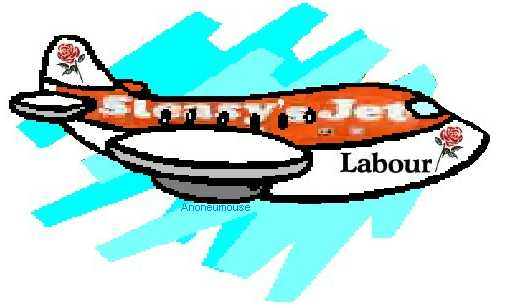
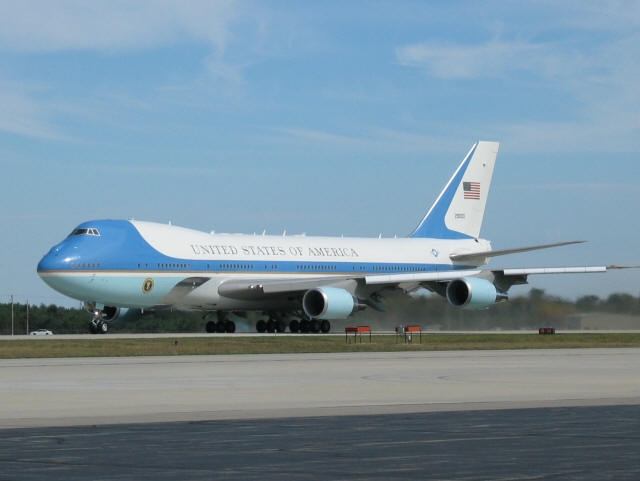
On hearing the news that the prime minister had decided to invest our money in a private fleet of jets for his personal use, I had half expected them to be Airbusses from Enron Airliners – in a gesture of solidarity with the "colleagues".

According to The Times, though, the bigger of the two – to be used for long-haul flights – in what our own Anoneumouse has dubbed "Sleazy Jet" airlines – will be a modified Boeing 737. That never struck me as a long-haul machine, but what do I know?

Anyhow, at over £12 million a year, this is a serious PR gaff, which will no doubt rebound on the prime minister. But - whether intentionally or not – it is also going seriously to dischuff the "colleagues". Tact it ain't – when the Enron Airliner situation seems to be spiralling out of control.

According to the Australian press, Blair might have been able to get a better deal if he had bought "European" as buyers seem to be bailing out of Airbus faster than the Wehrmacht over Crete.

Los Angeles-based International Lease Finance, the world's biggest aircraft leasing company, is threatening to pull its order for 10 of the A380s, worth $3 billion, while Qantas, which has ordered 12 of the "superjumbos" has despatched senior executive John Borghetti to investigate the delay. He is keeping his company's options open.

With Singapore Airlines threatening to sue for damages and ordering $US4.52 billion worth of aircraft from rival Boeing in preference to the A350, things could not look less rosy and a little help from Blair would, no doubt have been appreciated.

Hilariously, the airline builder's problems are even spilling over into the French Assembly, where prime minister Dominique de Villepin sparked uproar yesterday when he accused the Socialist leader of cowardice in a debate over the crisis.

Eat your heart out Froggies - this one flies!Socialist party members stormed out and the session had to be suspended, to the strains of Socialist grandee, Henri Emmanuelli, shouting, "He's mad". Apparently, parliamentary stewards had to stand guard around de Villepin as Socialist politicians advanced towards him chanting "resign."

Meanwhile, Bush has arrived in Vienna for a summit with European Union leaders, who seem to be spoiling for a fight over Guantanamo prison camp, Iran, the Iraqi war, trade relations and anything else they can think of. At least, though, Bush has the one consolation. When he sets out to go back home, there will be a pristine Jumbo jet out on the tarmac, a Boeing 747, that can actually fly.

I hope he has the sense to wait until the door of Air Force One has closed before he puts two fingers up to the "colleagues".

COMMENT THREAD

Tuesday, June 20, 2006

Defence – where the debate should lie

How Tory Diary sees itIt is just the way it stacks up. Liam Fox, the shadow secretary of state for defence gave a speech on the "Europeanisation of Defence" at the Centre for Policy Studies last night and, although it unbalances the blog somewhat – with rather a heavy concentration on defence issues recently – this is something which we cannot ignore.

The Tory Boy Blog got to it first with its own commentary and the view seems to be that it was "a thoughtful and well-balanced speech". For my own part, I have to disagree with the blog author. Much as I would very much like to see a coherent defence policy from the Conservatives, I found Fox's speech horribly superficial, demonstrating an almost complete lack of understanding of the core issues and strategic developments. As a result, it lacked clear (or any) substantive conclusions or direction.

The man starts well enough, pointing out that there are three distinct problems we must consider in relation to European defence co-operation: defence expenditure, foreign policy and democratic accountability.

The first, inevitably, is a given – in that our defence capabilities and therefore policy in general are inevitably determined by what we are prepared to pay, or are capable of paying. As to foreign policy, Fox rightly says, "Defence policy follows foreign policy...". From thereon, however, it is all downhill.

The problem is that Fox does not even begin to define our foreign policy interests, where they have a defence interface, which is probably why he ends up with a curiously flat speech, so lacking in substance.

Arguably, in the context of limited funding, the central issue is that we are pursuing two fundamentally incompatible defence strategies in pursuit of two entirely different foreign policy objectives. The first is supporting the US in Iraq and Afghanistan, prosecuting the "war on terror". The second is the building up an air-portable expeditionary force, primarily to fulfil our commitment to the EU's European Rapid Reaction Force – although this force is "double hatted" and can be used for Nato tasks or with ad hoc multinational alliances.

Failing to make that distinction, Fox blathered on about the European Defence Agency, Nato co-operation and sundry other matters, but what he really did not address was that the shoe is already pinching badly. The problem is that force structures, equipment and tactics required for each of our two objectives are fundamentally different. Given our current defence budget – which Fox shows no inclination to increase – we simply cannot do both simultaneously and well.

This is coming over with increasing clarity from the situation in Iraq. As the experience of Viet Nam adequately demonstrates, once the flow of body bags reaches a certain level, deployment of troops on extended foreign campaigns becomes politically unsustainable, even if the military objectives are achievable. Thus, the political need is for a heavy investment in force protection, to keep down casualties to a tolerable level.

Not only did Fox fail to address that issue, he failed also to acknowledge that the bulk of our procurement funds are already being devoted to fulfilling our commitment to the European/Nato Rapid Reaction Force, which means that the finance is not available properly to equip our forces in existing theatres.

Thus, his central argument that "Nato remains the cornerstone of our defence" is actually irrelevant or, at least, downstream. Both the EU and Nato are competing over the same strategic vision – air-mobile expeditionary forces, able to respond at short notice to crises but equipped only for short-term deployment.

Fox, it seems, want to argue that the force should be dedicated to Nato rather than the EU, but the current demand is for forces equipped and structured for the counter-insurgency role. In layman's terms, I suppose the difference is that, in expeditionary warfare, we move in to beat up the natives while, in counter-insurgency, we stay still and they beat us up. In the latter, the emphasis needs to be on heavy armour for force protection, with forces engaged in long-term action which might extend to decades. In this, the question of EU or Nato does not really arise. The more urgent question is whether we go for "counter-insurgency" or an "expeditionary force". Only if we chose the latter does the EU-Nato issue really become central.

As it stands, in trying to satisfy all demands – which is what Blair is attempting to do - we potentially end up with a dangerously inadequate expeditionary force – whether it is tasked to the EU's ERRF or to Nato - while our forces in Iraq and Afghanistan are undermanned and ill-equipped, because we are devoting so much funding to building up the rapid reaction capability.

We are at risk, therefore, of performing all tasks badly and, in the context of our unwillingness to increase defence spending, the crucial issue must be where we put our resource. That is where the debate should lie, and one which Fox completely ignored (or missed). And, despite the indifference and the ignorance of the media, it is a debate which must eventually dominate.

COMMENT THREAD