Friday, March 24, 2006

The EU remains strangely silent

Abdul RahmanThe EU and its various bodies, such as the Toy Parliament, are fond of expressing their views on all subjects around the world. Well, here is one for them: the fate of Abdul Rahman, an Afghan Christian, who is being tried for apostasy in Afghanistan and for whose blood (quite literally) the clerics are baying.

Afghan President Hamid Karzai has expressed the desire that constitutional legality will prevail. Unfortunately as with all constitutional legalities, it depends on what you mean.

On the one hand, the Afghan constitution guarantees freedom of religion; on the other hand it does not allow for anything that breaks the essential tenets of Islam. Unfortunately, the essential tenets of Islam includes death to all apostates. So, Karzai is stuck.

Equally stuck are President Bush and Secretary of State Rice, both of whom expressed shock and horror at the idea of a man being put to death for being a Christian and a hope that the Afghan courts would not behave that way. They and John Howard of Australia have said that people of all faiths have fought and died to make the country free, which should not abuse that freedom to restore injustice and moral slavery.

That’s fine and dandy but having given Afghanistan freedom the West cannot be seen to be interfering overtly in its judicial affairs. Should President Bush order the Afghani courts to release Abdul Rahman we shall hear a great deal about evil American imperialism from people who have remained strangely silent about the man who is on trial.

For instance, though Ruth Gledhill mentions that the Bishop of Rochester expressed what can only be described as mild indignation to her, I cannot recall the Archbishop of Canterbury, the man who thought that Guantánamo was the most relevant topic in Sudan and who voted for Church of England disinvestment from a firm that deals with Israel, saying a single word about the fate of a fellow Christian. (Then again, I do not recall him saying anything about the persecution of Palestinian Christians by Hamas and Fatah as well as other local groupings.)

What of the Christian Peace Campaigners, that organization so full of Christian feelings of gratitude towards the men who had risked their lives to rescue their moonbat members from rather unpleasant criminal gangs in Iraq? Abdul Rahman, who had wanted to live in peace and practise his religion? Nothing, rien, nada.

Above all, where is the European Union? Apart from the United States, three countries, according to CNSNews.com, Canada, Italy and Germany have voiced concern. (This does not allow for John Howard’s statement but, perhaps, there had been no official Australian reaction.)

And the EU? Has Javier Solana made any comments? Has the benighted European Parliament passed any resolutions? Not that I know of. The Italian Foreign Ministry, having chastised the Afghan ambassador is threatening to take the matter further:
“If this news is confirmed, Italy will move at the highest level, referring the issue to the E.U. in Brussels, to prevent a development that would be incompatible with the defense of human rights and fundamental freedoms.”
That should make those cleric shiver with fright.

COMMENT THREAD

Beyond parody

The EU base camp - 'somewhere in Antarctica'While the "colleagues" disport themselves in Brussels, with the added entertainment of L'escroc walking out in a hissy fit at the sound of English, the great empire is seeking to make its presence felt in deepest, darkest Africa.

This is the "EU military mission" to the Congo, which started out with a proposal for 2000 troops, got whittled down to about 1200 and now, according to Reuters has emerged as a "battalion-size force", i.e., around 800 troops.

Not that the EU has actually approved the troop movement yet – the Council has simply approved the "concept" of EU troops supporting the UN Mission during the presidential and legislative elections process this year. Furthermore, if the troops are ever despatched, they will not actually be sent to the Congo – goodness me, no! The EU is planning to make the troops available as an "on-call" unit. The battalion would be "over the horizon outside the country".

Through our diligent and extensive researches, we have managed to track down a photograph of the EU base camp, somewhere in Antarctica where, according to the Council statement, "it will have a major impact for peace and development in the region of the Great Lakes and Africa as a whole."

COMMENT THREAD

A message from Dr Imran Waheed

Dr Imran WaheedWe have received the following e-mail from Dr Imran Waheed, representative of the Hizb ut-Tahrir Britain Organisation. He writes:

Dear Ms. Szamuely,

Your article concerning
Shabina Begum alleges that she, her brother and her cousin are members of our organisation. This is untrue and there is no evidence to substantiate this. Even the law lords in their verdict do not suggest that she or any members of her family are members of our organisation. They are not, and have never been, members of our organisation.

In addition, you allege that our organisation is linked to Al-Qaeda in some shape or form. This is an outlandish allegation that again has no evidence to substantiate it. Hizb ut-Tahrir rejects violence as a methodology for change, as is clearly pointed out in our publications and press statements. Even those, who have studied the party in depth do not make such outrageous allegations.

After seeking legal advice, we ask that these allegations are removed immediately from your website. We also ask that you correct the above mistakes. Other sites that had carried your article have already removed the article, once this matter was brought to their attention.

If you are not prepared to remove the aforesaid article, we would be grateful if you could provide us with a postal address at which we can serve documents in relation to the publication of these allegations.

This correspondence will be placed before a judge in any forthcoming legal action that we decide to take against you, the owners of the website and its host.

Yours sincerely,

Dr Imran Waheed

Hizb ut-Tahrir Britain
Suite 301, 28 Old Brompton Rd, London, SW7 3SS
press@hizb.org.uk

www.hizb.org.uk/pressnew

+44(0)7074-192400
We wonder if Dr Waheed has read this and this, as well as this little gem, this one and, of course, this, this and this.

We, on the other hand, have read this. The post stands.

COMMENT THREAD

Thursday, March 23, 2006

Important dates

Patrick Henry delivering his famous speech to the Virginia Provincial ConventionMany things happened on March 23 over the centuries but two of them seem of particular note:

In 1775 Patrick Henry made his famous speech to the Virginia Provincial Convention calling on it to join the movement for independence from British rule. It can be argued that the American War of Independence was the second Civil War as Briton fought Briton for various principles in North America.

Patrick Henry was successful. The Virginia Provincial Convention voted for his proposal and one sentence from his speech has gone into every dictionary of quotations:
“Give me liberty, or give me death!”
Fast-forwarding to the twentieth century, on March 23 in 1983 President Reagan first proposed developing technology to intercept enemy missiles --- a proposal that came to be known as the Strategic Defense Initiative, as well as "Star Wars".

Instead of death, that brought liberty to millions of people who had been living under Communism.

COMMENT THREAD

What fun!

Sivio BerlusconiToday's the day, but not for teddy bears – unless you count Berlusconi. From the twenty-five corners of the vast Brussels empire, heads of state and governments are winging their way to the Capital, all under the gallant leadership of Herr Schuessel, chancellor of a country which once laid claim to a vast empire of its own.

Speaking of Berlusconi, Reuters tells us that the man has his own agenda – shock! Embroiled in an increasingly bitter general election battle with Romano Prodi, former presidente of the Brussels empire, he is hoping to use the occasion to revitalise his flagging prospects of regaining power.

Trailing in the opinion polls, Berlusconi, it seems, may well decide he has nothing to lose in Brussels and try to settle old scores, particularly with the French who have repeatedly crossed him. "I think it is almost certain that he will use the summit to launch an attack against French protectionism and reaffirm his liberal values," says Gianni Bonvicini, director of the Italian Institute of International Affairs. "He is clearly using every occasion available to him to send very strong messages to his electorate."

Meanwhile, according to that trusted and dispassionate source, The Guardian, Tony Blair's “intellectual guru”, the noble Lord Anthony Giddens - former director of the London School of Economics - has firmly put the boot into the whole sheebang, declaring that France, Germany and Italy are facing an economic crisis with worrying levels of unemployment, unless they reform.

This is supposed to be "a rare insight into the prime minister's private thoughts", although we are not told whether the rarity arises from the paucity of thought, or simply from the novelty of having them expressed.

This notwithstanding, Giddens runinates on whether there is "enough shock" in France and Germany and Italy to produce changes. "There manifestly is a kind of crisis in France, Germany and Italy," he says, to absolutely no one’s surprise.

Whether that sense of crisis will pervade the halls of the Justus Lipsus, however, is anyone's guess. Not least as Britain is playing the field, holding off from backing Berlusconi, on the basis that he might be out of office in a few weeks. Then, once again, Blair will be dealing with our Romano, this time ensconced as Italian prime minister.

Giddens is telling the Guardian that the Blairites regard Berlusconi as a failure. "Italy's got virtually zero growth rate," he says. It, as well as France and Germany should follow the example of Britain, the Netherlands and Scandinavian countries”.

Peter Mandelson, however, seems less than optimistic that this will happen. "Sometimes you listen to people and wonder if they just imagine that if they bring a comfort blanket over their heads far enough and firmly enough, all that is happening in the world will pass them by and they can re-emerge and carry on business as usual as if nothing has changed," he says.

And no, he was not talking about Tony Blair.

COMMENT THREAD

When is a rescue not a rescue?

The three hostages

When British, American and other coalition soldiers risk their lives to save one British and three Canadian peace campaigners from terrorists who had kidnapped them. Then it becomes “release”. Or so it seems from the various comments on the BBC Website.

The Kember family, for instance, released the following statement:

“We are very pleased that Norman and his friends are safe.

We are grateful for all the support we have had from so many people since Norman was taken hostage.

We also thank everyone who has worked so hard for him to be set free.”

Well, how nice. Who worked so hard? And who actually set him free? Common decency requires gratitude to the soldiers who had gone in there not knowing whether they would come out alive and unharmed. But common decency seems to be in short supply among Christian peace campaigners.

Presumably, by all those who “worked so hard for him to be set free” they mean people like Moazam Begg, former Guantánamo detainee who had, one assumes, been taking a walking holiday in Afghanistan, carrying arms and ammunition when those perfidious Americans picked him up. He, too, is quoted by our own BBC:

“I am extremely pleased. I am very, very happy and hope to meet him soon after he gets back here.

I am a little concerned about the military operation and hope that nobody was hurt during that. It is the best news to come out of Iraq in a long time.

I just know the experience of being kept away from your home for such a long time. He needs time to recover and I hope that everybody gives him that.”

Gosh, how caring.

In fact, in the long list of people quoted by the Beeb, only the Prime Minister’s spokesman used the word “rescue”. Even that statement was mealy-mouthed but better than the Foreign Secretary’s who appeared to think that all these people had somehow been freed in some unexplained fashion.

Michelle Malkin (who else?) prints some letters of outraged Christians to the Christian Peacemakers Teams, who are rejoicing on their website at the “release” of their friends and comrades.

I can’t resist quoting from one letter:

“Congratulations on the safe return of your activists. I'm sorry they did not all make it home safely. I read your press release relating the "release" of the activists; please note that they were not released, they were rescued. The term release implies that their captors let them go. You know that is not true, they were rescued by a team of American and British soldiers who risked their lives to free people whom apparently have no gratitude for their actions. It is one thing to be against war and the actions of our military (I'm not justifying that position, just acknowledging your right to it), but another to deny when they SAVED YOUR ASS!!!!”

Couldn’t have put it better myself. (Well, I could, actually, by using the correct nominative case instead of the accusative in the third sentence.)

I am overcome by a strange and, no doubt, unworthy wish that the soldiers had left this bunch of ungrateful brats where they were.

COMMENT THREAD

Britain deserves better

Dr Liam FoxOne can sympathise with Liam Fox, shadow secretary of state for defence. Speaking to the think-tank First Defence on Tuesday night in what was billed a keynote speech on defence overstretch, he complained that keeping defence issues in the forefront has not been an easy task in a political environment increasingly obsessed with personality and trivia.

He could have been making a prediction as the only newspaper to cover his speech in any depth at all was The Scotsman.

Even the threat of global terrorism does not seem to have shaken some out of their complacency about our future security, he adds, declaring that it was essential "that we keep defence and security issues up the political agenda". That, he said, "is my task in the coming months".

He illustrated the nature of the problem "with a few facts and a quote". For the facts, this year we will spend only 2.2 percent of our GDP on defence. This is the smallest proportion of our national wealth that we have spent on defending our country since 1930.

By the time we finish the new Wembley Stadium, we will be able to seat the ranks of the whole of the British army inside it. The Royal Navy will be smaller than the French navy. And the RAF Museum at Hendon will have more attack aircraft than the RAF does now.

Then the quote:

A strong defence capability is an essential part of Britain’s foreign policy … By 1999 defence spending will have fallen to 2.6 percent of GDP … The people who have had to bear the burden of these cuts are our servicemen and women, overstretched and under strength as never before. The strain on our Armed Forces is huge. We have a continuing commitment in Northern Ireland. Our forces operate in the Gulf, the Balkans, Africa, the Falklands, Cyprus, Hong Kong, Gibraltar, Germany and other parts of the world all at once.
This was Tony Blair in February ’97, in full pre-election flow.

From the same Tony Blair in government, Fox noted, we have had further commitments overseas in Sierra Leone, Iraq and Afghanistan with cuts in our armed forces of almost 40,000; the Army down 9,000, the Royal Navy down 10,000 and the RAF down 16,000.

In common with this blog, Fox then observed that there is little focus on Labour’s neglect of our defence forces. "The lack of general debate about defence and security policy – rather than domestic affairs – is doubly strange", he says, "given the varied locations in which British troops are currently serving."

Therefore, Fox argues, there is an urgent debate for this country to have: "Do we reduce our commitments to match the size of our defence budget or do we increase our defence budget to match our commitments?"

Part of the problem, he adds, "is that there is little strategic thinking about our foreign policy and so our defence policy has constantly to play catch up to overseas commitments that respond to the latest summit. An ad hoc foreign policy based on the latest summit communiqué is no basis for a sound defence policy for the United Kingdom." He then tells us:

Under David Cameron’s leadership William Hague and I are determined that the Conservatives will have a properly integrated foreign and defence review so that the size and shape of our armed forces will properly reflect the strategic interests and defence requirements of this country. That is what our policy group on national and international security, and the work we will do once it reports, is designed to do.
He concludes that:

…we are weakened by the fact that the current Labour Government does not have a coherent foreign and defence strategy. With an increasingly threatening international environment the response of Blair and Brown has been to spend the smallest share of GDP on defence since 1930, cut the size of the army, navy and airforce while overstretching our service men and women, their families and their equipment. And if Blair and New Labour have failed our service personnel so they have failed this country. As Tony Blair himself once said "Britain deserves better". At least he got something right.
Clearly, Britain does deserve better and, equally – as we have observed before - we really do need that debate.

COMMENT THREAD

Wednesday, March 22, 2006

Oh joy, oh joy! (Not)

From the Labour Party Website - purportedly illustrating the 'family friendly' nature of the budget

While the Chancellor tries to stupefy us with the various micromanagement proposals in his budget (just exactly how or, for that matter, why is he going to hire all those science teachers?), the Adam Smith Institute has calculated that Tax Freedom Day this year will be June 3, the latest since 1988. Last year it was May 31.

Mind you, on other matters the Adam Smith Institute seems rather off the mark. It has published a new paper, which we shall be reviewing and, indeed, fisking in the coming days. The paper, by Keith Boyfield and Tim Ambler, is called Eutopia (original!) and is a call for Britain to stop being the grumpy old man of the European Union.

“Instead, Britain should be combining with other countries, particularly the new East European members, to advance its own vision of a common market, open trade, cost-consciousness, better decision-making, and deregulation. EU countries often try to protect their own interests against those of others, but these goals would be as good for the whole of Europe as they would be for Britain, say the authors. Instead of a fruitless debate about pulling out of the EU, we should instead be striving to end protectionism and make the Union a paragon of open markets, free trade, and efficient administration.”

I can’t wait to read what those policy wonks suggest by way of methodology. Precisely how do we “make the Union a paragon of open markets, free trade, and efficient administration”, even if we knew what it meant?

Link with which countries? Eastern Europe a paragon of efficient administration? And how do we put the reforms through? The IGC, the European Council, the Council of Ministers? Well, I have no doubt, it will all be revealed.

COMMENT THREAD

The Law Lords do the right thing

Shabina BegumIn an important decision, the Law Lords, led by Lord Bingham, have upheld the right of Denbigh High School in Luton to devise its own uniform – in this case a version of the shalwar kameez – and to exclude anyone who refuses to adhere to it.

The case of Shabina Begum (who is usually flanked by her brother and cousin, both members of the Hizb ut-Tahrir, an organization that openly supports Al-Qaeda and one that has been banned in a number of countries, though not, naturally, in Britain) has been going on for some time but has, now, reached the end. Unless, of course, she and her brother and cousin do go to the ECHR.

Ms Begum’s argument, conveyed by her counsel, Cherie Booth QC, was that the shalwar kameez was not modest enough for her and she had to have the right to wear a full hiljab, an outfit that is completely unsuitable to a school.

Denbigh High School pointed out that the shalwar kameez is worn across the Indian sub-continent (whence Ms Begum’s family originates) and was considered to be perfectly suitable by the many Muslims who attend the school, teach in it and sit on its parent teacher association and the governing body.

There was some debate as to why Ms Begum thought that a shalwar kameez was unsuitable. The school’s lawyers quoted her as opining that it was worn by “unbelieving women” and, therefore, she could not sully herself with it. I expect the hiljab is worn by unbelieving women, too, on occasion, particularly when they have to hide cuts and bruises inflicted on them by their loving families.

Ms Booth QC insisted that the lawyers were not accurate. Apparently Ms Begum did not consider the shalwar kameez suitable for a pubescent and post-pubescent girls. Which opinion, M’lud, is obvious nonsense, as many women of varying ages wear it.

At this point, rather uncharacteristically, I should like to ward off the personal attacks on Ms Booth. She is a barrister and, therefore, takes cases as they come up. I have no idea whether Matrix Chambers has a cab rank system or whether she took this one because it was likely to be high-profile. But if we start saying that barristers must not take on certain cases because they are clearly wrong we undermine the basic notion of both the English and the Scottish legal systems, that everyone has the right to defence.

It is, of course, true that Ms Booth set up the Matrix Chambers, to specialize in Human Rights cases immediately after that particularly contentious piece of legislation had been pushed through Parliament by her husband, the Prime Minister.

While this may not qualify as sleaze, many of us held our noses as we read about it.

Another question is who paid for the Ms Begum and her family through the various appeals (the one to the Law Lords was brought by the school). Not, I trust, the taxpayer.

Having defended, however lukewarmly, Ms Booth QC, I must add that it would be ever so nice to see her in court defending a girl who had managed to escape her family’s imprisonment, having refused to go along with a forced marriage. What price human rights in those cases?

COMMENT THREAD

Eurofederalism begins at home

Two letters appear in The Daily Telegraph today, in response to the Hannan piece two days ago.

The first, from UKIP member Alan Smith, need not detain us long. His main theme, under the heading, "province of Europe", is that Parliament, since its inception, has been the manifestation of the power of the people. "The institutions of the EU, which is a foreign power," writes Smith, "have superseded it and the people, as typified by Mr Hannan, are gradually waking up to that fact."

Clearly, Smith – and many of his colleagues – still see the EU as an imposition on us by a "foreign power", failing to realise that our membership continues only with the assent of Parliament, and that our own government is one of the main cheerleaders in the process of integration. The EU is, therefore, imposed upon us by our own government, with the support of our own Parliament.

The same lack of understanding pervades the next letter, from Brian Denny, representing the Trade Unionists against the EU Constitution. He writes that "Daniel Hannan is quite right to point out that the EU constitution, rejected by the French and Dutch electorates, is being imposed on us anyway," putting it down to "eurofederalist intrigue".

That may or may not be the case, but the question is: imposed by whom? In the intergovernmental context of the latest developments, it is member state governments – and the UK in particular – which are making the running so, again, we have our own government to blame.

Denny's substantive point, however, is that Hannan is wrong to claim that Open Europe is "waging a lonely campaign" to alert people to the danger of the continuing implementation of the constitution. He adds the Trade Unionists against the EU Constitution, the Campaign against Euro Federalism, the Centre for a Social Europe and the Democracy Movement (which has just published a review of The Great Deception – thank you). To that list, we could also add UKIP and the Bruges Group. This blog has also been known to publish the occasional critical piece about the EU.

Concludes Denny, "Democrats are in danger of talking ourselves into a self-fulfilling prophecy of dominance from Brussels unless we highlight the vast breadth of growing opposition that exists against such a state of affairs."

We, of course, have pointed out the other danger – the failure to recognise who the actual enemy is – our own government. It is very much part of the "little Englander" tendency to position the issue as a take over by a "foreign power" but that, in many ways, suits those who are responsible for our continued membership.

I have lost count of the number of times I have spoken to ministers and MPs who claim that there is nothing they can do when confronted with EU legislation. They project a sense of fatalism, absolving themselves from responsibility for the mess, transferring the blame to that same "foreign power" against which the "little Englanders" rail.

This is where Eurosceptics need to wake up and get their act together. The blame lies not in Brussels but in Westminster, and that is where the enemy lies. They need to realise that "eurofederalism" begins at home.

COMMENT THREAD

It has gone

The UN posterAfter many protests round the world, not least by the Lego company (though not a whole lot from the MSM outside Denmark) the UN has removed its rather unpleasant poster. Hasn't been able to put anything in its place, either. Its Orwellian abilities are not yet fully developed.

As Michelle Malkin points out, there have been some specious attempts to explain away and, indeed, whitewash the UN's little charade. We agree with Michelle: the poster spoke for itself, and, just in case, we are leaving it on our blog.

But the bigger problem remains: how long are we going to tolerate and finance that noisome organization, the UN?

COMMENT THREAD

Summit blues

The Justus Lipsus building in Brussels, where the leaders will meet.For some reason, I got the impression that the Spring European Council, traditionally reserved for economic matters, was set for last week. In fact, it starts this Thursday, one day after Gordon Brown delivers his budget to the nation.

Anyhow, despite Schuessel's desperate hopes that something constructive is going to emerge from the "summit" and that any rancour is avoided, the Financial Times is telling us that Britain, Italy and the Netherlands are preparing a wrecking action which should set the whole scene ablaze.

This is to be a joint denunciation of protectionism in the European Union, drafted by the excitable Giulio Tremonti - Italy's finance minister, couched so as to criticise "economic nationalism". The trio then plan to assemble a coalition of "liberal-minded colleagues" to add their signatures to the document prior to the Council, thus ensyring a right royal dust-up with France, Spain and Poland in the hot seat.

The FT suggests that there is a strong element of national politics in this – ironic when it is denouncing "economic nationalism". It appears that Berlusconi intends to use the issue to try to revive its flagging campaign ahead of next month’s general election.

At least, this time, Italy – and its fellow travellers – will be on-side with José Manuel Barroso, who is also telling member state leaders to drop their “absurd” talk of economic nationalism, declaring that, "by definition we cannot accept nationalisms. We cannot build barriers against each other in a single market – that would be absurd."

Charlie McCreevy, the internal market commissioner, is adding to fray, having told French bankers in Paris it was useless building "political Maginot lines" around a national economy – a direct dig at the embattled Chirac and his less than merry men.

Schuessel, meanwhile, is still bleating about a new energy strategy for Europe, as well as wanting member states to commit themselves to "concrete" commitments to boost the economy. He has a better chance of swimming the Channel in concrete boots.

COMMENT THREAD

Tuesday, March 21, 2006

The Nescafe solution

Wolfgang SchuesselCulminating as it did in a huge climbdown over the EU budget, few will forget Britain's last term in the EU presidency. But, just short of mid-term, the Austrian presidency seems to have disappeared without trace.

That perception shines through in an interview published yesterday on the website of the German news magazine Der Spiegel, where Austrian chancellor Wolfgang Schuessel seeks to defend his country's record. In the interview, Schuessel is challenged over his ambition "to give new momentum to the EU". These were big words, he is told: "where are the actions?"

Apart from crisis management, however, all Schuessel seems to be able to offer is "the discussion about the identity of the citizen of Europe with the 'Sound of Europe' event...", which Der Spiegel airily dismisses. "No doubt 99 percent of EU citizens have never heard of it," says the interviewer.

But it enables us to "track the discontent", says Scheussel, "what do the citizens not like about Europe, about the institutions?" He adds:

If you do not see that as momentum, I cannot help that. The fact that we do not immediately have the right answers to every individual question is, in my opinion, even a positive sign. We must reflect a little before we can give the right answers. Where should the journey take us? Who is assuming responsibility?
Schuessel then burbles on about projecting the "European Way of Life" more self-confidently to the outside world, to which Der Spiegel responds, "This idea does not seem to have had much success… for the majority of the citizens, Europe is very far away."

The answer is predictable: "We need more Europe… foreign policy, the coordination of a European energy strategy… we need less small-mindedness… the regions must be strengthened… the nation-state is often too small for the big problems and too big for the small, everyday concerns." Despite all that, he goes on, "the successes are absolutely there: If we look back to 15 years ago, the reality of European unity has surpassed even the boldest fantasies of that time."

On how to deal with the constitution, Der Spiegel suggests it "has missed the mark" and "discussion is at an impasse". "There will be something new," responds Schuessel. "We must look into the unease that caused the constitution to fail in two referendums… At the summit in June, we will offer some proposals of our own in this regard."

He would not, however, be drawn on this. "You cannot expect me simply to pull out the answer like a packet of Nescafe - according to the slogan: Here is the instant solution," he declares.

Interestingly, Nescafe is running a "makeover" competition at the moment, offering a £10,000 prize so that the winner can "wake up to a new you". Perhaps the answer is on a Nescafe packet after all.

COMMENT THREAD

Different reactions

The War of the Danish Cartoons goes on and on, though the main battles are over. The Islamic Faith Community, an umbrella organisation of 27 radical Muslim organisations in Denmark is lodging a complaint with the Office of the United Nations High Commissioner of Human Rights (OHCHR), who, presumably has no other problems in the in-tray at the moment.

Meanwhile, through the Little Green Footballs site one finds a story on the BBC website that tells us that the Archbishop of Wales has ordered the recall of 500 copies of the Church of Wales magazine, whose editor has resigned, because it had the temerity to publish a cartoon that included the Prophet Mohammed.

This was not one of the Danish cartoons, let alone one of the three pictures, forged by the Danish imams or their sidekicks, but

“The drawing - which was from the French magazine France Soir - shows the Prophet Muhammad sitting on a heavenly cloud with Buddha, and Christian and Jewish deities.

He is being told "don't complain... we've all been caricatured here".”

The Archbishop saw fit to grovel, though not to the Jews or Buddhists or, for that matter, the Christians of Wales.

“The article was perfectly OK, but for some reason, the editor decided to print one of these cartoons which was a gross error of judgement.

"It no way reflects the policy of the church in Wales and when I saw it I was totally horrified.

"We recalled all the papers, I personally picked up some from some churches and they have all been pulped.

"I've unreservedly apologised to my Muslim colleagues and they've been very gracious and I've said to them this in no way reflects the policy or attitude in the Church in Wales.”

How nice to know that they were gracious. Did the Archbishop apologize to the editor of the magazine?

As Little Green Footballs says:

“It’s not the policy of the Church in Wales to advocate tolerance of all religions, by all religions?

Pitiful.”

Meanwhile Aftenposten reports that the Swedish Foreign Minister, Laila Freivald, has resigned with immediate effect. There appear to be several reasons for this “entirely personal” decision but the most proximate cause was the shutting down of a website that had published those cartoons. It seems Ms Freivald acted unconstitutionally.

Win some, lose some.

COMMENT THREAD

Now we know what the UN thinks (as if we didn't before)

The UN posterToday is not just the first day of spring (something of a joke in these latitudes this year) and, incidentally, the anniversary of the Hungarian Soviet Republic of 1919 (lasted 133 days), it is also the International Day for the Elimination of Racial Discrimination. And what a success that has been.

The reason this day has been picked is because
“Forty-six years have passed since the Sharpeville massacre, where 69 demonstrators were shot and killed during a non-violent protest against apartheid on 21 March.”
Fair enough but, alas, we have had many more massacres, some based on race, some on tribe, some on religion and many in Africa since then. Rwanda anyone? Darfur? Eritrea? Southern Sudan? Nigeria? I could go on.

But have a look at the poster the UN has chosen for this year. What do they present as a symbol of racial discrimination? That’s right, a piece of Lego. And who produces Lego, one of the greatest inventions as far as toys go? Well, well, well, if it is not Denmark, the country that is insisting on her right to have a free press.

Our taxes are keeping that noisome organization, the UN, alive.

COMMENT THREAD

Our unaccountable masters

No sooner did I finish reading Philip Johnston’s article in yesterday’s Daily Telegraph, entitled Benighted laws that oppress us all than I heard news that proved his central argument to the hilt.

Mr Johnston starts with the new piece of legislation that creates “light pollution” a statutory offence and goes on to muse:

“No doubt for people irritated beyond measure by the incessant glare of a neighbour's lights, this law may prove a blessed relief, though they might be better advised to invest in a set of thick curtains first before starting proceedings that could prove costly and time-consuming.

But the reason why this law just does not feel right is that it represents yet another incursion into our daily lives. You just know that, for all the talk of turning the cities into a star-gazer's paradise, it will inevitably be used to stop people having too many Christmas tree lights, or to intercede in a row between neighbours over excessive security lighting, or to put an end to late-night floodlit tennis.

And the reason you know it is because many of the worst light pollutants are exempt from the law: airports, bus stations, road and rail transport facilities and (sensible one this) lighthouses are not covered by the new proscription.

Apparently, some campaigners' first target is not the new Heathrow Terminal Five, which lights up the horizon for about 20 miles around, but the floodlamps used to illuminate Nelson's Column in Trafalgar Square.”

Those who refuse to dim their lights can be punished by a fine of up to £50,000. I need not even go into the probably numbers of people who will be hired by local councils to deal with complaints, investigations, fines and so on.

All the while, it will clash with an EU proposal (considerably dafter) that it should become mandatory for car drivers to keep their lights on all the time, even when the sun shines brightly on pain of severe fine.

And so it goes. If it is not mercury in thermomenters, it is lead in the pipes. If it is not water it is waste disposal. I would disagree with Mr Johnston’s contention that

“Since 1997, our lives have become increasingly circumscribed by laws that are essentially about how we should live, rather than a curb on behaviour that would normally be regarded as criminal.”

The process has been going on for considerably longer than that. Where was Mr Johnston when we were fighting the Meat Hygiene Service, for instance? Or the many other regulations that were destroying small businesses, particularly food producers?

Yet one cannot argue with the central point of his article:

“Why are so many laws introduced that merely inconvenience the respectable and law-abiding majority, while almost daily, it seems, there is a horror story telling the dreadful consequences that have arisen because someone in authority has failed to keep real criminals in jail for the duration of their sentence?”

And what was the news I saw as soon as I finished reading the article? That four out of the six brutal and vicious hoodlums who have just been found guilty of kidnapping, raping and torturing two girls, then mudering one and leaving the other one for dead, had been out on probation. Not nearly as important as whether you keep your lights on in your porch or not.

COMMENT THREAD

Monday, March 20, 2006

Chris Tame RIP

Image Hosted by ImageShack.us

Some of our readers would have known that Chris Tame, the founder and first President of the British Libertarian Alliance and a stalwart supporter of the eurosceptic cause has been very ill.

For some months he has been battling a rare and fast-spreading bone cancer. A few days ago we were all told that there was very little time left and today the news came that Chris died this afternoon in a London clinic.

I understand that the end was peaceful (if anything about Chris can be said to be peaceful). He was surrounded by friends, one only a few months old, the daughter of his great friends who looked after him all this time.

Those of us who knew Chris will miss him enormously – his pugnaciousness, his strength of opinion, his tremendous joie de vie. Others would have heard him speak or read his essays. Much of his work will still be with us and he was very glad to know that this was so. (I know people always say this but it happens to be true.)

There is nothing else I can say: Chris Tame 20.12.1949 - 20.03.2006. He will live in the memory of his many friends.

COMMENT THREAD

And he's got it wrong

"So, you thought the European constitution was dead, did you?” That is the heading of the op-ed in today's Daily Telegraph by Daniel Hannan, Conservative MEP and darling of the Eurosceptic movement.

"Two years from now," he writes, "the European constitution will be in force - certainly de facto and probably de jure, too. Never mind that 15 million Frenchmen and five million swag-bellied Hollanders voted against it. The Eurocrats have worked out a deft way of getting around them."

We then get another thousand words on Hannan’s considered view, a view that is hopelessly superficial and wrong.

In his writing, Hannan argues that the process of integration is carrying on uninterrupted, seeing the EU in the one-dimensional way that so may people do – those who understand a little of it but who have never bothered to get to grips with its subtleties and complexities – or its history.

Thus he writes in his ignorance that the EU was "born out of a reaction against the Second World War, and the plebiscitary democracy that had preceded it", thus claiming that “the EU is based on the notion that "populism" (or "democracy", as you and I call it) is a dangerous thing."

In so doing, he ignores the fact that the concept was born in the aftermath not of the Second, but the First World War and was a reaction to the failures of the League of Nations and its rule by unanimity, which prevented any robust action on contentious issues.

In the 1920s, therefore, Monnet and Salter both sought a construction that would by-pass the unanimity rule, introducing the concept of "qualified majority voting". This would not only enable decisions to be made, but would safeguard the rights of the smaller nations as the weighting in the "qualified" structure would prevent the big nations ganging up on the "dwarfs" and imposing their demands on them.

Thus was born the core philosophy of the "Monnet method", which sought to replace the evil – as Monnet thought – of intergovernmentalism with the more benign doctrine of supranationalism.

Where Hannan gets his analysis wrong is that he fails to recognise that, although the "European Union" as an entity is powering ahead with issues which were introduced in the EU constitution, they are being implemented on an entirely different basis.

The aim of the constitution was to add to the commission's powers, collapsing the so-called "pillar" structure and bringing much of the intergovernmental nature of pillars two and three (Foreign and Security Policy & Justice and Home Affairs) into the maw of the supranational acquis.

But, with the rejection of the constitution by the Dutch and the French, the "pillars" stand intact. While policies named in the constitution are being added to the Union’s brief, the power is not going to the commission, but the European Council, with the council of ministers increasingly acting as subordinate structures to the Council.

In other words, there has been a fundamental shift in the nature of the EU, with member state governments re-asserting their authority, giving the Council more power. On the other hand, the political power and the authority of the commission is ebbing away. What we are seeing, therefore, is the antithesis of Monnet's supranational integration and a reversion to intergovernmentalism.

This has profound implications. Not least, although the supranational model has massive structural imperfections, in its way it has a systematic element to it. Its proposals are published and their is a structure to their approval, not least through public discussions in the European Parliament. Thus, while we can rarely prevent new measures coming through, at least we know of them and know they are coming.

Not so with the Council route. The Council, of all the EU institutions, is least transparent. There are no structures for its decision-making and there are neither EU nor national mechanisms for scrutiny of its actions. Much of what goes on in Council is neither recorded, witnessed nor understood, letting member states stitch up deals between them, with minimal interference or democratic input.

The upside is that, in it is own way, this structure bears within it the seeds of its own destruction. As Monnet observed, the rule of unanimity does not work on the serious decisions, when national priorities reassert themselves. Already, we have seen this with the Lisbon process - and much else besides - so that little constructive can be expected from the new intergovernmentalism. More likely, the friction engendered by high expectations combined with the inability to deliver, will hasten the demise of the Union.

Not that this needs to trouble the likes of Hannan and his cohort of worshipers. He can continue with his highly-paid drivel and be adored by the many, while the tide of history will find its own level without his help or understanding.

COMMENT THREAD

They got it wrong

It is ten years to the day, at 3.30 in the afternoon, that Stephen Dorrell, then Secretary of State for Health, stood up in a packed Commons to read a statement prepared by the Spongiform Encephalopathy Advisory Committee (SEAC). He told MPs that the CJD surveillance unit's work relating to ten cases of CJD identified in people under 42 had "led the committee to conclude that the unit has identified a previously unrecognised and consistent disease pattern".

He went on, reading from the statement: "A review of patients' medical histories, genetic analysis and consideration of other possible causes have failed to explain those cases adequately". Then came the punchline: "There remains no scientific proof that bovine spongiform encephalopathy can be transmitted to man by beef, but the committee concluded that the most likely explanation at present is that those cases are linked to exposure to BSE before the introduction of the specified offal ban in 1989".

The statement caused pandemonium, triggering one of the largest and most costly food scares in the history of mankind. With the final bill not yet in, direct government costs have exceeded £4 billion and the cost to the industry is incalculable.

Furthermore, the scare brought the Major government into direct conflict with the European Union when it banned the export of British beef to anywhere in the world. This precipitated the "beef war", as Major attempted to get the ban lifted, leading to a humiliating climb-down in Florence in June 1996, when he conceded the EU's right to set conditions for the return of the beef to the market.

Before leaving for Florence, Major had faced a hostile Commons, saying that a start on lifting the ban could be made in the early autumn, but had refused to indicate when it would be completed. In response, Blair – in what was to prove one of his best Commons performances - declared he it was likely to be "years not months". To loud Labour cheers, he had added: "Mr Major is now so desperate to extricate himself from this mess that he will settle for anything. There is humiliation in this deal. There is ignominy in this deal. In fact it is no deal at all - it is a rout".

Blair, of course, was right. It was only last month that the EU finally lifted the ban, and then with a huge tranche of conditions remaining, that add further to the burden already on the industry.

Back in March 1996, it as well to remind ourselves of what the media were saying. On Sunday 24 March 1996, day five of the scare, The Observer gave most of its space to the issue.

Its feature coverage was headed: "A conspiracy to make us all mad". The strap read: "For ten years the Tories hid the emerging truth about BSE. The more damning the evidence, the more Ministers gambled with the health of the nation. And in protecting their friends the farmers they sacrificed the population at large". Its piece opened:

It is 20 March 2016, precisely 20 years on from that wet Wednesday when loyal backbenchers bounced to their feet in Westminster and began to bray, yet again, at the Opposition for scaremongering. Now, Britain's National Euthanasia Clinics churn on overtime, struggling to help 500 people a week to a dignified death before brain disease robs them of reason and self-control.

This nation, whose leaders spent a decade in denial, is now in quarantine, the world long since having shunned contact with a population in which half a million people a year succumb to CJD spread in the late twentieth century through eating beef products. The Channel Tunnel is blocked with five miles of French concrete. The health service is crippled; blood transfusions are impossible because undetectable prions infect most donors, and the strain of caring for more than two million CJD victims has overwhelmed support staff. The fabric of the nation is being torn apart.
As at 3 March this year, the Department of Health Summary gave the total number of definite or probable vCJD (dead and alive) as 160 – in ten years (actually 13, as the records started three years before 1996).

The Observer was by no means on its own, with the whole media, broadcast as well as printed, indulging in an orgy of scaremongering and recriminations. Small wonder, therefore, that ten years later - on a date that coincides with the anniversary of the Iraqi invasion, to which copious coverage is given – not a single media source, usually besotted with anniversaries, has chosen to mark the events of ten years ago.

This is hardly surprising. The MSM, together with the phalanx of politicians, scientists, experts and commentators, got it hopelessly, completely and utterly wrong. It is a measure of them all that, ten years on, they do not have the grace to admit it.

COMMENT THREAD

The UN feels left out

A bomb explosion at the entrance to the green zone in January 2004In August 2003 the UN refused American protection for its compound in Baghdad, not wishing to be seen as supportive of the war waged on the Ba’athist regime by the coalition. We can remember the outcome: a huge bomb detonated by a suicide bomber that killed 21 people, including the head of the mission, Sergio Vieira de Mello of Brazil.

Since then most of us have assumed that the UN has packed its bags and left Iraq. Not so, apparently. There is a 90-member U.N. Assistance Mission for Iraq, or UNAMI, safely ensconced in the highly secure Green Zone. And, at least, one person thinks that it is time to come out of there.

He is SecGen Kofi Annan’s Special Representative in Iraq, Ashraf Qazi, who is spending some days in Washington to discuss matters with the Pentagon, State Department and the National Security Council.

The UN, he assures us, is involved in many projects and the Americans would like them to be involved in more. But most people have no idea that this is so.
“It is a fact that the United States strongly encourages us to play a more proactive role in a whole range of activities to make an impact on Iraqi lives.

A lot of people are not aware of our contributions. … People ask 'where are you?' because they don't always notice us.

We need to do a better job in terms of enlarging the scale of our activities, being seen and being safe at the same time.”
Interestingly, Mr Qazi is not impressed by the doom-mongers.
“"What is civil war? I wouldn't say it is even a prospect right now, but there is no reason to be complacent," he said, acknowledging serious human rights violations, sectarian violence, little protection for civil servants and an absence of civil services that would make daily life easier for average Iraqis.”
Could it be that at the third anniversary of the start of the war, the UN’s representative feels that Iraq, despite its difficulties, is more likely to be a long-term success story than many other projects it is involved in?

COMMENT THREAD

Sunday, March 19, 2006

Obscurity compounded by confusion

Tanks line up at the start-line for Operation Iraqi FreedomTomorrow, as today's newspapers have been quick to remind us, is the third anniversary of the invasion of Iraq, the so called "Operation Iraqi Freedom".

Whatever the issues, and we will explore some of them in the coming days, the participation of British troops alongside the Americans has given the appearance of a strengthened Atlantic alliance. It has also given rise to many accusations that Tony Blair is but a poodle of the United States, and Mr Bush in particular.

Looking back over the years, however, one can argue that our current involvement in Iraq is driven by political motives other than support of the United States.

In the first instance, the 2003 invasion can be regarded as unfinished business, left over from Desert Storm in 1991, the liberation of Kuwait. But, politically, the genesis possibly lies in the Falklands War of 1982, which is largely credited with winning Margaret Thatcher her second term, with a massive majority, in the June 1983 general election.

We tend to forget now, well before 2003, Blair had been was lining up alongside the US for another military adventure. But his war-like poses were primarily aimed at securing for New Labour a second term of office. Noting how the "Falklands effect" had come to the aid of Thatcher, it was widely rehearsed at the time that Blair was looking to replicate that effect. And, although the war has backfired on him, nothing has transpired to refute those suggestions.

Another motivation, again much rehearsed at the time, was Blair's desire to prove his potency as a bridge between the United States and Europe, demonstrating that, by positive engagement with the Americans, he could influence US policy – not only on his behalf but as an emissary for the European Union.

To that extent, therefore, Blair's apparently "pro-American" policy of 1993 was not that, but an attempt to increase his own influence in the European Union, by demonstrating that he had the ear of president Bush.

As the Iraqi war has dragged on into a bloody insurgency, however, it has become fashionable – in the superficial way that so attracts the "chattering classes" – to brand Blair as an Atlanticist and Bush supporter, when the truth is far more complex and the facts may point to other conclusions.
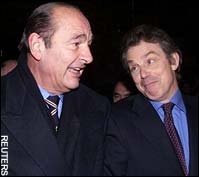
Blair and Chirac at St Malo in 1998Either way, the Iraqi involvement has obscured an opposing trend within the defence and political establishments, that of the progressive European military integration. This was happening under successive Conservative administrations and continued when Blair took over, given fresh impetus by the St. Malo agreement of 1998 and the commitment, the following year, to form European Rapid Reaction Force.

Also, because the Iraqi War is the dominant defence issue, on which the media has largely concentrated, this is also the issue on which the Conservatives have concentrated, a process made easier by the fact that they are untainted by the decision to go to war – which was undertaken entirely on Blair’s watch

When it comes to European defence integration, however, the Conservatives are heavily compromised, not least by virtue of the Maastricht Treaty, which conferred on the EU powers to take action in respect of the newly created "second pillar" of the Foreign and Security Policy.

In effect, therefore, the Iraqi War has obscured the ongoing process of European defence integration and focused attention elsewhere. It has also given a false impression of US-UK solidarity, which has provided a "cover" for the process of defence integration and it has diverted attention from it.

With the Conservatives so heavily compromised on that issue, they themselves have not been keen to bring it up , so there has been very little light shone on the very significant developments which have occurred since Blair’s agreement with Chirac at St. Malo, back in 1998.

Thus it is that defence policy is more a matter of obscurity compounded by confusion, which makes Booker’s column today, on the eve of the third anniversary of the Iraqi invasion, especially relevant.

Headed, "When it comes to defence, there is no Opposition", Booker notes that:

That new double-act of British politics, our Labour Government and the Not-the-Conservative Party, was to the fore in Washington last week when Lord Drayson, the defence procurement minister, addressed the Senate Armed Services Committee, supported by Tory defence spokesman Liam Fox. They "warned" senators that, unless the US lifted its embargo on the electronic "source codes" necessary to operate the Joint Strike Fighter, the British would pull out of this last major Anglo-US military project, the aircraft intended for the Royal Navy's two planned "super-carriers".
This picks up on our analyses on this blog, the latest here, where Booker records that from the way the JSF issue was presented, it seemed that this problem was all the fault of the Americans. No one bothered to explain the background - the reason our US allies have become so wary about giving us military secrets is our increasing defence entanglement with our EU "partners", particularly France. Booker continues:

Since 2000 we have been treaty-bound to hand on our military secrets to the French, who in turn have become ever closer to the Chinese, America's greatest potential enemy. So the senators that Lord Drayson was addressing fear that any secrets shared with the British may end up in Beijing.

For some time now, it has been evident that the Ministry of Defence was anticipating an end to the Joint Strike Fighter project and its replacement by the French-made Rafale, which the French plan to use on their own "super-carrier", as part of our joint contribution to the European Rapid Reaction Force. The only significance of Drayson's visit to Washington was that at last he openly admitted this.

Thus does the MoD's stealthy campaign to end our "special relationship" with the US in favour of European integration continue. Because the Tories fail to grasp what is happening, Government spin is again allowed to prevail. The media just echo the spin.
However, to be fair to the Tories, the new shadow defence secretary, Dr Liam Fox did speak to the Heritage Foundation in Washington DC on 16 Feburary, when he told his audience that there were issues which put co-operation between the UK and America at risk. Tony Blair, he said, wanted to duck the decision about where Britain's defence and security interests should gravitate towards - Washington or Brussels, continuing:

In 1998 at the French port of St. Malo Tony Blair reversed Britain's earlier Atlanticist defence strategy. He did so not, of course, because he was anti-American. He did it simply because he wanted to prove his European credentials in a way that he thought would have only a small political cost. In cooperation with France, Europe's only other nuclear power, he pledged the integration of Britain's defence effort with that of Europe. The implications of that decision have only gradually become apparent.
He went on to single out defence procurement, adding:

Defence procurement is a powerful instrument for integration, because individual decisions often receive little public attention. Which satellite system the military uses to navigate by may not sound like a matter of geopolitical importance. But we are in an age where such decisions may well end up influencing military alliances. For those who would seek to see a European army replace NATO, defence procurement offers the perfect means of undermining the Special Relationship by stealth.
There is, therefore, some indication that Fox is getting the message, although he has not conveyed his understanding of it over the JSF issue. However, he is to speak again on 21 March, billed as "one of his first major policy speeches since becoming Shadow Secretary of State for Defence".

We will await with interest to hear what he has to say.

COMMENT THREAD

A nation doomed

Reuters gives the first hand account of yesterday's French student demonstrations, under the headline, "Huge protests against French job law, some violence".

In what has become almost symbolic of France, we have again the sight of cars burning in the street – the infamous car-b-q – as hundreds of thousands of students, workers and left-wing politicians took to the streets. Organisers estimated the turnout nationwide at 1.3 to 1.4 million, with up to 400,000 of them in Paris.

And all because Chirac and de Villepin have attempted to bring in a tiny change to the labour laws, to allow employees to fire workers under 26 without explanation in their first two years on the job.

According to Reuters, the marches were mostly festive and peaceful, but dozens of youths pelted police with missiles, overturning and setting fire to a car at the end of the main protest in Paris. Police fired many rounds of tear gas to clear them from Nation square. Scattered violence was also reported in Marseille, Rennes and Lille, where police also charged and teargassed crowds.

But, as my colleague remarked the current situation is clearly unsustainable. But, if that number turns out for such a minor change, there is no hope of any more fundamental changes to the French labour laws.

This is a nation doomed.

COMMENT THREAD

Saturday, March 18, 2006

An accidental ban?

The organ at Wells CathedralIf you search for "EU" on Google "news", you will be offered 54,400 entries (currently), ostensibly a cornucopia of information about our government. But what is striking about the list of stories – or, at least the first hundred or so – is the utter banality, the subjects invoking tedium even in those amongst us who are interested in following the machinations of the "Brussels empire".

This is reflected in the daily newspapers. Never packed with information on the EU, even in quiet periods one would normally expect one or two EU-related stories in a day. Now, days on end go by with no mention. For the average reader, it must be almost as if "Brussels" has ceased to exist.

One exception today is a story in The Times, to which we had been alerted earlier by readers and from other sources, not least from the organ-builders' website, but had decided to hold off until Booker had done it in his column, after gathering more information.

This is the quite bizarre predicament in which the organ-builders of Europe find themselves unintended victims of EU Directives 2002/95/EC (Restrictions on hazardous substances) and 2002/96/EC (Waste electronic and electrical equipment).

You have to struggle through The Times's story to get to the crux of the issue but the essence is that under these joint directives, the use of lead is prohibited in any kind of electrical appliance. Those organs which are fitted with electric blowers fall under the definition of "electrical appliances" and, as organ pipes are, necessarily, a tin-lead alloy (with 50 percent of lead or more), the building or refurbishment of the same becomes illegal.

Predictably, in the shallow way that typifies the contemporary media, The Times concentrates on the consequences of this law, focusing on church instruments, noting that the organs "at Salisbury Cathedral, St Paul's in London, Worcester Cathedral, St Albans Abbey and Birmingham Town Hall" are among the first that may be silenced. They are due to be refurbished or rebuilt and will fall foul of the directives.

The substantive issue, however, is ignored – and it is this that we are researching. Essentially, the point is that both directives, in their inception, never set out to ban organs, in which sense the effect was originally unintended.

Nevertheless, the process of drafting EU law is long drawn-out and the organ-makers were quick to notify the Department of Trade and Industry (DTI) and the commission of the effects of their legislation, if it went through unaltered. Yet, despite this, the drafts were not changed and went through the whole process with the inevitable result.

Somewhere, therefore, the system failed. Quite where, why and how, we have yet to establish, but this is surely an important part of the story, which we intend to explore. After all, apart from the cultural consequences of this ban, in Britain there are about 70 companies employing about 800 people on organ-building and repairs, and all their jobs are at risk.

That we seem to be in a position where our governments, by accident, almost, can ban an important feature of "England's cultural and liturgical life", as even Europhile Tony Baldry MP put it, and completely wipe out a whole industry. This is something of considerable concern to all of us.

COMMENT THREAD

The students are revolting (again)

You’d think they would have other things to worry about, what with exams due in a couple of months. But no, the Paris students are out there again, demonstrating, even rioting.

This is not quite a repetition of 1968 but a bit unpleasant for Prime Minister Dominique de Villepin all the same.

As these demos are in the pretty Quartier Latin, where there are lots of attractive bars, cafes and restaurants and not in some ghastly banlieu, the journalists have been reporting them in full (more or less).

The gist of the matter is very simple. It is not about changing the world. If the Sorbonne students had wanted to do that they would have supported Villepin’s proposals. No, they would like the world to stay the same with lots of goodies for them in it and they do not realize that the world as it is, cannot afford those goodies.

French unemployment has hovered between 9 and 10 per cent for a decade now. Unemployment among young people is 23 per cent. All of that would be even higher if a large number of well educated, well qualified young French had not left the country to go and work mostly among the terrible Anglo-Saxes. Around half a million of them are in Britain and very welcome they are, too.

The situation is clearly unsustainable as even the soi-disant poet and philosopher Villepin has realized. Last year he proposed certain changes to employment rules that would make it easier to hire and fire young people for the first two years of their employment with a firm.

Up with this they will not put! As Jeff Randall put it in yesterday’s Daily Telegraph:
“Of all the subjects being taught in the country's 84 state universities, basic economics appears not to be among them. Before any more French students riot over proposed changes to employment laws, they would do well to put down Sartre for five minutes and pick up a copy of Positive Economics by Richard G Lipsey, for many years the standard A-level text book in Britain.”
The need for this sort of elementary text book is quite clear:
“Unlike some of Sartre's more testing ideas, Lipsey is simple to follow. You don't need a bottle of Calvados and a packet of Gitanes to get past the first chapter.

A quick flick through and you'll learn that the real cost of jobs comprises not just wages. Regulations that force businesses to retain staff whom they no longer need are a financial drain and lead to companies thinking twice before recruiting new workers.”
You don’t really need that bottle of Calvados for Sartre either but he and others, even more opaque, certainly seem to have befuddled those young French brains.

La jeunesse priviligée is out there demonstrating against what they see as the undermining of certainty of employment. The trouble is that a very large and growing proportion of young people is facing no certainty but that of prolonged unemployment.

COMMENT THREAD

Busy as a bee

The Chinese "shoe war" is grumbling on but, as we predicted, the MSM – lacking the sexy headlines that "bra-wars" gave them - are treating the issue somewhat superficially.

What is interesting, though, is how little support there is for Peter Mandelson - a meeting of the EU's anti-dumping committee meeting on Thursday last, only three member states voted in favour of the commission plan, nine to ten voted against it while eleven abstained.

But, if the MSM can't get particularly interested in shoes, what price Chinese chamois-leathers, which yesterday fell victim to the latest round of EU protectionism, the commission slapping a hefty 62 percent tariff on imports from China.

Once again, the justification is "dumping", with the commission claiming that the Chinese had nearly tripled their European market share to 32 percent by selling below prices in China or less than the cost of production.

Somehow, I guess, this one is not going to dominate the headlines though. “Chamy wars” has a distinctly unsexy feel to it, and no one is going to write reams about our disadvantaged window cleaners and car washers.

No content with that, the comission is also planning a new round of tariffs on US goods, covering farm goods, steel, nuclear-power equipment and other goods worth $2.4 billion, after the WTO this week upheld a ruling that found the US had not complied fully with an order immediately to end its system of tax credits for its own exporters.

But the pièce de resistance of a busy week must surely be the ban – with effect from yesterday, of Brazilian honey. This is not an insignificant trade as, last year, Brazil exported 14.4 thousand tons of honey to the European Union, earning it a cool US$18.9 million.

The commission claims that Brazil needs to perform further quality control analysis on the product and that the country's processes need to be similar to those performed in Europe. However, the Brazilian Director of the Sanitary and Phytosanitary Issues of the Ministry of Agriculture, Livestock and Supply – there's glory for you – says Brazil already has its own control procedures, even if the EU does not recognise them.

Nevertheless, if it wants to continue exporting, Brazil now has to restructure its "National Programme of Residue Control" in order "to adapt to the EU export norms." It must demonstrate absence of elements that may affect its quality, for example antibiotics and heavy metals. The funny thing is, though, even the EU is admitting that it has never found any problems with Brazilian honey.

Perhaps reflecting a certain exasperation with the EU, the Brazilian Ministry of Agriculture now intends to look for new markets besides Europe.

Why should we worry? Who needs Brazilian honey, or Chinese shoes, or even their chamois leathers? Such deprivation is of nothing compared to warm glow we experience as we marvel at the productivity of the commission. We might even say it's been as busy as a (Brazilian) bee.

COMMENT THREAD

Friday, March 17, 2006

Blog standard

The Times today takes a tilt at bloggers in its Thunderer column:

What blogs do effectively is provide a vehicle for instant comment and opinion. Some newspapers have established blogs for their journalists or other commentators. But the overwhelming majority of blogs — no one knows how many there are — are set up by amateurs using software that is easily available and almost free.

These are not a new form of journalism, but new packaging for a venerable part of a newspaper. Even the best blogs are parasitic on what their practitioners contemptuously call the "mainstream media". Without a story to comment on or an editorial to rubbish, they would have nothing to say.

Most blogs have nothing to say even then. Without editorial control, they are unconstrained by sense, proportion or grammar. Almost by definition, they are the preserve of those with time on their hands. Blogs have a few successes in harrying miscreant politicians or newspapers, but they are a vehicle for perpetuating myths as much as correcting them.
Right. That's why you can read things like this and this in The Times.

COMMENT THREAD

Mon Dieu, les Biftecks rule OK!

France’s rival to CNN and BBC World is scheduled to go on air in mid-December, aiming to broadcast initially to Africa, the Middle East and Europe. The idea, as we have mentioned a few times in the past, is to give a French interpretation of news, events and developments.

Problems have already arisen because of the lack of funding. Its annual budget, met by the French taxpayer, will be $88 million, about an eighth of CNN's.

Now one hears that there is another difficulty. The broadcasts will be aimed at “opinion formers, journalists and people who travel a lot”, as a spokesman for the new channel explained. And what is the language people like that use? Ahem, English.

Thus the new all-singing, all-dancing (well, almost) French international broadcasting channel will have a Francophile but Anglophone slant. In other words, it will broadcast mostly in English, some in Arabic and around three or four hours a day in French.

“Marc Favre d'Echallens of the Association for the Defense of the French Language expressed outrage that a station designed to give a "French vision" of world affairs would contain so little in French.

"After celebrating Trafalgar with the English and making light of our own great victory of Austerlitz, it probably follows that a publicly funded French television channel should end up broadcasting in English," he said.

"If all we get is a poor man's version of what is already available, what is the point of doing it at all?"”

C’est vrai. Sans doute, c’est vrai.

COMMENT THREAD

Lessons from the masters

Joseph Goebbels - master of propagandaToday, through the letter box, plonked a thick envelope, addressed jointly to Mrs EU Referendum and myself, her name prominently above mine. This, of course, was the dreaded Council Tax and, for the first time ever, it has broken the £1,000 barrier.

Part of the stuffing was thick wodges of corporate propaganda, with a pamphlet headlining how Bradford Council is "always improving our services for you".

And, from the £368.5 million to be spent on providing "services" on 2006-7, I note that £1.2 million is to be spent "improving waste management". Yet this is the week when, for the first time in living memory, I transferred large quantities of discarded newspapers from the recycling bin to the dustbin after the Council had, yet again, failed to collect the paper.

The Council Tax also includes the police precept and, for sheer Chutzpah, it would be hard to beat the message from Chief Constable "Plod" Cramphorn who proudly proclaims that, "Over the least three years the number of police officers and police staff have risen, thanks to the willingness of residents to pay more for policing."

As I recall, last time I refused to pay the police precept, as a protest at the utter uselessness of West Yorkshire’s finest, I had two plods through the kitchen window at 11.30pm on a Friday night, arresting me and locking me up in the cells until the Monday morning, until the long-suffering Mrs EU Referendum could come up with the readies (in cash) to spring me.

And the reason Mrs EU Referendum's name is on top of the bill now is that, as the first name, it is she that gets the arrest warrant for non-payment. It is thus she that is now locked up if I refuse to pay. Unlike any other bill, failure to pay means prison and the Council is quite prepared to lock up innocent women in order to get their money.

Elsewhere, my colleague writes that the EU is losing the propaganda battle. From the example of what dropped through my letter-box today, if they want to improve their performance, I can only suggest the "colleagues" come to Bradford to take some lessons from the masters.

Mr Goebbels would have been proud of them.

COMMENT THREAD

You will go on holiday…

By order of the EUEver had one of those years when things have been so hectic that you just have not had time to take your holiday entitlement? Or needed the money more than the break? Well, tough! By order of our masters in Brussels, you will take the time off, or else.

This is the thrust of an ECJ judgement yesterday, brought to us courtesy of the Guardian. The court, we are told, court ruled that workers will no longer be able to be paid for unused holiday entitlement. The judges' view was that the so-called "rolled-up holiday pay" system breached the EU's working time directive, which requires employers to give employees a minimum four weeks' holiday a year.

The case was brought by a group of British shift workers demanding the right to payment during their holidays instead of notional extra hourly pay instead but, under the working time directive, the minimum period of paid annual leave cannot be replaced by an allowance, except where employment is terminated.

The judges said that payment for annual holidays included in hourly or daily pay rates - "rolled-up holiday pay" - was contrary to the working time directive. This was because the system could lead to situations where minimum holiday was replaced just by an allowance - and annual paid leave was a key entitlement under the rules.

Said the judgement, "The entitlement of every worker to paid annual leave is an important principle of community social law from which there can be no derogation … Holiday pay is intended to enable the worker actually to take the leave to which he is entitled."

So, there you are – yet another benefit of our membership of the beneficent EU. You shall have your holidays - even if you don't want them. There is, as yet, no directive that says you must enjoy them but, no doubt, they are working on that.

COMMENT THREAD

Thursday, March 16, 2006

Good enough is good enough for the UN

In one of the least surprising developments the UN has voted for a new Human Rights Council to replace the somewhat discredited Human Rights Commission (the one that had members like Sudan, China, Zimbabwe and Cuba and was, at one point, chaired by Libya). This is, according to all sorts of pundits like former President Jimmy Carter and alas still functioning Foreign Secretary Jack Straw is a GOOD THING.

Not, you understand, because this Council will actually be of any use, but because it is clearly an improvement on the Commission. Well, not clearly, perhaps but probably. Oh surely, it will be an improvement.

It will, for example, have fewer members, 47 instead of 53. You can see immediately what an improvement that is going to be. Also, it is going to meet three times a year for a total of ten weeks. The Commission used to meet once a year for six weeks. It seems churlish not to accept how much better the new regime is going to be.

And the members? Ah yes, the members. Well, that is a bit of a problem, there not really being enough UN members with what one might call a decent record in human rights.

In future these members will not be elected by their own regions but by the Assembly as a whole, though the original plan of a two-thirds majority to vote a country onto the Council was dropped in favour of a simple majority, that is 96 votes. Off-hand I can’t think of a single country except Israel and the United States that would not be able to muster those votes. And, of course, the regional representation will have to remain.

As the Wall Street Journal Europe pointed out in an editorial yesterday (subscription only):
“Worse, seats are distributed by a formula that guarantees Africa, Asia and the Middle East – the world’s least democratic areas – 26 Council seats, an absolute majority.

By contrast, the U.S. and the 27 other members of the so-called West European and Others Group [i.e. those that recognize human rights as a genuine issue] would have the right to no more than seven seats.”
Uplifting, isn’t it. No wonder Foreign Secretary Straw came out with a statement that was fatuous even by his standards:
“The U.N. must remain at the forefront in setting standards in the promotion and protection of human rights worldwide and examining progress in the implementation of these standards.”
When he says “remain” he must be thinking of Darfur, DR Congo, the Balkans and such notable events as the election of Sudan and Cuba onto the previous Commission.

Four countries voted against this idiotic proposal: the United States, Israel, the Marshall Islands and Palau. (No, I don’t know either. Sorry.) Three countries abstained, for reasons that are unclear: Iran, Belarus and Venezuela, all of whom had been seriously criticized for their human rights record though not always by the UN.

Other countries with a bad record, like China, Cuba and Zimbabwe, voted in favour, though China did say that when potential Council members’ records are examined
“decisions on human rights must be evaluated in the context of the history of individual countries”.
Quite so. You cannot expect China to stop torturing members of the Falun Gong or Cuba to stop imprisoning librarians for displaying copies of the UN Charter of Human Rights. It all depends on the historical context.

And what of Europe, the epitome, supposedly, of all that is free, democratic and full of human rights? Every single country, including Britain voted in favour, on the grounds that by doing so they were giving the Council the chance to improve.

We can all expect interesting developments on May 9 (Soviet Victory Day) when the first members are elected.

Can anyone seriously doubt that there is only one answer to the UN and all its shenanigans?

COMMENT THREAD