Thursday, May 11, 2006

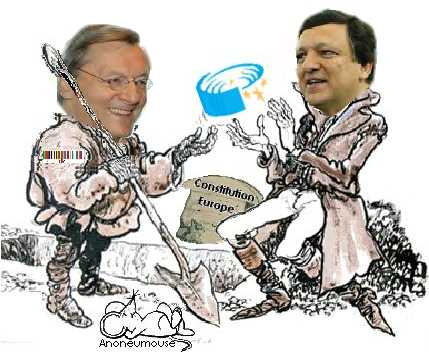
You have to smile

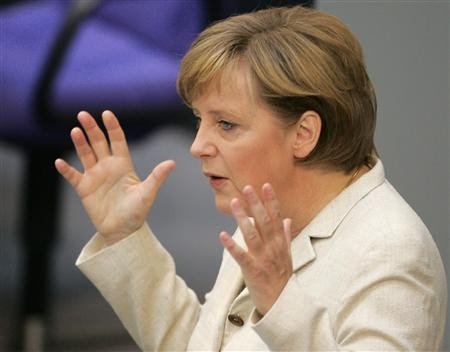
Merkel addressing the German parliamentSame event – different reports… wholly different "take". The Financial Times, often dismissed as Europhile, but nonetheless a reliable source of news, headlines Merkel's "first major speech on Europe to the German parliament" with: "Germany proposes cutting EU laws by 25 percent".

On the other hand, the BBC website, while covering the same event, headlines its story, "Merkel says EU needs constitution", with a cut-away panel which has her declaring, "We need to think about how we make the constitution a success".

The substantive part of the FT report has Merkel calling on Brussels "to abolish a quarter of European legislation to free business from bureaucracy", saying that "promoting the fight against bureaucracy, encouraging growth and employment, was the best way for the EU to reclaim support from overwhelmingly sceptical citizens."

Nevertheless, albeit downpage, the FT does report Merkel strongly endorsing the constitutional treaty, saying: "Europe needs it... I want it, Germany wants it, and, I am sure, the vast majority of this house does too." Yet, although she said her government would push the project forward "at the latest" during the German EU presidency, she warned against acting precipitously.

"It is a difficult issue; there are antagonistic interests; [undue haste] could lead to a blockade. We must therefore think hard about how to proceed," she added, with the FT noting that Berlin "shares the Commission's scepticism" about the likelihood of achieving a breakthrough on the constitution before next year’s presidential elections in France.

What we get from the BBC, though, is Merkel saying, "We absolutely need the constitution to ensure the European Union is effective," and, after a token nod to scrapping "a quarter of the EU's rules and regulations", it has Merkel concentrating on the constitution. Through the prism of the BBC, she declares: "If it's not tackled before, you can be sure that the German presidency will focus on this," only then being allowed to say: "However, I am against moving too quickly and putting us back in a situation where we can't move forward."

The BBC's emphasis is doubly interesting as it was only on Tuesday that Merkel said that Germany would continue to look for ways to revive the dormant EU constitution, but would "give priority to research when its assumes presidency of the European Union". Then as now, she warned against taking "hasty action" that could result in setbacks, clearly signalling that she was not going out on a limb for the constitution.

I suppose, though, we can't be too critical of the BBC in its desperation to advance the cause of the EU it loves so much, especially as Reuters also offers a piece entitled, "Merkel vows to press for European constitution".

But, at the very least, you have to smile.

COMMENT THREAD

How not to learn from elections

As an history undergraduate I used to wonder how the ruling classes of the French and Russian anciens régimes managed not to see the telling signs of what was in store. I no longer wonder, as I watch our own ruling class, in this case, the political establishment rather than an aristocracy, do their own world-famous imitation of an ostrich.

Over at the One London blog there is a list of three ostriches with a description of their behaviour. Enjoy!

COMMENT THREAD

Spy in the (Euro) sky

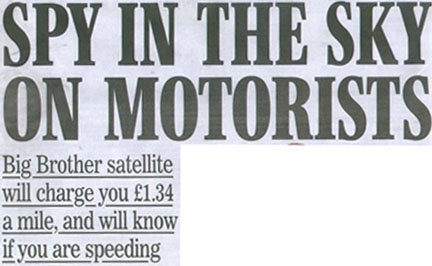
Bursting onto the front page of the Daily Express today is the banner headline (illustrated), "Spy in the sky on motorists" – the paper's "take" on the announcement by the newly appointed transport secretary, Douglas Alexander, that he intends to make satellite-based road pricing his "personal priority".

The government's "big idea" for reducing road congestion is to impose a system of variable charging which could force motorists to pay up to £1.34 per mile at peak times, with lower charges – down to 2p per mile – on less frequented roads.

Predictably – and understandably – the paper picks up on the "big brother" aspect of the system, noting that the technology could be used to "snoop on the private lives of citizens" – a highly justified fear as the system itself relies on being able to record, very accurately, every journey you make in a car.

And, as the Express's strap warns, the same technology could be used for monitoring vehicle speeds, with the spectre of a speeding ticket winging its way to your door every time you go over the posted limit. Further down the line – although not noted by the paper – is the possibility of installing "intelligent" speed limiters, which actually prevent a driver exceeding the posted limits in any area.

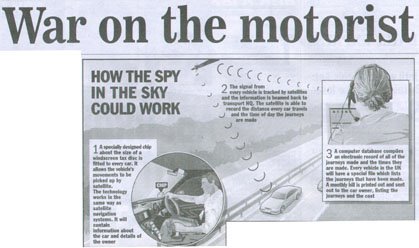
Hillariously, the report author, "transport editor" John Ingham, seems not to have the faintest idea of how the system works, hence a lurid graphic (illustrated) which portrays an anonymous satellite actively tracking a vehicle, "beaming back" the information to a "transport HQ".

For the record, this is not at all how the system works. In fact, it utilises the GPS satellite navigation system and – of very great interest, to which we will refer shortly – this will almost certainly be the EU's Galileo system. This system, in common with the US "Navstar" GPS system, is entirely passive, each satellite in the constellation simply transmitting a time signal. With three or more such signals, a vehicle-mounted receiver can translate these data into positional information and tell drivers where they are.

An on board unitFor a road pricing system, this information is processed by what is called an "on board unit" (OBU) which holds personal and vehicle details in its microchip memory. It continually processes satellite signals to work out positioning, integrates those data with the personal details and then transmits that information via an in-built GMS mobile phone to a receiving station. There, the trip details are recorded and charges are calculated. Generally, the user then receives a monthly invoice, or cash can be withdrawn directly from users' bank accounts.

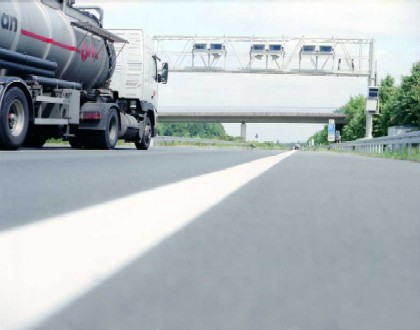
To prevent "free riders", there is also a separate, but linked enforcement system. This involves, typically, road gantries with highly sophisticated cameras linked to number plate recognition software. The German system is also able to take 3-D infra-red images, which can identify the type of vehicle going through.

A German camera gantry used to enforce the toll systemEvery vehicle going under a gantry (or past a free-mounted and sometimes vehicle-borne camera) is recorded and the details are checked with the charging database. It the vehicle is not registered, details are automatically beamed to mobile enforcement units which intercept the vehicle and take the necessary action.

Such a system has been applied very successfully in Germany, through a private company set up to run the scheme, called Toll Collect. Detailed information on the scheme can be found here (64 pages, PDF).

Crucially, though, what makes the system politically acceptable – and feasible – is that it only applies to trucks, and then only to the motorway system. This ensures that the high proportion of foreign trucks transiting the system bear their share of the running costs, the surplus income being used wholly for road maintenance.

Furthermore, the sensitive "big brother" issue does not apply, as there is no problem about truck journeys being recorded. Also, charges are set at a relatively modest level, between 9-13 cents per Km for a three-axle truck, depending on emission levels. That emission "discount" has been highly welcomed as it creates an incentive to operate "green" trucks. Additionally, there is a surcharge for empty trucks, which has seen the number of empty runs reduce by 17 percent, keeping trucks off the road.

However, what Alexander is proposing is in a wholly different league. Given the huge number of private vehicles on British roads – approximately 25 million, as against less than 500,000 goods vehicles – and the extent of the road network, he is setting out to try something, the scale of which has never been attempted before – all in the context where over 30 percent of the DVLA database contains errors.

The government track-record on major computer systems is lamentable and the sheer practicalities of getting the scheme up and running are daunting. Most likely, this would be another spectacular failure.


The Galileo satellite constellationNevertheless, in order to get public agreement, Alexander might attempt to sugar the pill by promising to lower petrol tax. But, according to the Express, fewer than one percent of drivers actually believe the government would do this. The charges would be yet another tax on motorists. Combine that with the "civil liberties" issue of all journey data being recorded and public hostility is almost guaranteed.

But there is also a strong EU dimension. Although the German system currently uses the US GPS signal, the EU commission is determined that any European system should be based exclusively on Galileo (illustrated above), for which use it will be charging national operators. Therein lies the prospect of a lucrative "Euro-tax", with motorists contributing to the EU coffers every time they take to the roads.

Needless to say, the former Europe minister is silent on this aspect and it is not mentioned by the Express. But Alexander is determined to move the debate from "why" to "how". He will have a battle on his hands, not least from the Eurosceptic community.

COMMENT THREAD

Human rights are safe in their hands

The new Human Rights Council of the new reformed United Nations has been elected and very entertaining it was to watch the webcast of the announcement. My colleagues wondered whether I was listening to the listing of the World Cup teams.

So here they are, the countries that will defend human rights in the world.

13 from Africa: Ghana, Zambia, Senegal, South Africa, Mali, Mauritania, Morocco, Gabon, Djibouti, Cameroon, Tunisia, Nigeria, Algeria;

13 from Asia: India, Indonesia, Bangla Desh, Japan, Malaysia, Pakistan, South Korea, China, Jordan, Philippines, Bahrain, Saudi Arabia, Sri Lanka;

6 from Eastern Europe: Russia, Poland, Czech Republic, Romania, Ukraine, Azerbaijan;

8 from Latin America and the Caribbean: Brazil, Argentina, Mexico, Peru, Guatemala, Uruguay, Cuba, Ecuador;

7 from Western Europe and others: Germany, France, UK, Switzerland, Netherlands, Finland, Canada;

Well, OK, Sudan is not on it but Sudan was not encouraged to be a candidate. Iran was a candidate and was not elected so, I suppose, we must be thankful for small mercies. Libya is not on the new Council.

But look who is: Morocco, Senegal, Bangla Desh, China, Saudi Arabia, Cuba, Azerbaijan.

John Bolton has been triumphantly right. As he said, the new council has taken over the weaknesses” of the human rights commission.

While his opinion was shared by various commentators on all sides of the political divide, Louise Arbour, the UN Human Rights Commissioner, has welcomed the new body, at least, according to the People’s Daily:
“"The signs from the election of the 47 members of the council are very encouraging for the future of this new body," said the high commissioner in a statement.

The polls were not "business as usual", as there were genuinely contested candidacies and all those elected made specific pledges and commitments expressing their concrete engagement to promote and protect human rights, she said.”
Reassuring or what? Some of our readers might ask (after they managed to stop laughing) what happened to the great UN reform that was going to do away with the unfortunate rules of the discredited Human Rights Commission under which countries were elected regionally, thus putting known violators of human rights on it.

Well, it is quite simple, really. The members are no longer elected regionally but by the entire General Assembly of 191 members. However, (please pay attention at the back) candidates are still divided into regions with a set number to be elected from each one.

Thus, regions with few countries (if any) that have even remotely acceptable human rights records, like Africa have 13 representatives while Western Europe and others have 8. On the whole, the World Cup draw seems to me to be a little more fairly arranged.

Another complication is the number of years each country will serve on the Council.
“Elected for one year are Algeria, Morocco, South Africa, Tunisia, Bahrain, Indonesia, Philippines, India, Poland, Czech Republic, Argentina, Ecuador, Finland and the Netherlands.

Nations serving for two years are Gabon, Ghana, Mali, Zambia, Pakistan, Japan, Sri Lanka, Republic of Korea, Romania, Ukraine, Brazil, Guatemala, Peru, the United Kingdom and France.

Cameroon, Djibouti, Mauritius, Nigeria, Senegal, Bangladesh, China, Jordan, Malaysia, Saudi Arabia, Azerbaijan, Russia, Cuba, Mexico, Uruguay, Canada, Germany and Switzerland will serve for three years.

In the future, nations will be elected to three-year terms of office.”
Confused? You are meant to be. But worry not.
“Candidates submitted pledges and commitments to promote and protect human rights. According to the regulations establishing the new council, its members will be the first to have their human rights records reviewed.”
Can’t wait to see how the various members will vote on each other’s record. What will Azerbaijan say about Cuba, for instance, or Morocco about Algeria or Tunis?

Just as you thought that the UN could not descend any further, having reached absolute rock bottom, a new chasm opens up. As one of the participants of our forum reminded us, the Weekly Standard has found another interesting development in that august body:
“Switzerland’s nomination of its national, Jean Ziegler, to membership on the U.N. Subcommission on the Promotion and Protection of Human Rights illustrates in a nutshell (and a nut) why there is so little hope for meaningful reform of the world body.

The subcommission should not be confused with the U.N. Commission on Human Rights, which has just held its last meeting. The commission has been abolished at the initiative of Secretary General Kofi Annan, who lamented that it had become a stain on the U.N.'s reputation.

However, the subcommission, which is a body of "experts" rather than diplomats, does not go out of existence with the commission. It presumably will now be linked with the new Human Rights Council, which is slated to replace the commission as part of the overall reform plan.”
It is hard to see what the role of this subcommission might be but, I have no doubt, it is an expensive proposition in both political and financial terms. And who is Jean Ziegler?
“Until now, he has served as the old commission's "special rapporteur on the right to food." A sociologist by training and a politician, Ziegler did not bring to his post any particular expertise on food or agriculture. His credentials were all in the realm of ideology. Ziegler's main idea was anti-Americanism. He was a founding editor of the journal L'Empire, and you don't need many guesses to know which "empire" was the subject. The United States, according to Ziegler, is an "imperialist dictatorship" that is guilty, among other atrocities, of "genocide" against the people of Cuba by means of its trade embargo.”
Wonderful. Just what one needs in a spokesman on human rights on whichever commission or subcommission he might be sitting. I take it no mention was ever made by M Ziegler of the large number of people being imprisoned in Cuba for opposing Fidel Castro’s one-party rule? No, I thought not.

Mind you M Ziegler’s career gets better and better:
“In 1989, Ziegler was one of a group of self-described "intellectuals and progressive militants" who gathered in Tripoli to announce the launching of the annual "Muammar Qaddafi Human Rights Prize," awarded by the government of Libya. Ziegler explained that the purpose of the Qaddafi prize was to counterbalance the Nobel prize, which, he said, constituted a "perpetual humiliation to the Third World."

Winners of the Qaddafi prize have included Fidel Castro, Louis Farrakhan, and recently Venezuela's Hugo Chávez. When no individual of such luminous human rights credentials has presented himself, the award has gone to collectivities. In 1996, it went to a female member of the Cuban Communist party's central committee, a leader of a Ba'ath party women's organization in Saddam's Iraq, and a couple of other "symbols of women's struggle for freedom."

In 1990, it went to the "Stone Throwing Children of Occupied Palestine" and in 1991 to the "Red Indians." In 2002, the awardees were "13 intellectual and literature personalities," of whom the most notable were the French Holocaust denier Roger Garaudy and (you guessed it) Jean Ziegler.”
As they say, you couldn’t make this up. And if you did, no publisher or TV director would accept such a plot-line. For goodness’s sake, they would say, go away and write something a little more realistic.

COMMENT THREAD

A question of priorities

The Afghan aircraft that brought the hijackers to StanstedWell, it looks like we are required to give asylum to Afghan hijackers, a decision by Mr Justice Sullivan so absurd that, for once, we find ourselves in agreement with Tony Blair, who declared his judgement "an abuse of common sense".

Nor were we able to deport Mustaf Jama, the Somali criminal and one-time asylum-seeker, now being hunted by police in connection with the murder of PC Sharon Beshenivsky – who is now believed to have fled to Somalia, the very country that the authorities decided was so "unsafe" that he could not be returned there.

Nor indeed can be exclude, except on very limited grounds, any citizen of an EU member state, Directive 3004/38/EC guaranteeing "the right of citizens of the Union and their family members to move and reside freely within the territory of the Member States", and the EU treaties declaring that the "free movement of persons" constitutes one of the fundamental freedoms of the internal market. And should any of those people residing in our country commit criminal offences, even then our rights to get rid of them are severely restricted.

So strong, in fact, are the rights of criminals of all nations (including our own) that we have effectively lost our own rights to freedom from their depredations. We must suffer whatever they chose to impose on us – and pay for the privilege.

Thus, I wonder if I can be the only one to question the priorities of justice commissioner Franco Frattini who, according to Reuters has decided that football hooliganism is such a great threat that there should be a "Europe-wide ban" to keep offenders from travelling and entering stadiums.

It is not that one particularly wants to give such hooligans right of free passage, or that we would particularly disagree with Frattini – especially when he admits that this can only be done through member states' own laws – but we do question his rather distorted priorities.

When murders, rapists, child molesters, robbers, fraudsters and even hijackers, are given free passage as of right, why should he be getting so worked up about football hooligans?

COMMENT THREAD

Wednesday, May 10, 2006

That famous European diplomacy

Jonathan Clarke is a former British diplomat, not a position to be terribly proud of these days, and a scholar at the Cato Institute in Washington DC. I have a reasonably high opinion of Cato, which does a lot of extremely interesting work but I do think they should be a little more careful of whom they appoint as scholars.

Clarke is, in fact, a Research Fellow in Foreign Policy Studies and, as befits a former British diplomat, with an impressively if somewhat improbably wide area of expertise: his speaking topics are Africa, Balkans, East Asia and the Pacific, Europe, Foreign Policy and General Strategy and US Foreign Policy. The first five of those are, presumably, places where he has been stationed at various times in his career, thus becoming an expert.

Anyway, he writes syndicated columns and books on various problems to do with American foreign policy (one wonders whether he was responsible for any of the supreme achievements of British foreign policy, like farming it out to the European Union).

Today’s Financial Times carries an article by him [subscription only], entitled “Europe undersells diplomatic expertise to US”.

Well, to start with, what is this Europe that has a diplomatic expertise? A couple of days ago I had a meeting with one of Mr Clarke’s colleagues from Cato as he was passing through London. I spent a little time explaining to him that I did not mind people in Washington not being interested in European affairs (who could be?) but I did mind them getting it so horribly wrong. For instance, why do they keep talking about European this or European that when they mean either the EU or, more likely, individual European countries?

My acquaintance agreed with me but pointed out that there are not many people in the Washington think-tanks who really know about European politics. Presumably, that is why they hire people like Jonathan Clarke, a former British diplomat. What precisely is he going to be able to tell them?

If today’s article is anything to go by, what he tells them is that diplomacy is rightly the preserve of Europeans (well, some Europeans, one assumes) and the latter should be bolder in advising the American government or diplomats or just about anybody as to how to deal properly with all those difficult foreigners.

His first two paragraphs really sum it all up and if our readers could just refrain from sniggering, here those paragraphs are:
“In spite of the rewards of more lucrative careers in business, the foreign services of Europe continue to attract the cream of each generation’s youth. With this sure supply of talent at her disposal, Margaret Beckett, the new British foreign secretary, might ask herself why European diplomacy seems to lurch from crisis to unresolved crisis. This is nowhere more marked than in relations with the US, where European policy swings between docile subservience and opportunistic pouting from the sidelines, forever falling short of the happy mean of assured self-confidence.

Docility and name-calling are soft options that fail to bring to bear Europe’s vast experience of the most pressing security problems: religiously fuelled separatism and terrorism, insurgency, post-conflict civil society building and regional integration. Just think how the looming catastrophe in Iraq might have been mitigated had these skills, which the Europeans possess in abundance, been available to the US.”
Setting aside the obvious question as to which particular European diplomatic corps Mr Clarke may be referring to, one wonders why somebody who has seen fit to go and be a scholar at the ultra-libertarian, anti-statist Cato Institute should think it to be a matter of rejoicing that top graduates prefer to be a burden on the taxpayer in order to promote inane policies to going into the wealth-creating sector.

Well, OK, clearly a former diplomat would think that. But really, European skills would have prevented whatever he deems to be the present catastrophe in Iraq? Who, in his opinion, helped to create that catastrophe in the first place?

It was British diplomacy at its finest that set up the modern Iraqi state and then gave power to the Sunnis. It was further British diplomacy that recognized the Ba’athist regime long before it was absolutely necessary.

It was French diplomacy at its finest that gave the Iraqis the chance to build nuclear reactors (not for nothing was Osirac referred to as Ochirac) and German diplomacy at its finest that supplied Saddam with various other state-of-the-art weaponry. Not that the Americans are in the clear either, but let us not forget who Saddam’s closest supporters have been in the West.

I need not even mention the money that flowed into the various diplomatic chancelleries from Iraq under the food-for-oil scam. A couple of the Quai d’Orsay’s finest are being investigated even as we speak and many more should be.

And, of course, there was the marvellous display of European diplomacy in dragging the whole saga through the UN (Britain), thus giving Saddam the chance to hide whatever he wanted to hide and undermining all attempts (France and Russia) to solve the problem peacefully.

Never mind, it was all a wasted opportunity, as far as Mr Clarke can see it. (His knowledge of the Balkans no doubt tells him about the wondrous way European diplomacy encouraged Slobodan Milosevic and his thugs to wage a ten-year-long war, in the process bankrupting his own Serbia as well as destroying large areas and thousands of people in the other former Yugoslav states.)

It seems, however, that Europeans should really tell the Americans what should be done about Iran.
“So, let the Europeans strip away the US illusions over Iran. The US has not had an embassy there for 25 years. The upper levels of the State department are devoid of Farsi speakers. Much of the information available to the US comes from technical surveillance or shadowy exile sources, including the Mujahedin-e-Khalq, officially a terrorist group. By contrast, the Europeans have official relations with Iran and embassies in Tehran. On-the-ground knowledge abounds. A recent German ambassador in Washington spoke Farsi. The Europeans should be interpreting the recent Iranian letter to the Americans, not the other way around.

This information “edge” should allow the Europeans to demand something in return from the US supporting their negotiations with Iran. This could include a guarantee from the US that should Iran abandon its nuclear weapons ambitions, the US would move quickly to normalise relations. The Europeans seem not to have sought anything of this sort, so it is not surprising that their negotiations failed.”
No doubt, it was that information edge that allowed the EU3, Germany, France and the UK to be diddled by the Iranian mullahs. Anyone who does not live in a parallel universe knows that those incredibly subtle negotiations that the 3 carried on and on for years on end actually gave the Iranians time to build up their nuclear facilities. As diplomacy goes I have heard of more successful efforts.

Besides, the famous letter was not addressed to any European politician but to President Bush. I expect he can find the odd farsi speaker who will translate and interpret it for him.

Then there is Hamas. Mr Clarke is quite clear - and I think we should all be in the light of the recent news that even the US has relented and will give money to the Hamas-led Palestinian Authority but only if it is well spent- that European pressure should be directed to that end.
“On Hamas, for example, if it turns out that some form of re-established EU funding is the factor that prevents the Palestinian territories from collapsing into a terrorist-ridden failed state and allows Hamas to mature, the Europeans should expect a substantial reciprocal policy move from Washington.”
At present the funding is likely to be resumed, Hamas is showing no signs of maturing but will, undoubtedly view the weakening as a justification for continuing with their policy of trying to destroy Israel and Gaza has already turned into a permanent anarchy and civil war. The Palestinian territories are well on their way to becoming a failed state because of the organizations the Europeans support in their diplomacy.

All this is a great success story for Europe’s finest brains. Perhaps, it is best they do not go into the private sector.

COMMENT THREAD

A citizen's agenda?

The commission today – or so it tells us - has adopted "an ambitious policy agenda for Europe's citizens", proclaimed under the heading: "Delivering results for Europe: Commission calls for a citizens' agenda".

There is one slight problem with this though. The "agenda" is set out in the document, "Communication on Plan D and the period of reflection", COM (2006) 212, 10 May 2006, which so far has not been published on the web. Thus, while this may be a "citizen's agenda", at the moment, neither mere citizens nor even journalists are allowed to see it.

Thus do we rely on the commission's own press release (link above), from which we learn that this is its contribution to the June European Council, "picking up the messages the Commission has received from Plan D and the national debates during the period of reflection called by Europe's leaders last year."

"It is time to match dialogue with delivery," proclaims the commission, with el Presidente telling us, "Today is a milestone for my Commission." Without identifying the planet from which he is speaking (which does not seem to be Earth), he then goes on: "Over the last eighteen months we have successfully addressed many of the issues that were deadlocked when I took office. Today, we are adopting an ambitious, policy driven agenda for citizens."

So, in fact, this is not a "citizen's agenda" after all – in the sense that it is determined by said citizens… it is an agenda for citizens, an altogether different thing.

Never mind though, the fragrant Margot tells us that, "with this agenda, we demonstrate that we have listened to citizens." So, even if we are not allowed to see it, we know it's alright. Margot has said so. "Citizens want to have their say. They look for European leadership…" she says, also without declaring from which planet she is speaking. She does, however, acknowledge that "they have mixed feelings about membership in the EU or the way the Union works."

I suppose that's one way of putting it, as is her assertion, "they trust the European Union on policy delivery". We do, of course, have no option... having not seen the document. We have, therefore, to take it entirely on trust that the commission's agenda (which we haven't seen) is "rooted in the strategic objectives of prosperity, solidarity and security," and that it has a "continued focus on jobs and growth". But what price this little gem? "As the debate on Europe shows…", says the commission,

…there is a gap between the action Europe takes and the public's perception of Europe’s role. To regain the confidence of the public, the commission will harness all its resources, both internally and externally, to deliver solutions to the issues raised by citizens. This is a policy response centred around a citizens' agenda (which we haven't seen).
Then we get to the "meat": the commission has set out twelve policy initiatives to deliver "a Europe of results". However, as yet, we are not allowed to know what they are – only some of the "concrete" proposals:

  • A forward looking single market review,
  • A agenda for access and solidarity, in parallel to the single market review.
  • Delivering better access for EU citizens to their existing rights, and greater awareness of those rights, by proposing an "entitlement card" for all EU citizens.
  • Improving decision taking and accountability in justice, liberty and security policies, through the use of existing Treaty possibilities.

    For the glorious finalé, though, the commission proposes that the June European Council should endorse "a step by step approach" on "institutional issues", with as a first step Europe's leaders adopting a new political declaration, and commitment in 2007, 50 years after the signature of the Treaty of Rome.

    It proposes to draft a new solemn declaration, inspired by the Messina Declaration, "setting out Europe's values and ambitions, with a shared undertaking to deliver them". This will then "serve as the basis for decisions by the European Council to launch a process designed to lead to a future institutional settlement." That, of course, is code for disinterring the moribund constitution, with a further "rendezvous" step in 2008/2009 when the commission reports on the future financing of the Union.

    This is the sort of garbage that daily emanates from this organisation and you can quite see why it is it has so much difficulty "reconnecting" with the public - if it ever "connected" in the first place.

    Reuters picks up on all this with its own report, featuring Barroso as the star performer.

    According to its report, el Presidente accused Europe's "national leaders" of undermining the EU by breaking pledges to work together and using Brussels as a scapegoat for their own failures. As well as urging them to sign the Messina Declaration "clone", he challenged the national leaders, asking them, "Are you committed or not to this project of living together in Europe?"

    Glad he asked that… any answers?

    COMMENT THREAD
  • Whither regionalisation?

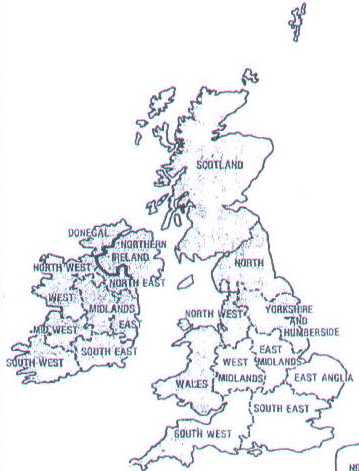
    The regions of the UK, circa 1975One of the unanswered questions following Blair's recent reshuffle is whether Prescott's successor, Ruth Kelly, will display the same enthusiasm for the regionalisation of England, to whether the project will mark-time or even wither on the vine.

    As we have pointed out earlier, the regional agenda was very much Prescott's personal "baby" and without him controlling the Department responsible for local government, it is possible that the drive has gone out of the project.

    This notwithstanding, there remains a strong conviction within a faction of the Eurosceptic community that the regional project is – and always has been – a dark "plot" by the EU, aimed at furthering political integration. But, while there is unquestionably a current EU agenda, there has never been any documentary evidence produced which shows that Britain has been forced down the regional route, to the extent that we are currently seeing.

    This much I argued in my report on regionalisation, published in 2002 but still remarkably relevant after the passage of four years.

    In that document, I referred to the Treaty of Rome, remarking that regional policy was not one of its mainstream concerns of the then EEC. In fact, the only mention in the Treaty was a general objective of “reducing the differences existing between the various regions and the backwardness of the less favoured regions”. There was no specific policy devoted to that objective and the newly formed Commission was charged only in general terms with keeping under review all systems of aid existing in member states.

    I then added that regionalisation was so low on the Community's agenda that the Commission did not even present its first memorandum on regional policy until 1965.

    At the time of writing, however, I was having to rely on secondary reference to that document, as I had not been able to obtain a copy which, in any event, was written in French.

    Fortunately, though, it has now turned up – an unofficial translation of the original report, dated 11 May 1965, together with an additional report, published in 1975, after the UK had joined the EEC. Of some considerable historical interest, it shows the original regional maps, a fragment of which – showing the UK – is reproduced above. Readers will see that there were originally 11 regions (excluding London), including Scotland, Wales and Northern Ireland, with borders only slightly different to those of today.

    But what is fascinating about both reports is that they absolutely confirm that – at the time – there was no political agenda. The policy was dedicated to reducing the regional disparities in employment and standards of living, but the whole thing was subject to the caveat that the methods employed should be "appropriate to the political and constitutional systems of each country".

    By no measure can it be taken that there was – at this time, at least – any declared, or implicit intention to create semi-autonomous regional governments.

    Another fascinating insight into the thinking of the time comes in the 1965 report, which argues that "mobility of manpower between economic sectors and regions is a prerequisite for dynamic activity", but the report then goes on to say:

    …beyond certain limits, interregional migration produces not only social and human problems, but also economic drawbacks. The less-favoured peripheral regions lose the younger and more vigorous elements of the population, impairing their chances of future expansion, while expanding areas have to bear the costs of excessive industrial concentration.
    It seems to me that those words, written more than forty years ago, are highly appropriate to today's situation.

    COMMENT THREAD

    Grist to the mill

    A German hospital container, of the type that would be used by the EU 'special reaction corps'One of the real evils of the European Union is the tawdry way it manages to debase everything it touches by converting apparently benign, well-meaning initiatives into yet another excuse for more integration.

    Even in the generally dispassionate reporting by Reuters, this now shines through, witness their latest story on a call for the European Union to create a "special reaction corps" to deal with disasters such as the Asian tsunami of 2004.

    This was actually suggested last year by EU external relations commissioner Benita Ferrero-Waldner, who actually wanted it set up by 2007. But now aid commissioner Michel Barnier has got in on the act, and is also suggesting pooling national consular services to help "EU citizens" caught in disasters.

    With Barnier on the case, though, the timetable has slipped from 2007 to 2010, with the details yet to be decided but, as Reuters observes, the proposal "is the latest effort by the EU to plough ahead with integration" despite the uncertain future of the EU constitution.

    Readers will recall that the constitution included a "solidarity clause", obliging member states to come to each others' aid in natural disasters, and the "special reaction corps" would give effect to that clause, despite there being no treaty base to give it legal effect.

    No doubt, with the proposal on the table, the commission is hoping that the "feel good" factor engendered will pave the way for a wider popular approval of the stalled constitution. Once again, though, all this proves is that, when it comes to pursuing the integration agenda, everything and anything is grist to the mill – nothing is sacred.

    COMMENT THREAD

    Tuesday, May 09, 2006

    Whoopee!

    European citizens can hardly contain their joy at the news that Estonia has ratified the EU constitution on this of all days.

    It has become the 15th member state do the deed, putting the text to its parliament rather than troublesome people, gaining 73 votes in favour, with one vote against in the 101-seat parliament.

    The idea of choosing Europe day was to send out a message of support for the project and I am sure that the Dutch and French will now realise the error of their ways and follow the example set by the brave Estonian MPs - not.

    Certainly, Finland is planning to ratify the constitution soon, although it too is not going to do anything so rash as consult its people. There is a possibility they might say "no".

    That clears the way for tomorrow when the commission is to adopt a paper containing its own suggestions which it hopes will end the impasse on the ratification process.

    However, although some think that the German presidency in the first part of next year might be the opportunity to kick-start the process, no one who is actually sane expects anything to happen until after the French presidential elections.

    Even then, there are plenty of people ready to remind the "colleagues" of the meaning of the word "no", even if, as is possible, the commission tries to introduce a "constitution-lite" and slide it past the French and Dutch without referendums.

    Did I hear riots, anyone?

    COMMENT THREAD

    Europe Day

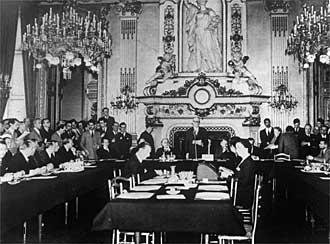
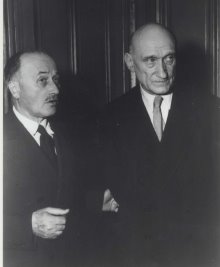
    Jean Monnet and Robert SchumanAlthough the EU is quick to denounce "Euromyths", what very few people realise is that the European Union itself is based on a foundation of its own myths, assiduously cultivated to project an entirely false image of modernity.

    No greater myth can be found that in the commission's carefully crafted account of Europe Day, which it "celebrates" today, coincidentally alongside the Russians who celebrate "Victory Day", the anniversary of the end of what it calls "The Great Patriotic War".

    Claims the commission, "probably very few people in Europe know that on 9 May 1950 the first move was made towards the creation of what is now known as the European Union," thus perpetuating the myth that this indeed was the first (and successful) attempt at creating a construct, the intellectual genesis of which actually lies in the 1920s, as a reaction to the problems arising out of the First World War.

    But, claims the commission, in Paris that day, against the background of the threat of a Third World War engulfing the whole of Europe, the French Foreign Minister Robert Schuman read to the international press a declaration calling France, Germany and other European countries to pool together their coal and steel production as "the first concrete foundation of a European federation". The narrative continues:

    What he proposed was the creation of a supranational European Institution, charged with the management of the coal and steel industry, the very sector which was, at that time, the basis of all military power. The countries which he called upon had almost destroyed each other in a dreadful conflict which had left after it a sense of material and moral desolation.
    Thus, concludes the commission, "Everything... began that day".

    Needless to say, the reality is very different. Far from the heroic Schuman standing at the centre of the "project", he turns out to be little more than an unwitting stooge, manipulated by one man who had made its his life's work to set up a "government for Europe".

    That man, of course, was Jean Monnet. At the time, he was nearing the end of implementing his four-year plan for the "modernisation" of France. Already, he had seen two post-war attempts at creating his "government" fail, the OEEC, created on the back of the Marshall Plan, and the Council of Europe. With a sense of resigned detachment, he had decided that neither of them could

    …ever give concrete expression to European unity. Amid these vast groupings of countries, the common interest was too indistinct, and common disciplines were too lax. A start would have to be made by doing something more practical and more ambitious. National sovereignty would have to be tackled more boldly and on a narrower front.
    However, if Monnet was sure that something much "more practical and ambitious" was needed to achieve the desired goal, then events in the late spring of 1950 conspired to create precisely the opportunity he was looking for.

    During 1949, West Germany had finally emerged to self-government under the Chancellorship of Konrad Adenauer. Under its Basic Law, passed on 8 May 1949, the new Federal Democratic Republic, or FDR, was based on a federation of the eleven highly decentralised Land governments which, on British insistence, retained considerable power, guaranteed by a constitutional court. In crucial respects the federal government, centred in Bonn, could not act without the consent of the Länder. In particular, all international treaties had to be ratified by the Länder through their legislative assembly, the Bundesrat.

    At the time, the new Germany, under the guidance of Ludwig Erhard, was already showing signs of a remarkable economic recovery. This raised the question of how the new nation should be assimilated into the western European community. At the Council of Europe in August 1949 Churchill had shocked many delegates by proposing that she should be given the warmest of welcomes. Two of the western occupying powers, the USA and Britain, wanted to see her continue on the road towards full economic recovery and nationhood as soon as possible. But this had provoked a deep rift with France, which wanted to continue exercising control over the German economy, for fear that she might once again become too strong a political and economic rival.

    The argument centred on that old bone of contention, the coal and steel industries of the Ruhr, heartland of Germany's economy and formerly the arsenal of her war machine. In 1948, France had demanded the setting up of an International Ruhr Authority, which would enable French officials to control Germany's coal and steel production and ensure that a substantial part of that production was diverted to aid French reconstruction. It was a curious echo of France's disastrous policy after the First World War. Naturally the new West Germany was bitterly opposed to such an authority. Equally so were the other two occupying powers, America and Britain.

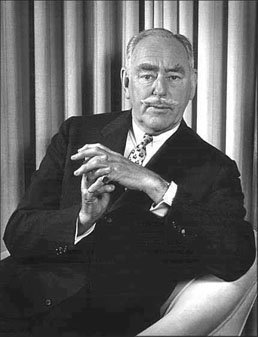
    For over two years this dispute had festered, without resolution. But in the spring of 1950 the US Secretary of State Dean Acheson finally lost patience. He issued France with what amounted to an ultimatum. On 11 May there would be a foreign ministers' meeting in London; and unless the French could offer a satisfactory compromise proposal, the USA would impose a solution on all parties.
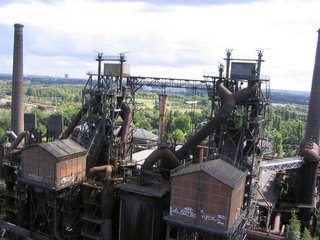
    Disused (now) blast furnaces on the Ruhr - the foundation of the EUThis gave Monnet the opportunity for which he had been waiting. For years he had dreamed of building a "United States of Europe", beginning by integrating the coal and steel industries, and setting up a supranational authority to run them. This was the idea first put forward in the 1920s, by Coudenhove and Louis Loucheur, and partly implemented by Luxembourg steel magnate, Emil Mayrisch in 1926. It was the idea Monnet himself had outlined to Paul-Henri Spaak in 1941 and in a memorandum he had written in Algiers in 1943.

    What Monnet had in mind was that the coal and steel industries, not just of France and Germany but of other western European countries, should be placed under the direction of a supranational authority: just as over dinner in Paris in 1917 he and Arthur Salter had come up with a similar plan for the control of allied shipping.

    When Monnet came to commit his plan to paper, he was obviously troubled by how much he dare reveal of its real underlying purpose. Before getting to its final stage, it went through nine separate drafts. In the first, the pooling of coal and steel was regarded as "the first step of a Franco-German Union".

    The second opened it up to the "first step of a Franco-German Union and a European federation". By the fifth draft, this had been changed to "Europe must be organised on a federal basis. A Franco-German Union is an essential element is this". The seventh demanded that "Europe must be organised on a Federal basis". But, by the final draft, almost all this was missing. All he would allow himself was a reference to the pool being "the first step of a European federation", a vague term which could mean different things to different people.

    Although what Monnet really had in mind was the creation of a European entity with all the attributes of a state, the anodyne phrasing was deliberately chosen with a view to making it difficult to dilute by converting it into just another intergovernmental body. It was also couched in this fashion so that it would not scare off national governments by emphasising that its purpose was to override their sovereignty.
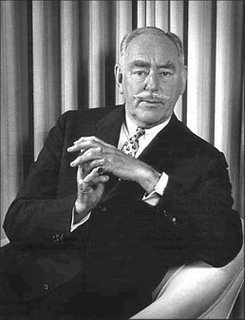
    Dean Acheson - US Secretary of State and 'unwitting' conspirator in the creation of the EUOnce his memorandum was complete, Monnet's next problem was how to get it adopted. He could not act as the champion of his own plan. As a natural behind-the-scenes operator, his style was always to act indirectly. He needed to win over very senior support in the French government. In this, he had few problems as he had constant contact with senior members of the French government. His obvious choice was foreign minister, Robert Schuman. It would be he that would have to face US Secretary of State Dean Acheson in a few days time. Monnet knew that his officials had few ideas to offer. He would most likely, therefore, be receptive to some new ideas.

    Furthermore, as a potential advocate, Schuman had other advantages. Born in 1886 in Luxembourg to a German mother, he was fluent in both German and French, having read law at the universities of Berlin, Munich and Bonn. He had then moved to Alsace Lorraine when it was under German rule, which meant that in 1914 he had been recruited into the German army. Yet in the Second World War, when Alsace Lorraine was again part of Germany, he had, as a French citizen, been arrested by the Gestapo. He was thus a perfect witness to the need to resolve the Franco-German conflict.

    To get to Schuman, Monnet approached his chef de cabinet Bernard Clappier, telling him to advise his boss that he had some ideas for the London conference. He had expected Clappier to call him back but, by Friday 28 April, Monnet had heard nothing. Fearing that Schuman was not interested, Monnet sent a copy of his memorandum to prime minister Georges Bidault, via his closest aide, again asking for it to passed on. In the memorandum, Monnet wrote of the "German situation" becoming a cancer that would be dangerous to peace. For future peace, he wrote, the creation of a dynamic Europe is indispensable:

    We must therefore abandon the forms of the past and enter the path of transformation, both by creating common basic economic conditions and by setting up new authorities accepted by the sovereign nations. Europe has never existed. It is not the addition of sovereign nations met together in councils that makes an entity of them. We must genuinely create Europe; it must become manifest to itself…
    Alas for Bidault, who thereby missed his chance of immortality, the memorandum did not reach him. Meanwhile, Clappier had re-appeared full of apologies. Monnet gave him a copy of the memorandum and immediately decided that Schuman should see it. He caught him at Gare de l'Est, as he was sitting in a train, waiting to go to Metz for the weekend. When Schuman returned to Paris, after studying the document, he had adopted the plan wholeheartedly. It had now become the "Schuman Plan", although in reality it was not his at all. In the final analysis, he was not even committed to it, except as a device to get him off a hook.

    Once Schuman had agreed, the contents of the Plan were passed by his office in great secrecy to the German chancellor, Konrad Adenauer, in the hope of securing his provisional agreement. Other governments, especially the British, were not told. According to Professor Bernard Lavergne, a prominent political commentator of the time, who was to publish a highly critical study of the plan:

    The curious thing was that M. Bidault, the Premier, was – at least, at first – not at all favourable to the Plan which, in early May, was suddenly sprung on him by his Foreign Minister, M. Schuman. And oddly enough – though this was typical of M. Schuman's furtive statesmanship and diplomacy – neither was M. François-Poncet, the French High Commissioner, nor the Quay d’Orsay, or even the French Government, properly informed of what was going on during the days that preceded the "Schuman bombshell" of 9 May.
    However, "as a result of a curious coincidence", Dean Acheson was already on his way to the summit in London, and had decided to go via Paris to confer informally with Schuman. By another "coincidence", Monnet was present at their meeting. As Monnet disingenuously put it, "courtesy and honesty obliged us to take Acheson into our confidence". The Plan was also presented to the French Cabinet, but only in a most perfunctory way:

    Only three or four ministers were informed about it (the Plan), and when, finally, on 8 May, the Council of Ministers met, no serious discussion took place at all. Schuman gave them a rough sketch of the Plan, and, without really knowing what it was all about, they gave it their blessing.
    Schuman then took an audacious step. He would announce "his" plan by appealing directly to the peoples of Europe, through the media. In a radio broadcast on 9 May 1950 – today officially commemorated as "Europe Day" – he revealed Monnet's plan to the world. "World peace", he began,

    …cannot be safeguarded without the making of creative efforts proportionate to the dangers which threaten it. The contribution which an organised and living Europe can bring to civilisation is indispensable to the maintenance of peaceful relations. In taking upon herself for more than 20 years the role of champion of a united Europe, France has always had as her essential aim the service of peace. A united Europe was not achieved and we had war. Europe will not be made all at once, or according to a single plan. It will be built through concrete achievements which first create a de facto solidarity. The coming together of the nations of Europe requires the elimination of the age-old opposition of France and Germany…

    With this aim in view the French Government proposes that action be taken immediately on one limited but decisive point…it proposes that Franco-German production of coal and steel as a whole be placed under a common High Authority, within the framework of an organisation open to the participation of the other countries of Europe. The pooling of coal and steel production should immediately provide for the setting up of common foundations for economic development as a first step in the federation of Europe.
    After describing how "the solidarity in production thus established will make it plain that any war between France and Germany becomes not merely unthinkable, but materially impossible", he went on to say that this would help simply and speedily to achieve "that fusion of interest which is indispensable to the establishment of a common economic system".
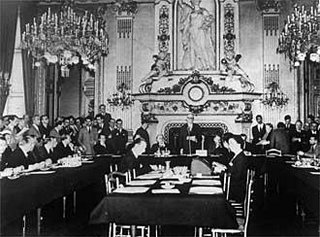
    Schuman announcing 'his' plan - like so much to do with the history of the EU, the photograph is a fake.  At the time, Monnet failed to arrange for photographers to be present, so the 'historic' event was reconstructed some days after 9 MayThis was the "Schuman Declaration" which now occupies pride of place on the EU's Europa website as the document "which led to the creation of what is now the European Union". Yet, according to one historian, although the plan was immediately greeted with great excitement by the press, the curious thing was that literally nobody knew exactly what it was about, not even Schuman.

    The whole thing was an elaborate charade, a meticulous coup by the puppet-master extraordinaire, Jean Monnet, to a plan he and his colleague Arthur Salter had devised all those years ago, to deal with a different war and an entirely different geopolitical situations.

    But, with the backing of the commission, the myth endures. Hilariously, though, when I addressed a group of 150 sixth-formers recently, on the history of the European Union, not one of them knew that 9 May was "Europe Day". For all the effort the EU has expended on cultivating its core myth, it has failed to have any decisive impact. It is truly an idea whose time has gone.

    The core of this narrative is drawn from The Great Deception by Christopher Booker and Richard North.

    COMMENT THREAD

    Another try-on?

    The shape of things to come?The Financial Times and others are telling us that the commission is calling for a greater EU role in judicial matters. This is Barroso, speaking in his home city of Lisbon, who claims greater EU involvement is needed to bolster cross-border efforts against terrorism and organised crime.

    But what is particularly wicked is that the commission president is calling in a the special Eurobarometer, declaring that "People are asking for more Europe in order to combat terrorism and organised crime. It is our duty to respond to this appeal."

    In that Eurobarometer, however – as readers will recall – the qualitative study revealed that, "the institutional workings of the Union and how decisions are made is a matter of nearly complete ignorance!. Thus, if people are calling for !more Europe", it is from a position of ignorance of what that might entail, and the consequences.

    Nevertheless, the lack of what might be called "informed consent" does not worry Barroso. But, as the FT reports, such a move "could face resistance from some countries," prompted by concerns that the commission is making yet another power grab.

    Yet again, though, the same old arguments are being wheeled out, that action is often delayed as police and judicial co-operation falls within the "intergovernmental" Pillar III provisions of the Treaty of the European Union, with decisions reached by unanimity.

    Barroso wants member states to give up national vetoes, moving to qualified majority voting (QMV), which would "make decision-making easier". And the UK, as always (remember Blair's "red lines"?) is not opposed in principle to such an idea.

    The crucial issue, however, is that the provision for QMV was in the EU constitution, so this is seen by some as yet anther attempt to smuggle the constitution in through the back door. Conservative MEP Syed Kamall says, "This latest attempt by the European Commission to take away yet more national sovereignty will just go to exacerbate Britain's impression of the EU as out of touch."

    According to Bloomberg though, details are very vague, and no formal proposals have yet been tabled.

    Possibly, the Finnish government, which takes the EU presidency in July this year, may firm up on proposals, although the growing Euroscepticism in that country may make that difficult. Equally possible, this is just another try-on by Barroso, desperately anxious to launch a high-profile initiative to bolster his own lacklustre presidency.

    Only time will tell.

    COMMENT THREAD

    Monday, May 08, 2006

    Our favourite Latin American dictators

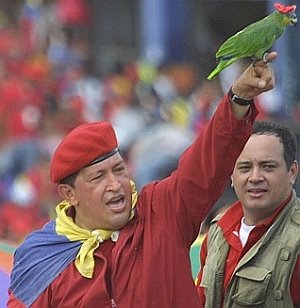
    Hugo ChávezSome time ago the writer and journalist John Derbyshire restated Orwell’s famous dictum:

    “Wherever there is a jackboot stomping on a human face, there will be a well-heeled Western liberal to explain that the face, does, after all, enjoy free health care and 100 percent literacy.”
    We have heard a good deal of this about Cuba, a country from which people seem to be very anxious to escape. It cannot be, surely, that they dislike free health care and 100 percent literacy?

    It seems that some of that free health care is now spreading to Venezuela, another country suddenly beloved by the Left and not so Left commentariat of Europe. We have it on no less an authority than Hizonner the Mayor of LondON that millions of Venezuelans, who have never seen a doctor in the past, are now treated by the Cuban medicos flown in for the purpose.

    How many Cuban doctors we are not told and how is it that they could just simply leave their own country en masse remains a mystery.

    It is, of course, obvious what Hugo Chávez and Fidel Castro have in common and it is not, strangely enough, ideology, the former being more of a nationalist than an internationalist despite the meddling in other countries. They are both challenging the United States and that seems terribly chic.

    Naturally, it was not so amusing when Chávez turned on the Europeans, forcing new contracts on them, which involved greater ownership by the Venezuelan government, sometimes to the point of outright confiscation or, as has been announced, deciding to tax companies working the Orinoco.
    “The tax and royalty increases will affect ChevronTexaco, ConocoPhillips and ExxonMobil of the US, as well as Total of France and Statoil of Norway. About $17bn has been invested in the four Orinoco projects since their inception in the late 1990s, and the projects are today estimated to be worth about $33bn.

    On Sunday, Mr Chávez said that Venezuela would tap extra revenue from the world oil price boom through what he termed an "extraction tax" on the Orinoco Belt operations, which are known as "strategic association" projects.

    "For next year the extra revenue looks like it will come to more than a billion dollars," he said. Venezuela's move to boost rates on the heavy-oil projects follows measures taken last month to convert 32 separate operating contracts, which accounted for about 500,000 b/d, into joint ventures in which the state holds majority stakes.

    That move upset some oil multinationals. Total and Italy's Eni, which objected to the conversions, saw their oilfields unilaterally taken over by the government, so far without compensation.

    Humberto Calderón Berti, a former energy minister, warned that Venezuela might also seek conversion of the Orinoco projects into state-majority joint ventures.”
    Chávez has also supported the forcible nationalization of oil fields in Bolivia, which may not be such a good idea for the industry. Bolivia is not a major oil-producing power yet and does not have customers all over the world, merely in Brazil. It is not in a position to play too many games with the market.

    Unfortunately, Hugo Chávez is already going the way most dictators do. He has just announced that if the opposition continues to boycott elections, citing various irregularities and El Presidente’s growing authoritarianism, he will have a referendum that will change the constitution to give him power for 25 years.
    “Speaking Saturday at a stadium packed with supporters in central Lara state, Chavez rejected allegations he was a power-hungry tyrant but said he might seek to extend his rule beyond current term limits if the opposition pulls out of the presidential vote, as it did last year's congressional election. ...

    The Venezuelan Constitution allows a president to be re-elected only once in immediate succession. Chavez is eligible for re-election to another six-year term in December, but if he wins he wouldn't be able to run again in 2012.

    It wasn't clear if Chavez, 51, was talking about holding a legally binding vote to eliminate limits on re-election or proposing a plebiscite. Before Chavez took the stage, thousands of his supporters chanted: "Oh, no! Chavez won't go!"

    Opposition leaders accuse Chavez, a former paratroop commander first elected in 1998, of becoming increasingly authoritarian and opening dangerous divisions along class lines in Venezuela — the world's fifth largest oil exporter.”
    Things are, in fact, going from bad to worse in Venezuela.

    Fearing that he might lose support in the barrios, Chávez has decreed that nobody can sell petrol for more than 3 cents a litre. Sounds great, except that the petrol stations, burdened as all businesses in that country with rising taxes, minimum wages and so on, cannot make a living.

    About half of them have told the ministry that they would like to close. At that point the joy of having petrol at a fraction of the cost that Americans pay for it will disappear. If nobody is selling the stuff, the cars will have to stop and that will cause some hardship in the country.

    But the biggest shock seems to have been barely noticed. On April 28 the Financial Times reported [subscription only] that
    “Venezuela, the world's fifth-largest oil exporter, has struck a $2bn deal to buy about 100,000 barrels a day of crude oil from Russia until the end of the year.

    Venezuela has been forced to turn to an outside source to avoid defaulting on contracts with "clients" and "third parties" as it faces a shortfall in production, according to a person familiar with the deal. Venezuela could incur penalties if it fails to meet its supply contracts.”
    The reason is not hard to seek for anyone familiar with the way socialized industries work and countries run by power-mad demagogues function:
    “Under President Hugo Chávez, PDVSA's oil output has declined by about 60 per cent, a trend analysts say has accelerated in the past year because of poor technical management.

    Mr Chávez's push to extend his influence throughout Latin America and the Caribbean with promises of cheap oil for friends and allies may be overstretching PDVSA's finances, however.”
    The story has now been reported by Mosnews.com, which quoted the Financial Times. It is, however, curious that it was not picked up by anyone else, least of all by those who would like to see something heroic in the plucky little challenger of the American giant.

    Venezuela is denying that the purchase of Russian crude oil has anything to do with declining production.

    COMMENT THREAD

    Is it any wonder?

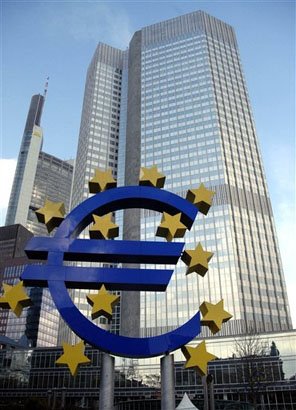
    the European Central Bank in FrankfurtReports on the economic health of the EU are out today and, depending on which source you prefer, the member state economies are doing well or very badly.

    If you prefer Associated Press, what it quaintly describes as the "European Union head office" is forecasting that the economy is "to rebound", expanding by 2.3 percent this year - compared with 1.6 percent last year - boosted by increased investment and sustained world growth.

    The only cloud in the sky in this assessment is the volatility of the oil markets, which remains "the biggest near-term risk" because "very low spare capacities" leave the EU vulnerable to supply disruptions.

    However, even this glowing account does not seem to hold together. Down-page, AP reports that, a against last year's growth of 1.6 percent, this year's 2.3 percent forecast level is not expected to be sustained. Next year, growth is expected to slightly slacken to 2.2 percent and, in the eurozone, growth is expected to be 2.1 percent this year before declining to 1.8 percent next year.

    Furthermore, this must be set against world growth, which is expected to reach 4.6 percent this year and only slightly less, 4.3 percent next year.

    Thus it is that Bloomberg reports that "risks to 2007 Euro-region growth" is "tilted to downside", citing the commission as saying that growth in the eurozone will slow next year as oil prices surge and rising interest rates around the world cool global growth.

    However, The Business yesterday puts a wholly different and much more negative spin on the data, picking up on the Spanish economy, suggesting that its overheating threatens the entire eurozone.

    The "one-size-fits-none" interest rate in the eurozone means that Spain is undergoing an unsustainable consumer boom, which will be followed by a savage bust, against the background of the eurozone once again drastically underperforming against the world's fastest-growing economies.

    The whole process may take two or three years to unfold, says The Business, with the Spanish economy will becoming even less competitive against its euro area peers, leading to a loss of business confidence, a rise in unemployment, a sharp downturn in the housing market and a rise in bad debts.

    Whatever your take on these data, the one thing that does shine out is that the European Union economies – and especially the eurozone – are sliding backwards compared with the rest of the world. Beyond that, one is reminded of the saying that, if all the world's economists were laid end-to-end, they still wouldn't reach a conclusion.

    Is it any wonder?

    COMMENT THREAD

    One of our excuses is missing

    The JSF - stealth as it never wasAs correctly forecast by this blog, it seems like the second engine for the new "stealth" Joint Strike Fighter (not pictured, left) is to go ahead, thus removing what we thought could be an excuse for the British government to cancel its order for the aircraft.

    The deal in not quite in the bag yet but, according to the Financial Times, two congressional committees have recommended restoring money in the 2007 defence budget for an alternative engine.

    Discussed here, this was very much expected. Although the Pentagon earlier this year recommended cancelling the engine, which was being developed by General Electric and Rolls Royce, the final decision on the defence budget - and thus any cancellation - is made by Congress.

    The decision to restore the programme has been made by the House armed services committee and, last Thursday, by the Senate armed services committee. While this does not guarantee funding, it sends a strong signal to the appropriations committees, which must approve the measure in the final budget.

    However, the situation looks hopeful, but perhaps not to the MoD. Conspiratorial or not, we felt that the lobbying by Blair personally, and leakage of Bush's rebuff, could have been set up to give him to excuse to cancel the JSF, clearing the way for the UK government to buy the French Rafale.

    As it stands, a decision by the British government on whether to participate in the production phase of the JSF is still expected in November, whence we will know where we stand on a "litmus test" project that will either reinforce the Anglo-American "special relationship", or spell its demise.

    COMMENT THREAD

    Sunday, May 07, 2006

    Death of a sage

    Jean François RevelNot the death of Bernard Lewis, I am glad to say, as he is flourishing at the age of 90 and will, no doubt, be producing more books. Nor do I propose to write much about J. K. Galbraith, whose death was announced a few days ago.

    The best thing I can do is quote from Mark Anthony’s funeral oration in “Julius Caesar”:

    “The evil that men do lives after them,
    The good is oft interred with their bones.”
    Galbraith was wrong in all his analyses and predictions. He thought that the Soviet economic system was superior to the American because it utilized the work force more fully. Well, those camps were pretty labour intensive.

    Worse, his advice, particularly to the Indian government about the need for state control and direction of the economy, lost that and other developing countries many possible years of growth.

    “So let it be with Caesar.”
    The sage I wish to write about is one whose death at the age of 82 was also announced a few days ago: Jean François Revel.

    Revel was one of the true French intellectuals, a writer, a journalist (he was for many years the conservative and pro-American editor-in-chief of the weekly L’Express. Subsequently he became a commentator on another weekly, Le Point, and on the radio.

    He was also one of the so-called 40 immortels, in other words, a member of the Academy. and, apparently, a bon vivant with gourmet tastes, as is appropriate to a French political philosopher.

    It is very unfortunate that when someone like that dies, the establishment, in this case the soi-disant poet, admirer of Napoleon and Prime Minister, Dominique de Villepin, find it necessary to heap praise on him.

    For Revel was truly a great man and a wonderful writer. Apart from Raymond Aron he was probably intellectually the most courageous French political philosopher and commentator.

    As so many on the Continent he started on the left of the spectrum and moved progressively towards liberal economic and political views. But even on the left he was not afraid to defend the United States as early as 1972 in his book “Without Marx or Jesus” or to attack the Western intellectual propensity to worship totalitarianism.

    His seminal book “The Totalitarian Temptation” was published in 1976 in French and 1977 in English. In it he still argued in favour of true socialism but proclaimed that the two enemies of it were the nation state and communism, the latter being far worse and oppressive than the former.

    Indeed, he drew an interesting parallel:
    “What difference in practice is there between those irresponsible “socialists” who, as soon as they come to power, impose their untested ideological principles on the management of the nation, with the result that production drops by one half – and, on the other hand, those irresponsible capitalists who permit an economic cisis in which a fall in production is accopanied by inflation and unemployment?

    There is in fact no difference, except that the damage done by the capitalists is often less extensive and less permanent, and that they spare us the sanctimonious sermons of the 'socialists’. At least capitalism is not satisfied with itself except in good times when it is performing sucessfully, whereas socialist boasting need not be based on any performance at all.

    Failure raises the socialist morale – luckily, since if its self-esteem had to be based on success, socialism would live in a state of constant humilation.”
    These were shocking things to say in the mid-seventies and not only in France. Indeed, I suspect many people would still be shocked by them.

    Revel went further, though. He mused whether there was a desire for totalitarianism actually present in some people, particularly intellectuals. His analysis of the way Western commentators, politicians, authors criticize ferociously the much more free system under which they live but refuse to see anything wrong with the then seemingly triumphant communist countries, could be applied to the same commentators or their successors.

    While Revel’s analysis of the way democracy was retreating and communist totalitarianism advancing may seem far too pessimistic after Reagan, Thatcher and the collapse of the Berlin Wall, his comment about anti-Americanism is, alas, all too realistic 30 years on:
    “Why does the President of the United States have to be heavily protected in Rome, Tokyo, Paris, or Stockholm against hostile demonstrators while in some Western cities any Eastern statesman walks or drives peacefully through friendly or indifferent crowds? Abroad, the only violent demonstrators that a Communist head of state fears are usually refugees from his own country.”
    Well, why, indeed? Has anything much changed in that respect?

    In 2002 as French opinion apparently hardened against the United States and in favour of numerous tyrants and terrorists, Revel published another book, another bombshell: “The Anti-American Obsession – Its Functioning, Its Causes, Its Inconsequentialness”. It was published in English in the United States but ignored in Britain, though some of its analyses ought to be of interest to us.

    Interestingly, it became a best-seller in France, which would argue that the united opinion presented by the French political class and media is a myth in that country as well.

    Revel, without pretending that America is perfect (what country is?) argued that the daily criticism and obloquy that Europeans heap on their ally and, for many years, protector, has long ago exceeded the bounds of decency.

    Instead of getting hysterical about the 2000 presidential elections, Europeans should have been examining their own “abysmally run” European Union. We cannot but agree with his view that the Europeans are desperate “to project [their] faults onto America so as to absolve ourselves”.

    Let us face it, much of the hysterical anti-Americanism, both on the left and the right of the political spectrum grows out of frustration. We are no longer in control of our politics and democracy in Europe is slowly evaporating. Mutatis mutandis this is similar to the rage and frustration that many in the Arab world feel. Instead of facing up to our problems and trying to sort them out we prefer to blame outsiders and who better than the United States?

    COMMENT THREAD

    A conspiracy of silence

    Lord Butler of BrockwellI am allergic to conspiracy theories and tend to prefer "cock-up" as the ruling power behind most adverse events in this universe.

    But Booker today in The Sunday Telegraph casts a conspiratorial glow on the strange silence of the politicos on the vexed subject of the European Union.

    The illumination comes from none other than Lord Butler of Brockwell, formerly Robin Butler, cabinet secretary under five prime ministers. He recently gave a talk to his old school, Shrewsbury, where he not only entertained his audience with some caustic comments on Tony Blair's handling of the Iraq war but startled them by observing that the biggest issue at the 2005 election should have been "Europe", because it is in Brussels that most of our important legislation now originates.

    It was contemptible, Lord Butler said, that the parties had conspired not to discuss this with the electorate, then noting: "Of course to readers of Booker this was not news!"

    Neither, of course, is it news to our readers, but it does confirm from a very high source with intimate knowledge of the Blair government that the absence of discussion on European Union issues is very far from accidental.

    Given its performance on this issue, one nevertheless expects the government to be reluctant to promote a debate, but it can only succeed in avoiding discussion if the opposition parties do conspire to keep it off the agenda.

    This in part explains our loathing of the Boy King, who was highly influential in setting the tone for Howard's general election campaign. His determination to keep the issue out of the headlines – which continues to this day – is a continued testament to his unsuitability to become prime minister.

    Worst still, it encourages those moronic commentators who pop up every time European Union affairs are raised, those who seek to marginalise people who are concerned for the future of this nation and who declare that "no one is interested in 'Europe'", demanding that we concentrate on "mainstream" issues.

    But the only reason "Europe" is not mainstream is that very conspiracy of silence to which our former senior civil servant referred. We are pleased to have the importance of the issue reaffirmed from so senior a source and will, of course, keep "banging on", despite the silence of those conspirators who would seek to ignore it.

    COMMENT THREAD

    A personal tale

    Reading and listening to exchanges on migrant labour, I am going to depart from our normal practice of providing a commentary on the days events and offer some observations, based on personal experience, which might help fuel and inform the debate.

    By way of background, one starting point is my earlier experience as a consultant environmental health officer, specialising in food safety, when I used to inspect dozens of "big name" hotels and restaurants in London's West End, on behalf of their owners.

    The main part of my job then was inspecting the kitchens and writing reports on the conditions found. And, as you would expect, most of the problems related to cleanliness, which I would laboriously record, time and time again.

    Over the years, what I found were two things – that the same problems constantly recurred, and that the root of those problems was the employment of low-paid, most often migrant labour, who were simply not up to the job.

    But, when I pointed this out, I was told that the economics of the catering business did not allow better wages and, in any case, British workers (except the very dregs) would never be prepared to do such low-grade jobs as kitchen cleaning.

    And, believe you me, the job – most often described as "kitchen porter" – could hardly get any lower in the social pecking order. In my researches, I actually took on the job, working as a cleaner in the hothouse of a number of kitchens, and you very quickly learn that you are the lowest of the low.

    Frankly, I was bored with writing the same old reports about the muck I had found so, with one particularly enlightened employer, I set about changing the nature of the job.

    To do this, I researched means of mechanising many of the more arduous tasks, and making them more interesting. For the most deadly and time-consuming job of them all – pot washing – I found a device used in the automotive industry, used for degreasing components, called an ultrasonic tank. With some modifications and the right chemicals, we found that heavily soiled kitchen utensils could be immersed in the tank – sometimes for only a few minutes – and come out factory new.

    So efficient was the machine that, in one kitchen - for the modest expenditure of £5,000 – we replaced two low-paid men with one man, who also did other duties.

    For the general cleaning, I found specialist floor scrubbing machines, even wall scrubbing machines, and bought high-pressure cleaners to do things like ovens, together with air-powered tools to replace the ubiquitous scrapers.

    In a group of six restaurants, I then took out one low grade porter from each, and created a team of four, specialist, peripatetic "technicians". We gave them uniforms, special training and – a higher grade of pay but, with being able to dispense also with periodic deep cleaning, the overall costs were less and the standards immeasurably better.

    To my great delight, such was the status of my new "team", and so high was it held in the esteem of the company, that when vacancies came up, we actually had chefs applying for the job – chefs applying for jobs as cleaners!

    After than experience, I was employed as a consultant to a major multi-national contract cleaning company, to set up a kitchen "deep cleaning" operation. I applied the same magic, this time recruiting, quite deliberately, ex-prisoners for my workforce. I found them hard-working, loyal and incredibly effective. The first job I took on was an inherited contract, cleaning a hospital kitchen. Normally taking three weeks, with twenty (low-paid) staff, I put in eight of my technicians and we cracked it in five days.

    To my amazement, however, my ideas were not welcome in the group. Then, one of the senior directors took me aside and explained what the job was really about.

    Contract cleaning, he told me, was not about cleaning – it was about making money. And the industry base was "cost-plus", adding a percentage to the wages of every cleaner employed. Thus, the more cleaners on the contract, the higher the charge and the greater the profit. However, the greater profit came from keeping wages low, so that cheap, migrant labourers were at a premium.

    There was simply no mileage in better trained, more efficient workforces. The individual profit margins might be higher, but the net yield was lower, so there was more money in having a large, unskilled workforce.

    In building terms, there is a similar equation. Recently, we had our own kitchen refurbished. Two local workmen turned up on the appointed day. The equipment was delivered and, four days later, we had a brand, spanking new kitchen, finished on-time, to budget, at a very reasonable cost, with a superb standard of workmanship.

    In Yorkshire, we have no shortage of good craftsmen and building workers, and it used to be common practice for teams to take vans down to the "smoke" for the working week, enjoying the cheaper living standards here while taking advantage of the higher wages in the capital. But their employers got greedy, lifting charges (but not wages) to exploit the local labour shortages and then, as the limit was reached, employing cheaper migrant labour to keep up profit margins. Man for man, though, the highly-skilled Yorkshire tradesman, is better value, but there is no premium in efficiency.

    Many of the notional gains from employing migrant labour, therefore, are illusory, based on the economics of the madhouse. Better skilled, indigenous labour can often do the job more economically, if the charging framework allowed it.

    But there is another aspect to this. On the broader national scale, what is the economic value is getting migrants in to do the job if that means your British workforce is sitting idle at home, on the dole or on benefits – or out thieving, to make a little bit on the side.

    The same also goes for manufacturing goods, especially in terms of public procurement. If a public authority buys "offshore", then – since this is paid for by the taxpayer - a simple calculation should apply. Take the "offshore" price and then compare it with the price from a domestic manufacturer. But, in respect of the domestic price, deduct the amount of tax that will be paid by the supplier and his employees. Then, to the "offshore" price, add the total cost of the dole and benefits that will be paid to British workers sitting idle because the work went to foreign workers. In many instances, the "cheapest" price turns out to be very expensive.

    The trouble is, that in assessing the individual costs of project, the supplier of services or the purchaser of cheap foreign goods does not bear the social cost of their actions. They may get the benefits of the cheap labour, or the cut-price imports, but the taxpayer pays the real price.

    As for the bullshit that the migrants are "only doing jobs we would not do", no more is this used than in agriculture, where – it is claimed – that British people simply would not do the job.

    Yet, in my youth, I spent a year on an Israeli kibbutz, working for nothing as a farm labourer, doing precisely the jobs which our industry tells us the British won't do. And the "tourist camp" – as the Israelis called it – was one of hundreds, housing thousands of young foreigners who kept Israeli agriculture going while their sons and daughters went off to war.

    Now, the situation is not analogous but, with a little imagination, I have no doubt that "farming camps", set up for British students and youngsters – with basic entertainment and other diversions – could be highly popular. We don't know that, and will not know it, because it has not been tried and will never be tried.

    Yet, during the war, when hundreds of thousands of middle-class women were conscripted into farming, as part of the Land Army, many counted the time spent as the happiest in their lives. My own mother was one such.

    In short, there are many different facets to the use of migrant workers and while – or so they tell us – there are economic benefits, these may be overstated, while the downsides are all too apparent. For sure, any one of us can gain short-term, from the Polish plumber – especially when getting a local seems impossible – but there is more to this than saving a quick buck. There are other ways round local labour shortages and difficulties, without having to resort to migrant labour in what amounts to a "race for the bottom".

    Opening our borders to the unrestricted flow of migrant workers, from the EU or anywhere else, has never been a good idea and, in many respects, British society is suffering the trauma from earlier phases of such a policy, when huge numbers of Jamaican workers were imported to solve post-war labour shortages.

    It is this, in its diffident, and ill-expressed way, that UKIP has been pointing out. It is one of the few parties that have attempted to raise this issue – apart from the BNP, which loses out because of the racist overtones – and this issue is certainly one that should be discussed widely. Knapman, with his little antics, has betrayed his own party, and made rational discussion that much more difficult. But, as I suggested on my earlier post on the BNP, simply not talking about it won't make it go away.

    COMMENT THREAD