Tuesday, November 15, 2005

Condi has sleepless nights

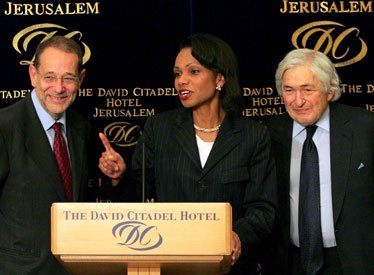
For reasons that may not be entirely clear to everybody, Secretary of State Condoleezza Rice has made the progress on the Palestinian state her very own project. Maybe, having been known as a Russian expert and having not managed to understand the European Union, she is enlarging her specialist expertise.

Whatever the reason, she postponed a trip to the APEC meeting, to stay in Jerusalem and beat her way through to an agreement on the Rafah crossing between Gaza and Egypt.

Secretary Rice has spoken soulfully of the various things the Palestinians, especially in Gaza, need, in order to achieve economic and political progress, saying of the latest agreement:
“This agreement is intended to give the Palestinian people the freedom to move, to trade, to live ordinary lives.”
Somehow, she forgot to mention that one of the things they need to achieve all of that is a little less fighting between the various militant groups.

She has tried to put pressure repeatedly on Mahmoud Abbas to stand up to militant groups but neither the pressure nor Abbas’s own rather vague promises have achieved anything. In fact, according to Reuter’s
“In a sign of tensions, President Mahmoud Abbas, in a speech after the Gaza deal was unveiled, accused Israel of trying to avoid peace talks and incite Palestinian civil war by insisting that militants be disarmed before any negotiations on statehood.”
Pretty unreasonable, I call it. Anyway, after long negotiations that have left the Secretary of State looking less than her usual radiant self because of lack of sleep certain arrangements have been achieved and the EU is very much part of it.

The Rafah crossing will be open and will be monitored by Palestinian border guards and European Union security forces, so far unspecified. The Israelis had tried to insist that they be given real-time video information about crossing as they are worried about arms and terrorists being smuggled through Rafah.

The Palestinians have insisted that Israeli presence would impinge on their sovereignty. Reuter’s reports:
“An Israeli Defense Ministry source said a compromise was reached whereby Israeli and Palestinian security officers will man a control room a few kilometers (miles) from Rafah monitoring remote-control cameras at the border crossing.”
The BBC World Service website describes the agreement slightly differently:
“The deal also includes video surveillance of the Rafah crossing to Egypt by a joint EU-Palestinian team.

Israel will have access to the video via the Europeans, but will not have veto power over individuals moving through Rafah, as it had wanted.”
One hopes that the first terrorist atrocity carried out by someone who was allowed through Rafah will produce a certain amount of soul-searching but one does not hope too much.

Secretary Rice will smile radiantly and plead for more patience on the part of the Israelis, while the EU will swank around on its first really big overseas mission. It is, of course, also supposed to be training the Palestinian police force, a task it has not in the past been particularly successful in, the Palestinian police force not being one to reckon with.

Other aspects of the deal include travel for Palestinians between Gaza and the West Bank some time in the near future, the building of Gaza seaport and a possible airport (presumably on international money), and “allowing the urgent export from Gaza of all the agricultural produce of the 2005 harvest”.

COMMENT THREAD

The EU's spies in the sky

An extraordinary article in The Daily Telegraph today announced that the EU is "to build network of spy satellites".

The multi-billion-pound system is known as "Global Monitoring for Environment and Security" (GMES), on which the commission, with the European Space Agency, has already spent £154 million on preparatory work, and expects the whole project to cost £1.54 billion between 2006 and 2013.

But what makes the article so extraordinary is that this project was actually announced in March 2002 and its definitive structure was set out in a commission communication in February last year.

However, far be it for us to look a gift horse in the mouth. Anything which draws attention to the EU's plans in space is welcome, especially as the Telegraph piece, by David Rennie, tells us that this network of spy satellites will allow Brussels "to ensure nations and private individuals are obeying its policies."

Also of interest is that, while the system was originally intended to be up and running by 2008, the date has slipped to 2010, according to a commission spokesman, announcing the launch of a "pilot stage" for GMES.

Predictably, as it has done with Galileo, the commission stressed its "user-friendly" application in guiding relief work after disasters or providing real time images of forest fires or oil spills. But, writes Rennie, “a commission memo” also acknowledged that GMES would play a key role in the "implementation, review and monitoring of EU policies", including watching for agriculture and fisheries fraud and boosting "internal security".

In addition, Rennie continues, officials hope GMES will support the EU's first steps towards becoming a military power. It will "provide authorities with necessary elements for a European Security and Defence Policy", the commission memo said.

That "memo" was the commission communication produced in 2004 (link above), but never mind – it is good to see this Blog's warnings in print in the MSM, especially as Rennie goes on to write that US politicians are already suspicious of Galileo project.

Curiously, there is nothing written of UK involvement in GMES but, as part of the EU and a member of the ESA, we will be funding the system, even though, traditionally, we have largely relied on US satellite data. Once again, therefore, the UK is piggy-in-the-middle, with yet another strand pulling it in the direction of Europe.

COMMENT THREAD

Be careful what you wish for

So, for the eleventh year, the EU's Court of Auditors has refused to sign off the accounts. That much was revealed by ECA president Hubert Weber at the EU parliament in Strasbourg yesterday, leading to a predictable chorus of disapproval, not least from the Conservatives and UKIP, which denounces "The EU's Fairytale Accounts".

However, while your average Eurosceptic may be crowing at yet another example of the EU’s ineptitude, not everything is quite as straightforward as it seems. Several reports, not least in Eupolitix and The Independent point up that because about 80 percent of EU spending is conducted by national and regional authorities and it is in these areas that the greatest concern is expressed by the Court.

Says Weber, "The supervisory and control systems are not yet implemented and operating effectively and payments are still affected by errors," adding that agricultural spending was particularly error-strewn. Far from directing his ire at the commission, therefore, Weber was particularly critical of the national authorities, stating that "The improvement in systems and controls at the level of the commission has not been reflected in those within the member states."

Even the triumphant Conservative MEP James Elles is warning that the member states must face up to their responsibility to ensure euro-funds channelled through them were better accounted for. He is echoes by Chris Davies, leader of the British Liberal Democrat MEPs, who declares that: "The finger of blame should be pointed towards Gordon Brown and his fellow finance ministers who have refused to accept responsibility for the money spent by their own administrations.”

As for the commission, in its classic, gruesome Euro-speak, it is telling us that it has:

…proposed to the other institutions a roadmap to an integrated control framework, which will provide the Commission and its stakeholders with a reinforced assurance as to the legal and regular use of EU monies, including under shared management with Member States. The Commission has undertaken an analysis of the gaps between its existing internal control framework and that advocated by the Court of Auditors in its opinion 2/2004 on the "single audit" model and a proposal for a Community internal control framework. The gap analysis has been discussed by an expert panel with representatives from all Member States in September 2005, and is being jointly examined by Commission services and the auditors.
Cutting to the chase, this simply means more power to the commission to vet member state accounts, an inevitable consequence of a supranational system where the central government – in this case the commission – is disbursing funds to its subordinate tiers.

Never mind the overt fraud and maladministration in the commission itself, the responsibility for the bulk of the funds that are not properly accounted for does lie with the member states. To cure that, the commission needs more power. Those who want more accountability, therefore, had better be careful what they wish for.

The alternative, of course, is to get rid of the EU budget altogether, and have member states paying their own way, with their governments accountable to their own parliaments. Now, that would be a refreshing change.

COMMENT THREAD

More bilateral problems?

Old enmities die hard, and never more so than between Poland and Russia. Relations are already strained by a deal between Russian and Germany to build a $5 billion gas pipeline under the Baltic Sea, bypassing Poland and the Baltic states and taking Russian gas directly to western Europe - thereby depriving the detoured countries of lucrative transit fees.

This is on the back of Ukraine's "orange revolution", when Poland acted as mediator, and pro-Western Viktor Yushchenko beat his pro-Russian rival Viktor Yanukovich in the disputed presidential election.

Relations then worsened in May, when Polish President Aleksander Kwasniewski was snubbed by Russian President Vladimir Putin during a visit to Moscow to mark the 60th anniversary of the end of World War II.

But now, inexplicably, according to Polish foreign minister Stefan Meller, Russia has imposed restrictions on imports of Polish farm produce and meat.

So serious is the situation that, prime minister Kazimierz Marcinkiewicz is appealing to the EU commission to help sort it out, with the news agency AFX reporting that he has even made a public appeal on national radio.

The Russian authorities are saying that they have taken their action because of fraudulent practices among Polish exporters, including falsification of health and hygiene certificates, as if a member of the European Union could ever stoop so low.

In Poland, the restrictions are considered politically motivated and aimed as a test of the new conservative minority government led by Marcinkiewicz. "All the signs from Moscow must be analysed in a political context," Meller said in the Polish Rzeczpospolita daily. "If the incidents of which Russia accuses us did occur, they were already known," he said.

So far, there are no tanks massing on the borders but it remains to be seen whether the commission will intervene or whether, as so often is the case with the Eastern and central European states, their external relations are suddenly, in defiance of the Common Foreign and Security Policy, merely "bilateral" problems.

COMMENT THREAD

Monday, November 14, 2005

French leave

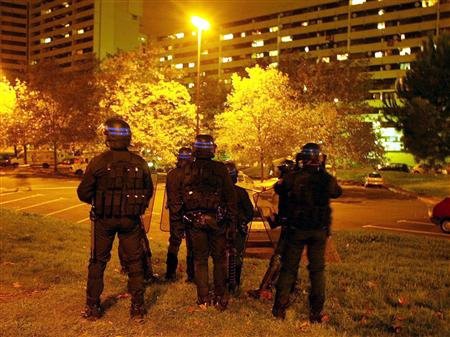
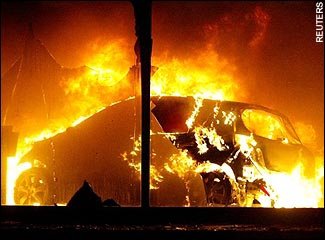
Riots can go one of two ways. If there is a big enough impetus they can turn into a real revolution or they can slowly peter out. It looks like the French riots of the last two weeks will go the second way. For the time being, that is.

It seems that only a few hundred cars are burned every night instead of the 1,200 or 1,300 that were being torched just a few days ago. Am I the only person around who is finding two things slightly odd: one is the number of cars in the banlieus; and the fact that nobody thinks of moving the ones that had not been torched to a safer place during the day. I hope we get an explanation for it all some time.

The European Union, as my colleague has pointed out, has finally made its appearance with offers of dosh, though, it could be merely credit relief. Hard to tell. In any case they are offering €50 million to help build various facilities in the horrible and now severely damaged areas.

That is very generous, particularly as this is our money that is being shelled out. But has nobody managed to recall that at least £58 million from the social housing fund has been misappropriated by various politicians of the UMP while l’escroc Chirac was Mayor of Paris. (That is the sum we know about definitely. There have been other unresolved cases about money that belongs to the people of Paris disappearing.)

It is not only the banlieus that are the problem. It seems that we have forgotten a few other fires: one big one last year, two slightly smaller ones this year of tenement blocks for immigrants. In each fire a large number of children died. Had these tenements been inspected by the fire brigade, one wonders.

Apart from a few copy-cat car torchings the riots did not spread to other countries (the matter of Århus is different and needs to be discussed separately), which would vindicate those of us who have maintained from the very beginning that this is not a jihad but a long overdue explosion caused by the various tensions within France.

Last Thursday John Vinocur wrote in the International Herald Tribune:
“On one hand, there is French hubris, and its gratuitously insulting embrace of France’s immigrants as partners in the country’s threadbare formulas of grandeur, equality and universality.

On the other, there is the eternal French dependency on the state, the allegiance to the French model that has failed to provide the jobs, education, housing or respect adequate to integrate Arab and African Muslims into a rich and resourceful country with real claims to special grace.”
Added to which there is the disintegrating social and economic structure, as numerous commentators have noted.

Yesterday’s Business carried an editorial on the subject, entitled “Why Paris is burning”, which placed the blame squarely at the stagnant French economy and regulation-laden society.
“The riots have been seized on, sometimes gleefully, by excitable right-wing commentators as the intifada of a new Eurabia. It is more accurately seen as the unthinking rebellion of an underclass. It has been one of the more sophisticated criticisms of the Left that capitalism in the Information Age has created an unemployed (and increasingly unemployable), marginalised underclass amid general prosperity, a group with none of the strengths, culture or ambitions of the old industrial working class.

Current events in France show that left-wing, big-government societies in the 21st century, for all their emphasis on welfare and social solidarity, have an underclass of their own, whose condition may be even more hopeless than the underclass of capitalist societies. On the streets of the rougher French suburbs this past fortnight, we have just glimpsed the grim underbelly of the European social model.”
The article then enumerates the problems with jobs: the high regulatory cost, the expense of employing people and the impossibility of laying them off, the high minimum wage – it all adds up to a country where employers will keep the pay roll to a minimum. Given the basically racist attitude of much of France, it is easy to see who would suffer in a stagnating country.

Or as John Vinocur writes of the internal contradictions:
“An Arab kid in Clichy-sous-Bois may not articulate it, but what rage it must create to hear he lives in the greatest, smartest, most fair country in the world, revered as Islam’s best-friend-in-the-west from Algeria to Oman, and then have to deal with a French realityof racist scorn and rejection.”
In so far as Mr Vinocur offers any solutions, they are precisely the ones that the Business editorial rejects as being actively harmful:
“It is tragic to hear calls to smother these flames with yet more money. Throwing alms at the impoverished suburbs has been tried for 30 years in France: it is no substitute for market-led policies which find people jobs. Prime Minister Dominique de Villepin has proposed to add E100m in subsidies to local community associations, add 5,000 teaching assistant posts, offer 20,000 work contracts with local governments and set up an anti-discrimination agency.

It is a dismal dirigiste prescription and shows he has learnt nothing. Billions have already been spent on infrastructure projects for the ghettos and achieve nothing. Using taxpayers’ money to create non-jobs simply drags the wealth-creating side of the economy down further.”
Certain other voices have been heard from the business organizations. Though they, too, talk of affirmative action they are also pointing out ever more loudly the difficulty of running businesses and employing people in France. (All of which, as the Business points out, slowly overtaking Britain under Gordon Brown’s stewardship.)

It is time to start speculating about the effect these events might have on future French politics. While the opinion polls are showing support for Dominique de Villepin, there is no reason to suppose that the government or any of its members has come out well.

President Chirac was all but invisible, though he has now reappeared to make a grandiloquent presidential statement about France's malaise; Nicolas Sarkozy talked tough but failed to control the riots for whatever reason; de Villepin appeared late, announced a completely unnecessary state of emergency (according to which local authorities have the right to close down cafes, should they think it necessary – that’s when the real riots will start) and appears to have spent all his time trying to upstage Sarkozy.

Meanwhile Le Pen is claiming that people are streaming into his party and he is probably right. His own showing in the next election should be interesting.

The Paris Bureau Chief for Dow Jones Newswires, Pierre Briançon, writes in today’s Wall Street Journal Europe [subscription only]:
“The Sarkozy and Villepin camps are already back to poling and counting potential votes. One can already see how the blame game will be played once a decent interval elapsed after the crisis. Mr de Villepin will note that something must have been wrong at the interior ministry to let such events develop. And Mr Sarkozy will point out that he was not responsible for job creation.

With the ailing president absent and the fractured left mum, France is a headless body. It’s been a very long time, in French political history, since a leader of either persuasion has stepped back, paused, thought and wondered what would be in the public good, whatever the pollsters might tell him.

Cynicism is played in the open through infighting at the highest levels and with the media counting points as ringside judges. And if the ruling elites have their say, nothing will move in the next 18 months as no one will want to take the risks unavoidably associated with reform. So, everyone, back to normal.”
Which is all very well but the problems will not go away. The next lot of riots might be a little nearer the centre of cities and the next lot of political shenanigans might disgust the people of France even more.

There is just the possibility that what we are witnessing is the beginning of the end of the Fifth Republic, that is becoming enmired in political feebleness and corruption, just like its predecessor. As it was created out of the turmoil of the Algerian war, it would be fitting if it disappeared in the turmoil that its outcome eventually brought to France.

The invisible hand…

We have remarked on it before and even last night there was a particularly egregious example of EU requirements being discussed, without the EU even being mentioned. And here we go again.

In that well-known publication, The Bradford Telegraph and Argus – which boasts that it outsells the combined total of national dailies within its area - features a long article by David Snowball, assistant regional director of the Health & Safety Executive, to commemorate "ladder week".

Headed: "steps to ensure the safety of ladder users", Snowball deals in detail with the hazards of ladder usage, with reference to the government's Work at Height Regulations, to which effect his organisation's "ladder week" has been devoted.

But nowhere in his article is there any mention that the Regulations to which he refers are based on and required by the EU’s working at heights directive (Directive 2001/45/EC, 27 June 2001). Bizarrely, there is not a single mention of the EU in the whole piece. You would think there was something to hide.

COMMENT THREAD

Taking the city by storm

In a recent council by-election for Edinburgh City - Murrayfield Ward, on 10th November 2005, the Conservatives polled 1327, against the Lib Dems on 859, an Independent candidate on 226 and Labour with 114.

The Greens scored 58, the SNP 52, and the Liberal Party 12. UKIP, however, stormed home with four - yes, four - votes. What makes you think they are flogging a dead horse?

COMMENT THREAD

Where there's EU, there's brass…

It used to be, as the great Yorkshire saying went, where there's muck, there's brass, but that has now been overtaken by the great European Union which is creating untold wealth for a select few in the recycling business.

According to the Telegraph business section today, Britain’s largest scrap metal group is coining it, having seen sales surpass £1billion for the first time last year. This is after tackling 20,000 cars and 12,000 fridges a week handed over for scrapping, all courtesy of the EU.

The firm in question is European Metal Recycling, which has recycled its one- millionth fridge at its £2.5m purpose-built facility in Willesden Junction, in north-west London, and has reported company profits nearly doubled to £101m in 2004 on sales 40pc higher to £1.15billion.

The company is chaired by Philip Sheppard, dubbed "the god of metal recycling", and who this year leapt from equal 206th to equal 93rd in the Sunday Times Rich List with his family and their estimated £510m fortune, with the highest-paid director receiving £6.75m, including pension contributions, up from £5.95m in 2003.

Meanwhile, on Radio 4's Westminster Hour last night Andrew Rawnsley ran a feature on the expected increase in council tax, hearing complaints from Wolverhampton Council that the current government targets on recycling were adding at least a £1 million to the council’s annual bill – with not a single mention of the EU.

Likewise, Bradford's current edition of its local propaganda news sheet, Community Pride, proudly headlined its "Waste crime clampdown", recording how fly-tippers were among the targets "during the biggest crackdown on waste crime ever".

Of course, with the Landfill Directive coming into force in July last year, closing down nearly 190 of the 200 toxic waste tips in the country, and making tipping so much more expensive and difficult, fly-tipping has become epidemic throughout the nation - but this is not mentioned.

Never mind, according to Community Pride, officers from Bradford Council's environmental services department, with "colleagues" from the Environmental Agency, West Yorkshire Police, West Yorkshire Trading Standards, Leeds City Council and Customs and Excise, were on the case, in their fabled clampdown.

Small wonder that Ruth Lea is complaining in today’s Personal View that: “Our overweight public sector is threatening to devour the economy”. But, for those officials, on their weighted salaries, guaranteed annual increments and final salary pensions, they're not worried. They are too busy blessing the EU for the job opportunities it is creating.

COMMENT THREAD

The dog barks

Throughout the prolonged spasm of rioting in France, now in its 17th day, one dog which has been strangely silent is the European Union. Quick to give its opinion – wanted or not – on any manner of issues, it has refrained to commenting, much less offering anything like criticism.

Now, that silence is broken. El presidente Barroso has leapt into the foreground, not of course criticising France but actually offering money - €50 million, "to help it tackle problems in its suburbs that have provoked unrest”.

According to Reuters, Barroso revealed his offer on Europe 1 radio, stating that the main challenge facing France in dealing with impoverished suburbs was to create youth employment, "The best social politics is to create employment," he said. "When you have 60 percent of youths unemployed in suburbs it is a problem."

Interestingly, Barroso said he had offered to make the funds available in a letter to Villepin on Friday. "If the French authorities want to do this with us, it is possible to do it with a rescheduling of credits," he is reported as saying, which seems to suggest that this is not new money. Could it be that Barroso is grandstanding? Perish the thought.

COMMENT THREAD

Sunday, November 13, 2005

Pass the ammunition, s'il vous plait

Few stories I have reported over the years, Christopher Booker writes in The Sunday Telegraph have been more significant than my revelation last week that Britain's Armed Forces are for the first time in history to become dependent for their ammunition and missiles on explosives imported from abroad. The planned closure of our last two Royal Ordnance explosives factories means our forces will be unable to operate without the tacit consent of foreign governments, notably that of France.

Booker is picking up on the story rehearsed on this Blog earlier this week, which is hardly surprising as, amongst my many day jobs, I provide a research function for the column.

Thus, reports Booker, duly informed by the Blog, almost the only paper which picked up on this was Defense News, the leading US defence journal. Meanwhile it was not denied in the carefully worded answers given to questions I put to BAE Systems, owners of the plants due to close, and the Ministry of Defence. He continues:

BAE Systems refuses to admit where it plans to source its explosives (although it is now in partnership with a French state firm which boasts of creating hundreds of jobs). It merely insists that the MoD has approved its plans as being aligned with the ministry's "defence industrial strategy".

Since the MoD is now sourcing most defence contracts with our EU "partners", in line with its policy of European defence integration, this is hardly surprising. The MoD itself merely says it is "confident that BAE Systems has in place a robust supply chain for the delivery of general munitions with alternative sources in place to guarantee continuity and security of supply".

The MoD also announced last week that it is to close large parts of its aviation and military repair and engineering services, with the loss of 1,900 jobs. The Army's engineering service was part of an Anglo-US consortium bidding for the Army's biggest-ever trucks order, which would have created 600 British jobs.

To the surprise of defence experts, this £1.1 billion order went instead to a German firm, Man-Nutzfarzheuge, now boasting on its website that this will "safeguard jobs" in Vienna. Considering the huge price we are now paying for it, the MoD must be delighted that its new "Europe-first" policy continues to attract so little public notice.
Needless to say, the very idea that a "Europe-first" policy exists is hotly disputed, strangely by defence industry sources as well as the MoD. In response to my article in The Spectator on 15 October, Nick Prest, former chairman of Alvis Plc and the Defence Manufacturers Association takes me to task in a letter, published 5 November.

Writing as someone who has been in a senior position in the UK defence industry, he says, I do not recognise the picture painted by Richard North of a UK government policy of "Europe first" in defence procurement. Where he cites particular decisions on armoured-vehicle programmes as evidence of this policy he has simply got his facts wrong. Prest continues:

The UK approach is, broadly, to source from UK companies where the right equipment is available at sensible cost. When it is not, the MoD looks mainly to the US, but also to Europe, for allies with advanced technology to fill the gap. Which way to go on an individual project is a function of cost, technical performance, risk, employment and industrial considerations, and a desire to keep some balance between transatlantic and European commitments.

In this sense, UK policy on defence procurement is a microcosm of broader national policy, which is precisely not to choose between US and European destinies. Nothing discomfits Whitehall more than the idea that one day it may have to. Until now this has been a broadly sensible policy in defence procurement.

The real and interesting question is whether it will continue to be. Because of rising costs and shrinking budgets, the UK is increasingly looking overseas for defence technology. But the US relationship is an unequal one. We need their technology much more than the Americans need ours. As a result, the US is loath to share key aspects: for example critical software for the Joint Strike Fighter. Without this the UK does not have sovereign use of a system which could be fundamental to national security.

For all the difficulties in funding and efficiency that afflict European co-operative programmes, it is at least possible to establish true reciprocity in technology exchange. But while continental firms are consolidating in Europe, UK firms are focusing their efforts mainly on the US market. This, in the long run, combined with the UK's commitment of resources to transatlantic programmes, may make it more difficult for the UK to participate as a full partner in European defence technology development. Then we may not get what need from either flank. In the words of the Swahili proverb "he who rides two horses breaks his backside".
One suspects that Mr Prest has neither read my full paper The wrong side of the hill , or Christopher Booker’s recent columns, otherwise he could hardly have missed our finding that excess costs of the "Europe-first" policy exceeds £5.8 billion, plus another £8 billion to come on excess spending on the FRES programme.

It remains a mystery, therefore, why senior figures throughout the defence establishment are so keen to deny that which is demonstrably provable.

What is interesting, though, is Prest's comment that continental firms are consolidating in Europe, while UK firms are focusing their efforts mainly on the US market. Coincidentally, this is borne out by a long "puff" in The Business, headed "Finmeccanica aims to become a global force".

This story is about the Italian state-owned aerospace compnay, Finmeccanica, the owner of helicopter-maker AgustaWestland, which, says The Business, "claims the UK as its 'second home base'".

But, we are told, the Anglo-Italian aerospace and defence company has ambitions well beyond the boundaries of Europe: it has set its sights on far flung frontiers including Russia, China and America.

All this looks very good, especially as, in China, it is involved in a joint venture, setting up an assembly line for the production of 109 civil helicopters while, in America, Finmeccanica’s aerospace division Alenia Aeronautica is in line for a good share of work on the 787 Boeing, the new Boeing flagship. And it is also aiming to capitalise on the special relationship between the UK and US that Finmeccanica to bid in a new $13bn competition for about 150 combat search and rescue helicopters.

And, closer to home, the piece concludes, Finmeccanica intends to be at the forefront of European defence consolidation. As Remo Pertica, co-chief operating officer, told The Business last week: “We think we could play a very important role in European aerospace and defence.”

Now go back to January 2002 - a year after Westland had been “merged” with the Italian helicopter maker Augusta, and taken over by Finmeccanica - and look at the practical implications of this “European defence consolidation. Headlines at the time were blaring, “Westland announces 950 job losses”, followed in March by a perceptive piece in Aviation Today.

The rationale behind the merger, it wrote, has been neither clear nor convincing. Although AgustaWestland was a single entity, the 950 jobs to be cut at Westland were not spread across the board to the Italian partner, nor was any work being transferred from Italy to take up the slack at the British factories.

Then, when in January 2005, AgustaWestland US101 was selected by the US Navy for the
presidential helicopter replacement programme, the company celebrated by announcing another 640 job losses at Westland.

A week previously BAE systems announced 2,000 redundancies across the country, all at a time when our purchases from European suppliers have never been higher.

Booker’s story this week, redolent of the chaplain at Pearl Harbour in December 1941 who was heard chanting "praise the Lords and pass the ammunition," is headlined: "Pass the ammunition, s'il vous plait", a clever play on words which sums up the fact that we are now reliant on the French for crucial war supplies.

But, if we are importing the material, we are also exporting the jobs. And all we get are denials.

COMMENT THREAD

Those familiar concepts

The Sunday Telegraph has picked up a story my colleague wrote about back in September, though, to be fair, he found it in the Financial Times Observer column. Presumably, because the Commission official was not named in the original story, Justin Stares in Brussels has decided that these are two separate people. Or, maybe, he simply does not read any other newspaper, let alone any blog.

Still, the story does bear repeating, reminding us as it does of past accusations issued against whistle blowers by the Commission and those of us with longer memory of the way the dear departed Soviet Union used to deal with dissidents.

It seems that Jose Sequeira, a Portuguese career diplomat, who has been working in the Commission’s ministry for development (what on earth is that?) has found, to his surprise, that there are entries in his personnel notes which said that his behaviour “sowed doubt regarding the state of his mental health”. Well, not creeping schizophrenia, at least, so beloved by Soviet psychiatrists.

What was this behaviour, one asks oneself? Or, rather, one asks the Commission? According to the Telegraph article
“He was put on permanent sick leave after tests found he suffered "verbal hyper-productivity" and a "lack of conceptual content" in his speech.”
And there I was thinking that those were absolute prerequisites for getting a job with the Commission. They certainly are if you want to be the Commissar for Truth and Reconciliation. Just read the fragrant Margot’s blog if you do not believe me. A clearer case of verbal hyper-productivity and lack of conceptual content I have yet to see.

It seems that Mr Sequeira was offered early retirement, which he refused. Now early retirement, especially if it is in any way enforced, is expensive business with the Commission. The pay-off and subsequent perks are extremely generous, unless, of course, you can prove that something is wrong with the early retiree.

Mr Sequeira tells an extraordinary tale:
“They offered me early retirement in February 2004 and I refused. The medical service then began to call me straight away asking me to come in for consultations, which I thought was strange. A month later I received notice that I had been placed on compulsory medical leave for psychiatric reasons but told that the commission would drop the issue if I agreed to early retirement.

I protested, and a few days later the doctor came to my desk with security guards to physically remove me from my building. There is a system of psychiatric trials in place in the commission and I am a victim. I am not the only one, but the first to decide to fight the system.”
It is that “I am not the only one” that sends shivers down one’s spine. How many more and who are they? Of course, we know that Martha Andreasen, Paul van Buitenen and Bernard Connolly were all described as unstable and having pasychiatric problems after they revealed various unsavoury aspects of the project.

It seems that Mr Sequeira found himself in that company quite by accident. According to him,
“… his relationship with his superiors soured when they became wrongly convinced that he was planning to blow the whistle on an internal fraud scandal. He says that he had no knowledge of any fraud, but that he then fell victim to a campaign to discredit him.”
Mr Sequeira has had himself examined by four psychiatrists in an attempt to prove himself sane and is taking the Commission to court. His case is being championed by Paul van Buitenen, who knows a thing or two about dirty games played by the Commission.

One or two other people have surfaced with stories of how they were threatened with psychiatric reports if they did not take early retirement when it was suggested to them. For once the word Kafkaesque, so often misused, would be applied accurately.

Useful narratives

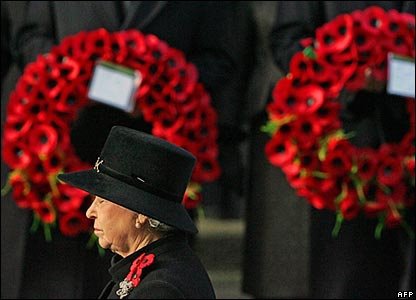
As I listened to the Service of Remembrance on Radio 4 (first time I listened to it for months - in fact, possibly, exactly a year), and heard of the High Commissioners laying wreaths to honour the soldiers of their countries, who had volunteered to fight in the two big wars of the twentieth century, I thought of the silliness of trying to find a "new narrative" for the descendants of many immigrants in this country, particularly the Muslims, most of whom are from the Indian sub-continent.

As ever, the obvious answer is the teaching of history: that of Britain, of the British Empire and, with an eye to the future, as all good history teaching must be, of the Anglosphere. The full posting on the subject can be read on Albion's Seedling.

COMMENT THREAD

Riding two horses

In The Business today, Bill Jamieson – former economics editor for The Sunday Telegraph when it was still a newspaper – writes an analysis of the current status of the euro, described as "a truly damaged currency".

He opens his piece by highlighting the massive US trade gap of $66bn (£37bn, E55bn), up from $59bn a month ago which, he writes, should have sent the US dollar crashing. But, instead, the dollar rose and the euro fell to a two-year low. Its latest bout of weakness, the euro has lost two percent on the week, taking its fall against the dollar since August to 5 percent and the plunge from its December 2004 highs to a numbing 14 percent, taking it once again below its 1999 launch level.

Jamieson then offers his reasons for the “plunge”, some of which are quite familiar to readers of this Blog. But he also points out that higher US short-term interest rates – now at four percent against the euro zone’s two – have made the dollar all the more appealing.

This, adds Jamieson, is creating a growing crisis over the credibility of the ECB. It is struggling to balance the inflationary risk from a weakening currency, which dictates a rise in interest rates, against pressure from the French finance minister who argues that a hike now would be highly unwelcome and difficult to sell to French businesses and households. Nor indeed would Germany welcome a rise that might damage what is already a frail recovery.

Jamieson cites Stephen Lewis, economist with London-based Monument Securities, saying that "…the longer the ECB delays in raising interest rates, the stronger will be the impression of disunity in its decision-making and possibly the belief that it is yielding to political pressures."

Therein lies the dilemma inherent in the euro experiment ever since it started – what is necessary for the health of the currency is not what is acceptable to members. And, in attempting to ride two horses, the ECB risks falling off both.

COMMENT THREAD

Saturday, November 12, 2005

A loss of enthusiasm

Few things are higher up on the list of benefits of the EU than its "achievements" in the field of the environment. But, it seems while member states are happy enough to laud the theory, it seems they are less happy with the practice.

That much is evident from the irritation of the EU commission, which has noted that it has been nine years since member states adopted the 1996 hugely complex Integrated Pollution Prevention Control (IPPC) Directive, yet many states are failing to adopt it. Infringement procedures are ongoing against eight Member States due to incorrect transposition.

Even those member states which have fully adopted the law are in trouble. Although they still have two years to ensure all factories, power stations and agri-business comply, such is the complexity of the Directive, requiring a bureaucratic layer of inspections, standards and approvals that it is unlikely that there systems will be in place throughout the Community by the deadline. Hence, there are rumblings from the upper echelons of the commission that its patience is wearing thin.

Meanwhile, that other great legislative leviathan, the proposed REACH Directive - is running into trouble. This week, the German Bundesrat called on the Federal Government not to accept the current proposals, arguing that the course and outcome of the consultation procedures in the EU had been unsatisfactory. The Bundesrat wanted the Directive to be simpler, more transparent and more cost effective.

The newly formed Federal government responded by asking Britain, in its role as the EU presidency, to delay a Council vote later this month. This was accepted and a new meeting is planned for the end of the year.

Environmental groups, however, are suspicious that Merkel's government will call for further changes to the draft Directive, not least because Germany is by far the biggest producer of chemicals in the EU, and companies such as BASF and Degussa have considerable political influence.

The next move, though, is a vote in the EU parliament this coming week, whence the EPP and the Socialists – the two largest groups in the parliament – will vote to water-down the directive, removing a large proportion of the 30,000 substances for which full registration and testing requirements.

When the EU parliament itself – one of the cheerleaders for EU environmental legislation – has cold feet, this is clear evidence of a certain loss of enthusiasm for the project.

COMMENT THREAD

They just don't give up

Even though the idea of the tranzies taking over the internet is plainly preposterous, as my colleague pointed out last month, the EU commission is still persevering in its attempts to detach the US from the system.

This is the spat about who should control the so-called "top-level domains", currently administered by the California-based non-profit company, Internet Corporation for Assigned Names and Numbers (ICANN), under the oversight of the US Department of Commerce.

But EU officials are now complaining that Washington has changed the rules of the game and plans to keep permanent control of the system. According to Reuters, the EU is claiming that there was an agreement that Department of Commerce control would be phased out but this summer, but the US has now announced they would maintain this oversight function.

The Commission wants to take Commerce out of the loop but, amazingly, does not have any concrete alternative proposals. It officials simply resort to arguing that the system should be under the control of an international body, in which "the role of governments ... should be mainly focussed on principal issues of public policy, excluding any involvement in the day-to-day operations."

Americans are less than impressed, contrasting their "light touch" with the prospect of interference from upwards of 200 countries. "We don't really see how an organisation can have oversight and final veto control and not have an impact on day-to-day activities," says David McGuire of the non-government Centre for Democracy and Technology in Washington, D.C. "We don't think it's optimal for any government to be directly involved in the oversight management," of ICANN.

McGuire says the US government has never reversed an ICANN decision and eventually the organisation should stand on its own two feet.

The whole issue comes to a head at the World Summit on the Information Society (WSIS) in Tunis on Wednesday and Thursday, when the EU will press its case, alongside most of the rest of the world. With the US still not budging, it should be an interesting meeting.

COMMENT THREAD

Friday, November 11, 2005

Over before it began

Remember those heady days when the German Christian Democrats under Angela Merkel were going to re-write the script in Germany? When they were going to introduce reforms that would free up the economy, lower taxation, decrease public spending, turn the country once again into the motor of Europe?

Well, no, as it happens I cannot remember them either. All too long ago and overlaid by weak campaigning, an indecisive result, shenanigans between the parties.

A day ahead of schedule the grand coalition, the second in post-WWII German history has been signed, though not yet delivered, since the various party congresses have to put their seal of approval.

But, as Chico and Groucho agreed in “A Night at the Opera” we have a contract. Unlike theirs, which had been reduced to a tiny strip of paper by the destruction of all the articles either or both of them disliked, this one weighs in at 130 pages of policy detail.

Among them, we have the following items, as quoted by the BBC World Service website:
“Reports say top wage earners will have to pay an extra 3% in income tax, VAT will rise by 3% and social insurance contributions will also go up.”
Curiously, the BBC describes Angela Merkel as having a “tough reform agenda for Germany” Tough it may be, reform it ain’t.

Deutsche Welle adds one or two other details:
“The parties agreed in their program to raise the main value-added tax rate by three points to 19 percent from 2007, an unpopular measure whose revenue will be used to plug the budget and lower non-wage labor costs to promote hiring.

The retirement age will gradually be raised to 67 from 65.


One crucial area where the new government will continue the legacy of its predecessor is nuclear energy.

Schröder's government had committed itself to gradually phasing out nuclear power, a point that most conservatives opposed tooth and nail. The issue was set to be one of the most serious stumbling blocks in coalition negotiations between the two sides. But Merkel's new government, in a sign of compromise, now says it will continue on the same course and shut down all of the country's nuclear power plants over the next two decades.

On foreign policy, the incoming government will seek improved relations with the United States -- strained over German opposition to the Iraq war and strengthen ties with European Union partners.”
Presumably, Germany will become more and more reliant on Russian gas and oil, thus limiting its ability to deal with that country in any sensible fashion.

It is good to see that Merkel intends to keep her promise to abandon the disastrous policy of being a French poodle and will improve relations with the United States. Strengthening ties with European Union partners? What on earth do they mean by that?

Sooner or later all these countries (and, increasingly, Britain) will have to face the unavoidable fact: a high tax, high regulation economy does not work. And the longer those reforms are postponed the more painful they will be.

COMMENT THREAD

The European model

This posting has to start with a declaration of interest: ever since the glamorous Sir Christopher Meyer and his even more glamorous wife Catherine took up residence in the British embassy in Washington DC, I have experienced extreme nausea at the mention of their names.

This, I suspect, had something to do with the endless, sick-making drooling of the media about their youth, their charm, their glamour, his brilliance and her elegance. The last time we had that sort of adulation going on about the charm and glamour of the couple that was supposedly representing this country in the United States was back in the days of the Jays, Peter and Margaret. That came a cropper with scandals, infidelities and broken marriages all round.

If we must have ambassadors, a questionable proposition in this day of easy communication, they should not, in my opinion, be self-publicizing glamour boys or girls. The Meyers seemed the epitome of Blairite politics and diplomacy. So, I was not unduly surprised when Sir Christopher proceeded to stab the Prime Minister and the entire government severally and together in the back by publishing a somewhat self-serving (his brilliance as described by himself in his book appears to be undeniable) memoir of his days in the American capital.

Well, now, before we start to laugh too heartily at another problems Tony Blair seems to have encountered, let us have a look at the truth of the matter.

Sir Christopher Meyer is a civil servant, a diplomat. One assumes he signed something called the Official Secrets’ Act at some point in his career but that does not seem to inhibit anyone any more. As ambassador he was in a position of trust and confidentiality. Above all, he is not supposed to engage in open party politicking. Two years after his ambassadorship he is not exactly expected to diss his employer, the British government.

One of the big questions in this rather distasteful saga was asked by Ferdinand Mount in today’s Daily Telegraph:
“So why did the Cabinet Office wave the book through without suppressing a semi-colon? I cannot imagine such a thing happening under Heath or Thatcher. It is, after all, a longstanding rule that former ambassadors do not publish books containing confidential stuff on topics that are still hot.

And this rule is certainly not defunct. The Foreign Office has just refused Sir Jeremy Greenstock permission to publish a memoir of his time at the UN, originally due out last week.”
That is rather a pity. I, for one, would like to know more about the shenanigans at the UN and whether the British legation there was really quite as gormless as it seems to have been. But these things are not to be revealed. A story denied by a politician must be true; a book banned by the Foreign Office must be important. (Well, actually, that does not always work. Many a banned intelligence memoir turned out to be of no interest or importance whatsoever.)

Mr Mount’s explanation is that Blair is now fair game for everybody; that his “joined-up government” has turned into “Cock-Up Central”.

Maybe. But there is another force at work here. Some call it the politicization of the bureaucracy but it is more the turning of governance away from politics towards management. Or, as my colleague would put it, the Monnet method.

The same week as Sir Christopher Meyer has been indulging in his usual orgy of self-publicity we had news that police chief constables have been lobbying MPs for the 90- day detention, the only part of that shocking Bill that has been defeated, as the media failed to mention.

Setting aside the pros and cons of the 90-day detention, and the cons outweigh the pros enormously, despite Melanie Phillips’s rather hysterical outburst about “Britain’s moral imbecility” in people wishing to protect a few of our remaining liberties, the idea of the police getting involved in political lobbying is outrageous.

Police officers are not supposed to be seen in overt political behaviour. They are the servants of the people and are regulated by elected politicians. Charles Clarke’s comment that this controversial measure must be put through because the police wants it was extraordinary. People on every side of the political spectrum asked the same question: who legislates – the elected Members of Parliament or the unelected, unaccountable and, frankly, rather inadequate police force? (Of course, on most matters we know the answer: the EU legislates.)

In many ways Blair is reaping the rewards of his own policies. His government has set up more unaccountable organizations and positions than any before and the Conservatives were not exactly sluggish in this respect. We have all lost track of the many task forces, czars, quangoes that have come and gone without any “blue sky thinking”. And then they wonder why people are disillusioned with politicians and do not bother to turn up to vote.

This is not simply a question of a politicized civil service. It is a development that can be seen across the world and has been encouraged and pushed by Tony Blair, not just internally but in his obsession with transnational organizations.

In the United States we have seen the CIA blatantly becoming involved in political activity against the elected President, who is, according to the American Constitution, the commander in chief. Despite constitutional prohibition of foreign laws being imposed on Americans, there has been a growing tendency in the Supreme Court (probably to be stopped by the new Chief Justice) to use foreign and, particularly, European precedents for their decisions.

Here we come to the crux of the matter. This is, of course, the European model. EU legislation is initiated by the Commission, a political civil service, and goes through a long and complicated procedure that unrolls regardless of elections, changes of government in member states or, even, changes of balance in the European Parliament.

It is governance by management, justified by two spurious arguments: politicians cannot provide the sort of expertise that that administrators can; and politicians look to short-term results and benefits because they are hampered by electoral necessity.

I have no doubt that many in the CIA have justified their disgraceful intervention in the American political process by the same spurious arguments.

We see it at all levels, from the unelected and unwanted regional assemblies all the way to the transnational organizations, the chief of them being the United Nations. Unelected bureaucrats and lawyers, all pushing their own political agenda, are claiming the right to overrule politicians who, for better or worse, have been elected by the people and have to account, however imperfectly, for their actions and decisions to the people.

As for expertise, particularly in matters that touch on economics, finances, environment, agriculture, numerous other issues, those who really have it are not going to be in the civil service, the Committee of Permanent Representative in Brussels or in the various administrations of the various tranzi organizations. They are the people who are actually creating wealth or dealing with matters arising from that process. They are the people to whom politicians should be answerable.

The role of administrators should be secondary to all of them. And yet, as the European model becomes more and more accepted, they are the ones who are emerging as our masters. At least Sir Humphrey pretended to take instructions.

COMMENT THREAD
Remembrance Day

On the 11th hour of the 11th day of the 11th month 1918 the First World War came to an end (except in Russia where it had come to an end in March of that year). Since then the day has been used as a memorial to all those who have died in that and subsequent wars. Despite the fact that the ceremony itself has been moved to Sunday in Britain, for many people across the world (it is called Veterans’ Day in the United States) this is the day of remembrance.

By a strange coincidence I shall be in Bush House at that hour, recording my part in a programme about the EU and its history. (Yes, that’s right it will be in Russian, nasty, xenophobic, inward looking eurosceptic that I am.) And my theme? That it was the shock of the First World War and its immediate aftermath on the Continent that turned people’s minds seriously towards the idea of Union.

It may be special pleading but as my text I shall take “The Great Deception”, the only book, so far, that has traced the history of this pernicious organization to its sources.

COMMENT THREAD

Then there were three

It was on 1 November that we broke the story that BAE Systems was to close two former Royal Ordnance factories, one in Bridgwater, Somerset, the other in Chorley, Lancs, respectively the last UK manufacturer of military explosives and of “initiators”, the explosive charges used for igniting small-arms ammunition.

Apart from Christopher Booker, in The Sunday Telegraph, however, no national newspaper has picked up the story, and it has been left entirely to the specialist journals to fill in the details.

One such is this week's edition of DefenseNews which devotes the best part of a page to the story, under the headline, "No Boom in British Munitions", adding the strap "BAE's Move to Imports Leaves Just Three Domestic Plants".

And there we have the issue in a nutshell. When the government-owned factories were privatised in 1984, to become Royal Ordnance PLC, there were 37 factories in operation, ensuring Britain was entirely self-sufficient ammunition and explosives manufacture.

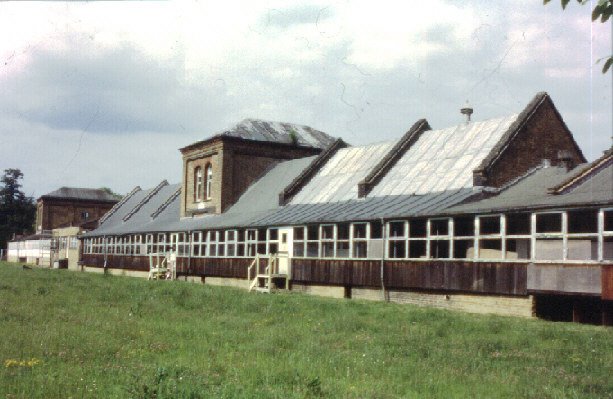
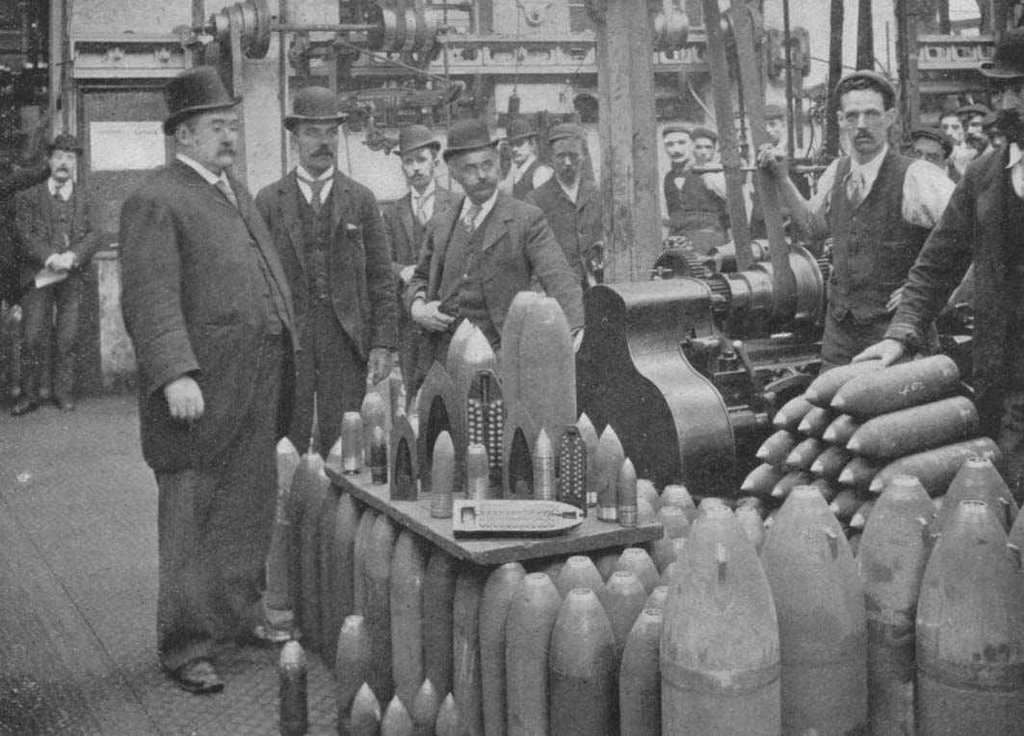
In April 1987, though, the business was acquired by BAE Systems in April 1987 for the knock-down price of £190 million, whence the company has been steadily closing down plants and moving production abroad, slowly withdrawing from a business that can trace its history back to the creation of the Royal Gunpowder Factory at Waltham Abbey in 1560 (with buildings remaining on the site until recently – illustrated above left. )

In August of this year, we pointed out how this steady disposal of assets was leaving us as a nation dangerously vulnerable, not least because we no longer have a domestic capability to manufacture the Army's assault rifles, and it is precisely this issue that DefenceNews picks up.

Ending production at the Bridgwater and Chorley sites, says the journal, means the Ministry of Defence’s only local ammunition supplier will depend on imports for the bulk of its key raw materials. From its heyday, BAE's munitions activities in Britain will be reduced to a rump operation comprising a medium- and large-caliber ammunition-filling facility at Glascoed, a small arms ammunition plant at Radway Green and a shell casing foundry at Birtley.

The contraction of the Royal Ordnance business has come despite the 1999 “Framework Partnering Agreement” between BAE and the MoD, where BAE undertook to supply the Army's ammunitions needs against a guaranteed minimum level of orders for 10 years. BAE has fulfilled its orders increasingly by importing materials, which last year totalled £20 million against only £1 million pounds in 2000

BAE is justifying its closure of the Bridgwater plant, saying production is only running at about 400 tons a year, against a plant capacity of 7,000 tons a year, and it has been losing money for years. It also claims that it has not decided where it will find a source for the materials, suggesting that it may buy from the US.

However, on both counts, the company seems to be economical with the truth, as it has not revealed its tie-up with the French state-owned Societe Nationale des Poudres et Explosifs (SNPE). Nor has it mentioned its partnership with the French owned GIAT to produce the guns using the innovative "case telescoped ammunition" for the next generation of armoured vehicles – ammunition which will be manufactured in France.

DefenseNews also confirms that Bridgwater also supplies strategic material for Britain’s nuclear warhead program and a BAE spokesman said the “Atomic Weapons Establishment had contracted the company to manufacture a strategic stockpile of critical materials to support their long-term requirements.”

Where we are going to obtain these material is not yet clear, but we are already dangerously reliant on imports. Previous closures of the Bishopton propellant factory and Blackburn fuse plant saw the bulk of production replaced by imports from Germany. BAE imports propellants from Nitrochemie under a long-term partnership and fuses are supplied by Junghans.

Thus, with the latest closures, the bulk of four key ingredients for munitions manufacture will be imported to Glascoed for assembly into finished products, which has had Gerald Howarth, the Conservative Party’s shadow defense minister stating that "Security of supply is the critical issue here… We do not want to face a situation where UK forces are hobbled".

However, currently being undertaken by the MoD is a review of the Defence Industry Strategy (DIS), which is due to be completed by mid-December, when the list of materials which should be manufactured locally will be announced.

Pre-empting this review, however, the MoD has already indicated that the BAE closures fall outside the list of manufacturing capabilities it wishes to keep. A spokesman recently that although it was purely a commercial decision by BAE, the “decision was taken in the context of the sustainment strategy for munitions, which is part of the DIS.”

As we remarked earlier, this is utter madness but, what is doubly terrifying is that the media in general seems unable to grasp the importance of this issue, a situation where, at a critical time, the British Army could find itself unable to fight through ammunition supplies being withheld.

COMMENT THREAD

Thursday, November 10, 2005

Who forged them and why?

As Libby’s indictment and the Plame/Wilson saga trundles on and as more and more people begin to question the CIA’s role in politics, the subject of the yellowcake that Saddam may or may not have wanted to buy in Niger has cropped up in Europe. And what a convoluted tale it is, to be sure.

The man who has been accused of passing on the forged documents about the possible Niger shopping expedition is Rocco Martino, a one-time spy with Italian military intelligence agency Servizio per le Informazioni e la Sicurezza Militare (SISMI). In fact, he has also been accused of forging them but whether he did or did not, he is supposed to have done so off his own bat.

As ISN Security Watch repeated on Monday:
“Enzo Bianco, chairman of an oversight committee on Italy’s secret services, said on 3 November that SISMI had played no role in passing on the bogus information.”
So, errm, who did pass on the bogus information. According to Signor Martino, “known in the Italian media by his intelligence code name ‘Giacomo’”, it was he who acquired the information from the Niger Embassy in Rome. He did not think the dossier was forged and he did what any intelligence agent would do when he acquires a particularly juicy piece of information:
“Once he had the information in hand, he turned to Italian news magazine Panorama to publish an article based on part of it, and then he sold the entire dossier to US intelligence officials after first shopping it to Italy, Britain, France, and a US television network.”
Well trained, these people, aren’t they. But then, as I recall, Ambassador Wilson, having spent 8 days in Niger, gave an oral report of his mission in Langley and then, a little while later, published an op-ed piece in which he contradicted everything he said in his report. I suppose, it is his wife who is the agent but still.

Back to the Martino documents. The surprising part of it, as Michael Ledeen points out jocularly in one of his spectral conversation pieces in the National Review, was how easily was the forgery was recognized. Does this mean, as he suggests that it was meant to be seen as such? In which case, why did Signor Martino not realize that they were dubious?

There is a good deal of doubt as to who Rocco Martino was working for. He had been a SISMI agent but was, apparently, not one by this stage. His shenanigans would indicate that he was strictly free-lance, out to get whatever he could for himself.

There have been two main suggestions. One is that it was an Italian forgery, designed to bolster the case for the Iraqi war and Italy’s part in it. In which case, one has to ask, whatever happened to the Italian ability, noted throughout history, to produce amazing forgeries?

Then there is the other theory: that this was a French forgery (Signor Martino has once acknowledged that he worked for the French intelligence but then he has acknowledged so many different things at so many different times that it is hard to know what one can believe).

The French forgery theory is a little more believable, the idea being to discredit the case for war and to protect Chirac’s buddy Saddam Hussein. That would explain quite satisfactorily why the forgeries were so easily detected.

There is, as it happens, a good deal of indication that these documents were produced some years earlier than they surfaced, the idea being to stop President Clinton from going to war. Clinton, as we know, huffed and puffed and decided not to blow Saddam’s house down. Therefore, if one goes along with the French forgery theory, the documents were not needed.

When Bush showed that his intentions were a bit more serious (several things having happened in the meantime), the documents appeared through some unknown intermediary in the Niger Embassy in Rome.

They were hawked round, used by Bush in his State of the Union speech and unmasked as forgeries by the UN Atomic Commission. And eventually, they made Ambassador Joseph E. Wilson’s career as a political pundit.

Doha… ha, ha, ha…

This is definitely one of those issues where, if you think you know what is going on, you haven't been listening. But the one thing which is certain is that the latest trade talks on the Doha round of WTO negotiations, due to climax in Hong Kong next month, have gone belly-up and everybody seems to be blaming the EU – except the EU of course.

As we left it in early October, a breakthrough was in the offing on the previously stalled talks, with US trade representative, Robert Portman, leading the way. He came up with an offer to cut "the most trade-distorting American farm support" by 60 percent by 2013, reducing the US "subsidy ceiling" from $19 billion a year to $7.6 billion.

This was conditional on the EU following suit with an 80 percent reduction, to which the EU trade commissioner Mandelson responded. He called the US offer "constructive” and announced a plan to cut EU agricultural subsidies by 70 percent and to set a ceiling of 10 percent for industrial tariffs. He was then roundly condemned by L'Escroc Chirac, who accused Mandelson of exceeding his mandate, whereupon the trade commissioner promptly did a handbrake turn, covering his tracks in a welter of incomprehensible detail.

However, even Mandelson's genius for spin has not been able to conceal that France, which receives around 21 percent of EU farming subsidies, placed further shackles on him. It threatened to use a veto if France found the outcome of the talks, currently being held in Geneva, unacceptable.

As it stands – although not even the specialist journals appear to agree – while the US offer has remained on the table, the EU is offering a range of tariff cuts of between 35 and 60 percent, each applicable to different goods, averaging out at 46 percent – or 38 percent, depending on which source you read - across the board from a very high base.

Whatever the actual rate, that is very far short of the minimum acceptable 54 percent that the developing countries, backed by the US, are asking for, especially when, according to the US agriculture department's foreign service administrator, Ellen Terpstra, the US actually has an average tariff rate of 12 percent, compared with the EU average of 31 percent.

So it is that, this morning, The Times is recording that "squabbling ministers from key trading blocs" are blaming each other after hopes of a breakthrough evaporated. As the latest impasse, says the paper, raised fears that the Hong Kong meeting may end in debacle like the previous WTO ministerial summit, in Cancún in 2003, and raise doubts over the WTO's viability.

Reuters has Brazil's Foreign Minister Celso Amorim accusing the EU of coming up with nothing new on agriculture, complaining that the way out of the tariff impasse "fell on deaf ears" with European negotiators.

The Australian Daily Telegraph is more robust, reporting: "Dismay at EU tariff 'obscenity'", citing Geoff Raby, deputy secretary of the (Australian) Department of Foreign Affairs and Trade, claiming that the EU was unable to cut agricultural tariffs to free up world trade because it lacks the political will to take on wealthy farmers.

He is warning of a potential "train smash" for Australia when trade ministers meet in Hong Kong, also branding Switzerland, Norway and Japan as "intransigent" in negotiations and attacking their defence of protectionist policies as an "obscenity".

Altogether, no one is particularly surprised at this turn of events, and a failure next month will accelerate the trend towards bi- and multilateral trade agreements outside the framework of the WTO. Meanwhile, shackled to the EU, we continue to be lumbered with a policy designed for France, leaving Blair's attempts to aid developing countries, through liberalising trade, in tatters.

At this point, one collapses, jibbering, Doha… ha, ha, ha…

COMMENT THREAD

Wednesday, November 09, 2005

Clear blue water

Since the start of the Tory leadership campaign, and especially after the field was narrowed down to two candidates, we have been looking for some “clear blue water” between them, on EU policy.

For reasons we need not rehearse here, but have explored previously on this Blog, we say little in the way of practical difference between David Cameron and David Davis – neither, in our view, offering realistic policies that had any chance of success.

However, this evening, all that changed. Following meetings with both candidates, Owen Paterson MP – a leading member of the Cornerstone Group failed to get any assurances from Cameron that the current Conservative Party commitment on repatriating the EU's Common Fisheries Policy would be honoured.

On the other hand, David Davis has decided, unequivocally, to support the existing policy and, in particular, to back the terms of the letter offered by Michael Howard on 10 June last year, addressed to John Whittingdale, OBE MP, then shadow agriculture and fisheries minister, after a meeting between Mr Howard and Messrs Whittingdale and Owen Paterson MP.

To remind readers, the text of the letter was as follows:

Dear John

You told me this evening that a number of those in the fishing industry have commented on my remarks on the Today Programme this morning. I thought it would therefore he helpful if I reiterated the position which I set out very clearly
in Dundee and in my subsequent visits to fishing communities during this campaign.

We are determined that the next Conservative government will establish national and local control over fishing. We intend to raise this in the Council of Ministers at the first opportunity and I believe we can achieve this through negotiation. However, should negotiations not succeed, it remains the case, as I said in Plymouth, that the British Parliament is supreme and we would introduce the necessary legislation to bring about full national and local control.

Yours ever

Michael.
In June, when I received a copy of this letter, I wrote that I could not stress enough the historic importance of the document. The sentiments were not new but this was an absolute commitment from the Leader of the Opposition that, if elected to government, he would seek repatriation of an important EU policy, by invoking the supremacy of the British Parliament. Now, we have that same commitment from David Davis.

The importance of the commitment is, of course, that this is not just about fishing. It does two things. Firstly, it underlines the supremacy of parliament, reaffirming that the UK is – for as long as Parliament is capable of repudiating an EU treaty provision – still an independent nation.

Secondly, it challenges head on the central dogma of the European Union, the "irreversibility" of the acquis communautaire – the body of law, including the treaties, which gives the Union its power. By seeking to overturn just one part of it, through the fishing policy, we hope to “breach the dam”, whence we expect the acquis to start unravelling.

To that extent, the fishing policy is the Trojan horse, starting a process of what we have termed reverse engrenage, mirroring the way the step-by-step process by which integration has been implemented.

How ironic that one of the most contentious issues to be negotiated on Britain’s entry to the then EEC was fishing and how delicious it would be if that same issue became the key to Britain's departure from the EU. With David Davis at the helm, therefore, there would indeed be clear blue water – between us and the EU.

COMMENT THREAD

An open letter to President Bush

Dear President Bush,

This blog has been extremely supportive of your war on terrorism and we have, even, suggested that the Nobel Peace Prize should go to the body of men and women who have done more for peace and democracy round the world than any other: the US Marine Corps. (We do acknowledge the achievement of the rest of the American services and, indeed, of the coalition troops.)

On balance, it seems to us that you will have to consider opening up another front but, on the good side, this may be the decisive one.

Another country is being engulfed in disorder that might easily spread across a continent (it has not so far, because that country’s problems are greater than many of the others’). This disorder has grown out of the dysfunctionality and extreme corruption of the political system. Your advisers would have told you that the president of this country managed to beat his extreme right-wing rival on a slogan: “Vote for the crook not the fascist.”

The country in question suffers from a severe democratic deficit with an ultra-centralized political system that is run by a small political elite. It has little by way of a free media and its tradition of democracy is very weak.

When, as we hope, the Marines deal with the present disorders, there will have to be a regime change accompanied by a constitutional convention. I very much fear the process of democratizing this particular country might be more difficult than similar processes were in Afghanistan and Iraq. However, it needs to be done.

Why does it need to be done, you might ask. After all, there are many dysfunctional, corrupt countries in the world, which periodically erupt into tribal violence. The United States, quite rightly, cannot police them all.

This particular country is a special case. It does have WMDs, though we do not know exactly the state they are in or who they are aimed at. You might have had better intelligence on that, although, to be quite candid, given the attachment some of your advisers feel for the country in question, you ought to read reports very carefully and balance them against others.

There are other reasons why this particular country needs your attention and why, quite possibly, no other will afterwards. In the first place, it is a country that is implacably hostile to the United States and to the Anglosphere. That, in itself, is not a reason for having to intervene. But it has created a union (which is not as strong as it used to be, since its social model is going up in flames even as we speak), whose prime purpose is to oppose the United States.

The country in question and its corrupt political leadership have an extensive track record of supporting tyrannical regimes and terrorists as well as terror masters. Remember who gave all possible help and support to Chairman Yasser Arafat, to the detriment of the peace process in the Middle East? Remember who had close and mutually beneficial relations with Saddam Hussein? I could go on.

It is not only political and financial support that anti-American dictators and various terror masters can hope for. The country in question has provided ideological training to an even greater extent than the Soviet Union had done in the past. Several of the world’s worst, most bloodthirsty dictators and mass murderers were radicalized not in their own countries but in the one I am describing.

From every point of view, Mr President, it is highly expedient that the United States looks carefully at the possibilities of dealing with this particular problem. Do not look to the United Nations. Any resolution you might contemplate would be blocked by China, the country’s greatest friend.

It is up to you to make a decision. However, let me assure you that should the United States decide to launch Operation French Freedom, Britain will be there with you, just as it was in 1944.

COMMENT THREAD

Where did all those jobs go?

Reported on the BBC website, under the headline "Defence shake-up hits 1,900 jobs", we learn that the MoD has announced a “jobs shake-up”. It is to close down some of the operations run by the Defence Aviation Repair Agency's (DARA) and the Army engineering and repair service, ABRO.

DARA is to lose its fast-jet site in St Athan, south Wales, which will close with 500 job losses, and its engine maintenance business in Fleetlands, Hampshire, with the loss of 225 jobs.

But especially significant are the 1,226 jobs that are being axed from ABRO, not least from the units at Warminster, Wiltshire, which is to lose approximately 100 posts.

Now go back to October last year, when the MoD announced that it was to award the contract to build 5,200 trucks for the Army to MAN, the manufacture to be carried out by MAN Nutzfahrzeuge Österreich AG in Austria. No wonder the MAN website happily chirped that the contract "ensures a continuous workload for the Vienna plant and thus helps to safeguard jobs".

But one of the losers (and the favourite for the contract) was an Anglo-American consortium led by the Wisconsin-based Oshkosh Truck Corporation, maker of trucks for the US forces and supplier of tank transporters and wheeled tankers to the British Army.

Interestingly, one of Oshkosh's partners was ABRO, which was to have manufactured the cargo bodies for the trucks, installed ancillary equipment, performed final test and delivery functions, and provided through-life maintenance support.

If the truck contract had been won by Oshkosh, of the 600 British workers who would have been employed, ABRO would have secured approximately 100 posts, the majority of which would have been at their site in Warminster, Wiltshire.

Hey, never mind though. MAN Nutzfahrzeuge Österreich AG in Austria has "a continuous workload for the Vienna plant" which "thus helps to safeguard jobs" – Austrian jobs.

COMMENT THREAD

Meanwhile, back in Germany

No, not riots, not even, it would seem, copy cat ones (I may be speaking too soon on that) but the usual run of the mill, stuck in the mud political negotiations.

The time is approaching for the grand coalition to take shape but as we have written before, this shape ain’t taking. In yesterday’s Wall Street Journal Europe [subscription only] there is an interesting article by Mariam Lau, op-ed page editor of Die Welt.

Entitled The Bossis, the piece points out that there has been a recent shift in political opinion about the East. The ossis are moving into mainstream political life and taking over. Not only is Angela Merkel a scientist from the former DDR but so is the newly chosen SPD chairman, the Brandenburg governor, Matthias Platzeck. While Ms Merkel has a degree in physical chemistry, Mr Platzeck is an engineer for biomedical cybernetics.

In the old DDR it was scientists rather than “teachers and jurists” who took political posts, says Ms Lau. There are other scientist ossies at the top of the political tree: Thomas de Maizière, the new secretary of the chancellery, Wolfgang Tiefensee, designated minister for transport and others.

Their background is not dissimilar. They come
“from politial and/or religious families, which upheld a bourgeois tradition in the hostile climate of an ‘Arbeiter und Bauernstaat’ (state of workers and peasants). None of them was a hero of the East German ‘revolution’. They came to the civil rights movement relatively late in time. This is why some of the 68ers accuse them of cowardice. That’s hard to swallow from a generation whose own claim to ‘resistance’ credentials is rooted in street-fighting the democratic government of Willy Brandt – himself a former refugee from Hitler’s Germany.”
It is not clear which came first the rise of the politicians from the former DDR or a more benign view of the eastern part of the country but both exist now, according to Ms Lau, with newspapers and their readers speaking hopefully of “Aufbruch Ost” (Rise of the East).

The tabloid Bild proclaimed very quickly after Mr Platzeck’s appointment: “The Ossis Are Our New Bossis!”

But coming after the ridiculous split in the SPD, which led to Franz Müntefehring’s resignation as chairman and the even more ridiculous retreat by Edmund Stoiber back to Bavaria, the new kids on the block do not look bad at all.
“Ms Merkel and Mr Platzeck share a pragamatic, can-do attitude and a lack of patience for ideology. They have no take in the enduring battles between the ‘68ers’ and the conservatives that the West Germans are so fond of fighting. In the very same week that the famous Frauenkirche in Dresden was formally reconsecrated – when East and West Germans were praising technicians, engineers and civil society rather than nursing old resentments – it seems that that the Federal Republic as we knew it has finally come to an end.”
Ms Lau’s indictment of the wessie politicians is harsh:
“The rise of the Bossis is more than pure coincidence. What happened in Berlin last week was a clear failure of the West’s political elites, who put their own needs, careers and moods before the interests of their parties, let alone the country as a whole.”
Will the Bossis be any different? For the moment, Angela Merkel appears to be an honest, if somewhat bemused politician, who is prepared to do her best for the country and not just because her own background is different from those of her western colleagues, castigated by Mariam Lau.

How long that will last remains to be seen. And, above all, will the Bossis promulgate the desperately needed reforms and fill the vacuum that exists at the heart of the German political establishment? They are in a good position to do so, thinks Ms Lau. But if not … well, France is not the only country that has riots in its history.

COMMENT THREAD

Tuesday, November 08, 2005

What a wonderful thought

In today’s International Herald Tribune Catherine Field gives an interesting analysis of the French riots and their origin. [I may as well warn some of our readers that she does not think that it is an intifada or a jihad.]

Her suggestions of long-term answers are hit and mix in my opinion: breaking up the stranglehold of the enarques on public life is a good idea, an encouragement of social and political integration even better, but throwing more government money without economic and social reforms will do nothing.

A far more interesting exchange of ideas can be seen in the Letters section of the newspaper.

But Ms Field does come up with a wonderful couple of sentences:
“President Jacques Chirac is notorious for trying to foil investigations into his scandal-tainted financial past. Unsurprisingly, there were only guffaws when he warned rioters that France is a country where justice is firmly applied.”
The thought of l’escroc, who is hanging on to the presidency in order to keep himself out of the courts, if not prison, presiding over a state in which “justice is firmly applied” fills one with joyous laughter.

COMMENT THREAD