Tuesday, November 08, 2005

At last!

Clearly, the Telegraph has run out of photographs of scantily-clad supermodels and the Royals cannot be doing anything terribly interesting.

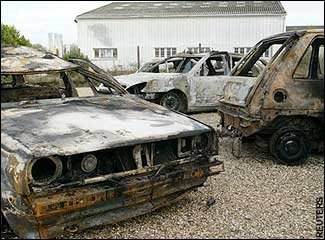
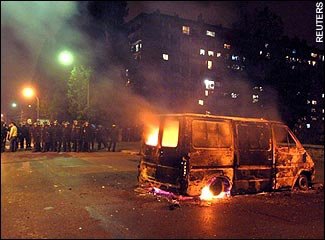
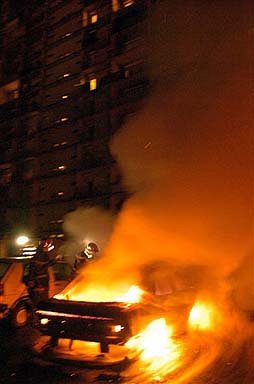
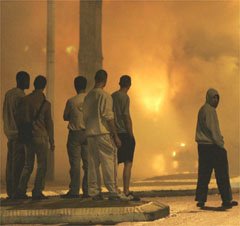
This means - at last – that it has elevated the French riots to the front page, complete with picture. And this at a time when the BBC is desperately trying to convey the impression that the situation is calming down

Anyhow, under the headline, "Leaders fiddle as France burns" – not exactly original, but never mind – the paper reports that the riots have "spun out of control", describing prime minister Villepin as "beleaguered".

MarkSteyn also gives over his column to the riots, under the headline "Early skirmish in the Eurabian civil war". His thesis seems to be that the describing the riots as spontaneous "rage" are wide of the mark - "a very slapdash characterisation of what, after two weeks, is looking like a rather shrewd and disciplined campaign." "Some of us," writes Steyn, "believe this is an early skirmish in the Eurabian civil war."

Actually, I share my colleague's view that this ain't necessarily so. In any dysfunctional society – and what is France if not that? – the violence always erupts amongst the disadvantaged, so the fact immigrant population also being the most disadvantaged is difficult to disentangle.

Certainly, the smouldering resentment is there, and you don’t have to stay in France for very long before you realise how "institutionally racist" the society really is. All you need to do is watch the queues at immigration at the airport and see how much longer it takes for the official to clear someone with a dark skin.

And as for Steyn's "shrewd and disciplined campaign", I think he neglects what they have been finding in Iraq, where the terrorists are no longer operating in defined cells with a set hierarchy.

The marvels of the mobile 'phone, texting, and the internet, means that different groups and individuals can share knowledge, "intelligence" and tactics, with amazing rapidity, learning from each others' experiences, without any single guiding mind. If technology favours democracy, it is also the handmaiden of anarchy.

That said, the leader expresses the fear that the riots could spread through Europe.

It refers to comparisons with the May events of 1968, and even the revolutions of 1848, are tempting, but ventures that the current riots are distinguished more by their differences than their similarities. They have no clear political aim beyond an expression of disgust with the government and, in particular, the interior minister, Nicolas Sarkozy, and have not attracted other sections of society.

But, says the paper, the sense of impending crisis is deepened by the extraordinary weakness of those in office. France is marked by fin de régime rivalry between Mr Sarkozy and Dominique de Villepin, the prime minister. Germany faces the sclerosis of a grand coalition. In Italy, Silvio Berlusconi is more discredited than ever. In Britain, while Tony Blair defiantly bangs the security drum, the electorate waits for him to step down.

There, the paper has a point. When there is a vacuum of power at the centre, dark forces go to work and, if nothing else, the French riots have been fed by indecision and bickering in the government. And, elsewhere, there is a general feeling of malaise, of disillusionment with politicians, expressed by low voting figures. On this, concludes, the leader, the riots rocking France could feed.

I have a feeling that this is not very far off the mark.

COMMENT THREAD

Tug of war

"Everyone is pulling in their own directions." So says Jaroslaw Pietras, the Polish minister for European affairs, at the end of yesterday's first formal negotiations on the EU budget since the rancorous June European Council meeting.

"We cannot see any package emerging from today's discussions," Pietras added, underlining what little Jack Straw – who chaired the talks – describes as "the intense difficulty of securing a compromise by December".

With touching naivety, Graham Bowley of the International Herald Tribune reports that an agreement would go a long way toward repairing the spirit of co-operation that was damaged by the breakdown of the June meeting. Any deal, Bowley continues, would also illustrate the political lessons drawn from the referendums in France and the Netherlands in May and June.

Needless to say, the definition of "co-operation" in the Community lexicon is "give and take", as further defined by France, meaning "you give and we take". While their capital burns – or, at least, a goodly number of cars and buildings – the French continue to resist any cuts spending on farm support, while demanding that Britain gives up its rebate.

Meanwhile, Straw bleats away, telling assembled reporters that, "We made it clear there will have to be significant changes in levels of overall spending of the EU and in the structure of funding compared to what was on the table in June if there is going to be a deal in December."

In other words, there ain't going to be a deal – not until Tony Blair and his less than merry men manage to cobble together a formula that gives France what it wants, while making the deal looking acceptable to the British public. And that is not going to be easy. There are far too many people watching, ready to cry foul.

It looks like Finland, which is next in the hot seat of the EU presidency, is going to have to make the running.

COMMENT THREAD

Monday, November 07, 2005

A gloomy analysis

Andreas Noll provides a gloomy but balanced analysis on Deutsche Welle of the situation in France and the possible consequences to the rest of Europe. While not excluding the Muslim aspect of the problem, he sees it as essentially a European failure, ending with the following paragraph:
“Attempts to integrate rapidly growing Muslim communities in other countries haven't been much more successful. Europe has so far not found a solution for the integration of a group that has a hold on the future -- at least from a demographic perspective -- but that has no idea what this future should look like.”
Unfortunately, as we have written on this blog in connection with numerous other issues, few people in Europe have any idea of what the future should look like. The only thing that I find puzzling is why are the Americans not gloating, the way Europeans do when even smaller things go wrong over the pond?

COMMENT THREAD

I don't love Europe

"I love my family, I love my children, I love my dogs, but I don't love Europe." So says Reijo Kemppinen and, before you ask "so what?", he is the EU's new man in London – specifically, head of the European Commission’s UK office, a replacement for Jim Dougal, who resigned complaining about Commission bureaucracy.

And, while Paris burns, The Times has interviewed the man on taking up his new post, only to gain the "rather unexpected confession".

This, apparently is part of a new approach by Brussels, aimed at winning the hearts and minds of the British people. Kemppinen wants to transform the debate in Britain, starting a publicity drive not just to raise the profile of the Commission, and finally to reconcile Britons to being in the EU.

He tells The Times: "I am not calling for everyone to be a Europhile or a supporter of Europe, but to step away from this useless argument about whether you're a member of Europe or not." As far as Kemppinen is concerned, "The fact is that Britain is part of Europe and part of the EU and will stay part of the EU."

He has no time for the "in-out" argument, adding that "As long as every piece of work the EU produces is analysed through the argument of to be or not to be (in the EU), the journalism will be distorted. The editorial line doesn’t allow room for other arguments."

Kemppinen's post — in effect the EU's ambassador to Britain, says The Times — is often seen as the most difficult job in the Commission, not least because of the innate hostility displayed by the British to the "project" But Kemppinen, a 48-year-old Finn and a former chief spokesman for Romano Prodi, is the first non-citizen to head one of the EU's national offices.

Despite this, he intends to take the bull by the horns, taking on extra staff to change the debate by arranging conferences and seminars. He also plans to send teams of press officers out to speak to regional newspapers, and set up EU information centres around the country.

He also eschews defensively rejecting criticism, agreeing with many complaints about the EU, from excessive regulation to absurd laws, and is keen not to turn critics into enemies.

"If you love Europe, please say it, but if someone doesn't love Europe, please don't define them as Eurosceptic," he says. "I refuse to define Britain’s relationship to Europe by the word Eurosceptic. Perhaps it is where I came from, but I have always had great difficulties labelling Britain as Eurosceptic."

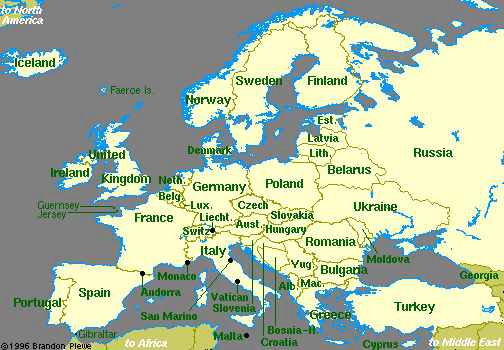
Well, Mr Kemppinen, we wish you luck. But, as always, you are barking up the wrong tree – as your ilk always does. It's not "Europe" we have a problem with – it's the European Union. Perhaps you might make it your first task to learn the difference and, just to help you out, we’ve printed a map for you.

COMMENT THREAD

Sunday, November 06, 2005

Looking at France

Now that the French riots have gone on long enough even for the British media to start paying attention (as usual the blogs, this one included, were there ahead of the MSM) the time has come for analyzing the commentators, as these events are not deemed to be important enough for any analysis to be published here or anywhere else.

There have been so many reactions outside the British media and on the blogs that it is hard to know where to start. But I have derived no small amusement from the fact that people who have been blithely calling for a revolution and gleefully predicting that soon the people will rise against the terrible European monolith are among those first to squeal about the French riots.

This is not a revolution, nor an insurrection, nor an intifada (just try coping with that as the Israelis have had to). It is a series of riots that are not leading anywhere special and have grown out of the peculiar tensions that have existed in French society for decades, possibly since the Algerian war. And yet, it seems, that the predicted riots and possible revolution meets with no approval among those who had done the predicting.

Far from looking at the causes they are largely blaming Islamic fundamentalists, chattering on about Eurabia and all but demanding that the French police employ the harshest measures possible. (And believe me there is little the French police does not know about harsh measures.)

All of which proves the point I have made once or twice on the forum: revolutions are not nice things. Riots are not nice things. They are scary. Think of the unfortunate people who are not burning cars or throwing stones but are caught in those appalling banlieus, their lives already hopeless, now surrounded by this violence and knowing that at some point they will all have to pay for the fact that the French government has lost its head.

There are curious omissions in the babel of comments. For instance, nobody is pointing out the fact that it cannot be French foreign policy that is causing these riots. France has famously (or infamously, given what has come out in the Volcker’s report) opposed the Iraqi war.

Equally famously it has tried to meddle in Middle Eastern politics, largely unsuccessfully but always on the side of the dictators and terrorists. Some of this can be put down to the basic theme of French foreign policy, which is the European common foreign policy in embryo: an opposition to the United States no matter where, when or how.

Some of it, on the other hand, as has been pointed out before, was motivated by fear. Fear of the large and growing Muslim population inside the country, which has, as anyone with the slightest knowledge of France, perceived some time ago, been treated abominably badly.

For the same reason, it would seem, though here the record is murkier, French authorities have largely looked the other way at the growing instances of anti-Semitism and attacks on Jewish targets. It may have been Muslim youths, apparently inflamed by events in the Palestine, or it may have been a mixture of dissatisfied Muslim and non-Muslim underclass, inflamed by left-wing propaganda. As there were no serious investigations we do not know.

Then there is another aspect of the problem that is rarely mentioned though Fukuyama, never afraid of controversy, pointed it out: the European social model, particularly strong and well regarded in France, has created high unemployment, made it impossible to start new businesses and next to impossible for people with no qualification get jobs.

Over on Chicagoboyz, where intellectual argument tends to be the order of the day, Lexington Green has written amusingly about the collapse of the American Left’s second Utopia – Europe and, specifically, France.

We, too, have noted on occasion the strange American tendency among that strange breed of anti-American Americans to praise Europe or the EU or France, largely indiscriminately as the place which provides social cohesion through a high taxation, high regulation system; in which the benevolent government ceaselessly watches over the people’s welfare and accumulates more and more power for that purpose; and in which lower productivity is not the sign of a sick economy but of a greater enjoyment of life.

Let us hope these riots, which have been predicted for a long time, will blow away those fancies but if I know left-wing pundits (and unfortunately I do know them) they will either pretend nothing happened or find any number of excuses, preferably, ones that blame the United States or root around for yet another semi-Utopia.

It is unfortunate that those, mostly across the blogosphere, who have presented these riots as a new revolt of Islam are playing the same game. If there is nothing rotten in the state of France, if this is merely part of a world-wide Islamic attack on the West, then we can simply forget about French and European problems. They do not really exist.

A small minority, poor and marginalized through its own faults, has been stirred to violence and as soon as that is put down, we can go back to worshipping the European social model and its various delightful aspects: high taxation, impossible regulation, protectionism, high unemployment and a smouldering resentment that will break out in some other way.

There have been other comments. On Chicagoboyz a series of postings by Ralf Goergens, the elegant weasel of our forum, I suspect, have tried to look at the genuine grievances and resentments that have set off the mindless and semi-organized violence of the last week and a half. (Although there has been some talk of organizers who ensure that lads get around from place to place quickly, there seems to be little of real organization and people who might consider themselves to have authority over the youngsters are as much at a loss as the government is.)

One of Goergens’s postings deals with the architecture of the banlieus, the soullessness of the buildings and impossibility of a fruitful human existence in them. He traces the ideas behind those monstrosities to Le Corbusier, arguably one of the evil geniuses of the twentieth century with his ideas of social and cultural experimentation on human beings. We in this country, who have known the problems of the council estates, those tenth rate embodiments of Corbusier’s plans, should not dismiss these arguments.

Goergens was challenged when he posited that far from wanting to create a separate community, what the rioters and, indeed, the people in the banlieus want is to integrate in French culture. This has been dismissed by the “it is all an intifada” commentators but that, once again, does not take into account the peculiarity of the French situation.

By and large, it seems, that is precisely what many of the newcomers and not so newcomers (third generation or so) would like. Remember with what unexpected ease the problem of the banned headscarf was solved. Very few people protested. When a couple of French journalist were kidnapped and one of the demands was that the ban be rescinded, North Africans and their descendants joined a demonstration against the kidnappers. They proclaimed themselves to be French, who would obey the French law. In return, they expected France to recognize them as equals.

France has always described its colonies as being part of the mother country – France Outre Mer. As we know, that means certain islands in the Caribbean can produce all-important votes in referendums. It also means that France feels fully justified to march in and sort out recalcitrant fromer colonies such as the Côte d’Ivoire. (Not that they are having all that much success, but let that pass.)

In theory that also means that all those who arrive in France from the former colonies, especially those who found they had to flee as a result of the Algerian war and its rather sudden ending, are French and will be treated as such. Alas, this has not been the case and the resentment has been smouldering, strengthened by the undoubted frequent brutality displayed by the police.

On Deutsche Welle there have been worried discussions as to whether riots like this could happen in Germany. Opinion seems to be that it is unlikely for a somewhat unexpected reason:

“Those allegedly responsible -- groups of young Muslim men of largely North African and black African origin -- have said that they are protesting economic misery, racial discrimination and provocative policing.

But while some blame the government's recent hardline law-and-order policies, others see the root of the problem in broken promises by the French government to its immigrant communities: The French integration model insists that all citizens are equal before the state, but some say cultural minorities are being left without a voice.

In Germany, on the other hand, immigrants have so far lacked any sense of entitlement. Unlike France, Britain or the Netherlands, Berlin has only recently opened up citizenship and loosened naturalization laws.”

In Germany it is Germans who riot, usually during May 1 demonstrations. If there are any problems with immigrants, these tend to be about issues back in their home countries. Thus Turks and Kurds will fight on the streets and the various Yugoslav nationalities and groups have been and remained a headache for the German police.

If the immigrants felt that they were German, runs the argument, with the same entitlements as other Germans, which they were not getting, they might start rioting as well. The French riots should, therefore, encourage Germany to produce better and clearer policies on integration while there is still time.

It is an interesting argument and not unsustainable. Whether Germany, bedevilled with even worse economic problems and suffering from many of the same political and cultural ones as France is, can come up with the necessary policies, remains to be seen.

In the meantime, it might be worth casting a swift glance at the difference, from what we can tell, between the Danish and the French riots. It seems that, for the moment the Danish situation is under control, though I am ready to listen to anyone who has better and more up to date information. The riots in Århus were very different, clearly organized and caused by events that were not directly related to the people’s lives: the series of cartoons of the Prophet in a Danish newspaper and the Prime Minister’s refusal to control the press.

So far as one can tell, the swaggering youngsters, from various parts of the Middle East, were not interested in better conditions or jobs or integration on whatever level. They wanted a surrender to Muslim demands and an acknowledgement that their area should be a no-go area for the police.

This was very different from what is happening in France. The common factor is that the participants are largely Muslim, which appears to be sufficient to lump them together. There is, I fear, a tendency to do this with all events world-wide.

This is an understandable reaction to official Western reluctance to blame all Muslims for the terror that has spread across the world and a much more serious, what one might term politically correct silence or obfuscation about the fact that at present most terrorist attacks are carried out by Muslim groups.

Nevertheless, different events have different causes and there is no question that Islamic extremists have latched on to troubles that had other causes. One unfotunate outcome of this reluctance to look closely has been a difficulty many of us have experienced in trying to explain what is going on in Chechnya and to what extent the problem is Russian brutality as well as Chechnyan terrorism. Again, the outcome is unfortunate from a geopolitical point of view: a refusal to analyze has played into President Putin’s hands.

On a slightly more light-hearted note, one may point out that the riots were typically French, down to the attacks on a McDonald’s, and that it has seemed for some time that France was due for another revolution. This could be the beginning of one or it might peter out as did les événements of 1968.

COMMENT THREAD

Intelligent and elegant?

Well, the new dumbed-down Sunday Telegraph is with us and, entirely in keeping with its editor’s desire to make it "intelligent and elegant", the front page is graced with a picture of Kate Moss, coke-snorting supermodel, in exotic lingerie.

Meanwhile, exiled to its new home on the inside back page is the truncated Booker column, with a story which, in a serious – as opposed to an “intelligent and elegant” newspaper, would have been on the front page.

Crammed into 500 words is a story which completes with such delights as the page three "Harry Potter and the Goblet of fear", occupying a full half page, with pictures and the stunning revelation on page five that "William beats Harry in Army intelligence test".

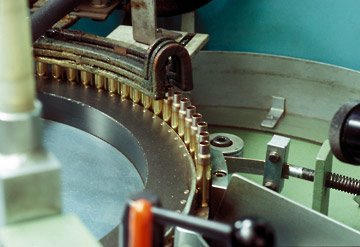
And the trivia consigned to page 37? Oh, that's just a boring little tale about how BAE Systems is closing down the last factory in the UK that makes military explosives, and another which makes a key component from rifle ammunition, moving the production to France.

Even the headline is calculated to inspire ennui in Mz Sand's "intelligent and elegant" newspaper, asking "Is it wise for an army to buy its shells abroad", a headline which also manages both to downplay the gravity of the issue and get it wrong.

Picked up by us on Tuesday and run on this Blog, the issue is, as Booker records, BAE Systems’s decision to close the former Royal Ordnance plants at Bridgwater, Somerset, and Chorley, Lancashire, incidentally with the loss of 200 jobs.

At the Bridgwater plant is made a range of military explosives, needed for shells and missiles used by Britain's Armed Forces, including components for our nuclear weapons. At Chorley, an equally vital function is carried out – making the "initiators" for rifle cartridges – the tiny blob of explosive in the base of the cartridge which explodes when struck by the firing pin, setting off the propellant charge.

As regards the Chorley plant, Union officials have told us that, for the last two years, senior production staff have been seconded to a factory in France to set up new machinery and teach the staff there how to run it – concrete evidence that the production is to be moved to France.

But the “smoking gun” seems to be an agreement which approved by the French Senate on 7 May 1998, the record of which shows that it was planned to set up a joint company between BAE Systems and the French state-owned Société Nationale des Poudres et Explosifs (SNPE), to manufacture “powders and explosives”. But the killer passage (machine translation) is this:

The Minister for defence moreover specified that a majority of the activities of production would be maintained in France and that Royal Ordnance would reduce the share of activity of its own installations in Great Britain (Bridgewater and Bishopton) or in the Netherlands where it also has a factory (Muiden). He however added that alliance would modify the distribution of the activity between the three French sites: the site of Angouleme, which is depend on the markets of the armament, would be private of part of its activity since 1999 whereas the establishments of Bergerac and Sorgues would profit from the clear creation of a hundred employment.
We contacted both BAE Systems and the MoD, asking specifically what was to happen to the production from Bridgwater and Chorley, and neither answered the questions we put to them. Alerted by us, however, Gerald Howarth, the Tory defence spokesman, has tabled a series of urgent questions to the MoD on the implications of this decision. "The prospect of Britain being unable to supply its Armed Forces with explosives and ammunition and being dependent on other countries," he warns, "is extremely alarming."

However, such is Mz Sands and her quest for "intelligence and elegance" that it will have to be other newspapers - and, of course - this Blog, that keep you appraised of the responses.

COMMENT THREAD

EU popularity nose-dives

If not in actualité, the picture to the left of Berlaymont must accurately reflect the state of mind of its denizens, following the release of the latest Eurobarometer "snapshot" of opinion on the EU.

This is according to The Business, this morning, which reports that the survey has found confidence in the EU in freefall across almost every member state. It represents a "cascade" which, says the research firm that conducted the study, is the most severe since records began in 1975.

Furthermore, the survey reveals that that only one-third of Britons see benefit in continued membership, the lowest in the 25 countries polled. Overall, trust in the EU commission has plunged from 52 percent to 46 percent throughout the union and, in Britain, the picture is even bleaker for our government across the water. It is trusted by only by 31 percent and distrusted by 38 percent. A majority – 42 percent to 40 percent – believe the UK has not benefited from its 30-year membership and only 36 percent of those questioned considered membership "a good thing".

The full 440-page report is available on the Eurobarometer website and even the selective optimism cannot conceal a picture of unremitting gloom.

For the Tory leadership contest, the report has some considerable significance. Compared with the tentative steps suggested by the candidates to effect a selective withdrawal from the EU, the survey shows that public opinion is way ahead of what is on offer. Arguably, the two Davids are misreading public opinion and risk missing the boat.

COMMENT THREAD

Sources of radicalism

It seems appropriate to discuss sources of radicalism and the question of terrorism that is rooted in religion as well as political dissatisfaction on the anniversary of that earlier attempt to undermine the government of England. 400 years ago yesterday the plot to blow up Parliament was discovered with dire consequences for its perpetrators.

Plus ça change, plus ça reste la même. Once again we are facing an enemy that is outside the country as well as inside it. Europe, though not Britain particularly, has fought Islam before but it was usually in the shape of an external, and highly visible enemy. Now, we are less sure. Most of the Muslims we know are not our enemies. They want out of life much the same sort of things non-Muslims want: a job, a home, a family, good things for the children. But how do we know who are the ones who want something else: destruction and a weird idea of future conquest?

The parallels are not exact. I shall, I expect, be reminded by various readers that the Catholics of Elizabethan and Jacobean England had been here for as long as the Potestants had (though Guy Fawkes himself was not, I believe, of English origin), while the Muslims are relatively recent incomers.

But the real difference is not there but in the reaction. A new, muscular and aggressive Protestantism fought what it perceived to be the enemy. There was more to it than that, as there is in the fight with radical Islam. Catholicism was seen as a political enemy. Even later in the seventeenth century Milton in his Areopagitica explained why he did not consider it advisable to be tolerant of the Catholics – they were then the country’s political enemies.

Political enemies had to be dealt with in a political way as many a hapless Catholic found out under Elizabeth’s reign. Her answer to the Pope’s “fatwa”, if one may put it that way, was to create the most efficient secret service of the day.

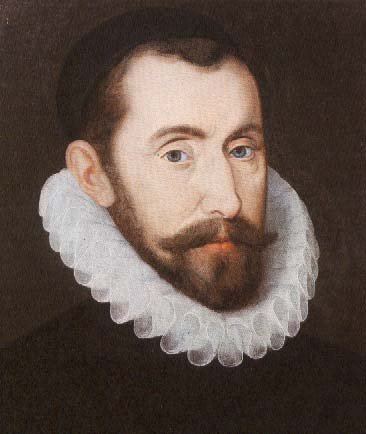
Walsingham’s lads dealt efficiently with Catholic plotters; knew exactly on which ships young scions of recusant families were departing to study on the Continent; and, if needs be, kidnapped escaping priests from the Catholic Lowlands.

Protestantism under Elizabeth blended into the concept of England, developed earlier than any other country’s self-definition as a cursory reading of Shakespeare’s history plays as well as other contemporary writings will show.

Modern Europe and modern Britain are, of course, very different. Gradually, we can see certain ideas being formulated about the fight we need to wage but it is taking a long time, the main problem being is that few people can seriously define what it is they are fighting for. (I believe I have pointed out in the past that only Hungarians manage to define Englishness or Britishness to any satisfactory degree.)

Francis Fukuyama, the eminent philosopher, goes further than that. In an article last Wednesday in the Wall Street Journal Europe [subscription only] he posited the theory that the roots of radical jihadist terrorism are not in the Middle East but in Western Europe.

This is not such an extraordinary idea. Let us remember that some of the worst ideologically motivated bloodthirsty dictators such as Pol Pot, Ho-Chi Minh and sundry African rulers, were not radicalized by seeing the poverty or alienation of their people but by studying in Western Europe, notably France.

(Of course, there were the Marxist African rulers who were educated and trained in the Soviet Union and its East European satellites but that was a deliberate plan.)

With the Muslims the problem lies in the non-existent social and cultural networks.
“We profoundly misunderstand contemporary Islamist ideology when we see it as an assertion of traditional Muslim values or culture. In a traditional Muslim country, your religious identity is not a matter of choice; you receive it, along with your social status, customs and habits, even your future marriage partner, from you social environment. In such a society there is no confusion as to who you are, since your identity is given to you and sanctioned by all of society’s institutions, from the family to the mosque to the state.”
This, I think, underestimates problems many Muslim countries have faced in the modern world where the traditional values do not seem to be as valuable or admirable as they might be expected to be.

Nevertheless, Fukuyama’s theory becomes of great interest when he compares the position of a Muslim in a traditional society to that of a Muslim in a West European country. Professor Bernard Lewis has written that while Islamic legal scholars in the past had discussed the way a religious Muslim should behave towards the “infidel” who had been conquered or who is the conqueror, there is no guidance for behaviour by Muslims who have, for various reasons, chosen or whose families had chosen to live under “infidel” rule. And that is confusing.

Fukuyama says:
“The same [certainty of identity] is not true for a Muslim who lives as an immigrant in a suburb of Amsterdam or Paris. All of a sudden, your identity is up for grabs; you have seemingly infinite choices in deciding how far you want to try to integrate into the surrounding, non-Muslim society.


The identity problem is particularly severe for second- and third-generation children of immigrants. They grow up outside of the traditional culture of their parents, but unlike most newcomers to the U.S., few feel truly accepted by the surrounding society.”
The problem, as analyzed by the theoreticians of European integration (well not Monnet or Salter but some of the lesser ones and the second-rate ones we are saddled with at the moment) is virulent nationalism. An integrated European Union would miraculously excise all the nasty parts of European history from its identity, to be left, as we are often told, with the “European heritage” of freedom, democracy, human rights, motherhood and apple pie, as long as the pastry is not made with lard.

It is, however, this indecisive and far from robust cultural definition that is causing many of the problems, particularly as underneath all the talk, it is clear that national identity and self-definition remains stronger than European ones. But, as they are not supposed to be articulated so they cannot be offered to those on the margins of society.

Fukuyama sees it slightly but not all that much differently:
“Contermporary Europeans downplay national identity in favour of an open, tolerant, ‘post-national’ Europeanness. But the Dutch, Germans, French and others all retain a strong sense of their national identity, and to differing degrees it is one that is not accessible to people coming from Turkey, Morocco or Pakistan.”
In fact, it might be accessible in some of the countries. What remains inaccessible because it is incomprehensible and to a great extent non-existent, is the official post-nationalist European identity. Since we cannot (and many of us do not want to) define it ourselves, we cannot expect people who come to it from outside to join it.

At the same time, we no longer seem capable of defining that “strong sense of national identity” that undoubtedly still exists, albeit in a muddled way. Not all is lost. National identities are easier to define when they are under attack.

There is another problem for the immigrants and their descendants and this is a direct result of that famous European social structure that we are supposed to be so proud of:
“Integration is further inhibited by the fact that rigis European labour laws have made low-skill jobs hard ot find for recent immigrants or their children. A significant proportion of immigrants are on welfare, meaning that they do not have the dignity of contributing through their labour to the surrounding society. They and their children understand themselves as outsiders.”
As my colleague wrote some time ago about his childhood in a strictly Jewish neighbourhood of London, this is different from what happened in the past, when immigrants and their offspring made their way into society through various jobs, at first menial, then, perhaps, trading, then educated ones.

The European social model, that we must, according to all and sundry from Commission President Barroso downwards, preserve is little different from the old semi-feudal structure where everybody stays in the same place and advance is made as difficult as possible.
“It is in this context that someone like Osama bin Laden appears, offering young converts a universalistic, pure version of Islam that has been stripped of its local saints, customs and traditions. Radical Islamism tells them exactly who they are – respected memebrs of a global Muslm umma to which they can belong despite their lives in lands of unbelief.”
Fukuyama then goes on to explain that radical Islamism “is as much a product of modernization and globalization as it is a religious phenomenon; it would not be nearly as intense if Muslims could not travel, surf the web, or become otherwise disconnected with their culture.”

In fact,
“Democracy and modernization in the Muslim world are desirable for their own sake, but we will continue to have a big problem with terrorism in Europe regardless of what happens there.”
At the end of the article Fukuyama outlines some of the measures being taken by several West European countries, some with more success than others, of ensuring that incomers become aware of the culture they are entering and become part of it.

Certain measures can be taken, though I think he is over-optimistic about the powers the British police has been given “to monitor, detain and expel inflammatory clerics”. I shall believe it when I see it. And, although there is a general recognition that multiculturalims is a failure, there is precious little evidence that it is being abandoned. For one thing, far too many people are doing well out of it.

What is, however, considerably more difficult and harder to define (as witnessed by the risible “test” of Britishness that is being proposed for new immigrants) will be the national identity we want newcomers to participate in, if they want to stay here. Unfortunately, wishy-washy European “ideals” of general kindliness are no substitute for a clear understanding, warts and all, of what a country is, what its people are and where they are going. Indeed, they are a big part of the problem.

COMMENT THREAD

Saturday, November 05, 2005

Waiting for Godot

The eighth day of rioting in Paris, with the unrest spreading outwards into new parts of the country. But hey! Who cares? Certainly The Independent does not – it has other fish to fry.

Its lead today is President George Bush, "his presidency foundering and his popularity at record lows at home," who ran into new protests at a Western hemisphere summit in Argentina. And, quelle horreur, not far from the sealed-off, massively protected hotel where the leaders met, some 10,000 demonstrators marched through the resort city of Mar del Plata chanting "Get Out Bush."

This clear anti-American bias was one of the things my colleague and I talked about on the Charlie Wolf show this morning, in between talking at length about the two Davids.

It is interesting how being put on the spot during a radio broadcast focuses the mind, as indeed it did when Charlie asked me what I thought of yesterday’s televised debate. Quick as a flash – I kid you not – I came up with the stunningly original line, “Well you’ve heard of fantasy football – well this was fantasy politics”.

To be fair to Davis, I did think he talked a lot of sense on tax, and said so, but it is in his "Europe" policy, in common with David Cameron, that he dwells in never-never land.

Cameron, of course, is more vacuous, claiming that he can "handbag" the EU into giving him what he wants – which is not very much at all – but Davis, who sounds as if he has thought his policy through, has an equally unworkable plan.

Before dwelling on this, I must digress, and remind readers that, with Christopher Booker, I wrote a book on the history of the European Union – 300,000 words of it. The way we work is that I produce the briefs, from which Booker writes to final copy, to which effect I produced the best part of two million words, much of it summaries of original records, debates and news cuttings.

To get these, I read every word of the UK Parliament’s Maastricht debates, and every treaty debate since. I read over 600 books, and thousands of documents, and when it came to the first day of the EU convention on a constitution for Europe, I was there, in the Parliament, watching it.

The point – and there is a point – is that I have spent decades of my life studying this animal called the European Union. I live and breath EU politics, 24/7 and know as well as anyone how it works and what makes it tick.

And when Mr Davis confidently asserts that he can hold a referendum in the UK on what powers to repatriate, and then go over to Brussels and expect the colleagues to roll over and give him what he wants, he is wrong.

I am not sure whether Davis understands this, but for the Community to repatriate powers would require a treaty change. For that to happen, firstly the European Council must agree to hold an Intergovernmental Conference (IGC), and that that requires a majority vote.

Then there must be that prolonged and fractious process of an IGC, for which a draft treaty must be prepared, with many more drafts to follow. Throughout the process, which could take years, the UK government has - GB has to persuade all the other member states to include their changes, and to desist from adding any of their own, that would diminish the UK position.

Then, the final treaty draft must be agreed by all 25 member state heads of government/state – unanimously – at a summit meeting. And we have all too recent experience of how difficult these can be. The last, on the budget, broke up in disarray, without agreement.

Should that hurdle be overcome, and the draft be agreed, the new treaty must be ratified by all 25 member states, some of them by referendum. Any one member state can block the treaty. And this is precisely what happened with the last treaty – only two countries blocked it, France and Holland.

With the "colleagues" bruised by the experience, and beset by problems of their own, the last thing they would want to do is open pandora's box with another treaty. They would go to almost any lengths to avoid it, especially as the constitutional treaty is still "on the table" – theoretically, at least. There would, therefore, be enormous resistance even to agreeing an IGC.

Should there be one, other member states would also tabling their own proposals, leading to enormous tensions. This would precipitate yet another major crisis, which is exactly what the Community would not want. And even, should a treaty be agreed, then the chance of all countries ratifying another treaty are probably nil.

Thus, on balance, Davis demanding a new treaty would almost certainly not succeed. He could create his "crisis", as he has promised, but, as the Community did with John Major over the beef ban, they would most likely close ranks and see him off.

In other words, a Davis-inspired crisis would be "trumped" by fear of an even greater crisis, so his tactics would get nowhere. To get through to the "colleagues", he would have to invoke the "nuclear option" and create an even bigger crisis by threatening to leave. This he refuses to do and thus, I believe, his current strategy is valueless.

That is my analysis – my expert opinion, if you like. It comes from all those years of study, analysis, discussion, writing and thought. What Davis is offering is indeed "fantasy politics".

Given that I believe he is offering the impossible, I don't know what worries me most – that he genuinely believes that it could work or that he is cynically offering the Eurosceptics in his Party something that looks superficially attract, in the hope of capturing their votes.

Either way, this is not a man from whom we can expect salvation. We will have to wait longer for grown-up politician. And that, it seems, is rather like waiting for Godot.

COMMENT THREAD

Friday, November 04, 2005

Things are stirring across the Continent

One way or another, things are stirring but you wouldn’t know that from our own esteemed media. The BBC World Service finally put the French riots at the top of its website yesterday but demoted the story again in favour of the anti-free trade demonstrations in Argentina. At least, it is there, as the lead European story.

From this morning’s newspapers you would not have guessed that serious riots are spreading around the capital of our nearest neighbour. Some of the American newspapers are covering the story and it has gone like wildfire, if I may use that expression, round the blogs.

It is only from the blogosphere (mostly American) that you can find out about the Danish events, if you do not happen to live in Denmark, though the Canadian media has picked the story up. The Daily Telegraph today did have a rather uninformative article by Kate Connolly, reporting from Berlin. Someone should tell Ms Connolly and her editor that the war ended sixty years ago, Denmark was liberated some time before that and Berlin is not the capital of western Europe. How long does it take to get to Denmark from Berlin and find out what is going on?

The article gave no details beyond that already available on the various blogs and a few interviews, clearly conducted by telephone, one with the Dutch MP Ayaan Hirsi Ali, a courageous lady of strong opinions, but not a Dane. It was not even clear from the article whether the riots were over or whether they were still going on and there was a definite feeling that Ms Connolly thought that the rioters had a point. Prime Minister Rassmussen’s stand for free speech was explained by his reliance on the support of anti-immigration groups. Nice to know journalists care about such details as freedom of the press.

Elsewhere in the media, Denmark was not even mentioned. A not so far off country, of which we know nothing.

Another story that seems to have escaped most of our journalists is the big demo and vigil outside the Iranian embassy in Rome that was protesting against Iranian threats to obliterate Israel.

The two night vigil has excited some debate in Italy on whether there was any point to it and whether this was the right way of dealing with the problem. But the fact remains: thousands of people went out in support of Israel and to protest the Iranian President’s statement. It has been reported in China and India but here only the Financial Times ran an article.

The demonstration and the vigil was organized by the right-wing newspaper Il Foglio and had the support of numerous politicians and public figures. Two ministers, Giancarlo Fini and Antonio Martini expressed their support but did not join it, for fear of making the life of Italians in Iran more difficult.

The official Iranian media immediately poured abuse at the demonstrators, labelling them zionist warmongers and threatening them with the annihilation as well. And, of course, a counter-demonstration went to the Italian embassy in Teheran.

Interestingly, Italy, as Michael Ledeen of the American Enterprise Institute, is breaking the mould – a debate is growing in that country (as in Denmark) about freedom of speech.

Magdi Allam, the Muslim Deputy Editor of the Corriera della Sera, wrote a front-page editorial last week, in which he openly discussed the need for Arab states to recognize Israel’s right to exist in order to proceed with a peaceful solution to the Palestinian woes. In the teeth of Islamic and, one may add, a great deal of West European opinion, he made it clear that he did not think the problem was the fault of Israel alone.

This may not seem as important as whether banks have banned the use of piggy banks – the issue remains unresolved – but, surely, we must pay attention to the fight for freedom of speech, whether it happens in Denmark or Italy. And it might be of interest to the British reader that there are large demonstrations in Rome or riots in Århus.

COMMENT THREAD

A personal note

Blogging over the last weeks has been a little trying. Mrs EU Referendum, after the best part of 15 years of (my) neglect, decided it really was time for some redecoration, which she decided should be combined with fitting central heating (in the wrong order, of course).

Writing and posting over the last couple of weeks, therefore, has been to the accompaniment of power saws, drills, clattering, banging and – it seems – the inevitable Radio 1, without which workmen are incapable of work.

The purpose of the note, however, is to refer to a thread currently on the forum complaining of a lack of "ideas" from this blog, and other posts complaining of "negativity".

This, if we may say so, it to miss the point. The objective of this blog is to bring to a wider audience two central ideas – one, that the rule of the transnational élites is undemocratic and destructive and, two, that the current political system seems incapable of dealing with the encroachment of these élites.

It seems to us that until a broader constituency recognise this, and share our sense of outrage at the depredations of the élites and the inadequacies of our politicians, very little is going to change. Hence, we will work towards making this blog entertaining reading, informative and wholly negative, in order to promote these ideas.

Comments, as always, will be treated with the usual disdain, especially when, I am (we are) in "snarl mode".

Now, if you will excuse me, I have to see a man about some floorboards.

COMMENT THREAD

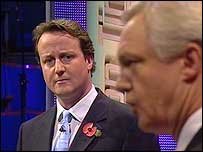
The two Davids

In what was an unprecedented television debate, the two contenders for the Tory leadership came together last night on the BBC TV programme Question Time.

A quick straw poll carried out by this blog suggests that David Davis had the better of David Cameron, coming over as more decisive and knowledgeable, although Cameron's presentation was flashier. Certainly, of the early papers, The Independent seems to agree that Cameron came off worse.

The Guardian seems to reserve judgement but both papers home in on a voluble man in a tweed jacket who told Cameron, "I've listened to you, and you're good on your feet, I give you that - I used to lecture, and you're good, not as good as I was, but good. But you waffle. You don't tell us how you're going to do things!"

On the European Union, though, both were as useless as each other. Cameron, on the one hand, confined himself to clawing back powers only on employment and social legislation while Davis was much more comprehensive, excluding nothing other than the single market.

But the million dollar question was how would the achieve their aims. Would Davis leave the EU if he wasn't given what he wanted? That would not be necessary, he said. A refusal would create a crisis and, out of crises, things emerge. Cameron would do it all by negotiation, citing the Thatcher "handbag" ploy that she used in negotiating the British rebate.

But neither of the strategies is realistic. When John Major provoked a crisis in 1996 over the beef ban, the "colleagues" simply closed ranks, forcing him into a humiliating climb-down. And while Thatcher succeeded in her ploy, she could do so because the colleagues needed her agreement and she had a veto. When it comes to a treaty change, however, all the other member states have the veto and the UK would be the supplicant.

On this key issue, therefore, neither of the candidates impress. It is worrying that two politicians can climb so far up the Tory hierarchy yet still, apparently, have no idea how to deal with the EU. It does not auger well.

The programme can be watched on this link.

COMMENT THREAD

Thursday, November 03, 2005

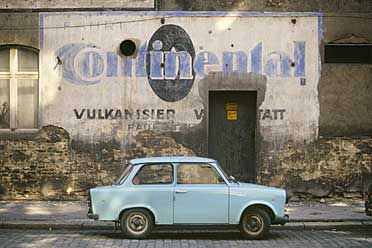
Ostalgie ain't quite what it is painted

[By popular demand - well, at least two readers were interested - I am reprinting the article that was first published in the Salisbury Review in December 2003.]

We do seem to hear rather a lot about nostalgia for Communism or, at least, the old order in Russia, the rest of the Soviet Union and Eastern Europe. Mind you, we hear it from mostly from western writers and journalists, many of whom are nostalgic for the old certainties themselves. Just occasionally, there is a sigh or two from the old artistic and intellectual establishment in the post-Communist countries.

It is fair to assume that the Left has not completely recovered from the body blow that the collapse of Communism has dealt to its assumptions, particularly as it did not collapse under a direct onslaught from the capitalist west but from its own people. It was not wanted by those whom it was supposed to benefit and that is hard to accept if one's entire world-view was built on the assumption that with all its faults Communism tried to provide what people were supposed to long for in life. And then it was all over. Communism did not and could not, as its opponents said, reform itself. It simply collapsed, leaving behind, it is true a horrible mess economically and, often, politically speaking. It did not even turn into socialism with a human face – it just went.

Surely that was a mistake. Perhaps, we could have a replay. Surely, the people who so thoughtlessly brought that supposedly good, though, alas, often misguided system crashing down are regretting it all. Surely, they must by now be tired of the tawdriness of Western "culture" which, as they have surely found out, consists of little more than McDonald's golden arches and pornography.

Alas, this does not seem to be true. For one thing, the people of the post-Communist societies seem no more disgusted or enamoured with McDonald's than people anywhere else and it is somewhat arrogant on the part of well-meaning Western intellectuals to assume that somehow East Europeans and Russians would be incapable of dealing with the problem of hamburger joints or Starbucks. They, too, can exercise their freedom to choose.

Then, again, it does not take many brains to work out that freedom means far more than just eating hamburgers or watching pornography. Interviews in the former Soviet Union or Eastern Europe always seem to come to the same conclusion. Yes, people complain about difficulties, economic restructuring, understandable bewilderment, but all too often, to the almost audible disgust of the interviewer they add things like: "Yes, but it is good not to have to watch what you say any longer."

Or they talk artlessly about the pleasure of being able to buy what they want to buy when they want to buy it, not when the factory decides to produce it. These pleasures are incomprehensible and, even, unknown to Western intellectuals who have never had to go without anything much in their lives.

Of course, there is nostalgia. There is always nostalgia. It is part of the human condition that people always look longingly to the past when things were better, easier, more interesting, even purer. In the depths of one's nostalgia one knows that the picture painted by the imagination is not entirely accurate but that matters little. It is almost inevitable that the sort of economic, political and intellectual upheaval that Eastern Europe experienced in the last fifteen years should have left many people bewildered and with a feeling of fausse nostalgie, recently dubbed in East Germany or, at least about East Germany, as ostalgie.

I came across its first manifestation even before the upheaval truly happened, in about 1986 at a conference organized by PEN International in London on the subject of translation. Among the many different discussions and presentations there was one about the changes in the circumstances of East European translators as other conditions changed.

I remember an East German translator, whose loudly and extensively voiced complaint was that in the new capitalist culture he and his colleagues had to compete with West German translators who worked to contracts and, therefore, produced translations faster and more smoothly. The implication of his complaint was that these West German hacks were clearly inferior but he showed no evidence of this. The main problem was clearly that he could even then foresee a period when he would have to produce work in accordance with his contract or not get paid; he and his colleagues would have to say good-bye to their comfortable existence as salaried members of the Union of Writers and Translators. Creative freedom was all very well but a good flat, guaranteed holidays and a very acceptable regular income may well be more important.

I heard similar complaints when I went to the then Soviet Union a couple of years later. One writer (unpublished for reasons unknown) who lived in the second flat that his father, a high-ranking member of the Writers' Union had, suggested that I might like to translate his book. I pointed out that translations in Britain were paid for and if I did not get paid I could not live. He was clearly shocked by such capitalist mercantilism. He could afford to be then. One wonders whether he is now suffering from a Russian form of ostalgie or whether he has managed to come to terms with actually having to work for money rather than, as the old East European joke had it, to pretend to work for pretend pay.

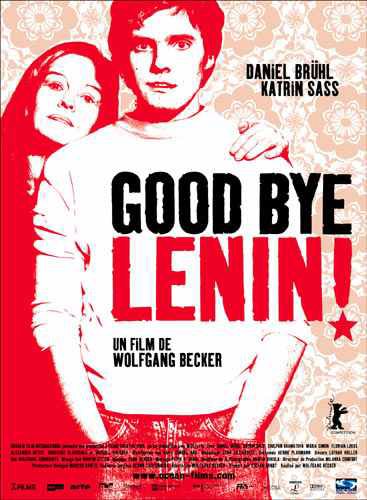
It did not, therefore, surprise me when I first read about the latest supposed manifestation of ostalgie, Wolfgang Becker's film Goodbye Lenin. Critics fell over themselves to praise the elegance, sensitivity, political understanding displayed by the director and by the actors. I assumed that a diet of special effects and endless films about adolescents coming to terms with their sexuality had addled their brains to the point when any film that had a plot and a few serious points to make seemed like a work of genius.

I went to see the film fully prepared to come out declaring that if they want the Wall back, well, let them have it. But the film turned out to be unexpectedly better and worse than described. In the first place, I wondered whether I was watching the same film that the critics had seen. The one I watched showed no nostalgia for the old order at all. In fact, the shabbiness of life under Communism was made as clear as the general happiness about the collapse of the Wall, the improved living conditions and, even, the acquisition of "real" money, Western marks. The only people who grumbled about the changes were a few old curmudgeons, clearly well past retirement age, who, nevertheless, adjusted to the new conditions well enough to watch western TV and wear western clothes.

The plot of the film is well known: Alex, a rebellious East German teenager is arrested during the brutal breaking-up of a demonstration. This is witnessed by his mother who has a heart attack. The police are too busy carting youngsters off to the hoosegow to pay attention to a middle-aged woman collapsing in the street and by the time she gets to the hospital she is in a coma. There she stays for eight months while the world changes utterly. When she wakes up, the doctor warns Alex and his sister that she must not be subjected to any shocks. She had been an obnoxiously good Communist and Alex decides that to prevent her having a second heart attack he has to recreate the living conditions that she is used to. This necessitates all sorts of entertaining subterfuges, retrieval of old furniture, mock pioneer songs (sung by a couple of suitably bribed young boys), transference of new western goodies into old East German jars and so on.

As the film progresses it becomes clear that Alex has, indeed, recreated the Communist system in his own little enclosed world, not by using old East German pickle jars or making everyone dress in what his sister describes as "the crap we used to wear" but by building a system that is based entirely on a lie. His sister calls it creepy; his highly intelligent Russian girlfriend points the facts out to him: once you start lying it grows on you. And it does.

The lie gets bigger and bigger as Alex drags more people in by a combination of self-centred bullying and heavy doses of emotional blackmail. Outside, people rejoice while feeling a little scared but in Alex's little world obsessiveness and lying predominates. He no longer allows any kind of deviation. When his sister announces that she is pregnant and intends to move to another flat with her boyfriend and existing child he launches a vicious attack of the kind that would, in the real world, deserve a slap. Interestingly, he never manages to win a reasoned argument with the sister's wessie boyfriend, who shows himself to be a much nicer and more accommodating personality than the supposedly kind and sensitive Alex.

It is Alex who makes the derogatory comments about the ridiculous "benefits" of the reunification but when the film pans out into the world outside the flat the benefits are real. In fact, economic difficulties are not shown at all. Maybe the sister works at Burgerking but there is no indication that she ever liked studying economics and, in any case, what use is a Marxist economics degree anywhere except, maybe, a western university.

There is an interesting little vignette, not mentioned by the critics, but unlikely to have gone unnoted by Germans in the east of the country. Alex's sister, when pregnant, has an ultrasound scan. Her delight and amazement indicates clearly that she had had nothing like that with her first child a year or so previously. This is probably true. Standards of ante-natal care under Communism made one's hair stand on end. It is not only the golden arches that came to East Berlin once the Wall was no longer there.

In the end, the film remains unsatisfactory for a very ordinary reason: the plot goes nowhere after the first hour or so. Two thirds of the way through the film, Alex, his sister, his girlfriend and the sister’s boyfriend find out that the mother has a secret of her own: she knew that her husband was going to stay in the West and had intended to join him with the children. In the end she was too scared to apply for a visa. The world Alex was trying to re-create for her mother, the world for which he has forfeited his own soul and truth, turns out to have been based on a double lie even before his efforts: that of the system and that lived by the mother within the system.

Either the film should have finished there on a note of savage irony or it should have explored what the mother’s admission really entailed. It does neither but meanders on to an unlikely and sentimental conclusion in which Alex creates an artificial "alternative" reunification for his mother's benefit so she can die happy.

It is this "alternative" reunification that has appealed to so many critics in the West, who do not seem to like the reality of the true people’s power that swept away the Wall and all that it had entailed. There is, as it happens, a modicum of doubt in the film about the mother’s final attitude: does she believe Alex or is she going along not to upset him? This, too, remains unexplored. In the end, by taking Alex’s side and accepting his mutterings about how East Germany ought to have ended the film appears to create a lie of its own.

It succumbs to a certain ideological explanation in the teeth of its own evidence. Or maybe not. Could it be that Becker is now using the famous Aesopian language that writers, artists and film-makers employed to circumvent Communist censorship, to tell the truth but also to gratify those western critics who still dislike the truth about Communism and its collapse? After all, if Alex creates a more fitting end for the German Democratic Republic than the one that really happened then the conclusion is inescapable: the fitting end is one that is surrounded by lies.

As the country lived so it should die – not in an outburst of popular joy and songs of freedom but in a rather mean and shabby, distorted little claustrophobic world, created for possibly the best of reasons but built on untruth. If that is what Becker meant then his film is understandably popular in the east of Germany – the people there have always known and understood this. It is also understandably popular with the bien pensants of the West, who are less capable of reading Aesopian language.

And yet, who knows? Perhaps they are right and I am wrong in my interpretation. Perhaps, German film-makers are suffering from ostalgie to the point when they are ready to make films that start off as the truth but fall into a sentimental and untruthful trap.

COMMENT THREAD

And now for something completely different

The last place you would think of to find yet another example of the effects of an utterly absurd and crass EU regulation might be the sports section of The Daily Telegraph but, today, it provides us with just such an example.

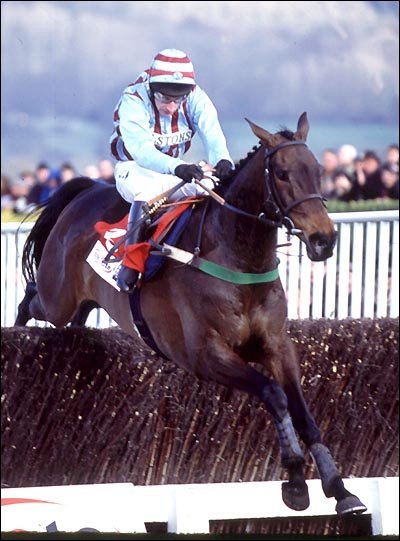
This is the tragi-comedy of attempt to bury the three-time Cheltenham Gold Cup winner, Best Mate, on top of Haldon Hill, where he died two days ago after a suspected heart attack during a race.

What was a noble gesture, for a fine horse that had captured the imagination of many fans, became entangled in red tape when trading standards officers from Devon County Council refused a request from Exeter Racecourse to bury the steeplechaser near the spot where he died.

This means, says the Telegraph, that, unlike most great racehorses before him, who have all been buried at studs, stables, in their paddocks or, in Red Rum's case - by Aintree's winning post - at the scene of their greatest triumph, he will now have to be cremated.

This, as everyone knows, it not actually true because Best Mate could have been disposed of as waste by burial in a landfill approved under Directive 1999/31/EC, this being one of the options provided for by the 108-page EU Animal By-Products Regulation 1774/2002, which came into force on 1 October 2003.

Of course, there is an exemption under the regulations for pets and, according to the Telegraph narrative, officials at Exeter sought permission to respect owner Jim Lewis's wish to bury the great steeplechaser near the spot where he died.

This descended into farce as one government agency after another passed the buck and eventually, after the Environment Agency and DEFRA had had a crack at whether or not burying Best Mate would be “legal”, the question ended up with Devon County Council's TSOs in Exeter.

They had to decide on whether, as a racehorse, Best Mate was defined as a “pet” or "commercial animal." Though the definition of a "pet" is an "animal nurtured by humans but not normally eaten" – something, says the Telegraph, you'd imagine described Best Mate fairly accurately - because we are dealing with EU law, it "must" be interpreted in a "European context". As horses are eaten on the continent the Europeans would regard a racehorse as a commercial animal.

Said Roger Rivett, head of Trading Standards, said: "Since foot and mouth and BSE it has been illegal to bury any fallen stock. They must be disposed of in approved ways. We were not trying to be obstructive, just interpreting the law. We've suggested he be incinerated and his ashes buried. After all 50 percent of humans are cremated these days."

When asked what possible harm there could be in burying such a famous horse 10ft underground, miles from anywhere on top of Haldon Hill, Rivett pointed out the dangers of disease possibly being spread by carrion or seeping into a watercourse. "We're here to enforce the law, not bend it," he concluded. Exeter, it would seem, is plagued by crows with spades.

A day of wrangling with civil servants was just what Best Mate's owner, Jim Lewis, did not need, added the paper. "I understand they had to close various gaps in the law after foot and mouth," Lewis said, "but horses don't get or carry it. It's political correctness gone mad but we'll have to abide by their decision. Ideally I wanted him to be buried today but, to be honest, it's been another torrid day."

However, as anyone will be quick to tell our Jim, the law is the law and must be obeyed. So, denied the opportunity to bury him, Exeter are looking at some sort of permanent memorial. At Cheltenham a statue of Best Mate is likely to be on the agenda at their next board meeting. A suitable race will also be named after Best Mate.

One thing for sure, though, Jim Lewis will not be putting down the EU as his "best mate". I wonder whether the fragrant one will mention it on her blog.

COMMENT THREAD

Ah, come on…

I listened to the BBC World Tonight news programme on Radio 4 last night, to hear the obligatory headlines about Blunkett, and it was some way down the bulletin before we heard that prime minister Villepin was cancelling a trip to Canada in order to deal with the riots in Paris.

That was it. The main part of the programme was taken up with Claire Balderson in Washington gloating at Bush's approval rating being at "an all-time low" – the BBC's way of celebrating the first anniversary of the president's second term.

Yet, Paris is in its seventh night of riots, with violence now spreading to several suburbs, within a fifteen-minute car ride of the centre, and the police clearly unable to keep control. Last night alone, about 180 cars were set on fire in the greater Paris region and 34 people were arrested.

And, of course, this is immigrant violence, matched by the traditional response from the less than gentle French police, witnessed by Abdel Srhiri, 52, a Moroccan immigrant, whose account was reported by the International Herald Tribune.

Srhiri went for a walk with his family after dinner on Tuesday, when he witnessed riot police firing rubber bullets at local teenagers, who in turn hurled bottles at the officers. "Bullets were flying through the air and there was broken glass - it was war, right here," he said. In his 28 years in France - and in the same neighborhood - he had never seen anything like this. "There is real aggression in the air," he added.

A mere two days ago, my colleague reported on the strange disparity between the low key media reporting of 47 French politicians, 27 of whom can be described as senior, being found guilty of financial malpractice and receiving suspended sentences as well as rather high fines, compared with the orgy of coverage devoted to the indictment of Lewis Libby, former assistant to Vice-President Cheney.

And here we go again. Just imagine the coverage if this level of rioting was happening in downtown Washington. Just think of the commentary little Claire Balderson would be enjoying if, after a full six days of escalating riots, the president had to take time out to appeal for calm, as indeed Chirac had to do yesterday.

The TV would be full of it and the "Washington riots" would be front page of every newspaper, with ponderous articles in The Guardian and Independent about the failure of race relations and the inadequacies of the US capitalist model.

But, of course, this isn't downtown Washington, thousands of miles away. It is in Paris, only just over a hundred from our shores, a neighbour, ally and "partner" in the European Union - champion of the "social model" of which the Guardianistas and the Beebees so approve.

So, what do we get? Down page, down bulletin items and no comment. Ah, come on.

COMMENT THREAD

Wednesday, November 02, 2005

Czechs in the balance

Just 18 months into their membership of the EU, and the Czechs are not happy bunnies, according to the Czech News Agency. In a survey carried out by the STEM polling agency, clear 41 percent of respondents believe that the European Union affects the life in the Czech Republic more than necessary.

In the 1990s, most Czechs said that the EU had a weak impact on their lives while, eight years ago, only 15 percent said that the EU affected events in the Czech Republic too much.

Mind you, a high number of Czechs also say that the ministers and legislators enjoy an inappropriately high influence in the country. Many Czechs would like to increase the influence of trade unions and municipal authorities, although two thirds of respondents are happy with the presidential office. We wonder why.

COMMENT THREAD

Merkel's woes

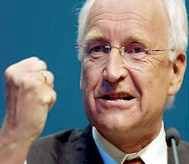
It never rains but it pours. Or whatever the German equivalent is. No sooner has Chancellor-in-waiting Angela Merkel heard of the disappearance of the Social-Democrat Chairman, Franz Müntefering, than she was told that the designated Finance Minister, Edmund Stoiber (left), has decided to remain in Bavarian politics.

In many ways this is quite a good thing, as his baneful influence has been seen in the watering down of all reform proposals that Merkel advocated at the start of her campaign. His replacement in the coalition, Michael Glos, though a senior member of the Christian Social Union (CSU) is unlikely to have the same influence or position.

Herr Stoiber’s immediate excuse was that with Herr Müntefering resigning, the SPD was no longer a predictable political force and could not be relied on to be a reasonable coalition partner.

Will the negotiations conclude by November 12? Will Merkel be formally elected to be Chancellor by the Bundestag on November 22? Can they find their way out of a paper bag? Who can tell?

COMMENT THREAD

A suspension of interest

The really interesting thing about the continuing "drama" of the Tory leadership contest is how uninteresting it has become – trivial even.

Today we get, according to The Guardian and others, a report that David Davis – whom I believe is one of the contenders – is pledging not one but two EU referendums if he becomes prime minister.

Since Davis is unlikely to become even leader of the opposition, this is largely an academic issue, but it is interesting to see a man offering a policy which, on current estimates would cost the best part of £10 million per go. Hasn't he heard of general elections and manifesto commitments?

Anyhow, for the first referendum – and £10 million - Davis would ask the electorate which powers should be returned from Brussels to Westminster. For the second – at another £10 million – he would ask the if he had delivered on the first.

Despite this, though, Davis insists that withdrawal is not on the agenda. The man simply wants a mandate which would "give us the authority to look the European commission in the eye and say this is the view of the British people".

Needless to say, the BBC immediately pulled Ken Clarke on to the Today programme, to denounce Davis and Mr “Policy Vacuum” Cameron, declaring the Eurosceptic stances of the two Davids as a "whip up our core vote" strategy.

In full flight, Clarke told the BBC listener that: "If the two Davids start competing on the Eurosceptic front, which there is a slight sign that they are, I hope it doesn't mean that the Tories are going to go back to the old, old 'Let's whip up our core vote with rightwing issues' approach to elections.

"Frankly," he said, "that is the way in which we will be choosing a leader of the opposition and no more."

In all probability Clarke is right on this one, althpough not for the reasons stated. Even with (or especially with) Cameron, few but the very optimistic believe that the Tories will win the next election. Even though the Labour government is beginning to look increasingly like the Major government in its dying days – especially with the forced resignation of Blunkett – there is no guarantee that disillusioned Labour voters will switch to the Tories.

We are, effectively, in new territory, where the main opposition part can no longer rely on the disaffected to sweep it into power, so the real political question is what are the Tories going to do when they lose the next election. Then, it will start getting interesting.

COMMENT THREAD

Read it and weep

Let no one say we are not catholic in our tastes (that's with a small "c"), or that we don't give you variety. From the deeply disturbing news of selling out our last explosives factory, we now offer a beautifully written piece in Cumbria's Business Gazette about farming in the Lakes.

Called, "Clash of cultures that can really blight lives in real world", it is a variation on the theme of the EU schizophrenia we reviewed a couple of days ago, only in a rural setting. It starts softly, the anonymous author telling us a tale about a tractor:

Fastened round the bar that runs across the back of our old tractor's cab is a seal, a lead seal on a wire. Any farmer would probably recognise it, as it was put on by Defra during FMD to "seal" our tractor and stop it being used except for the licensed movement it was about to make.

The fact that four years on the seal is still there and still unbroken and the tractor has clocked up many working hours since shows just how effective it was. But whoever drafted the regulation hadn't a clue about tractors and the hapless official who was faced with the necessity of "sealing" a tractor merely shrugged and got on with the job knowing full well it was meaningless.
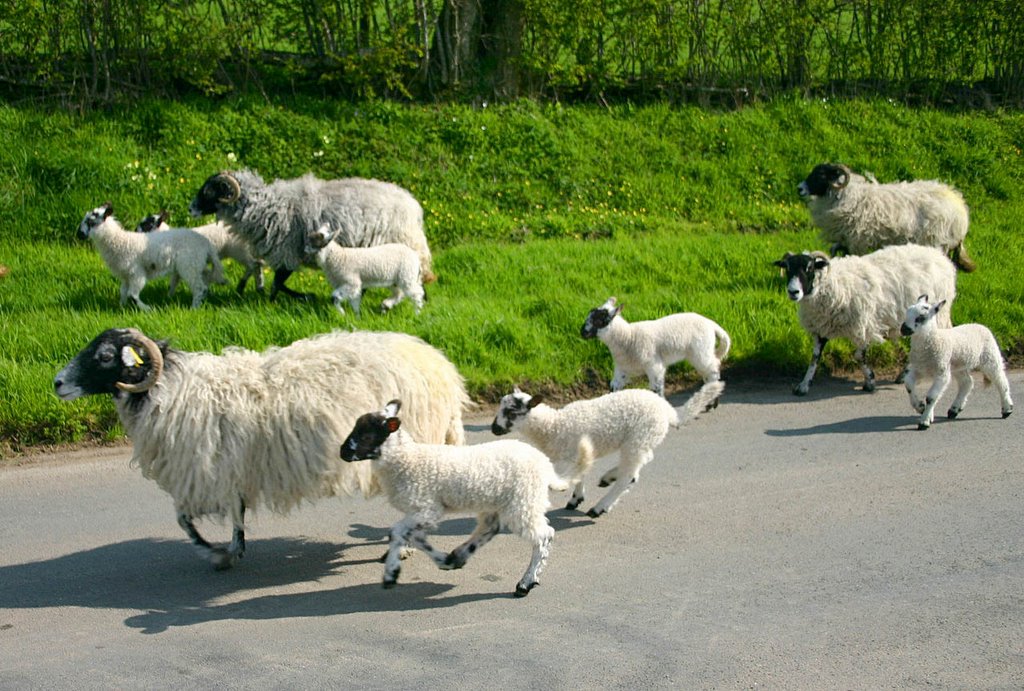
Then, being Cumbria, there is rather a lot about sheep, and the EU's wonderful ideas about ear tagging. It is so well written that it is pointless giving you a précis. Read it yourself, from the link above – and weep.

COMMENT THREAD

Tuesday, November 01, 2005

Ethics á la française

The Wall Street Journal Europe reports with some bemusement that the French Foreign Ministry, the Quai d’Orsay wants to create an “ethics committee” for its diplomatic services. No, it seems the story is not a leg-pull. They really are talking about it.

As the article [available on subscription only] says:
“Certainly the foreign ministry does have a huge PR mess on its hands. A former French ambassador to the United Nations, a former secretary-general of the French foreign ministry, nine other high-ranking Frenchmen as well as a plethora of French companies stand accused of profiting from the U.N.’s corrupt program. While on Saddam Hussein’s bribe-roll, many of these official were ouspokenly opposed to American-led efforts to depose him.”
Things have got so bad that the French press has been critical of the government line, Le Monde going so far as to say:
“Even the most indulgent will wonder about the risks of a pro-Arab policy that was at times willfully blind.”
Strewth. That’s telling them.

The French Foreign Minister, Philippe Douste-Blazy, on the other hand, seems quite unaware of the problem, even though, he presumably authorized the idea of an “ethics committee”. Writing in Libération a few days ago, he boasted:
“If France preserves a pioneering role for the respoect of cultural diversity, if its voice carries in the great conflicts of the world, if our country continues to draw attention and to cause curiosity and admiration, she owes this recognition largely to our diplomacy.”
And we think our politicians live in a hermetically sealed bubble.

COMMENT THREAD

Grand coalition or new elections?

The German coalition negotiations may be in jeopardy and there are vague talks about the possibility of another election. They will vote and vote until they elect a government.

The latest crisis or possible crisis was caused by the president of the Social Democratic Party, Franz Müntefering, announcing that he would not run for the position again. His anger was caused by the fact that his nominee for the party’s general secretaryship, Kajo Wasserhövel, was defeated by the left-wing former leader of the youth wing, Andrea Nahles.

All in all, this shows a certain fractiousness within the party, with the older generation like Schröder, who is largely out of the game, and Müntefering being shouldered aside by the younger, more extreme left-wing sections. These oppose vehemently the rather tame reforms introduced by Schröder. They will certainly be against any possible reform agenda that the two big parties have to agree on.

The coalition talks are supposed to end on November 12 in time for Angela Merkel to be elected as Chancellor by Parliament. Müntefering had been expected to become Vice Chancellor and Labour Minister. Now all bets are off.

COMMENT THREAD

Is our government completely mad?

The only military explosives factory left in the UK is to be closed down, with production possibly moving to Bordeaux France, in a deal between the factory operator BAE Land Systems and the state owned French company Societe Nationale des Poudres et Explosifs (SNPE).

The unit to be closed is the former Royal Ordnance factory in Bridgewater, Somerset, now owned by BAE Land systems. It not only makes explosives for artillery shells, bombs and solid fuel for missiles, but also produces unique components for Britain's nuclear weapons.

The closure is one of two announced by BAE, the other at Chorley, near Preston in Lancashire, which produces ammunition, another facility vital to the security of Britain's defences.

This is part of what has been termed the "rationalisation" of the European missiles and explosives industry, which has already seen a partnership between BAE Systems and Paris based Giat Industries to produce the guns and ammunition for the next generation of British armoured vehicles.

Predictably, in view of the job losses, the move has been condemned by the engineering union Prospect, which said it threatened the supply of ammunition and explosives to the MoD, leaving the UK entirely reliant on foreign suppliers.

Concern has already been expressed by the House of Commons Defence Committee, which has already expressed its concerns over security of supply.

In 2002, it expressed its fears that if Bridgwater was to cease to manufacture then explosives would have to be imported from other suppliers, which would require a very large stockpile of explosives for production purposes.

There was, it felt, an increased risk in safety in transportation from terrorism and normal shipping and road accidents. But, crucially, it was concerned that only by keeping the only military high explosive manufacturing facility in the UK would the government be in total control of its foreign policy.

No foreign government, it said, would be able to interfere with the supply of explosives, as was seen in the Middle East conflict when Belgium refused to send Britain supplies.

Amazingly, though, the MoD has dismissed these concerns, saying of the Bridgewater and Chorley closures that they were "a matter for BAE Systems". Given the implications raised by the Defence Committee, we can only ask whether our government is completely mad?

COMMENT THREAD

This mad, destructive organisation

A story to make your blood boil comes today from the New Zealand Herald, headed "English test makes NZ nurses sick".

The paper informs us that New Zealand nurses who want to work in Britain now face new hurdles, including having to pass an English language test. And, even though their training is equivalent to the UK regime, they must also complete a 20-day training programme of supervised practice.

The point, of course, is that these new rules apply to all nurses from outside the European Union, but anyone from within the EU, with the requisite qualifications in their own countries – even if they are from non-English speaking states - can apply for work in the UK, and their language skills are not tested.

To require citizens from member states to demonstrate their language skills, or undergo additional testing, would breach the "non-discrimination" rules of the treaties.

For NZ nurses, there is the additional problem that places on the mandatory 20-day courses were in short supply. Says the Herald, about 400 New Zealand nurses go to Britain each year to work and the changes are already deterring some. "It is causing people to reconsider their travel to the UK," says Josephine Wallis, chief executive of recruiting company Geneva Health International.

Associate Professor Judy Kilpatrick, of the Auckland University School of Nursing, said it was "ridiculous" to make New Zealanders pass an English language test.

It is, in fact, more than "ridiculous". It is deeply offensive. Under EU rules, we are required to make our kith and kin – native English-speakers – jump through hoops when someone from, say, Greece, Italy or Spain, with no English and no knowledge of our culture, can walk right in.

We met a similar crass stupidity in 1992 when the EU meat hygiene rules came fully into force, requiring qualified veterinary surgeons to supervise red meat and poultry slaughterhouses while they were operating – at enormous expense. With UK-trained vets in short supply – and unwilling to do slaughterhouse work - we were deluged with young Spanish vets, straight out of training, many of whom could barely speak a word of English (or tell a turkey from a chicken).

I remember one, a young female, who found her first day at a slaughterhouse so difficult that she retreated to the car park and spent the rest of the day, and every day thereafter, sitting in her car reading books – with charges of £60 per hour being levied on the slaughterhouse for her "services".

God, how I loath and detest the European Union, this mad, destructive organisation that forces us to do such utterly stupid things.

COMMENT THREAD