Monday, September 12, 2005

The measure of the beast

Christopher Patten, that completely independent EU pensioner, is airing his views in the The Guardian today, telling us that the Tories have "lost the plot" and only Ken Clarke can find it again.

He argues of the Conservative Party that what has "helped to wreck its prospects, delivering Britain into the hands of a Labour government" is the reversal of "the international posture it had first warmly embraced 30 years before when it had become a pro-European party."

He claims that Conservative "anti-Europeans" have been indulging in a ruinous fantasy have no idea what to put in place of the arrangements against which they rail. Theirs is a programme, he says, whose main achievement has been to exclude from all hope of the party leadership the man - Kenneth Clarke - most able to exercise it in a way likely to restore the party's fortunes.

He believes that Clarke is the man to drag the Conservative party back into a more sensible and comprehensible European posture. Others with similar views to his are driven to the outer fringes of Conservatism, to watch with dismay the continued infatuation of the party they love.

What is especially interesting, I suppose, is not the content, but the fact that the EU pensioner feels the need to make it – so keenly that he will even, as a supposed Conservative, open up his heart to the distinctly un-Conservative Grauniad. In that, he is really showing the obsession with "Europe" of which he accuses us "anti-Europeans".

Outside the ranks of the constituency party, however – amongst "normal" people, I fear that it is considerably less of an issue. Today, for instance, I met my new (lady) bank manager – by definition middle-class, and reasonably well off. We got to talking about my job, as one does, whereupon she asked me: "Do you think we will eventually join this European Union?"

Hearing this, I was reminded of the anarchic cartoon strip South Park, an episode of which I watched yesterday called "Quest for ratings".

South Park Elementary has a closed circuit television network. Jimmy and "Rick" Cartman are the anchors for "Super School News", but the school is cancelling their programme since it only gained 4 viewers in the week. Cartman wants to make the show more populist, but Jimmy does not want to jeopardise their integrity by "dumbing down." Cartman offers the immortal words: "Look, the school is already dumb. We're just giving them what they want."

Cartman, rather than Patten, may have the measure of the beast.

COMMENT THREAD

Him again

Jack Straw is in trouble again. Not big trouble, you understand. After all, he did not do anything bad, just showed his support for the new Iranian government that is full of people with interesting past histories.

In particular, the Iranian state news agency made much of a picture that shows our Foreign Secretary shaking hands with Esfandiar Rahim Masha'ie, who was recently appointed as a Vice-President and Head of Iran's Cultural Heritage and Tourism Organisation. Cultural Heritage and Tourism eh?

Little in the man’s past history indicates that these might be his interests.

“In 1979, Masha’ie became a commander in the komitehs, a paramilitary armed organisation charged with law and order after the rise of Islamic clerics to power. He rose rapidly, becoming head of Tonekabon’s komiteh in the same year.He was soon appointed governor of the city and later became Deputy Minister of Mines and Industries. He also served for some time as the Deputy Interior Minister and worked for some time in the Ministry of Islamic Guidance. When Ahmadinejad was the Mayor of Tehran, Masha’ie became his deputy for social affairs.

Critics say throughout his career since the early 1980s, Masha’ie’s has been working for Iran’s secret police, the Ministry of Intelligence and Security.”

There is more:
“Tonekabon residents say Esfandiar Rahim Masha'ie was known for his brutality against the relatives of dissidents. He once sentenced the father of an opposition activist to four years in prison. At the end of the sentence period, Masha’ie demanded that he continue to remain behind bars since the man had refused to disown his son.“They called him the Butcher in Tonekabon in the 1980s”, said Saeed Shirkhodai, who fled his native city in northern Iran and now lives in exile in Sweden. “People of Tonekabon, Ramsar, and other nearby cities and towns in western Mazadaran still remember the horrific crimes of Masha’ie”.”
What a delightful new friend for our Foreign Secretary and the Culture Commissar, Tessa Jowell. And how it takes one back to the Wilson government and the various welcome guests that arrived from the Soviet Union and other East European countries.

If I may just reminisce for a moment. One of the most odious of the Labour Government’s best friends was Mitja Ribicic, then Prime Minister of Yugoslavia, before that Prime Minister of Slovenia and before that Head of Secret Police in Slovenia. Never a man to shirk his duty, Mr Ribicic, though of exalted rank, was known to torture prisoners personally. One of them is the highly regarded expert on Communist matters, Dr Ljubo Sirc, happily still with us and still battling away. Less happily, Mr Ribicic is also still with us, though there are some desultory moves to have him charged with responsibility for various massacres.

There were others: Comrade Shelepin, the eternal head of the Komsomol, even though he was well into his fifties; Comrade Kosygin, described by Prime Minister Wilson as being “part of the British way of life”; and, above all, the butcher of Budapest, Comrade Andropov, the alleged jazz lover.

Well there we are. Reminiscence over. But what has changed? The names are different but the attitude is the same. As Hamid Solhju, an Iranian exile living in London said:
“Haven’t we had enough? Is there no end to this appeasement?”
It seems not.

COMMENT THREAD

Changed for the worse

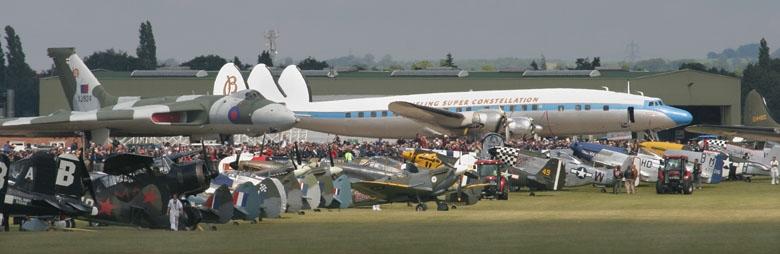
Unusually, yesterday, I abandoned the Blog to travel down with my son to Duxford for the final airshow of the season, not least to see Sally B (pictured left) fly. This aircraft, the last remaining airworthy B-17 Flying Fortress on the UK register, has recently been in the news after a particularly inane EU law on aviation insurance grounded her.

The precise problem was (and still is) EC regulation 785/2004, under which the B-17 must now be classified for insurance purposes alongside commercial airliners, prohibitively raising its premiums to the equivalent of £1,000 for each hour of flying time. However, due to the intervention of some wellwishers and a bit of creative accounting, the operators managed to salvage something of the 2005 flying season, although the problem is by no means over, and the 2006 and further seasons remain in doubt.

As it happens, the Sally B did not fly yesterday. Having escaped, temporarily, the clutches of the EU, she – with the rest of the flying programme – was caught in the grip of ghastly weather which hovered around the airfield all day, with the cloud base at 400 feet and visibility down to a mile at times. Apart from a spirited display by a Chinook, and a vain attempt by a Chipmunk (the aeroplane variety) to cheer us up, there was no flying.

However, that did give us plenty of time to visit the huge Sally B tent, to the edge of which was a small table with a petition calling on the government to negotiate an exemption to the directive. However, the table was unmanned and none of the staff there seemed interested in gathering signatures, very much reflecting the attitude of the Sally B operators, who seem anxious to downplay the political aspects of this problem.

Instead, the emphasis was very much on fund-raising and it is very clear that the operators’ game is to increase the flow of funding in order to buy their way out of the problem, rather than confront the issue head on.

The greater problem is that Sally B is not on its own. The commentator, over the Tannoy, also prattled on for a while about the spiralling costs of insuring display aircraft, although, in a long dissertation, not once did he mention the EU. We mustn’t be "political" must we?

But the shadow of the EU now permeates the whole airshow. The great thing about Duxford always used to be that it was an enthusiasts show. People by the thousands came from all over the country came to see aeroplanes, in the static park and flying. And while other airshows throughout the country were becoming progressively infested with funfairs, bouncy castles, trade stalls and hamburger vans, at Duxford you still got what you paid for – pure, raw aviation.

However, this time – in an attempt to cover those spiralling costs – the bouncy castles had arrived. While the hangers used to be emptied of their exhibits and given an airing out on the tarmac, where we could see them in their glory, the aircraft are now swept aside to make room for the stalls, the funfair and all the other garbage. The character has gone. All we are left with is another "family entertainment" venue, with the majority of the crowd entirely uninterested in the flying.

On the other hand, what once used to be an uncluttered flight line is now obscured by corporate hospitality tents, and special seating enclosures for those who are prepared to pay an extra fee on top of the £23 entrance ticket. The great unwashed, who actually came to see the aircraft, are now confined to a smaller and smaller section of the airfield, where we are all squashed together so tight that it is hard to see anything of the display.

After 15 years without a break of going to Duxford airshows, I will not be going again. In the pursuit of greater revenue, the shows have been terminally "dumbed down". Doubtless, the EU is not wholly to blame, but it has played its part, and another treasured part of life (my life, certainly) has been changed for the worse.

COMMENT THREAD

He is part of the problem not part of the solution

Next week's grand UN summit is looking more and more like a damp squib. And it looks as if the British Government will be on the wrong side of the debate. Well, that is hardly unusual.

We have already mentioned Jack Straw’s inexplicable support for Kofi Annan on the day of the damning Volcker report (and it was not as bad as it could have been) but it seems that he is not alone. The entire government and the Foreign Office are right there with him. What a surprise, eh?

From the Sunday Telegraph we find out the delightful detail that Mr Straw’s support was given to SecGen Annan over dinner at Le Gavroche restaurant. How very pleasant. This Mayfair restaurant, run by Michel Roux and named, incongruously, after a street urchin in Victor Hugo’s mammoth novel Les Misérables, happens to be one of the most expensive ones in London. One cannot help wondering who picked up the tab, though it probably does not matter in the long run. You and I, dear reader, pay for these jollifications and there are plenty more that we do not find out about.

The article then continues:

“Immediately after the damning oil-for-food report was released to the Security Council on Wednesday morning, Sir Emyr Jones Parry, the British ambassador to the UN, led Britain's public response by placing blame for the fiasco on Saddam Hussein.”

Well, far it be from us to exonerate former President and Tyrant-in-Chief Saddam Hussein, but is there not some responsibility resting on the wonderful transnational organizations which was supposed to supervise this whole scheme? And which, by the way, made very little effort to get rid of the said Tyrant-in-Chief, possibly because of a nagging awareness that with coalition troops sweeping through the country the oil-for-food scam will not stay secret for long.

Mr Blair and Mr Straw, it seems, are long-standing admirers of the SecGen Annan and consider his presence absolutely vital to the reform of the UN. One rather wonders why the UN should need reforming if it has been led for some years by this amazingly good and honourable personality.

Just in case there is anybody among our readers who cannot remember the highlights of SecGen Annan’s career, let us recall some of them. He was responsible for the UN shambles in Rwanda as the then operational chief. It led to a million and a half deaths.

Under his leadership, the UN has gone on being high-spending, terrorist supporting and seriously anti-semitic.

On SecGen Annan’s watch we have had the half-hushed up scandal of UN troops raping and buying the sexual favours of under-age girls in DR Congo.

We have also had the completely hushed up scandal of sex trade conducted by UN troops and officials in the Balkans.

While Annan has been SecGen, the UN has not been able to sort out Iran and has failed miserably in the Sudan, particularly in Darfur.

One official after another has had to have his diplomatic immunity lifted for the FBI to arrest them and charge them with various forms of embezzlement. There have been scandals of sexual misdemeanour of very unpleasant kind among the higher ranking staff.

I need not go on. The man in charge of this complete and utter mess is one who is highly regarded by the Prime Minister and Foreign Secretary of this country. They think that he is indispensable to the projected reform of the entire organization.

"We genuinely hold Annan in high esteem," said a senior Straw adviser. "We believe he's good news and he wants to do the right things." None the less, senior diplomats who back Mr Annan privately acknowledged that in other walks of life - either business or government - he would have had to quit following last week's report. "That's just not the culture here," admitted one official.

That’s just about the size of it. In the meantime, what of that famous reform? Well, there is the proposal to increase the Security Council. As The Business puts it:

“The reform's centrepiece was expanding the UN Security Council beyond the five permanent members - the US, UK, France, Russia and China - and 10 non-permanent members elected to two-year terms. Annan laid out three scenarios for enlargement and all failed due to regional rivalries. Argentina and Brazil,India and Pakistan, Germany and Italy, and Japan and South Korea fought each other over new permanent seats. There will be none for the foreseeable future.”

This probably will not happen but, on the whole, I fail to see why it should make any difference. Of course, with more members on the Security Council that body will be in a permanent log-jam, which has certain advantages but it does not precisely make the UN more accountable for its actions.

The other important part of the “reform”,

“Annan's attempt to get rich countries to commit to foreign aid of 0.7 percent of their national gross domestic product, which he claims would halve world poverty by 2015, has also foundered. The European Union has made such a commitment; Washington has refused.”

Good of the EU to agree on the member states’ behalf. They, of course, have already made it clear that the money will not, in practice, be forthcoming, which is just as well, when one looks at the UN’s past record. Just precisely why giving more money and power to an organization that has proved itself to be inefficient and corrupt should be described as a “reform” passes one’s understanding.

Naturally, much of the blame for the fact that the jamboree this coming week will fail is being laid at John Bolton’s feet. He and his government should not have produced 29 proposed amendments so late. Mr Bolton’s response, when he stopped laughing, was that the American proposals had been first presented on June 25, hardly at the last minute.

And, as some British diplomat has pointed out, everyone is getting in there, amending this, disagreeing with that, demanding something else. The Business says:

“Another failed US and EU proposal is creating a human rights council to replace the UN human rights commission, discredited for allowing rights violators like Libya and Sudan to sit on it. But Cuba, Syria and Pakistan, with the support of Russia and China, have killed it.”

The Telegraph adds other details:

“Ahead of the summit, Britain has led efforts to secure an unequivocal UN condemnation of terrorism - considered a priority by America and the EU after the September 11 attacks and the Madrid and London bombings.

The Palestinian delegation, Egypt and Iran are leading efforts by a mostly Muslim and Arab bloc to add a qualifying paragraph that effectively excludes acts committed in support "of the struggle for independence" from the definition of terrorism.”

This leaves the matter where it was as one man’s terrorists is another one’s fighter for independence. Anybody’s independence.

This reminds one of that wonderful scene in the Marx Brothers’ film A Night at the Opera, when Groucho presenting himself as the representative of the New York Metropolitan Opera tries to sign up a tenor and negotiates with Chico, who, actually, “represents” the wrong singer. As they cannot agree on any of the articles of the contract, they tear each one off as one or other objects, till finally they are left with tiny scraps of paper and a “Sanity Clause”. (“Aw, you’re crazy,” – says Chico. – “There ain’t no Sanity Clause.”)

At the end of it all they shake hands with great satisfaction. “Well, at least we have an agreement.” – says Groucho. And so it is here. At least we have a reform.

In the meantime, the editorial in the Sunday Telegraph has reiterated its sister paper’s call for SecGen Annan’s resignation.

“[The UN’s] institutional inability to hold anyone to account for their failings guarantees that those failings infect the UN at every level. As a result, the UN is comprehensively incapable of doing anything effectively.Keeping Kofi Annan will send a very simple signal to every one of its bureaucrats: your job is safe, no matter how serious your incompetence.”

The article dismisses the British government’s argument that Annan’s dismissal would alienate the developing countries (I thought it was the fact that Annan is such a wonderful person):

“But there is no point in an incompetent UN whose only function is to provide tax-free jobs for fat bureaucrats from Third World nations. If the UN is to achieve any of its noble and laudable goals, it needs to be a minimally efficient organisation. That requires root-and-branch reform. Without it, the organisation might as well cease to exist.”

Well, well. So the unthinkable is being thought and said.

COMMENT THREAD

Sunday, September 11, 2005

A memorial

There are days in our lives that we shall never forget. Those of us who are old enough to remember (even if only just) know where we were when we heard about the assassination of President Kennedy. I shut my eyes and remember the family supper, the phone call from my grandmother who had been listening to the radio news; I hear every word my father said as he spoke to her. I know which film I had seen that afternoon.

I must confess that I have not a clue where I was when I heard John Lennon was assassinated. Indeed, I am not even sure I was aware of it for several days.

There is, of course, for us, Brits, the day Mrs Thatcher resigned. I even recall one of my first thoughts: “It will be just like the seventies now.” Of course, it isn’t really. There are no three-day weeks, endless strikes, electricity available in different districts at different times, refuse collectors on strike, lack of candles, lack of bread in shops, lack of all sorts of things. But politically, I am not sure I was that far wrong.

Today we must recall a day, whose memory must scar us all, whether in America or in other countries. I doubt if there is a single hour of that day I have forgotten. We all knew, as we watched those horrific pictures, stunned by it all, that the world had changed. The fact is, dear readers, the moment those planes flew into the World Trade Centre and the Pentagon, we were at war. We still are. We shall be for a long time. Get used to it.

A memorial is to people, not just to the 3,000 plus victims, but to those who fought: the firemen and the police officers (so different from what we have seen recently in New Orleans), the ambulance men, the hospitals, the people of New York and Washington, who rallied round.

Then there are the other heroes we must remember: the people in the planes who, faced with death, used their last minutes to leave messages of love and hope to their families; and, above all, the passengers on Flight 93, who fought their captors and brought the plane down, perhaps saving many more lives.

Todd Beamer's call to action was so ordinary as to be almost typical of the sort of war we are fighting, to affirm as well as protect our lives and our society.

This blog has affirmed its stand in the great battle and has consistently proclaimed that the West must stand together. It has also proclaimed its faith in the basic tenets of what the West is about: freedom and democracy. These have many enemies and we intend to fight them as best we can.

"OK, let’s roll."

COMMENT THREAD

As chosen by Eurocorps

Have a good look at the picture on the left. It shows an Army truck assembled at the Vienna plant of MAN Nutzfahrzeuge Österreich AG in Austria, and you are going to see an awful lot of them over here. The MoD has chosen these to equip the British Army, and 5,200 are to be delivered between 2007 and 2013. The contract is worth £1.1 billion and the MAN website happily chirps that it "ensures a continuous workload for the Vienna plant and thus helps to safeguard jobs" – Austrian jobs.

The fact that the MoD should have bought vehicles from a German-owned firm is, we have argued, one of the strands of evidence that demonstrates that this government has adopted a "Europe first" policy when it comes to defence procurement, an issue to which Booker has referred in his columns. But last week, former MoD official and now Iveco employee Mr Andrew Simpson of Bath took Booker to task in a letter, declaring that "impartial observers generally agree" that the MAN vehicles were far the best for the role.

In this week's column, Booker takes on board Mr Simpson's claim, noting that it seems "odd" to assert that "impartial observers" generally agree that the MAN vehicles selected were the best. This is because among those highly critical of this choice were the National Audit Office, which found that in two crucial respects they did not match up to the Army's requirements. They were not capable of meeting "Defence Planning Assumptions" nor "capable of operating in world-wide climatic conditions", the latter directly contradicting the MoD claim that "the vehicles will be capable of transporting large quantities of bulk equipment to our front-line troops wherever they are operating in the world."

What precisely is meant by "Defence Planning Assumptions" is not known, although we intend to find out. Nor do we know very much more about the contract, as the details are "commercial in confidence".

What we do know, however, is that the lack of capability to operate "in world-wide climatic conditions" is a serious deficiency. Designed for western European conditions, the MAN truck is not able – without substantial modification – to operate in theatres like Iraq. On the other hand, we do know that one of the competitors, the Stewart and Stevenson FMTV series (pictured right), is fully equipped to operate in any theatre, without modification. On these grounds alone, it is a better choice.

The production company itself had teamed with UK firms LDV Limited, Multidrive Limited and Lex Defence, in order to bid for the contract. It intended to build the trucks in Birmingham, giving the contract a high British-design and build component. Furthermore, the firm Multidrive is a specialist in off-road industrial vehicles and contracted to develop the Future Cargo Vehicle for the US Army.

The other unsuccessful competitor (also pictured right), is produced by Oshkosh Truck Company, based in Wisconsin. However, it has a British subsidiary in Llantrisant, Wales where much of the manufacturing would have been done there. In this plant, the company is already fulfilling a contract for wheeled tankers and tank transporters for the British Army.

When bidding for the contract, Oshkosh announced that it would work with other British industrial partners, including ABRO, formerly the Army Base Repair Organization). ABRO would assemble cargo bodies, provide vehicle integration and deliver the in-service support and associated functions. Oshkosh would also transfer vehicle production technology and processes to ABRO. Having failed to gain the contract, ABRO was recently reported as having to shed 150 jobs, not many less than MAN claimed to be employing on the British end of the contract.

What the MoD appears to have done, therefore, it purchase a truck which did not meet its own specifications, and one which had the lowest British manufacturing and design component of all three main bidders.

But, perhaps most important of all, both Oshkosh and Stewart and Stevenson supply to the US Army and Marines, the latter having delivered over 29,000 trucks from their range. Many of these have been deployed in the arduous conditions of Iraq and Afghanistan and, as the contracts have progressed, both manufacturers have made a substantial number of modifications to their equipment, reflecting the experience gained.

Last week, I had a lengthy conversation with an expert in military vehicles, who told me that battlefield experience was vital in developing a reliable product. For that reason, he said, either of the US trucks would have been a bargain. In additional to getting the trucks, the MoD would have benefited from the fruits of hundreds of millions of dollars of research and development, carried out by the manufacturers and the US government under battlefield conditions, for which they would not have to pay. Yet Britain has rejected what could be lifesaving knowledge, opting for a vehicle that lacks battlefield exposure and is clearly substandard.

"Such is the price," writes Booker, "that the Army and we must now pay for Mr Blair's headlong pursuit of what is known as the 'European Defence Identity'." Perhaps it helps to know that the MAN vehicle has also been selected by Eurocorps. We shall be known by the company we keep.

COMMENT THREAD

Saturday, September 10, 2005

Rewriting history

Goodness MEPs are tiresome. Comes from not having enough to do, I expect. The European Parliament has backed an idea proposed by Michael Cramer, a German Green MEP of creating a bicycle tourist trail along what he fondly imagines was the Iron Curtain.

As the BBC correspondent points out, the Parliament may agree and the Commission may support the the suggestion but it is up to the Transport Ministers to make the final decision and that may not happen for a while, despite the Greens (few of them supported their Communist brethren back in the bad old days) being all in favour. There is also the question of money, though Mr Cramer thinks that the entire bicycle trail would cost less than 1km of road tunnel. Not sure what he bases his calculations on.

It is really Mr Cramer’s arguments that are so interesting, repeated as they are without any commentary by the dear old BBC. The bicycle trail is for people to remember history, he maintains.

“Only those who can remember and who know the past will master the future. And for decades, this continent was divided. Now we can have a ride in the history,culture and politics of Europe and we'll master the future.”
For somebody who wants to remember history, Mr Cramer’s grasp does not seem too sure. Europe has always been divided into states of varying size and importance. The few attempts to unite it were not very long and usually rather unpleasant.

The whole argument is rather weird. On the one hand, Mr Cramer was inspired by the Freedom Trail in Boston that commemorates the American War of Independence (well, some of it, anyway). On the other hand, there is the fact that some of the former Communist countries have commemorating parks around the old borders and, indeed, inside the countries. In particular there is an almost complete bicycle route along the old Berlin Wall.

Then again, according to the BBC, the plan is to extend that route:
“… from the Finnish-Russian border, through the Baltic states of Estonia,Latvia and Lithuania, then via Poland and central Europe to Slovenia.

Ultimately it would also extend through Bulgaria and Romania on the Black Sea.”
How do they mean “through”? The border did not run through these countries.

And what of the countries that are on the other side of the new curtain, whatever material it might be made out of: Ukraine, Moldova, Belarus, Russia herself? Presumably, they are not part of Europe. It is all very confusing.

One thing seems to be clear: the European Parliament with the support of the BBC wants to celebrate the “reunification” of Europe. Perhaps, they would like to tell us the last time Europe was “united”.

COMMENT THREAD

Good news

Some of our readers will recall the plan for an educational institution that would concentrate on the teaching of this country’s history. One of the starting points of that project was the news that the think-tank Civitas was going to republish Henrietta Marshall’s book for children: Our Island Story.

It seems little is known about H. E. Marshall apart from the fact that she wrote wonderful books for children that introduced many of them to the delights of history and of British history in particular.

They are, of course, all based on the narrative principle and told as an exciting tale. I am delighted to inform those of our readers who have not been following the developments that the book is now available to order directly from Civitas or from Telegraph Books. I trust it will be in bookshops soon, as well.

If you follow the link above, you can also donate money to ensure that a copy reaches every primary school in the country, though whether teachers will then bother to use the book is questionable. You can take a horse to water ….

The website also has a chapter of the book to show what Marshall’s style and writing is like. The chapter about the Princes in the Tower has been one of the favourites of many generations. And with a great sigh I have to point out that far from being the hope of England, Henry Tudor was a usurper with no rights to the throne but determined to ensure that anyone who had better claims would be either killed or executed. How sad.

As for Richard III and the Princes, may I recommend, in addition to H. E. Marshall’s wonderful book, Josephine Tey’s highly imaginative novel: The Daughter of Time? All of which will make a nice change from EU matters.

COMMENT THREAD

The sleep of the damned

The most worrying aspect of the YouGov poll published in today’s Daily Telegraph is not so much the news that Ken Clarke has crept ahead in the Tory leadership race, preferred by 33 percent of the rank-and-file as opposed to 28 percent who prefer Davis. That much would be expected after Clarke’s high profile launch last week, with Davis presumably keeping his powder dry.

No, what is worrying is the response to the question on whether "Europe" should be an issue in the leadership election, phrased in somewhat laborious terms as follows:

Some people say that Europe should not be a major issue in the leadership election, now that it is clear that the European Union’s proposed constitution is dead, and that there is no real prospect of Britain joining the euro (single currency) in the next few years. Other people say that Britain’s relations with the rest of Europe should be a major issue in the leadership election, whatever happens to the constitution and the single currency. What is your view?
To that question, 42 percent felt that the EU should be a major issue but the majority felt otherwise, at 56 percent, with only two percent "don't knows".

This would appear to endorse the prevailing view amongst the Tory hierarchy that “Europe” should be off the agenda, leaving the field clear for bickering about schools‘n’hospitals, and will undoubtedly be taken as a welcome sign by the leadership candidates that they can ignore the vexed question of the European Union.

One could, of course, take the question apart as being hopeless anodyne, inviting the majority response it did. Couched in different terms, it might have elicited a different response. It could, for instance, have been phrased thus:

Despite the "no" votes in the Dutch and French referendums, the EU constitution is still being implemented piecemeal, the rate of political integration is continuing unchecked, more than 60 percent of our laws are still made in Brussels, the number of laws from that source increases daily and the powers of Parliament and the British government are steadily diminishing. Do you think that the power of the European Union should be a major issue in the leadership election?
Arguably, the response might have been considerably different, but such a question was never going to asked. In its original form, the question fairly represents the general perception of the population, a feeling that, after the Dutch and French referendums "Europe" is somehow no longer an issue – a feeling reinforced by the relative lack of activity of the "colleagues" as they enjoyed their long summer holiday.

This is compounded by the reluctance of any of the candidates to bring the EU issue to the fore. To a man, they are refusing to offer any clear direction by way of a European policy, or provide a clear plan of action to claw back powers from the monster. In this, they are aided and abetted by the media, which are obsessed by their celebrity culture and "Bush-bashing".

We have seen this for ourselves on this Blog, with the hit rate peaking about the time of the referendums, only to slide back down and settle at half the rate of the peak readership, now growing only sluggishly. Despite all that is happening on the EU front, people are less interested in what is going on, and are content to attend to their own affairs.

So be it. It was Thomas Jefferson who told us that: "The price of freedom is eternal vigilance." I don't know who said "we get the government deserve", but the price of going to sleep is further European integration. To the people out there, those who believe that "Europe" should not be an issue in the Tory leadership election, all I can say is "Enjoy your sleep". But it is the sleep of the damned.

COMMENT THREAD

The BBC begins to lose its shine

One of the most extraordinary aspects of American life and attitude is the respect, verging on idolization so many in that country give to the BBC. In part this can be put down to the fact that they mostly know the World Service, which, even in its rather miserably unsatisfactory TV form, is better than the domestic programmes.

It must also be added that most of the programmes that do get exported are of the somewhat better variety and, of course, there is the touching and incomprehensible love and admiration for all things British that spreads across the United States.

What have we given in return: envy, undeserved contempt, complete refusal to know and understand (despite wanting to rush there for anything from short breaks to working assingments); our media, as Frank Johnson points out in his column in today’s Daily Telegraph does not bother even to report American affairs properly.

This was noticeable during the last election campaign. The flood of abuse directed at Bush and the complete conviction as reported by almost all of the MSM that he was hated across the United States left many people rather puzzled when he won comfortably with an increased vote. Those of us who had been reading the American media and, especially, the blogs were not surprised in the slightest.

Of all the villains in this whole sad saga, the BBC is the worst. It exists off a tax. Let us not pretend it is anything else. It is a tax on the ownership of a television set. It has a special position, a special charter, various privileges that come with an assured income. It has a duty to report events accurately and in as unbiased a fashion as possible.

It has done nothing of the kind on most issues but it has especially failed in its duty to report American affairs accurately. Instead, the BBC, that much admired organizations in the US, has been a cheer-leader in America-hating and Bush-bashing. It has used language about our greatest ally and its freely and fairly elected president that it would not dare to use about the most kleptocratic and bloodthirsty dictator. Well, especially not about kleptocratic and bloodthirsty dictators.

It seems, however, that the shine is beginning to get tarnished. The BBC and its journalists are too grand to read blogs, I expect, which is a pity from their point of view. But one of the highly popular and much visited blogs, USS Neverdock, has raised the subject of the BBC bias, giving prominence to its habit of affording authority to discredited or little known people as long as they can be expected to toe the line.

Since then the blog has returned to the subject with an obvious title: Katrina – America Wakes Up to BBC Bias. Of course, it quotes several of the British blogs that have been charting this sad state of affairs. But will the BBC read any of it?

COMMENT THREAD

A confusion of summits

To be honest, the first place I would expect to find comment on the European Union is not the West Bengal Statesman. Least still would I expect it to be written by Kirsty Hughes. She seems to be the former European director at the Royal Institute of International Affairs, now working for Open Democracy, having reinvented herself as a far-eastern expert.

Anyhow, if it is the same person, our Kirsty is not exactly being overwhelmingly kind about the former object of her affection, declaring that the EU will never be taken seriously as a foreign policy player until it first gets its own house in order.

This is in the wake of the "whirlwind tour" by Tony Blair Esq. "He jetted in from China to Delhi on Tuesday evening this week to head two back-to-back summits in Delhi — first as the current head of the EU presidency at the EU-India summit on Wednesday, then as British Premier at the UK-India summit on Thursday," writes Mz Hughes. "Indian observers, not always entirely sure (with good reason) if the UK is a full or partial member of the European Union, may be forgiven for being a little confused."

"Since the UK is indeed a full member of the EU," she then asks, "why the need to distract time and attention from the strategic summit between the EU and India?"

This is an especially pertinent question as British and Indian newspapers tended to focus headlines and photos on Blair’s pronouncements and talks, leaving the EU itself rather in the shadows. His action, recounts Mz Hughes, led an "unimpressed Brussels EU official" to say: "it is unusual to follow up an EU summit with a national summit the next day, but then party conference time is coming up (in the UK)".

But Mz Hughes notes that "this confusion of summits reflects a twin schizophrenia" - of British attitudes towards the EU, and of EU attitudes towards building a genuine common European foreign policy. She contrasts the enthusiasm for the EU when New Labour came to power in 1997 with the current hostility to the concept of a political Europe.

Then she also argues that the British also hate to be left out: they want both the right to opt out of EU policies they don't like (such as the euro) but they also want to be a major influential power at the heart of Europe: "Hence the twin European summits in Delhi: first milk the British presidency of the EU for all its worth, but then remind both India and European colleagues that the UK has an important, separate relationship with India."

Not all was sweetness and light though. One senior European diplomat in Delhi observed with wry satisfaction that, as the current presidency of the EU, the British High Commission in Delhi was finally obliged to have a second flagpole to fly the EU flag alongside the national flag, something regarded as normal by other EU embassies. Hughes then continues:

But while the UK is notoriously sceptical about the EU as a political body, the rest of the EU has to face up to its own schizophrenia over EU foreign policy. European leaders — and bureaucrats — love to attend grand-sounding strategic summits whether in Delhi, Beijing or Washington. But with the significant exception of trade, the high flown rhetoric of these summits tend to conceal the fact that the main outcomes are usually action plans for officials to implement. These plans may promote worthy goals — from encouraging civil society to interact, to co-operation on research and development, or general dialogues on the environment. But anyone who thinks that EU political and diplomatic relations with Delhi, Moscow, or Beijing are more important than bilateral ties from London, Paris and Berlin has not been paying attention. The serious stuff of high level global politics is not — yet at least — in EU hands.
She observes that "Europe's most successful common foreign policy has been a regional one — expanding its membership to surrounding countries, most recently to some of the former Soviet bloc — and so underpinning peace, democracy and economic development" – debatable, but there you go – but then goes on to say that even this policy is in trouble, over Turkey.

With that and the failure of the Union to come to terms with "the stark rejection of its draft constitution by French and Dutch voters" leaves the EU with a political legitimacy crisis. "It is this wider political crisis that the EU’s leaders will have to solve first," writes Hughes, "if they want later to develop a strong effective foreign policy — and not be upstaged at their own summits by the Prime Minister of one single member state."

She concludes that some EU officials and diplomats in Delhi lament the fact that the EU has a low profile in India, and that Indian diplomats and officials tend to place contacts to bilateral embassies ahead of those to the EU presidency or the European Commission’s office. But, faced with the tale of two summits, this should not be a surprise. The EU will be taken seriously as a foreign policy player — and not just as a trade bloc — when it gets its own house in order. But not before.

Agree or disagree, the commentary is interesting. Despite its ambitions and its determination to ignore the setback of the referendums, this is one of many indications that the EU has suffered a grievous blow, and things are not going as well as it might hope.

COMMENT THREAD

Friday, September 09, 2005

Trying out the merchandise?

China is playing a constructive and positive role in the world affairs both economically and politically and it will have a lot to offer and experience to share with other countries at the upcoming 2005 World Summit next week.

So says UN SecGen Kofi Annan, at the United Nations yesterday in a joint interview with China's Xinhua News Agency and the China Central Television.

Annan believes China is “a very important country in the world today… not just economically but also politically,” and it is important that Chinese president Hu Jintao joins all the leaders from around the world to review "how we improve our collective security, how we improve the non-proliferation issue, how we improve human rights, how we deal with development and help the poor".

China, he continues, can make a major contribution by working with the developing countries, assisting them economically and sharing its experience with them. "I think that is the area where quite a lot of developing world are looking up to China," he said.

No doubt one area where China has “experience to share” is in its innovative cost-effective development of mobile execution vans, pioneered by provincial authorities to replace the traditional method of execution by firing squad in which prisoners are taken to an execution ground and made to kneel with hands cuffed before being shot in the head.

Officials in Yunnan province proudly explain that only four people are required to carry out the execution in the mobile vans: the executioner, one member of the court, one official from the procuratorate and one forensic doctor.

Eighteen mobile executions vans, converted 24-seater buses, have been distributed to all intermediate courts and one high court in Yunnan province. The windowless execution chamber at the back contains a metal bed on which the prisoner is strapped down. Once the needle is attached by the doctor, an act which breaches international medical ethics, a police officer presses a button and an automatic syringe inserts the lethal drug into the prisoner's vein. The execution can be watched on a video monitor next to the driver’s seat and can be recorded if required.

Zhao Shijie, president of the Yunnan Provincial High Court, was quoted as praising the new system: "The use of lethal injection shows that China’s death penalty system is becoming more civilized and humane."

If the Chinese need any testimonies, for something that could become a major export earner, they need only apply to the SecGen, who happily declares: "China obviously is an active player on the economic scene and rose fast in the world. It also has been extremely successful in production, in marketing and in exporting its goods".

With a little bit of luck, they might even get Annan to try out the merchandise.

COMMENT THREAD

Those workers are sooooooooooo stupid

The Optical Radiation Directive has hit a slight and very temporary snag. The European Parliament (est. cost over £1 million per year per member) has had a furious discussion about an amendment to it, as it is not allowed to have a proper debate about any directive as a whole, and decided to go easy. Well, relatively easy.

The esteemed body voted that while exposure to artificial radiation has to be regulated by the EU (most of us thought that there were already various rules in place but let that pass),

“... it should be up to national governments of the 25-nation European Union to decide whether companies should be held responsible for their employees' neglecting to use suncream or wear sunglasses”.

That, of course, is not much use to us and our companies as the British government will, undoubtedly, add a layer of Factor 25 suncream to the directive (or demand this nice little line in workers' apparel). In any case, the decision will now go to conciliation and as both the Council of Ministers and the Commission view such laxity disapprovingly, the MEPs will probably outvoted, as usual.

What I find so interesting is the immediate reaction from various MEPs. We find the usual “victory for common sense” rubbish, this time from the Lib-Dim Liz Lynne. The idea of the directive is hardly commonsensical but then a European Parliament has little to do with any kind of sense.

Then you get the attack from the Left, led this time by the Greens, no doubt demonstrating their eurosceptic credentials.

““Skin cancer is the same regardless of whether you catch it from aritificial or natural radiation,” said Jean Lambert, British Green party coordinator of the employment committee.

“People have called for 'light touch' legislation in the EU, and to a great extent we agree -- laws should be proportionate. But the touch cannot be so light that it fails to protect Europe's workers,” she added.”

And, of course, workers who are exposed to the sun are much too stupid to do anything about it. It has never ceased to amaze me how contemptuous of workers or, indeed, ordinary people the average left-wing politician is.

What a good thing we have the old East European apparatchiks to tell us what government is all about:

“"It is the role of the commission to ensure the highest protection of workers," said Vladimir Spidla, EU commissioner for employment, social affairs and equal opportunities.”

No doubt Mr Spidla got a little confused, what with that rather interesting title for his commissariat and imagined he was back in the good old socialist camp.

COMMENT THREAD

Oil-for-food - what is it about?


This blog is proud of the fact that we were among the very first in Britain to have raised the subject of the oil-for-food scandal. We wrote about it long before the dozy British MSM even heard about it.

Even when the story became too big to be hidden behind the latest antics of Big Brother contestants or Z-list celebrities, the MSM concentrated on the rather unimportant role of that rather unimportant back-bench MP and self-publicist, George Galloway (last seen trying to organize a convoy around the United States with Hanoi Jane Fonda and Commodore Sean Penn).

Once even Paul Volcker, a cheer-leader for the UN in another life, found that the scandal and corruption had honeycombed the entire organization, we have had a certain amount of rather reluctant discussion with emphasis on the rather dubious fact that SecGen Kofi Annan (father of Kojo) remains a shining example of probity to us all.

It was left to blogs like this one to follow the story as well as the many other examples of UN corruption and inefficiency. We intend to continue doing so. However, we have found an excellent summary of the entire oil-for-food saga and thought that our readers might like to see it as well.

Now this is what we call responsible journalism.

COMMENT THREAD

Who governs Britain

Following the dismal attempts of Tory leadership candidates to offer anything resembling a sensible idea of what they would do if elected, much less - heavens forbid - form a government, we thought we would have a go. The following, therefore, is something like what we would wish to see from a Tory leadership candidate:

People are fed up with politics and politicians because they know that their vote has little impact on how they are actually governed. A vote in a local government election will have little bearing on the level of council tax or the manner in which refuse is collected because most of local government finance and the tasks imposed on local government are decided by central government.

Victims of crime cannot change their local policing policy or their Chief Constable because these are decided by central government which dictates national policies. No vote in any election will elect politicians capable of changing the Working Time Directive, the most expensive piece of legislation ever imposed upon the British people. The European Commissioners are effectively a one party state; no Commissioner can ever be removed by a popular vote.

The other great problem of contemporary government is that there is simply too much of it. Central government has taken on so many responsibilities that it is not possible for the politicians to discharge their responsibilities adequately, with a result that vital decisions are delegated either to civil servants or the growing number of agencies and quangos. Again, those that run these quangos spending huge sums of public money run no risk of losing their jobs in an election.

Conservative policy should be driven by a simple ideal. No organisation which supplies a citizen with services should be exempt from the citizen’s ability to change that supplier either by voting or by spending his money differently. Privatisation has given citizens unprecedented choice and the power to change suppliers of telecommunications and energy supply.

The State has a lousy track record as a supplier of health and education services and these can be returned to the market. Under a voucher system, patients and parents would have the power to choose between state, private and charitable provision as in every other successful Western country. The whole costly paraphernalia of centrally directed targets and bureaucracy, requiring providers to satisfy political objectives laid down by national politicians rather than the demands of individual patients and pupils, would disappear at a stroke. Huge sums would be released from unproductive bureaucracy to satisfy customers.

At local level, it is essential that we return local accountability to police forces by introducing elected chief constables to take charge of each force and dictate local policy in accordance with the wishes of the people they serve.

In order for local authorities to act independently and be responsive to their local voters, they should be given clear areas of policy which they would have to fund themselves. This would give responsibility to Council candidates to present a programme of activity that they would have to finance and justify to their electorate. The current revenues from VAT are approximately the same as the central government funding to local authorities. VAT and uniform business rate should be abolished and replaced by a local sales tax, paid to local authorities. This would create a virtuous circle of tax competition between local authorities driving local taxes down.

This would free local authorities from central government interference to provide services in accordance with the wishes and the purses of their electors, instead of being subject to targets or any other performance indicators set by central government. Councillors would be accountable to their electors. Services would conform to the wishes of local people expressed at a local election rather than being imposed by European directives or central government diktats over which local government electors have no control whatsoever.

There is a strong case for returning local services to delivery by county authorities. Counties have a long track record of showing that they are small enough to be trusted by local people, that they can be represented by genuine locals but that they are large enough to have the momentum to deliver. Returning real power to these units would be true devolution and would render the current, totally imbalanced, devolution settlement void. The devolution referendums excluded 85 percent of the population i.e. the English but the disgracefully wasteful talking shops in Edinburgh and Cardiff are supported by a preponderance of English taxpayers' money. This is wrong and there should be an all UK referendum on the issue of abolishing the existing devolution settlement and replacing it with real genuine devolution to county units.

Other functions should be devolved to elected local authorities or other bodies. These would include sea fishing, with the establishment of regional marine management authorities and agriculture, which could be managed at county level.

For those functions retained by central government, Parliamentary scrutiny should be improved and the system of Parliamentary Select Committees strengthened. Members should be elected by MPs and chairmen should be drawn from opposition parties or independent members. There is much to be learnt from American Congressional Committees. Inquiries should be properly funded and staffed, with trained researchers. The Committees should have power to summon witnesses and to demand evidence under oath, with criminal sanctions for perjury.

There is a common feeling of helplessness that officials, more than elected politicians, run the country. This must change and Parliamentary Select Committees should have a role here. Employment terms of public servants must be revisited. The perception is that, in far too many cases, when large amounts of public money are wasted or there have been serious failures of duty, no one is found responsible, or those responsible are not punished and in some cases are actually promoted. Governments, whether central or local, must also have the power to terminate the employment of those who fall short of the standards set and should be prepared to exercise that power.

We must get back to the Conservative concept that the State exists to serve the people and that the people are genuinely sovereign. It should therefore be a central tenet of a Conservative government that it cannot delegate its law-making powers to any other organisation or institution. This applies to external bodies such as the European Union and internally, where currently so much effective law is made by officials without political input or control. Law-making must remain in the hands of politicians directly elected by the British people to serve their exclusive interests, affording the people an opportunity to remove legislators if they do not approve of their actions.

It is ludicrous that over 60 percent of the laws imposed upon the fourth largest economy in the world are created by people who have not been elected and cannot be removed in elections. A Conservative government should regain the power currently vested in the European Union by a fundamental renegotiation of all the existing treaties. Central to this would be the removal of the supremacy of the European Court of Justice and other international courts, including the Court of Human Rights. This would entail the withdrawal from the Convention on Humans Rights and the repeal of the Human Rights Act which give excessive powers over British citizens to those who have not been elected. All existing EU legislation should be reviewed and unless an overpowering case can be made for its retention - in which case it should be re-enacted as British law - it should be repealed.

Parliament should not only be supreme but in respect of the actions of British citizens or legal entities in the UK, no institution other than a British court should have jurisdiction over them. In the application of law, British courts should be supreme, headed by the House of Lords which should be the sole, final arbiter of law. Furthermore, no British institution should have the power to levy fines or other penalties on citizens, without their having recourse to a court of law. As to our relations with other countries, we should look to normal government-to-government treaties.

COMMENT THREAD

Denied justice

It was never going to be any different, but following the airlines' appeal to the European Court of Justice on the denied boarding regulations, they now have "denied justice" to add to their woes.

So far, it is not definitive, but yesterday the advocate general ruled that the regulations, which oblige airlines to pay compensation to passengers up to €600 flights when are delayed or cancelled, should stand.

Advocate General Leendert Geelhoed recommended the European Court of Justice dismiss the complaints brought by the International Air Transport Association and the European Low Fares Airline Association, a move that the airlines say will cost them hundreds of millions of euros. They had complained that the rules infringed international agreements, breached legal principles and gave unfair advantages to other forms of transport.

Geelhoed's opinion is not binding on the court, but final rulings follow the advocate general's recommendations in about 80 percent of cases. The ruling is expected to take several months. In a public statement, he declared that the rules were "proportionate to the inconvenience suffered by the passengers and therefore fair."

The International Air Transport Association estimates that new legislation will cost 600 million euros ($745 million) this year. Low cost airlines have been particularly critical, claiming the compensation is often much higher than the cost of their tickets.

Chillingly, Geelhoed rejected their claim of discrimination. "A decision by an airline to pursue a low-fares model should not result in them being privileged under the law," he said. "Rules on consumer protection must be of general application irrespective of the price paid for the ticket."

Thereby, in one fell swoop, Geelhoed is denying consumer choice - preventing travellers opting for cheap fares at the risk of occasional inconvenience – and, in the process, denying the airlines justice.

COMMENT THREAD

Thursday, September 08, 2005

Drinks all round, chaps

Commenting on the disgraceful episode of the internet giant Yahoo helping the Chinese authorities convict a dissident journalist, a Telegraph leader goes some way towards making up for the paper’s bad taste on the Garland cartoon.

Yahoo, it writes, stands accused of helping Beijing to send a dissident journalist to prison for 10 years. The company is said to have supplied the authorities with computer records proving that Shi Tao had posted on the internet an internal government document banning the Chinese media from commenting on last year's 15th anniversary of the Tiananmen Square massacre.

It is easy to understand, says the paper, why Yahoo should have wished to co-operate with the Chinese government. The company recently invested some £550 million in the Chinese internet sector. It had its shareholders to consider, as well as its undertakings to abide by Chinese law. It continues:

Why, the company may have asked itself, should Yahoo have felt any duty of confidentiality to an individual customer who was knowingly breaking the law of the land - no matter how offensive that law may appear to Western eyes. From a strictly legalistic point of view, Yahoo may have felt that it had no more duty to protect Mr Shi than to shield a pedlar of child pornography from the consequences of publishing his filth on the internet in Britain.

But the affair still leaves a foul taste in the mouth. The Chinese government is one of the most oppressive regimes on Earth, clinging to power by the ruthless suppression of any sort of dissent. Western companies - and Yahoo is by no means alone in this - have shown themselves much too ready to ingratiate themselves with this odious regime, in the hope of cashing in on the vast Chinese market.
One could remark, rather sourly, that the company is only following to the footsteps of others, who also add hypocrisy to their many sins. Note, for instance, this extract from the joint statement of the 8th EU-China Summit, signed by Tony Blair and Chinese premier Wen Jiabao:

The two sides underlined their commitment to the protection and promotion of human rights and continued to place a high value on the EU-China human rights dialogue. They underlined the importance of concrete steps in the field of human rights and reaffirmed their commitment to further enhance co-operation and exchanges in this field on the basis of equality and mutual respect, while making efforts to achieving more meaningful and positive results on the ground.
It seems, however, that the only "concrete" steps are locking up journalists in concrete cells. No wonder Blair doesn't look like he is enjoying his champagne.

COMMENT THREAD

And he's off!

Another contender for the Tory leadership has put forward his manifesto today. Dr Liam Fox, the Shadow Foreign Secretary, though this might surprise some people, has published an article in today’s Daily Telegraph, setting out his wares.

Some wag of a sub-editor gave it the title Britain must control its own destiny. Of course, her own destiny would have sounded better but let us not quibble. The real problem is that there is nothing in the article that develops the theme of the heading.

We get three paragraphs of the compulsory “we Conservatives must stop looking inward and start telling people what we stand for” line. To which one can reply stop telling us that you must tell us what you stand for and start telling us what it is you do stand for. Alas, Dr Fox does nothing of the kind.

Similarly, there is no point in saying:
“We need to make the case that lower taxation is vital to creating the business climate that will shape our economic future.”
As we kept saying to Britain in Europe and shall go on saying to the European Movement, just make that case. Don’t tell us that you need to make the case. We know that. It is the Conservatives’ inability to make any case for anything that prevents people from voting for them.

The fact that Dr Fox is has no real idea what Conservative policy should be about is displayed early on:
“We need to build a Britain that is dynamic, innovative and entrepreneurial,that invents and reinvents. We need new ideas on which we can build new businesses and to strip away the state-imposed barriers that hold them back. We need skilled and talented people to shape our future successes.”
Well, errm, no, Dr Fox. You cannot build a dynamic, innovative or entrepreneurial anything. You are a politician. Your party is a political party. Dynamism, innovation, entrepreneurship comes from people who actually create something, whether it is financial services or organic bread. A Conservative government should simply aim at getting out of those people’s way, not imitate the failed Lisbon Agenda, which was based on the notion that economic dynamism could be quantified and ticked off in a series of boxes.

Right. We have little social cohesion in the country and a great deal of truancy. All of that needs to be dealt with. How? Ah, we are not told by Dr Fox (seen here in his natural environment). It is enough for us, the would-be voters, should he become leader, to know that he has noticed these problems and decided that they need to be dealt with. Welfare reform? Taking education away from the state? Don’t bother me with details. This is blue sky thinking. Well, all I can say is there is stormy weather ahead.

Then again Dr Fox is Shadow Foreign Secretary. (What happened to the last one? Oh yes, he went to Defence.) So, maybe he has some ideas about foreign policy. Indeed, here is his policy on Europe:

“Britain also needs to re-acquire the self-confidence to take its rightful place in international affairs - that is, centre-stage. We must break free from the shackles of the utterly Euro-centric view that Britain has taken of the world in recent decades.

In June, I made it clear that I do not believe in "ever-closer union". Britain's destiny does not lie in a United States of Europe. Our vision is of a much looser association of sovereign states, characterised by the economic values I outlined earlier. If Europe fails to reform, the price will be very high. China and India are changing the world we live in, producing high-quality products at a fraction of the price that we can and building service sectors that are also sucking business away from us.”
Sounds good. What does it mean? How is Britain going to take centre-stage on anything if our defence procurement is ever more closely integrated with the European defence structures?

How are we to extricate ourselves from that ever-closer union that Dr Fox does not believe in? It is going ahead and we have had no ideas from the Conservatives (with the exception of Lord Tebbit who is not, alas, a contender) on how the process is to be stopped and, preferably, reversed.

The economic values are all about less taxation and less regulation but, frankly, who is going to believe that? Not anyone who looks at the Tory record in government or tries to find out from Dr Fox what he is going to do with the existing regulatory structure, inspired largely though not wholly by the EU and implemented by our own civil servants and quangoes.

Anyway, here is more on future Conservative foreign policy:
“Under my stewardship, Conservative foreign policy will always seek to strengthen democratic principles around the world, in pursuit of what I call the "Freedom Agenda". Democracy is not just the ability to put a cross in a box now and then; to be strong and survive, it has to be underpinned by a free market,respect for the rule of law and human rights.”
Excellent if vague, one might think. Well, one would think until one read the next paragraph:

“Likewise, we must take a lead in meeting head-on the challenge of global warming and the threat to our environment. This is a crucial issue for the younger generation in particular, and one that the Conservative Party must be at the forefront of addressing. The last Conservative government took a lead over key environmental issues such as reducing emissions and protecting biodiversity.

We must be Conservative with a small "c" as well as a large one.”

That, presumably, means that under Dr Fox’s “stewardship” the Conservatives would stick with the benighted Kyoto agreement, having not bothered to look at any of the more modern and interesting ideas around, not to mention more up-to-date literature. One can be conservative with a small or a large “c” but there is no need to be backward.

And finally:
“This is what my leadership would be about: sound defence; keeping more of what you earn; less government interference in people's lives; a sense of family,community and respect for the law; Britain controlling its own destiny.”
At least, he does not tell us that the Conservatives must think about power and not ideas but then, apart from assuring us that he is “against sin” of whatever kind, Dr Fox does not tell us anything very much.

We all know there are serious problems in this country. What we are looking for is some indication that politicians who would be Prime Minister have thought of some way of dealing with them.

COMMENT THREAD

And your point is?


No doubt someone can explain precisely why The Daily Telegraph chose to publish this Garland cartoon this morning on its op-ed page.

Rapier-like wit, it certainly ain't. So what is the point?

COMMENT THREAD

Flooded farmers call for EU aid

Farmers are asking the EU for financial support following damage to crops from flooding. But hey, this is not the US of A. Here we are talking about German farmers, and they didn’t even have a hurricane to deal with, much less broken levees.

The main affected area is in the southern German state of Bavaria, where recent flooding is estimated to have caused €100 million of damage, the Danube having risen by 18 feet in some areas – although still three feet lower than in the devastating floods of 2002.

As well as direct aid, farmers are also calling upon Brussels to relax conditions relating to the purchasing of grain by the EU to stabilise prices, and are also requesting permission to use cereal crops as fuel.

Interestingly, while UK donations to the US to help them out with their minor local difficulties are entirely voluntary, here we do not have a choice. Any aid payments to German farmers will come out of the general EU budget, to which the UK pays so handsomely. Our forced generosity, therefore, will far exceed any aid given to the survivors of huricane Katrina.

And the German flooding isn't even president Bush's fault - unless you blame it on him for not signing up to Kyoto.

COMMENT THREAD

What will it take?

Poor old Jack Straw. He seems to be unable to say the right thing. We get another Volcker report that says as clearly as it possibly can, given that it also tries to be seriously mealy-mouthed, that the whole of the UN is corrupt, that SecGen Kofi Annan (father of Kojo) presided over the biggest scam in the history of international relations, the oil-for-food, and what does our esteemed Foreign Secretary say?

“Foreign Secretary Jack Straw has offered his "firm support" to United Nations Secretary General Kofi Annan in the wake of the publication of a damning report on the UN's handling of the oil-for-food programme in Iraq.

Mr Straw said that the British Government and he personally held Mr Annan in "very high regard" and made clear he could rely on the UK's support in his efforts to drive through reform of the UN at a key summit of global leaders in New York next week.”

What will it take for Mr Straw and the British Government to acquire some sense?

The best analysis of the Volcker commission and report is given by Claudia Rossett, the journalist who made the story of the oil-for-food her own for weeks after MEMRI first published the relevant documents.

Ms Rossett makes an extremely important point. SecGen Annan has tried to pre-empt the report by telling the BBC (who else, alas?) that

“Honestly, I wish we were never given that program, and I wish the UN will never be asked to undertake that kind of program again.”

Really? Part of those much-vaunted “reforms” that Mr Straw and the British Government are so anxious to support is Mr Annan’s

“… pet proposal that the rich nations of the world give an automatic 0.7 percent of their gross domestic product for aid, much of it presumably to be funneled through the United Nations. Such amounts would run into the hundreds of billions, dwarfing even Oil-for-Food, and through the same fingers that Annan piously assures the BBC he wishes would never touch such lucre again.”

This is not a good time for SecGen Annan and the UN. There is the grand getting together next week of representatives of 170 states to celebrate the 60th anniversay of the organization. This is supposed to see the unveiling of the so-called reform plans that amount to little more than an attempt to grab more power for the UN.

But the oil-for-food scandal will not go away, what with UN officials being arrested practically every day; the other scandals are not so well known but they are there in the background; the Volcker report has not been as nice about Annan as he had hoped; John Bolton is snapping at the SecGen’s heels.

All of this is dwarfed by a forthcoming book. Pedro Sanjuan, a former high-ranking UN official has written a no-holds-barred account of that organization under the title The UN Gang. He will be giving a talk on it to the Heritage Foundation on September 23 and, no doubt, many other organizations round about then. This is what the blurb says:

“While serving in a high-ranking UN post, Ambassador Sanjuan’s real mission was to keep an eye on Soviet espionage activities. Over the years, the Russians had managed to install nearly four hundred KGB and GRU agents in strategic positions throughout the Secretariat, and had turned it into a massive spy facility, operating openly and with impunity on American soil. But this, it turned out, was only part of the problem. Sanjuan soon discovered that incompetence, corruption, anti-Semitism, and outright criminality riddled the UN Secretariat.”

Can’t wait for the book and for the inevitable message of support for the UN and its SecGen that the British Government and its Foreign Secretary will send.

COMMENT THREAD

Wednesday, September 07, 2005

Power before ideology

This, according to The Daily Telegraph is what Tory leadership challenger Ken Clarke is telling Party members. More specifically, he is warning them that the Tory party will not regain power unless it puts the will to win above its hostility to the European Union. Clarke says he lost the leadership contest in 2001 because activists, who voted against him, had put ideology above winning.

Strangely, three of the most electorally successful Western leaders of recent times have been Ronald Reagan, Margaret Thatcher and George W. Bush. The very antithesis of modern "wishy-washy" consensus politics, their names invoke strong passions – strong loyalties and almost frenzied hatred. And what made them winners was, in each case, that they had an identifiable ideology.

What Clarke fails to realise is that his is the dictum of "power before principles", which is what is turning people off politics. It is the reason why so many politicians are regarded with the utmost contempt. And it is exactly the reason why Clarke would make a disastrous leader of the Conservative Party.

COMMENT THREAD

Bouncing the member states?

There is something not quite right about the announcement today that India has signed an agreement with the EU, "sealing its participation in the Galileo satellite navigation system."

Participation was, in fact, agreed in principle in November 2004 when it was announced that India was prepared to pledge €300 million to the project (€100 million more than China). This, however, was followed a month later by news that New Delhi would pull out and join the Russians on a co-operative venture, unless the EU promised that India would be an "equal partner" and just a "mere customer".

Barring the occasional vague reference, the issue then dropped out of the public domain and only now has reappeared to conicide with the EU-India summit which started today.

What is totally missing from the official announcements is any reference to the amount India is prepared to pay for its participation. All the journalists got out of the joint press conference with Tony Blair was an enigmatic statement from G Madhavan Nair, secretary in the Department of Space and chairman of Indian Space Research Organisation. He dismissed calls for figures, saying: "The equity will be decided according to the extent of our participation."

One wonders whether this lack of detail has any connection with the fact that the whole Galileo project is in trouble, reported by this Blog last July. The operating concessionaires are demanding an extra €1 billion for the period 2007-2013 to pay for the running of the system, when the revenues will not match expenditure and, so far, EU member states have not approved the payment.

As it stood last July, without a guarantee of future revenues, the earlier phases of the poject were at risk because the contractors were unwilling to sign a contract until they were assured that a funding stream had been secured. A deadline was set for September for the member states to come up with the money.

Obviously, it can be no coincidence that one of the first agenda items of the EU parliament on its return from the summer break was to "approve" the spending of the extra billion, misleadingly announced by Ireland online as "EU approves funding for Galileo satellite system".

The parliament, of course, has no say in the money, as it is for the member states to find the money, and so far there has been no indication that they are prepared to stump up.

Added to this is another "coincidence", a sudden annoucement, for no particular reason, that Israel is set to join EU Galileo space project, something it has been thinking about for years. This, with the declaration yesterday between China and the EU on Galileo, and the India declaration today, combined with the EU parliament vote, and it begins to look like less than subtle pressure is being exerted on the member states to bounce them into opening the purse strings.

However, when push comes to shove, national governments are being presented with a pretty hefty bill for a system that is not yet online, and for a service that they already get for free from the US "Navstar" GPS system. It will be interesting to see whether the pressure works and, in the UK context, whether Mr Gordon Brown will be at all happy at being bounced into paying even more for this EU extravagence.

COMMENT THREAD